MAINTENANCE OF DISCIPLINE
MS. PRIYANKA SINHA
B.Sc NURSING IV YEAR
INDIRA GANDHI COLLEGE
OF NURSING
 INTRODUCTION
 MEANING & DEFINITION
 NEED FOR DISCIPLINE
 AIMS & OBJECTIVES OF DISCIPLINE
 PRINCIPLES OF DISCIPLINE
 APPROACHES OF DISCIPLINE
 TYPES/ CLASSIFICATION OF DISCIPLINE
 INDISCIPLINE: CAUSES
 INDISCIPLINE IN CLASS ROOM & CLINICAL AREAS
 SELF DISCIPLINE: 5 PILLARS
 CONSTRUCTIVE & DESTRUCTIVE DISCIPLINE
 DISCIPLINARY ACTIONS: PRINCIPLES, COMPONENTS
 DISCIPLINARY PROCEDURE
 PENALTIES: TYPES
 DEALING WITH DISCIPLINRY PROBLEMS
 ROLE & FUNCTIONS OF ADMINISTRATOR/ MANAGER IN
MAINTAINING DISCIPLINE
CONTENTS
 One method by which a nurse manager can control
subordinates behaviour is to invoke official disciplinary
procedure.
 It can be self-control by which an employee brings his or
her behaviour into agreement with the agency’s official
behavior code or it can be managerial action to enforce
employee compliance with agency rules & regulations.
INTRODUCTION
 The word ‘discipline’ is derived from the latin word
‘disciplina’ which means teaching, learning and
growing.
 Megginson offer three distinct meaning of the word
discipline:
 Self – discipline
 Necessary condition of orderly behaviour
 Act of training and punishing
MEANING
 According to Basavanthappa,
It can be defined as a training or molding of
the mind & character to bring about desired behaviors.
 According to Dr. Jane Nelson, 2002
a branch of knowledge & the treatment
suited to a disciple or learner in education: development of
the faculties by instructions, exercise and training whether
physical, mental or moral.
DEFINITION
In a simple manner we can say that
‘It refers to working in accordance with certain
recognized rules, regulations & customs,
whether they are written or implicit in
character.’
 Discipline should be administered promptly
thoughtfully and consistently following rule
of infarction.
 It should be progressive in nature and
preceded by counseling.
 Disciplinary actions may have serious and
long-term consequences for the employees
such as loss of income and damage of
professional reputation.
NEED FOR DISCIPLINE
 To obtain a willing acceptance of the rules
regulations and procedures of an organisation so
that organisation goals can be achieved.
 To impart an element of certainty despite several
differences in informal behaviour patterns and
other related changes in an organisation.
 To develop among the employees a spirit of
tolerance and a desire to make adjustments.
 To create an atmosphere of respect for the
human personality and human relations.
 To give and seek direction and responsibility.
 to increase the working efficiency and moral of
the employees so that their productivity is
stepped, up the cost of production brought down
and the quality of production improved.
 To improve the productivity.
AIMS AND OBJECTIVES OF DISCIPLINE
 Disciplinary guidelines should be in harmony with the
ultimate goals of education.
 It must be implemented through love and understanding not
through fear.
 It should be primarily positive and constructive.
 It should ensure equal justice for all, respects for the rights
and dignity of an individual and humanitarian approach
towards all.
 Discipline is not the end, it is rather means for successful
implementation of educational programme.
 Disciplinary policies and procedures should be first
preventive, then corrective but never retributive.
PRINCIPLES OF DISCIPLINE
 The approach of discipline should be to place increasing
responsibility on the students.
 Discipline is something that the teacher helps students to
attain.
 Avoid collective punishment.
 Disciplinary conversations should be held in private.
 Do not let disciplinary measures interfere with other
developmental opportunities.
 sending a student to the head of the institution should be
the last resort for a teacher. It should be done when no
other way is left.
There are mainly 5 approaches of discipline. They
are:
 Traditional approach
 Developmental approach
 Positive discipline approach
 Self controlled discipline approach
 Enforced discipline approach
APPROACHES OF
DISCIPLINE
 TRADITIONAL APPROACH
 It emphasizes on punishment for undesirable
behaviour.
Purpose:- To implement punishment for sin.
 To enforce conformity to custom.
 To strengthening authority of old over the young.
 DEVELOPMENTAL APPROACH
It emphasizes discipline as a shaper of desirable
behaviour.
Purpose:- To shape the behaviour by providing
favorable consequences for right behaviour or
unfavorable consequences for wrong behaviour,
and avoidance of physical punishment, protection
of rights of the accused.
POSITIVE DISCIPLINE APPROACH
 It is based on the assumption that an employee with self-
respect, respect for authority and interest in the job will
adhere to high quality work standards.
 The organisations which employed this have noted a
subsequent decrease in absences, dissmisals, disciplinary
actions, grievances etc..
SELF CONTROLLED DISCIPLINE APPROACH
 The employees bring his or her behaviour into agreement
with the organisations behavioral official code i.e., the
employees regulate their own activities for the common
good of the organisation. As a result human beings are
reduced to work for a peak performance under this.
ENFORCED DISCIPLINE APPROACH
A managerial action enforces compliance with
organisations rules and regulations. It is a
common discipline imposed from the top.
TYPES OF DISCIPLINE
 Authoritarian discipline
 Democratic discipline
 Assertive discipline
 Self controlled discipline
 Enforced discipline
1. AUTHORITARIAN
DISCIPLINE - It is
traditional form. Authority of
old over young punishment
for undesirable behaviour.
2. DEMOCRATIC
DISCIPLINE - Students and
teachers have mutual
participation.
3. ASSERTIVE
DISCIPLINE - Clear
expectation for the required
behaviour is set out by the
teacher.
specific concrete and verbal
price are given for the
desired behaviour.
4. SELF CONTROLLED
DISCIPLINE- It is true
discipline it's satisfy the need
for satisfying the need of self
respect and security source of
control largely within the
individual students.
 Means disorderliness
 Insubordination
 Not following rules and regulations of an
organisation.
The symptoms of indiscipline are change in
the normal behaviour, absenteeism, apathy, go
slow at work and lack of concern for performance.
INDISCIPLINE
 Non placement of the right person on the right
job.
 Undesirable behaviour of senior officials
 Faculty valuation of persons and situations by
executive leads of favoritism
 Lack of upward communication
 Leadership which is weak flexible incompetent
and distrustful
 Defective supervision and an absence of good
supervisor
 Workers personal problems their fears and
hopes improper co-ordination delegation of
authority and fixing of responsibility
 Discrimination based on caste color sex
CAUSES
Classroom- not attending, sleeping, lying, cheating, not
studying, not completing homework and assignment and not
punctual.
Clinical areas - gross negligence, disobedience, no attitude
and improper behaviour, not punctual, not considerate, not
studying, laziness, absenteeism and leaving clinical area
without permission.
Of an employee - changes in behaviour, apathy, absenteeism,
go slow at work, strikes and education, increasing number and
lack of concern for performance.
INDISCIPLINE AREAS
It is best defined as the ability to regulate pawns conduct
by principles and sound judgment, rather than by
impulse, desire or social custom.
This can be considered a type of selective training,
creating new habits of thought, action and speech toward
improving yourself and reaching goals.
SELF DISCIPLINE
A WHIP- ACCEPTANCE
WILL POWER
HARD WORK
INDUSTRY
PERSISTENCE
5 PILLARS OF SELF DISCIPLINE
 CONSTRUCTIVE DISCIPLINE AUR POSITIVE
DISCIPLINE
This uses discipline as the means of helping the
employees grow not as a punitive measures.
The primary emphasis assisting employees to behave in
a manner that allows them to be self directed in meeting
organizational goals
 DESTRUCTIVE DISCIPLINE OR ENFORCED
DISCIPLINE OR NEGATIVE DISCIPLINE
If employees are forced to follow the rules and
regulations of the organisation by inducing fear in them then it
is termed as negative discipline.
COSTRUCTIVE & DESTRUCTIVE
DISCIPLINE
The disciplinary actions are the measures which are taken
to solve or sort out disciplinary problems.
DISCIPLINARY ACTIONS
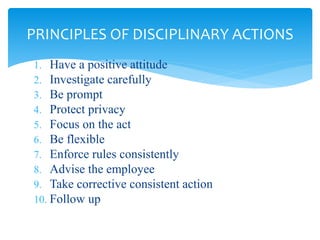
1. Have a positive attitude
2. Investigate carefully
3. Be prompt
4. Protect privacy
5. Focus on the act
6. Be flexible
7. Enforce rules consistently
8. Advise the employee
9. Take corrective consistent action
10. Follow up
PRINCIPLES OF DISCIPLINARY ACTIONS
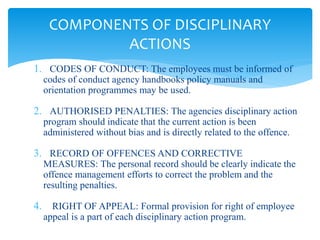
1. CODES OF CONDUCT: The employees must be informed of
codes of conduct agency handbooks policy manuals and
orientation programmes may be used.
2. AUTHORISED PENALTIES: The agencies disciplinary action
program should indicate that the current action is been
administered without bias and is directly related to the offence.
3. RECORD OF OFFENCES AND CORRECTIVE
MEASURES: The personal record should be clearly indicate the
offence management efforts to correct the problem and the
resulting penalties.
4. RIGHT OF APPEAL: Formal provision for right of employee
appeal is a part of each disciplinary action program.
COMPONENTS OF DISCIPLINARY
ACTIONS
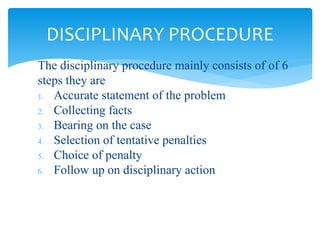
The disciplinary procedure mainly consists of of 6
steps they are
1. Accurate statement of the problem
2. Collecting facts
3. Bearing on the case
4. Selection of tentative penalties
5. Choice of penalty
6. Follow up on disciplinary action
DISCIPLINARY PROCEDURE
It is defined as of fine punishment in the form of financial
payment.
TYPES
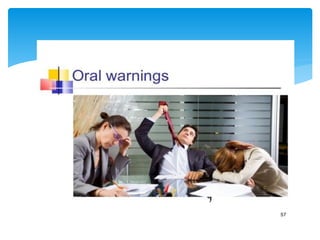
 Oral warning
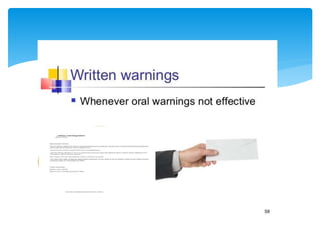
 Written
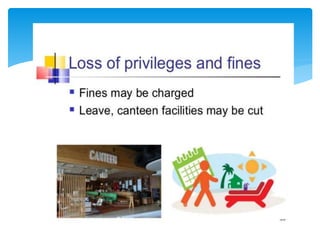
 Fine
 Suspension
 Withholding
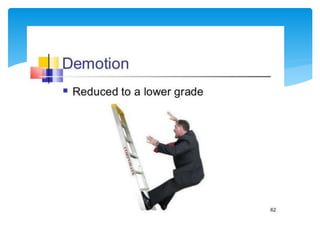
 Demotion
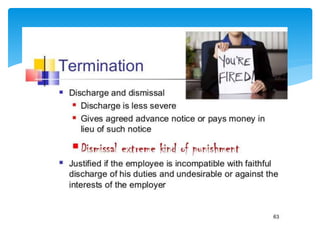
 Discharge
 Dismissal
PENALTIES
 DISCIPLINARY CONFERENCE- it is a group discussion
using both directive and non directive interview techniques. It
is damaging to employees self-esteem to receive criticism from
an authoritative figure. Thus it is anxiety provoking situation
for both employee and manager.
 DISCIPLINARY LETTER- It is a letter sent to the nurse or
employee immediately after the conference, documenting
interview content from the managers view point.
 MODEL STANDING ORDERS- It specifies the terms and
conditions which govern day to day employer employee
relationship infringement of which could result in a charge of
misconduct.
DEALING WITH DISCLIPINARY
PROBLEMS
 Helping students/ employees to identify themselves with
the school/ organizational goals.
 Encourage them to be self disciplined and comply with
the established rules & regulations.
 Periodically assessing the need for the existing rules &
regulations & suggesting modifications as necessary.
 Humanistically using discipline as a means of promoting
employee growth.
 Demonstrating sensitivity to the environment in which
discipline is enforced.
 Being aware of the power and responsibility.
ROLE & FUNCTIONS OF ADMINISTRATOR/
MANAGER IN MAINTAING DISCIPLINE
 Ensure that the rules and regulations are
written and communicated to them.
 Serving the role of coach to tackle lack of
performance.
 Enforcing established rules fairly and equally.
 Resolving their queries.
 Carefully documenting their conduct that
invites disciplinary action & counseling them.
 Advising them on how to seek redressal in
disciplinary matters.
 Discipline is a vital component in the process of nursing
management. it is the control of behavior to attain a goal
and purpose.
 This can be classified into authoritarian, democratic &
self- discipline.
 Self discipline is a combination of self control & self
direction.
 Discipline plays an important role in the growth process
of young people. Without constructive and proper
discipline, aims & aspirations of society cannot be
realized.
CONCLUSION
• Clement I. management of Nursing Service and Education.
2nd ed. New Delhi; Elsevier 2015 pg. no. 271-276.
• http://www.slideshare.net/deepaajithkumar/discipline-in-
nursing-education-106604380?from_m_app=android
• http://www.slideshare.net/bivinjose/discipline-
bjb?from_m_app=android
• http://www.slideshare.net/Jyothi19587/discipline-
9434417?from_m_app=android
• http://www.slideshare.net/AlluriGlory/6discipline?from_m_a
pp=android
• http://www.slideshare.net/visanth/maintenance-of-discipline-
nursing-management?from_m_app=android
• http://www.slideshare.net/vadivukkarasi/discipline-in-
nursing?from_m_app=android
BIBLIOGRAPHY
Maintenance of discipline

Maintenance of discipline

  • 1.
    MAINTENANCE OF DISCIPLINE MS.PRIYANKA SINHA B.Sc NURSING IV YEAR INDIRA GANDHI COLLEGE OF NURSING
  • 2.
     INTRODUCTION  MEANING& DEFINITION  NEED FOR DISCIPLINE  AIMS & OBJECTIVES OF DISCIPLINE  PRINCIPLES OF DISCIPLINE  APPROACHES OF DISCIPLINE  TYPES/ CLASSIFICATION OF DISCIPLINE  INDISCIPLINE: CAUSES  INDISCIPLINE IN CLASS ROOM & CLINICAL AREAS  SELF DISCIPLINE: 5 PILLARS  CONSTRUCTIVE & DESTRUCTIVE DISCIPLINE  DISCIPLINARY ACTIONS: PRINCIPLES, COMPONENTS  DISCIPLINARY PROCEDURE  PENALTIES: TYPES  DEALING WITH DISCIPLINRY PROBLEMS  ROLE & FUNCTIONS OF ADMINISTRATOR/ MANAGER IN MAINTAINING DISCIPLINE CONTENTS
  • 3.
     One methodby which a nurse manager can control subordinates behaviour is to invoke official disciplinary procedure.  It can be self-control by which an employee brings his or her behaviour into agreement with the agency’s official behavior code or it can be managerial action to enforce employee compliance with agency rules & regulations. INTRODUCTION
  • 4.
     The word‘discipline’ is derived from the latin word ‘disciplina’ which means teaching, learning and growing.  Megginson offer three distinct meaning of the word discipline:  Self – discipline  Necessary condition of orderly behaviour  Act of training and punishing MEANING
  • 5.
     According toBasavanthappa, It can be defined as a training or molding of the mind & character to bring about desired behaviors.  According to Dr. Jane Nelson, 2002 a branch of knowledge & the treatment suited to a disciple or learner in education: development of the faculties by instructions, exercise and training whether physical, mental or moral. DEFINITION
  • 6.
    In a simplemanner we can say that ‘It refers to working in accordance with certain recognized rules, regulations & customs, whether they are written or implicit in character.’
  • 7.
     Discipline shouldbe administered promptly thoughtfully and consistently following rule of infarction.  It should be progressive in nature and preceded by counseling.  Disciplinary actions may have serious and long-term consequences for the employees such as loss of income and damage of professional reputation. NEED FOR DISCIPLINE
  • 8.
     To obtaina willing acceptance of the rules regulations and procedures of an organisation so that organisation goals can be achieved.  To impart an element of certainty despite several differences in informal behaviour patterns and other related changes in an organisation.  To develop among the employees a spirit of tolerance and a desire to make adjustments.  To create an atmosphere of respect for the human personality and human relations.  To give and seek direction and responsibility.  to increase the working efficiency and moral of the employees so that their productivity is stepped, up the cost of production brought down and the quality of production improved.  To improve the productivity. AIMS AND OBJECTIVES OF DISCIPLINE
  • 9.
     Disciplinary guidelinesshould be in harmony with the ultimate goals of education.  It must be implemented through love and understanding not through fear.  It should be primarily positive and constructive.  It should ensure equal justice for all, respects for the rights and dignity of an individual and humanitarian approach towards all.  Discipline is not the end, it is rather means for successful implementation of educational programme.  Disciplinary policies and procedures should be first preventive, then corrective but never retributive. PRINCIPLES OF DISCIPLINE
  • 10.
     The approachof discipline should be to place increasing responsibility on the students.  Discipline is something that the teacher helps students to attain.  Avoid collective punishment.  Disciplinary conversations should be held in private.  Do not let disciplinary measures interfere with other developmental opportunities.  sending a student to the head of the institution should be the last resort for a teacher. It should be done when no other way is left.
  • 11.
    There are mainly5 approaches of discipline. They are:  Traditional approach  Developmental approach  Positive discipline approach  Self controlled discipline approach  Enforced discipline approach APPROACHES OF DISCIPLINE
  • 12.
     TRADITIONAL APPROACH It emphasizes on punishment for undesirable behaviour. Purpose:- To implement punishment for sin.  To enforce conformity to custom.  To strengthening authority of old over the young.  DEVELOPMENTAL APPROACH It emphasizes discipline as a shaper of desirable behaviour. Purpose:- To shape the behaviour by providing favorable consequences for right behaviour or unfavorable consequences for wrong behaviour, and avoidance of physical punishment, protection of rights of the accused.
  • 13.
    POSITIVE DISCIPLINE APPROACH It is based on the assumption that an employee with self- respect, respect for authority and interest in the job will adhere to high quality work standards.  The organisations which employed this have noted a subsequent decrease in absences, dissmisals, disciplinary actions, grievances etc.. SELF CONTROLLED DISCIPLINE APPROACH  The employees bring his or her behaviour into agreement with the organisations behavioral official code i.e., the employees regulate their own activities for the common good of the organisation. As a result human beings are reduced to work for a peak performance under this.
  • 14.
    ENFORCED DISCIPLINE APPROACH Amanagerial action enforces compliance with organisations rules and regulations. It is a common discipline imposed from the top.
  • 15.
    TYPES OF DISCIPLINE Authoritarian discipline  Democratic discipline  Assertive discipline  Self controlled discipline  Enforced discipline
  • 16.
    1. AUTHORITARIAN DISCIPLINE -It is traditional form. Authority of old over young punishment for undesirable behaviour. 2. DEMOCRATIC DISCIPLINE - Students and teachers have mutual participation. 3. ASSERTIVE DISCIPLINE - Clear expectation for the required behaviour is set out by the teacher. specific concrete and verbal price are given for the desired behaviour. 4. SELF CONTROLLED DISCIPLINE- It is true discipline it's satisfy the need for satisfying the need of self respect and security source of control largely within the individual students.
  • 17.
     Means disorderliness Insubordination  Not following rules and regulations of an organisation. The symptoms of indiscipline are change in the normal behaviour, absenteeism, apathy, go slow at work and lack of concern for performance. INDISCIPLINE
  • 18.
     Non placementof the right person on the right job.  Undesirable behaviour of senior officials  Faculty valuation of persons and situations by executive leads of favoritism  Lack of upward communication  Leadership which is weak flexible incompetent and distrustful  Defective supervision and an absence of good supervisor  Workers personal problems their fears and hopes improper co-ordination delegation of authority and fixing of responsibility  Discrimination based on caste color sex CAUSES
  • 19.
    Classroom- not attending,sleeping, lying, cheating, not studying, not completing homework and assignment and not punctual. Clinical areas - gross negligence, disobedience, no attitude and improper behaviour, not punctual, not considerate, not studying, laziness, absenteeism and leaving clinical area without permission. Of an employee - changes in behaviour, apathy, absenteeism, go slow at work, strikes and education, increasing number and lack of concern for performance. INDISCIPLINE AREAS
  • 20.
    It is bestdefined as the ability to regulate pawns conduct by principles and sound judgment, rather than by impulse, desire or social custom. This can be considered a type of selective training, creating new habits of thought, action and speech toward improving yourself and reaching goals. SELF DISCIPLINE
  • 21.
    A WHIP- ACCEPTANCE WILLPOWER HARD WORK INDUSTRY PERSISTENCE 5 PILLARS OF SELF DISCIPLINE
  • 22.
     CONSTRUCTIVE DISCIPLINEAUR POSITIVE DISCIPLINE This uses discipline as the means of helping the employees grow not as a punitive measures. The primary emphasis assisting employees to behave in a manner that allows them to be self directed in meeting organizational goals  DESTRUCTIVE DISCIPLINE OR ENFORCED DISCIPLINE OR NEGATIVE DISCIPLINE If employees are forced to follow the rules and regulations of the organisation by inducing fear in them then it is termed as negative discipline. COSTRUCTIVE & DESTRUCTIVE DISCIPLINE
  • 23.
    The disciplinary actionsare the measures which are taken to solve or sort out disciplinary problems. DISCIPLINARY ACTIONS
  • 24.
    1. Have apositive attitude 2. Investigate carefully 3. Be prompt 4. Protect privacy 5. Focus on the act 6. Be flexible 7. Enforce rules consistently 8. Advise the employee 9. Take corrective consistent action 10. Follow up PRINCIPLES OF DISCIPLINARY ACTIONS
  • 25.
    1. CODES OFCONDUCT: The employees must be informed of codes of conduct agency handbooks policy manuals and orientation programmes may be used. 2. AUTHORISED PENALTIES: The agencies disciplinary action program should indicate that the current action is been administered without bias and is directly related to the offence. 3. RECORD OF OFFENCES AND CORRECTIVE MEASURES: The personal record should be clearly indicate the offence management efforts to correct the problem and the resulting penalties. 4. RIGHT OF APPEAL: Formal provision for right of employee appeal is a part of each disciplinary action program. COMPONENTS OF DISCIPLINARY ACTIONS
  • 26.
    The disciplinary proceduremainly consists of of 6 steps they are 1. Accurate statement of the problem 2. Collecting facts 3. Bearing on the case 4. Selection of tentative penalties 5. Choice of penalty 6. Follow up on disciplinary action DISCIPLINARY PROCEDURE
  • 27.
    It is definedas of fine punishment in the form of financial payment. TYPES  Oral warning  Written  Fine  Suspension  Withholding  Demotion  Discharge  Dismissal PENALTIES
  • 35.
     DISCIPLINARY CONFERENCE-it is a group discussion using both directive and non directive interview techniques. It is damaging to employees self-esteem to receive criticism from an authoritative figure. Thus it is anxiety provoking situation for both employee and manager.  DISCIPLINARY LETTER- It is a letter sent to the nurse or employee immediately after the conference, documenting interview content from the managers view point.  MODEL STANDING ORDERS- It specifies the terms and conditions which govern day to day employer employee relationship infringement of which could result in a charge of misconduct. DEALING WITH DISCLIPINARY PROBLEMS
  • 36.
     Helping students/employees to identify themselves with the school/ organizational goals.  Encourage them to be self disciplined and comply with the established rules & regulations.  Periodically assessing the need for the existing rules & regulations & suggesting modifications as necessary.  Humanistically using discipline as a means of promoting employee growth.  Demonstrating sensitivity to the environment in which discipline is enforced.  Being aware of the power and responsibility. ROLE & FUNCTIONS OF ADMINISTRATOR/ MANAGER IN MAINTAING DISCIPLINE
  • 37.
     Ensure thatthe rules and regulations are written and communicated to them.  Serving the role of coach to tackle lack of performance.  Enforcing established rules fairly and equally.  Resolving their queries.  Carefully documenting their conduct that invites disciplinary action & counseling them.  Advising them on how to seek redressal in disciplinary matters.
  • 38.
     Discipline isa vital component in the process of nursing management. it is the control of behavior to attain a goal and purpose.  This can be classified into authoritarian, democratic & self- discipline.  Self discipline is a combination of self control & self direction.  Discipline plays an important role in the growth process of young people. Without constructive and proper discipline, aims & aspirations of society cannot be realized. CONCLUSION
  • 39.
    • Clement I.management of Nursing Service and Education. 2nd ed. New Delhi; Elsevier 2015 pg. no. 271-276. • http://www.slideshare.net/deepaajithkumar/discipline-in- nursing-education-106604380?from_m_app=android • http://www.slideshare.net/bivinjose/discipline- bjb?from_m_app=android • http://www.slideshare.net/Jyothi19587/discipline- 9434417?from_m_app=android • http://www.slideshare.net/AlluriGlory/6discipline?from_m_a pp=android • http://www.slideshare.net/visanth/maintenance-of-discipline- nursing-management?from_m_app=android • http://www.slideshare.net/vadivukkarasi/discipline-in- nursing?from_m_app=android BIBLIOGRAPHY