LEADERSHIP
PRESENTED BY
MR. ABHAY RAJPOOT
M SC NURSING FINAL YEAR
DEFINITION
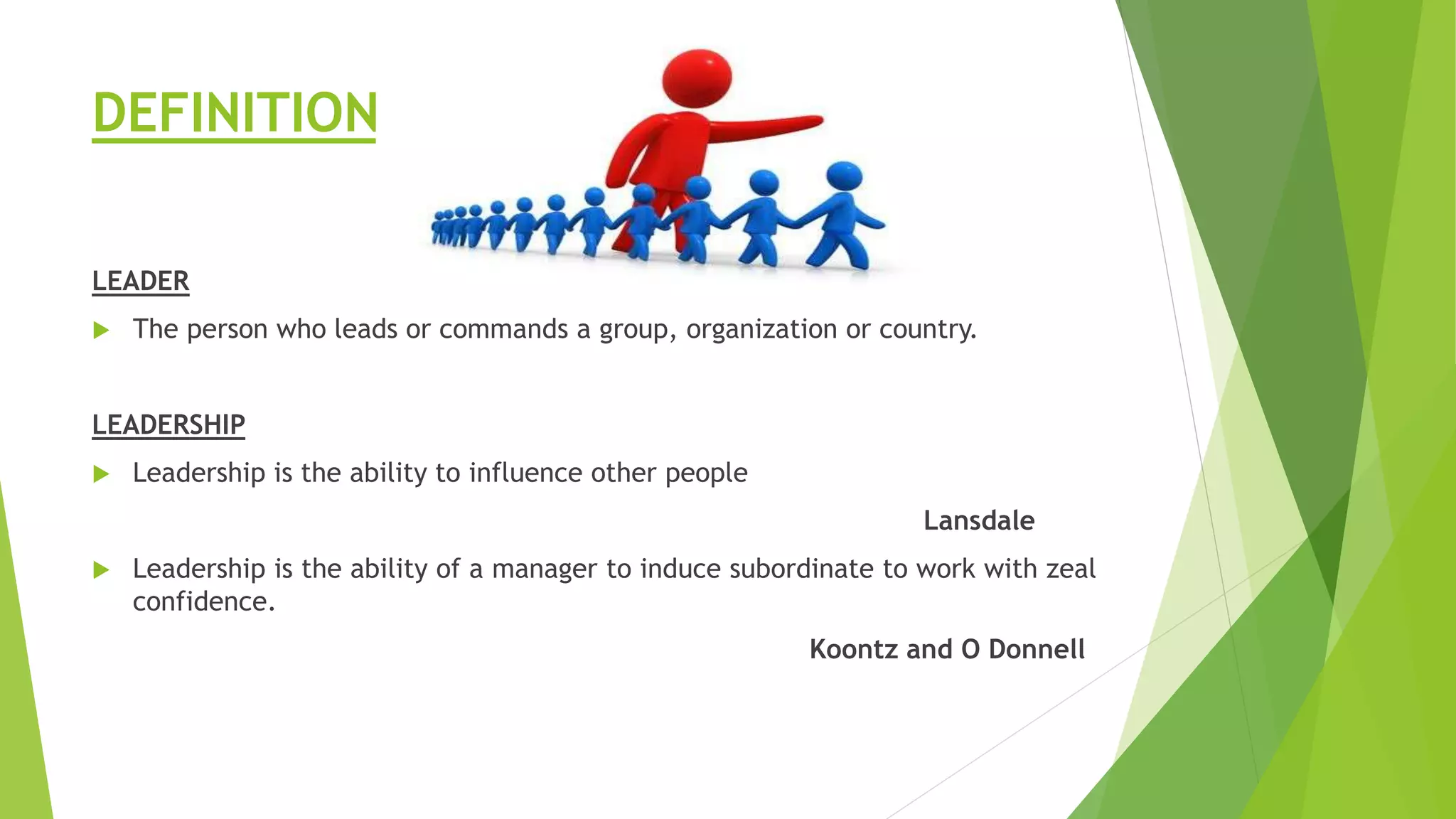
LEADER
 The person who leads or commands a group, organization or country.
LEADERSHIP
 Leadership is the ability to influence other people
Lansdale
 Leadership is the ability of a manager to induce subordinate to work with zeal
confidence.
Koontz and O Donnell
IMPORTANCE OF LEADERSHIP:
 Planner
 Executive
 Policy maker
 Expert
 External group representative
 Controller of internal relation
 Purveyor of rewards and punishment
TYPES OF LEADER
A) Intellectual leader
B) Creative leader
C) Persuasive leader
D) Institutional leader
E) Democratic leader
F) Autocratic leader
TRAIT THEORY/GREAT MAN THEORY-
This theory suggests that leaders have some inborn traits. They
have certain set of characteristics that are crucial for inspiring
others towards a common goal. A successful leader is supposed
to have the following traits- good personality, tirelessness,
capacity to read other‘s mind, ability to make quick decision,
courage, persuasion, intelligence, reliability, imagination
STYLE THEORY-
This focuses on what leaders do in relational and contextual
terms. The achievement of satisfactory performance measures
requires supervisors to pursue effective relationships with their
subordinates, while comprehending the factors in the work
environment that influence outcomes.
TRANSACTIONAL/TRANSFORMATIONAL
THEORY
This theory describes the relationship between leaders and
followers. New concepts such as empowerment, inspiration
motivation and social learning are present. This refers to a
process whereby the leader attends to the needs and motives of
followers so that interaction raises to high levels of motivation
and morality.
SITUATIONAL THEORY
This theory believes that leadership effectiveness depended on the
relationship among the leaders task at hand, their interpersonal
skills and the favorableness the work situation.This theory
considers the challenge of situation and encourages an adaptive
leadership style to complement the issue being faced.
STYLES OF LEADERSHIP
AUTOCRATIC LEADERSHIP:
Leader assumes complete control over the decisions and activities
of the group.
CHARACTERISTIC OF THE LEADER
 Firm personality, insistent, self-assured, highly directive,
dominating.
 Shows no regards to the interests of the employees
 Set rigid standards and method of performance and expects the
sudordinates to obey the rules and follow the same
 Makes all decision by himself or herself
 Minimal group participation or none from the workers
CONT..
ADVANTAGES
 Efficient in time of crisis, easy to make decision by one group and less time
consuming
 It is useful when the workers are unsure of taking decision and expect the
leader to tell what to do
DISADVANTAGES
 Does not encourage the individuals growth and does not recognize the
potentials, imitativeness and creates less cooperation among members
 Leader lacks supportive power that results in decision made with
consultation although he may be correct
 Less job satisfaction leads to less commitment to goals of the organization
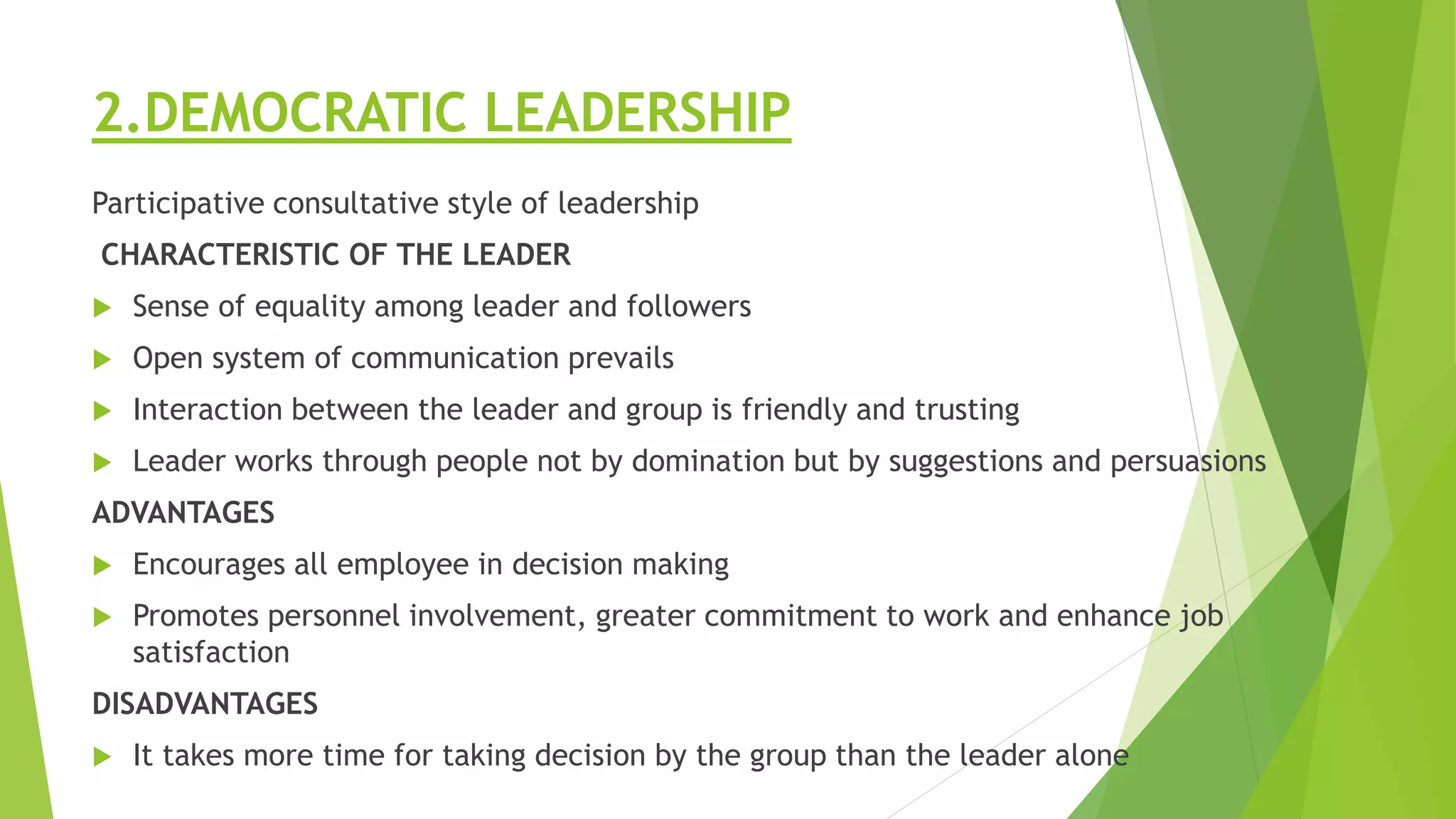
2.DEMOCRATIC LEADERSHIP
Participative consultative style of leadership
CHARACTERISTIC OF THE LEADER
 Sense of equality among leader and followers
 Open system of communication prevails
 Interaction between the leader and group is friendly and trusting
 Leader works through people not by domination but by suggestions and persuasions
ADVANTAGES
 Encourages all employee in decision making
 Promotes personnel involvement, greater commitment to work and enhance job
satisfaction
DISADVANTAGES
 It takes more time for taking decision by the group than the leader alone
LAISSARE-FAIRE LEADERSHIP
Free- Rein, Anarchic and Ultraliberal style of leadership. The
leader gives up all power to the group.
CHARACTERISTIC FEATURES
 Encourages independent activity by the group member
 Group members are free to set their own goals determine
their own activities and allowed to do almost what they
desire.
CONT…
ADVANTAGES
 In limited situations creativity may be encouraged for specific
purposes
 To try new method of action
DISADVANTAGES
 May lead to instability, disorganization, inefficiency, no unity
of action
 Lack of feeling responsible to solve the problem that may
arise. Individual will lose interest, initiative and desire for
achievement
BUREAUCRATIC LEADERSHIP
In this the leader function only with rules and regulations.Leader
cannot be flexible and does not like to take any risk out of the
rules. E.g defense leader
Characteristics of leadership
1. Its style may differ from situation to situation.
3. It involves an unequal distribution of authority among leaders
and groups.
LEADERSHIP SKILLS
SKILLS OF PERSONAL BEHAVIOUR
 Sensitive to the feeling of the group
 Identifies self with needs of the group
 Does not argue
SKILLS OF COMMUNICATION
 Listen attentively
 Make sure everyone understands
 Establish positive communication with the group
 Recognizes that everyone‘s contribution are important
CONT…
SKILLS OF ORGANIZATION
 Develop short and long term objectives
 Break big problem into small ones
 Share responsibilities and opportunities
 Plan, act, follow-up and evaluate
SKILLS OF SELF EXAMINATION
 Aware of personal motivation
 Aware of group members
 Helps group to aware of their attitudes and values
S- Self reliant
E- enthusiastic
L- Loyal
F- Factual
APPLICATION OF LEADERSHIP IN
NURSING
1 Patient care coordination
2 Employee responsibilities
3. Guidelines for delegating nursing care
4. Mentorship
5. Preceptor ship
6. Continuing education
SUMMARY
CONCLUSION
In a long-term care facility, nurse leaders are constantly on the
move. As a result, many nurse leaders naturally adopt a leadership
style known as Management by Walking Around (MBWA) or Leading
by Walking Around (LBWA.) In addition to checking on clinical
issues and keeping the environment looking homelike, MBWA gives
you the opportunity to:
Observe team members interacting with residents and families
Let staff know that leader is interested in them and their work
Evaluate the quality of care being delivered
Demonstrate leaders interest in daily operations
ASSIGNMENT
 Difference between management and leadership
BIBLIOGRAPHY
 https://www.mindtools.com/pages/article/newLDR_41.htm
 https://www.psychologytoday.com/us/basics/leadership
 https://www.forbes.com/sites/kevinkruse/2013/04/09/what-is-leadership
 https://www.powershow.com/viewfl/599645-
Yzc5N/Nursing_Leadership_and_Management_powerpoint_ppt_presentation
 www.slideworld.org/slidestag.aspx/nursing-leadership-and-management
THANK YOU

Leadership

  • 1.
    LEADERSHIP PRESENTED BY MR. ABHAYRAJPOOT M SC NURSING FINAL YEAR
  • 2.
    DEFINITION LEADER  The personwho leads or commands a group, organization or country. LEADERSHIP  Leadership is the ability to influence other people Lansdale  Leadership is the ability of a manager to induce subordinate to work with zeal confidence. Koontz and O Donnell
  • 3.
  • 4.
     Planner  Executive Policy maker  Expert  External group representative  Controller of internal relation  Purveyor of rewards and punishment
  • 5.
    TYPES OF LEADER A)Intellectual leader B) Creative leader C) Persuasive leader D) Institutional leader E) Democratic leader F) Autocratic leader
  • 7.
    TRAIT THEORY/GREAT MANTHEORY- This theory suggests that leaders have some inborn traits. They have certain set of characteristics that are crucial for inspiring others towards a common goal. A successful leader is supposed to have the following traits- good personality, tirelessness, capacity to read other‘s mind, ability to make quick decision, courage, persuasion, intelligence, reliability, imagination
  • 8.
    STYLE THEORY- This focuseson what leaders do in relational and contextual terms. The achievement of satisfactory performance measures requires supervisors to pursue effective relationships with their subordinates, while comprehending the factors in the work environment that influence outcomes.
  • 9.
    TRANSACTIONAL/TRANSFORMATIONAL THEORY This theory describesthe relationship between leaders and followers. New concepts such as empowerment, inspiration motivation and social learning are present. This refers to a process whereby the leader attends to the needs and motives of followers so that interaction raises to high levels of motivation and morality.
  • 10.
    SITUATIONAL THEORY This theorybelieves that leadership effectiveness depended on the relationship among the leaders task at hand, their interpersonal skills and the favorableness the work situation.This theory considers the challenge of situation and encourages an adaptive leadership style to complement the issue being faced.
  • 11.
  • 12.
    AUTOCRATIC LEADERSHIP: Leader assumescomplete control over the decisions and activities of the group. CHARACTERISTIC OF THE LEADER  Firm personality, insistent, self-assured, highly directive, dominating.  Shows no regards to the interests of the employees  Set rigid standards and method of performance and expects the sudordinates to obey the rules and follow the same  Makes all decision by himself or herself  Minimal group participation or none from the workers
  • 14.
    CONT.. ADVANTAGES  Efficient intime of crisis, easy to make decision by one group and less time consuming  It is useful when the workers are unsure of taking decision and expect the leader to tell what to do DISADVANTAGES  Does not encourage the individuals growth and does not recognize the potentials, imitativeness and creates less cooperation among members  Leader lacks supportive power that results in decision made with consultation although he may be correct  Less job satisfaction leads to less commitment to goals of the organization
  • 15.
    2.DEMOCRATIC LEADERSHIP Participative consultativestyle of leadership CHARACTERISTIC OF THE LEADER  Sense of equality among leader and followers  Open system of communication prevails  Interaction between the leader and group is friendly and trusting  Leader works through people not by domination but by suggestions and persuasions ADVANTAGES  Encourages all employee in decision making  Promotes personnel involvement, greater commitment to work and enhance job satisfaction DISADVANTAGES  It takes more time for taking decision by the group than the leader alone
  • 16.
    LAISSARE-FAIRE LEADERSHIP Free- Rein,Anarchic and Ultraliberal style of leadership. The leader gives up all power to the group. CHARACTERISTIC FEATURES  Encourages independent activity by the group member  Group members are free to set their own goals determine their own activities and allowed to do almost what they desire.
  • 17.
    CONT… ADVANTAGES  In limitedsituations creativity may be encouraged for specific purposes  To try new method of action DISADVANTAGES  May lead to instability, disorganization, inefficiency, no unity of action  Lack of feeling responsible to solve the problem that may arise. Individual will lose interest, initiative and desire for achievement
  • 18.
    BUREAUCRATIC LEADERSHIP In thisthe leader function only with rules and regulations.Leader cannot be flexible and does not like to take any risk out of the rules. E.g defense leader Characteristics of leadership 1. Its style may differ from situation to situation. 3. It involves an unequal distribution of authority among leaders and groups.
  • 19.
    LEADERSHIP SKILLS SKILLS OFPERSONAL BEHAVIOUR  Sensitive to the feeling of the group  Identifies self with needs of the group  Does not argue SKILLS OF COMMUNICATION  Listen attentively  Make sure everyone understands  Establish positive communication with the group  Recognizes that everyone‘s contribution are important
  • 20.
    CONT… SKILLS OF ORGANIZATION Develop short and long term objectives  Break big problem into small ones  Share responsibilities and opportunities  Plan, act, follow-up and evaluate SKILLS OF SELF EXAMINATION  Aware of personal motivation  Aware of group members  Helps group to aware of their attitudes and values S- Self reliant E- enthusiastic L- Loyal F- Factual
  • 21.
    APPLICATION OF LEADERSHIPIN NURSING 1 Patient care coordination 2 Employee responsibilities 3. Guidelines for delegating nursing care 4. Mentorship 5. Preceptor ship 6. Continuing education
  • 22.
  • 23.
    CONCLUSION In a long-termcare facility, nurse leaders are constantly on the move. As a result, many nurse leaders naturally adopt a leadership style known as Management by Walking Around (MBWA) or Leading by Walking Around (LBWA.) In addition to checking on clinical issues and keeping the environment looking homelike, MBWA gives you the opportunity to: Observe team members interacting with residents and families Let staff know that leader is interested in them and their work Evaluate the quality of care being delivered Demonstrate leaders interest in daily operations
  • 24.
    ASSIGNMENT  Difference betweenmanagement and leadership
  • 25.
    BIBLIOGRAPHY  https://www.mindtools.com/pages/article/newLDR_41.htm  https://www.psychologytoday.com/us/basics/leadership https://www.forbes.com/sites/kevinkruse/2013/04/09/what-is-leadership  https://www.powershow.com/viewfl/599645- Yzc5N/Nursing_Leadership_and_Management_powerpoint_ppt_presentation  www.slideworld.org/slidestag.aspx/nursing-leadership-and-management
  • 26.