2
PREPARED BY:
NEHA PATEL
SUMANDEEP COLLEGE OF
NURSING
GUIDED BY:
Ms. Sijo koshy
INTRODUCTION
INTRODUCTION:
 The word ‘discipline’ comes from the Latin term
‘disciplina’ which means teaching , learning and growing.
 Discipline will enhance the:
1. learning situation
2. more creative
3. self-disciplined understanding needed for good
citizenship in today’s changing world.
 Essential for maintaining a conducive environment in
educational institutions.
 It is a necessary and positive tool in promoting
subordinate growth.
MEANING & DEFINATION
DEFINITION:
 According to Percynunn:
 “ Discipline consists in the submission of
one’s impulses and powers to a regulation
which imposes form upon chaos and brings
efficiency and economy where there would
otherwise be ineffectiveness and waste.
Though part of our nature may resist this
control, its acceptances must on the whole be
willing acceptance, the spontaneous
movement of a nature in which there is an
inborn impulses towards greater perception”
“Discipline”
 can be defined as a training or moulding of
the mind and character to bring about
desirable behaviour.
 is a vital component in the process of
education.
 is the control of behaviour to attain a goal
and purpose.
THE MODERN CONCEPT OF DISCIPLINE:
 Today, we teach students to obey, but we
want this obedience to be a thinking
obedience, not merely a reliance up on
authority
 Recently, positive and creative type
discipline in focus.
 The modern educator believes in self-
discipline.
 It implies not only bringing under control but
also submitting one’s behaviour to self-
imposed regulations.
 In short, modern discipline helps the
students to become self-propelled, self-
controlled and self-guiding person.
NEED FOR DISCIPLINE
 for the successful implementation
of the educational programme.
 for helping child in the growth of
individual personality,
 for giving him the feeling of
security
 For a sense of confidence and a
knowledge of boundaries of his
freedom.
CONTI…
 essential for the teacher also, before
he/she can teach the children
 For good teaching, good conditions
are necessary as a good ideas and
good teachers.
 For good administration
FUNCTION OF DISCIPLINE:
 Discipline as a universal cultural phenomenon
is considered as serving a number of
specific functions in the growth process of
young people:
 It facilitates learning
 It assists in learning those standards of
conduct acceptable within society
 It helps to acquire characteristics of positive
nature such as self-control and persistence
 It assists in securing stability of the social
order within which the young may achieve
security and maturity.
AIMS AND OBJECTIVE OF
DISCIPLINE:
 Heidgerken describes the aims of discipline in nursing education
as follows:
 To create and maintain desirable condition in the teaching- learning
situation
 To create favourable attitudes towards the establishment and the
maintenance of conditions essential to effective work, in order to
achieve the desired objectives.
 To assist in the development of self-control and co-operation which are
regarded as essential traits in the daily living as well as in professional
functioning.
 To cultivate in the students good conduct, self-discipline and
responsibility, under the school motto: ‘ diligence, frugality, loyality,
faithfulness’ in order to lead a rich and meaningful of life
CONTI….
 To help students to realize the importance of school regulations, and to abide to them.
 To maintain a peaceful and harmonic environment for school life.
 To encourage students to love each other and be respectful to teachers.
 To develop among the employees a spirit of tolerance and a desire to make adjustment.
 To give and seek direction and responsibility.
 To create an atmosphere of respect for the human personality and human relations.
 To obtain a willing acceptance of the rules, regulation and procedure of an organization
so that organization goals can be achieved.
 To impact an element of certainty despite several differences in normal behaviour
patterns and other related changes in an organization.
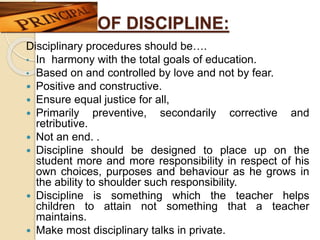
PRINCIPAL OF DISCIPLINE:
Disciplinary procedures should be….
• In harmony with the total goals of education.
• Based on and controlled by love and not by fear.
 Positive and constructive.
 Ensure equal justice for all,
 Primarily preventive, secondarily corrective and
retributive.
 Not an end. .
 Discipline should be designed to place up on the
student more and more responsibility in respect of his
own choices, purposes and behaviour as he grows in
the ability to shoulder such responsibility.
 Discipline is something which the teacher helps
children to attain not something that a teacher
maintains.
 Make most disciplinary talks in private.
TYPES OF DISCIPLINE:
 Self-discipline
 Assertive discipline
 Enforced behaviour
 Self-controlled
discipline
 Positive discipline
 Negative discipline
 Gentle discipline
 Boundary based
discipline
 Behaviour
modification
 Constructive
discipline
Self-discipline :
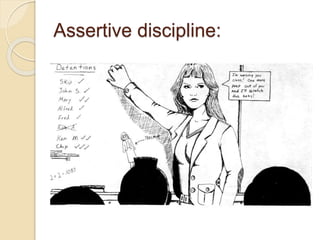
Assertive discipline:
Enforced behaviour:
Self-controlled behaviour:
Positive discipline:
Negative discipline:
Gentle discipline:
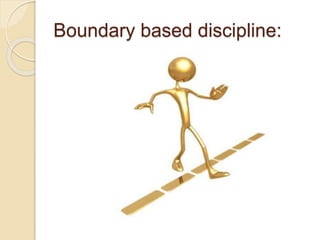
Boundary based discipline:
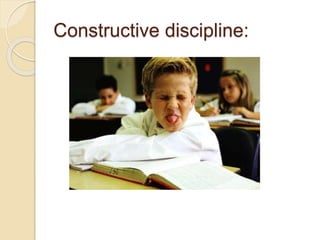
Constructive discipline:
APPROACHES FOR DISCIPLINE:
 (A)Traditional approach emphasizes
punishments for undesirable
behaviour. The main purpose of
traditional discipline are:
1. To implement punishment for sin,
2. To enforce conformity to custom,
3. To strengthen authority of old over
the young.
CONTI…..
 (B)Development approaches emphasizes
discipline as a shaper of desirable
behaviour. The main purposes of this
approach are:
1. To shape the behaviour by providing
favourable consequences for the right
behaviour or unfavourable consequences
for wrong behaviour.
2. To avoid physical punishments, protection
of rights of the accused and replacement
of arbitrary individual judgement with group
judgement and guilt.
OTHER APPROACHES:
1. Positive discipline approaches
2. Self-controlled discipline
approaches
3. Enforced discipline approach
4. Self-discipline approach
5. Emotional approach
McGregor’s hot stove rules for fair
and effective discipline:
 Four elements must be present to
make discipline as fair and growth
producing as possible:
1. Forewarning
2. Immediate consequences
3. Consistency
4. Impartiality
COMPONENTS OF A DISCIPLINARY ACTION
PROGRAM:
 Codes of conduct:
 Authorized penalties:
 Oral reprimands
 Written reprimand
 Other penalties
DEALING WITH DISCIPLINARY
PROBLEM:
 Disciplinary conference
 Disciplinary letter:
 Model standing order:
DISCIPLINE.pptx

DISCIPLINE.pptx

  • 2.
    2 PREPARED BY: NEHA PATEL SUMANDEEPCOLLEGE OF NURSING GUIDED BY: Ms. Sijo koshy
  • 3.
  • 4.
    INTRODUCTION:  The word‘discipline’ comes from the Latin term ‘disciplina’ which means teaching , learning and growing.  Discipline will enhance the: 1. learning situation 2. more creative 3. self-disciplined understanding needed for good citizenship in today’s changing world.  Essential for maintaining a conducive environment in educational institutions.  It is a necessary and positive tool in promoting subordinate growth.
  • 5.
  • 6.
    DEFINITION:  According toPercynunn:  “ Discipline consists in the submission of one’s impulses and powers to a regulation which imposes form upon chaos and brings efficiency and economy where there would otherwise be ineffectiveness and waste. Though part of our nature may resist this control, its acceptances must on the whole be willing acceptance, the spontaneous movement of a nature in which there is an inborn impulses towards greater perception”
  • 7.
    “Discipline”  can bedefined as a training or moulding of the mind and character to bring about desirable behaviour.  is a vital component in the process of education.  is the control of behaviour to attain a goal and purpose.
  • 8.
    THE MODERN CONCEPTOF DISCIPLINE:  Today, we teach students to obey, but we want this obedience to be a thinking obedience, not merely a reliance up on authority  Recently, positive and creative type discipline in focus.  The modern educator believes in self- discipline.  It implies not only bringing under control but also submitting one’s behaviour to self- imposed regulations.  In short, modern discipline helps the students to become self-propelled, self- controlled and self-guiding person.
  • 9.
    NEED FOR DISCIPLINE for the successful implementation of the educational programme.  for helping child in the growth of individual personality,  for giving him the feeling of security  For a sense of confidence and a knowledge of boundaries of his freedom.
  • 10.
    CONTI…  essential forthe teacher also, before he/she can teach the children  For good teaching, good conditions are necessary as a good ideas and good teachers.  For good administration
  • 11.
    FUNCTION OF DISCIPLINE: Discipline as a universal cultural phenomenon is considered as serving a number of specific functions in the growth process of young people:  It facilitates learning  It assists in learning those standards of conduct acceptable within society  It helps to acquire characteristics of positive nature such as self-control and persistence  It assists in securing stability of the social order within which the young may achieve security and maturity.
  • 13.
    AIMS AND OBJECTIVEOF DISCIPLINE:  Heidgerken describes the aims of discipline in nursing education as follows:  To create and maintain desirable condition in the teaching- learning situation  To create favourable attitudes towards the establishment and the maintenance of conditions essential to effective work, in order to achieve the desired objectives.  To assist in the development of self-control and co-operation which are regarded as essential traits in the daily living as well as in professional functioning.  To cultivate in the students good conduct, self-discipline and responsibility, under the school motto: ‘ diligence, frugality, loyality, faithfulness’ in order to lead a rich and meaningful of life
  • 14.
    CONTI….  To helpstudents to realize the importance of school regulations, and to abide to them.  To maintain a peaceful and harmonic environment for school life.  To encourage students to love each other and be respectful to teachers.  To develop among the employees a spirit of tolerance and a desire to make adjustment.  To give and seek direction and responsibility.  To create an atmosphere of respect for the human personality and human relations.  To obtain a willing acceptance of the rules, regulation and procedure of an organization so that organization goals can be achieved.  To impact an element of certainty despite several differences in normal behaviour patterns and other related changes in an organization.
  • 15.
    PRINCIPAL OF DISCIPLINE: Disciplinaryprocedures should be…. • In harmony with the total goals of education. • Based on and controlled by love and not by fear.  Positive and constructive.  Ensure equal justice for all,  Primarily preventive, secondarily corrective and retributive.  Not an end. .  Discipline should be designed to place up on the student more and more responsibility in respect of his own choices, purposes and behaviour as he grows in the ability to shoulder such responsibility.  Discipline is something which the teacher helps children to attain not something that a teacher maintains.  Make most disciplinary talks in private.
  • 16.
    TYPES OF DISCIPLINE: Self-discipline  Assertive discipline  Enforced behaviour  Self-controlled discipline  Positive discipline  Negative discipline  Gentle discipline  Boundary based discipline  Behaviour modification  Constructive discipline
  • 17.
  • 18.
  • 19.
  • 20.
  • 21.
  • 22.
  • 23.
  • 24.
  • 25.
  • 26.
    APPROACHES FOR DISCIPLINE: (A)Traditional approach emphasizes punishments for undesirable behaviour. The main purpose of traditional discipline are: 1. To implement punishment for sin, 2. To enforce conformity to custom, 3. To strengthen authority of old over the young.
  • 27.
    CONTI…..  (B)Development approachesemphasizes discipline as a shaper of desirable behaviour. The main purposes of this approach are: 1. To shape the behaviour by providing favourable consequences for the right behaviour or unfavourable consequences for wrong behaviour. 2. To avoid physical punishments, protection of rights of the accused and replacement of arbitrary individual judgement with group judgement and guilt.
  • 28.
    OTHER APPROACHES: 1. Positivediscipline approaches 2. Self-controlled discipline approaches 3. Enforced discipline approach 4. Self-discipline approach 5. Emotional approach
  • 29.
    McGregor’s hot stoverules for fair and effective discipline:  Four elements must be present to make discipline as fair and growth producing as possible: 1. Forewarning 2. Immediate consequences 3. Consistency 4. Impartiality
  • 30.
    COMPONENTS OF ADISCIPLINARY ACTION PROGRAM:  Codes of conduct:  Authorized penalties:  Oral reprimands  Written reprimand  Other penalties
  • 31.
    DEALING WITH DISCIPLINARY PROBLEM: Disciplinary conference  Disciplinary letter:  Model standing order: