
PRESENTATION
BOBBY ABRAHAM
MSc NURSING
DISCIPLINE
DEFINITION
Discipline refers to working in accordance with
certain recognized rules, regulations and
customs, whether they are written or implicit in
character.
AIMS AND OBJECTIVES OF DISCIPLINE
1. To develop among the employees a spirit of
tolerance and a desire to make adjustments
2. To give and seek direction and responsibility
3. To create an atmosphere of respect for the
human personality and human relations
4. Organizational goals to be achieved.
5. To increase the working efficiency and morale
of the employees so that their productivity is
stepped up, the cost of production brought
down and the quality of production improved.
PRINCIPLES OF DISCIPLINARY ACTION
SELF DISCIPLINE
It refers to one‘s effort at self-control for the
purpose of adjusting oneself to certain needs
and demands.
This form of discipline is based on two
psychological principles. First, punishment
seldom produces the desired results. Often, it
produces undesirable results.
Second, a self-respecting person tends to be a
better worker than one who is not
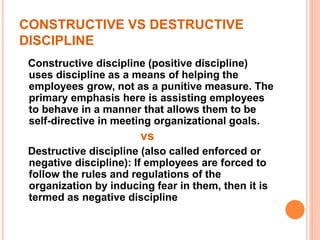
CONSTRUCTIVE VS DESTRUCTIVE
DISCIPLINE
Constructive discipline (positive discipline)
uses discipline as a means of helping the
employees grow, not as a punitive measure. The
primary emphasis here is assisting employees
to behave in a manner that allows them to be
self-directive in meeting organizational goals.
vs
Destructive discipline (also called enforced or
negative discipline): If employees are forced to
follow the rules and regulations of the
organization by inducing fear in them, then it is
termed as negative discipline
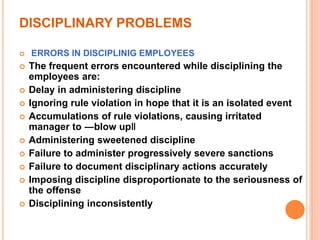
DISCIPLINARY PROBLEMS
 ERRORS IN DISCIPLINIG EMPLOYEES
 The frequent errors encountered while disciplining the
employees are:
 Delay in administering discipline
 Ignoring rule violation in hope that it is an isolated event
 Accumulations of rule violations, causing irritated
manager to ―blow up‖
 Administering sweetened discipline
 Failure to administer progressively severe sanctions
 Failure to document disciplinary actions accurately
 Imposing discipline disproportionate to the seriousness of
the offense
 Disciplining inconsistently
CAUSES OF DISCIPLINARY
PROCEEDINGS
A. Acts
1. Acts amounting to crimes
Eg. Bribery, corruption
2. Acts amounting to misdemeanor
Eg. Misbehavior, disobedience
3. Acts amounting to misconduct
Eg. Violation of conduct rules or
standing orders
B. Omissions
Eg. Habitual late attendance,,negligence.
irresponsibility
STAGES OF DISCIPLINARY PROCEEDING
ENQUIRY
1.Preliminary enquiry
2 .Decision to start formal departmental enquiry
3. Suspension
4. Charge sheet and its service
5. Appointment of enquiry officer
6. Written statement of defence
7. Recording of evidence by the enquiry officer
8. Personal hearing of charged official
9. Report of enquiry officer
10. Show cause notice by the disciplinary authority
11. Reply to show-cause notice and decision thereon
12. Review of punishment order
13. Appeal or revision
14. Reinstatement and restitution
15. Show-cause notice against withholding of emoluments
for suspension period in the case of a reinstated.
Discipline bobby.docx

Discipline bobby.docx

  • 1.
  • 2.
  • 3.
    DEFINITION Discipline refers toworking in accordance with certain recognized rules, regulations and customs, whether they are written or implicit in character.
  • 4.
    AIMS AND OBJECTIVESOF DISCIPLINE 1. To develop among the employees a spirit of tolerance and a desire to make adjustments 2. To give and seek direction and responsibility 3. To create an atmosphere of respect for the human personality and human relations 4. Organizational goals to be achieved. 5. To increase the working efficiency and morale of the employees so that their productivity is stepped up, the cost of production brought down and the quality of production improved.
  • 5.
  • 6.
    SELF DISCIPLINE It refersto one‘s effort at self-control for the purpose of adjusting oneself to certain needs and demands. This form of discipline is based on two psychological principles. First, punishment seldom produces the desired results. Often, it produces undesirable results. Second, a self-respecting person tends to be a better worker than one who is not
  • 7.
    CONSTRUCTIVE VS DESTRUCTIVE DISCIPLINE Constructivediscipline (positive discipline) uses discipline as a means of helping the employees grow, not as a punitive measure. The primary emphasis here is assisting employees to behave in a manner that allows them to be self-directive in meeting organizational goals. vs Destructive discipline (also called enforced or negative discipline): If employees are forced to follow the rules and regulations of the organization by inducing fear in them, then it is termed as negative discipline
  • 8.
    DISCIPLINARY PROBLEMS  ERRORSIN DISCIPLINIG EMPLOYEES  The frequent errors encountered while disciplining the employees are:  Delay in administering discipline  Ignoring rule violation in hope that it is an isolated event  Accumulations of rule violations, causing irritated manager to ―blow up‖  Administering sweetened discipline  Failure to administer progressively severe sanctions  Failure to document disciplinary actions accurately  Imposing discipline disproportionate to the seriousness of the offense  Disciplining inconsistently
  • 9.
    CAUSES OF DISCIPLINARY PROCEEDINGS A.Acts 1. Acts amounting to crimes Eg. Bribery, corruption 2. Acts amounting to misdemeanor Eg. Misbehavior, disobedience 3. Acts amounting to misconduct Eg. Violation of conduct rules or standing orders B. Omissions Eg. Habitual late attendance,,negligence. irresponsibility
  • 10.
    STAGES OF DISCIPLINARYPROCEEDING ENQUIRY 1.Preliminary enquiry 2 .Decision to start formal departmental enquiry 3. Suspension 4. Charge sheet and its service 5. Appointment of enquiry officer 6. Written statement of defence 7. Recording of evidence by the enquiry officer 8. Personal hearing of charged official 9. Report of enquiry officer 10. Show cause notice by the disciplinary authority 11. Reply to show-cause notice and decision thereon 12. Review of punishment order 13. Appeal or revision 14. Reinstatement and restitution 15. Show-cause notice against withholding of emoluments for suspension period in the case of a reinstated.