TRADE UNIONS MOVEMENT IN INDIA
Trade Unions Formed to protect and promote the interests of their members  Primary function is to protect the interests of workers against discrimination and unfair labor practices Objectives: Representation (Workers’ Interests) Negotiation (Collective Bargaining) Voice in decisions (Lay off, Retrenchment) affecting workers Member Service (Education, Training, Welfare, Discounts, Loans) Functions: i)  Militant functions, (ii) Fraternal functions
Importance of Trade Unions For industrial peace Decisions taken through the process of collective bargaining and negotiations between employer and unions are more influential Effective communication between the workers and the management  Economic development  Recruitment & selection Discipline among workforce Settlement of ID in rational manner
Purpose of Trade Unions Employment Protection and Job Creation. Economic Protection. Social Status - Identity. Political Role - Democratic Institution Societal Obligation - Transformation. Competitiveness / Sustainable Development.
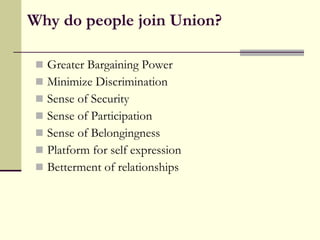
Why do people join Union? Greater Bargaining Power  Minimize Discrimination  Sense of Security  Sense of Participation  Sense of Belongingness  Platform for self expression  Betterment of relationships
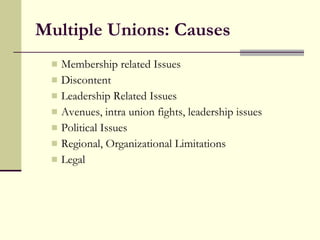
Multiple Unions: Causes Membership related Issues Discontent Leadership Related Issues Avenues, intra union fights, leadership issues Political Issues Regional, Organizational Limitations Legal
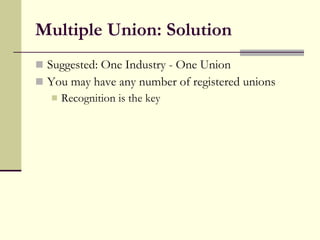
Multiple Union: Solution Suggested: One Industry - One Union You may have any number of registered unions Recognition is the key
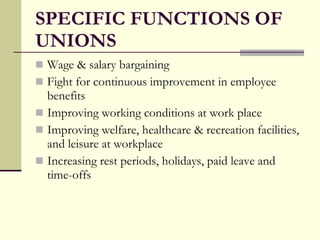
SPECIFIC FUNCTIONS OF UNIONS  Wage & salary bargaining Fight for continuous improvement in employee benefits Improving working conditions at work place Improving welfare, healthcare & recreation facilities, and leisure at workplace Increasing rest periods, holidays, paid leave and time-offs
SPECIFIC FUNCTIONS OF UNIONS Decreasing working hours, work load esp. manual, and hazardous working conditions Improving career and salary rise prospects & job security Protecting employees against arbitrary / unjust actions of Management
Major  Trade Union Organizations  AITUC (All India Trade Union Congress) Centre of Indian Trade Unions (CITU) Hind Mazdoor Sabha All India Council of Central Trade Unions All India United Trade Union Centre  United Trade Union Centre All India federations of banks, insurance, railways, defence, telecom, airline and airports. Centre of Indian Trade Unions -president M.K. Pandhe
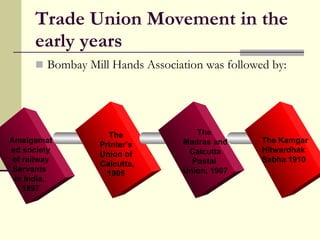
Trade Union Movement in the early years Bombay Mill Hands Association was followed by: Amalgamated society of railway Servants  in India,  1897 The Printer’s Union of Calcutta, 1905 The  Madras and Calcutta Postal  Union, 1907 The Kamgar Hitwardhak Sabha 1910
Eight Core Rights (ILO)  29- Forced on Compulsory Labour. 87  Freedom of Association. 98  Right for Collective Bargaining. 100 Equal Remuneration. 105 Abolition of Forced Labour. 111 Discrimination in Employment. 138 Minimum Age for Employment. 182 Worst forms of Child Labour Convention.
Emergence and Development of TU First cotton mill in India was established in 1851 in Bombay and the first jute mill in 1855 in Bengal First Factory Commission was appointed in Bombay in the year 1875  First Factories Act was passed in 1881 Was dissapaointing Second Factory Commission was appointed in 1884 Mr. Lokhandey organised a conference of workers in Bombay and drew up a memorandum signed by some 5,300 to present to the  Commission This was the first organized effort by workers in India However, no roll or membership, no funds and no rules.
Emergence and Development of TU Contd. Printers’ Union, Calcutta - 1905  Kamgar Hitwardhak Sabha - 1910 Social Service League – 1910 The amalgamated societyof railway servants of India and Burma Were essentially labour welfare organisations and may hardly be regarded as modern trade unions Marjory called as Social welfare period
Present Central Trade Union Organizations   All India Trade Union Congress (AITUC) Bharatiya Mazdoor Sangh (BMS)  Centre of Indian Trade Unions (CITU) Hind Mazdoor Kisan Panchayat (HMKP) Hind Mazdoor Sabha (HMS) Indian Federation of Free Trade Unions (IFFTU) Indian National Trade Union Congress (INTUC) National Front of Indian Trade Unions (NFITU) National Labor Organization (NLO) Trade Unions Co-ordination Centre (TUCC) United Trade Union Congress (UTUC)  United Trade Union Congress - Lenin Sarani (UTUC - LS)
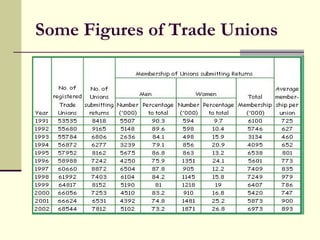
Some Figures of Trade Unions
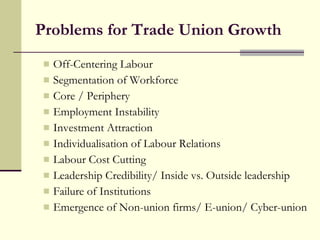
Problems for Trade Union Growth Off-Centering Labour Segmentation of Workforce Core / Periphery Employment Instability Investment Attraction Individualisation of Labour Relations Labour Cost Cutting Leadership Credibility/ Inside vs. Outside leadership Failure of Institutions Emergence of Non-union firms/ E-union/ Cyber-union

Trade Union ppt

  • 1.
  • 2.
    Trade Unions Formedto protect and promote the interests of their members Primary function is to protect the interests of workers against discrimination and unfair labor practices Objectives: Representation (Workers’ Interests) Negotiation (Collective Bargaining) Voice in decisions (Lay off, Retrenchment) affecting workers Member Service (Education, Training, Welfare, Discounts, Loans) Functions: i) Militant functions, (ii) Fraternal functions
  • 3.
    Importance of TradeUnions For industrial peace Decisions taken through the process of collective bargaining and negotiations between employer and unions are more influential Effective communication between the workers and the management Economic development Recruitment & selection Discipline among workforce Settlement of ID in rational manner
  • 4.
    Purpose of TradeUnions Employment Protection and Job Creation. Economic Protection. Social Status - Identity. Political Role - Democratic Institution Societal Obligation - Transformation. Competitiveness / Sustainable Development.
  • 5.
    Why do peoplejoin Union? Greater Bargaining Power Minimize Discrimination Sense of Security Sense of Participation Sense of Belongingness Platform for self expression Betterment of relationships
  • 6.
    Multiple Unions: CausesMembership related Issues Discontent Leadership Related Issues Avenues, intra union fights, leadership issues Political Issues Regional, Organizational Limitations Legal
  • 7.
    Multiple Union: SolutionSuggested: One Industry - One Union You may have any number of registered unions Recognition is the key
  • 8.
    SPECIFIC FUNCTIONS OFUNIONS Wage & salary bargaining Fight for continuous improvement in employee benefits Improving working conditions at work place Improving welfare, healthcare & recreation facilities, and leisure at workplace Increasing rest periods, holidays, paid leave and time-offs
  • 9.
    SPECIFIC FUNCTIONS OFUNIONS Decreasing working hours, work load esp. manual, and hazardous working conditions Improving career and salary rise prospects & job security Protecting employees against arbitrary / unjust actions of Management
  • 10.
    Major TradeUnion Organizations AITUC (All India Trade Union Congress) Centre of Indian Trade Unions (CITU) Hind Mazdoor Sabha All India Council of Central Trade Unions All India United Trade Union Centre United Trade Union Centre All India federations of banks, insurance, railways, defence, telecom, airline and airports. Centre of Indian Trade Unions -president M.K. Pandhe
  • 11.
    Trade Union Movementin the early years Bombay Mill Hands Association was followed by: Amalgamated society of railway Servants in India, 1897 The Printer’s Union of Calcutta, 1905 The Madras and Calcutta Postal Union, 1907 The Kamgar Hitwardhak Sabha 1910
  • 12.
    Eight Core Rights(ILO) 29- Forced on Compulsory Labour. 87 Freedom of Association. 98 Right for Collective Bargaining. 100 Equal Remuneration. 105 Abolition of Forced Labour. 111 Discrimination in Employment. 138 Minimum Age for Employment. 182 Worst forms of Child Labour Convention.
  • 13.
    Emergence and Developmentof TU First cotton mill in India was established in 1851 in Bombay and the first jute mill in 1855 in Bengal First Factory Commission was appointed in Bombay in the year 1875 First Factories Act was passed in 1881 Was dissapaointing Second Factory Commission was appointed in 1884 Mr. Lokhandey organised a conference of workers in Bombay and drew up a memorandum signed by some 5,300 to present to the Commission This was the first organized effort by workers in India However, no roll or membership, no funds and no rules.
  • 14.
    Emergence and Developmentof TU Contd. Printers’ Union, Calcutta - 1905 Kamgar Hitwardhak Sabha - 1910 Social Service League – 1910 The amalgamated societyof railway servants of India and Burma Were essentially labour welfare organisations and may hardly be regarded as modern trade unions Marjory called as Social welfare period
  • 15.
    Present Central TradeUnion Organizations All India Trade Union Congress (AITUC) Bharatiya Mazdoor Sangh (BMS) Centre of Indian Trade Unions (CITU) Hind Mazdoor Kisan Panchayat (HMKP) Hind Mazdoor Sabha (HMS) Indian Federation of Free Trade Unions (IFFTU) Indian National Trade Union Congress (INTUC) National Front of Indian Trade Unions (NFITU) National Labor Organization (NLO) Trade Unions Co-ordination Centre (TUCC) United Trade Union Congress (UTUC) United Trade Union Congress - Lenin Sarani (UTUC - LS)
  • 16.
    Some Figures ofTrade Unions
  • 17.
    Problems for TradeUnion Growth Off-Centering Labour Segmentation of Workforce Core / Periphery Employment Instability Investment Attraction Individualisation of Labour Relations Labour Cost Cutting Leadership Credibility/ Inside vs. Outside leadership Failure of Institutions Emergence of Non-union firms/ E-union/ Cyber-union