You can never conquer the
mountain. You can only
conquer yourself.
– Jim Whittaker, American mountaineer and CEO
DISCIPLINE
• DISCIPLINE SERVICE RULES
• SELF DISCIPLINE
• CONSTRUCTIVE VERSUS DESTRUCTIVE
• DISCIPLINE
MEANING
The word “discipline” is derived from the Latin word
“disciplina”, which means teaching, learning and
growing.
Megginson offer three distinct meaning of the word
discipline:
– Self-discipline
– Necessary condition of orderly behavior
– Act of training and punishing.
DEFINITION
• Discipline is the orderly conduct of affairs by the members of
an organization who adhere to its necessary regulations
because they desire to cooperate harmoniously in forwarding
the end which the group has in view and willingly recognize
that, to do this, their wishes must be brought into a reasonable
unison with the requirements on the group in action. -
- Ordway Teads
• Discipline is the process of training a worker so that he can
develop self-control and can become more effective in his work.
OBJECTIVES OF DISCIPLINE:
To obtain a willing acceptance of the rules, regulations
and procedures of an organization so that
organizational goals may be attained.
To impart an element of certainty despite several
differences in informal behavior pattern and other
related changes in an organization.
To develop among the employees a spirit of tolerance
and a desire to make adjustments.
OBJECTIVES OF DISCIPLINE:
To give and seek direction and responsibility
To create an atmosphere of respect for the human
personality and human relations
To increase the working efficiency and morale of the
employees so that their productivity is stepped up the
cost of production improved.
TYPES OF DISCIPLINE
1. Self controlled discipline :
– n self controlled discipline the employee brings her or his
behavior in to agreement with the organizations official behavior
code, ie the employee regulate their activities for the common
good of the organization.
– As a result the human beings are induced to work for a peak
performance under self controlled discipline.
TYPES OF DISCIPLINE
2. Enforced Discipline :
• Is a managerial action enforces employee compliance with
organization’s rules and regulations. ie it is a common
discipline imposed from the top here the manager
exercises his authority to compel the employees to behave
in a particular way.
INDISCIPLINE:-
• Indiscipline means disorderliness, insubordination and not
following the rules and regulation of an organization.
• The symptoms of indiscipline are change in the normal
behaviour, absenteeism, apathy, go-slow at work, increase
in number and severity of grievances, persistent and
continuous demand for overtime allowance, and lack of
concern for performance.
• Defective supervision and an absence of good supervisors
who know good techniques, who are in a position to
appreciate critically the efforts or their subordinates.
• Lack of properly drawn rules and regulations.
• Workers’ personal problems, their fears, apprehensions,
hopes and aspirations; and their lack of confidence in and
their inability to adjust with their superior and equals.
Causes of indiscipline:-
• Non-placement of the right person on the right job
• Undesirable behaviour of senior officials.
• Faulty evaluation of persons and situations by
executives leads of favoritism.
• Lack of upward communication.
• Leadership which is weak, flexible, incompetent and
distrustful.
• Worker’s reactions to rigidity and multiplicity of
rules and their improper interpretation.
• Intolerably bad working conditions.
• Inborn tendencies to flout rules.
• Absence of enlightened, sympathetic and scientific
management.
• Errors of judgment on the part of the supervisor or
the top management.
Causes of indiscipline:-
• Improper co-ordination, delegation of authority and
fixing of responsibility.
• Discrimination based on caste, colour, creed, sex,
language, and place in matters of selection, promotion,
transfer, placement and discrimination in imposing
penalties and handling out rewards.
Causes of indiscipline:-
APPROACHES TO DISCIPLINE:-
The different approaches to discipline include:
• Human relation approach:
– In human relation approach the employee is. helped to correct his
deviations
• Human resources approach:
– Under the human resources approach, the employee is treated as
resource and the act of indiscipline are dealt by considering the
failure in the area of development, maintenance and utilization of
human resources.
• Group discipline approach: The group as a whole sets the
standards of discipline, and punishments for the deviations.
The individual employees are awarded punishments for
their violation under the group discipline approach.
• Leadership approach: In this approach, every supervisor
administers the rules of discipline and guides, trains and
controls the subordinates regarding disciplinary rules.
APPROACHES TO DISCIPLINE:-
• Judicial approach:
– In judicial approach, indisciplinary cases are dealt on the
basis of legislation and court decisions.
– The Industrial Employment Act, 1946, to a certain extent,
prescribed the correct procedure that should be followed
before awarding punishment to an employee in India.
APPROACHES TO DISCIPLINE:-
ASPECTS OF DISCIPLINE:-
• Positive aspect:
– Employees believe in and support discipline and adhere to the rules,
regulations and desired standards of behaviour.
• Negative aspect:
– Employees sometimes do not believe in and support
discipline.
– As such, they do not adhere to rules, regulations and desired
standards of behaviour.
– As such, disciplinary programme forces and constraints the
employees to obey orders.
SERVICE RULES
• Service law is an important field of law.
• It is essential that those concerned with the administration of
service matters know the correct procedure to deal with them
according to law.
• The expression ‘condition of service’ means all those conditions
which regulate the holding of a post by the person right from
the time of his/her appointment till his/her retirement, and
even beyond it in matters like pension.
The highest level
and most effective
form of discipline is
self-discipline.
Ideally, all
employees should
have adequate self-
control and should
be self-directed in
their pursuit of
organizational
goals.
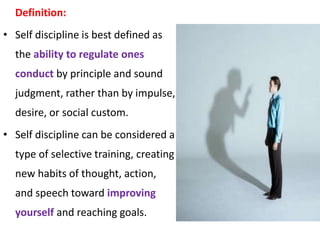
Definition:
• Self discipline is best defined as
the ability to regulate ones
conduct by principle and sound
judgment, rather than by impulse,
desire, or social custom.
• Self discipline can be considered a
type of selective training, creating
new habits of thought, action,
and speech toward improving
yourself and reaching goals.
The Five Pillars of self discipline
Acceptance
Willpower
Hard work
Industry
Persistence.
If you take the first letters of each word you get the acronym “A
WHIP”- since many people associate self discipline with
whipping themselves into shape.
To be self disciplined:
• Get yourself organized
• Don’t constantly seek to be entertained
• Be on time
• Keep your word
• Do the most difficult tasks first
• Finish what you start
• Accept correction
• Practice self denial
• Welcome responsibility

Discipline

  • 2.
    You can neverconquer the mountain. You can only conquer yourself. – Jim Whittaker, American mountaineer and CEO
  • 3.
    DISCIPLINE • DISCIPLINE SERVICERULES • SELF DISCIPLINE • CONSTRUCTIVE VERSUS DESTRUCTIVE • DISCIPLINE
  • 4.
    MEANING The word “discipline”is derived from the Latin word “disciplina”, which means teaching, learning and growing. Megginson offer three distinct meaning of the word discipline: – Self-discipline – Necessary condition of orderly behavior – Act of training and punishing.
  • 5.
    DEFINITION • Discipline isthe orderly conduct of affairs by the members of an organization who adhere to its necessary regulations because they desire to cooperate harmoniously in forwarding the end which the group has in view and willingly recognize that, to do this, their wishes must be brought into a reasonable unison with the requirements on the group in action. - - Ordway Teads • Discipline is the process of training a worker so that he can develop self-control and can become more effective in his work.
  • 6.
    OBJECTIVES OF DISCIPLINE: Toobtain a willing acceptance of the rules, regulations and procedures of an organization so that organizational goals may be attained. To impart an element of certainty despite several differences in informal behavior pattern and other related changes in an organization. To develop among the employees a spirit of tolerance and a desire to make adjustments.
  • 7.
    OBJECTIVES OF DISCIPLINE: Togive and seek direction and responsibility To create an atmosphere of respect for the human personality and human relations To increase the working efficiency and morale of the employees so that their productivity is stepped up the cost of production improved.
  • 8.
    TYPES OF DISCIPLINE 1.Self controlled discipline : – n self controlled discipline the employee brings her or his behavior in to agreement with the organizations official behavior code, ie the employee regulate their activities for the common good of the organization. – As a result the human beings are induced to work for a peak performance under self controlled discipline.
  • 9.
    TYPES OF DISCIPLINE 2.Enforced Discipline : • Is a managerial action enforces employee compliance with organization’s rules and regulations. ie it is a common discipline imposed from the top here the manager exercises his authority to compel the employees to behave in a particular way.
  • 10.
    INDISCIPLINE:- • Indiscipline meansdisorderliness, insubordination and not following the rules and regulation of an organization. • The symptoms of indiscipline are change in the normal behaviour, absenteeism, apathy, go-slow at work, increase in number and severity of grievances, persistent and continuous demand for overtime allowance, and lack of concern for performance.
  • 11.
    • Defective supervisionand an absence of good supervisors who know good techniques, who are in a position to appreciate critically the efforts or their subordinates. • Lack of properly drawn rules and regulations. • Workers’ personal problems, their fears, apprehensions, hopes and aspirations; and their lack of confidence in and their inability to adjust with their superior and equals. Causes of indiscipline:-
  • 12.
    Causes of indiscipline:- •Non-placement of the right person on the right job • Undesirable behaviour of senior officials. • Faulty evaluation of persons and situations by executives leads of favoritism. • Lack of upward communication. • Leadership which is weak, flexible, incompetent and distrustful.
  • 13.
    • Worker’s reactionsto rigidity and multiplicity of rules and their improper interpretation. • Intolerably bad working conditions. • Inborn tendencies to flout rules. • Absence of enlightened, sympathetic and scientific management. • Errors of judgment on the part of the supervisor or the top management. Causes of indiscipline:-
  • 14.
    • Improper co-ordination,delegation of authority and fixing of responsibility. • Discrimination based on caste, colour, creed, sex, language, and place in matters of selection, promotion, transfer, placement and discrimination in imposing penalties and handling out rewards. Causes of indiscipline:-
  • 15.
    APPROACHES TO DISCIPLINE:- Thedifferent approaches to discipline include: • Human relation approach: – In human relation approach the employee is. helped to correct his deviations • Human resources approach: – Under the human resources approach, the employee is treated as resource and the act of indiscipline are dealt by considering the failure in the area of development, maintenance and utilization of human resources.
  • 16.
    • Group disciplineapproach: The group as a whole sets the standards of discipline, and punishments for the deviations. The individual employees are awarded punishments for their violation under the group discipline approach. • Leadership approach: In this approach, every supervisor administers the rules of discipline and guides, trains and controls the subordinates regarding disciplinary rules. APPROACHES TO DISCIPLINE:-
  • 17.
    • Judicial approach: –In judicial approach, indisciplinary cases are dealt on the basis of legislation and court decisions. – The Industrial Employment Act, 1946, to a certain extent, prescribed the correct procedure that should be followed before awarding punishment to an employee in India. APPROACHES TO DISCIPLINE:-
  • 18.
    ASPECTS OF DISCIPLINE:- •Positive aspect: – Employees believe in and support discipline and adhere to the rules, regulations and desired standards of behaviour. • Negative aspect: – Employees sometimes do not believe in and support discipline. – As such, they do not adhere to rules, regulations and desired standards of behaviour. – As such, disciplinary programme forces and constraints the employees to obey orders.
  • 19.
    SERVICE RULES • Servicelaw is an important field of law. • It is essential that those concerned with the administration of service matters know the correct procedure to deal with them according to law. • The expression ‘condition of service’ means all those conditions which regulate the holding of a post by the person right from the time of his/her appointment till his/her retirement, and even beyond it in matters like pension.
  • 20.
    The highest level andmost effective form of discipline is self-discipline. Ideally, all employees should have adequate self- control and should be self-directed in their pursuit of organizational goals.
  • 21.
    Definition: • Self disciplineis best defined as the ability to regulate ones conduct by principle and sound judgment, rather than by impulse, desire, or social custom. • Self discipline can be considered a type of selective training, creating new habits of thought, action, and speech toward improving yourself and reaching goals.
  • 22.
    The Five Pillarsof self discipline Acceptance Willpower Hard work Industry Persistence. If you take the first letters of each word you get the acronym “A WHIP”- since many people associate self discipline with whipping themselves into shape.
  • 23.
    To be selfdisciplined: • Get yourself organized • Don’t constantly seek to be entertained • Be on time • Keep your word • Do the most difficult tasks first • Finish what you start • Accept correction • Practice self denial • Welcome responsibility