INTRODUCTION
The word “discipline”comes from the Latin word “disciplina”,
which means teaching, learning, and growing. Discipline can be
training or molding of the mind and character to bring about desired
behaviors. The constructive discipline uses discipline as a means of
helping the employees to grow, not as a punitive measure.
3.
DEFINITION
•Discipline is theforce that prompts individual or groups to observe
rules, regulations, standards and procedures deemed necessary for an
organization.
- Richard D Calhoon
4.
• International LaborOrganization (ILO) refers “discipline” as a
control mechanism to ensure compliance with organizational
objectives.
• It is used to control those who deviate from performance and
behavioral standards.
• Discipline means voluntary and willing compliance of rules and
regulations and instructions and also the development of the right
habits of conduct in work with others at the workplace.
5.
NEED FOR DISCIPLINE
Lackof knowledge about policies and procedures is a major cause of
the need for disciplinary action.
Management should provide orientation from the first day of
employment.
6.
Most employees arenot disciplinary problems, but some individuals
require more than positive stimuli. These few cases are potentially
explosive.
The disciplinary action program and grievance procedure must
be uniform for all personnel of a specific grade or classification.
A standard disciplinary action program with procedures outlined
and forms provided should be available to managers.
7.
PURPOSES OF DISCIPLINE
oTo take appropriate action against the misconduct of employees
o To develop and protect other employees
o To improve organizational efficiency
o To improve the functioning of the organization
o To create a positive work culture
8.
o To implementa code of conduct for guiding employees
o To teach a discipline work culture
o To develop human capacity and stimulate efficiency
o To create a spirit of tolerance and good interpersonal relationship
o To impart an element of certainty to give and seek direction and
responsibility
9.
PREREQUISITE
Three essential requisitecan help in maintaining discipline:
Self-discipline:
Discipline that an employee has from oneself
Has her or his principles of life
Adopts a particular pattern of behavior
The employee needs to have self-knowledge, courage, and committed and
have internal consciousness
10.
Orderly behavior: Tobe in discipline, the employee should have
orderly conduct
Punishment: It is a preventive measure to take action against
indiscipline
11.
TYPES OF DISCIPLINE
1)Positivediscipline / Willful discipline / Constructive discipline
Employee maintains discipline willingly by following established
rules and regulations of the organization.
It is called constructive when it assists employee growth
12.
Employee feelscreative, accountable and motivated
Developmental approach
Shaping the behavior
Avoiding physical punishments
13.
2)Negative discipline /Punitive discipline
Type of control whereby the employee is forced to obey rules and
regulations that may be fear of getting the punishment, warnings,
and penalties.
14.
• Employee havelow morale, more destructive, frustrated and give
low work output
• Traditional and negative approach
• Managers are autocratic
15.
CHARACTERISTICS OF DISCIPLINARYSYSTEM
The employees should be aware of the code of conduct or conduct
rules: Agency handbooks, policy manuals and orientation programs may be
used
There should be a timely inquiry in a case of break of conduct rules:
The agency’s disciplinary action program should indicate that the current
action is being administered without bias and is directly related to the
offense.
16.
The personnelrecord should clearly indicate the facts surrounding
the offense, management’s efforts to correct the problem of the
employee’s noncompliance with corrective measures, and resulting
penalties.
The disciplinary officer should impersonal and consistent
17.
There shouldbe a system of warning to the employee not
following a code of conduct
Right of Appeal
18.
DISCIPLINE RULES
•To maintaindiscipline and behavior among the employees
•To prevent them misusing the powers given to them
•To maintain the correct behavior toward superiors
•To protect the integrity of the officials
•To regulate the activities
19.
PRINCIPLES OF DISCIPLINE
Themanager should have a positive attitude
There should be a sound standard of conduct, codes, and norms in
the organization
Employees should be aware of the rule of conduct, codes and norms
20.
Conscious efforts shouldbe made to create conditions for easy
acceptance of the laid down norms
Implement standard of behavior, codes, and norms promptly and
review time to time.
Take disciplinary action if required, quickly, privately,
thoughtfully and consistently
21.
Take disciplinary actionin a systematic way:
• Investigate carefully
• Collect the facts
• Check allegations
• Talk to witnesses
• Ask accused employees for their side of the story.
22.
Use progressive anddevelopment approach in dealing with
disciplinary action
Follow up
23.
INDISCIPLINE - DEFINITION
Theword “indiscipline” means the absence of discipline
among employees. Indiscipline depicts in the form of
confusion, chaos, abuse etc
24.
CAUSES
Lack ofawareness of organizational rules and regulations
Incorrect philosophy of discipline
Lack of well-defined code of conduct
Absence of any procedure to handle grievances
Improper attitude toward employees’ problem
25.
False promisesmade by superiors
Favoritism
Poorly defined employees’ expectations
Misuse through dividing people and exploitation of subordinates
“Divide and Rule” policy in the organization
Inappropriate supervision
26.
Communication barriers
Low morale and motivation among staff
Poor employees’ selection and orientation
Poorly selected and trained supervisors
27.
Unfair managementpractices such as wage discrimination,
discrimination in job assignment, distribution of work load, too
strict, noncompliance of promotional and transfer policies
Personal frustrations and misunderstandings
28.
PROGRESSIVE DISCIPLINE
• Processthat deals with job related behavior of the employees when
they do not meet expected and communicated performance standards.
• Purpose - for correcting and improving the misbehavior of
employees.
There are two ways to improve the performance behavior of the
problematic employees, oral reprimand and written reprimand
29.
1)Oral reprimand:
• Supervisormay have verbal interaction with the employee to discuss
the problem behaviors and the expectations to change the practices
which are a form of oral reprimands.
30.
When a verbalwarning is given, the manager is advised to make an
anecdotal note of the time, place, occasion, facts, and the gist of the
reprimand.
2)Written reprimand:
• Supervisor documents if the behavior continues or if an employee
commits a serious offense.
31.
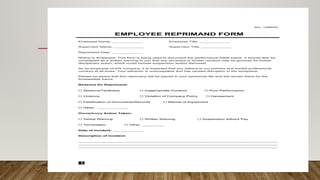
• The writtennotice should include:
o Name of the worker
o Name of the manager
o Facts and behaviors describing the problem
o Plan for correction
o Consequences of future repetition
33.
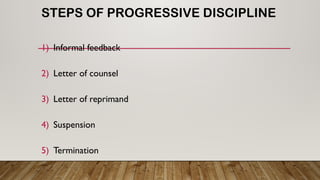
STEPS OF PROGRESSIVEDISCIPLINE
1) Informal feedback
2) Letter of counsel
3) Letter of reprimand
4) Suspension
5) Termination
34.
Informal feedback -verbal notification:
• Take informal feedback and give a verbal warning to an employee
on receiving a complaint from superior for the misconduct.
• Before even verbal warning, initial inquiry and counselling are
done to confirm that the employee is aware of the problem.
• If the problem continues, the employee gets a verbal warning
35.
Letter of counsel– written warning:
• It is a written warning of unacceptable behavior or unsatisfactory
work performance and kept in the official personnel file
36.
Letter of reprimand:
•Includes a written description of warning
• Consists of a review of any prior related corrective action
• A thorough statement of the circumstances causing current
corrective action
• Clear picture of future expectations
37.
Suspension – finalwarning:
• During the suspension, the employee may either get a salary or may
be without pay, depending on the severity of the offense.
• The notification has the reasons for the action.
• Employee may be removed from the work immediately before
conducting and investigation where there is suspected theft, a
disorderly conduct, or a threat to other employees or clients.
38.
Termination:
• If allthe above steps are against an employee, the employee may
get a termination order.
1.A TYPE OFDISCIPLINE WHEREBYTHE EMPLOYEES
FOLLOW THE RULES AND REGULATIONSWILLINGLY
IS:
a) Positive discipline
b) Negative discipline
c) Progressive discipline
d) Self discipline
WHICH TYPE OFWARNINGIS APPLICABLE FOR AN
EMPLOYEE ON RECEIVING A COMPLAINT FROM
SUPERIOR FOR HER MISCONDUCT?
a) Written
b) Oral
c) Reprimand
d) Suspension
A TYPE OFDISCIPLINE WHEREBYTHE EMPLOYEES HAVE
LOW MORALE, MORE DESTRUCTIVE AND LOW WORK
OTPUT?
a) Progressive discipline
b) Self discipline
c) Negative discipline
d) Positive discipline
SUBSTANCE ABUSERS /CHEMICALLY IMPAIRED
EMPLOYEE
• Substance abuse is not uncommon among health professionals.
• It affects all socioeconomic classes, cultures, and races.
• Nurses with alcohol or other drug addictions often exhibit
psychosocial problems
48.
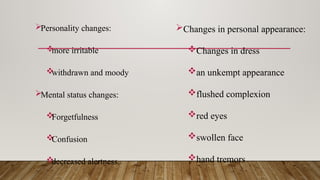
Personality changes:
more irritable
withdrawnand moody
Mental status changes:
Forgetfulness
Confusion
decreased alertness.
Changes in personal appearance:
Changes in dress
an unkempt appearance
flushed complexion
red eyes
swollen face
hand tremors
49.
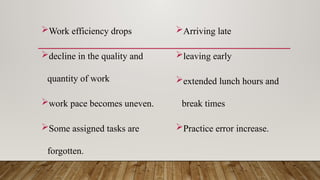
Work efficiency drops
declinein the quality and
quantity of work
work pace becomes uneven.
Some assigned tasks are
forgotten.
Arriving late
leaving early
extended lunch hours and
break times
Practice error increase.
50.
When a staffmember reports to work in a state of acute
intoxication:
• The manager notes the signs objectively
• Asks a second person to validate the observations.
• The intoxicated staff person is removed from the situation
51.
• Confronted brieflyand firmly about the behavior
• Sent home to rest and recuperate.
• Some agency policies require that a blood sample be evaluated for
alcohol concentration to validate or refute the suspicion
• The incident is then recorded
52.
• The managerdescribes the observation
• States the action taken
• Indicates future plans
• The employee should sign and date the memo after returning to
work.
53.
ANGRY OR WITHDRAWNEMPLOYEES
Angry employee:
May become hostile
Use critical, sarcastic and obscene language with others.
Consequently, interpersonal relationships suffer
54.
Productive workmay be impaired.
Anger can also be displaced to patients and others
55.
Withdrawn persons:
Donot invest emotional energy in others.
Fear of self-disclosure or having others become attached to
them is frightening.
Not assertive
56.
Do notprotect their rights.
May be delegated more than their fair share of the work because
they are so cooperative and polite.
This cycle leads to more feelings of use, abuse, and
helplessness
57.
Role of Nursemanagers:
Need to recognize aggressive and passive behaviors among employees
Teach and display assertive behavior
Encourage problem solving.
Should help personnel understand themselves and their job
responsibilities
58.
Develop trust
Promote groupharmony
Job expectations should be clear
personnel rewarded liberally and disciplined justly.
59.
DECREASED PRODUCTIVITY
• Itis a side effect of personnel problems.
• Managers should make sure that desired performance is not being
punished or undesirable behavior rewarded.
• Expectations are taught how to do what they are expected to do.
• If boredom is a problem, job rotation and special projects are
considered.
60.
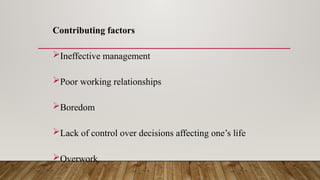
ABSENTEEISM
• It isa side effect of personnel problems
• Some workers are immature and lack the self-discipline to get
themselves to work.
• Others stay away to avoid an unpleasant or boring job.
61.
• Some arepoorly motivated, do as little as necessary to prevent
being terminated, and do not see their jobs as means toward ends.
• Some personnel are exhausted from overwork, have lost their
enthusiasm for the job, or are burned out.
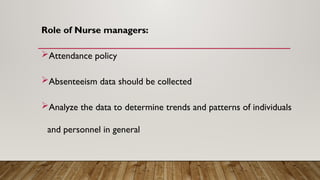
Role of Nursemanagers:
Attendance policy
Absenteeism data should be collected
Analyze the data to determine trends and patterns of individuals
and personnel in general
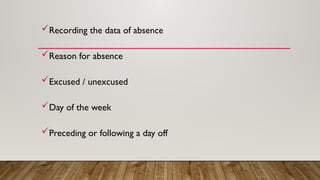
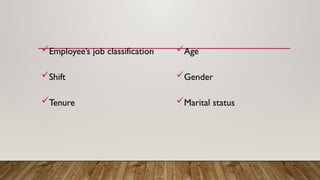
64.
Recording the dataof absence
Reason for absence
Excused / unexcused
Day of the week
Preceding or following a day off
MODIFICATION OF EMPLOYEEBEHAVIOR
Behavior leads to consequences, and the consequences that follow
the behavior affect the probability of recurrence of that behavior.
Because behavior is a function of the consequence, it is important
for nurse managers to identify the contingency relationship
67.
REINFORCEMENT
• Positive reinforcementincreases the probability of a recurrence of
desired behavior.
• It is more effective the sooner it follows the desired behavior
• It should be clearly connected to the behavior that the manager
wishes to increase.
68.
STIMULI USED TOREINFORCE BEHAVIOR:
Feedback
Attention
Praise
Avoidance of punishment
Merit pay increases
Special assignments
Assistance with tuition
Tickets to a ball game or play
69.
SHAPING
• It isa behavior modification technique used when the response does
not meet the criteria.
• The manager provides favorable consequences after any attempt at
the desired behavior and then withholds consequences until
improvement is made.
70.
• Once thelevel of desired performance has been reached, it can be
maintained by providing favorable consequences intermittently
• Too many positive consequences cause satiation and lose their
effect on the behavior
71.
EXTINCTION
• Withholding reinforcerswill decrease the probability of the
occurrence of the behavior and contribute to its extinction.
• Therefore, if the manager does not mention or otherwise reward
undesirable behavior, the lack of cation should contribute to
extinction
72.
PUNISHMENT
• Employees whodo not meet work standards will be terminated.
• If management does nothing to reinforce the more productive work
behavior, avoidance behavior is likely to occur.
• Once managers have started an aversive stimulus, they should not stop
it until the behavior has been corrected or the cessation may act as
positive reinforcer.
73.
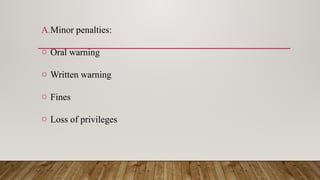
PENALTIES FOR MISCONDUCT/ INDISCIPLINE
A.Major penalties:
Some of the significant penalties are;
o Demotion
o Dismissal
o Transfer
o Discharge
o Withholding increments
74.
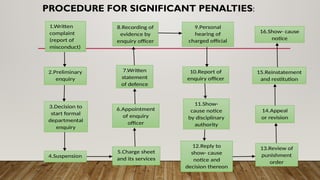
PROCEDURE FOR SIGNIFICANTPENALTIES:
1.Written
complaint
(report of
misconduct)
2.Preliminary
enquiry
3.Decision to
start formal
departmental
enquiry
4.Suspension
8.Recording of
evidence by
enquiry officer
7.Written
statement
of defence
6.Appointment
of enquiry
officer
5.Charge sheet
and its services
12.Reply to
show- cause
notice and
decision thereon
11.Show-
cause notice
by disciplinary
authority
10.Report of
enquiry officer
9.Personal
hearing of
charged official
16.Show- cause
notice
15.Reinstatement
and restitution
14.Appeal
or revision
13.Review of
punishment
order
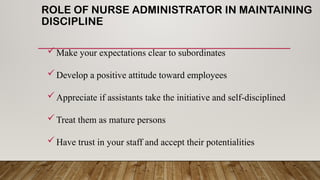
ROLE OF NURSEADMINISTRATOR IN MAINTAINING
DISCIPLINE
Make your expectations clear to subordinates
Develop a positive attitude toward employees
Appreciate if assistants take the initiative and self-disciplined
Treat them as mature persons
Have trust in your staff and accept their potentialities
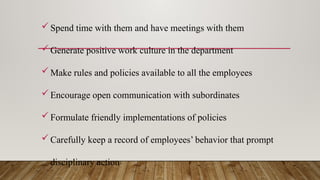
77.
Spend time withthem and have meetings with them
Generate positive work culture in the department
Make rules and policies available to all the employees
Encourage open communication with subordinates
Formulate friendly implementations of policies
Carefully keep a record of employees’ behavior that prompt
disciplinary action
78.
Investigate carefully andbe prompt if the staff has any grievances
Be empathetic to the complaints
Avoid severe disciplinary procedures that may backfire
Take corrective and constructive action
Allow employees feedback in the disciplinary process
79.
REVIEW OF LITERATURE
Unprofessionalconduct by nurses: A document analysis of
disciplinary decisions
Oili Papinaho, Arja Haggman-Laitila, Mari Kangasniemi
A retrospective study was conducted on 204 registered nurses. The
mean age of the registered nurses who were disciplined was 44 years
and 81% were female. Two-thirds had worked for their employer for 5
years or less, 53% had two or more employers and 18% had a criminal
history
80.
All the decisionsincluded a primary reason for why the nurses were
investigated, but there were also 479 coexisting reasons. In most
cases, unprofessional conduct was connected to substance abuse
(96%). In addition, stealing of medicine, a decreased ability to work
and neglect of nursing guidelines were reported. They found that the
nurses were investigated for unprofessional conduct for complex
combinations of primary and coexisting reasons.
81.
CONCLUSION
Discipline is consideredas an important factor that contributes to the
overall outcome in an organization. The organization should take
proper measures to maintain discipline. The rules framed should to
inform to all the workers or employees in the organization. The
employees who fail to follow the rules have to be monitored and
called for counseling they have to be informed about their mistake.
82.
REFERENCE
I Clement, Managementof Nursing Services and Education, 2nd
edition,
2015, Elsevier publications, p.no: 271-276
Patricia S, Yoder Wise, Leading and Managing Nursing, 5th
edition,
2011, Elsevier publications, p.no: 491- 493
Rebecca A, Patronis Jones, Nursing Leadership and Management
theories, processes and practice, 1st
edition, 2008, Jaypee brothers
medical publishers, p.no: 310- 312
83.
Vati Jogindra, Principlesand Practice of Nursing Management and
Administration, 2nd
edition, 2020, Jaypee brothers medical publishers,
p.no: 349- 355
Oili Papinaho, Arja Haggman-Laitila, Mari Kangasniemi
Unprofessional conduct by nurses: A document analysis of
disciplinary decisions, 2022 February 29 (1); 131- 144, doi:
10.1177/09697330211015289