Administration and Management
Nabin Lamichhane
Purbanchal University
Administration
• Ad+ Ministrate (Latin word)
• Management of all (Human) affairs.
2
Administration
• Administration is the universal process of
efficiently getting activities completed with
and through other people. –Stephen Robin
3
• Administration is defined as a social sciences,
includes principles, techniques and practices
whose application to human group/permits
establishment and maintenance of rational
systems of cooperative efforts, through which
common goals are realized that would be
impossible on an individual basis.
4
Public Health Administration
Public Administration related to
– Promotion of Health
– Preventive services
– Medical care and rehabilitation
– Human Resources for Health
– Public health/Medical education/Training
– Resource mobilization
5
The major Three aspects of Public
Health Administration:
• Organizational Structure
• Health Manpower Development
• Health planning and management
6
So, What we say in General……..
• Increasingly dynamic and complex field.
• Closely related to other scientific discipline.
• Series of functions Like planning, organization,
integration, direction, control, effective utilization
(5M) of resources for the production of goods (
Quality Health care delivery)
• Ideas, things and People
• Formulating concepts, structuring materials and
HRs, Guiding people for desired goals.
7
Principles of PHA
• Equity based health care delivery.
• Sound health administrative structure.
• Ensure the basic service.
• Health is Fundamental Human Rights.
• Proportional investment.
• Accessibility
• Affordability
• Health Should be the integral part of
socioeconomic development.
• Prevent, Promote and Protect.
8
Objectives of PHA
• Increasing the average length of human life.
• Reducing the mortality rate (MMR,IMR) due
those diseases which can be easily prevented or
remediated.
• Decreasing morbidity
• Increasing physical, mental and social well-being .
• Environmental adjustability.
• Providing total health care to enrich QOL.
9
Money doesn't create man but it is the man
who created money.
10
Management
• It is the essence of organized effort
• The meaning of management is changing.
• Management is an art and science.
• It is goal oriented.
11
Concepts of Management
1. Process Concept (Functional Concept)
- Regards management as a function of
planning, organizing, staffing, directing,
control, resource utilization to attain goals.
- Jobs are the focused in this concept.
- Easy to understand because managers
performs these functions in all organizations.
12
Concepts of Management
2. People Concept (Leadership concept)
– Regards management as a process of getting the
jobs done through the people.
– Emphasized Leadership, communication,
coordination, decision making.
– People are the focus of Management in
performing jobs under this concept.
– HRD for increasing the competencies of prople is
emphasized.
13
Concepts of Management………..
3. System concept (Integrative function)
– Coordinating resources towards efficient and
effective accomplishment of goals.
– Relating the organization to external environment
and responding to environmental change.
– Developing an organizational climate.
– Performing functions such as planning
implementing and controlling.
14
Management-Few Definitions
15
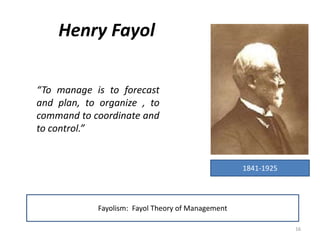
Henry Fayol
“To manage is to forecast
and plan, to organize , to
command to coordinate and
to control.”
1841-1925
Fayolism: Fayol Theory of Management
16
“Management is knowing exactly what you want to people to
do and then seeing that they do it in the best and cheapest
way.”
FW Taylor
17
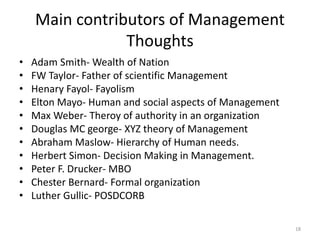
Main contributors of Management
Thoughts
• Adam Smith- Wealth of Nation
• FW Taylor- Father of scientific Management
• Henary Fayol- Fayolism
• Elton Mayo- Human and social aspects of Management
• Max Weber- Theroy of authority in an organization
• Douglas MC george- XYZ theory of Management
• Abraham Maslow- Hierarchy of Human needs.
• Herbert Simon- Decision Making in Management.
• Peter F. Drucker- MBO
• Chester Bernard- Formal organization
• Luther Gullic- POSDCORB
18
ADMINISTRATION Vs.
MANAGEMENT
19
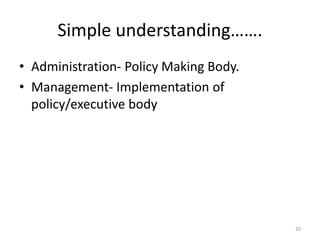
Simple understanding…….
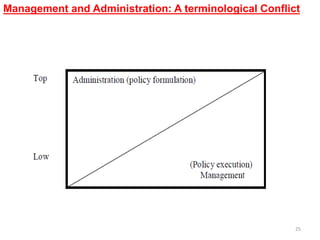
• Administration- Policy Making Body.
• Management- Implementation of
policy/executive body
20
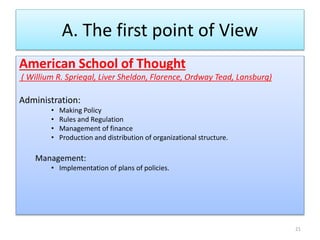
A. The first point of View
American School of Thought
( Willium R. Spriegal, Liver Sheldon, Florence, Ordway Tead, Lansburg)
Administration:
• Making Policy
• Rules and Regulation
• Management of finance
• Production and distribution of organizational structure.
Management:
• Implementation of plans of policies.
21
B. Second point of view
British School of thought (EFL
Brech)
Administration is a part of management. Management
is divided into three:
Top Level Plan and Policy
Middle level Implementation
Lower Level Daily activities Performances
22
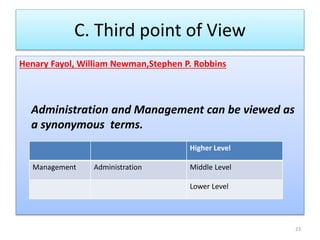
C. Third point of View
Henary Fayol, William Newman,Stephen P. Robbins
Administration and Management can be viewed as
a synonymous terms.
Higher Level
Management Administration Middle Level
Lower Level
23
24
Now, is there is any differences between
Administration and Management??
25
Management and Administration: A terminological Conflict
Conclusion
• Administration has been conceived by some as
evolution, reformulation and application of rules and
regulation, while management is viewed as a process
encompassing whole gamut of elements starting from
policy through strategy to program formulation ,
implementation, monitoring and evaluation and
repeating the cycle again.
• Administration is the sum of the organization and
management. In the last framework of administration
being the sum total of organization and management,
organization is conceived as anatomy/structure and
management as philosophy /function.
26
HOW Literatures differentiate
the Administration and
Management?
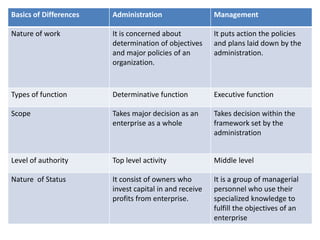
Basics of Differences Administration Management
Nature of work It is concerned about
determination of objectives
and major policies of an
organization.
It puts action the policies
and plans laid down by the
administration.
Types of function Determinative function Executive function
Scope Takes major decision as an
enterprise as a whole
Takes decision within the
framework set by the
administration
Level of authority Top level activity Middle level
Nature of Status It consist of owners who
invest capital in and receive
profits from enterprise.
It is a group of managerial
personnel who use their
specialized knowledge to
fulfill the objectives of an
enterprise
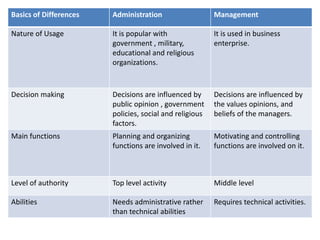
Basics of Differences Administration Management
Nature of Usage It is popular with
government , military,
educational and religious
organizations.
It is used in business
enterprise.
Decision making Decisions are influenced by
public opinion , government
policies, social and religious
factors.
Decisions are influenced by
the values opinions, and
beliefs of the managers.
Main functions Planning and organizing
functions are involved in it.
Motivating and controlling
functions are involved on it.
Level of authority Top level activity Middle level
Abilities Needs administrative rather
than technical abilities
Requires technical activities.
Health Management
Health management is defined as application
of management methods and technologies /
techniques to improve the efficiency of
healthcare delivery system so that the health
services can be delivered to people efficiently.
– WHO
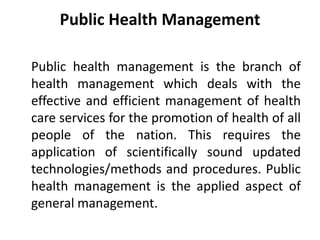
Public Health Management
Public health management is the branch of
health management which deals with the
effective and efficient management of health
care services for the promotion of health of all
people of the nation. This requires the
application of scientifically sound updated
technologies/methods and procedures. Public
health management is the applied aspect of
general management.
References
• Public Health Policy and Administration by SL
GOEL, 2005.
• Principal of Management, Govinda Ram
Agrawal current Edition.
• Contemporary Public Health (Pro. Gupta and
Pro. Sood)
• Principal of Management
• Various websites.
32
Questions
• Define PH administration? Is it science or an
art? How do you differentiate administration
with management. Briefly mention the
approaches of health management.
33
34
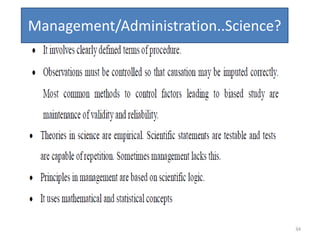
Management/Administration..Science?
35
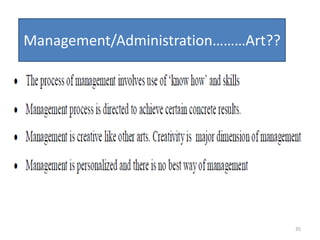
Management/Administration………Art??
36

Administration and management

  • 1.
    Administration and Management NabinLamichhane Purbanchal University
  • 2.
    Administration • Ad+ Ministrate(Latin word) • Management of all (Human) affairs. 2
  • 3.
    Administration • Administration isthe universal process of efficiently getting activities completed with and through other people. –Stephen Robin 3
  • 4.
    • Administration isdefined as a social sciences, includes principles, techniques and practices whose application to human group/permits establishment and maintenance of rational systems of cooperative efforts, through which common goals are realized that would be impossible on an individual basis. 4
  • 5.
    Public Health Administration PublicAdministration related to – Promotion of Health – Preventive services – Medical care and rehabilitation – Human Resources for Health – Public health/Medical education/Training – Resource mobilization 5
  • 6.
    The major Threeaspects of Public Health Administration: • Organizational Structure • Health Manpower Development • Health planning and management 6
  • 7.
    So, What wesay in General…….. • Increasingly dynamic and complex field. • Closely related to other scientific discipline. • Series of functions Like planning, organization, integration, direction, control, effective utilization (5M) of resources for the production of goods ( Quality Health care delivery) • Ideas, things and People • Formulating concepts, structuring materials and HRs, Guiding people for desired goals. 7
  • 8.
    Principles of PHA •Equity based health care delivery. • Sound health administrative structure. • Ensure the basic service. • Health is Fundamental Human Rights. • Proportional investment. • Accessibility • Affordability • Health Should be the integral part of socioeconomic development. • Prevent, Promote and Protect. 8
  • 9.
    Objectives of PHA •Increasing the average length of human life. • Reducing the mortality rate (MMR,IMR) due those diseases which can be easily prevented or remediated. • Decreasing morbidity • Increasing physical, mental and social well-being . • Environmental adjustability. • Providing total health care to enrich QOL. 9
  • 10.
    Money doesn't createman but it is the man who created money. 10
  • 11.
    Management • It isthe essence of organized effort • The meaning of management is changing. • Management is an art and science. • It is goal oriented. 11
  • 12.
    Concepts of Management 1.Process Concept (Functional Concept) - Regards management as a function of planning, organizing, staffing, directing, control, resource utilization to attain goals. - Jobs are the focused in this concept. - Easy to understand because managers performs these functions in all organizations. 12
  • 13.
    Concepts of Management 2.People Concept (Leadership concept) – Regards management as a process of getting the jobs done through the people. – Emphasized Leadership, communication, coordination, decision making. – People are the focus of Management in performing jobs under this concept. – HRD for increasing the competencies of prople is emphasized. 13
  • 14.
    Concepts of Management……….. 3.System concept (Integrative function) – Coordinating resources towards efficient and effective accomplishment of goals. – Relating the organization to external environment and responding to environmental change. – Developing an organizational climate. – Performing functions such as planning implementing and controlling. 14
  • 15.
  • 16.
    Henry Fayol “To manageis to forecast and plan, to organize , to command to coordinate and to control.” 1841-1925 Fayolism: Fayol Theory of Management 16
  • 17.
    “Management is knowingexactly what you want to people to do and then seeing that they do it in the best and cheapest way.” FW Taylor 17
  • 18.
    Main contributors ofManagement Thoughts • Adam Smith- Wealth of Nation • FW Taylor- Father of scientific Management • Henary Fayol- Fayolism • Elton Mayo- Human and social aspects of Management • Max Weber- Theroy of authority in an organization • Douglas MC george- XYZ theory of Management • Abraham Maslow- Hierarchy of Human needs. • Herbert Simon- Decision Making in Management. • Peter F. Drucker- MBO • Chester Bernard- Formal organization • Luther Gullic- POSDCORB 18
  • 19.
  • 20.
    Simple understanding……. • Administration-Policy Making Body. • Management- Implementation of policy/executive body 20
  • 21.
    A. The firstpoint of View American School of Thought ( Willium R. Spriegal, Liver Sheldon, Florence, Ordway Tead, Lansburg) Administration: • Making Policy • Rules and Regulation • Management of finance • Production and distribution of organizational structure. Management: • Implementation of plans of policies. 21
  • 22.
    B. Second pointof view British School of thought (EFL Brech) Administration is a part of management. Management is divided into three: Top Level Plan and Policy Middle level Implementation Lower Level Daily activities Performances 22
  • 23.
    C. Third pointof View Henary Fayol, William Newman,Stephen P. Robbins Administration and Management can be viewed as a synonymous terms. Higher Level Management Administration Middle Level Lower Level 23
  • 24.
    24 Now, is thereis any differences between Administration and Management??
  • 25.
    25 Management and Administration:A terminological Conflict
  • 26.
    Conclusion • Administration hasbeen conceived by some as evolution, reformulation and application of rules and regulation, while management is viewed as a process encompassing whole gamut of elements starting from policy through strategy to program formulation , implementation, monitoring and evaluation and repeating the cycle again. • Administration is the sum of the organization and management. In the last framework of administration being the sum total of organization and management, organization is conceived as anatomy/structure and management as philosophy /function. 26
  • 27.
    HOW Literatures differentiate theAdministration and Management?
  • 28.
    Basics of DifferencesAdministration Management Nature of work It is concerned about determination of objectives and major policies of an organization. It puts action the policies and plans laid down by the administration. Types of function Determinative function Executive function Scope Takes major decision as an enterprise as a whole Takes decision within the framework set by the administration Level of authority Top level activity Middle level Nature of Status It consist of owners who invest capital in and receive profits from enterprise. It is a group of managerial personnel who use their specialized knowledge to fulfill the objectives of an enterprise
  • 29.
    Basics of DifferencesAdministration Management Nature of Usage It is popular with government , military, educational and religious organizations. It is used in business enterprise. Decision making Decisions are influenced by public opinion , government policies, social and religious factors. Decisions are influenced by the values opinions, and beliefs of the managers. Main functions Planning and organizing functions are involved in it. Motivating and controlling functions are involved on it. Level of authority Top level activity Middle level Abilities Needs administrative rather than technical abilities Requires technical activities.
  • 30.
    Health Management Health managementis defined as application of management methods and technologies / techniques to improve the efficiency of healthcare delivery system so that the health services can be delivered to people efficiently. – WHO
  • 31.
    Public Health Management Publichealth management is the branch of health management which deals with the effective and efficient management of health care services for the promotion of health of all people of the nation. This requires the application of scientifically sound updated technologies/methods and procedures. Public health management is the applied aspect of general management.
  • 32.
    References • Public HealthPolicy and Administration by SL GOEL, 2005. • Principal of Management, Govinda Ram Agrawal current Edition. • Contemporary Public Health (Pro. Gupta and Pro. Sood) • Principal of Management • Various websites. 32
  • 33.
    Questions • Define PHadministration? Is it science or an art? How do you differentiate administration with management. Briefly mention the approaches of health management. 33
  • 34.
  • 35.
  • 36.