Disaster risk
management
Mr. Reginald B. Pabico
Disaster risk
reduction
and
Table of contents
01
04
02
05
03
06
What is a disaster
risk reduction?
How do we reduce
risk?
Identifying and
understanding risk:
the foundation of
risk reduction
Introduction
Are we reducing
disaster risk?
What is a disaster risk
management?
Introduction
01
Disaster risk reduction &
disaster risk management
The policy objective of anticipating and
reducing risk is called disaster risk
reduction (DRR). Although often used
interchangeably with DRR, disaster risk
management (DRM) can be thought of as
the implementation of DRR, since it
describes the actions that aim to achieve
the objective of reducing risk.
Adapted from UNISDR Global Assessment Report 2015
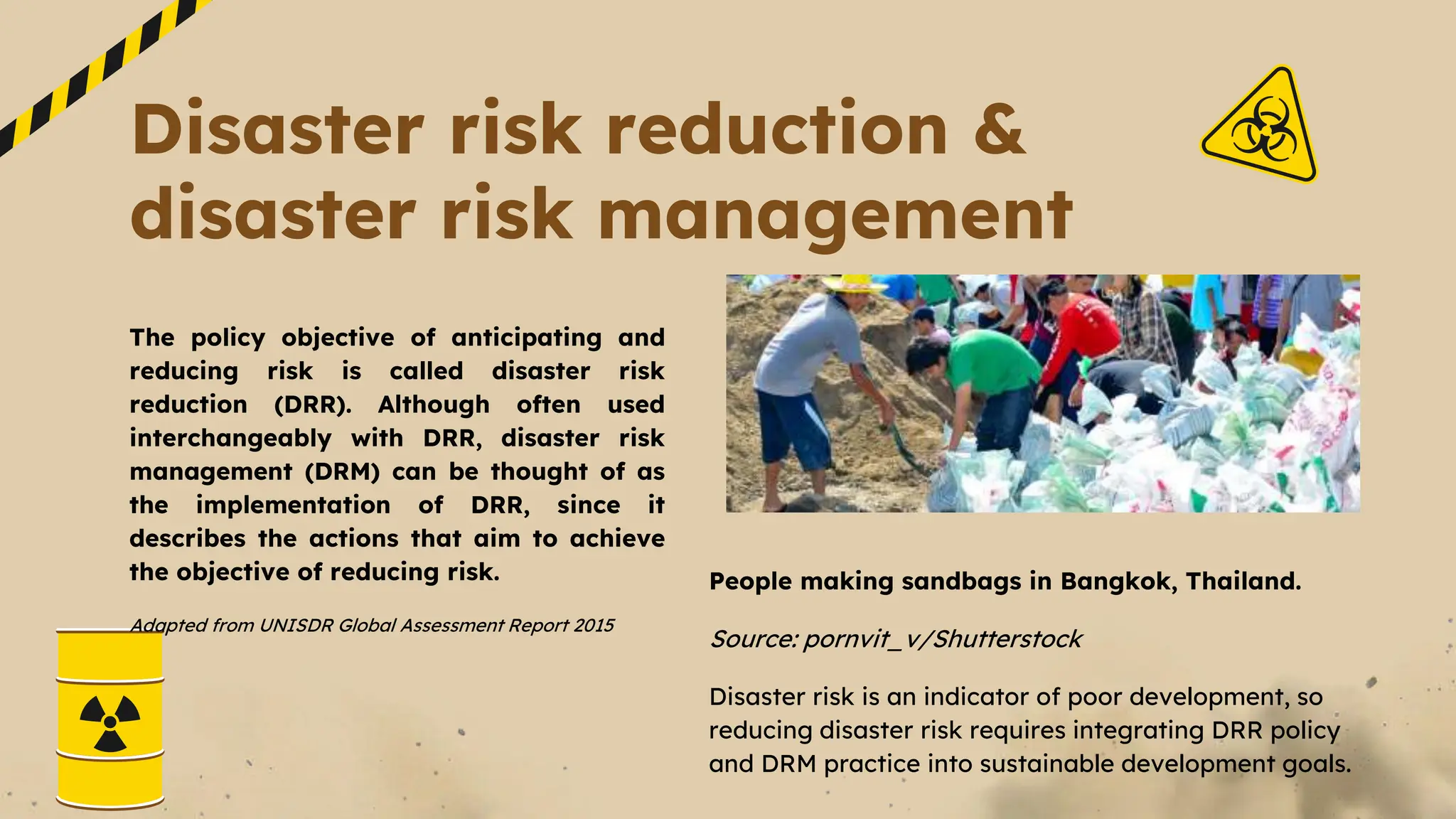
People making sandbags in Bangkok, Thailand.
Source: pornvit_v/Shutterstock
Disaster risk is an indicator of poor development, so
reducing disaster risk requires integrating DRR policy
and DRM practice into sustainable development goals.
What is a
disaster risk
reduction?
02
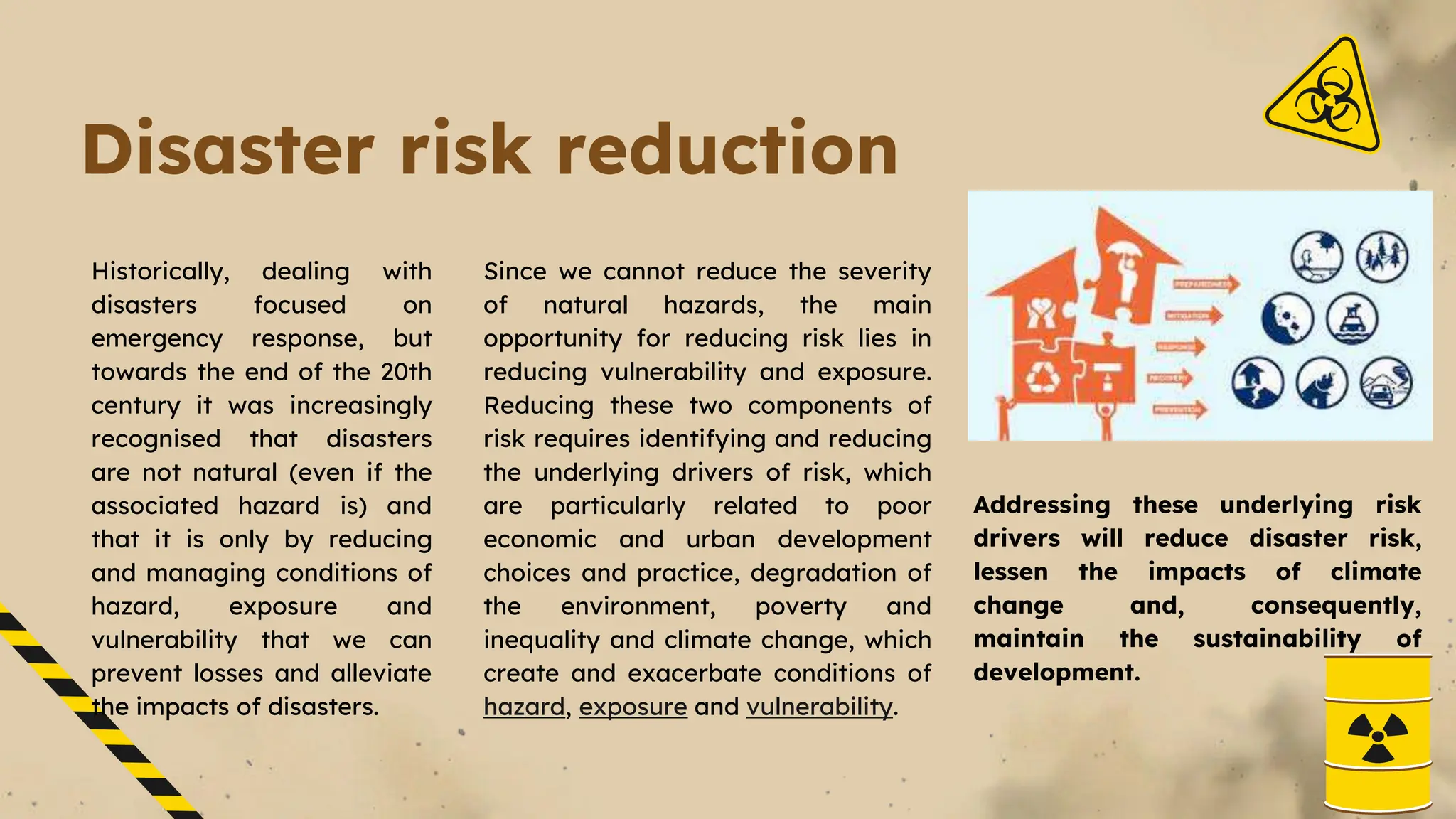
Disaster risk reduction
Historically, dealing with
disasters focused on
emergency response, but
towards the end of the 20th
century it was increasingly
recognised that disasters
are not natural (even if the
associated hazard is) and
that it is only by reducing
and managing conditions of
hazard, exposure and
vulnerability that we can
prevent losses and alleviate
the impacts of disasters.
Addressing these underlying risk
drivers will reduce disaster risk,
lessen the impacts of climate
change and, consequently,
maintain the sustainability of
development.
Since we cannot reduce the severity
of natural hazards, the main
opportunity for reducing risk lies in
reducing vulnerability and exposure.
Reducing these two components of
risk requires identifying and reducing
the underlying drivers of risk, which
are particularly related to poor
economic and urban development
choices and practice, degradation of
the environment, poverty and
inequality and climate change, which
create and exacerbate conditions of
hazard, exposure and vulnerability.
What is a
disaster risk
management?
03
Disaster risk management
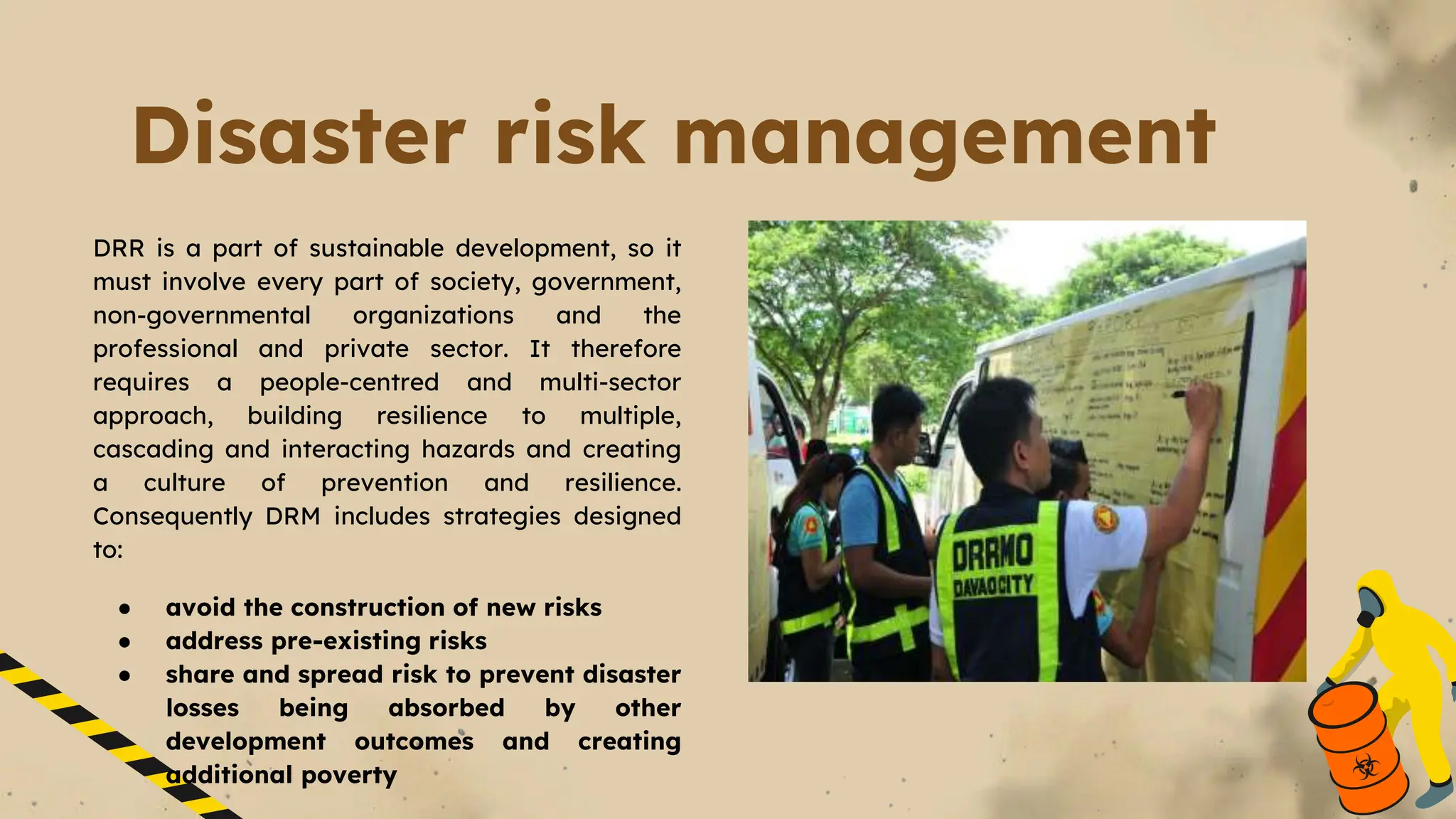
DRR is a part of sustainable development, so it
must involve every part of society, government,
non-governmental organizations and the
professional and private sector. It therefore
requires a people-centred and multi-sector
approach, building resilience to multiple,
cascading and interacting hazards and creating
a culture of prevention and resilience.
Consequently DRM includes strategies designed
to:
● avoid the construction of new risks
● address pre-existing risks
● share and spread risk to prevent disaster
losses being absorbed by other
development outcomes and creating
additional poverty
Disaster risk management
Although DRM includes disaster preparedness and response activities, it is about much more
than managing disasters.
Successful DRR results from the combination of top-down, institutional changes and strategies, with
bottom-up, local and community-based approaches. DRM programmes should not be standalone but
instead be integrated within development planning and practice, since disasters are an indicator of
failed or skewed development, of unsustainable economic and social processes, and of ill-adapted
societies. Approaches need to address the different layers of risk (from intensive to extensive risk),
underlying risk drivers, as well as be tailored to local contexts. There is no ‘one-size fits all’ approach to
DRM, but there exist a number of approaches and frameworks, which have been effectively
implemented to reduce disaster risk. But, before being able to reduce risk, we need to understand the
hazards, and the exposure and vulnerability of people and assets to those hazards.
We need to manage risks, not just disasters.
How do we
reduce risk?
04
Disaster risk management
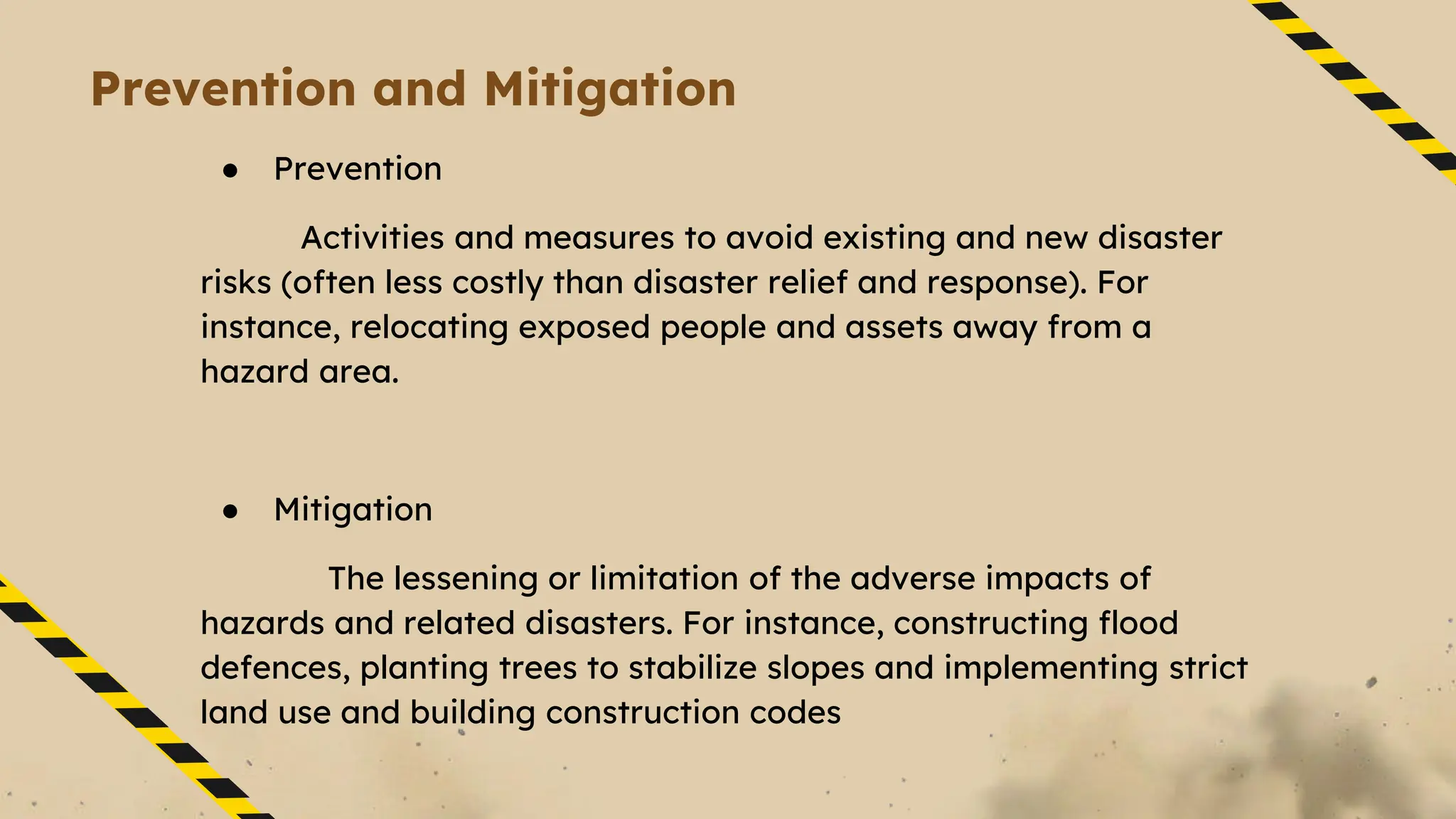
involves activities related to:
Prevention
Mitigation
Transfer
Preparedness
● Prevention
Activities and measures to avoid existing and new disaster
risks (often less costly than disaster relief and response). For
instance, relocating exposed people and assets away from a
hazard area.
● Mitigation
The lessening or limitation of the adverse impacts of
hazards and related disasters. For instance, constructing flood
defences, planting trees to stabilize slopes and implementing strict
land use and building construction codes
Prevention and Mitigation
Mitigation and prevention efforts aim to reduce the potential damage and
suffering that disasters can cause. While disaster management cannot
prevent disasters, it can prevent them from becoming compounded as a
result of neglecting causal factors and manageable risks. Mitigation
specifically refers to actions taken that can lessen the severity of a
disaster’s impact. Investing in measures that limit hazards can greatly
reduce the burden of disasters.
Strategies that disaster management professionals implement to protect
vulnerable communities and limit hazards include the following:
● Raising awareness about potential hazards and how to address them
● Educating the public about how to properly prepare for different types
of disaster
● Installing and strengthening prediction and warning systems
Prevention and Mitigation
Managing hazards and risks means planning to minimize a
community’s vulnerability to disasters. This can involve:
● Encouraging community members to buy appropriate
insurance to protect their properties and belongings
● Educating families and businesses on how to create effective
disaster plans
● Promoting the use of fire-retardant materials in construction
● Advocating for capital works initiatives, such as the
construction and maintenance of levees
● Building partnerships between sectors and agencies at the
federal, state, and local levels to collaborate on mitigation
projects
Prevention and Mitigation
Risk Transfer
The process of formally or informally
shifting the financial consequences of
particular risks from one party to another,
whereby a household, community, enterprise
or State authority will obtain resources from
the other party after a disaster occurs, in
exchange for ongoing or compensatory social
or financial benefits provided to that other
party.
Risk Transfer
Insurance is a well-known form of risk
transfer, where coverage of a risk is obtained from
an insurer in exchange for ongoing premiums paid
to the insurer. Risk transfer can occur informally
within family and community networks where
there are reciprocal expectations of mutual aid by
means of gifts or credit, as well as formally,
wherein governments, insurers, multilateral banks
and other large risk-bearing entities establish
mechanisms to help cope with losses in major
events.
Preparedness
● Preparedness action is carried out within the context of
disaster risk management and aims to build the capacities
needed to efficiently manage all types of emergencies and
achieve orderly transitions from response to sustained
recovery.
● A preparedness plan establishes arrangements in advance
to enable timely, effective and appropriate responses to
specific potential hazardous events or emerging disaster
situations that might threaten society or the environment.
Identifying and
understanding
risk: the
foundation of risk
reduction
05
Identifying and
understanding risk: the
foundation of risk
reduction
Awareness, identification,
understanding and measurement of
disaster risks are all clearly
fundamental underpinnings of
disaster risk management (UNISDR,
2015b). Disaster risk reduction is
about decisions and choices,
including a lack of, so risk
information has a role in five key
areas of decision making:
Risk Identification
https://docs.google.com/spreadsheets/d/1PfPjeylECpdLmzxdLmSJo9wlHZs6KV4f
Q3B5GfaF0N0/copy
Because the damages and
losses caused by historical
disasters are often not widely
known, and because the
potential damages and losses
that could arise from future
disasters (including infrequent
but high-impact events) may
not be known at all, DRM is
given a low priority.
Appropriate communication of
robust risk information at the
right time can raise awareness
and trigger action. See a
related story: GEM releases five
national and three regional
earthquake models for public
good application.
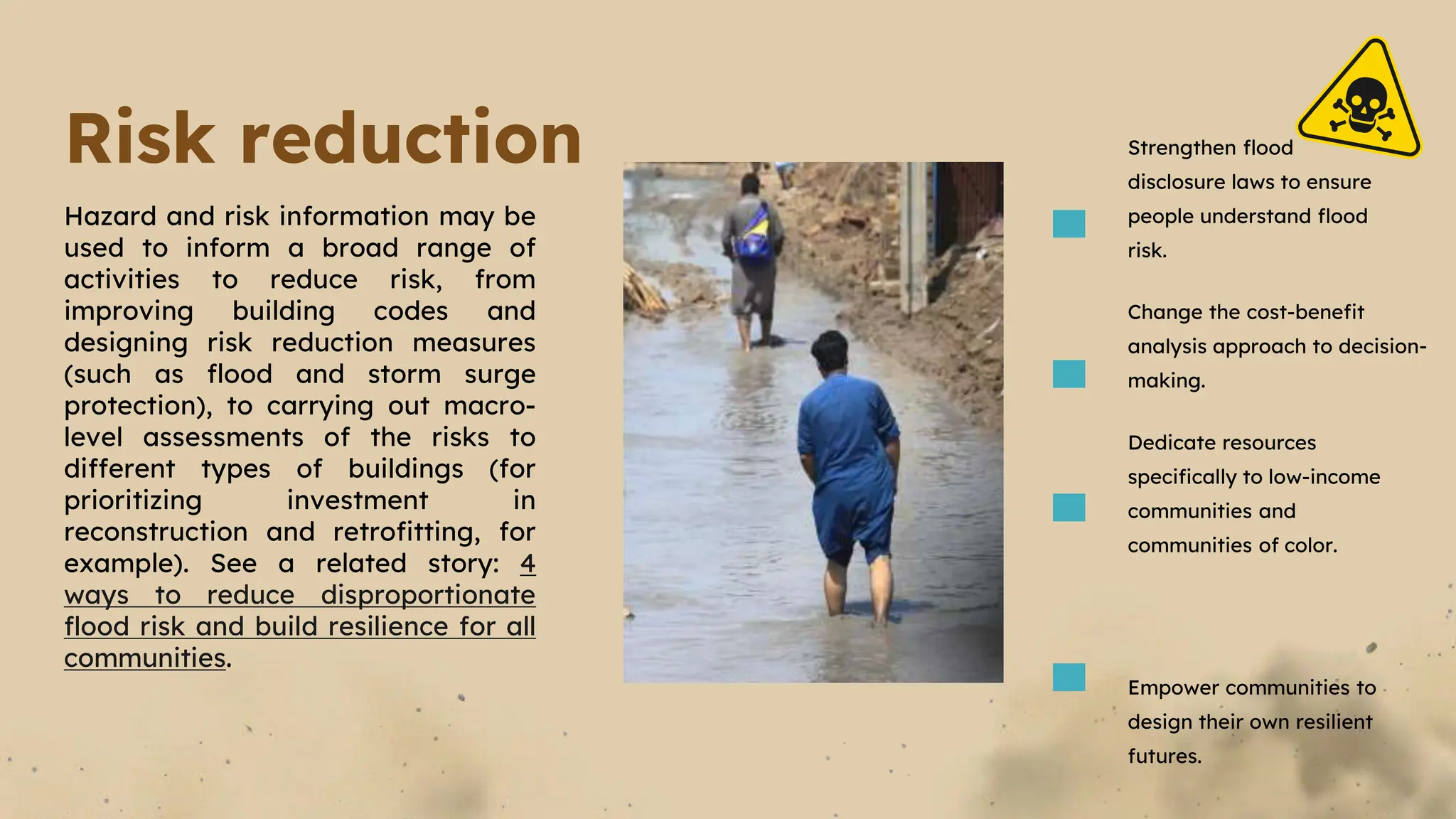
Risk reduction
Hazard and risk information may be
used to inform a broad range of
activities to reduce risk, from
improving building codes and
designing risk reduction measures
(such as flood and storm surge
protection), to carrying out macro-
level assessments of the risks to
different types of buildings (for
prioritizing investment in
reconstruction and retrofitting, for
example). See a related story: 4
ways to reduce disproportionate
flood risk and build resilience for all
communities.
Strengthen flood
disclosure laws to ensure
people understand flood
risk.
Change the cost-benefit
analysis approach to decision-
making.
Dedicate resources
specifically to low-income
communities and
communities of color.
Empower communities to
design their own resilient
futures.
Preparedness
Preparedness is based on a sound analysis of disaster risks and
good linkages with early warning systems, and includes such
activities as contingency planning, the stockpiling of equipment
and supplies, the development of arrangements for
coordination, evacuation and public information, and associated
training and field exercises. These must be supported by formal
institutional, legal and budgetary capacities. The related term
“readiness” describes the ability to quickly and appropriately
respond when required.
Disaster risk analysis was born out of the financial and insurance sector’s need to quantify the risk of
comparatively rare high-impact natural hazard events. As governments increasingly seek to manage
their sovereign financial risk or support programs that manage individual financial risks (e.g., micro-
insurance or household earthquake insurance). See a related story: Micro insurance company’s
evacuation insurance against disasters.
Financial protection
Resilient reconstruction
Risk assessment can play a
critical role in impact modelling
before an event strikes (in the
days leading up to a cyclone, for
example), or it can provide initial
and rapid estimates of human,
physical, and economic loss in an
event’s immediate aftermath.
Moreover, risk information for
resilient reconstruction needs to
be available before an event
occurs, since after the event
there is rarely time to collect the
information needed to inform
resilient design and land-use
plans.
https://www.preventionweb.net/sites/default/files/mg/I-DRRDRM.jpg
Resilient reconstruction
If those exposed to hazards
are unaware of the risks they
face, it is difficult to see how
or why households,
businesses or governments
would invest in reducing their
risk levels. However, while
risk awareness may be a
precondition, the importance
people attach to managing
their risks can only be
understood in the context of
the full range of social,
economic, territorial and
environmental constraints
and opportunities they face -
see the story of Ratnapura
and the Chao Phraya River
below.
We have over 30 years of
research into disaster risk,
but much of this is not
available in a form that is
understandable or useful to
those who need it the most.
There is therefore a need for
risk scientists and
researchers to shift their
focus to the production of
risk information that is
understandable and
actionable for different kinds
of users: in other words, risk
knowledge. Such a shift
requires more collaboration
and partnerships between
scientists and researchers
and those involved in DRR,
ranging from governments to
local communities.
Governments need to invest in the
collection, management and dissemination
of risk information, including disaster loss
and impact statistics, hazard models,
exposure databases and vulnerability
information. At the same time, they need
to put standards and mechanisms in place
to ensure openness and transparency so
that users not only have access to the
information they need but are aware of its
underlying assumptions and limitations.
The generation of understandable and
actionable risk information needs to be
particularly sensitive to extensive risk,
which, because it is configured to a large
extent by social, economic and
environmental vulnerability, can be
reduced effectively through risk
management and sustainable
development practices.
Are we
reducing
disaster risk?
06
Are we reducing disaster risk?
While we have made some progress in reducing disaster mortality associated with intensive risks,
increasing exposure of people and economic assets means that mortality and economic losses
from extensive risk are trending up and absolute global economic losses from disasters are
increasing, although not relative to GDP. Some low and middle-income countries may not have
the financial resilience to accommodate the likely average annual losses from future disasters,
which threaten the very economic existence of many small island development states.
We’ve been generating risk faster than we have been reducing it.
More needs to be done to prevent new risks, which are already emerging owing to increasing
urbanisation, the threat of climate change and other risk drivers. In an increasingly
interconnected world, we are seeing that disasters can also result in synchronous failures.
Development can be sustainable, it is just a question of whether we can change our approach
in time to prevent disaster risk from reaching dangerous levels.
We have made more progress in managing disasters than in
reducing our disaster risk.
Over the last 10 years, there has been significant progress in strengthening
disaster preparedness, response and early warning capacities and in
reducing specific risks, according to the HFA Monitor. However, progress has
been limited in most countries when it comes to managing the underlying
risks.
Although we know how to reduce disaster risk, there
is often a lack of incentive to do so.
The good news is that we can achieve great things when we invest in DRR.
There are countless success stories of reducing disaster risk ranging from
community-based participatory approaches to the global reduction in
disaster mortality associated with intensive risks.
Both individuals, governments and businesses tend to discount low-probability future losses and
seem reluctant to invest in DRM. Despite the magnitude of disaster costs, reducing risks is often
perceived as less of a priority than fiscal stability, unemployment or inflation. New evidence
demonstrates, however that the opportunity cost of disasters is high and that many low and
middle-income countries, and small island development states are financially unable to cope with
the predicted future losses from disasters while also maintaining their capacity to develop. In
other words, they are not resilient.
The costs and benefits of disaster risk management need to become fully encoded into public
and private investment at all levels, into the financial system and into the design of risk-sharing
and social protection mechanisms. Cost-benefit analyses can be expanded to highlight the
trade-offs implicit in each decision, including the downstream benefits and avoided costs in
terms of reduced poverty and inequality, environmental sustainability, economic development
and social progress. They can also help to identify who retains the risks, who bears the costs and
who reaps the benefits. Such a broad approach to cost-benefit analysis can increase the
visibility and attractiveness of investments in disaster risk reduction.
However, we need to recognize that the impact of some DRM measures
may not be immediate. It may take decades for the outcome of improved
planning regulations and building standards to translate into reduced
disaster losses, as a critical mass of new, risk-sensitive building and urban
development has to be achieved.
The future of DRR requires that we assess the costs and benefits of
DRM, reform risk governance, move from risk information to knowledge
and strengthen accountability.
Mr. Reginald B. Pabico
Thank you
disaster-risk-reduction-and-disaster-risk-management-ppt.pptx

disaster-risk-reduction-and-disaster-risk-management-ppt.pptx

  • 1.
    Disaster risk management Mr. ReginaldB. Pabico Disaster risk reduction and
  • 2.
    Table of contents 01 04 02 05 03 06 Whatis a disaster risk reduction? How do we reduce risk? Identifying and understanding risk: the foundation of risk reduction Introduction Are we reducing disaster risk? What is a disaster risk management?
  • 3.
  • 4.
    Disaster risk reduction& disaster risk management The policy objective of anticipating and reducing risk is called disaster risk reduction (DRR). Although often used interchangeably with DRR, disaster risk management (DRM) can be thought of as the implementation of DRR, since it describes the actions that aim to achieve the objective of reducing risk. Adapted from UNISDR Global Assessment Report 2015 People making sandbags in Bangkok, Thailand. Source: pornvit_v/Shutterstock Disaster risk is an indicator of poor development, so reducing disaster risk requires integrating DRR policy and DRM practice into sustainable development goals.
  • 5.
    What is a disasterrisk reduction? 02
  • 6.
    Disaster risk reduction Historically,dealing with disasters focused on emergency response, but towards the end of the 20th century it was increasingly recognised that disasters are not natural (even if the associated hazard is) and that it is only by reducing and managing conditions of hazard, exposure and vulnerability that we can prevent losses and alleviate the impacts of disasters. Addressing these underlying risk drivers will reduce disaster risk, lessen the impacts of climate change and, consequently, maintain the sustainability of development. Since we cannot reduce the severity of natural hazards, the main opportunity for reducing risk lies in reducing vulnerability and exposure. Reducing these two components of risk requires identifying and reducing the underlying drivers of risk, which are particularly related to poor economic and urban development choices and practice, degradation of the environment, poverty and inequality and climate change, which create and exacerbate conditions of hazard, exposure and vulnerability.
  • 7.
    What is a disasterrisk management? 03
  • 8.
    Disaster risk management DRRis a part of sustainable development, so it must involve every part of society, government, non-governmental organizations and the professional and private sector. It therefore requires a people-centred and multi-sector approach, building resilience to multiple, cascading and interacting hazards and creating a culture of prevention and resilience. Consequently DRM includes strategies designed to: ● avoid the construction of new risks ● address pre-existing risks ● share and spread risk to prevent disaster losses being absorbed by other development outcomes and creating additional poverty
  • 9.
    Disaster risk management AlthoughDRM includes disaster preparedness and response activities, it is about much more than managing disasters. Successful DRR results from the combination of top-down, institutional changes and strategies, with bottom-up, local and community-based approaches. DRM programmes should not be standalone but instead be integrated within development planning and practice, since disasters are an indicator of failed or skewed development, of unsustainable economic and social processes, and of ill-adapted societies. Approaches need to address the different layers of risk (from intensive to extensive risk), underlying risk drivers, as well as be tailored to local contexts. There is no ‘one-size fits all’ approach to DRM, but there exist a number of approaches and frameworks, which have been effectively implemented to reduce disaster risk. But, before being able to reduce risk, we need to understand the hazards, and the exposure and vulnerability of people and assets to those hazards. We need to manage risks, not just disasters.
  • 10.
  • 11.
    Disaster risk management involvesactivities related to: Prevention Mitigation Transfer Preparedness
  • 12.
    ● Prevention Activities andmeasures to avoid existing and new disaster risks (often less costly than disaster relief and response). For instance, relocating exposed people and assets away from a hazard area. ● Mitigation The lessening or limitation of the adverse impacts of hazards and related disasters. For instance, constructing flood defences, planting trees to stabilize slopes and implementing strict land use and building construction codes Prevention and Mitigation
  • 13.
    Mitigation and preventionefforts aim to reduce the potential damage and suffering that disasters can cause. While disaster management cannot prevent disasters, it can prevent them from becoming compounded as a result of neglecting causal factors and manageable risks. Mitigation specifically refers to actions taken that can lessen the severity of a disaster’s impact. Investing in measures that limit hazards can greatly reduce the burden of disasters. Strategies that disaster management professionals implement to protect vulnerable communities and limit hazards include the following: ● Raising awareness about potential hazards and how to address them ● Educating the public about how to properly prepare for different types of disaster ● Installing and strengthening prediction and warning systems Prevention and Mitigation
  • 14.
    Managing hazards andrisks means planning to minimize a community’s vulnerability to disasters. This can involve: ● Encouraging community members to buy appropriate insurance to protect their properties and belongings ● Educating families and businesses on how to create effective disaster plans ● Promoting the use of fire-retardant materials in construction ● Advocating for capital works initiatives, such as the construction and maintenance of levees ● Building partnerships between sectors and agencies at the federal, state, and local levels to collaborate on mitigation projects Prevention and Mitigation
  • 15.
    Risk Transfer The processof formally or informally shifting the financial consequences of particular risks from one party to another, whereby a household, community, enterprise or State authority will obtain resources from the other party after a disaster occurs, in exchange for ongoing or compensatory social or financial benefits provided to that other party.
  • 16.
    Risk Transfer Insurance isa well-known form of risk transfer, where coverage of a risk is obtained from an insurer in exchange for ongoing premiums paid to the insurer. Risk transfer can occur informally within family and community networks where there are reciprocal expectations of mutual aid by means of gifts or credit, as well as formally, wherein governments, insurers, multilateral banks and other large risk-bearing entities establish mechanisms to help cope with losses in major events.
  • 17.
    Preparedness ● Preparedness actionis carried out within the context of disaster risk management and aims to build the capacities needed to efficiently manage all types of emergencies and achieve orderly transitions from response to sustained recovery. ● A preparedness plan establishes arrangements in advance to enable timely, effective and appropriate responses to specific potential hazardous events or emerging disaster situations that might threaten society or the environment.
  • 18.
  • 19.
    Identifying and understanding risk:the foundation of risk reduction Awareness, identification, understanding and measurement of disaster risks are all clearly fundamental underpinnings of disaster risk management (UNISDR, 2015b). Disaster risk reduction is about decisions and choices, including a lack of, so risk information has a role in five key areas of decision making:
  • 20.
    Risk Identification https://docs.google.com/spreadsheets/d/1PfPjeylECpdLmzxdLmSJo9wlHZs6KV4f Q3B5GfaF0N0/copy Because thedamages and losses caused by historical disasters are often not widely known, and because the potential damages and losses that could arise from future disasters (including infrequent but high-impact events) may not be known at all, DRM is given a low priority. Appropriate communication of robust risk information at the right time can raise awareness and trigger action. See a related story: GEM releases five national and three regional earthquake models for public good application.
  • 21.
    Risk reduction Hazard andrisk information may be used to inform a broad range of activities to reduce risk, from improving building codes and designing risk reduction measures (such as flood and storm surge protection), to carrying out macro- level assessments of the risks to different types of buildings (for prioritizing investment in reconstruction and retrofitting, for example). See a related story: 4 ways to reduce disproportionate flood risk and build resilience for all communities. Strengthen flood disclosure laws to ensure people understand flood risk. Change the cost-benefit analysis approach to decision- making. Dedicate resources specifically to low-income communities and communities of color. Empower communities to design their own resilient futures.
  • 22.
    Preparedness Preparedness is basedon a sound analysis of disaster risks and good linkages with early warning systems, and includes such activities as contingency planning, the stockpiling of equipment and supplies, the development of arrangements for coordination, evacuation and public information, and associated training and field exercises. These must be supported by formal institutional, legal and budgetary capacities. The related term “readiness” describes the ability to quickly and appropriately respond when required.
  • 23.
    Disaster risk analysiswas born out of the financial and insurance sector’s need to quantify the risk of comparatively rare high-impact natural hazard events. As governments increasingly seek to manage their sovereign financial risk or support programs that manage individual financial risks (e.g., micro- insurance or household earthquake insurance). See a related story: Micro insurance company’s evacuation insurance against disasters. Financial protection
  • 24.
    Resilient reconstruction Risk assessmentcan play a critical role in impact modelling before an event strikes (in the days leading up to a cyclone, for example), or it can provide initial and rapid estimates of human, physical, and economic loss in an event’s immediate aftermath. Moreover, risk information for resilient reconstruction needs to be available before an event occurs, since after the event there is rarely time to collect the information needed to inform resilient design and land-use plans. https://www.preventionweb.net/sites/default/files/mg/I-DRRDRM.jpg
  • 25.
    Resilient reconstruction If thoseexposed to hazards are unaware of the risks they face, it is difficult to see how or why households, businesses or governments would invest in reducing their risk levels. However, while risk awareness may be a precondition, the importance people attach to managing their risks can only be understood in the context of the full range of social, economic, territorial and environmental constraints and opportunities they face - see the story of Ratnapura and the Chao Phraya River below. We have over 30 years of research into disaster risk, but much of this is not available in a form that is understandable or useful to those who need it the most. There is therefore a need for risk scientists and researchers to shift their focus to the production of risk information that is understandable and actionable for different kinds of users: in other words, risk knowledge. Such a shift requires more collaboration and partnerships between scientists and researchers and those involved in DRR, ranging from governments to local communities. Governments need to invest in the collection, management and dissemination of risk information, including disaster loss and impact statistics, hazard models, exposure databases and vulnerability information. At the same time, they need to put standards and mechanisms in place to ensure openness and transparency so that users not only have access to the information they need but are aware of its underlying assumptions and limitations. The generation of understandable and actionable risk information needs to be particularly sensitive to extensive risk, which, because it is configured to a large extent by social, economic and environmental vulnerability, can be reduced effectively through risk management and sustainable development practices.
  • 26.
  • 27.
    Are we reducingdisaster risk? While we have made some progress in reducing disaster mortality associated with intensive risks, increasing exposure of people and economic assets means that mortality and economic losses from extensive risk are trending up and absolute global economic losses from disasters are increasing, although not relative to GDP. Some low and middle-income countries may not have the financial resilience to accommodate the likely average annual losses from future disasters, which threaten the very economic existence of many small island development states. We’ve been generating risk faster than we have been reducing it.
  • 28.
    More needs tobe done to prevent new risks, which are already emerging owing to increasing urbanisation, the threat of climate change and other risk drivers. In an increasingly interconnected world, we are seeing that disasters can also result in synchronous failures. Development can be sustainable, it is just a question of whether we can change our approach in time to prevent disaster risk from reaching dangerous levels. We have made more progress in managing disasters than in reducing our disaster risk. Over the last 10 years, there has been significant progress in strengthening disaster preparedness, response and early warning capacities and in reducing specific risks, according to the HFA Monitor. However, progress has been limited in most countries when it comes to managing the underlying risks. Although we know how to reduce disaster risk, there is often a lack of incentive to do so.
  • 29.
    The good newsis that we can achieve great things when we invest in DRR. There are countless success stories of reducing disaster risk ranging from community-based participatory approaches to the global reduction in disaster mortality associated with intensive risks. Both individuals, governments and businesses tend to discount low-probability future losses and seem reluctant to invest in DRM. Despite the magnitude of disaster costs, reducing risks is often perceived as less of a priority than fiscal stability, unemployment or inflation. New evidence demonstrates, however that the opportunity cost of disasters is high and that many low and middle-income countries, and small island development states are financially unable to cope with the predicted future losses from disasters while also maintaining their capacity to develop. In other words, they are not resilient. The costs and benefits of disaster risk management need to become fully encoded into public and private investment at all levels, into the financial system and into the design of risk-sharing and social protection mechanisms. Cost-benefit analyses can be expanded to highlight the trade-offs implicit in each decision, including the downstream benefits and avoided costs in terms of reduced poverty and inequality, environmental sustainability, economic development and social progress. They can also help to identify who retains the risks, who bears the costs and who reaps the benefits. Such a broad approach to cost-benefit analysis can increase the visibility and attractiveness of investments in disaster risk reduction.
  • 30.
    However, we needto recognize that the impact of some DRM measures may not be immediate. It may take decades for the outcome of improved planning regulations and building standards to translate into reduced disaster losses, as a critical mass of new, risk-sensitive building and urban development has to be achieved. The future of DRR requires that we assess the costs and benefits of DRM, reform risk governance, move from risk information to knowledge and strengthen accountability.
  • 31.
    Mr. Reginald B.Pabico Thank you