COMMUNITY BASED
DISASTER MANAGEMENT

Shashi Mehta
Introduction




Sustainable development and disaster reduction are
essential preconditions for each other.
Reason

hamper the progress and achievements of sustainable
development.



physical infrastructure we are constructing itself constitute a
source of risk in the event of future disasters.



For instance- in the case of earthquakes, where majority of
victims are killed by their own collapsing houses.
Cont..








From the perspectives of environmental degradation,
human intervention and security aspects, disaster
management is a pressing issue.
The approach seeks communities at risk get engaged in all
of its phases: prevention, mitigation, preparedness,
response and recovery.
In order to build disaster-resilient communities, they first
need to be empowered so that community members can
cope with the adverse effects of natural hazards.
This is the approach to achieving sustainability in dealing
with natural disaster risks.
Cont..




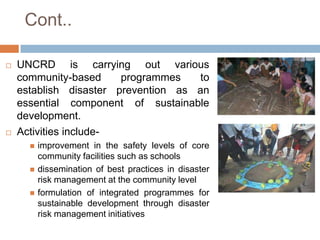
UNCRD is carrying out various
community-based
programmes
to
establish disaster prevention as an
essential component of sustainable
development.
Activities include



improvement in the safety levels of core
community facilities such as schools
dissemination of best practices in disaster
risk management at the community level
formulation of integrated programmes for
sustainable development through disaster
risk management initiatives
Why Community Based Disaster
Management?








Over the past decades, economic losses and number of
people affected by natural disasters have increased more
rapidly than both economic and population growth.
The impacts of the disasters are deeply related with the
socio economic conditions, tradition, culture, and climate of
the communities.
To minimize the damages caused by disasters, various
efforts have been taken by government, international
communities including donor agencies.
It has been observed that many of the disaster
management programmes have failed to be sustainable at
local level after the completion of the project.
Cont..




A critical element of sustainable disaster management is
communities’ participation in these activities.
The most common elements of community involvement
are partnership,




participation,
empowerment
ownership by the local people

 The

emphasis of disaster management efforts should
focus on communities and the people who live in
them.
 Unless
the disaster management efforts are
sustainable at individual and community level, it is
Cont..






Through these community–based activities, people should
be able to participate along side government officials and
experts group as the direct stakeholders of these activities.
People should own problems, consequences and
challenges of any mitigation and/or preparedness initiative,
it is necessary to take people’s involvement further, into
policy and strategy.
This process induces sense of ownership to the people
which results in their continuous engagement and long
term commitment to these activities.
Thus involvement of communities is important in both
pre-disaster mitigation and post disaster response and
recovery process.
Community Based Disaster
Management
(CBDM)




Most of the disaster response can be characterized as
command and control structure and top down approach.
Community Based Disaster Management (CBDM)
approach 


Promotes a bottom-up approach working in harmony with the top down
approach, to address the challenges and difficulties.
Local communities must be supported into analyzing their hazardous
conditions, their vulnerabilities and capacities.

People at the community level have more to lose because
they are the ones directly hit by disasters, whether major or
minor.
On the other hand, they have the most to gain if they can
reduce the impact of disasters on their community.
This concept gave rise to the idea of community-based

Community Based Disaster Management
Approach


CBDM approach provides opportunities for the local –







to evaluate their own situation based on their own experiences.
local community not only becomes part of creating plans and
decisions but also becomes a major player in its implementation.
CBDM does not ignore the importance of scientific and risk
assessment and planning.

CBDM approach acknowledges that as many
stakeholders as needed in the process, with the end
goal of achieving capacities and transferring of
resources into the community.
Case studies:






UNCRD launched a three-year project on titled
“Sustainability
in
Community
Based
Disaster
Management” in 2002.
To understand the gaps in the community initiatives, and
to take corrective actions in future.
In order to identify the key factors for successful CBDM,
six case studies were chosen in the Asian region
targeting three specific hazards:




Cyclones (India and the Philippines),
Earthquakes(Indonesia and Nepal)
Floods(Bangladesh and Cambodia)
Cont..
Followings were found as key factors for enhancing
sustainability:
 Risk assessment process involves participation of people.
 Genuine people’s participation within capacity building
specific focus on groups like women, elderly, children and
ethnic minorities.
 Well-delivered
training inputs in accordance with the
objectives of the project and the needs of the community for
training.
 Accumulation of physical, technological and economic
assets to reduce hazards and vulnerability.
 Integration of these projects into regular development
planning and budgeting to ensure sustainability
Afghan Training and livelihood
Initiative










UNCRD carried out “Afghan Training and Livelihood
Initiative (ATLI)” in Afghanistan from October 2002 to
June 2003.
Afghanistan is an earthquake prone country, and is
located in one of the most active seismic belts of the
world.
ATLI focused on developments
guidelines for
earthquake safe construction practices, training of
masons and engineers, and construction of model
houses.
These activities aimed to empower the communities with
their active participation in this process.
These
efforts
altogether
develop
human
resources, provide sustainable livelihood and are linked
Patanka New Life (PNY) Plan
After the Gujarat earthquake of Janaury 2001, PNY was
initiated as joint initiative of diverse including government,
non-government,
academics
and
international
for
community
based
effective
rehabilitation
 The aim of the initiative was-



to

train and empower local masons and communities with proper
earthquake-safer technologies focusing on local tradition and
culture.
 to ensure confidence building and long-term use of traditional
technologies.
There

were two major components of the initiative-

 construction


and rehabilitation of model village
training and confidence building of communities through
Cont..








The initiative was successful, especially in terms of
community involvement and ownership.
The initiative was considered a successful model for
sustainable community recovery.
The PNY was conceived as a model program right from
its inception stage.
It sought to empower the affected community to the
extent that they are sufficiently resilient against future
disasters.
School Earthquake Safety
Initiative






United Nations Centre for Regional Development
(UNCRD) is, currently, promoting School Earthquake
Safety Initiative through a project named“Reducing Vulnerability of School Children to
Earthquakes” jointly with UN Department of Economic
and Social Affairs (UNDESA) in Asia-Pacific region.
The project aims to make schools safe against
earthquakes and build disaster- resilient communities
through self-help, cooperation and education.
Cont..


The project includes




retrofitting of school building in a participatory way with the
involvement of local communities.
local governments and resource institutions, trainings on
safer construction practices to technicians, disaster
education in school and communities.

These activities are carried out in Fiji Islands, India,
Indonesia and Uzbekistan.
Cont..


There are three major aspects of the community
empowerment in earthquake disaster risk management
through this initiative:
 Seismic safety of school buildings


Capacity building of communities



Disaster education and awareness
Lesson Learnt












Community empowerment and communication help to
achieve sustainability in CBDM.
Community based action plans and training improves
community's problem.
Disasters are unpredictable, it is important to maintain the
projects and people's awareness of disasters.
Transparency of activities and dissemination of
knowledge
and
information
encourage
people's
participation in activities.
CBDM efforts need stable financial resources.
'What is accepted by the community' is more important
than 'what is necessary'.
Institutionalizing the community and the private

Community based disaster management

  • 1.
  • 2.
    Introduction   Sustainable development anddisaster reduction are essential preconditions for each other. Reason hamper the progress and achievements of sustainable development.  physical infrastructure we are constructing itself constitute a source of risk in the event of future disasters.  For instance- in the case of earthquakes, where majority of victims are killed by their own collapsing houses.
  • 3.
    Cont..     From the perspectivesof environmental degradation, human intervention and security aspects, disaster management is a pressing issue. The approach seeks communities at risk get engaged in all of its phases: prevention, mitigation, preparedness, response and recovery. In order to build disaster-resilient communities, they first need to be empowered so that community members can cope with the adverse effects of natural hazards. This is the approach to achieving sustainability in dealing with natural disaster risks.
  • 4.
    Cont..   UNCRD is carryingout various community-based programmes to establish disaster prevention as an essential component of sustainable development. Activities include   improvement in the safety levels of core community facilities such as schools dissemination of best practices in disaster risk management at the community level formulation of integrated programmes for sustainable development through disaster risk management initiatives
  • 5.
    Why Community BasedDisaster Management?     Over the past decades, economic losses and number of people affected by natural disasters have increased more rapidly than both economic and population growth. The impacts of the disasters are deeply related with the socio economic conditions, tradition, culture, and climate of the communities. To minimize the damages caused by disasters, various efforts have been taken by government, international communities including donor agencies. It has been observed that many of the disaster management programmes have failed to be sustainable at local level after the completion of the project.
  • 6.
    Cont..   A critical elementof sustainable disaster management is communities’ participation in these activities. The most common elements of community involvement are partnership,    participation, empowerment ownership by the local people  The emphasis of disaster management efforts should focus on communities and the people who live in them.  Unless the disaster management efforts are sustainable at individual and community level, it is
  • 7.
    Cont..    Through these community–basedactivities, people should be able to participate along side government officials and experts group as the direct stakeholders of these activities. People should own problems, consequences and challenges of any mitigation and/or preparedness initiative, it is necessary to take people’s involvement further, into policy and strategy. This process induces sense of ownership to the people which results in their continuous engagement and long term commitment to these activities. Thus involvement of communities is important in both pre-disaster mitigation and post disaster response and recovery process.
  • 8.
    Community Based Disaster Management (CBDM)   Mostof the disaster response can be characterized as command and control structure and top down approach. Community Based Disaster Management (CBDM) approach   Promotes a bottom-up approach working in harmony with the top down approach, to address the challenges and difficulties. Local communities must be supported into analyzing their hazardous conditions, their vulnerabilities and capacities. People at the community level have more to lose because they are the ones directly hit by disasters, whether major or minor. On the other hand, they have the most to gain if they can reduce the impact of disasters on their community. This concept gave rise to the idea of community-based 
  • 9.
    Community Based DisasterManagement Approach  CBDM approach provides opportunities for the local –     to evaluate their own situation based on their own experiences. local community not only becomes part of creating plans and decisions but also becomes a major player in its implementation. CBDM does not ignore the importance of scientific and risk assessment and planning. CBDM approach acknowledges that as many stakeholders as needed in the process, with the end goal of achieving capacities and transferring of resources into the community.
  • 10.
    Case studies:    UNCRD launcheda three-year project on titled “Sustainability in Community Based Disaster Management” in 2002. To understand the gaps in the community initiatives, and to take corrective actions in future. In order to identify the key factors for successful CBDM, six case studies were chosen in the Asian region targeting three specific hazards:    Cyclones (India and the Philippines), Earthquakes(Indonesia and Nepal) Floods(Bangladesh and Cambodia)
  • 11.
    Cont.. Followings were foundas key factors for enhancing sustainability:  Risk assessment process involves participation of people.  Genuine people’s participation within capacity building specific focus on groups like women, elderly, children and ethnic minorities.  Well-delivered training inputs in accordance with the objectives of the project and the needs of the community for training.  Accumulation of physical, technological and economic assets to reduce hazards and vulnerability.  Integration of these projects into regular development planning and budgeting to ensure sustainability
  • 12.
    Afghan Training andlivelihood Initiative      UNCRD carried out “Afghan Training and Livelihood Initiative (ATLI)” in Afghanistan from October 2002 to June 2003. Afghanistan is an earthquake prone country, and is located in one of the most active seismic belts of the world. ATLI focused on developments guidelines for earthquake safe construction practices, training of masons and engineers, and construction of model houses. These activities aimed to empower the communities with their active participation in this process. These efforts altogether develop human resources, provide sustainable livelihood and are linked
  • 13.
    Patanka New Life(PNY) Plan After the Gujarat earthquake of Janaury 2001, PNY was initiated as joint initiative of diverse including government, non-government, academics and international for community based effective rehabilitation  The aim of the initiative was-  to train and empower local masons and communities with proper earthquake-safer technologies focusing on local tradition and culture.  to ensure confidence building and long-term use of traditional technologies. There were two major components of the initiative-  construction  and rehabilitation of model village training and confidence building of communities through
  • 14.
    Cont..     The initiative wassuccessful, especially in terms of community involvement and ownership. The initiative was considered a successful model for sustainable community recovery. The PNY was conceived as a model program right from its inception stage. It sought to empower the affected community to the extent that they are sufficiently resilient against future disasters.
  • 15.
    School Earthquake Safety Initiative    UnitedNations Centre for Regional Development (UNCRD) is, currently, promoting School Earthquake Safety Initiative through a project named“Reducing Vulnerability of School Children to Earthquakes” jointly with UN Department of Economic and Social Affairs (UNDESA) in Asia-Pacific region. The project aims to make schools safe against earthquakes and build disaster- resilient communities through self-help, cooperation and education.
  • 16.
    Cont..  The project includes   retrofittingof school building in a participatory way with the involvement of local communities. local governments and resource institutions, trainings on safer construction practices to technicians, disaster education in school and communities. These activities are carried out in Fiji Islands, India, Indonesia and Uzbekistan.
  • 17.
    Cont..  There are threemajor aspects of the community empowerment in earthquake disaster risk management through this initiative:  Seismic safety of school buildings  Capacity building of communities  Disaster education and awareness
  • 18.
    Lesson Learnt       Community empowermentand communication help to achieve sustainability in CBDM. Community based action plans and training improves community's problem. Disasters are unpredictable, it is important to maintain the projects and people's awareness of disasters. Transparency of activities and dissemination of knowledge and information encourage people's participation in activities. CBDM efforts need stable financial resources. 'What is accepted by the community' is more important than 'what is necessary'. Institutionalizing the community and the private