CONCEPT OF
DISASTER RISK
MANAGEMENT

BY:
MOLVAREEN LANGSTIEH
ASSISTANT PROFESSOR,
DISASTER MANAGEMENT CENTRE, MATI.
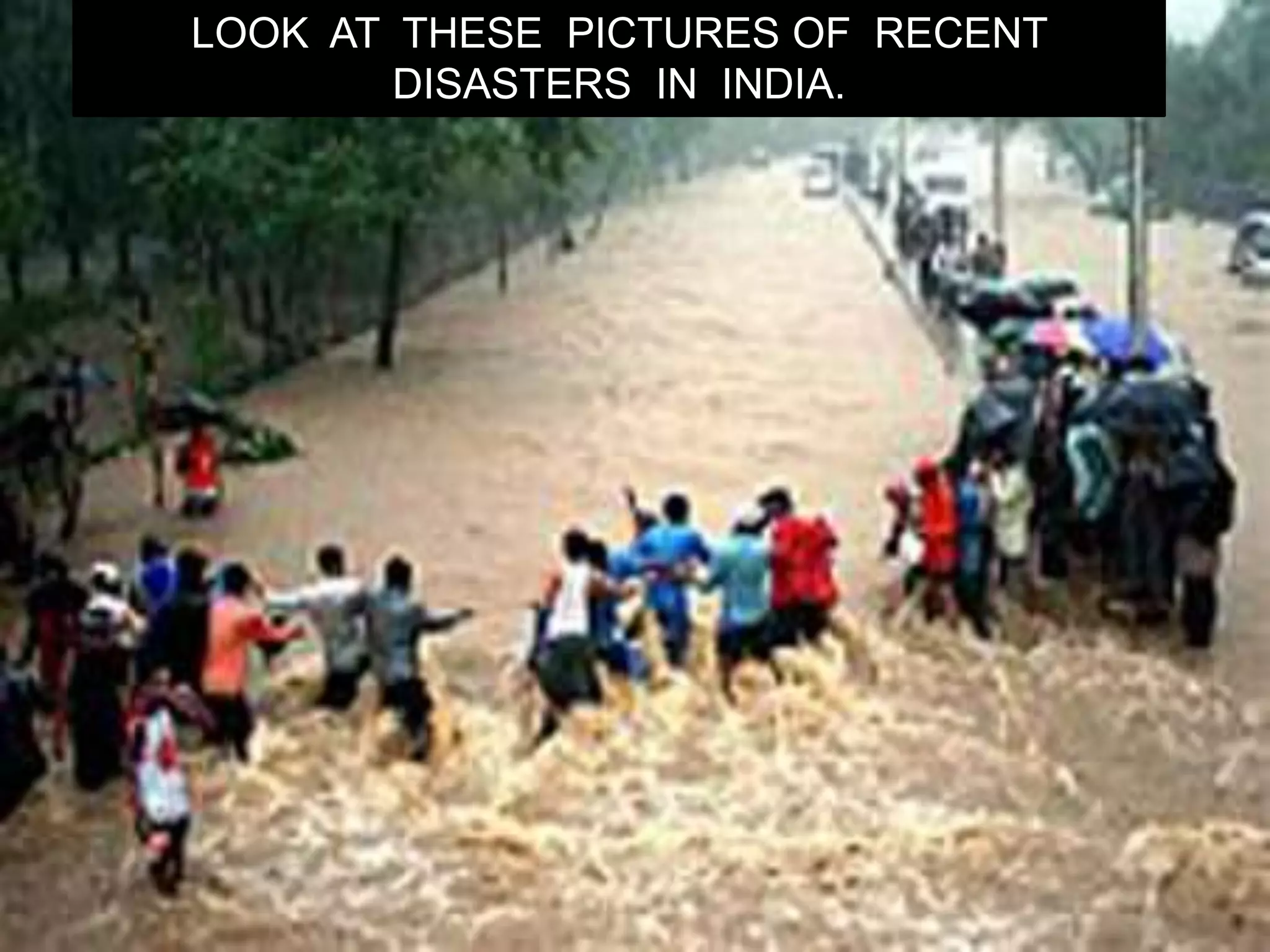
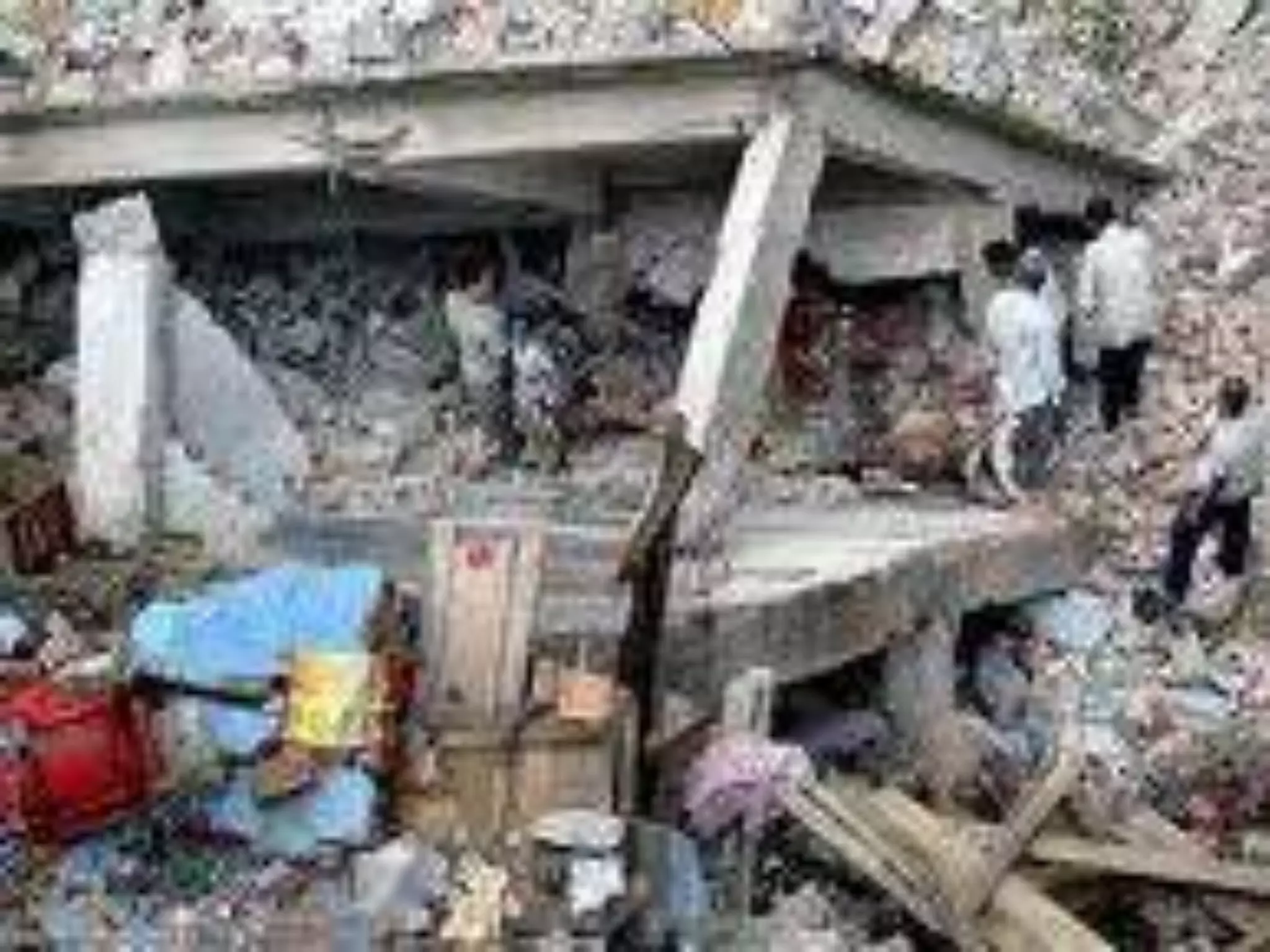
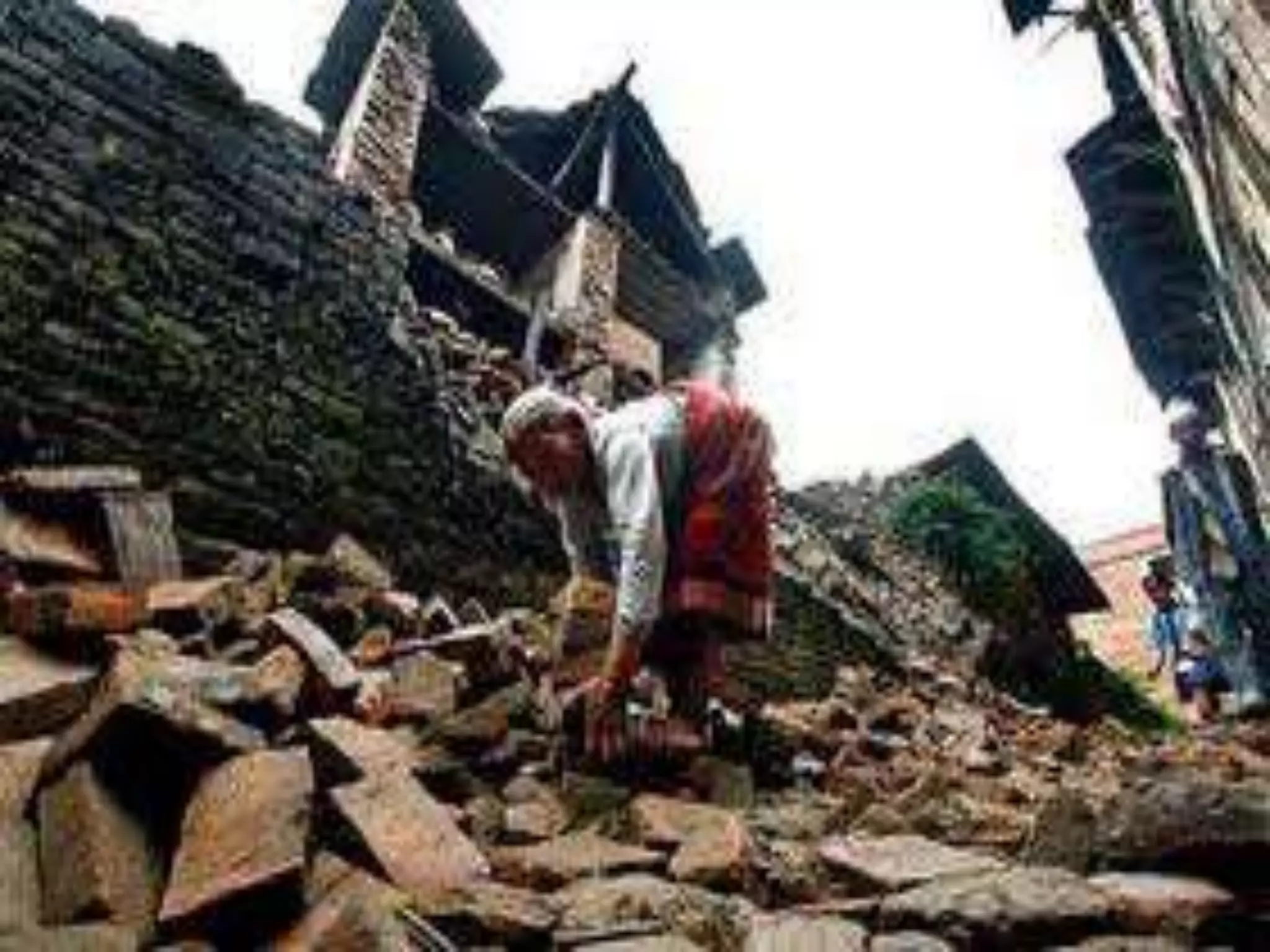
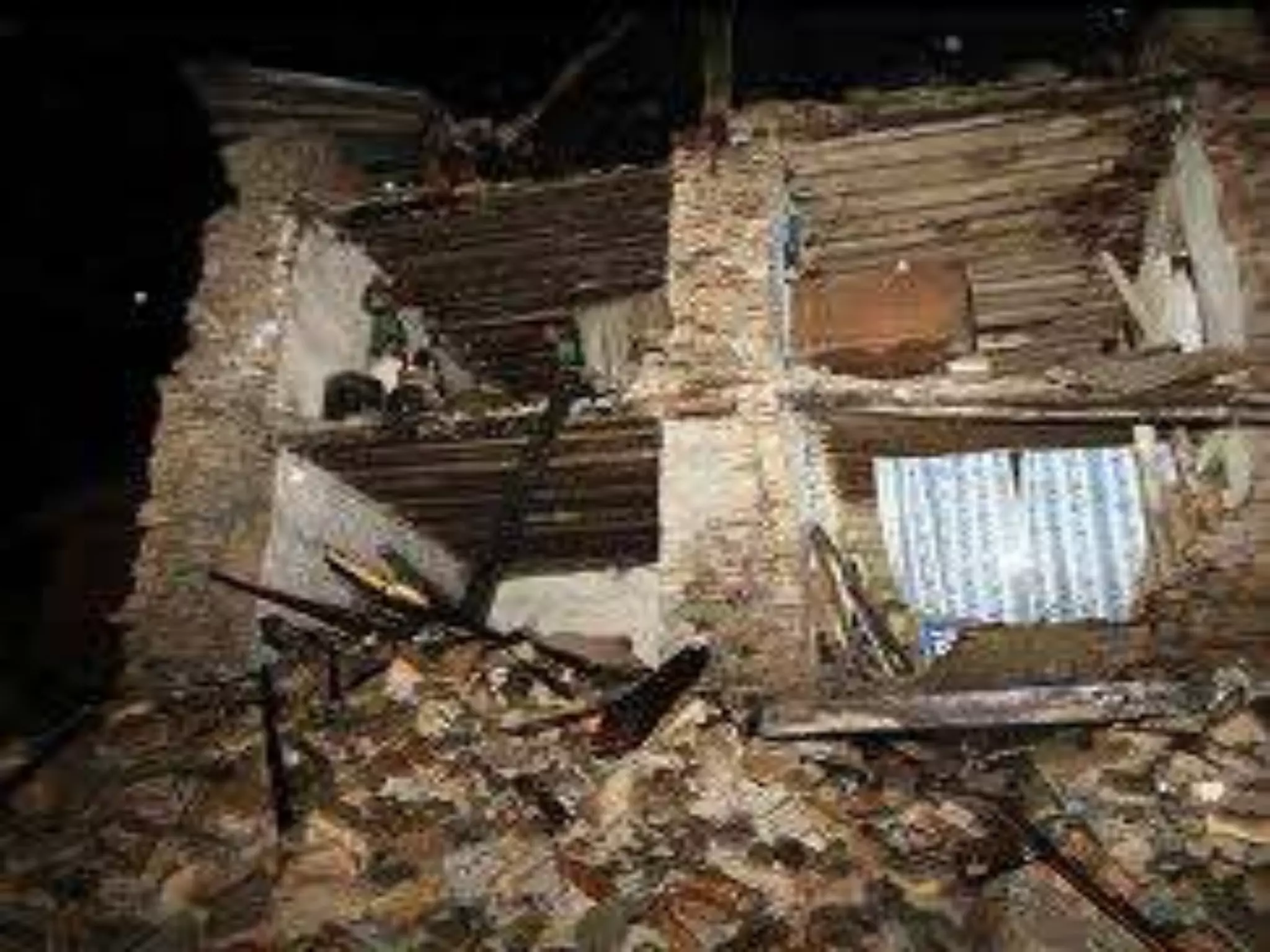
LOOK AT THESE PICTURES OF RECENT
DISASTERS IN INDIA.
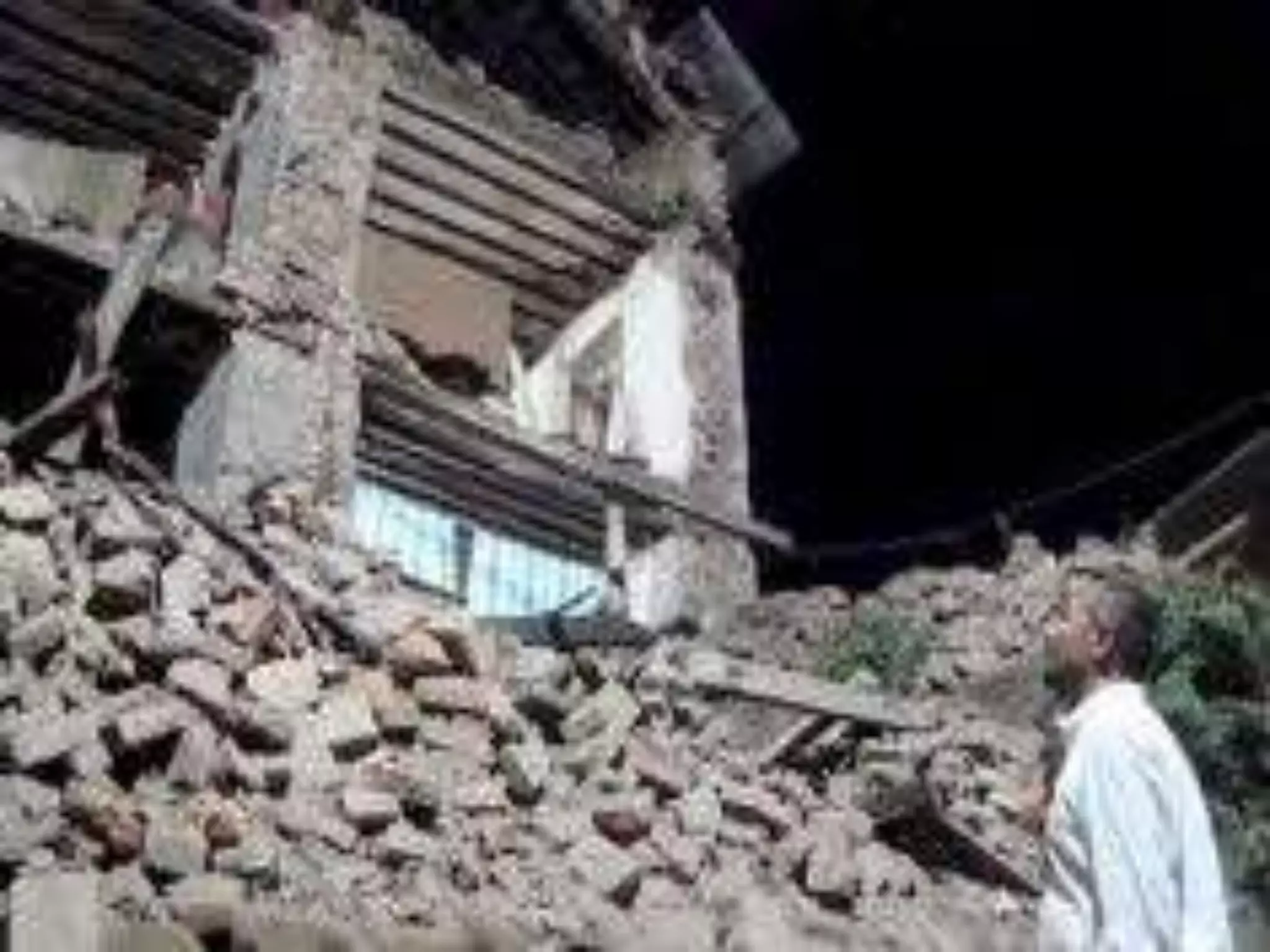
19TH SEPTEMBER 2011:
50 DEAD IN EARTHQUAKE IN SIKKIM AND NORTH EAST

3
WHERE
DO
WE
STAND?
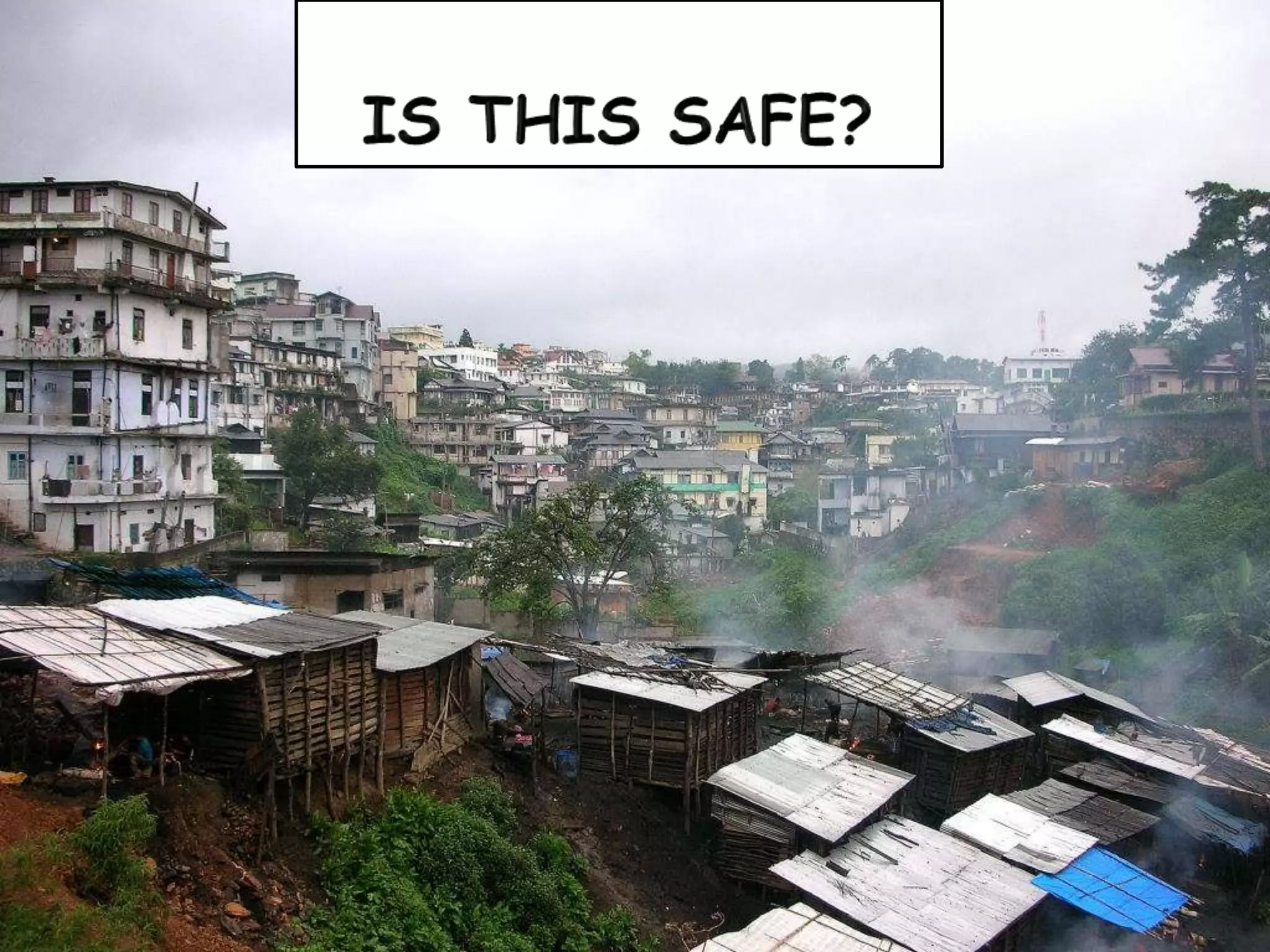
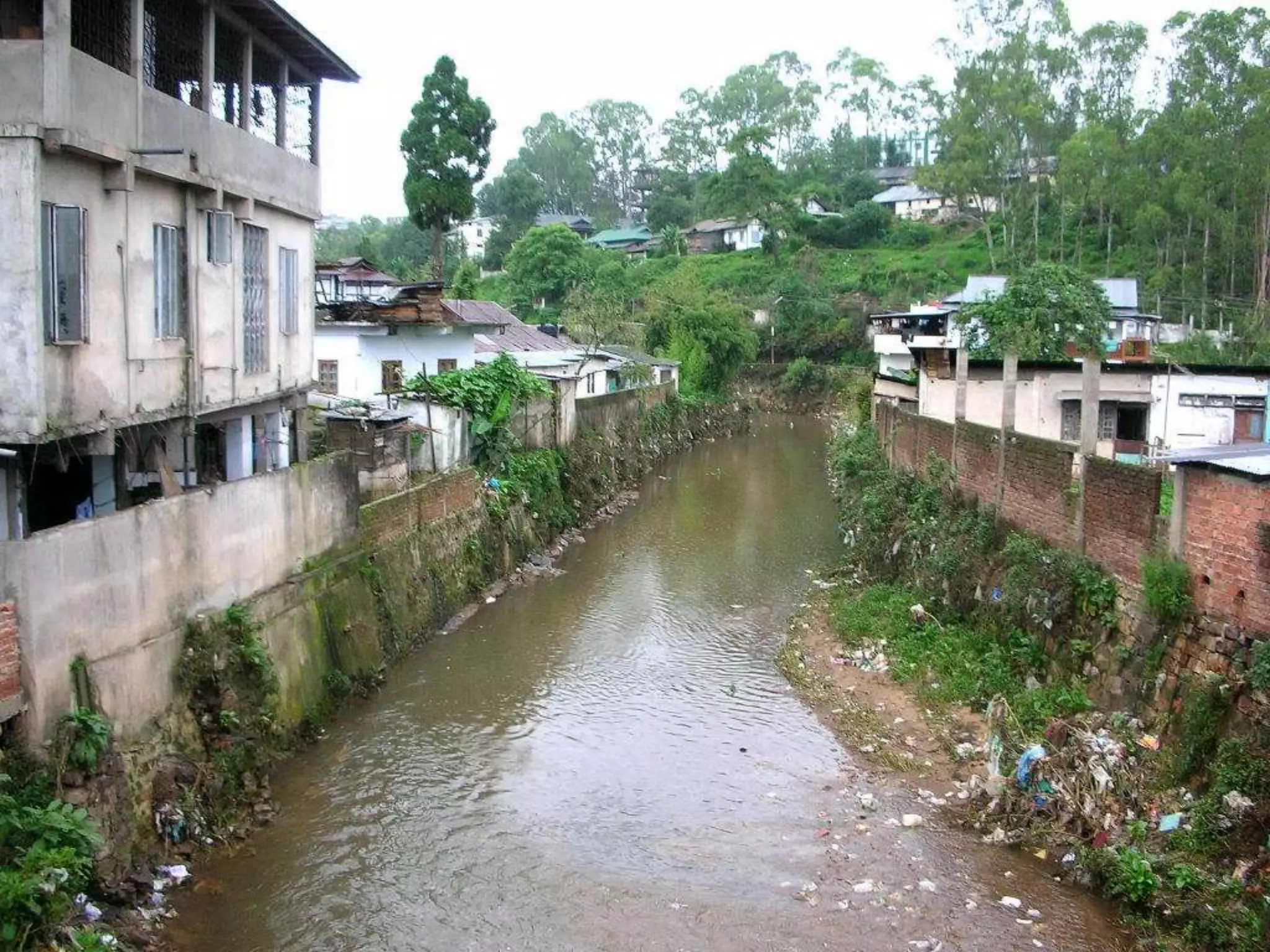
LOOK AT WHERE WE STAND:
WE ARE FACING IMPENDING
DISASTERS.....

WE ARE THEREFORE UNDER RISK
OF DISASTERS

WHAT IS DISASTER RISK?
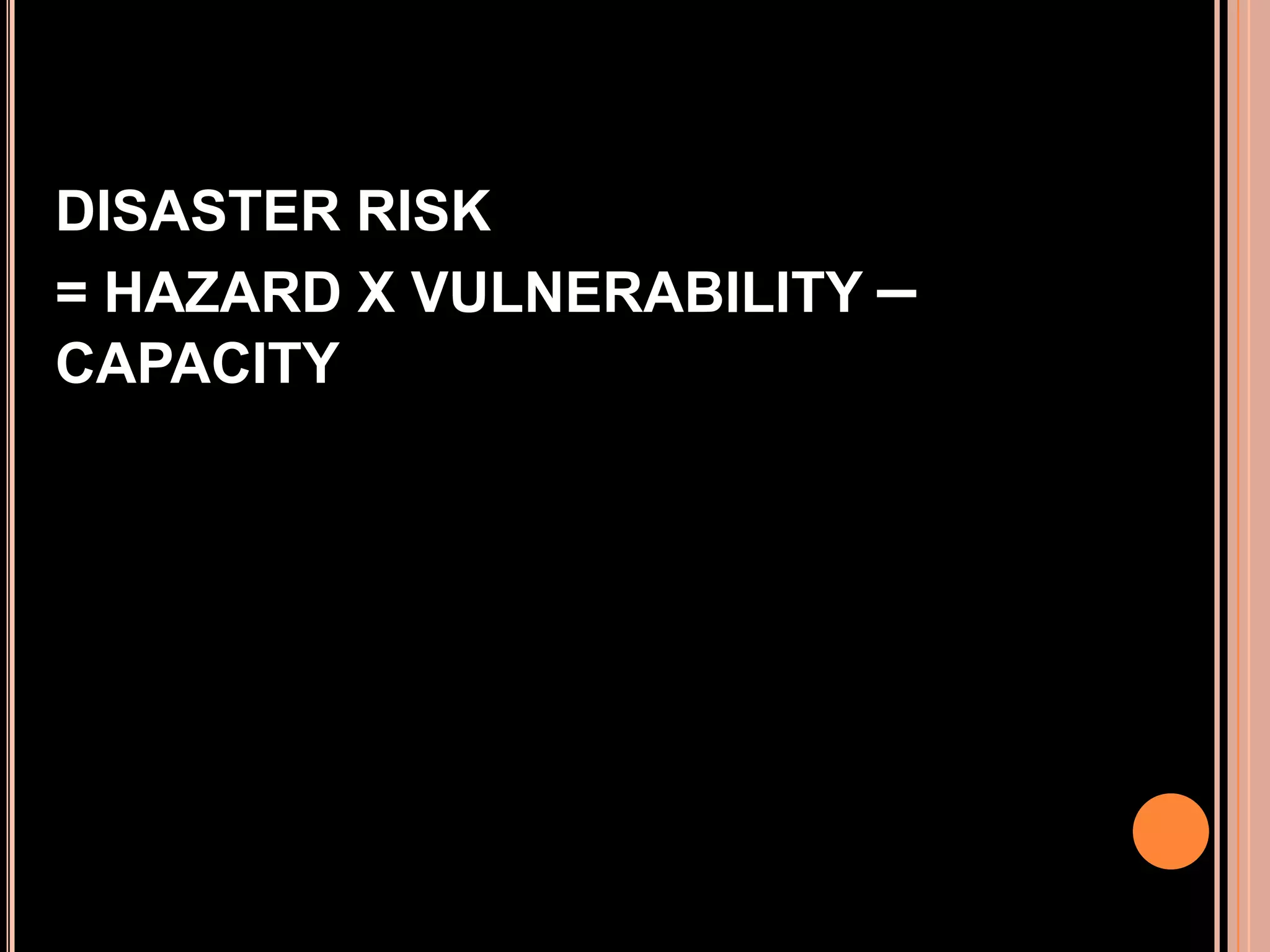
DISASTER RISK
= HAZARD X VULNERABILITY –
CAPACITY
A

serious disruption of the functioning of a
society, causing widespread human, material,
or environmental losses which exceed the
ability of the affected society to cope using its
own resources (Definition by the UN)
“A Catastrophe, mishap, calamity or grave
occurrence in any area arising from natural or
man made causes, or by accidents or
negligence which result in substantial loss of
life or human suffering or damage to, and
destruction of property, or damage to, or
degradation of, environment, and is of such a
nature magnitude as to be beyond the coping
capacity of the community of the affected
area.” (DM Act, 2005)

:




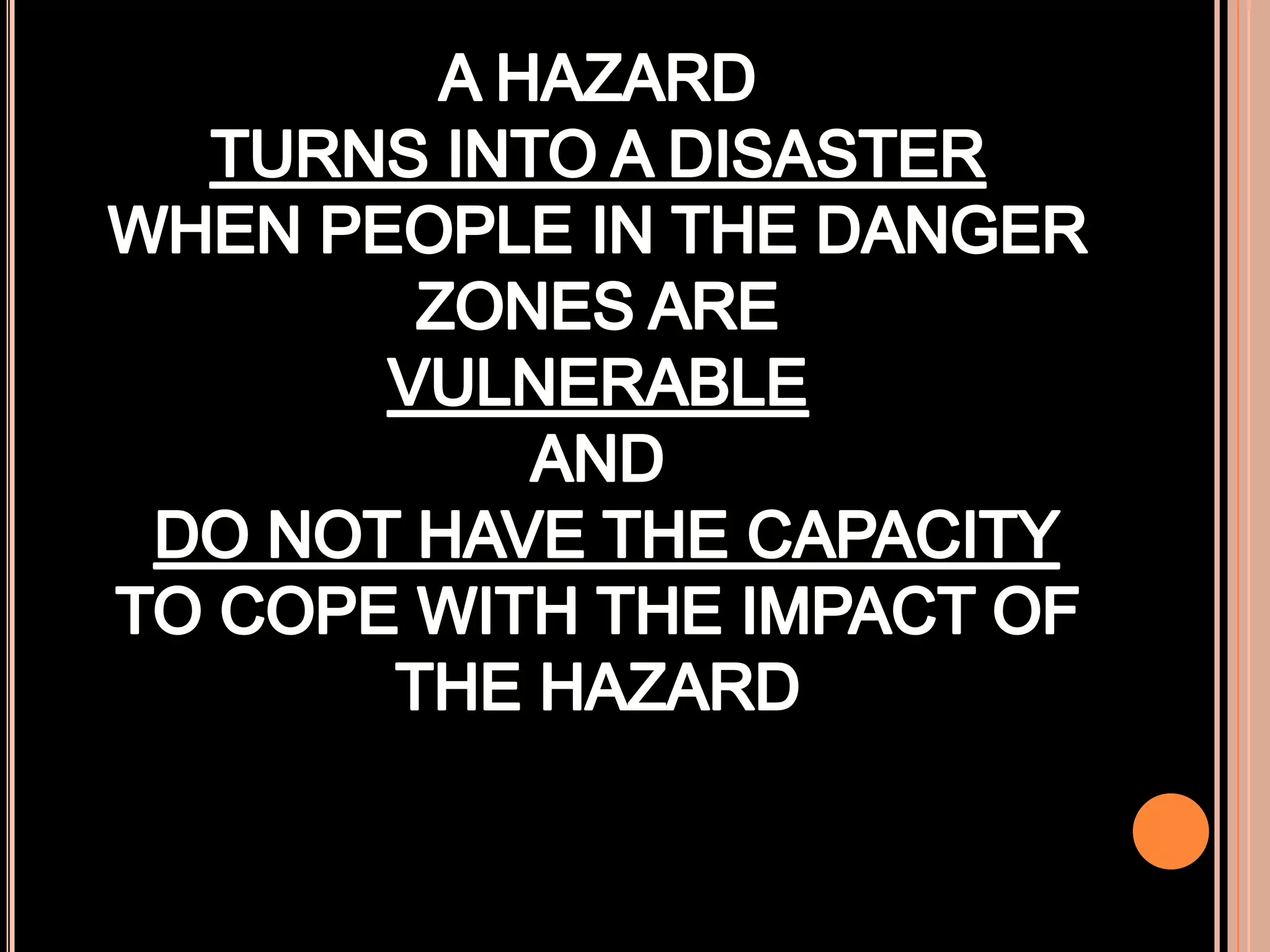
LET US THINK OF SOME EXAMPLES OF
DISASTERS...



CAN WE CALL AN EARTHQUAKE AS A
DISASTER?



WHAT IF A BIG EARTHQUAKE OCCURS IN AN
ISOLATED AREA?
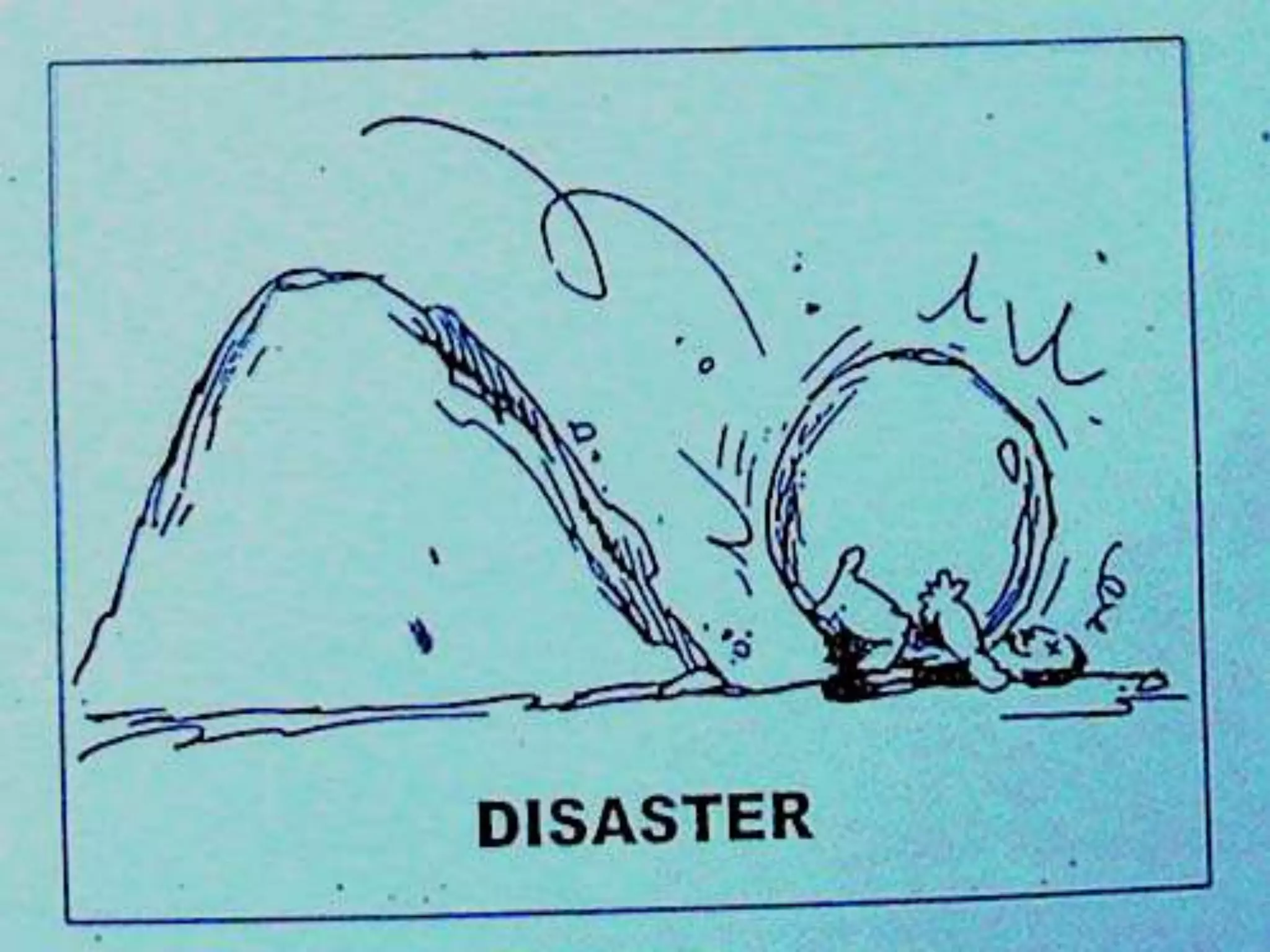
A

DISASTER IS A
PRODUCT OF A
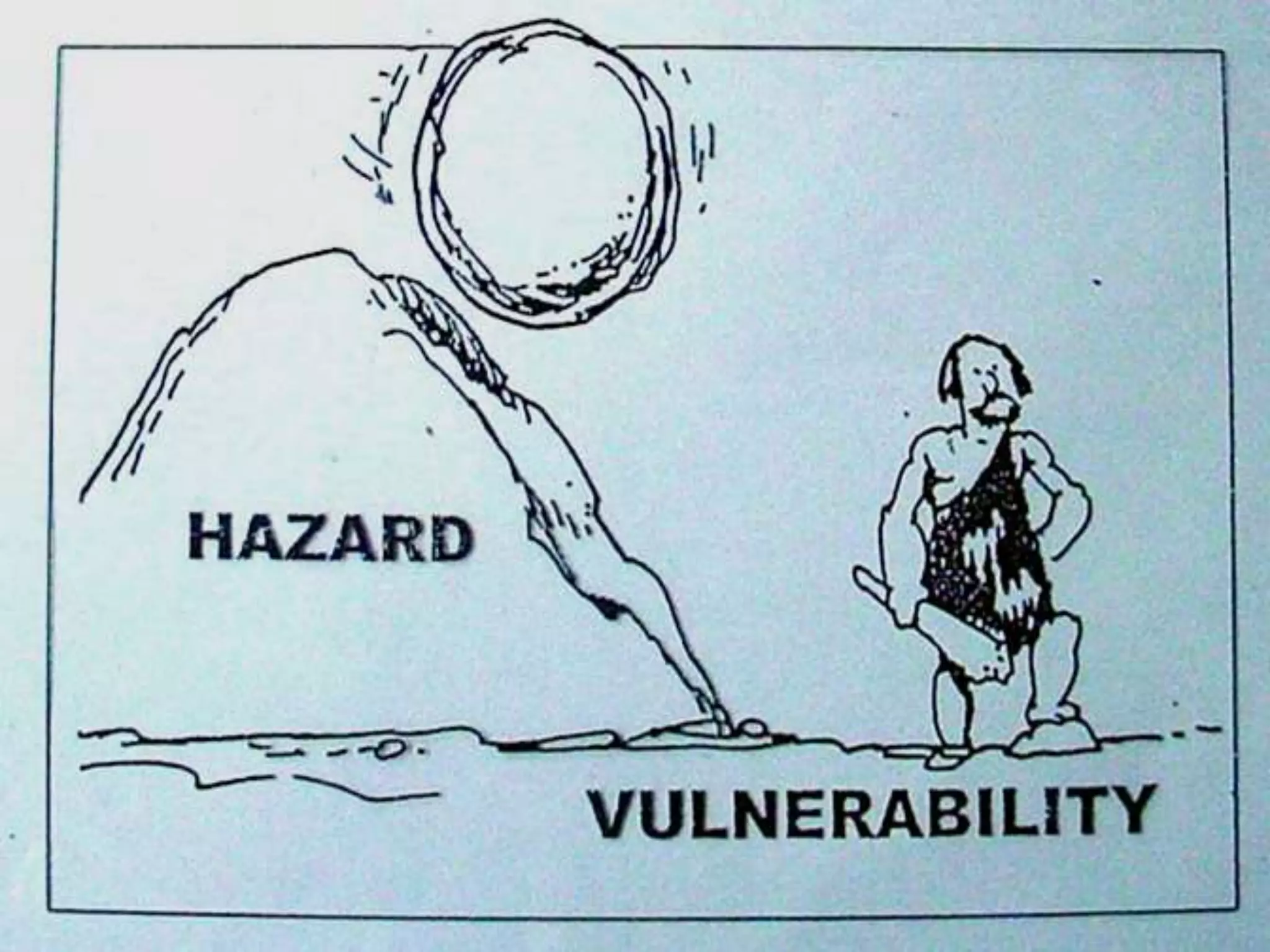
HAZARD
A dangerous condition or event or
occurrence that threatens or have the
potential to cause disruption / damage /
injury to life , infrastructure and
services, property and environment.
Example: Earthquake, landslide, cyclone,
floods,
volcanic eruptions, war etc.
Magnitude of the phenomenon,
probability of occurrence, the extent
and severity of impact may vary.
The extent to which a community can
be affected by the impact of a
certain hazard.
 Conditions like Ignorance, poverty,
lack of information, inadequacy etc
adds to the severity of a Disaster.
(Physical & Socio-Economic
Vulnerability)

 vulnerable conditions can turn
a situation into a risk or possibility of
Disaster in any area.
THOSE RESOURCES AND STRENGTHS
WHICH EXISTS IN HOUSEHOLDS AND
COMMUNITIES ENABLING THEM TO COPE
WITH, WITHSTAND, PREPARE FOR,
MITIGATE OR QUICKLY RECOVER FROM A
DISASTER
THOSE RESOURCES AND STRENGTHS
WHICH EXISTS IN HOUSEHOLDS
AND COMMUNITIES ENABLING THEM
TO COPE WITH, WITHSTAND ,
PREPARE FOR, MITIGATE OR
QUICKLY RECOVER FROM A DISASTER
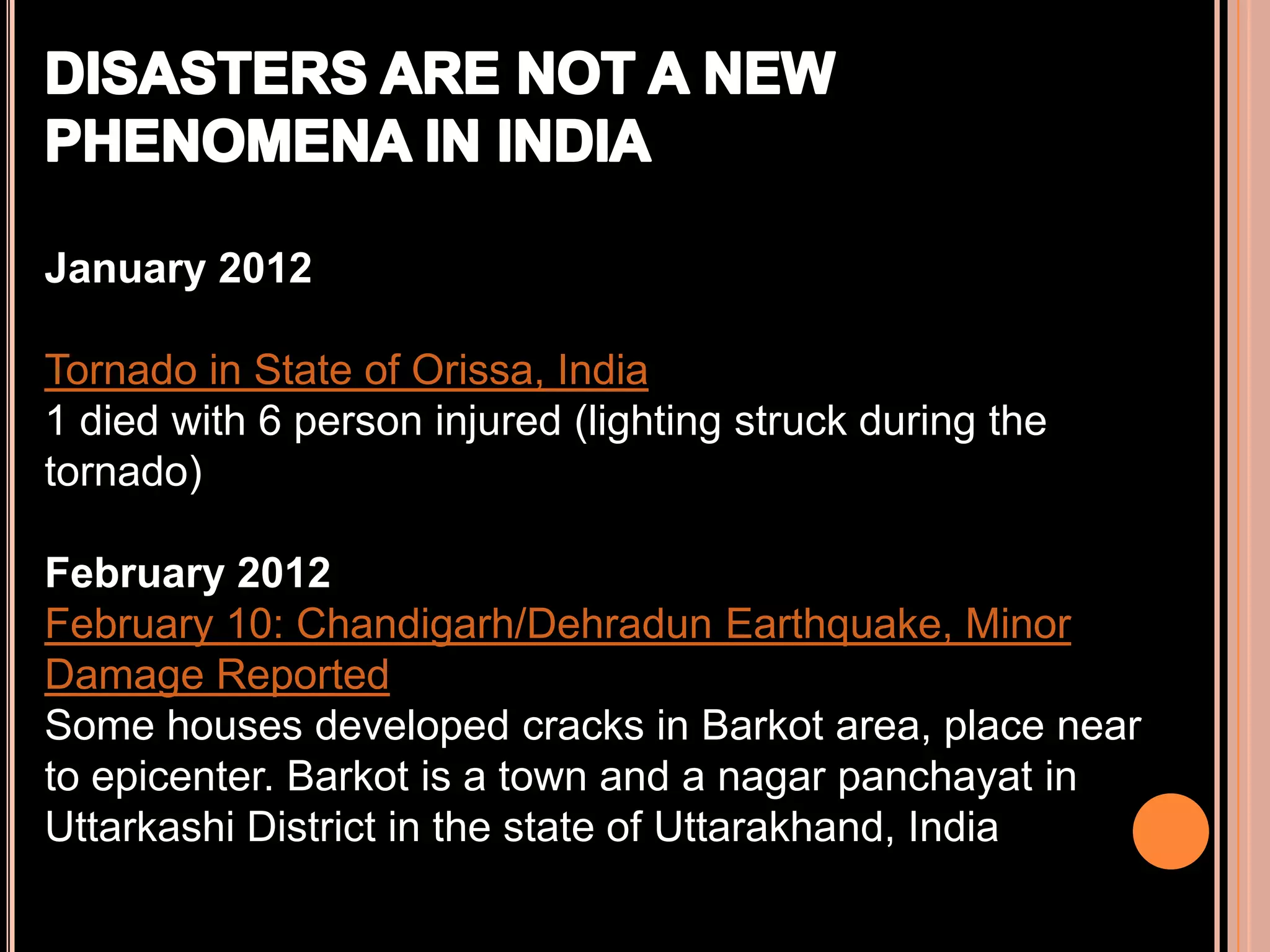
January 2012
Tornado in State of Orissa, India
1 died with 6 person injured (lighting struck during the
tornado)
February 2012
February 10: Chandigarh/Dehradun Earthquake, Minor
Damage Reported
Some houses developed cracks in Barkot area, place near
to epicenter. Barkot is a town and a nagar panchayat in
Uttarkashi District in the state of Uttarakhand, India
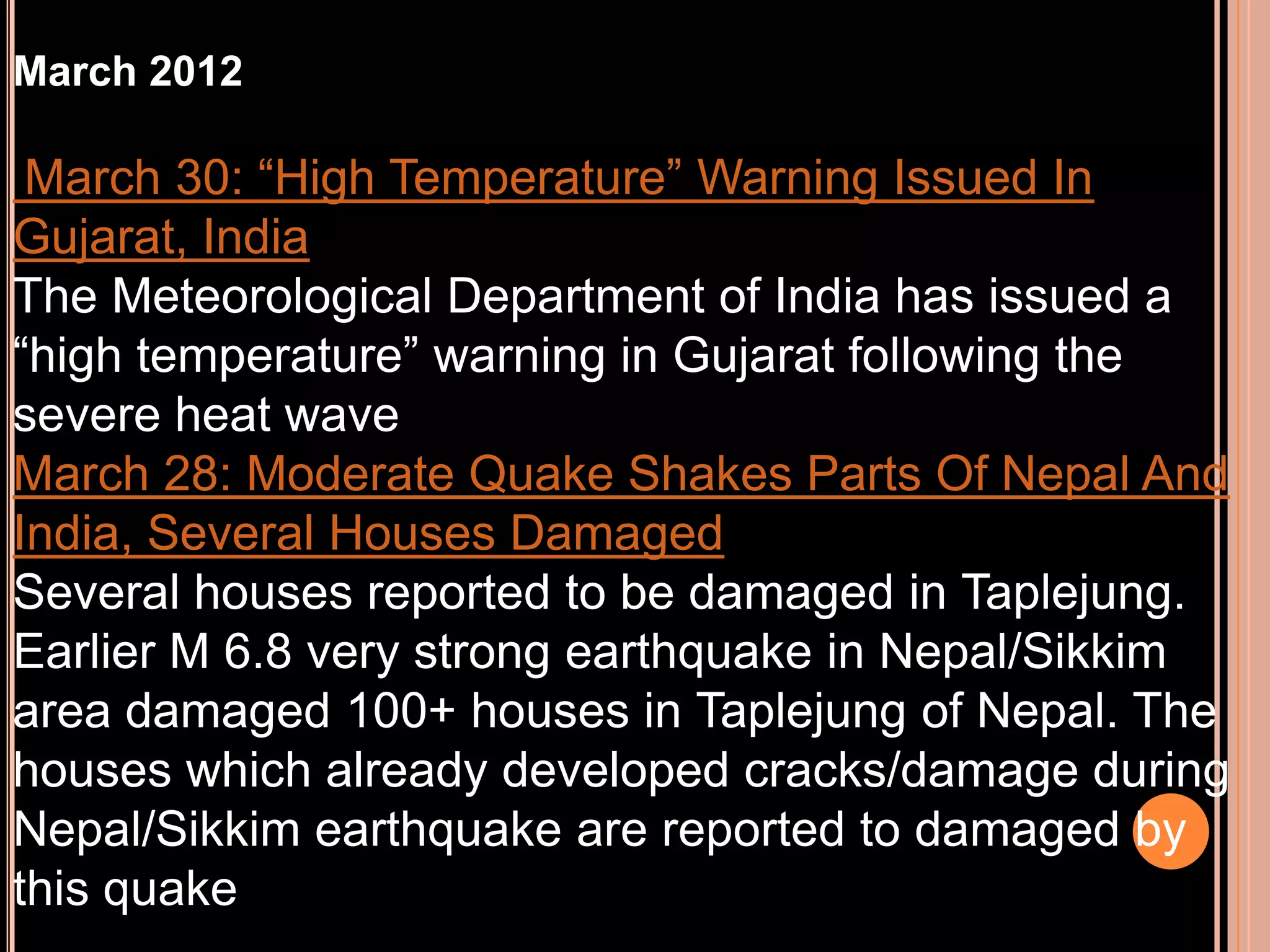
March 2012

March 30: “High Temperature” Warning Issued In
Gujarat, India
The Meteorological Department of India has issued a
“high temperature” warning in Gujarat following the
severe heat wave
March 28: Moderate Quake Shakes Parts Of Nepal And
India, Several Houses Damaged
Several houses reported to be damaged in Taplejung.
Earlier M 6.8 very strong earthquake in Nepal/Sikkim
area damaged 100+ houses in Taplejung of Nepal. The
houses which already developed cracks/damage during
Nepal/Sikkim earthquake are reported to damaged by
this quake
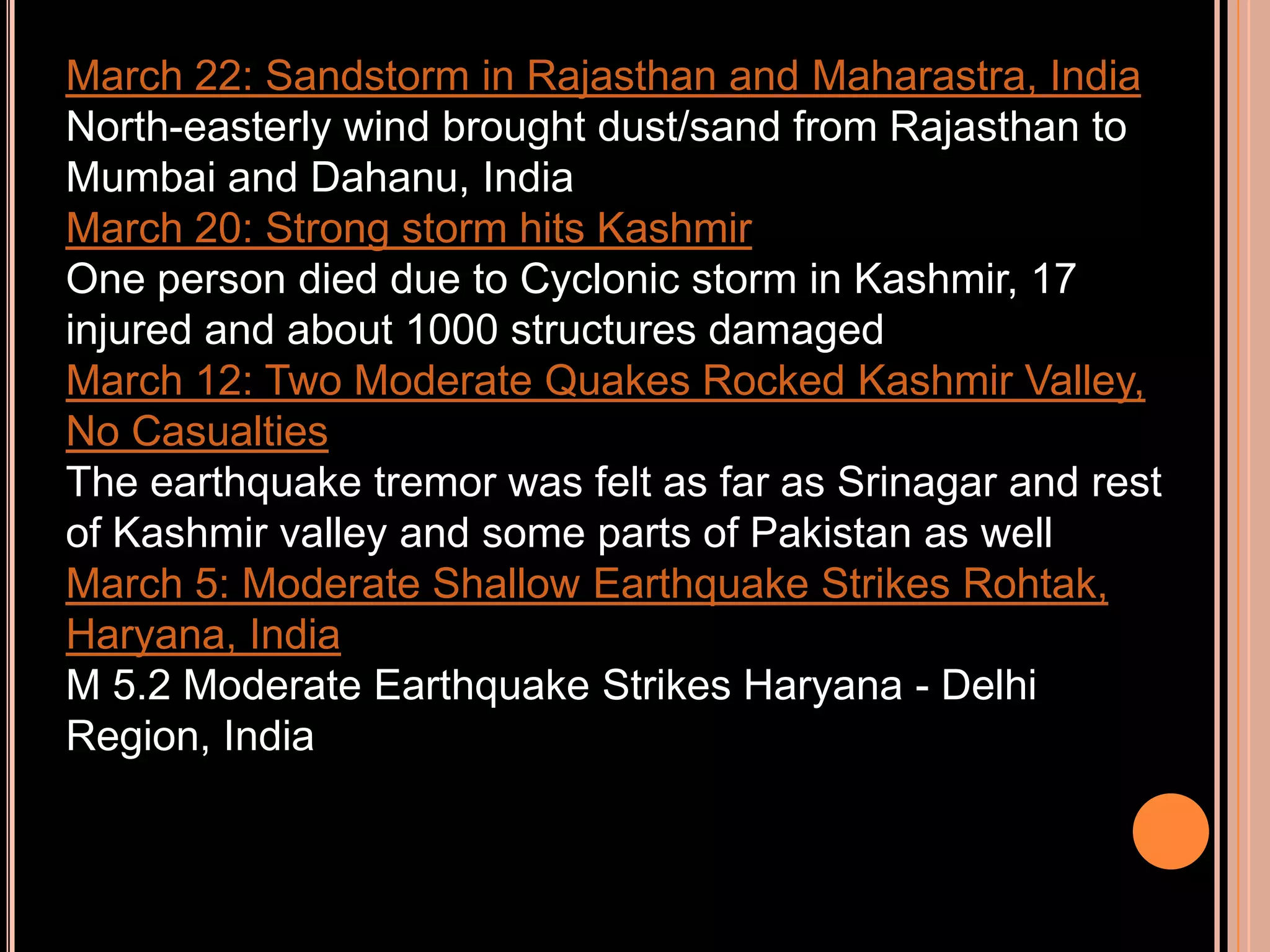
March 22: Sandstorm in Rajasthan and Maharastra, India
North-easterly wind brought dust/sand from Rajasthan to
Mumbai and Dahanu, India
March 20: Strong storm hits Kashmir
One person died due to Cyclonic storm in Kashmir, 17
injured and about 1000 structures damaged
March 12: Two Moderate Quakes Rocked Kashmir Valley,
No Casualties
The earthquake tremor was felt as far as Srinagar and rest
of Kashmir valley and some parts of Pakistan as well
March 5: Moderate Shallow Earthquake Strikes Rohtak,
Haryana, India
M 5.2 Moderate Earthquake Strikes Haryana - Delhi
Region, India
April 2012
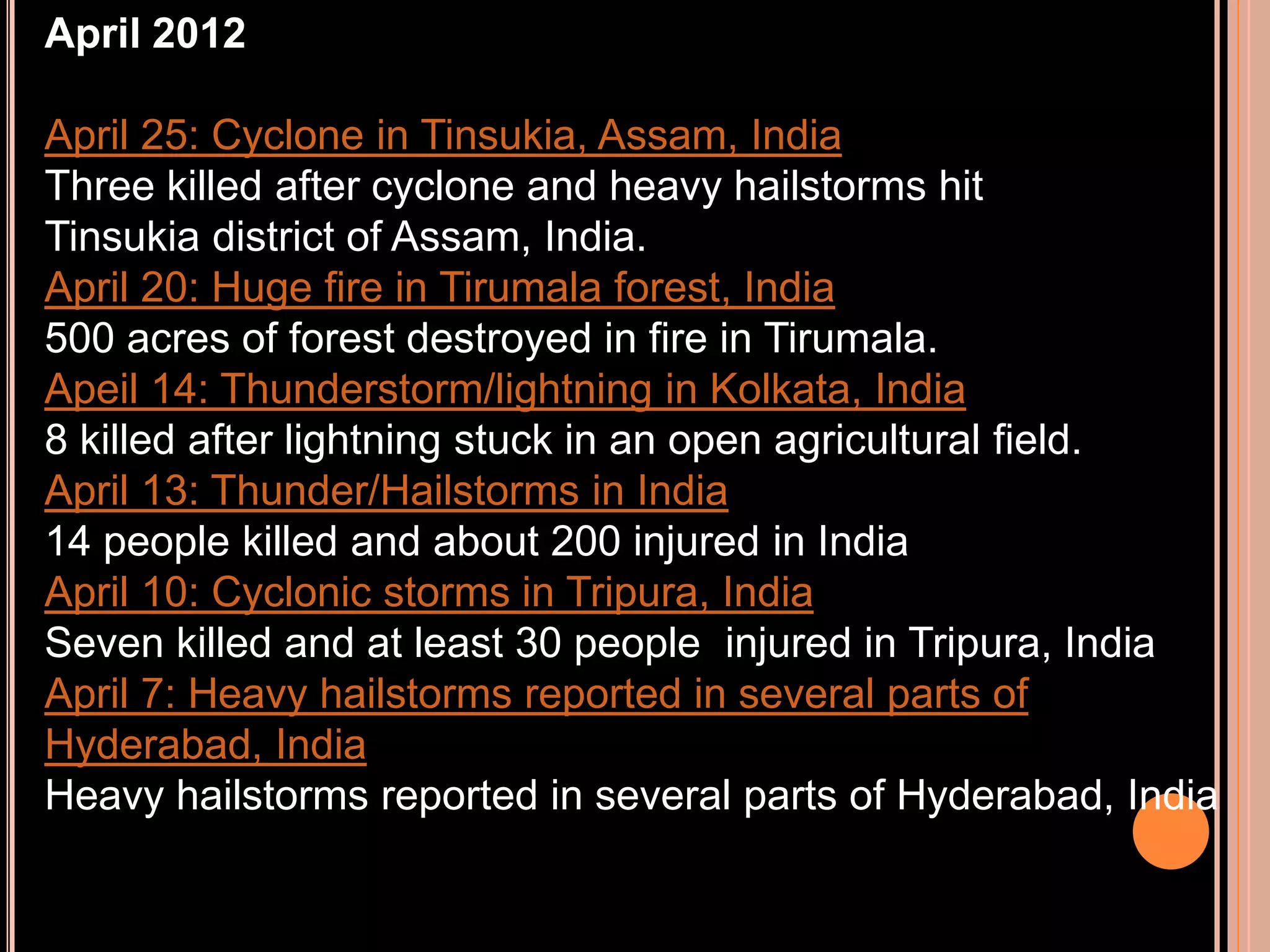
April 25: Cyclone in Tinsukia, Assam, India
Three killed after cyclone and heavy hailstorms hit
Tinsukia district of Assam, India.
April 20: Huge fire in Tirumala forest, India
500 acres of forest destroyed in fire in Tirumala.
Apeil 14: Thunderstorm/lightning in Kolkata, India
8 killed after lightning stuck in an open agricultural field.
April 13: Thunder/Hailstorms in India
14 people killed and about 200 injured in India
April 10: Cyclonic storms in Tripura, India
Seven killed and at least 30 people injured in Tripura, India
April 7: Heavy hailstorms reported in several parts of
Hyderabad, India
Heavy hailstorms reported in several parts of Hyderabad, India
May 2012
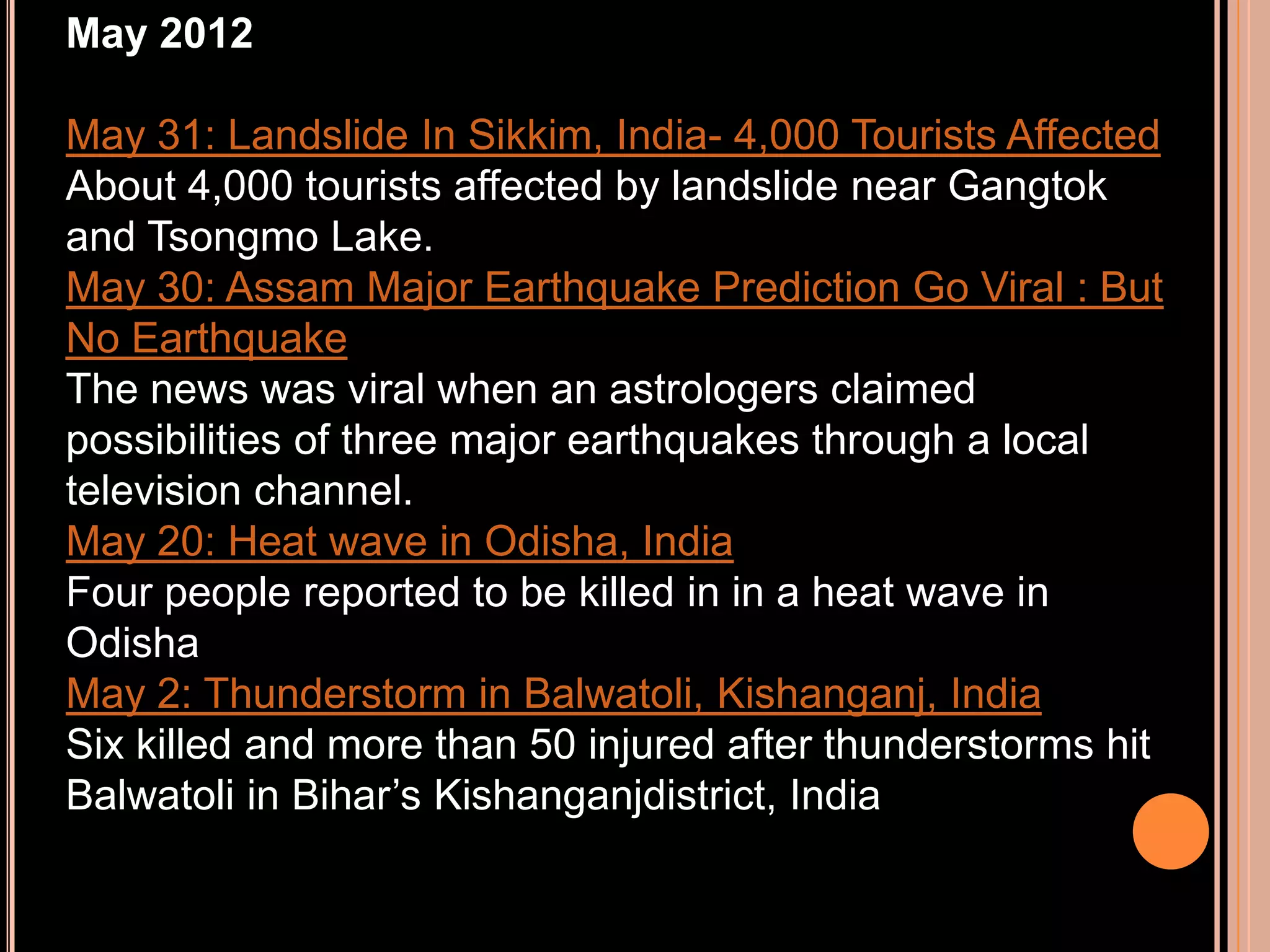
May 31: Landslide In Sikkim, India- 4,000 Tourists Affected
About 4,000 tourists affected by landslide near Gangtok
and Tsongmo Lake.
May 30: Assam Major Earthquake Prediction Go Viral : But
No Earthquake
The news was viral when an astrologers claimed
possibilities of three major earthquakes through a local
television channel.
May 20: Heat wave in Odisha, India
Four people reported to be killed in in a heat wave in
Odisha
May 2: Thunderstorm in Balwatoli, Kishanganj, India
Six killed and more than 50 injured after thunderstorms hit
Balwatoli in Bihar’s Kishanganjdistrict, India
June 2012
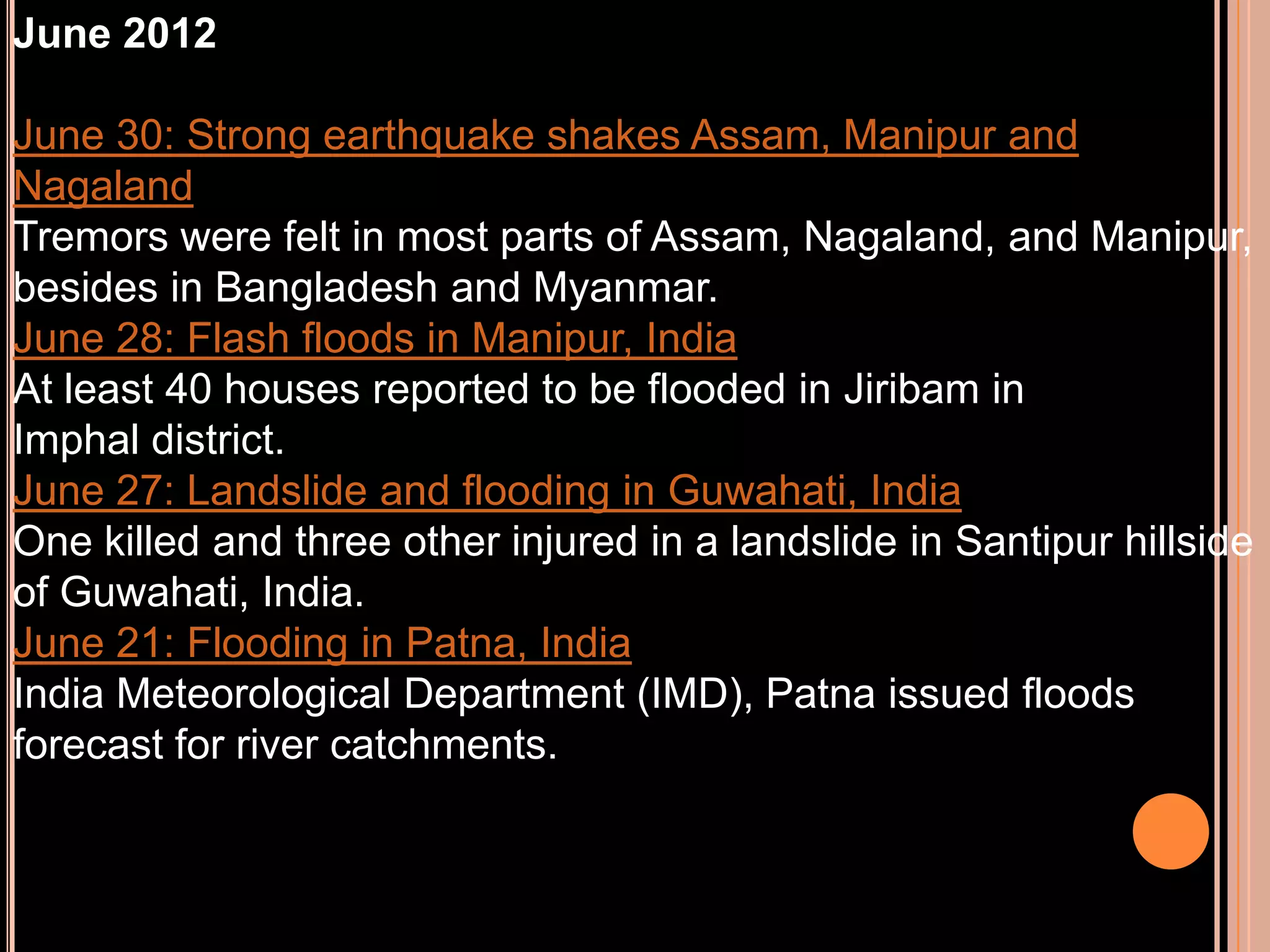
June 30: Strong earthquake shakes Assam, Manipur and
Nagaland
Tremors were felt in most parts of Assam, Nagaland, and Manipur,
besides in Bangladesh and Myanmar.
June 28: Flash floods in Manipur, India
At least 40 houses reported to be flooded in Jiribam in
Imphal district.
June 27: Landslide and flooding in Guwahati, India
One killed and three other injured in a landslide in Santipur hillside
of Guwahati, India.
June 21: Flooding in Patna, India
India Meteorological Department (IMD), Patna issued floods
forecast for river catchments.
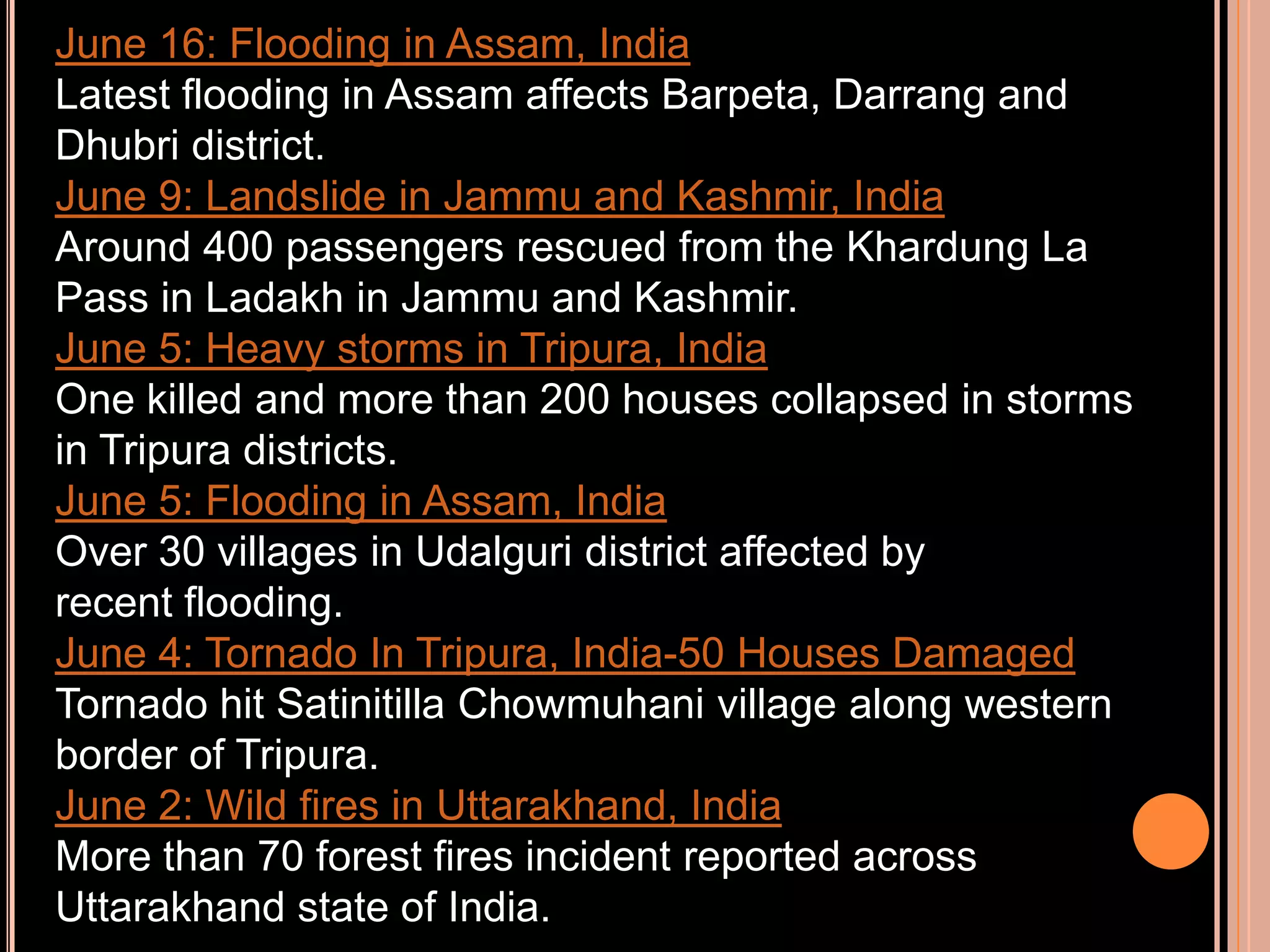
June 16: Flooding in Assam, India
Latest flooding in Assam affects Barpeta, Darrang and
Dhubri district.
June 9: Landslide in Jammu and Kashmir, India
Around 400 passengers rescued from the Khardung La
Pass in Ladakh in Jammu and Kashmir.
June 5: Heavy storms in Tripura, India
One killed and more than 200 houses collapsed in storms
in Tripura districts.
June 5: Flooding in Assam, India
Over 30 villages in Udalguri district affected by
recent flooding.
June 4: Tornado In Tripura, India-50 Houses Damaged
Tornado hit Satinitilla Chowmuhani village along western
border of Tripura.
June 2: Wild fires in Uttarakhand, India
More than 70 forest fires incident reported across
Uttarakhand state of India.
July 2012
July 21: Flooding in Hyderabad, India
Nine people reported to be killed in recent Hyderabad
floods.
July 19: Flooding in Malda, India
Three people reported to be killed in Malda flood.
July 17: Flooding in North Bengal, India
More than 2,000 people displaced after flash floods hit
North Bengal of India. One person is reported to be
missing in Magurmari.
July 5: Landslides in Chamoli, India
One killed and 15 other injured in a landslide in
Rishikesh-Badrinath National Highway in
Chamoli district of India.
July 4: Lightning in Mumbai, India
Lightning struck Mumbai-bound Boeing 737 carrying 99
passengers.
August 2012
August 20: Landslides in Himachal Pradesh, India
Hundreds of tourists remained stranded in the tribal Kaza area as
landslides blocked the roads.
August 15: Flash floods in Rajasthan, India
Three killed by recent flash floods in Pratapgarh and Ajmer
districts in Rajasthan.
August 13: Two killed in flash floods in Kumaon region of
Uttarakhand
Death toll from Uttarkashi is now 33. MI-17 helicopters airlifted
nearly 44 pilgrims from Harsil area.
August 05: Uttarkashi, India hit by worst natural tragedy in 34
years
Recent Uttarkashi flood has been declared as the worst natural
tragedy to hit the area in 34 years .
August 04: Flash floods in Kullu, India
Hundreds of families living close to river between Palchan and
Kullu evacuated.
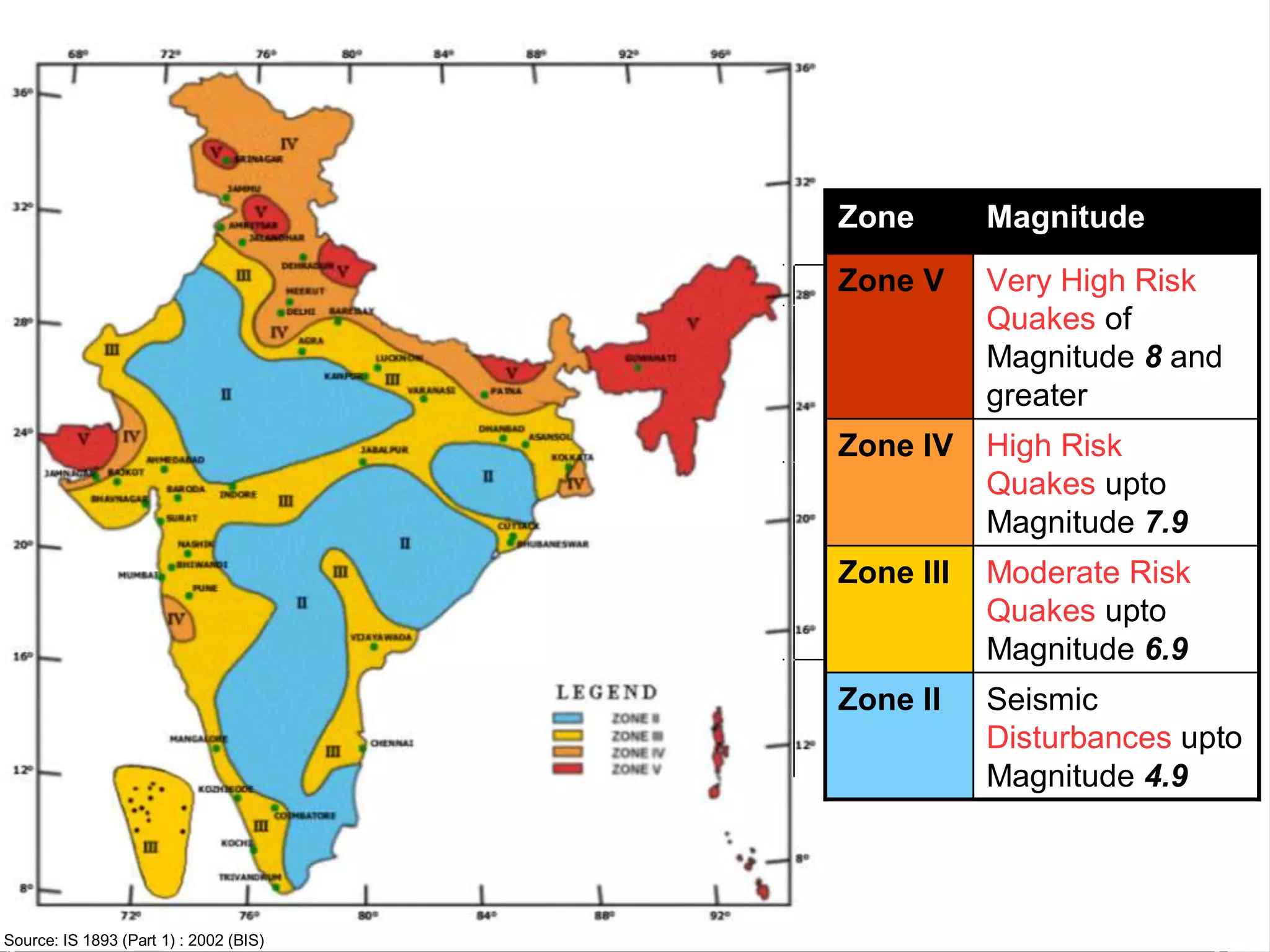
Zone
Zone V

Very High Risk
Quakes of
Magnitude 8 and
greater

Zone IV

High Risk
Quakes upto
Magnitude 7.9

Zone III

Moderate Risk
Quakes upto
Magnitude 6.9

Zone II

Source: IS 1893 (Part 1) : 2002 (BIS)

Magnitude

Seismic
Disturbances upto
Magnitude 4.9
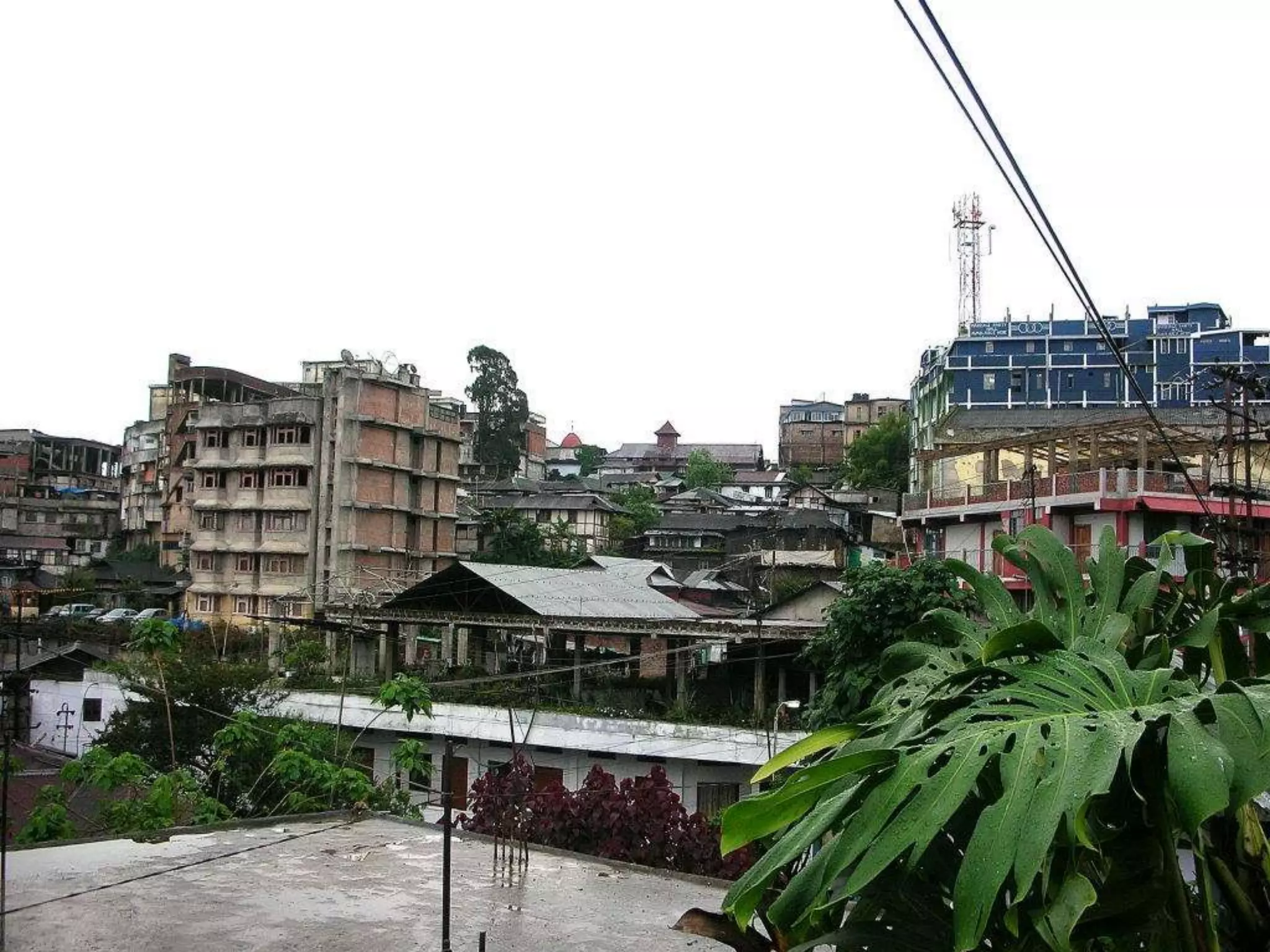
Records of Central Seismological Observatory
showed increasing seismic activity in the region.
A total 34 quakes of light and moderate intensity
were felt in the region in 2009. The area witnessed
26 earthquakes each in 2008 and 2007, while it was
23 in 2006, the data showed.
Earthquakes are not predictable, can occur any
time, and are of short duration
 Disasters due to Earthquake are Natural
Disasters
 We cannot prevent Earthquakes, we can be
prepared and try to mitigate the effects of an
earthquake

EARTHQUAKE DISASTER
Lives lost or people are injured
 Damage to property & infrastructure like roads and
bridges, Power Stations etc
 There may not be any electricity
 Water supply will be disrupted
 Mobile or telecommunication towers may collapse
 Road network may be affected

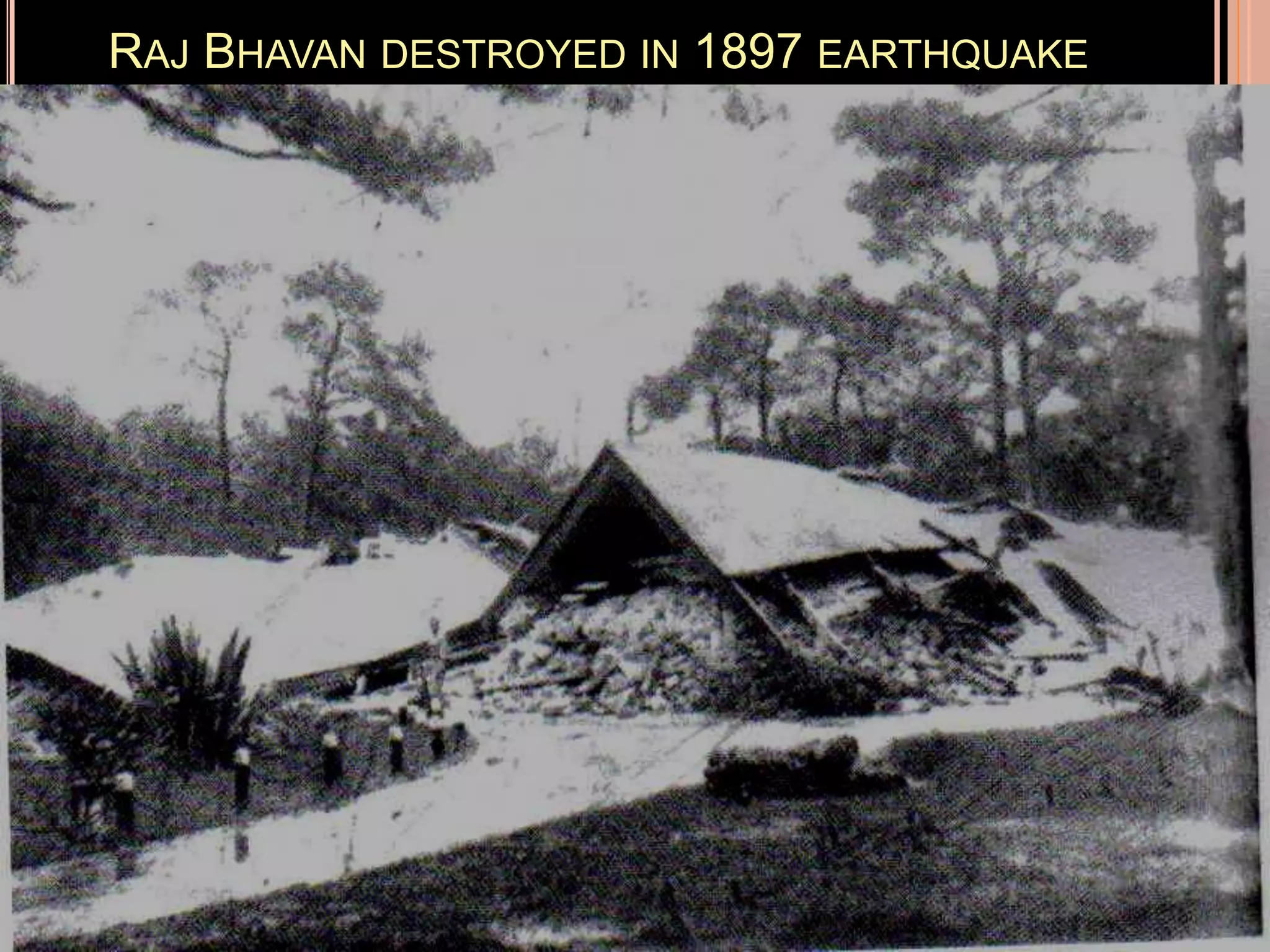
RAJ BHAVAN DESTROYED IN 1897 EARTHQUAKE
THE FUNDAMENTAL OBJECTIVE OF
DISASTER PREPAREDNESS IS TO
MINIMISE THE LOSS OF LIFE,
LIVELIHOOD AND SUFFERING THAT
ENTAILS.
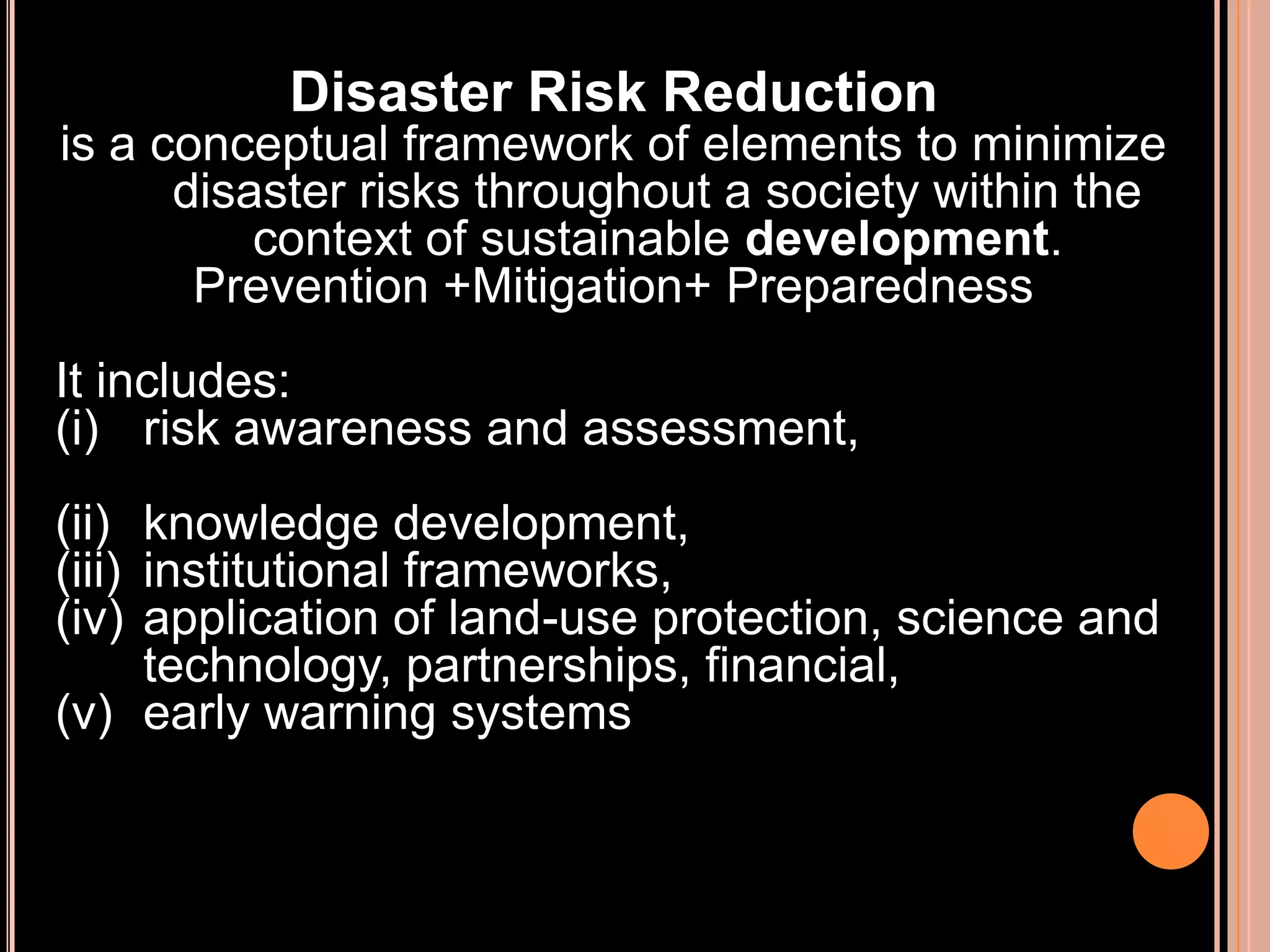
Disaster Risk Reduction
is a conceptual framework of elements to minimize
disaster risks throughout a society within the
context of sustainable development.
Prevention +Mitigation+ Preparedness
It includes:
(i) risk awareness and assessment,

(ii) knowledge development,
(iii) institutional frameworks,
(iv) application of land-use protection, science and
technology, partnerships, financial,
(v) early warning systems
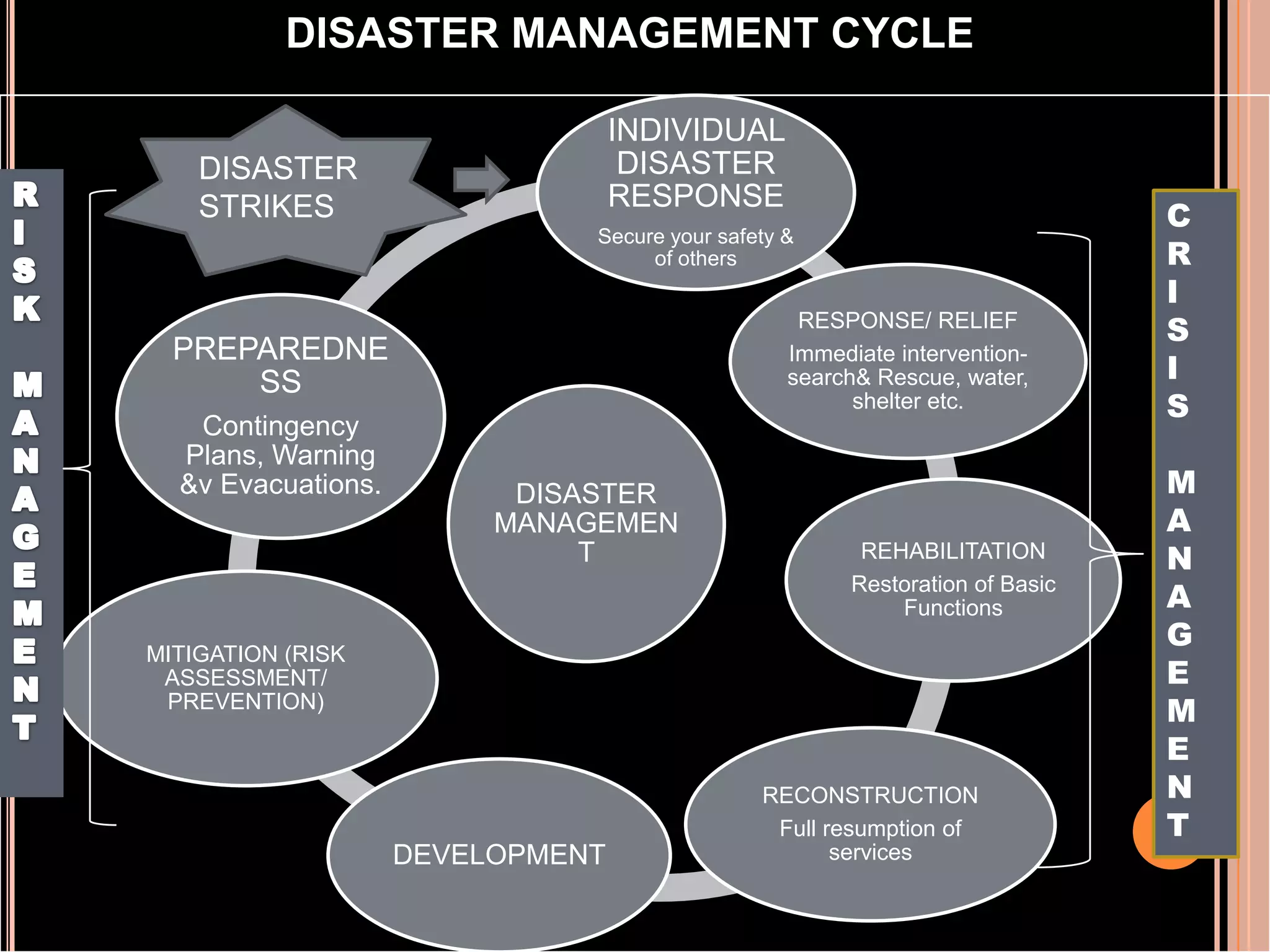
DISASTER MANAGEMENT CYCLE
INDIVIDUAL
DISASTER
RESPONSE

DISASTER
STRIKES

Secure your safety &
of others

RESPONSE/ RELIEF
Immediate interventionsearch& Rescue, water,
shelter etc.

PREPAREDNE
SS
Contingency
Plans, Warning
&v Evacuations.

DISASTER
MANAGEMEN
T

REHABILITATION
Restoration of Basic
Functions

MITIGATION (RISK
ASSESSMENT/
PREVENTION)

DEVELOPMENT

RECONSTRUCTION
Full resumption of
services

C
R
I
S
I
S
M
A
N
A
G
E
M
E
N
T
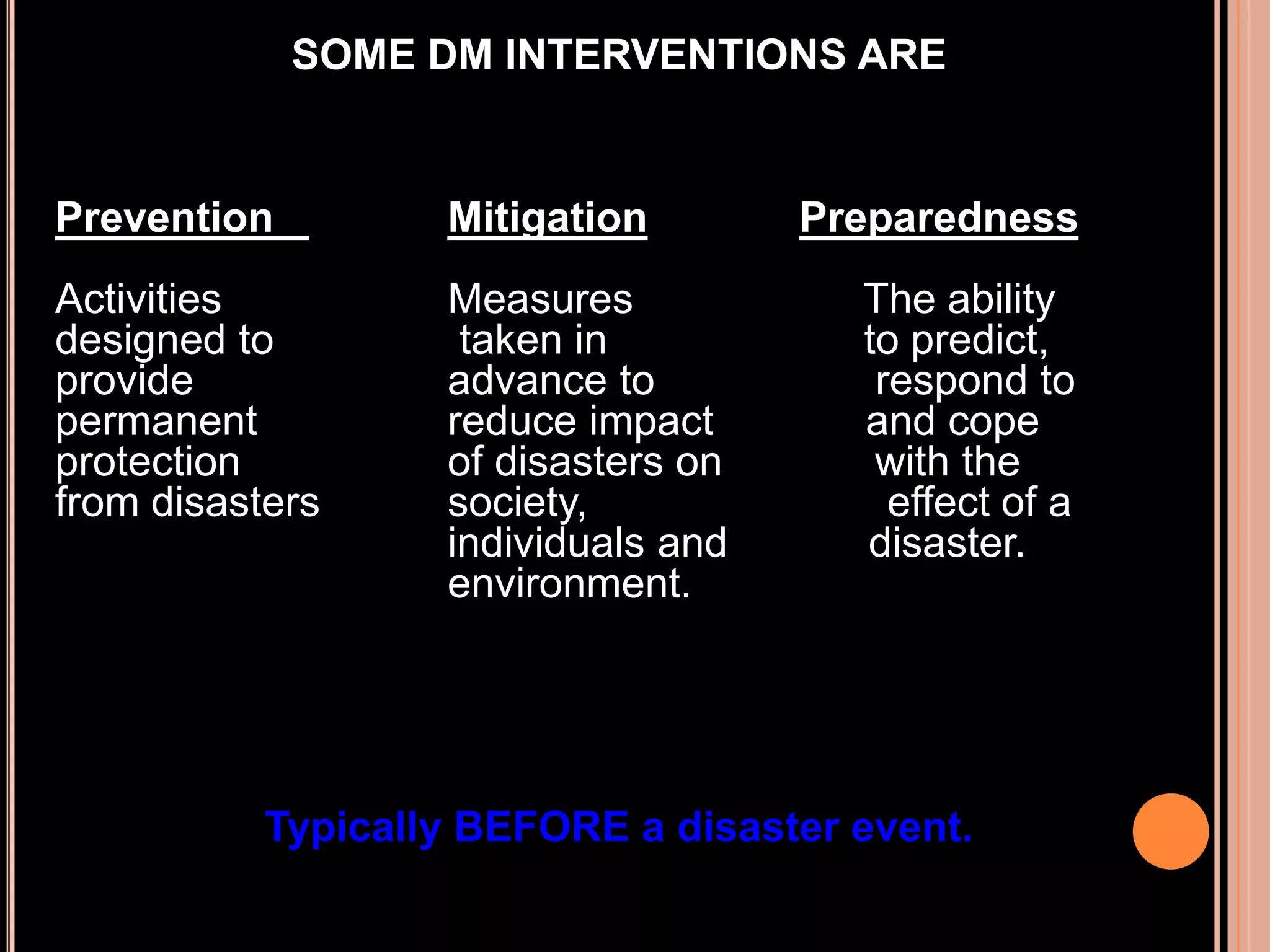
SOME DM INTERVENTIONS ARE

Prevention

Mitigation

Activities
designed to
provide
permanent
protection
from disasters

Measures
taken in
advance to
reduce impact
of disasters on
society,
individuals and
environment.
Preparedness

The ability
to predict,
respond to
and cope
with the
effect of a
disaster.

Typically BEFORE a disaster event.
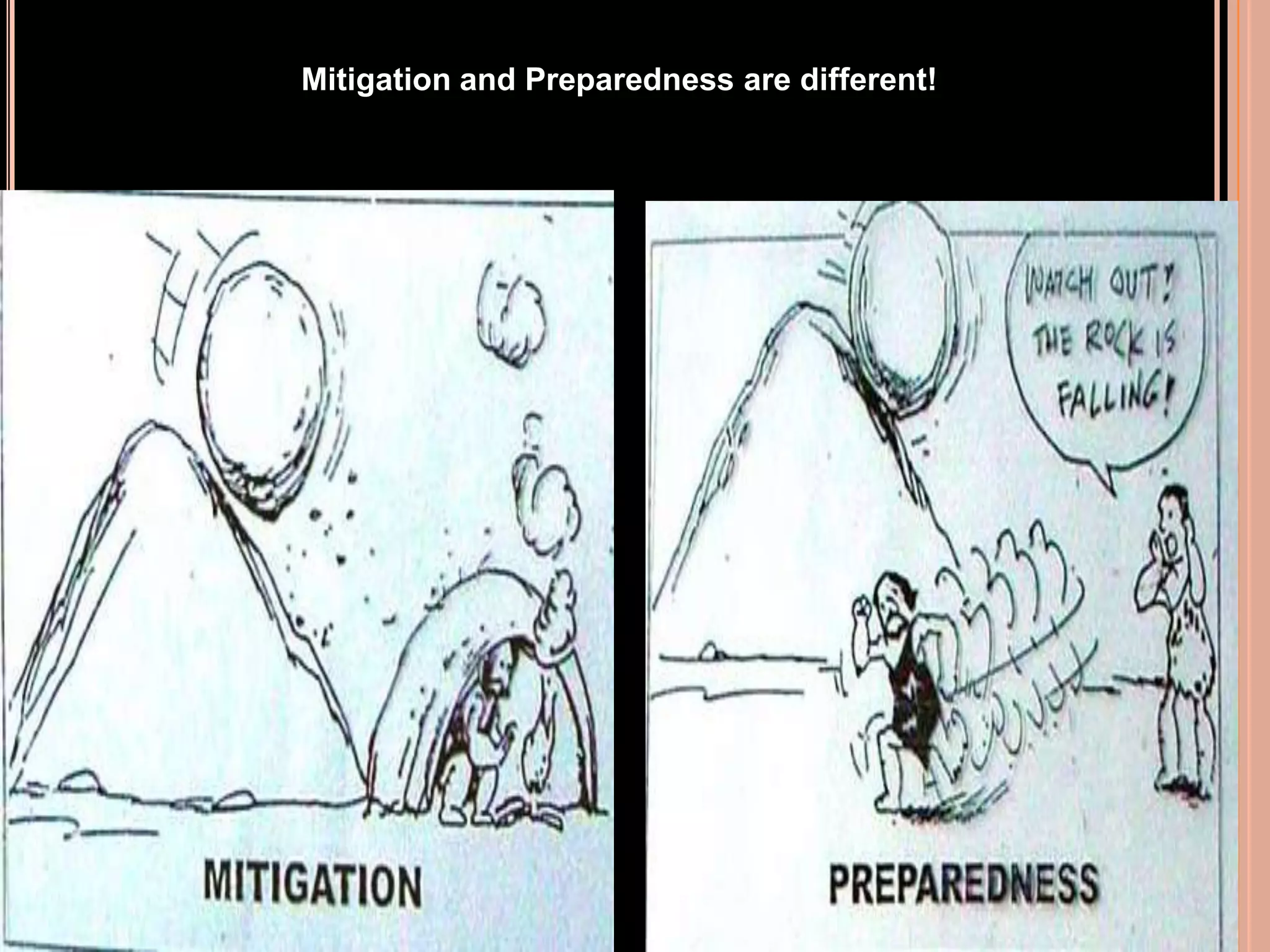
Mitigation and Preparedness are different!
Relief/Response
Activities designed to provide assistance to meet
basic preservation and subsistence needs of
affected people.
Typically DURING a disaster event
Recovery
Rehabilitation +
Reconstruction
Decisions and actions
taken with a view to
restoring or improving the
pre-disaster living
conditions of the stricken
community, while
encouraging and
facilitating necessary
adjustments to reduce
disaster risk.

Development
Activities designed
to inform
development
policies, strategies,
programme and
practices of disaster
risks.
This links up to
preparedness and
mitigation.

Typically AFTER a disaster event
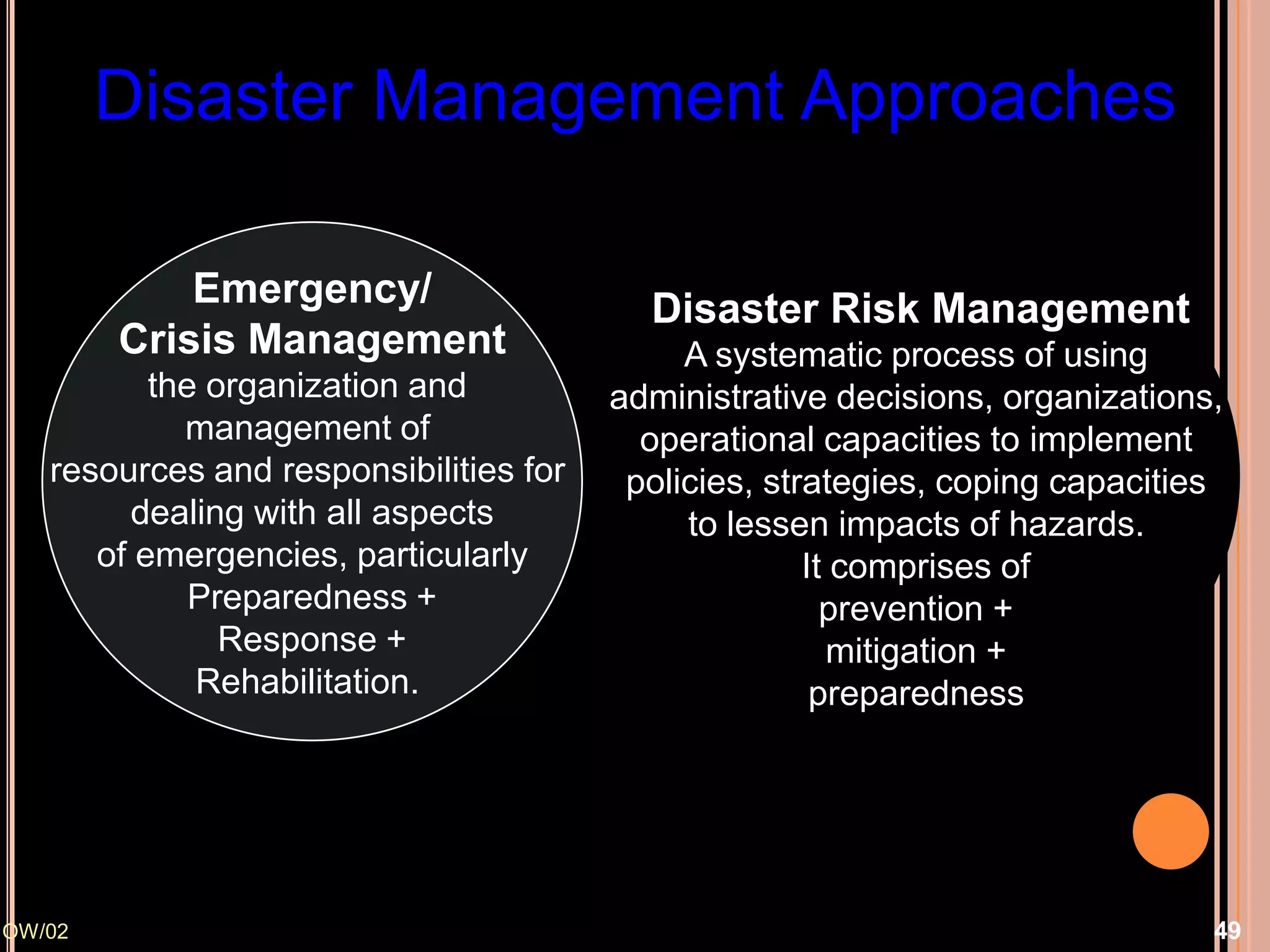
Disaster Management Approaches
Emergency/
Crisis Management
the organization and
management of
resources and responsibilities for
dealing with all aspects
of emergencies, particularly
Preparedness +
Response +
Rehabilitation.

OW/02

Disaster Risk Management
A systematic process of using
administrative decisions, organizations,
operational capacities to implement
policies, strategies, coping capacities
to lessen impacts of hazards.
It comprises of
prevention +
mitigation +
preparedness

49
PERSONAL & COMMUNITY AWARENESS
During time of Disaster, there will be delay before
help from outside arrives. A first help is essential.
A prepared Community is one which has:
An ALERT, INFORMED and actively AWARE
population
 A Preparedness & Response Plan
An active and involved local Government
Agreed, coordinated arrangements for Response,
Preparedness and Mitigation Measures.
Concept of disaster risk management

Concept of disaster risk management

  • 1.
    CONCEPT OF DISASTER RISK MANAGEMENT BY: MOLVAREENLANGSTIEH ASSISTANT PROFESSOR, DISASTER MANAGEMENT CENTRE, MATI.
  • 2.
    LOOK AT THESEPICTURES OF RECENT DISASTERS IN INDIA.
  • 3.
    19TH SEPTEMBER 2011: 50DEAD IN EARTHQUAKE IN SIKKIM AND NORTH EAST 3
  • 7.
  • 8.
    LOOK AT WHEREWE STAND:
  • 10.
    WE ARE FACINGIMPENDING DISASTERS..... WE ARE THEREFORE UNDER RISK OF DISASTERS WHAT IS DISASTER RISK?
  • 11.
    DISASTER RISK = HAZARDX VULNERABILITY – CAPACITY
  • 13.
    A serious disruption ofthe functioning of a society, causing widespread human, material, or environmental losses which exceed the ability of the affected society to cope using its own resources (Definition by the UN) “A Catastrophe, mishap, calamity or grave occurrence in any area arising from natural or man made causes, or by accidents or negligence which result in substantial loss of life or human suffering or damage to, and destruction of property, or damage to, or degradation of, environment, and is of such a nature magnitude as to be beyond the coping capacity of the community of the affected area.” (DM Act, 2005) : 
  • 14.
     LET US THINKOF SOME EXAMPLES OF DISASTERS...  CAN WE CALL AN EARTHQUAKE AS A DISASTER?  WHAT IF A BIG EARTHQUAKE OCCURS IN AN ISOLATED AREA?
  • 15.
  • 17.
    A dangerous conditionor event or occurrence that threatens or have the potential to cause disruption / damage / injury to life , infrastructure and services, property and environment. Example: Earthquake, landslide, cyclone, floods, volcanic eruptions, war etc. Magnitude of the phenomenon, probability of occurrence, the extent and severity of impact may vary.
  • 19.
    The extent towhich a community can be affected by the impact of a certain hazard.  Conditions like Ignorance, poverty, lack of information, inadequacy etc adds to the severity of a Disaster. (Physical & Socio-Economic Vulnerability)  vulnerable conditions can turn a situation into a risk or possibility of Disaster in any area.
  • 21.
    THOSE RESOURCES ANDSTRENGTHS WHICH EXISTS IN HOUSEHOLDS AND COMMUNITIES ENABLING THEM TO COPE WITH, WITHSTAND, PREPARE FOR, MITIGATE OR QUICKLY RECOVER FROM A DISASTER
  • 22.
    THOSE RESOURCES ANDSTRENGTHS WHICH EXISTS IN HOUSEHOLDS AND COMMUNITIES ENABLING THEM TO COPE WITH, WITHSTAND , PREPARE FOR, MITIGATE OR QUICKLY RECOVER FROM A DISASTER
  • 25.
    January 2012 Tornado inState of Orissa, India 1 died with 6 person injured (lighting struck during the tornado) February 2012 February 10: Chandigarh/Dehradun Earthquake, Minor Damage Reported Some houses developed cracks in Barkot area, place near to epicenter. Barkot is a town and a nagar panchayat in Uttarkashi District in the state of Uttarakhand, India
  • 26.
    March 2012 March 30:“High Temperature” Warning Issued In Gujarat, India The Meteorological Department of India has issued a “high temperature” warning in Gujarat following the severe heat wave March 28: Moderate Quake Shakes Parts Of Nepal And India, Several Houses Damaged Several houses reported to be damaged in Taplejung. Earlier M 6.8 very strong earthquake in Nepal/Sikkim area damaged 100+ houses in Taplejung of Nepal. The houses which already developed cracks/damage during Nepal/Sikkim earthquake are reported to damaged by this quake
  • 27.
    March 22: Sandstormin Rajasthan and Maharastra, India North-easterly wind brought dust/sand from Rajasthan to Mumbai and Dahanu, India March 20: Strong storm hits Kashmir One person died due to Cyclonic storm in Kashmir, 17 injured and about 1000 structures damaged March 12: Two Moderate Quakes Rocked Kashmir Valley, No Casualties The earthquake tremor was felt as far as Srinagar and rest of Kashmir valley and some parts of Pakistan as well March 5: Moderate Shallow Earthquake Strikes Rohtak, Haryana, India M 5.2 Moderate Earthquake Strikes Haryana - Delhi Region, India
  • 28.
    April 2012 April 25:Cyclone in Tinsukia, Assam, India Three killed after cyclone and heavy hailstorms hit Tinsukia district of Assam, India. April 20: Huge fire in Tirumala forest, India 500 acres of forest destroyed in fire in Tirumala. Apeil 14: Thunderstorm/lightning in Kolkata, India 8 killed after lightning stuck in an open agricultural field. April 13: Thunder/Hailstorms in India 14 people killed and about 200 injured in India April 10: Cyclonic storms in Tripura, India Seven killed and at least 30 people injured in Tripura, India April 7: Heavy hailstorms reported in several parts of Hyderabad, India Heavy hailstorms reported in several parts of Hyderabad, India
  • 29.
    May 2012 May 31:Landslide In Sikkim, India- 4,000 Tourists Affected About 4,000 tourists affected by landslide near Gangtok and Tsongmo Lake. May 30: Assam Major Earthquake Prediction Go Viral : But No Earthquake The news was viral when an astrologers claimed possibilities of three major earthquakes through a local television channel. May 20: Heat wave in Odisha, India Four people reported to be killed in in a heat wave in Odisha May 2: Thunderstorm in Balwatoli, Kishanganj, India Six killed and more than 50 injured after thunderstorms hit Balwatoli in Bihar’s Kishanganjdistrict, India
  • 30.
    June 2012 June 30:Strong earthquake shakes Assam, Manipur and Nagaland Tremors were felt in most parts of Assam, Nagaland, and Manipur, besides in Bangladesh and Myanmar. June 28: Flash floods in Manipur, India At least 40 houses reported to be flooded in Jiribam in Imphal district. June 27: Landslide and flooding in Guwahati, India One killed and three other injured in a landslide in Santipur hillside of Guwahati, India. June 21: Flooding in Patna, India India Meteorological Department (IMD), Patna issued floods forecast for river catchments.
  • 31.
    June 16: Floodingin Assam, India Latest flooding in Assam affects Barpeta, Darrang and Dhubri district. June 9: Landslide in Jammu and Kashmir, India Around 400 passengers rescued from the Khardung La Pass in Ladakh in Jammu and Kashmir. June 5: Heavy storms in Tripura, India One killed and more than 200 houses collapsed in storms in Tripura districts. June 5: Flooding in Assam, India Over 30 villages in Udalguri district affected by recent flooding. June 4: Tornado In Tripura, India-50 Houses Damaged Tornado hit Satinitilla Chowmuhani village along western border of Tripura. June 2: Wild fires in Uttarakhand, India More than 70 forest fires incident reported across Uttarakhand state of India.
  • 32.
    July 2012 July 21:Flooding in Hyderabad, India Nine people reported to be killed in recent Hyderabad floods. July 19: Flooding in Malda, India Three people reported to be killed in Malda flood. July 17: Flooding in North Bengal, India More than 2,000 people displaced after flash floods hit North Bengal of India. One person is reported to be missing in Magurmari. July 5: Landslides in Chamoli, India One killed and 15 other injured in a landslide in Rishikesh-Badrinath National Highway in Chamoli district of India. July 4: Lightning in Mumbai, India Lightning struck Mumbai-bound Boeing 737 carrying 99 passengers.
  • 33.
    August 2012 August 20:Landslides in Himachal Pradesh, India Hundreds of tourists remained stranded in the tribal Kaza area as landslides blocked the roads. August 15: Flash floods in Rajasthan, India Three killed by recent flash floods in Pratapgarh and Ajmer districts in Rajasthan. August 13: Two killed in flash floods in Kumaon region of Uttarakhand Death toll from Uttarkashi is now 33. MI-17 helicopters airlifted nearly 44 pilgrims from Harsil area. August 05: Uttarkashi, India hit by worst natural tragedy in 34 years Recent Uttarkashi flood has been declared as the worst natural tragedy to hit the area in 34 years . August 04: Flash floods in Kullu, India Hundreds of families living close to river between Palchan and Kullu evacuated.
  • 35.
    Zone Zone V Very HighRisk Quakes of Magnitude 8 and greater Zone IV High Risk Quakes upto Magnitude 7.9 Zone III Moderate Risk Quakes upto Magnitude 6.9 Zone II Source: IS 1893 (Part 1) : 2002 (BIS) Magnitude Seismic Disturbances upto Magnitude 4.9
  • 36.
    Records of CentralSeismological Observatory showed increasing seismic activity in the region. A total 34 quakes of light and moderate intensity were felt in the region in 2009. The area witnessed 26 earthquakes each in 2008 and 2007, while it was 23 in 2006, the data showed.
  • 39.
    Earthquakes are notpredictable, can occur any time, and are of short duration  Disasters due to Earthquake are Natural Disasters  We cannot prevent Earthquakes, we can be prepared and try to mitigate the effects of an earthquake 
  • 40.
    EARTHQUAKE DISASTER Lives lostor people are injured  Damage to property & infrastructure like roads and bridges, Power Stations etc  There may not be any electricity  Water supply will be disrupted  Mobile or telecommunication towers may collapse  Road network may be affected 
  • 41.
    RAJ BHAVAN DESTROYEDIN 1897 EARTHQUAKE
  • 42.
    THE FUNDAMENTAL OBJECTIVEOF DISASTER PREPAREDNESS IS TO MINIMISE THE LOSS OF LIFE, LIVELIHOOD AND SUFFERING THAT ENTAILS.
  • 43.
    Disaster Risk Reduction isa conceptual framework of elements to minimize disaster risks throughout a society within the context of sustainable development. Prevention +Mitigation+ Preparedness It includes: (i) risk awareness and assessment, (ii) knowledge development, (iii) institutional frameworks, (iv) application of land-use protection, science and technology, partnerships, financial, (v) early warning systems
  • 44.
    DISASTER MANAGEMENT CYCLE INDIVIDUAL DISASTER RESPONSE DISASTER STRIKES Secureyour safety & of others RESPONSE/ RELIEF Immediate interventionsearch& Rescue, water, shelter etc. PREPAREDNE SS Contingency Plans, Warning &v Evacuations. DISASTER MANAGEMEN T REHABILITATION Restoration of Basic Functions MITIGATION (RISK ASSESSMENT/ PREVENTION) DEVELOPMENT RECONSTRUCTION Full resumption of services C R I S I S M A N A G E M E N T
  • 45.
    SOME DM INTERVENTIONSARE Prevention Mitigation Activities designed to provide permanent protection from disasters Measures taken in advance to reduce impact of disasters on society, individuals and environment. Preparedness The ability to predict, respond to and cope with the effect of a disaster. Typically BEFORE a disaster event.
  • 46.
  • 47.
    Relief/Response Activities designed toprovide assistance to meet basic preservation and subsistence needs of affected people. Typically DURING a disaster event
  • 48.
    Recovery Rehabilitation + Reconstruction Decisions andactions taken with a view to restoring or improving the pre-disaster living conditions of the stricken community, while encouraging and facilitating necessary adjustments to reduce disaster risk. Development Activities designed to inform development policies, strategies, programme and practices of disaster risks. This links up to preparedness and mitigation. Typically AFTER a disaster event
  • 49.
    Disaster Management Approaches Emergency/ CrisisManagement the organization and management of resources and responsibilities for dealing with all aspects of emergencies, particularly Preparedness + Response + Rehabilitation. OW/02 Disaster Risk Management A systematic process of using administrative decisions, organizations, operational capacities to implement policies, strategies, coping capacities to lessen impacts of hazards. It comprises of prevention + mitigation + preparedness 49
  • 50.
    PERSONAL & COMMUNITYAWARENESS During time of Disaster, there will be delay before help from outside arrives. A first help is essential. A prepared Community is one which has: An ALERT, INFORMED and actively AWARE population  A Preparedness & Response Plan An active and involved local Government Agreed, coordinated arrangements for Response, Preparedness and Mitigation Measures.