Disaster Risk Reduction and
Management (DRRM)
Concepts, Principles and
Trends (RA 10121)
Instructor: MICHAEL ANGELO O. CASTRO
Disaster Risk Reduction and
Management (DRRM) Trends
(RA 10121)
Instructor: Greg Recto B. Cayabyab
REPUBLIC ACT No. 10121
THIS IS AN ACT STRENGTHENING THE PHILIPPINE
DISASTER RISK REDUCTION AND MANAGEMENT
SYSTEM, PROVIDING FOR THE NATIONAL DISASTER RISK
REDUCTION AND MANAGEMENT FRAMEWORK AND
INSTITUTIONALIZING THE NATIONAL DISASTER RISK
REDUCTION AND MANAGEMENT PLAN, APPROPRIATING
FUNDS THEREFOR AND FOR OTHER PURPOSES.
This Act shall be known as the "Philippine
Disaster Risk Reduction and Management Act
of 2010".
REPUBLIC ACT No. 10121
THIS IS AN ACT STRENGTHENING THE PHILIPPINE
DISASTER RISK REDUCTION AND MANAGEMENT
SYSTEM, PROVIDING FOR THE NATIONAL DISASTER
RISK REDUCTION AND MANAGEMENT FRAMEWORK
AND INSTITUTIONALIZING THE NATIONAL DISASTER
RISK REDUCTION AND MANAGEMENT PLAN,
APPROPRIATING FUNDS THEREFOR AND FOR OTHER
PURPOSES.
Disaster Risk Reduction and
Management (DRRM)
Concepts
Instructor: Greg Recto B. Cayabyab
Definition:
Disaster risk reduction (DRR) is a systematic
approach to identifying, assessing and reducing
the risks of disaster. It aims to reduce socio-
economic vulnerabilities to disaster as well as
dealing with the environmental and other
hazards that trigger them.
- markanthonymargallo
Preparation
Before we proceed to the principles to DRR, it is
essential that we first understand what a “disaster”
actually entails. Defining the concepts of Disaster Risk
I. Disaster
II. Risk
III. Hazard
IV. Vulnerability
V. Capacity
Definition
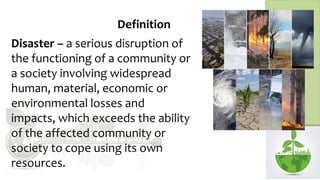
Disaster – a serious disruption of
the functioning of a community or
a society involving widespread
human, material, economic or
environmental losses and
impacts, which exceeds the ability
of the affected community or
society to cope using its own
resources.
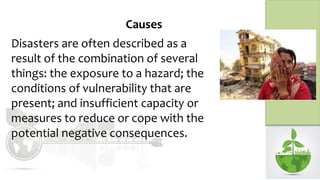
Causes
Disasters are often described as a
result of the combination of several
things: the exposure to a hazard; the
conditions of vulnerability that are
present; and insufficient capacity or
measures to reduce or cope with the
potential negative consequences.
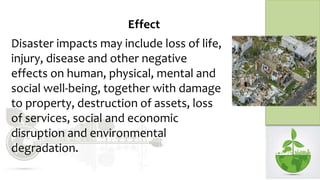
Effect
Disaster impacts may include loss of life,
injury, disease and other negative
effects on human, physical, mental and
social well-being, together with damage
to property, destruction of assets, loss
of services, social and economic
disruption and environmental
degradation.
Risk
The word “risk” has two connotations:
• concept of chance or possibility on
an event and its negative
consequence (the risk of an accident)
• In technical settings the emphasis is
usually placed on the consequences,
in terms of “potential losses” for
some particular cause, place and
period
HAZARD
• Defined as a “dangerous phenomenon,
substance, human activity or condition
that may cause loss of life, injury or
other health impacts, property
damage, loss of livelihoods and
services, social and economic
disruption, or environmental damage”.
Example: open electric cable, unstable
ladder etc.
VULNERABILITY
• Defined as the characteristics and
circumstances of a community, system
or asset that make it susceptible to the
damaging effects of a hazard.
Example: low ground elevation, lack of
drainage system, community’s nipa
houses and many more.
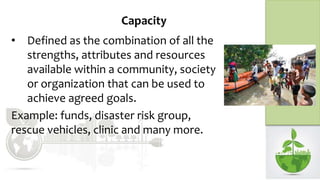
Capacity
• Defined as the combination of all the
strengths, attributes and resources
available within a community, society
or organization that can be used to
achieve agreed goals.
Example: funds, disaster risk group,
rescue vehicles, clinic and many more.
Disaster Risk Reduction and
Management (DRRM)
Principles
Instructor: Greg Recto B. Cayabyab
Components of DRR and
Management
Instructor: MICHAEL ANGELO O. CASTRO
PRE-EVENT
These are plans and strategies to
be accomplished and stabilized
before a certain disaster strike
PRE-EVENT
Mitigation
The lessening or limitation of the adverse impacts of
hazards and related disasters. While the adverse
impacts of hazards often cannot be prevented fully,
their scale or severity can be substantially lessened
by various strategies and actions. Mitigation
measures involve a wide range of elements from
engineering techniques to environmental policies
and even public awareness.
PRE-EVENT
Prevention
The outright avoidance of adverse impacts of
hazards and related disasters. Prevention expresses
the concept and intention to completely avoid
potential adverse impacts through action taken in
advance. Can be in the form of proper land use or
using suitable engineering design.
PRE-EVENT
Adaptation
The adjustment in natural or human systems in
response to actual or expected climatic stimuli or
their effects, which moderates harm or exploits
beneficial opportunities.
PRE-EVENT
Preparedness
The knowledge and capacities developed by
governments, professional response and recovery
organizations, communities and individuals to
effectively anticipate, respond to, and recover from,
the impacts of likely, imminent or current hazard
events or conditions.
POST-EVENT
These are plans and strategies to
be accomplished and stabilized
after a certain disaster strike
POST-EVENT
Response
The provision of emergency services and public
assistance during or immediately after a disaster in
order to save lives, reduce health impacts, ensure
public safety and meet the basic subsistence needs
of the people affected.
POST-EVENT
Recovery
The restoration, and improvement where appropriate, of
facilities, livelihoods and living conditions of disaster-
affected communities, including efforts to reduce disaster
risk factors. The recovery task of rehabilitation and
reconstruction begins soon after the emergency phase
has ended, and should be based on pre-existing
strategies and policies that facilitate clear institutional
responsibilities for recovery action and enable public
participation.
End of Discussion
Instructor: MICHAEL ANGELO O.
CASTRO

Lesson-5-Disaster-Risk-Management.pptx

  • 1.
    Disaster Risk Reductionand Management (DRRM) Concepts, Principles and Trends (RA 10121) Instructor: MICHAEL ANGELO O. CASTRO
  • 2.
    Disaster Risk Reductionand Management (DRRM) Trends (RA 10121) Instructor: Greg Recto B. Cayabyab
  • 3.
    REPUBLIC ACT No.10121 THIS IS AN ACT STRENGTHENING THE PHILIPPINE DISASTER RISK REDUCTION AND MANAGEMENT SYSTEM, PROVIDING FOR THE NATIONAL DISASTER RISK REDUCTION AND MANAGEMENT FRAMEWORK AND INSTITUTIONALIZING THE NATIONAL DISASTER RISK REDUCTION AND MANAGEMENT PLAN, APPROPRIATING FUNDS THEREFOR AND FOR OTHER PURPOSES. This Act shall be known as the "Philippine Disaster Risk Reduction and Management Act of 2010".
  • 4.
    REPUBLIC ACT No.10121 THIS IS AN ACT STRENGTHENING THE PHILIPPINE DISASTER RISK REDUCTION AND MANAGEMENT SYSTEM, PROVIDING FOR THE NATIONAL DISASTER RISK REDUCTION AND MANAGEMENT FRAMEWORK AND INSTITUTIONALIZING THE NATIONAL DISASTER RISK REDUCTION AND MANAGEMENT PLAN, APPROPRIATING FUNDS THEREFOR AND FOR OTHER PURPOSES.
  • 5.
    Disaster Risk Reductionand Management (DRRM) Concepts Instructor: Greg Recto B. Cayabyab
  • 6.
    Definition: Disaster risk reduction(DRR) is a systematic approach to identifying, assessing and reducing the risks of disaster. It aims to reduce socio- economic vulnerabilities to disaster as well as dealing with the environmental and other hazards that trigger them. - markanthonymargallo
  • 7.
    Preparation Before we proceedto the principles to DRR, it is essential that we first understand what a “disaster” actually entails. Defining the concepts of Disaster Risk I. Disaster II. Risk III. Hazard IV. Vulnerability V. Capacity
  • 8.
    Definition Disaster – aserious disruption of the functioning of a community or a society involving widespread human, material, economic or environmental losses and impacts, which exceeds the ability of the affected community or society to cope using its own resources.
  • 9.
    Causes Disasters are oftendescribed as a result of the combination of several things: the exposure to a hazard; the conditions of vulnerability that are present; and insufficient capacity or measures to reduce or cope with the potential negative consequences.
  • 10.
    Effect Disaster impacts mayinclude loss of life, injury, disease and other negative effects on human, physical, mental and social well-being, together with damage to property, destruction of assets, loss of services, social and economic disruption and environmental degradation.
  • 11.
    Risk The word “risk”has two connotations: • concept of chance or possibility on an event and its negative consequence (the risk of an accident) • In technical settings the emphasis is usually placed on the consequences, in terms of “potential losses” for some particular cause, place and period
  • 12.
    HAZARD • Defined asa “dangerous phenomenon, substance, human activity or condition that may cause loss of life, injury or other health impacts, property damage, loss of livelihoods and services, social and economic disruption, or environmental damage”. Example: open electric cable, unstable ladder etc.
  • 13.
    VULNERABILITY • Defined asthe characteristics and circumstances of a community, system or asset that make it susceptible to the damaging effects of a hazard. Example: low ground elevation, lack of drainage system, community’s nipa houses and many more.
  • 14.
    Capacity • Defined asthe combination of all the strengths, attributes and resources available within a community, society or organization that can be used to achieve agreed goals. Example: funds, disaster risk group, rescue vehicles, clinic and many more.
  • 15.
    Disaster Risk Reductionand Management (DRRM) Principles Instructor: Greg Recto B. Cayabyab
  • 17.
    Components of DRRand Management Instructor: MICHAEL ANGELO O. CASTRO
  • 18.
    PRE-EVENT These are plansand strategies to be accomplished and stabilized before a certain disaster strike
  • 19.
    PRE-EVENT Mitigation The lessening orlimitation of the adverse impacts of hazards and related disasters. While the adverse impacts of hazards often cannot be prevented fully, their scale or severity can be substantially lessened by various strategies and actions. Mitigation measures involve a wide range of elements from engineering techniques to environmental policies and even public awareness.
  • 20.
    PRE-EVENT Prevention The outright avoidanceof adverse impacts of hazards and related disasters. Prevention expresses the concept and intention to completely avoid potential adverse impacts through action taken in advance. Can be in the form of proper land use or using suitable engineering design.
  • 21.
    PRE-EVENT Adaptation The adjustment innatural or human systems in response to actual or expected climatic stimuli or their effects, which moderates harm or exploits beneficial opportunities.
  • 22.
    PRE-EVENT Preparedness The knowledge andcapacities developed by governments, professional response and recovery organizations, communities and individuals to effectively anticipate, respond to, and recover from, the impacts of likely, imminent or current hazard events or conditions.
  • 23.
    POST-EVENT These are plansand strategies to be accomplished and stabilized after a certain disaster strike
  • 24.
    POST-EVENT Response The provision ofemergency services and public assistance during or immediately after a disaster in order to save lives, reduce health impacts, ensure public safety and meet the basic subsistence needs of the people affected.
  • 25.
    POST-EVENT Recovery The restoration, andimprovement where appropriate, of facilities, livelihoods and living conditions of disaster- affected communities, including efforts to reduce disaster risk factors. The recovery task of rehabilitation and reconstruction begins soon after the emergency phase has ended, and should be based on pre-existing strategies and policies that facilitate clear institutional responsibilities for recovery action and enable public participation.
  • 26.
    End of Discussion Instructor:MICHAEL ANGELO O. CASTRO