
PRESENTATION ON
DISASTER
MANAGEMENT
BY : TEAM αLPHASHUBHAM JOSHI
ROOPASHREE PATTAR
SUNIL RATHOD
SANIKA SHAH
SHUBHAM SHAH
AKANKSHA JAIN
SHAHABAZ KHAN
DISASTER
MANAGEMENTWHAT IS A DISASTER ?
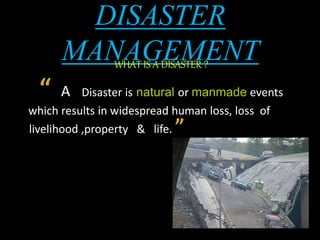
“ A Disaster is natural or manmade events
which results in widespread human loss, loss of
livelihood ,property & life. ”
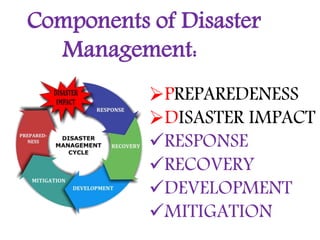
Components of Disaster
Management:
PREPAREDENESS
DISASTER IMPACT
RESPONSE
RECOVERY
DEVELOPMENT
MITIGATION
Disaster Preparedness
It involves measures to ensure that Communities
and Services are capable of coping with the
effect of disaster.
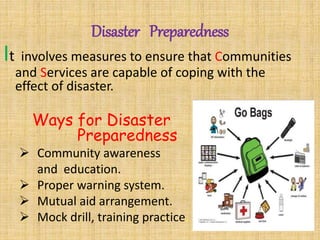
Ways for Disaster
Preparedness
 Community awareness
and education.
 Proper warning system.
 Mutual aid arrangement.
 Mock drill, training practice.
DISASTER IMPACT
If any disaster will take place then, millions of
people are effected by natural disaster every
year, and the impact can be calamitous.
• Displaced population.
• Health risks.
• Food Scarcity.
• Emotional Aftershocks.
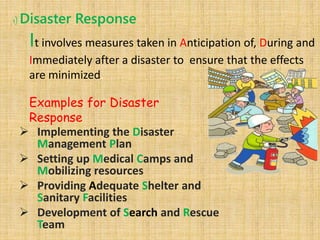
1) Disaster Response
It involves measures taken in Anticipation of, During and
Immediately after a disaster to ensure that the effects
are minimized.
Examples for Disaster
Response
 Implementing the Disaster
Management Plan
 Setting up Medical Camps and
Mobilizing resources
 Providing Adequate Shelter and
Sanitary Facilities
 Development of Search and Rescue
Team
2)DISASTER RECOVERY
It involves measures, which support emergency
affected areas in Reconstruction of the Physical
Infrastructure and Restoration of Economic and
Emotional well being.
 Counseling programme for those who lost the near ones.
 Restoring services like roads, communication link.
 Providing financial support employment.
 Reconstructing damaged buildings.
Examples for Disaster Recovery
3) DISASTER DEVELOPMENT NETWORK
The Disaster and Development Network (DDN)
aims to develop through Research, Teaching and
Learning, the Knowledge and Skills to address
hazards, disasters and complex Emergencies from
the perspective of different Development Debates
and Experience.
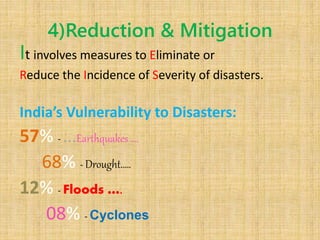
4)Reduction & Mitigation
It involves measures to Eliminate or
Reduce the Incidence of Severity of disasters.
India’s Vulnerability to Disasters:
57% - …Earthquakes ….
68% - Drought.….
12% - Floods ….
08% - Cyclones
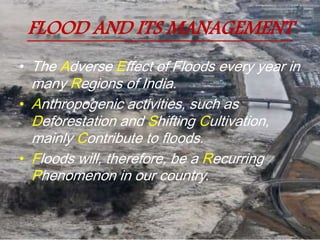
FLOOD AND ITS MANAGEMENT
• The Adverse Effect of Floods every year in
many Regions of India.
• Anthropogenic activities, such as
Deforestation and Shifting Cultivation,
mainly Contribute to floods.
• Floods will, therefore, be a Recurring
Phenomenon in our country.
STRUCTURAL AND NON-
STRUCTURAL MEASURES OF
FLOODS
both comes under the Mitigation measures:
Structural Measures:-
 Improvement of Flow Conditions in the
Channel and Anti-Erosion measures.
 Construction of Embarkments and Floodwalls
to prevent the Over-Bank spilling of Rivers.
 Reservoirs for Impounding monsoon flows.
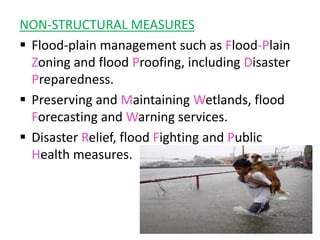
NON-STRUCTURAL MEASURES
 Flood-plain management such as Flood-Plain
Zoning and flood Proofing, including Disaster
Preparedness.
 Preserving and Maintaining Wetlands, flood
Forecasting and Warning services.
 Disaster Relief, flood Fighting and Public
Health measures.
EARTHQUAKE AND ITS
MANAGEMENT
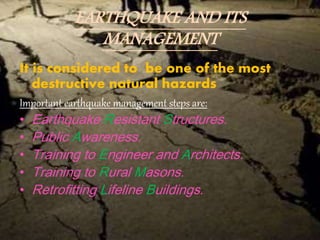
It is considered to be one of the most
destructive natural hazards
Important earthquake management steps are:
• Earthquake Resistant Structures.
• Public Awareness.
• Training to Engineer and Architects.
• Training to Rural Masons.
• Retrofitting Lifeline Buildings.
CYCLONES AND ITS
MANAGEMENT
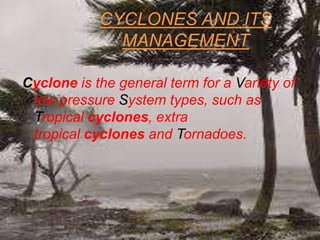
Cyclone is the general term for a Variety of
low pressure System types, such as
Tropical cyclones, extra
tropical cyclones and Tornadoes.
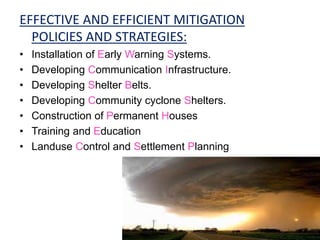
EFFECTIVE AND EFFICIENT MITIGATION
POLICIES AND STRATEGIES:
• Installation of Early Warning Systems.
• Developing Communication Infrastructure.
• Developing Shelter Belts.
• Developing Community cyclone Shelters.
• Construction of Permanent Houses
• Training and Education
• Landuse Control and Settlement Planning
LANDSLIDES AND ITS
MANAGEMENT
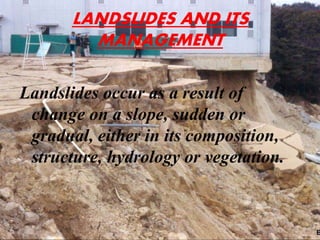
Landslides occur as a result of
change on a slope, sudden or
gradual, either in its composition,
structure, hydrology or vegetation.
• Developmental Programs that involve
Modification of the Topography,
Exploitation, Natural resources and
Change in the balance Load on the
ground should Not be permitted.
• Some Critical measures, that could be
undertaken to Prevent further
landslides are Drainage measures,
Erosion-control, preventing
Deforestation and Improving
Aforestation.
• A significant Reduction Caused by
landslides can be achieved by
TSUNAMI AND ITS
MANAGEMENT
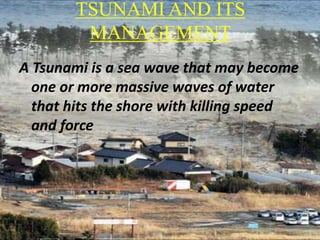
A Tsunami is a sea wave that may become
one or more massive waves of water
that hits the shore with killing speed
and force
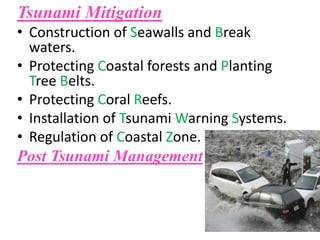
Tsunami Mitigation
• Construction of Seawalls and Break
waters.
• Protecting Coastal forests and Planting
Tree Belts.
• Protecting Coral Reefs.
• Installation of Tsunami Warning Systems.
• Regulation of Coastal Zone.
Post Tsunami Management
History
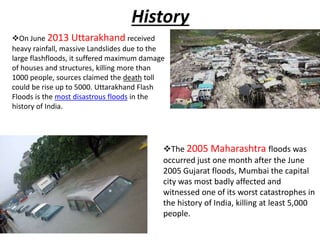
On June 2013 Uttarakhand received
heavy rainfall, massive Landslides due to the
large flashfloods, it suffered maximum damage
of houses and structures, killing more than
1000 people, sources claimed the death toll
could be rise up to 5000. Uttarakhand Flash
Floods is the most disastrous floods in the
history of India.
The 2005 Maharashtra floods was
occurred just one month after the June
2005 Gujarat floods, Mumbai the capital
city was most badly affected and
witnessed one of its worst catastrophes in
the history of India, killing at least 5,000
people.
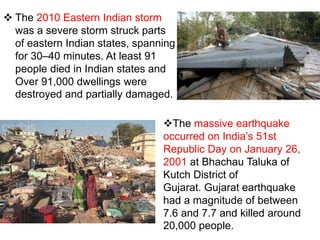
 The 2010 Eastern Indian storm
was a severe storm struck parts
of eastern Indian states, spanning
for 30–40 minutes. At least 91
people died in Indian states and
Over 91,000 dwellings were
destroyed and partially damaged.
The massive earthquake
occurred on India’s 51st
Republic Day on January 26,
2001 at Bhachau Taluka of
Kutch District of
Gujarat. Gujarat earthquake
had a magnitude of between
7.6 and 7.7 and killed around
20,000 people.
DISASTER MANAGEMENT
DISASTER MANAGEMENT

DISASTER MANAGEMENT

  • 1.
    PRESENTATION ON DISASTER MANAGEMENT BY :TEAM αLPHASHUBHAM JOSHI ROOPASHREE PATTAR SUNIL RATHOD SANIKA SHAH SHUBHAM SHAH AKANKSHA JAIN SHAHABAZ KHAN
  • 2.
    DISASTER MANAGEMENTWHAT IS ADISASTER ? “ A Disaster is natural or manmade events which results in widespread human loss, loss of livelihood ,property & life. ”
  • 3.
    Components of Disaster Management: PREPAREDENESS DISASTERIMPACT RESPONSE RECOVERY DEVELOPMENT MITIGATION
  • 4.
    Disaster Preparedness It involvesmeasures to ensure that Communities and Services are capable of coping with the effect of disaster. Ways for Disaster Preparedness  Community awareness and education.  Proper warning system.  Mutual aid arrangement.  Mock drill, training practice.
  • 5.
    DISASTER IMPACT If anydisaster will take place then, millions of people are effected by natural disaster every year, and the impact can be calamitous. • Displaced population. • Health risks. • Food Scarcity. • Emotional Aftershocks.
  • 6.
    1) Disaster Response Itinvolves measures taken in Anticipation of, During and Immediately after a disaster to ensure that the effects are minimized. Examples for Disaster Response  Implementing the Disaster Management Plan  Setting up Medical Camps and Mobilizing resources  Providing Adequate Shelter and Sanitary Facilities  Development of Search and Rescue Team
  • 7.
    2)DISASTER RECOVERY It involvesmeasures, which support emergency affected areas in Reconstruction of the Physical Infrastructure and Restoration of Economic and Emotional well being.  Counseling programme for those who lost the near ones.  Restoring services like roads, communication link.  Providing financial support employment.  Reconstructing damaged buildings. Examples for Disaster Recovery
  • 8.
    3) DISASTER DEVELOPMENTNETWORK The Disaster and Development Network (DDN) aims to develop through Research, Teaching and Learning, the Knowledge and Skills to address hazards, disasters and complex Emergencies from the perspective of different Development Debates and Experience.
  • 9.
    4)Reduction & Mitigation Itinvolves measures to Eliminate or Reduce the Incidence of Severity of disasters. India’s Vulnerability to Disasters: 57% - …Earthquakes …. 68% - Drought.…. 12% - Floods …. 08% - Cyclones
  • 10.
    FLOOD AND ITSMANAGEMENT • The Adverse Effect of Floods every year in many Regions of India. • Anthropogenic activities, such as Deforestation and Shifting Cultivation, mainly Contribute to floods. • Floods will, therefore, be a Recurring Phenomenon in our country.
  • 11.
    STRUCTURAL AND NON- STRUCTURALMEASURES OF FLOODS both comes under the Mitigation measures: Structural Measures:-  Improvement of Flow Conditions in the Channel and Anti-Erosion measures.  Construction of Embarkments and Floodwalls to prevent the Over-Bank spilling of Rivers.  Reservoirs for Impounding monsoon flows.
  • 12.
    NON-STRUCTURAL MEASURES  Flood-plainmanagement such as Flood-Plain Zoning and flood Proofing, including Disaster Preparedness.  Preserving and Maintaining Wetlands, flood Forecasting and Warning services.  Disaster Relief, flood Fighting and Public Health measures.
  • 13.
    EARTHQUAKE AND ITS MANAGEMENT Itis considered to be one of the most destructive natural hazards Important earthquake management steps are: • Earthquake Resistant Structures. • Public Awareness. • Training to Engineer and Architects. • Training to Rural Masons. • Retrofitting Lifeline Buildings.
  • 14.
    CYCLONES AND ITS MANAGEMENT Cycloneis the general term for a Variety of low pressure System types, such as Tropical cyclones, extra tropical cyclones and Tornadoes.
  • 15.
    EFFECTIVE AND EFFICIENTMITIGATION POLICIES AND STRATEGIES: • Installation of Early Warning Systems. • Developing Communication Infrastructure. • Developing Shelter Belts. • Developing Community cyclone Shelters. • Construction of Permanent Houses • Training and Education • Landuse Control and Settlement Planning
  • 16.
    LANDSLIDES AND ITS MANAGEMENT Landslidesoccur as a result of change on a slope, sudden or gradual, either in its composition, structure, hydrology or vegetation.
  • 17.
    • Developmental Programsthat involve Modification of the Topography, Exploitation, Natural resources and Change in the balance Load on the ground should Not be permitted. • Some Critical measures, that could be undertaken to Prevent further landslides are Drainage measures, Erosion-control, preventing Deforestation and Improving Aforestation. • A significant Reduction Caused by landslides can be achieved by
  • 18.
    TSUNAMI AND ITS MANAGEMENT ATsunami is a sea wave that may become one or more massive waves of water that hits the shore with killing speed and force
  • 19.
    Tsunami Mitigation • Constructionof Seawalls and Break waters. • Protecting Coastal forests and Planting Tree Belts. • Protecting Coral Reefs. • Installation of Tsunami Warning Systems. • Regulation of Coastal Zone. Post Tsunami Management
  • 20.
    History On June 2013Uttarakhand received heavy rainfall, massive Landslides due to the large flashfloods, it suffered maximum damage of houses and structures, killing more than 1000 people, sources claimed the death toll could be rise up to 5000. Uttarakhand Flash Floods is the most disastrous floods in the history of India. The 2005 Maharashtra floods was occurred just one month after the June 2005 Gujarat floods, Mumbai the capital city was most badly affected and witnessed one of its worst catastrophes in the history of India, killing at least 5,000 people.
  • 21.
     The 2010Eastern Indian storm was a severe storm struck parts of eastern Indian states, spanning for 30–40 minutes. At least 91 people died in Indian states and Over 91,000 dwellings were destroyed and partially damaged. The massive earthquake occurred on India’s 51st Republic Day on January 26, 2001 at Bhachau Taluka of Kutch District of Gujarat. Gujarat earthquake had a magnitude of between 7.6 and 7.7 and killed around 20,000 people.