DISASTER MANAGEMENT
• Unexpected tragic happening which causes a great loss of life and
property can be defined as a disaster
DISASTER
NATURAL DISASTER
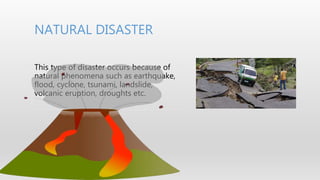
This type of disaster occurs because of
natural phenomena such as earthquake,
flood, cyclone, tsunami, landslide,
volcanic eruption, droughts etc.
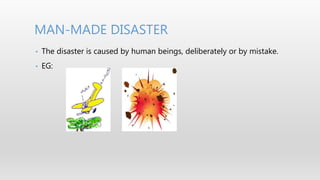
• The disaster is caused by human beings, deliberately or by mistake.
• EG:
MAN-MADE DISASTER
• In certain region are prone hazards or natural phenomenon that may
cause a disaster
• Town , banks of rivers are prone to floods
• Place near the coast are prone to cyclones and tsunami
• Place in Himalayas are prone to earthquake, landslide and
avalanches
• India highly disaster prone country
• Around 65 percent the land area is vulnerable to earthquake
• 12 percent flood, 8 percent cyclone, 70 percent drought
• People are made aware of the hazards and trained to take preventive
measures in case of a disaster.
• This can be seen in less developed country are far more severely
affected by disaster than developed countries and poor people
suffering most during disaster
• There are several effects of disaster : loss of life injury to human
being and animals damage to property and infrastructure such as
dams bridges roads railways power and communication network
environmental damage loss of livelihood and work psychological
damage and outbreak of disaster
EFFECTS OF A DISASTER
• We are aware that disaster occur without warning.
• Possible to mitigate its impact by being prepared for it
• Disaster management is a step towards a state of preparedness by
being alert with all possible arrangement so that the situation is
effectively handled to reduce the suffering of the affected people
• Government should remain an alert to face any kind of disaster
MANAGEMENT OF DISASTER
Mitigate: reduce
and lessen
• A special department for disaster management should set up
• Funds should be set aside for providing relief and disaster
management
• Advanced warning and forecasting systems should be in place in
disaster prone areas
• Organization to coordinate relief and rehabilitation work should be
set up
• Public awareness about disaster preparedness should be created
through various programmes by the government
FEW STEPS THAT CAN HELP IN DISASTER
MANAGEMENT
• There are disasters that are region specific
• People here should be equipped with medicine food ,shelter
materials , etc.
• Non government organizations the red cross society , un agencies ,
the police and army have always assisted in such situations

Disaster management

  • 1.
  • 2.
    • Unexpected tragichappening which causes a great loss of life and property can be defined as a disaster DISASTER
  • 3.
    NATURAL DISASTER This typeof disaster occurs because of natural phenomena such as earthquake, flood, cyclone, tsunami, landslide, volcanic eruption, droughts etc.
  • 4.
    • The disasteris caused by human beings, deliberately or by mistake. • EG: MAN-MADE DISASTER
  • 5.
    • In certainregion are prone hazards or natural phenomenon that may cause a disaster • Town , banks of rivers are prone to floods • Place near the coast are prone to cyclones and tsunami • Place in Himalayas are prone to earthquake, landslide and avalanches
  • 6.
    • India highlydisaster prone country • Around 65 percent the land area is vulnerable to earthquake • 12 percent flood, 8 percent cyclone, 70 percent drought • People are made aware of the hazards and trained to take preventive measures in case of a disaster. • This can be seen in less developed country are far more severely affected by disaster than developed countries and poor people suffering most during disaster
  • 7.
    • There areseveral effects of disaster : loss of life injury to human being and animals damage to property and infrastructure such as dams bridges roads railways power and communication network environmental damage loss of livelihood and work psychological damage and outbreak of disaster EFFECTS OF A DISASTER
  • 8.
    • We areaware that disaster occur without warning. • Possible to mitigate its impact by being prepared for it • Disaster management is a step towards a state of preparedness by being alert with all possible arrangement so that the situation is effectively handled to reduce the suffering of the affected people • Government should remain an alert to face any kind of disaster MANAGEMENT OF DISASTER Mitigate: reduce and lessen
  • 9.
    • A specialdepartment for disaster management should set up • Funds should be set aside for providing relief and disaster management • Advanced warning and forecasting systems should be in place in disaster prone areas • Organization to coordinate relief and rehabilitation work should be set up • Public awareness about disaster preparedness should be created through various programmes by the government FEW STEPS THAT CAN HELP IN DISASTER MANAGEMENT
  • 10.
    • There aredisasters that are region specific • People here should be equipped with medicine food ,shelter materials , etc. • Non government organizations the red cross society , un agencies , the police and army have always assisted in such situations