ABSTRACT
 The types of disaster ,its effects and its management
are reviewed in this presentation.
 Moreover weakness of the disaster management and
the expected disaster are also quoted.
INTRODUCTION
Climatic changes and activities of human is likely to
make the matter worse in some areas.
The present status of the world are forced to face the
changes of the earth known as disaster.
The activity of planning, preventing and
managing the disaster is called “Disaster
Management”.
DISASTER : DEFINITION
 It comes from astrological theme which are used to
refer destruction or reconstruction of stars.
 Disaster-a serious disruption, occurring over a
relatively short time, calamity or grave occurrence in
any area arising from nature or any man made
causes.
 A disaster is something very bad that happens to
people and almost always changes their lives
completely.
CLASSIFICATION
 WATER AND CLIMATIC DISASTER:
Floods,cyclones,hailstroms,cloudburst,heat
and cold waves, thunder and lightening.
 GEOLOGICAL DISASTER :
Landslides,earthquakes,minefires,dam
failure and general fires, volcanic eruptions
 BIOLOGICAL AND NUCLEAR DISASTER:
Chemical and industrial disaster, nuclear
accidents.
 ACCIDENTAL DISASTER:
Urban and forests fires,oilspill,bomb blasts,
mine flooding incidents.
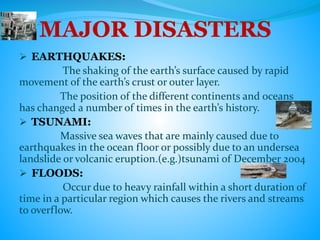
MAJOR DISASTERS
 EARTHQUAKES:
The shaking of the earth’s surface caused by rapid
movement of the earth’s crust or outer layer.
The position of the different continents and oceans
has changed a number of times in the earth’s history.
 TSUNAMI:
Massive sea waves that are mainly caused due to
earthquakes in the ocean floor or possibly due to an undersea
landslide or volcanic eruption.(e.g.)tsunami of December 2004
 FLOODS:
Occur due to heavy rainfall within a short duration of
time in a particular region which causes the rivers and streams
to overflow.
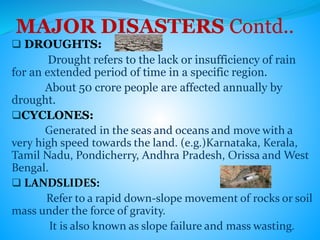
MAJOR DISASTERS Contd..
 DROUGHTS:
Drought refers to the lack or insufficiency of rain
for an extended period of time in a specific region.
About 50 crore people are affected annually by
drought.
CYCLONES:
Generated in the seas and oceans and move with a
very high speed towards the land. (e.g.)Karnataka, Kerala,
Tamil Nadu, Pondicherry, Andhra Pradesh, Orissa and West
Bengal.
 LANDSLIDES:
Refer to a rapid down-slope movement of rocks or soil
mass under the force of gravity.
It is also known as slope failure and mass wasting.
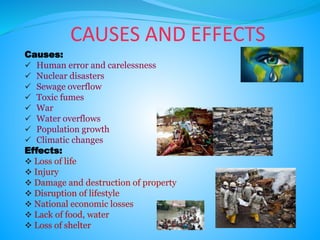
CAUSES AND EFFECTS
Causes:
 Human error and carelessness
 Nuclear disasters
 Sewage overflow
 Toxic fumes
 War
 Water overflows
 Population growth
 Climatic changes
Effects:
 Loss of life
 Injury
 Damage and destruction of property
 Disruption of lifestyle
 National economic losses
 Lack of food, water
 Loss of shelter
DISASTER MANAGEMENT
It is an effort to inquire into the process of hazard
turning to disaster to identify its causes.
It is a policy issue concerned with minimizing and
preventing the damaging impact of a natural or
manmade hazard.
PROCESS OF DISASTER
MANAGEMENT
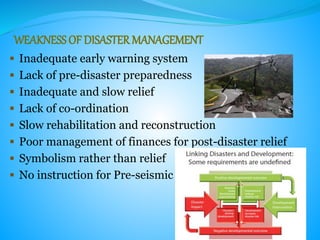
WEAKNESSOF DISASTER MANAGEMENT
 Inadequate early warning system
 Lack of pre-disaster preparedness
 Inadequate and slow relief
 Lack of co-ordination
 Slow rehabilitation and reconstruction
 Poor management of finances for post-disaster relief
 Symbolism rather than relief
 No instruction for Pre-seismic
Development of response system
 Preparation of special response team
It includes doctors,paramedics,structural
engineers
 Incident Command System
Most experienced and knowledgeable person
is charged with responsibility of interagency coordination
and management of the incident.
 Standard Operating Procedure
To ensure that all steps taken are put in place
 Trigger Mechanism
Activate the mechanism for response and
mitigation without loss of crucial time.
 Emergency Operation Centre
Function as nerve centres for integrated
command and control structure
FUTURE DISASTER
New Appropriate Technique -
Drought
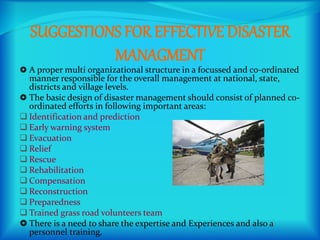
SUGGESTIONS FOR EFFECTIVE DISASTER
MANAGMENT
 A proper multi organizational structure in a focussed and co-ordinated
manner responsible for the overall management at national, state,
districts and village levels.
 The basic design of disaster management should consist of planned co-
ordinated efforts in following important areas:
 Identification and prediction
 Early warning system
 Evacuation
 Relief
 Rescue
 Rehabilitation
 Compensation
 Reconstruction
 Preparedness
 Trained grass road volunteers team
 There is a need to share the expertise and Experiences and also a
personnel training.
CONCLUSION
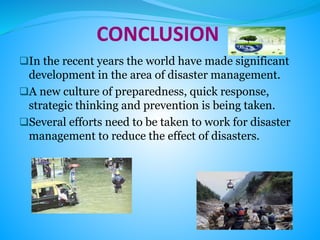
In the recent years the world have made significant
development in the area of disaster management.
A new culture of preparedness, quick response,
strategic thinking and prevention is being taken.
Several efforts need to be taken to work for disaster
management to reduce the effect of disasters.
Disaster management1

Disaster management1

  • 2.
    ABSTRACT  The typesof disaster ,its effects and its management are reviewed in this presentation.  Moreover weakness of the disaster management and the expected disaster are also quoted.
  • 3.
    INTRODUCTION Climatic changes andactivities of human is likely to make the matter worse in some areas. The present status of the world are forced to face the changes of the earth known as disaster. The activity of planning, preventing and managing the disaster is called “Disaster Management”.
  • 4.
    DISASTER : DEFINITION It comes from astrological theme which are used to refer destruction or reconstruction of stars.  Disaster-a serious disruption, occurring over a relatively short time, calamity or grave occurrence in any area arising from nature or any man made causes.  A disaster is something very bad that happens to people and almost always changes their lives completely.
  • 5.
    CLASSIFICATION  WATER ANDCLIMATIC DISASTER: Floods,cyclones,hailstroms,cloudburst,heat and cold waves, thunder and lightening.  GEOLOGICAL DISASTER : Landslides,earthquakes,minefires,dam failure and general fires, volcanic eruptions  BIOLOGICAL AND NUCLEAR DISASTER: Chemical and industrial disaster, nuclear accidents.  ACCIDENTAL DISASTER: Urban and forests fires,oilspill,bomb blasts, mine flooding incidents.
  • 6.
    MAJOR DISASTERS  EARTHQUAKES: Theshaking of the earth’s surface caused by rapid movement of the earth’s crust or outer layer. The position of the different continents and oceans has changed a number of times in the earth’s history.  TSUNAMI: Massive sea waves that are mainly caused due to earthquakes in the ocean floor or possibly due to an undersea landslide or volcanic eruption.(e.g.)tsunami of December 2004  FLOODS: Occur due to heavy rainfall within a short duration of time in a particular region which causes the rivers and streams to overflow.
  • 7.
    MAJOR DISASTERS Contd.. DROUGHTS: Drought refers to the lack or insufficiency of rain for an extended period of time in a specific region. About 50 crore people are affected annually by drought. CYCLONES: Generated in the seas and oceans and move with a very high speed towards the land. (e.g.)Karnataka, Kerala, Tamil Nadu, Pondicherry, Andhra Pradesh, Orissa and West Bengal.  LANDSLIDES: Refer to a rapid down-slope movement of rocks or soil mass under the force of gravity. It is also known as slope failure and mass wasting.
  • 8.
    CAUSES AND EFFECTS Causes: Human error and carelessness  Nuclear disasters  Sewage overflow  Toxic fumes  War  Water overflows  Population growth  Climatic changes Effects:  Loss of life  Injury  Damage and destruction of property  Disruption of lifestyle  National economic losses  Lack of food, water  Loss of shelter
  • 9.
    DISASTER MANAGEMENT It isan effort to inquire into the process of hazard turning to disaster to identify its causes. It is a policy issue concerned with minimizing and preventing the damaging impact of a natural or manmade hazard.
  • 10.
  • 11.
    WEAKNESSOF DISASTER MANAGEMENT Inadequate early warning system  Lack of pre-disaster preparedness  Inadequate and slow relief  Lack of co-ordination  Slow rehabilitation and reconstruction  Poor management of finances for post-disaster relief  Symbolism rather than relief  No instruction for Pre-seismic
  • 12.
    Development of responsesystem  Preparation of special response team It includes doctors,paramedics,structural engineers  Incident Command System Most experienced and knowledgeable person is charged with responsibility of interagency coordination and management of the incident.  Standard Operating Procedure To ensure that all steps taken are put in place  Trigger Mechanism Activate the mechanism for response and mitigation without loss of crucial time.  Emergency Operation Centre Function as nerve centres for integrated command and control structure
  • 13.
  • 14.
  • 15.
    SUGGESTIONS FOR EFFECTIVEDISASTER MANAGMENT  A proper multi organizational structure in a focussed and co-ordinated manner responsible for the overall management at national, state, districts and village levels.  The basic design of disaster management should consist of planned co- ordinated efforts in following important areas:  Identification and prediction  Early warning system  Evacuation  Relief  Rescue  Rehabilitation  Compensation  Reconstruction  Preparedness  Trained grass road volunteers team  There is a need to share the expertise and Experiences and also a personnel training.
  • 16.
    CONCLUSION In the recentyears the world have made significant development in the area of disaster management. A new culture of preparedness, quick response, strategic thinking and prevention is being taken. Several efforts need to be taken to work for disaster management to reduce the effect of disasters.