Introduction to Natural Disasters
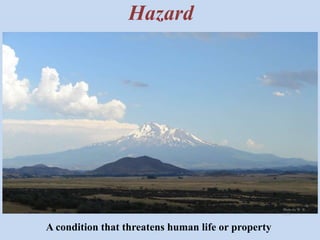
Hazard 
A condition that threatens human life or property 
Photo by W. W. 
Little
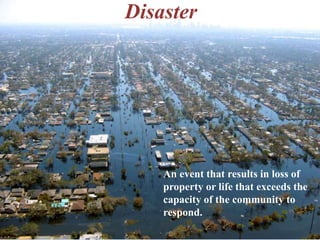
Disaster 
An event that results in loss of 
property or life that exceeds the 
capacity of the community to 
respond.
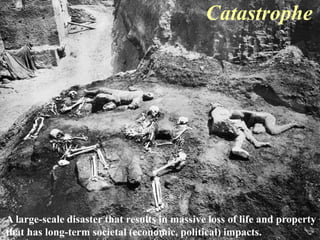
Catastrophe 
A large-scale disaster that results in massive loss of life and property 
that has long-term societal (economic, political) impacts.
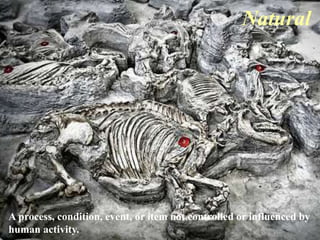
Natural 
A process, condition, event, or item not controlled or influenced by 
human activity.
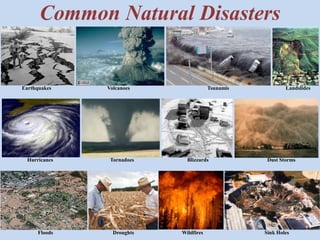
Common Natural Disasters 
Earthquakes Volcanoes Tsunamis Landslides 
Hurricanes Tornadoes Blizzards Dust Storms 
Floods Droughts Wildfires Sink Holes
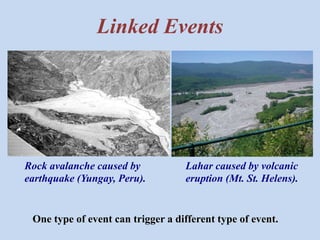
Linked Events 
Rock avalanche caused by 
earthquake (Yungay, Peru). 
Lahar caused by volcanic 
eruption (Mt. St. Helens). 
One type of event can trigger a different type of event.
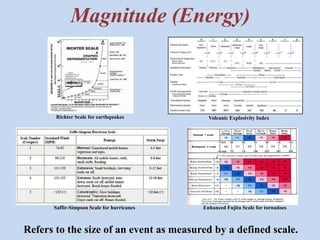
Magnitude (Energy) 
Richter Scale for earthquakes Volcanic Explosivity Index 
Enhanced Saffir-Simpson Scale for hurricanes Fujita Scale for tornadoes 
Refers to the size of an event as measured by a defined scale.
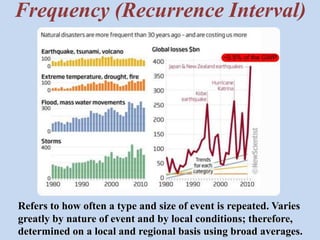
Frequency (Recurrence Interval) 
Refers to how often a type and size of event is repeated. Varies 
greatly by nature of event and by local conditions; therefore, 
determined on a local and regional basis using broad averages.
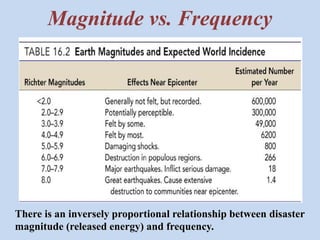
Magnitude vs. Frequency 
There is an inversely proportional relationship between disaster 
magnitude (released energy) and frequency.
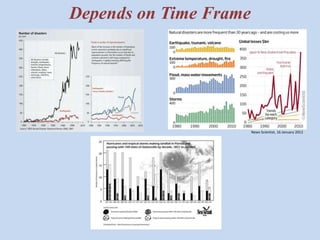
Is the Number of Natural 
Hazards/Disasters/Catastrophies 
Increasing? 
“The many eruptions, earthquakes and tidal waves which have 
occurred...are signs which the Savior declared would foreshadow 
his second coming... The wise and prudent will heed the warning 
and prepare themselves that they be not taken unawares.” 
Joseph F. Smith (Messages of the First Presidency, 4:132)
News Scientist, 16 January 2012 
Depends on Time Frame
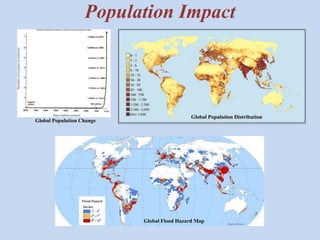
Population Impact 
Global Population Change 
Global Population Distribution 
Global Flood Hazard Map
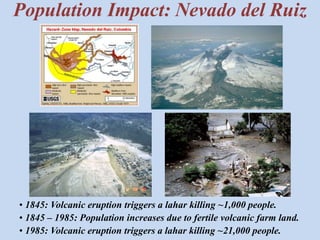
Population Impact: Nevado del Ruiz 
• 1845: Volcanic eruption triggers a lahar killing ~1,000 people. 
• 1845 – 1985: Population increases due to fertile volcanic farm land. 
• 1985: Volcanic eruption triggers a lahar killing ~21,000 people.
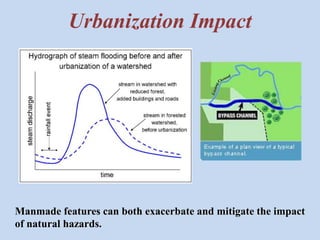
Urbanization Impact 
Manmade features can both exacerbate and mitigate the impact 
of natural hazards.
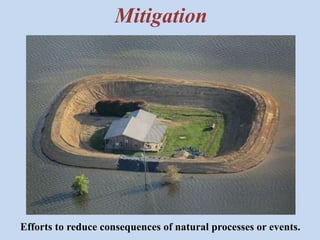
Mitigation 
Efforts to reduce consequences of natural processes or events.
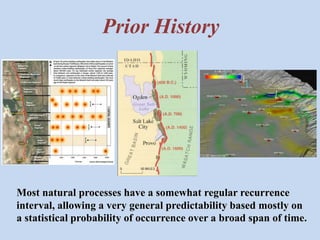
Prior History 
Most natural processes have a somewhat regular recurrence 
interval, allowing a very general predictability based mostly on 
a statistical probability of occurrence over a broad span of time.
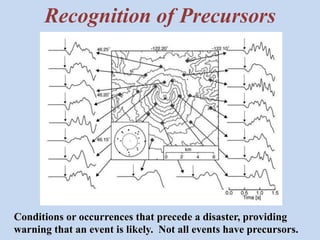
Recognition of Precursors 
Conditions or occurrences that precede a disaster, providing 
warning that an event is likely. Not all events have precursors.
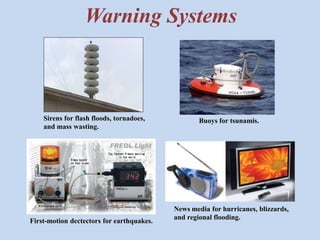
Warning Systems 
Sirens for flash floods, tornadoes, 
and mass wasting. 
Buoys for tsunamis. 
First-motion dectectors for earthquakes. 
News media for hurricanes, blizzards, 
and regional flooding.
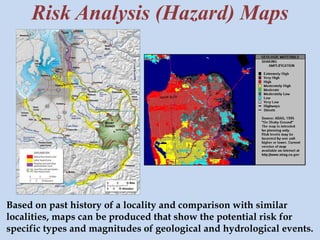
Risk Analysis (Hazard) Maps 
Based on past history of a locality and comparison with similar 
localities, maps can be produced that show the potential risk for 
specific types and magnitudes of geological and hydrological events.
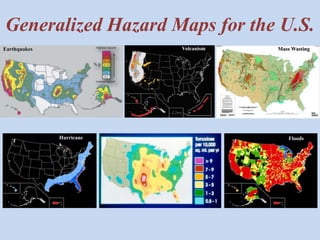
Generalized Hazard Maps for the U.S. 
Earthquakes Volcanism Mass Wasting 
Hurricane 
s 
Floods
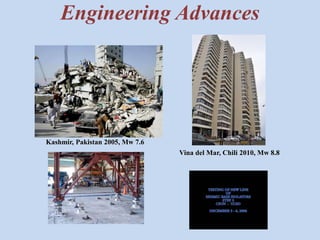
Engineering Advances 
Kashmir, Pakistan 2005, Mw 7.6 
Vina del Mar, Chili 2010, Mw 8.8
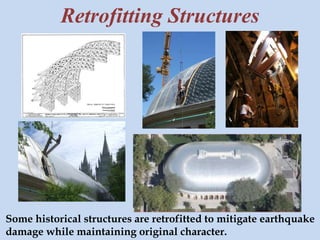
Retrofitting Structures 
Some historical structures are retrofitted to mitigate earthquake 
damage while maintaining original character.
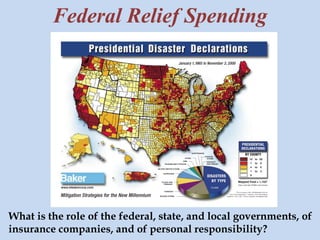
Federal Relief Spending 
What is the role of the federal, state, and local governments, of 
insurance companies, and of personal responsibility?
Best Advice: Be Prepared 
The prudent see danger and take refuge, but the 
simple keep going and suffer for it. 
Proverbs 27:12 
“Too often we bask in our comfortable complacency and rationalize that the ravages of war, economic 
disaster, famine, and earthquake cannot happen here. Those who believe this are either not acquainted 
with the revelations of the Lord, or they do not believe them. Those who smugly think these calamities 
will not happen, that they somehow will be set aside because of the righteousness of the Saints, are 
deceived and will rue the day they harbored such a delusion.” 
Ezra Taft Benson, “Prepare for the Days of Tribulation,” 
Ensign, Nov 1980, 32 
‘’In mercy the Lord warns and forewarns. He sees the coming storm, knows the forces operating to produce 
it, and calls aloud through His prophets, advises, counsels, exhorts, even commands— that we prepare for 
what is about to befall and take shelter while yet there is time. But we go our several ways, feasting and 
making merry, consoling conscience with the easy fancy of ‘time enough’ and in idle hope that the tempest 
will pass us by, or that, when it begins to gather thick and black about us we can turn back and find 
shelter.’’ 
James E Talmage, The Parables of James E. Talmage, p. 50
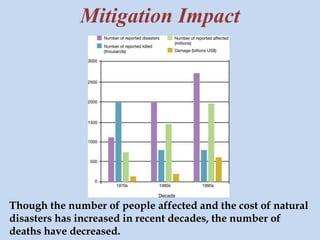
Mitigation Impact 
Though the number of people affected and the cost of natural 
disasters has increased in recent decades, the number of 
deaths have decreased.
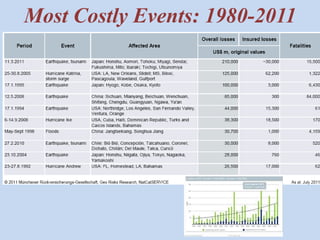
Most Costly Events: 1980-2011
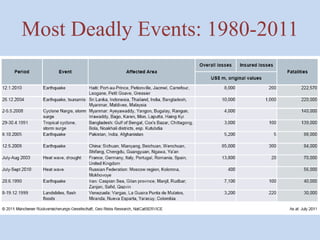
Most Deadly Events: 1980-2011
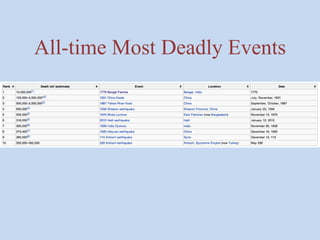
All-time Most Deadly Events

Natural Disasters Lecture 1 (Introduction)

  • 1.
  • 2.
    Hazard A conditionthat threatens human life or property Photo by W. W. Little
  • 3.
    Disaster An eventthat results in loss of property or life that exceeds the capacity of the community to respond.
  • 4.
    Catastrophe A large-scaledisaster that results in massive loss of life and property that has long-term societal (economic, political) impacts.
  • 5.
    Natural A process,condition, event, or item not controlled or influenced by human activity.
  • 6.
    Common Natural Disasters Earthquakes Volcanoes Tsunamis Landslides Hurricanes Tornadoes Blizzards Dust Storms Floods Droughts Wildfires Sink Holes
  • 7.
    Linked Events Rockavalanche caused by earthquake (Yungay, Peru). Lahar caused by volcanic eruption (Mt. St. Helens). One type of event can trigger a different type of event.
  • 8.
    Magnitude (Energy) RichterScale for earthquakes Volcanic Explosivity Index Enhanced Saffir-Simpson Scale for hurricanes Fujita Scale for tornadoes Refers to the size of an event as measured by a defined scale.
  • 9.
    Frequency (Recurrence Interval) Refers to how often a type and size of event is repeated. Varies greatly by nature of event and by local conditions; therefore, determined on a local and regional basis using broad averages.
  • 10.
    Magnitude vs. Frequency There is an inversely proportional relationship between disaster magnitude (released energy) and frequency.
  • 11.
    Is the Numberof Natural Hazards/Disasters/Catastrophies Increasing? “The many eruptions, earthquakes and tidal waves which have occurred...are signs which the Savior declared would foreshadow his second coming... The wise and prudent will heed the warning and prepare themselves that they be not taken unawares.” Joseph F. Smith (Messages of the First Presidency, 4:132)
  • 12.
    News Scientist, 16January 2012 Depends on Time Frame
  • 13.
    Population Impact GlobalPopulation Change Global Population Distribution Global Flood Hazard Map
  • 14.
    Population Impact: Nevadodel Ruiz • 1845: Volcanic eruption triggers a lahar killing ~1,000 people. • 1845 – 1985: Population increases due to fertile volcanic farm land. • 1985: Volcanic eruption triggers a lahar killing ~21,000 people.
  • 15.
    Urbanization Impact Manmadefeatures can both exacerbate and mitigate the impact of natural hazards.
  • 16.
    Mitigation Efforts toreduce consequences of natural processes or events.
  • 17.
    Prior History Mostnatural processes have a somewhat regular recurrence interval, allowing a very general predictability based mostly on a statistical probability of occurrence over a broad span of time.
  • 18.
    Recognition of Precursors Conditions or occurrences that precede a disaster, providing warning that an event is likely. Not all events have precursors.
  • 19.
    Warning Systems Sirensfor flash floods, tornadoes, and mass wasting. Buoys for tsunamis. First-motion dectectors for earthquakes. News media for hurricanes, blizzards, and regional flooding.
  • 20.
    Risk Analysis (Hazard)Maps Based on past history of a locality and comparison with similar localities, maps can be produced that show the potential risk for specific types and magnitudes of geological and hydrological events.
  • 21.
    Generalized Hazard Mapsfor the U.S. Earthquakes Volcanism Mass Wasting Hurricane s Floods
  • 22.
    Engineering Advances Kashmir,Pakistan 2005, Mw 7.6 Vina del Mar, Chili 2010, Mw 8.8
  • 23.
    Retrofitting Structures Somehistorical structures are retrofitted to mitigate earthquake damage while maintaining original character.
  • 24.
    Federal Relief Spending What is the role of the federal, state, and local governments, of insurance companies, and of personal responsibility?
  • 25.
    Best Advice: BePrepared The prudent see danger and take refuge, but the simple keep going and suffer for it. Proverbs 27:12 “Too often we bask in our comfortable complacency and rationalize that the ravages of war, economic disaster, famine, and earthquake cannot happen here. Those who believe this are either not acquainted with the revelations of the Lord, or they do not believe them. Those who smugly think these calamities will not happen, that they somehow will be set aside because of the righteousness of the Saints, are deceived and will rue the day they harbored such a delusion.” Ezra Taft Benson, “Prepare for the Days of Tribulation,” Ensign, Nov 1980, 32 ‘’In mercy the Lord warns and forewarns. He sees the coming storm, knows the forces operating to produce it, and calls aloud through His prophets, advises, counsels, exhorts, even commands— that we prepare for what is about to befall and take shelter while yet there is time. But we go our several ways, feasting and making merry, consoling conscience with the easy fancy of ‘time enough’ and in idle hope that the tempest will pass us by, or that, when it begins to gather thick and black about us we can turn back and find shelter.’’ James E Talmage, The Parables of James E. Talmage, p. 50
  • 26.
    Mitigation Impact Thoughthe number of people affected and the cost of natural disasters has increased in recent decades, the number of deaths have decreased.
  • 27.
  • 28.
  • 29.