B.R.A.C.T’s
Vishwakarma Institute of Information
Technology
Pune
Topic-Avalanche Disaster
Mr. Shubham S. Babar
What is Disaster..??
• A disaster is a sudden, calamitous event that seriously disrupts the functioning of a
community or society and causes human, material, and economic or
environmental losses that exceed the community’s or society’s ability to cope
using its own resources. Though often caused by nature, disasters can have human
origins.
• Disaster is a sudden, calamitous event bringing great damage, loss, and destruction
and devastation to life and property.
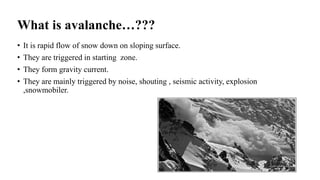
• It is rapid flow of snow down on sloping surface.
• They are triggered in starting zone.
• They form gravity current.
• They are mainly triggered by noise, shouting , seismic activity, explosion
,snowmobiler.
What is avalanche…???
Occurrence
• Due to snow has different layers having dissimilar physical properties.
• Due to loose snow.
• Cohesive snow separates from the surrounding snow and slides out.
How an avalanche is occurred..??
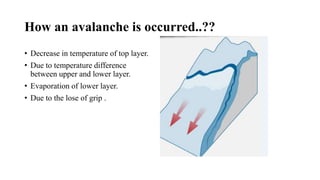
• Decrease in temperature of top layer.
• Due to temperature difference
between upper and lower layer.
• Evaporation of lower layer.
• Due to the lose of grip .
Anatomy of avalanche
An avalanche has three main parts.
• The starting zone is the most volatile area of
a slope, where unstable snow can fracture
from the surrounding snow cover and begin
to slide.
• The avalanche track is the path or channel
that an avalanche follows as it goes
downhill.
• The runout zone is where the snow and
debris finally come to a stop. Similarly, this
is also the location of the deposition zone,
where the snow and debris pile the highest.
Formation of avalanche..
1. Terrain :
• It requires slope shallow enough for snow to accumulate but steep enough to
accelerate the slope.
• The angle of the slope that can hold snow, called the angle of repose.
• The slope angle that can allow moving snow to accelerate depends on a variety of
factors such as the snow's shear strength and the configuration of layers and
interlayer interfaces.
2. Snowpack structure
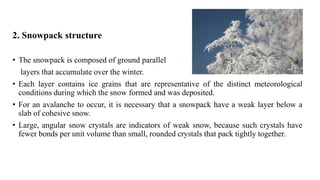
• The snowpack is composed of ground parallel
layers that accumulate over the winter.
• Each layer contains ice grains that are representative of the distinct meteorological
conditions during which the snow formed and was deposited.
• For an avalanche to occur, it is necessary that a snowpack have a weak layer below a
slab of cohesive snow.
• Large, angular snow crystals are indicators of weak snow, because such crystals have
fewer bonds per unit volume than small, rounded crystals that pack tightly together.
3 weather
• Mild winter weather will promote the settlement and stabilization of the snowpack; and
conversely very cold, windy, or hot weather will weaken the snowpack.
• A rapid rise in temperature above the freezing point of water, may cause avalanche
formation .
• Snowstorms and rainstorms are important contributors to avalanche danger.
• Most avalanches happen during or soon after a storm.
Causes of avalanche…..
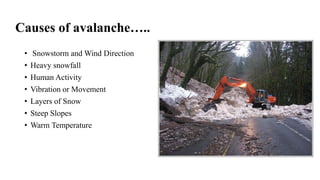
• Snowstorm and Wind Direction
• Heavy snowfall
• Human Activity
• Vibration or Movement
• Layers of Snow
• Steep Slopes
• Warm Temperature
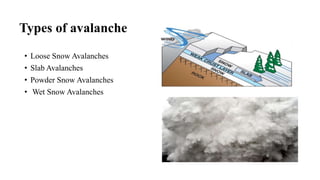
Types of avalanche
• Loose Snow Avalanches
• Slab Avalanches
• Powder Snow Avalanches
• Wet Snow Avalanches
Effects of avalanche
Positive effects
• Avalanche habitat
• Snow stabilization
• Diversify the landscape
Negative effects
• Damage to Life and Property
• Flash floods
• Economic Impact
• Utilities and Communication
Mitigation techniques
• To mitigate the effect of avalanches the construction of artificial barriers can be very
effective in reducing avalanche damage. There are several types: One kind of barrier
(snow net) uses a net strung between poles that are anchored by guy wires in
addition to their foundations. These barriers are similar to those used for rockslides.
• Another type of barrier is a rigid fence like structure (snow fence) and may be
constructed of steel, wood or prestressed concrete.
• Usually have gaps between the beams and are built perpendicular to the slope, with
reinforcing beams on the downhill side.
• Rigid barriers are often considered unsightly, especially when many rows must be
built.
• Direct protection-
Case study
• Gayari Sector avalanche
• On 7 April 2012, an avalanche hit a Pakistani military base in Gayari Sector, near the
Siachen Glacier region, trapping 140 soldiers and civilian contractors under deep snow.
• On 29 May 2012, Pakistan declared that the 129 soldiers and 11 civilians were dead.
• An avalanche rescue operation was quickly launched by the Pakistani military. Over 150
soldiers—using helicopters, rescue dogs,
• began searching the area for the missing soldiers and contractors, with "a team of doctors
and paramedics" standing by Local reports initially indicated that the operation had
recovered at least 12 bodies by the end of the day,but official reports stated that no
victims had been found, dead or alive.
Conclusion
From various case study and information following conclusions are made
• Avalanche is an deadliest natural disaster.
• Preventive measures to be taken in time to minimize the effect of avalanche .
• Better engineering structure to be construct to prevent avalanche on sloping
terrain.
• Stringent government steps where avalanche occurred.
• Awareness on avalanche disaster is required.
REFERANCES
• Pakistani troops dig for 135 missing in avalanche (AP)". Khaleej Times
Online. 7 April 2012. Retrieved 7 April 2012.
• wikipedia
• http://science.howstuffworks.com/nature/natural-
disasters/avalanche.html
THANK YOU

Avalanche

  • 1.
    B.R.A.C.T’s Vishwakarma Institute ofInformation Technology Pune Topic-Avalanche Disaster Mr. Shubham S. Babar
  • 2.
    What is Disaster..?? •A disaster is a sudden, calamitous event that seriously disrupts the functioning of a community or society and causes human, material, and economic or environmental losses that exceed the community’s or society’s ability to cope using its own resources. Though often caused by nature, disasters can have human origins. • Disaster is a sudden, calamitous event bringing great damage, loss, and destruction and devastation to life and property.
  • 3.
    • It israpid flow of snow down on sloping surface. • They are triggered in starting zone. • They form gravity current. • They are mainly triggered by noise, shouting , seismic activity, explosion ,snowmobiler. What is avalanche…???
  • 4.
    Occurrence • Due tosnow has different layers having dissimilar physical properties. • Due to loose snow. • Cohesive snow separates from the surrounding snow and slides out.
  • 5.
    How an avalancheis occurred..?? • Decrease in temperature of top layer. • Due to temperature difference between upper and lower layer. • Evaporation of lower layer. • Due to the lose of grip .
  • 6.
    Anatomy of avalanche Anavalanche has three main parts. • The starting zone is the most volatile area of a slope, where unstable snow can fracture from the surrounding snow cover and begin to slide. • The avalanche track is the path or channel that an avalanche follows as it goes downhill. • The runout zone is where the snow and debris finally come to a stop. Similarly, this is also the location of the deposition zone, where the snow and debris pile the highest.
  • 7.
    Formation of avalanche.. 1.Terrain : • It requires slope shallow enough for snow to accumulate but steep enough to accelerate the slope. • The angle of the slope that can hold snow, called the angle of repose. • The slope angle that can allow moving snow to accelerate depends on a variety of factors such as the snow's shear strength and the configuration of layers and interlayer interfaces.
  • 8.
    2. Snowpack structure •The snowpack is composed of ground parallel layers that accumulate over the winter. • Each layer contains ice grains that are representative of the distinct meteorological conditions during which the snow formed and was deposited. • For an avalanche to occur, it is necessary that a snowpack have a weak layer below a slab of cohesive snow. • Large, angular snow crystals are indicators of weak snow, because such crystals have fewer bonds per unit volume than small, rounded crystals that pack tightly together.
  • 9.
    3 weather • Mildwinter weather will promote the settlement and stabilization of the snowpack; and conversely very cold, windy, or hot weather will weaken the snowpack. • A rapid rise in temperature above the freezing point of water, may cause avalanche formation . • Snowstorms and rainstorms are important contributors to avalanche danger. • Most avalanches happen during or soon after a storm.
  • 10.
    Causes of avalanche….. •Snowstorm and Wind Direction • Heavy snowfall • Human Activity • Vibration or Movement • Layers of Snow • Steep Slopes • Warm Temperature
  • 11.
    Types of avalanche •Loose Snow Avalanches • Slab Avalanches • Powder Snow Avalanches • Wet Snow Avalanches
  • 12.
    Effects of avalanche Positiveeffects • Avalanche habitat • Snow stabilization • Diversify the landscape Negative effects • Damage to Life and Property • Flash floods • Economic Impact • Utilities and Communication
  • 13.
    Mitigation techniques • Tomitigate the effect of avalanches the construction of artificial barriers can be very effective in reducing avalanche damage. There are several types: One kind of barrier (snow net) uses a net strung between poles that are anchored by guy wires in addition to their foundations. These barriers are similar to those used for rockslides. • Another type of barrier is a rigid fence like structure (snow fence) and may be constructed of steel, wood or prestressed concrete. • Usually have gaps between the beams and are built perpendicular to the slope, with reinforcing beams on the downhill side. • Rigid barriers are often considered unsightly, especially when many rows must be built.
  • 14.
  • 16.
    Case study • GayariSector avalanche • On 7 April 2012, an avalanche hit a Pakistani military base in Gayari Sector, near the Siachen Glacier region, trapping 140 soldiers and civilian contractors under deep snow. • On 29 May 2012, Pakistan declared that the 129 soldiers and 11 civilians were dead. • An avalanche rescue operation was quickly launched by the Pakistani military. Over 150 soldiers—using helicopters, rescue dogs, • began searching the area for the missing soldiers and contractors, with "a team of doctors and paramedics" standing by Local reports initially indicated that the operation had recovered at least 12 bodies by the end of the day,but official reports stated that no victims had been found, dead or alive.
  • 17.
    Conclusion From various casestudy and information following conclusions are made • Avalanche is an deadliest natural disaster. • Preventive measures to be taken in time to minimize the effect of avalanche . • Better engineering structure to be construct to prevent avalanche on sloping terrain. • Stringent government steps where avalanche occurred. • Awareness on avalanche disaster is required.
  • 18.
    REFERANCES • Pakistani troopsdig for 135 missing in avalanche (AP)". Khaleej Times Online. 7 April 2012. Retrieved 7 April 2012. • wikipedia • http://science.howstuffworks.com/nature/natural- disasters/avalanche.html
  • 19.