
MANAGING OPERATIONS, QUALITY, AND
PRODUCTIVITY
TEAM INTRODUCTION
• Muhammad Aamir 2013-ch-41
• Fidda Hussain 2013-ch-91
• Shahid Alam 2013-ch-97
• Nabeel Ehmed 2013-ch-93
• Mohammad Rizwan 2013-ch-71
OPERATIONS MANAGEMENT
The set of management activities
used by an organization to transform
resource inputs into products, services,
or both.
IMPORTANCE OF OPERATIONS
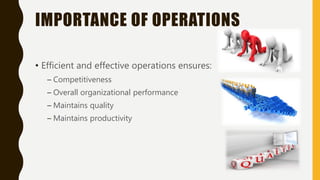
• Efficient and effective operations ensures:
– Competitiveness
– Overall organizational performance
– Maintains quality
– Maintains productivity
CONT…
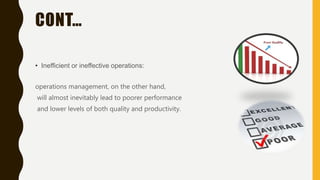
• Inefficient or ineffective operations:
operations management, on the other hand,
will almost inevitably lead to poorer performance
and lower levels of both quality and productivity.
WHAT DO YOU KNOW BY WORD
MANUFACTURING ?
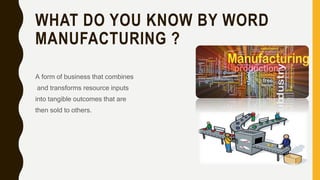
A form of business that combines
and transforms resource inputs
into tangible outcomes that are
then sold to others.
EXAMPLES
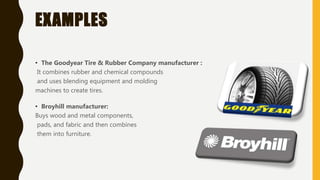
• The Goodyear Tire & Rubber Company manufacturer :
It combines rubber and chemical compounds
and uses blending equipment and molding
machines to create tires.
• Broyhill manufacturer:
Buys wood and metal components,
pads, and fabric and then combines
them into furniture.
SERVICE ORGANIZATION
• A service organization is one that
transforms resources into an intangible
output and creates time or place utility
for its customers.
EXAMPLES
• Merrill Lynch makes stock transactions for its customers
• Avis leases cars to its customers
THE ROLE OF OPERATIONS IN
ORGANIZATIONAL STRATEGY
• Operations management is very important to organizations
• It direct impact on such factors
• Competitiveness
• Quality
• Productivity
• Directly influences the organization's overall level of effectiveness.
DETERMINING PRODUCT-SERVICE
MIX
• The “Product-Service Mix,” to determine how many and what kinds of products or services (or
both) to offer.
• This decision flows from
• corporate
• Business
• Marketing strategies
• Managers have to make a number of decisions about their products and services starting with
how many and what kinds to
offer.
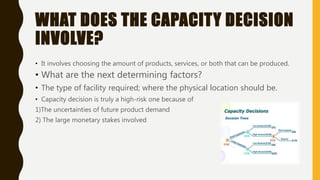
WHAT DOES THE CAPACITY DECISION
INVOLVE?
• It involves choosing the amount of products, services, or both that can be produced.
• What are the next determining factors?
• The type of facility required; where the physical location should be.
• Capacity decision is truly a high-risk one because of
1)The uncertainties of future product demand
2) The large monetary stakes involved
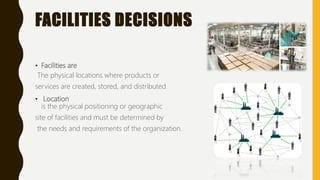
FACILITIES DECISIONS
• Facilities are
The physical locations where products or
services are created, stored, and distributed
• Location
is the physical positioning or geographic
site of facilities and must be determined by
the needs and requirements of the organization.
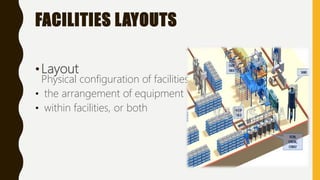
FACILITIES LAYOUTS
•Layout
Physical configuration of facilities,
• the arrangement of equipment
• within facilities, or both
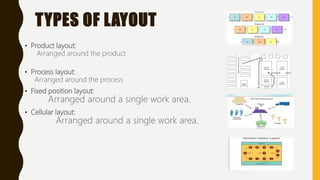
TYPES OF LAYOUT
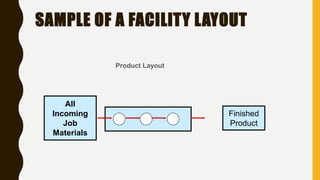
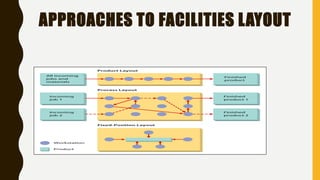
• Product layout:
Arranged around the product
• Process layout:
Arranged around the process
• Fixed position layout:
Arranged around a single work area.
• Cellular layout:
Arranged around a single work area.
SAMPLE OF A FACILITY LAYOUT
Product Layout
All
Incoming
Job
Materials
Finished
Product
APPROACHES TO FACILITIES LAYOUT
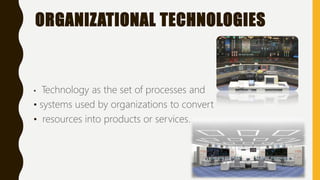
ORGANIZATIONAL TECHNOLOGIES
• Technology as the set of processes and
• systems used by organizations to convert
• resources into products or services.
CONT.…
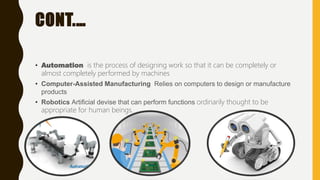
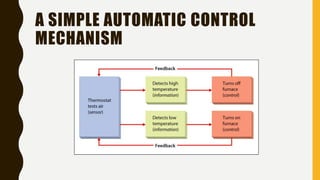
• Automation is the process of designing work so that it can be completely or
almost completely performed by machines
• Computer-Assisted Manufacturing Relies on computers to design or manufacture
products
• Robotics Artificial devise that can perform functions ordinarily thought to be
appropriate for human beings.
A SIMPLE AUTOMATIC CONTROL
MECHANISM
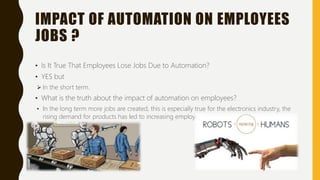
IMPACT OF AUTOMATION ON EMPLOYEES
JOBS ?
• Is It True That Employees Lose Jobs Due to Automation?
• YES but
 In the short term.
• What is the truth about the impact of automation on employees?
• In the long term more jobs are created, this is especially true for the electronics industry, the
rising demand for products has led to increasing employment.
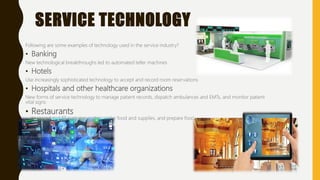
SERVICE TECHNOLOGY
Following are some examples of technology used in the service industry?
• Banking
New technological breakthroughs led to automated teller machines
• Hotels
Use increasingly sophisticated technology to accept and record room reservations
• Hospitals and other healthcare organizations
New forms of service technology to manage patient records, dispatch ambulances and EMTs, and monitor patient
vital signs
• Restaurants
to record and fill customer orders, order food and supplies, and prepare food
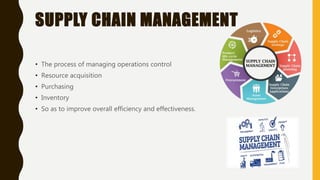
SUPPLY CHAIN MANAGEMENT
• The process of managing operations control
• Resource acquisition
• Purchasing
• Inventory
• So as to improve overall efficiency and effectiveness.
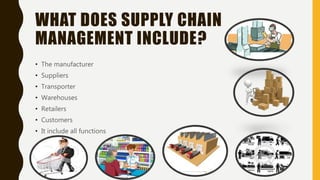
WHAT DOES SUPPLY CHAIN
MANAGEMENT INCLUDE?
• The manufacturer
• Suppliers
• Transporter
• Warehouses
• Retailers
• Customers
• It include all functions
PURCHASING MANAGEMENT
• Purchasing management, also called procurement
And is concerned with buying the materials and resources needed to create products
and services
• What is a new approach to purchasing?
-Many firms have changed their approaches to purchasing as a means
to lower costs and
improve quality and productivity
- They Reducing the number of suppliers and negotiating special product-delivery
arrangements.
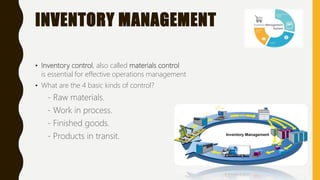
INVENTORY MANAGEMENT
• Inventory control, also called materials control
is essential for effective operations management
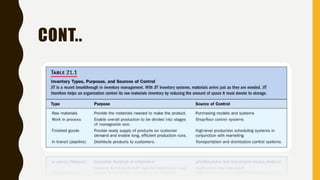
• What are the 4 basic kinds of control?
- Raw materials.
- Work in process.
- Finished goods.
- Products in transit.
CONT..
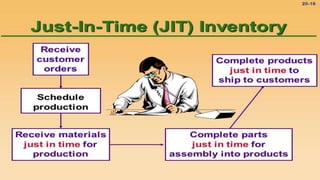
JUST-IN-TIME (JIT) METHOD
• An inventory system that has necessary materials arriving as soon as they are needed
(just in time) so that the production process is not interrupted
• Suppliers
• Transporting
• Transformation process
• Completed for customers
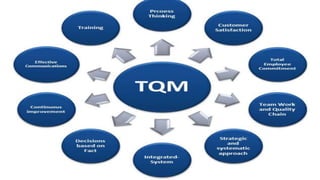
TOTAL QUALITY MANAGEMENT
• Quality and productivity have become major determinants of business success or
failure today
• achieving higher levels of quality is not an easy accomplishment
• What is needed for TQM?
The cooperation of all levels within the organization.
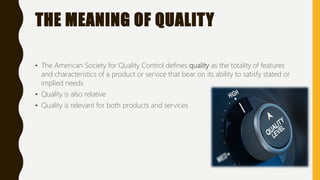
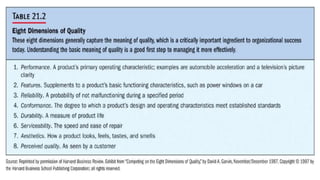
THE MEANING OF QUALITY
• The American Society for Quality Control defines quality as the totality of features
and characteristics of a product or service that bear on its ability to satisfy stated or
implied needs
• Quality is also relative
• Quality is relevant for both products and services
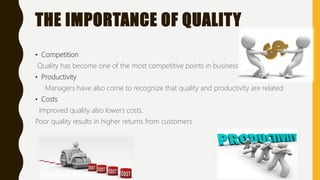
THE IMPORTANCE OF QUALITY
• Competition
Quality has become one of the most competitive points in business today
• Productivity
Managers have also come to recognize that quality and productivity are related
• Costs
Improved quality also lowers costs.
Poor quality results in higher returns from customers
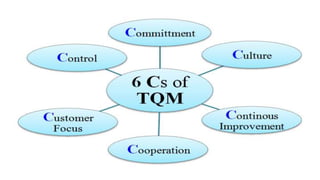
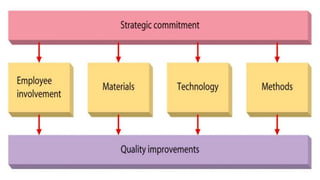
ELEMENTS FOR TQM
• Strategic commitment.
• Employee involvement.
• Technology.
• Materials.
• Methods improvement
CONT...
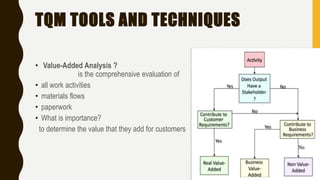
TQM TOOLS AND TECHNIQUES
• Value-Added Analysis ?
is the comprehensive evaluation of
• all work activities
• materials flows
• paperwork
• What is importance?
to determine the value that they add for customers
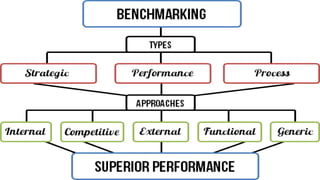
WHAT IS BENCHMARKING?
• The process of learning how other firms do things in
an exceptionally high quality manner.
• What does benchmarking enable firms to do?
–To stay abreast of improvements and changes its
competitors are using.
OUTSOURCING
• Another innovation for imp-roving quality is outsourcing
• is the process of subcontracting services and operations to other firms that can
perform them more cheaply or better
CONT’
• Reducing Cycle Time
Another popular TQM technique is reducing cycle time
• What does cycle time means?
Cycle time is the time needed by the organization to develop, make, and
distribute products or services.
MORE TQM TECHNIQUES:
• Speed:
– The time needed to get something accomplished; it can be emphasized
in any area, including developing, making, and distributing products or
services.
• ISO 9000:
– A set of quality standards created by International Organization for
Standards.
• SQC:
– Statistical Quality Control, a set of specific statistical techniques used to
monitor quality
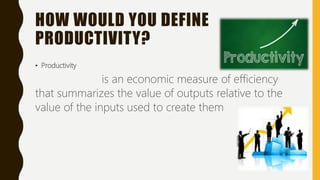
HOW WOULD YOU DEFINE
PRODUCTIVITY?
• Productivity
is an economic measure of efficiency
that summarizes the value of outputs relative to the
value of the inputs used to create them
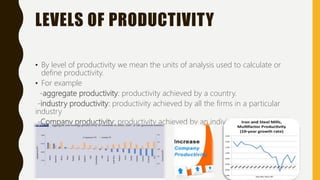
LEVELS OF PRODUCTIVITY
• By level of productivity we mean the units of analysis used to calculate or
define productivity.
• For example
-aggregate productivity: productivity achieved by a country.
-industry productivity: productivity achieved by all the firms in a particular
industry
-Company productivity: productivity achieved by an individual company
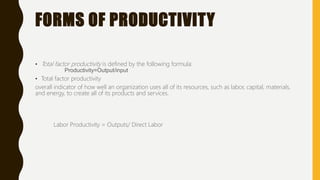
FORMS OF PRODUCTIVITY
• Total factor productivity is defined by the following formula:
Productivity=Output/input
• Total factor productivity
overall indicator of how well an organization uses all of its resources, such as labor, capital, materials,
and energy, to create all of its products and services.
Labor Productivity = Outputs/ Direct Labor
THE IMPORTANCE OF PRODUCTIVITY
• It determines the organization’s level of profitability.
• It determines people’s standard of living within a particular
country.
• Who has one of the highest level of productivity in the
world?
–The U.S.
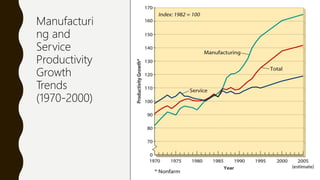
Manufacturi
ng and
Service
Productivity
Growth
Trends
(1970-2000)
Managing Operations, Quality and Productivity by nabeel

Managing Operations, Quality and Productivity by nabeel

  • 1.
  • 2.
    TEAM INTRODUCTION • MuhammadAamir 2013-ch-41 • Fidda Hussain 2013-ch-91 • Shahid Alam 2013-ch-97 • Nabeel Ehmed 2013-ch-93 • Mohammad Rizwan 2013-ch-71
  • 3.
    OPERATIONS MANAGEMENT The setof management activities used by an organization to transform resource inputs into products, services, or both.
  • 4.
    IMPORTANCE OF OPERATIONS •Efficient and effective operations ensures: – Competitiveness – Overall organizational performance – Maintains quality – Maintains productivity
  • 5.
    CONT… • Inefficient orineffective operations: operations management, on the other hand, will almost inevitably lead to poorer performance and lower levels of both quality and productivity.
  • 6.
    WHAT DO YOUKNOW BY WORD MANUFACTURING ? A form of business that combines and transforms resource inputs into tangible outcomes that are then sold to others.
  • 7.
    EXAMPLES • The GoodyearTire & Rubber Company manufacturer : It combines rubber and chemical compounds and uses blending equipment and molding machines to create tires. • Broyhill manufacturer: Buys wood and metal components, pads, and fabric and then combines them into furniture.
  • 8.
    SERVICE ORGANIZATION • Aservice organization is one that transforms resources into an intangible output and creates time or place utility for its customers.
  • 9.
    EXAMPLES • Merrill Lynchmakes stock transactions for its customers • Avis leases cars to its customers
  • 10.
    THE ROLE OFOPERATIONS IN ORGANIZATIONAL STRATEGY • Operations management is very important to organizations • It direct impact on such factors • Competitiveness • Quality • Productivity • Directly influences the organization's overall level of effectiveness.
  • 11.
    DETERMINING PRODUCT-SERVICE MIX • The“Product-Service Mix,” to determine how many and what kinds of products or services (or both) to offer. • This decision flows from • corporate • Business • Marketing strategies • Managers have to make a number of decisions about their products and services starting with how many and what kinds to offer.
  • 12.
    WHAT DOES THECAPACITY DECISION INVOLVE? • It involves choosing the amount of products, services, or both that can be produced. • What are the next determining factors? • The type of facility required; where the physical location should be. • Capacity decision is truly a high-risk one because of 1)The uncertainties of future product demand 2) The large monetary stakes involved
  • 13.
    FACILITIES DECISIONS • Facilitiesare The physical locations where products or services are created, stored, and distributed • Location is the physical positioning or geographic site of facilities and must be determined by the needs and requirements of the organization.
  • 14.
    FACILITIES LAYOUTS •Layout Physical configurationof facilities, • the arrangement of equipment • within facilities, or both
  • 15.
    TYPES OF LAYOUT •Product layout: Arranged around the product • Process layout: Arranged around the process • Fixed position layout: Arranged around a single work area. • Cellular layout: Arranged around a single work area.
  • 16.
    SAMPLE OF AFACILITY LAYOUT Product Layout All Incoming Job Materials Finished Product
  • 17.
  • 18.
    ORGANIZATIONAL TECHNOLOGIES • Technologyas the set of processes and • systems used by organizations to convert • resources into products or services.
  • 19.
    CONT.… • Automation isthe process of designing work so that it can be completely or almost completely performed by machines • Computer-Assisted Manufacturing Relies on computers to design or manufacture products • Robotics Artificial devise that can perform functions ordinarily thought to be appropriate for human beings.
  • 20.
    A SIMPLE AUTOMATICCONTROL MECHANISM
  • 21.
    IMPACT OF AUTOMATIONON EMPLOYEES JOBS ? • Is It True That Employees Lose Jobs Due to Automation? • YES but  In the short term. • What is the truth about the impact of automation on employees? • In the long term more jobs are created, this is especially true for the electronics industry, the rising demand for products has led to increasing employment.
  • 22.
    SERVICE TECHNOLOGY Following aresome examples of technology used in the service industry? • Banking New technological breakthroughs led to automated teller machines • Hotels Use increasingly sophisticated technology to accept and record room reservations • Hospitals and other healthcare organizations New forms of service technology to manage patient records, dispatch ambulances and EMTs, and monitor patient vital signs • Restaurants to record and fill customer orders, order food and supplies, and prepare food
  • 23.
    SUPPLY CHAIN MANAGEMENT •The process of managing operations control • Resource acquisition • Purchasing • Inventory • So as to improve overall efficiency and effectiveness.
  • 24.
    WHAT DOES SUPPLYCHAIN MANAGEMENT INCLUDE? • The manufacturer • Suppliers • Transporter • Warehouses • Retailers • Customers • It include all functions
  • 25.
    PURCHASING MANAGEMENT • Purchasingmanagement, also called procurement And is concerned with buying the materials and resources needed to create products and services • What is a new approach to purchasing? -Many firms have changed their approaches to purchasing as a means to lower costs and improve quality and productivity - They Reducing the number of suppliers and negotiating special product-delivery arrangements.
  • 26.
    INVENTORY MANAGEMENT • Inventorycontrol, also called materials control is essential for effective operations management • What are the 4 basic kinds of control? - Raw materials. - Work in process. - Finished goods. - Products in transit.
  • 27.
  • 28.
    JUST-IN-TIME (JIT) METHOD •An inventory system that has necessary materials arriving as soon as they are needed (just in time) so that the production process is not interrupted • Suppliers • Transporting • Transformation process • Completed for customers
  • 30.
    TOTAL QUALITY MANAGEMENT •Quality and productivity have become major determinants of business success or failure today • achieving higher levels of quality is not an easy accomplishment • What is needed for TQM? The cooperation of all levels within the organization.
  • 32.
    THE MEANING OFQUALITY • The American Society for Quality Control defines quality as the totality of features and characteristics of a product or service that bear on its ability to satisfy stated or implied needs • Quality is also relative • Quality is relevant for both products and services
  • 33.
    THE IMPORTANCE OFQUALITY • Competition Quality has become one of the most competitive points in business today • Productivity Managers have also come to recognize that quality and productivity are related • Costs Improved quality also lowers costs. Poor quality results in higher returns from customers
  • 34.
    ELEMENTS FOR TQM •Strategic commitment. • Employee involvement. • Technology. • Materials. • Methods improvement
  • 35.
  • 38.
    TQM TOOLS ANDTECHNIQUES • Value-Added Analysis ? is the comprehensive evaluation of • all work activities • materials flows • paperwork • What is importance? to determine the value that they add for customers
  • 39.
    WHAT IS BENCHMARKING? •The process of learning how other firms do things in an exceptionally high quality manner. • What does benchmarking enable firms to do? –To stay abreast of improvements and changes its competitors are using.
  • 41.
    OUTSOURCING • Another innovationfor imp-roving quality is outsourcing • is the process of subcontracting services and operations to other firms that can perform them more cheaply or better
  • 42.
    CONT’ • Reducing CycleTime Another popular TQM technique is reducing cycle time • What does cycle time means? Cycle time is the time needed by the organization to develop, make, and distribute products or services.
  • 43.
    MORE TQM TECHNIQUES: •Speed: – The time needed to get something accomplished; it can be emphasized in any area, including developing, making, and distributing products or services. • ISO 9000: – A set of quality standards created by International Organization for Standards. • SQC: – Statistical Quality Control, a set of specific statistical techniques used to monitor quality
  • 45.
    HOW WOULD YOUDEFINE PRODUCTIVITY? • Productivity is an economic measure of efficiency that summarizes the value of outputs relative to the value of the inputs used to create them
  • 46.
    LEVELS OF PRODUCTIVITY •By level of productivity we mean the units of analysis used to calculate or define productivity. • For example -aggregate productivity: productivity achieved by a country. -industry productivity: productivity achieved by all the firms in a particular industry -Company productivity: productivity achieved by an individual company
  • 47.
    FORMS OF PRODUCTIVITY •Total factor productivity is defined by the following formula: Productivity=Output/input • Total factor productivity overall indicator of how well an organization uses all of its resources, such as labor, capital, materials, and energy, to create all of its products and services. Labor Productivity = Outputs/ Direct Labor
  • 48.
    THE IMPORTANCE OFPRODUCTIVITY • It determines the organization’s level of profitability. • It determines people’s standard of living within a particular country. • Who has one of the highest level of productivity in the world? –The U.S.
  • 49.