Management Control Systems  Introduction Prof.C.S.Balasubramaniam
Basics of MCS  managerial pyramid of control  Strategic Control concerned with Long range corporate planning for 3 or more years  dealing with corporate performance analysis ,review of strategies, action plans and decisions for modifications through quarterly /half yearly reports on ROCE/ROI,  growth in sales, market share,  PESTLE factors
Business Unit Control  Concerned with annual plan /budgets dealing with product group ,regional performance analysis ,decisive actions on correctional actions through monthly/quarterly reports on sales,  costs and profits , working capital assets & liabilities
Operational Control  Concerned with operating plans and schedules for the month /quarter dealing with review of programmes/activities for each production section /branch/product/sales /territory and task and decisions on corrections at the field level /segments  of customers
Scope and Means  Defining the scope and objectives of control efforts  Ascertaining key factors that have impact on performance  Measuring deviations from planned course &their significance  Evolving, testing ,evaluating alternative action plans for control Determine appropriate tools /techniques for implementing actions  Compiling a performance monitoring ,review reports ,and deciding on corrective paths
What is MCS ? trouble shooting exercise  Problem solving scheme  Decision making through authority and action plans at appropriate levels by people oriented tasks  Human judgments play  critical role  Involving managerial skills
MCS at unit level  A process of evaluating ,monitoring & controlling the various sub units /divisions  Effective & efficient allocation and utilization of resources in achieving the predetermined goals  The focus of action plans is on identifying the managers who are responsible for performance of their departments –Responsibility Centre  Assessing planned performance (targets/budgets) against actual performance which are decided on the basis of available resources  of men, materials and money
MCS at the unit level  Actual against planned performance levels compared at regular time intervals so as to identify  resource gaps and if need be provide managers with higher resources transfer resources from one sub unit to another with the objective of better utilization and profits for the company as a whole
MCS is not idealistic ! Does not necessarily mean that actions should correspond to the plan (budget/targets)  The stated plans were based on circumstances  at that time of formulation  both inside and outside the unit /organization Purpose of MCS is discovering a better way of achieving organization’s goals and MCS would not prohibit the new ways and competitive means
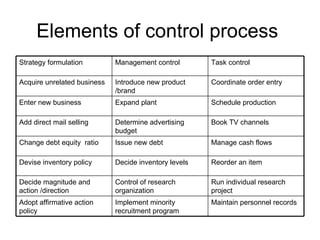
Elements of control process  Maintain personnel records  Implement minority recruitment program  Adopt affirmative action policy  Run individual research project  Control of research organization  Decide magnitude and action /direction  Reorder an item Decide inventory levels Devise inventory policy  Manage cash flows  Issue new debt  Change debt equity  ratio Book TV channels  Determine advertising budget  Add direct mail selling  Schedule production  Expand plant  Enter new business  Coordinate order entry  Introduce new product /brand  Acquire unrelated business  Task control  Management control  Strategy formulation
MCS-behavioral considerations  It involves interactions among individuals /managers ,their personal goals against organizational goals – Goal Congruence  Specification of organization hierarchy /structure ,roles and reporting relationships  Responsibilities that shape decision making within the organization  Organizational culture guiding managerial actions under leaders’ directions
MCS –financial /non financial ? Financial dimensions –’bottom line’ ,net income ,ROI , Return on equity etc. Non financial –product quality ,market share, customer satisfaction, on time delivery , employee morale  Interactive control calls for management’s attention for developments –either new troubles /opportunities –new strategies ,  Integral part of MCS –essentially non financial

Management control systems

  • 1.
    Management Control Systems Introduction Prof.C.S.Balasubramaniam
  • 2.
    Basics of MCS managerial pyramid of control Strategic Control concerned with Long range corporate planning for 3 or more years dealing with corporate performance analysis ,review of strategies, action plans and decisions for modifications through quarterly /half yearly reports on ROCE/ROI, growth in sales, market share, PESTLE factors
  • 3.
    Business Unit Control Concerned with annual plan /budgets dealing with product group ,regional performance analysis ,decisive actions on correctional actions through monthly/quarterly reports on sales, costs and profits , working capital assets & liabilities
  • 4.
    Operational Control Concerned with operating plans and schedules for the month /quarter dealing with review of programmes/activities for each production section /branch/product/sales /territory and task and decisions on corrections at the field level /segments of customers
  • 5.
    Scope and Means Defining the scope and objectives of control efforts Ascertaining key factors that have impact on performance Measuring deviations from planned course &their significance Evolving, testing ,evaluating alternative action plans for control Determine appropriate tools /techniques for implementing actions Compiling a performance monitoring ,review reports ,and deciding on corrective paths
  • 6.
    What is MCS? trouble shooting exercise Problem solving scheme Decision making through authority and action plans at appropriate levels by people oriented tasks Human judgments play critical role Involving managerial skills
  • 7.
    MCS at unitlevel A process of evaluating ,monitoring & controlling the various sub units /divisions Effective & efficient allocation and utilization of resources in achieving the predetermined goals The focus of action plans is on identifying the managers who are responsible for performance of their departments –Responsibility Centre Assessing planned performance (targets/budgets) against actual performance which are decided on the basis of available resources of men, materials and money
  • 8.
    MCS at theunit level Actual against planned performance levels compared at regular time intervals so as to identify resource gaps and if need be provide managers with higher resources transfer resources from one sub unit to another with the objective of better utilization and profits for the company as a whole
  • 9.
    MCS is notidealistic ! Does not necessarily mean that actions should correspond to the plan (budget/targets) The stated plans were based on circumstances at that time of formulation both inside and outside the unit /organization Purpose of MCS is discovering a better way of achieving organization’s goals and MCS would not prohibit the new ways and competitive means
  • 10.
    Elements of controlprocess Maintain personnel records Implement minority recruitment program Adopt affirmative action policy Run individual research project Control of research organization Decide magnitude and action /direction Reorder an item Decide inventory levels Devise inventory policy Manage cash flows Issue new debt Change debt equity ratio Book TV channels Determine advertising budget Add direct mail selling Schedule production Expand plant Enter new business Coordinate order entry Introduce new product /brand Acquire unrelated business Task control Management control Strategy formulation
  • 11.
    MCS-behavioral considerations It involves interactions among individuals /managers ,their personal goals against organizational goals – Goal Congruence Specification of organization hierarchy /structure ,roles and reporting relationships Responsibilities that shape decision making within the organization Organizational culture guiding managerial actions under leaders’ directions
  • 12.
    MCS –financial /nonfinancial ? Financial dimensions –’bottom line’ ,net income ,ROI , Return on equity etc. Non financial –product quality ,market share, customer satisfaction, on time delivery , employee morale Interactive control calls for management’s attention for developments –either new troubles /opportunities –new strategies , Integral part of MCS –essentially non financial