CONTROLLING
and
COORDINATING
PREPARED BY:
Padum Chetry
Pragya Haloi
Upasana Madhukalya
Govinda Roy
CONTENTS
CONTROLLING
Concept: meaning, definition
Features, steps
Major control techniques
Essentials of an effective control system
Importance
COORDINATION
Meaning, definition and features
Importance and Principles
Major coordination techniques
CONTROLLING
CONTROLLING
- Management control refers to setting of predetermined standards, comparing actual
performance with these standards and if required, taking corrective actions to ensure the
achievement of organizational goals.
‘‘Managerial control implies the measurement of accomplishment against
the standard and the correction of deviations to assure attainment of
objectives according to plans.’’
-Koontz and O’Donnell
Features:
 Determines standards, norms and
goals
 Fundamental management function.
 It is all pervasive.
 Continuous activity.
 It is related to results.
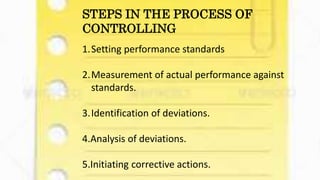
STEPS IN THE PROCESS OF
CONTROLLING
1.Setting performance standards
2.Measurement of actual performance against
standards.
3.Identification of deviations.
4.Analysis of deviations.
5.Initiating corrective actions.
Techniques of controlling:
a) Past oriented and future
oriented
b)Market control, bureaucratic
control and clan control
c)Old control and new control
techniques
1. Personal Observation
2. Statistical Reports
3. Break – even analysis
4. Budgetary control
Traditional
techniques
1. Return on Investment (ROI)
2. Management Audit
3. Management Information System(MIS)
4. Zero-based Budgeting (ZBB)
5. PERT (Programme Evaluation and
Review Technique)/CPM(Critical
Path Method)
6. Ratio Analysis
7. Responsibility Accounting
Modern
techniques
Essentials of an effective control system
• Suitable
• Timely and forward looking
• Objective and comprehensible
• Flexible
• Economical
• Prescriptive and operational
• Acceptable to organization members
• Reveal exceptions at strategic points
• Motivate people to high performance
• Should not lead to less attention to other aspects
• Should be periodically reviewed and evaluated
Importance of controlling:
 Accomplishing organizational goals
 Judging accuracy of standards
 Making efficient use of resources
 Improving employee motivation
 Ensuring order and discipline
 Facilitating coordination in action
RELATIONSHIP BETWEEN PLANNING AND CONTROLLING
 PLANNING identifies action and CONTROLLING ensures that those actions are
carries out properly.
 Poor control system is followed by failure of plans and effective control system
reinforces the present plans.
 Controlling helps the managers in either revising their plans or abandoning them
altogether.
 Framing plans presume the existence of a well designed control system and the
controlling function similarly presumes the existence of plans which are well
within the reach of the organization
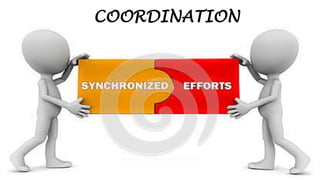
COORDINATION
COORDINATION
- an orderly arrangement of group efforts to maintain harmony among individuals efforts
towards the accomplishment of common goals of an organization.
‘‘Coordination is balancing and keeping together the team by ensuring suitable allocation
of tasks to the various members and seeing that the tasks are performed with harmony
among the members themselves.’’
-E.F.L.Brech
Features:
 Continuous activity
 Dynamic process
 Integrates group efforts
 Responsibility of all managers
 Ensures unity of action
 A deliberate function
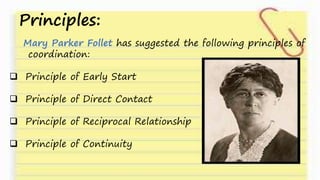
Principles:
Mary Parker Follet has suggested the following principles of
coordination:
 Principle of Early Start
 Principle of Direct Contact
 Principle of Reciprocal Relationship
 Principle of Continuity
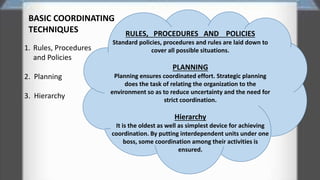
BASIC COORDINATING
TECHNIQUES
1. Rules, Procedures
and Policies
2. Planning
3. Hierarchy
RULES, PROCEDURES AND POLICIES
Standard policies, procedures and rules are laid down to
cover all possible situations.
PLANNING
Planning ensures coordinated effort. Strategic planning
does the task of relating the organization to the
environment so as to reduce uncertainty and the need for
strict coordination.
Hierarchy
It is the oldest as well as simplest device for achieving
coordination. By putting interdependent units under one
boss, some coordination among their activities is
ensured.
Importance of Coordination:
 To harmonize conflicts
 Total accomplishments
 Emphasizes human relation
 Retention of good personnel
 Promotes stability, growth and prosperity of the organization
 Efficiency and economy
“COORDINATION IS THE VERY ESSENCE OF
MANAGEMENT !!!”
Thank YOU

Coordinating and controlling

  • 1.
  • 2.
    CONTENTS CONTROLLING Concept: meaning, definition Features,steps Major control techniques Essentials of an effective control system Importance COORDINATION Meaning, definition and features Importance and Principles Major coordination techniques
  • 3.
  • 4.
    CONTROLLING - Management controlrefers to setting of predetermined standards, comparing actual performance with these standards and if required, taking corrective actions to ensure the achievement of organizational goals. ‘‘Managerial control implies the measurement of accomplishment against the standard and the correction of deviations to assure attainment of objectives according to plans.’’ -Koontz and O’Donnell
  • 5.
    Features:  Determines standards,norms and goals  Fundamental management function.  It is all pervasive.  Continuous activity.  It is related to results.
  • 6.
    STEPS IN THEPROCESS OF CONTROLLING 1.Setting performance standards 2.Measurement of actual performance against standards. 3.Identification of deviations. 4.Analysis of deviations. 5.Initiating corrective actions.
  • 7.
    Techniques of controlling: a)Past oriented and future oriented b)Market control, bureaucratic control and clan control c)Old control and new control techniques
  • 8.
    1. Personal Observation 2.Statistical Reports 3. Break – even analysis 4. Budgetary control Traditional techniques
  • 9.
    1. Return onInvestment (ROI) 2. Management Audit 3. Management Information System(MIS) 4. Zero-based Budgeting (ZBB) 5. PERT (Programme Evaluation and Review Technique)/CPM(Critical Path Method) 6. Ratio Analysis 7. Responsibility Accounting Modern techniques
  • 11.
    Essentials of aneffective control system • Suitable • Timely and forward looking • Objective and comprehensible • Flexible • Economical • Prescriptive and operational • Acceptable to organization members • Reveal exceptions at strategic points • Motivate people to high performance • Should not lead to less attention to other aspects • Should be periodically reviewed and evaluated
  • 12.
    Importance of controlling: Accomplishing organizational goals  Judging accuracy of standards  Making efficient use of resources  Improving employee motivation  Ensuring order and discipline  Facilitating coordination in action
  • 13.
    RELATIONSHIP BETWEEN PLANNINGAND CONTROLLING  PLANNING identifies action and CONTROLLING ensures that those actions are carries out properly.  Poor control system is followed by failure of plans and effective control system reinforces the present plans.  Controlling helps the managers in either revising their plans or abandoning them altogether.  Framing plans presume the existence of a well designed control system and the controlling function similarly presumes the existence of plans which are well within the reach of the organization
  • 14.
  • 15.
    COORDINATION - an orderlyarrangement of group efforts to maintain harmony among individuals efforts towards the accomplishment of common goals of an organization. ‘‘Coordination is balancing and keeping together the team by ensuring suitable allocation of tasks to the various members and seeing that the tasks are performed with harmony among the members themselves.’’ -E.F.L.Brech Features:  Continuous activity  Dynamic process  Integrates group efforts  Responsibility of all managers  Ensures unity of action  A deliberate function
  • 16.
    Principles: Mary Parker Follethas suggested the following principles of coordination:  Principle of Early Start  Principle of Direct Contact  Principle of Reciprocal Relationship  Principle of Continuity
  • 17.
    BASIC COORDINATING TECHNIQUES 1. Rules,Procedures and Policies 2. Planning 3. Hierarchy RULES, PROCEDURES AND POLICIES Standard policies, procedures and rules are laid down to cover all possible situations. PLANNING Planning ensures coordinated effort. Strategic planning does the task of relating the organization to the environment so as to reduce uncertainty and the need for strict coordination. Hierarchy It is the oldest as well as simplest device for achieving coordination. By putting interdependent units under one boss, some coordination among their activities is ensured.
  • 18.
    Importance of Coordination: To harmonize conflicts  Total accomplishments  Emphasizes human relation  Retention of good personnel  Promotes stability, growth and prosperity of the organization  Efficiency and economy “COORDINATION IS THE VERY ESSENCE OF MANAGEMENT !!!”
  • 19.