THE DIRECTING PHASE OF THE
MANAGEMENT PROCESS
LEARNING OBJECTIVES
• Upon completion of this unit, the student should be able to:
– 1) Define the directing phase of the management process.
– 2) Define the various elements of the directing phase of
the management process (i.e., motivation, delegation,
supervision, leadership).
– 3) Differentiate intrinsic from extrinsic motivation.
– 4) Explain the various motivational theories.
LEARNING OBJECTIVES
– 5) State the reasons for delegating errors.
– 6) Name the common delegation errors.
– 7) Describe the steps to ensure effective delegation.
– 8) Explain the purposes of supervision.
LEARNING OBJECTIVES
– 9) Compare and contrast the different styles of
supervision.
– 10) Explain the different leadership theories.
– 11) Compare and contrast the various leadership theories.
THE DIRECTING PHASE OF THE MANAGEMENT
PROCESS
process in which the managers instruct, guide and oversee the
performance of the workers to achieve predetermined goals.
Directing is said to be the heart of management
process.Planning,organizing, staffing have got no importance
if direction function does not take place. Directing is
influencing people's behavior through motivation,
communication, group dynamics, leadership and discipline.
Managers give this function a variety of names. Higgins calls it
leading. Other labels are: influencing, coaching, motivating,
interpersonal relations, and human relations
INTRODUCTION
DEFINITION OF DIRECTING
• It is the fourth phase of the
management process
wherein the manager sets
plans into action towards
attainment of organizational
goals
1ST Phase
PLANNING
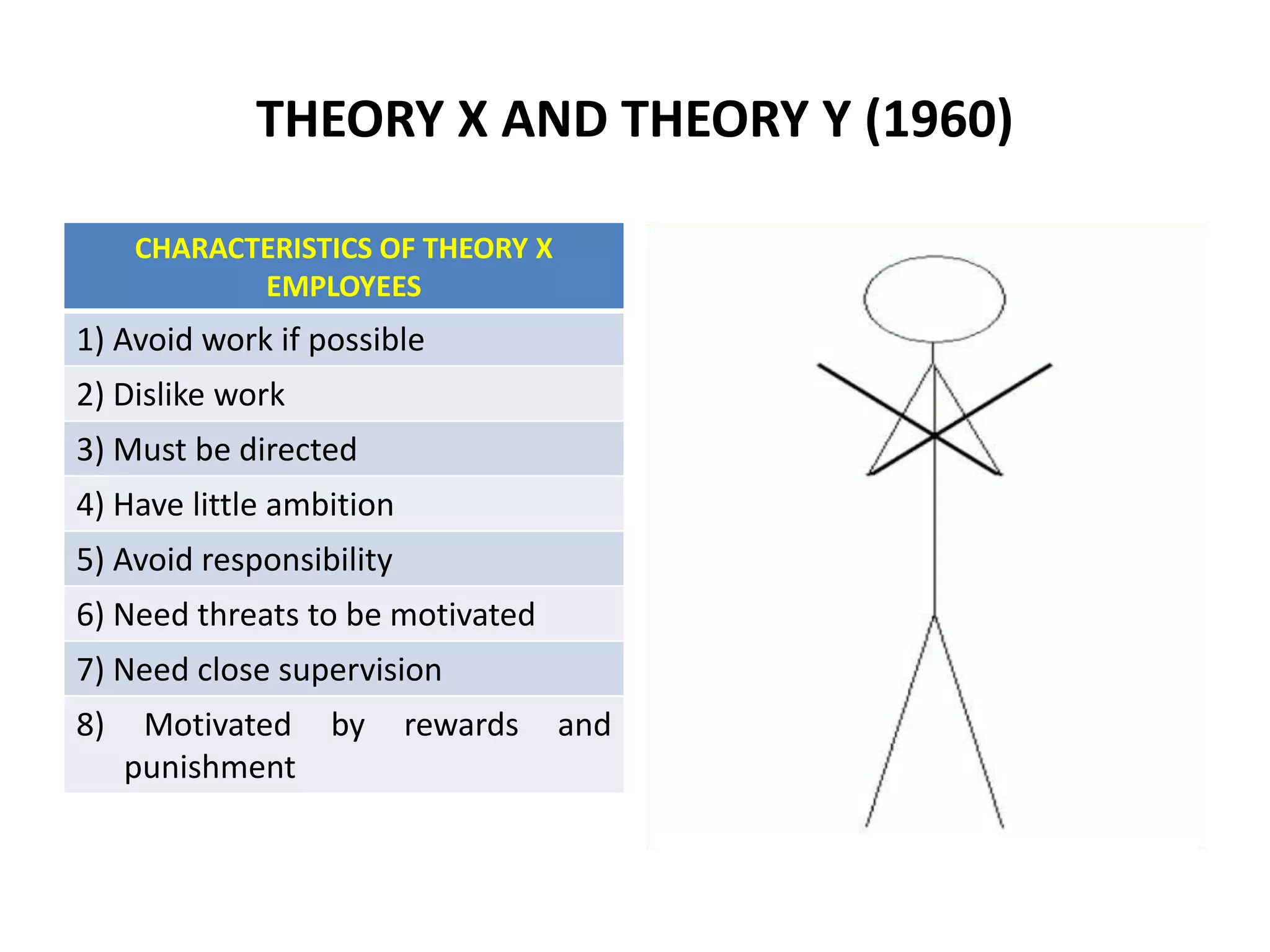
2ND Phase
ORGANIZIN
G
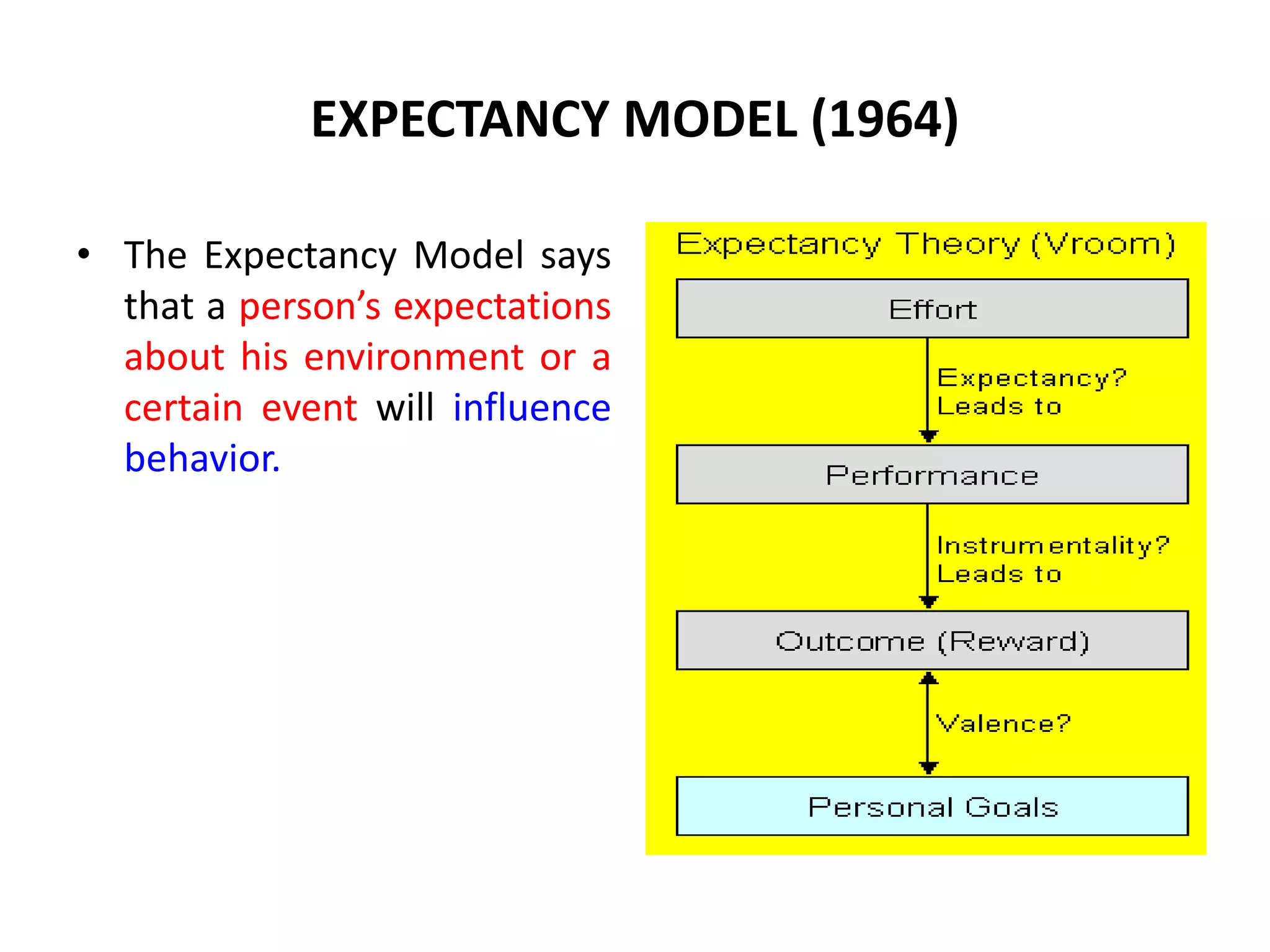
3RD Phase
STAFFING
4TH Phase
DIRECTIN
G
5TH Phase
CONTROLLING
DEFINITION OF DIRECTING
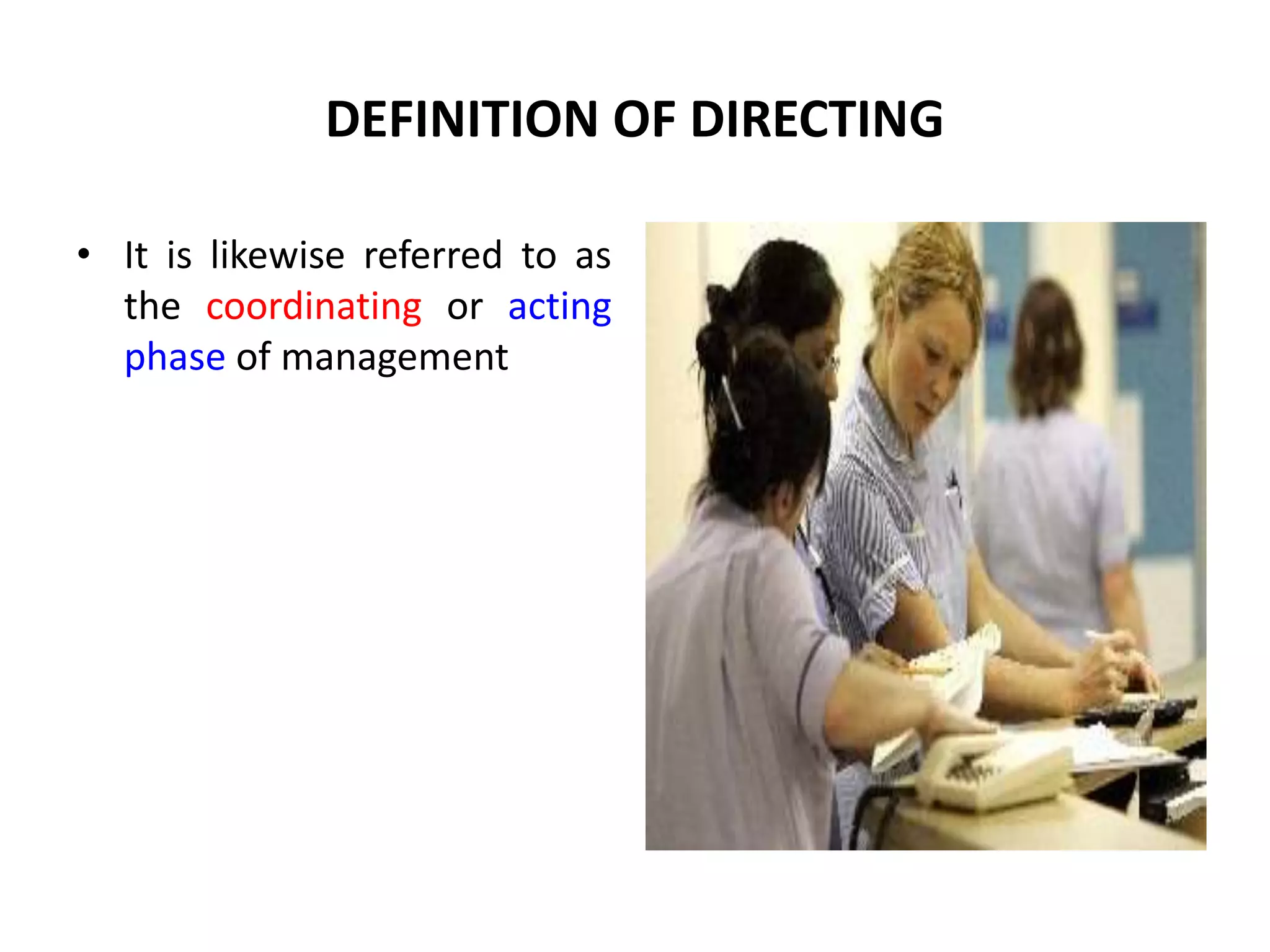
• It is likewise referred to as
the coordinating or acting
phase of management
DEFINITION OF DIRECTING
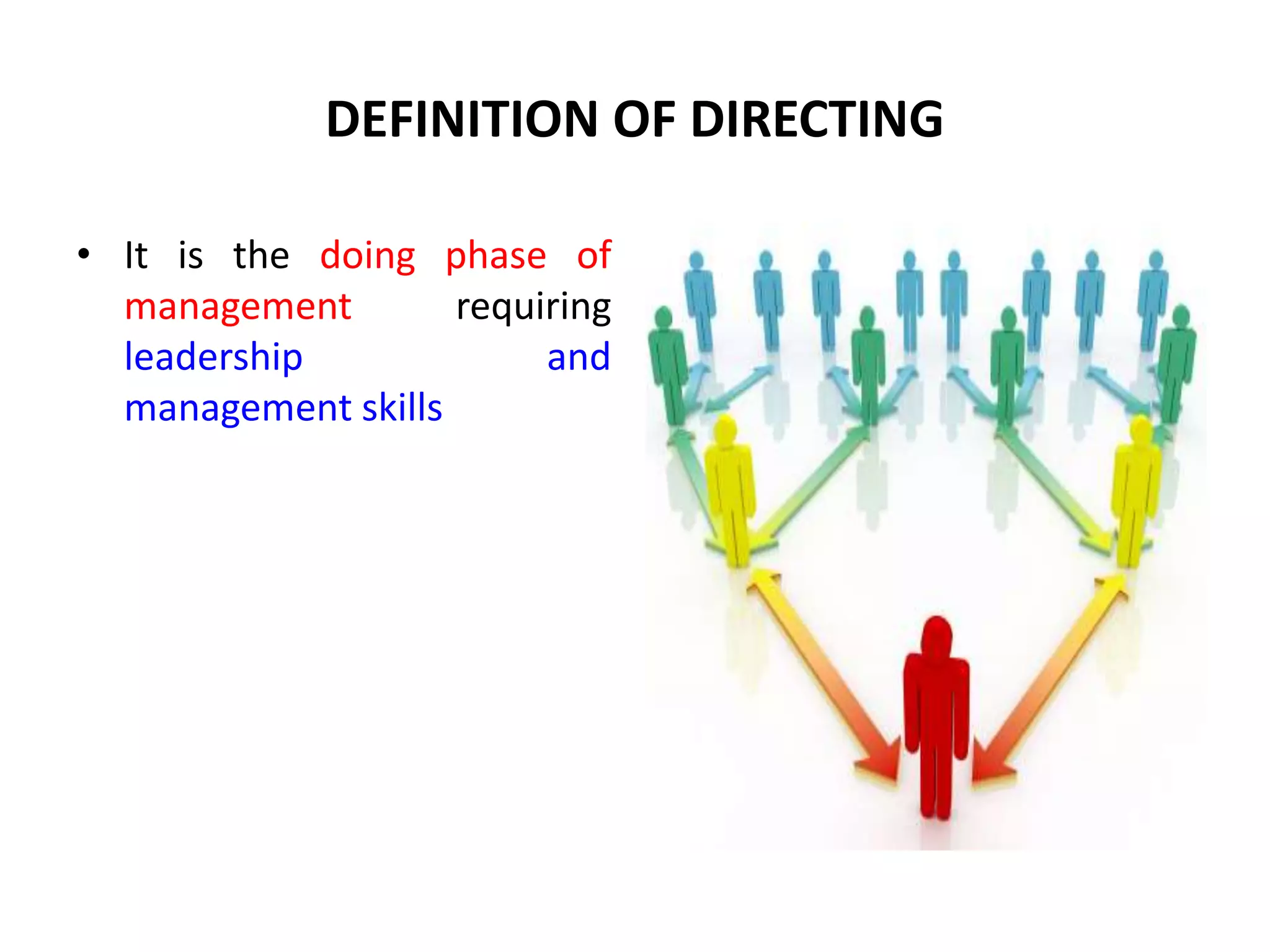
• It is the doing phase of
management requiring
leadership and
management skills
THE DIRECTING PHASE OF THE
MANAGEMENT PROCESS
 COMPONENTS OF DIRECTING
COMPONENTS OF THE DIRECTING PHASE OF THE
MANAGEMENT PROCESS
• 1) Creating a motivating climate
• 2) Establishing organizational communication
• 3) SUPERVISION
• 4) DELEGATION
• 5)LEADER SHIP
COMMUNICATION
Communication is a basic organizational function, which refers
to the process by which person (known as sender) transmits
information or messages to another person(known as
receiver). The purpose of communication in organizations is to
convey orders, instructions, or information so as to bring
desired changes in the performance and or the attitude of
employees. . In an organization, supervisors transmit
information to subordinates. Proper communication results in
clarity and securing the cooperation of subordinates. Faulty
communication may create problems due to
misunderstanding between the superior and subordinates.
The subordinates must correctly understand the message
conveyed to them.
• there are two parties, one is known as the sender
and the other is known as receiver;• there is a
message sent by the sender to the receiver; and• the
receiver receives the message and understands it.
Communication does not always flow from
supervisor to subordinate. It can also be from a
subordinate to a supervisor. For example,
subordinates can pass information to the supervisor
about the faults/problemsat the assembly line. Thus,
it is a two way process
IMPORTANCE
• Communication helps employees to understand their role
clearly and perform effectively.
• It helps in achieving co-ordination and mutual understanding
which in turn, leads to industrial harmony and increased
productivity.
• Communication improves managerial efficiency and ensures
cooperation of the staff.
• Effective communication helps in molding attitudes and
building up employees’ morale.
• Communication is the means through which delegation and
decentralization of authority is successfully accomplished in an
organization
• Formal and Informal Communication The path
through which information flows is called
channel of communication. In every
organization have both formal and informal
channels. The paths of communication which
are based on relationship establish formally by
management Aretha formal channels.
• Upward, Downward, Horizontal and Diagonal
Communication(On the basis of the flow or direction
of communication in organizations, it can be classified
as upward, downward, horizontal or diagonal) When
employees make any request, appeal, report, suggest
or communicate ideas to the superior, the flow of
communication is upward i.e., from bottom to top.
For instance, when a typist drops a suggestion in the
suggestion box, or a foreman reports breakdown of
machinery to the factory manager, the flow of
communication is upward
• Upward communication encourages employees to participate
actively in the operations of their department. They get
encouraged and their sense of responsibility increases when
they are heard by their supervisors about problems affecting
the jobs. When communication is made from superiors down
the hierarchy it is called a downward communication. For
instance, when superiors issue orders and instructions
tosubordinates,it is known as downward communication.
When the General Manager orders supervisors to work
overtime, the flow of communication is downward i.e., from
top to bottom. Similarly, communication of work assignments,
notices, requests for performance, etc. through bulletin boards,
memos, reports, speeches, meetings, etc, are all forms of
downward
communication. Communication can also be amongst members at the same
level in the organization. For instance, production manager may
communicate the production plan to the sales manager. This is known as
horizontal flow of communication. Here, the communication is among people
of the same rank and status. Such communication facilitates coordination of
activities that are interdependent. When communication is made between
people who are neither in the same department nor at the same level of
organizational hierarchy, it is called diagonal communication. For example,
cost accountant may request for reports from sales representatives not the
sales manager for the purpose of distribution cost analysis. This type of
communication does take place under special circumstances
CHANNELS OF COMMUNICATION
Verbal And Non – Verbal On the basis of the mode
used, communication may be verbal or non-verbal.
While communicating, managers may talk to their
subordinates either face to face or on telephone or they
may send letters, issue notices, or memos. These are
all verbal communication. Thus, the verbal modes of
communication may be oral and written. Face to face
communication, as in interviews, meetings and
seminars, are examples of oral communication. Issuing
orders and instructions on telephone or through an
intercommunication system is also oral communication.
The written modes of communication include letters,
circulars, notice sand memos. Sometimes verbal
communication is supported bynon-verbal
communication such as facial expressions and body
gestures. For example– wave of hand, a smile or a
frown etc. This is also termed as the gestural
communication
THE DIRECTING PHASE OF THE
MANAGEMENT PROCESS
 MOTIVATION
MOTIVATION
• It is the force within the
individual that influences
strength or direction of
behavior
MOTIVATION
• It is the action people take
to satisfy unmet needs
MOTIVATION
• It is the willingness to put
effort into achieving a goal
or reward to decrease the
tension caused by the need.
IMPORTENT
• with proper motivation there can be maximum
utilization of the factors of production like men,
money, material etc.;• if employees are motivated it
will reduce employee turnover and absenteeism;•
motivation fosters a sense of belongingness among
the employees towards the organization and also
improves their morale;• motivation helps in reducing
the number of complaints and grievances. The
wastage and accident rate also come down;• with
proper motivational techniques management can
attract competent and best quality employees
TWO TYPES OF MOTIVATION
• (1) Intrinsic Motivation
• (2) Extrinsic Motivation
INTRINSIC MOTIVATION
• This is the type of
motivation that comes from
within the person, driving
the person to be productive
IMPORTANT CONCEPT
• The intrinsic motivation to
achieve is directly related to
a person’s level of
aspiration.
EXTRINSIC MOTIVATION
• This is the type of
motivation that comes from
outside of the person,
driving the person to be
productive
IMPORTANT CONCEPT
• Extrinsic motivation is
enhanced by the job
environment or external
rewards.
THE DIRECTING PHASE OF THE
MANAGEMENT PROCESS
 MOTIVATIONAL THEORIES
MOTIVATIONAL THEORIES
MOTIVATIONAL THEORY YEAR PROPONENT
1) Hawthorne Effect 1953 Elton Mayo
2) Operant Conditioning 1953 B. F. Skinner
3) Theory X and Theory Y 1960 Douglas McGregor
4) Expectancy Model 1964 Victor Vroom
5) Hierarchy of Needs 1970 Abraham Maslow
6) Basic Motivational Needs 1971 David McClelland
7) Two-factor Theory 1977 Frederick Herzberg
HAWTHORNE EFFECT (1953)
• The studies conducted by
Elton Mayo and his Harvard
associates at the
Hawthorne Works of the
Western Electric Company
in Chicago began as an
attempt to look at the
relationship between light
illumination in the factory
and productivity
HAWTHORNE EFFECT (1953)
• Mayo discovered that when
management paid special
attention to workers,
productivity was likely to
increase, regardless of the
environmental working
conditions
HAWTHORNE EFFECT (1953)
• This “Hawthorne Effect”
indicated that people
respond to the fact that
they are being studied,
attempting to increase
whatever behavior they feel
will continue to warrant the
attention.
HAWTHORNE EFFECT (1953)
• Mayo also found that
informal work groups and a
socially informal work
environment were factors in
determining productivity
HAWTHORNE EFFECT (1953)
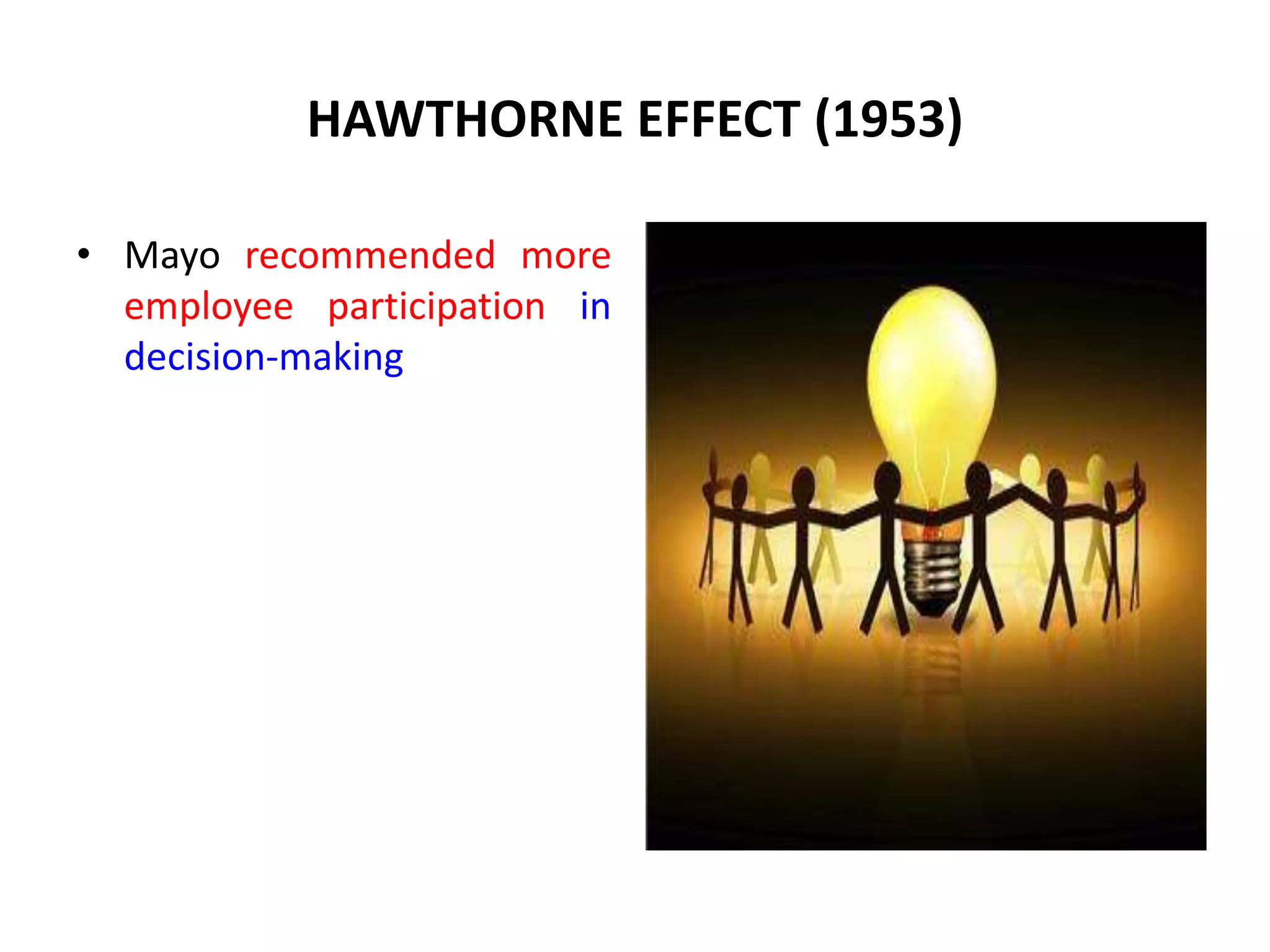
• Mayo recommended more
employee participation in
decision-making
OPERANT CONDITIONING (1953)
• B. F. Skinner demonstrated
that people can be
conditioned to behave in a
certain way based on a
consistent reward or
punishment system.
OPERANT CONDITIONING (1953)
• B. F. Skinner showed that:
– (1) behavior that is
rewarded will be
repeated and;
OPERANT CONDITIONING (1953)
• B. F. Skinner showed that:
– (2) behavior that is
punished or unrewarded
is extinguished.
THEORY X AND THEORY Y (1960)
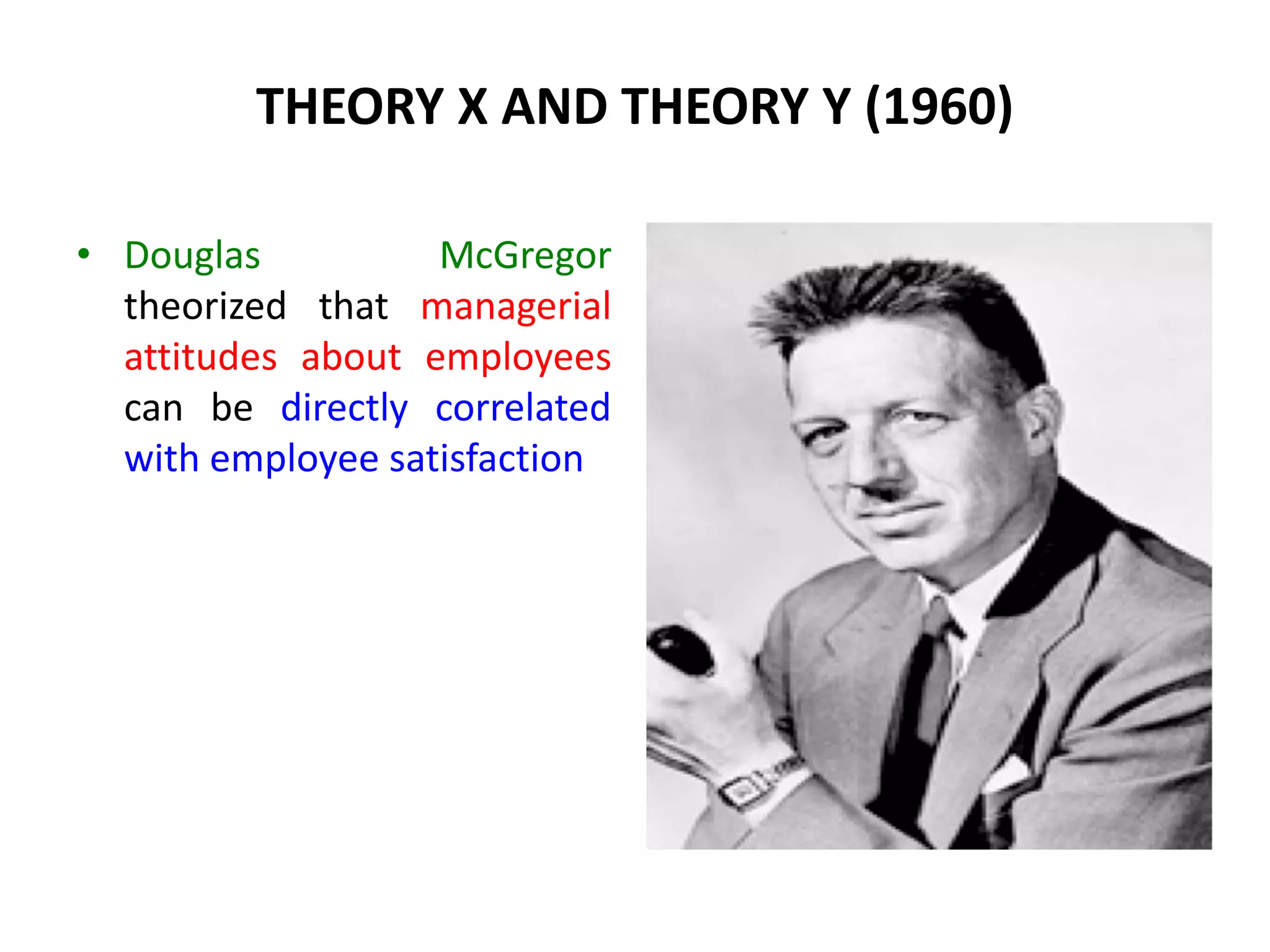
• Douglas McGregor
theorized that managerial
attitudes about employees
can be directly correlated
with employee satisfaction
THEORY X AND THEORY Y (1960)
CHARACTERISTICS OF THEORY X
EMPLOYEES
1) Avoid work if possible
2) Dislike work
3) Must be directed
4) Have little ambition
5) Avoid responsibility
6) Need threats to be motivated
7) Need close supervision
8) Motivated by rewards and
punishment
THEORY X AND THEORY Y (1960)
CHARACTERISTICS OF THEORY Y
EMPLOYEES
1) Like and enjoy work
2) Are self-directed
3) Seek responsibility
4) Are imaginative and creative
5) Have underutilized intellectual
capacity
6) Need only general supervision
7) Are encouraged to participate in
problem solving
EXPECTANCY MODEL (1964)
• Victor Vroom looked at
motivation in terms of the
person’s preference based
on social values.
EXPECTANCY MODEL (1964)
• The Expectancy Model says
that a person’s expectations
about his environment or a
certain event will influence
behavior.
EXPECTANCY MODEL (1964)
• People look at all actions as
having a cause and effect.
EXPECTANCY MODEL (1964)
• People make conscious
decisions in anticipation of
a reward.
HIERARCHY OF NEEDS (1970)
• Maslow believed that
people are motivated to
satisfy certain needs
ranging from basic survival
to complex psychological
needs
HIERARCHY OF NEEDS (1970)
• Maslow believed that
people seek a higher need
only when the lower needs
have been met.
MODIFIED VERSION OF MASLOW’S HIERARCHY
OF NEEDS (1990)
• The eight-level version of
Maslow’s Hierarchy of
Needs
BASIC MOTIVATIONAL NEEDS (1971)
• David McClelland claimed
that people are motivated
by three basic needs:
– (1) Achievement
– (2) Affiliation
– (3) Power
BASIC MOTIVATIONAL NEEDS (1971)
David McClelland’s Basic Motivational Needs Theory is also
known as the Acquired Needs Theory.
BASIC MOTIVATIONAL NEEDS (1971)
• (1) Achievement-oriented
people:
– (1.1) Actively focus on
improving what is
– (1.2) Transform ideas
into action
– (1.3) Take risks when
necessary
BASIC MOTIVATIONAL NEEDS (1971)
• (2) Affiliation-oriented
people focus their energies
on families and friends
BASIC MOTIVATIONAL NEEDS (1971)
• (3) Power-oriented people
want to:
– (3.1) command attention
– (3.2) get recognition
– (3.3) control others
TWO-FACTOR THEORY (1977)
• Frederick Herzberg believed
that:
• (1) employees can be
motivated by the work itself
• (2) there is an internal or
personal need to meet
organizational goals
• (3) separating personal
motivators from job
dissatisfiers was possible
TWO-FACTOR THEORY (1977)
MOTIVATORS
Achievement
Recognition
Work
Responsibility
Advancement
Possibility for growth
Company policy
Status
HYGIENE or MAINTENANCE FACTORS
Salary
Supervision
Job security
Positive working conditions
Personal life
Interpersonal relations / peers
Integrating leadership roles and
management functions in creating
a motivating climate at work
• Mangers cannot intrinsically motivate people,because
motivation comes froom within the person.the humanistic
manager can,however,create an enviroment in which the
development of human potential can be maximized
• Positive reinforcement is one of the most powerful motivation
the manager can use and is frequently overlooked or
underused.
• The supervisor or managers personal motivation is an
important factor affecting staffs commiment to duties and
morale.
• The success of a motivational strategy is
measured by the increased productivity and
benefit to the the organization and by the
growth in the person, whish motivates him or
her to accomplish again.
• Managers must show their own positive
attitude to demonstrate to employess that
there is joy in work
THE DIRECTING PHASE OF THE
MANAGEMENT PROCESS
 DELEGATION
DEFINITION OF DELEGATION
• It is the art of getting work
done through others
DEFINITION OF DELEGATION
• It involves directing the
performance of one or
more people to accomplish
organizational goals
REASONS FOR DELEGATING
• 1) Managers delegate
routine tasks in order to be
free to handle more
complex problems that
require a higher level of
expertise.
REASONS FOR DELEGATING
• 2) Delegation provides
learning or “stretching”
opportunities to
subordinates
REASONS FOR DELEGATING
• 3) Delegation empowers
subordinates to participate
and make a difference
toward the success of the
organization
COMMON DELEGATION ERRORS
• 1) Underdelegating
– A manager sparingly
delegates tasks that can
be accomplished by
subordinates resulting
into an overburdened
manager
REASONS FOR UNDERDELEGATING
• Underdelegating is brought
about by:
– (1) the manager’s false
assumption that
delegation may be
interpreted as a lack of
ability on his part to do
the job correctly or
completely.
REASONS FOR UNDERDELEGATING
• Underdelegating is brought
about by:
– (2) the manager’s desire
to complete the whole
job himself
REASONS FOR UNDERDELEGATING
• Underdelegating is brought
about by:
– (3) the manager lacks
experience in the job
REASONS FOR UNDERDELEGATING
• Underdelegating is brought
about by:
– (4) the manager lacks
experience in delegating
REASONS FOR UNDERDELEGATING
• Underdelegating is brought
about by:
– (5) the manager has an
excessive need to
control or be perfect
COMMON DELEGATION ERRORS
• 2) Overdelegating
– A manager turns over to
subordinates more tasks
than they can effectively
handle.
– This results into
overburdening the
subordinates
REASONS FOR OVERDELEGATING
• Overdelegating is brought
about by:
– (1) the manager
practicing poor time-
management.
REASONS FOR OVERDELEGATING
• Overdelegating is brought
about by:
– (2) the manager feeling
insecure about his ability
to perform a task.
COMMON DELEGATION ERRORS
• 3) Improperly Delegating
– A manager delegates at
the wrong time, to the
wrong person, or for the
wrong reason
COMMON DELEGATION ERRORS
• 3) Improperly Delegating
– A manager delegates
tasks and responsibilities
which are beyond the
capability of the
subordinate assigned to
do the task
COMMON DELEGATION ERRORS
• 3) Improperly Delegating
– A manager delegates
decision-making without
providing adequate
information
STEPS TO ENSURE EFFECTIVE DELEGATION
• 1) Plan ahead to identify
tasks to be accomplished
STEPS TO ENSURE EFFECTIVE DELEGATION
• 2) Identify the skill or the
educational level necessary
to complete the job
STEPS TO ENSURE EFFECTIVE DELEGATION
• 3) Identify the person best
able to complete the job in
terms of capability and
freedom of time to do so.
STEPS TO ENSURE EFFECTIVE DELEGATION
• 4) Clearly communicate
exactly what is to be done,
including the purpose for
doing so.
STEPS TO ENSURE EFFECTIVE DELEGATION
• 5) Delegate the authority
and the responsibility
necessary to complete the
task
STEPS TO ENSURE EFFECTIVE DELEGATION
• 6) Set time lines, and
monitor how the task is
being accomplished.
– This can be done
through informal but
regularly scheduled
meetings
STEPS TO ENSURE EFFECTIVE DELEGATION
• 7) If the subordinate is
having difficulty carrying
out the delegated task, be
available as a role model
and resource in helping
identify alternative
solutions
STEPS TO ENSURE EFFECTIVE DELEGATION
• 8) Evaluate the
subordinate’s performance
after the task has been
completed.
STEPS TO ENSURE EFFECTIVE DELEGATION
• 9) Be sure to reward
appropriately a successfully
completed task.
Management functions
• Creates gob descriptions and scope of practice
statements for all personal, including NAP,
that conform to national,state,and
professional recommendations for ensuring
safe patient care.
• Is knowledgeable regarding legal liabilities of
subordinate supervision.
• Accurately assesses subordinates capabilities
and motivation when delegation.
• Delegates a level of authority necessary to
complete delegated tasks
• Develops and implements a periodic review
process for all delegated tasks
• Provides recognition or reward for the
completion of delegated tasks.
THE DIRECTING PHASE OF THE
MANAGEMENT PROCESS
 SUPERVISION
DEFINITION OF SUPERVISION
• Supervision is a critical
watching and directing of
activities or course of action
of a subordinate by his
superior.
SUPERVISION
• After the employees have been instructed
regarding what they have to do and how to-
do, it is the duty of the manager to see that
they perform the work as per instructions.
This is known as supervision. Managers play
the role of supervisors and ensure that the
work is done as per the instructions and the
plans. Supervisors clarify all instructions and
guide employees to work as a team in co-
operation with others. Supervisors solve most
of the routine job-related problems of
FUNCTIONS
• clarifies orders and instructions issued to
subordinates and ensures that they have understand
and follow these fully;• ensures that subordinates
have the required facilities to perform their jobs;•
keeps a watch and guides the activities of
subordinates in performing their jobs;• broadens the
horizon of his subordinates by making them aware of
the wider aspects of their day-to-day work;•
coordinates the work of different subordinates under
him;• detects errors and omissions and ensures their
rectification
PURPOSES OF SUPERVISION
• (1) Supervision enhances
the professional functioning
of the subordinate
PURPOSES OF SUPERVISION
• (2) Supervision monitors the
quality of professional
service offered by the
subordinate to the client
IMPORTANCE
• Supervisors are the key people among
managers at different levels. They are the link
between the top and middle management
and the workers. Take, for example, the
foreman of the factory or the office
superintendent inthe office. Both of them are
members of the management team, and are
in direct contact with operatives in the
workshop and clerical staff in the office. They
are the mouthpiece of management for
communicating its ideas, plans and policies to
STYLES OF SUPERVISION
• 1) Directing Supervision
• 2) Coaching Supervision
• 3) Supportive Supervision
• 4) Delegating Supervision
DIRECTING SUPERVISION
• Involves high directive or
task communications with
low support or relationship
behavior
DIRECTING SUPERVISION
• Typical use would involve
managing an enthusiastic
newcomer to the particular
task (motivated, but needs
guidance).
DIRECTING SUPERVISION
• A Directing style makes use
of clear, assertive
communication behaviors:
– (1) setting expectations,
– (2) proposing,
– (3) reasoning and evaluating,
and
– (4) the use of incentives and
pressures
DIRECTING SUPERVISION
CHARACTERISTICS OF A DIRECTING SUPERVISOR
1) Identifies problems
2) Set goals and defines roles
3) Develops an action plan to solve problems
4) Controls decision-making
5) Provides specific directions
6) Initiates problem solving and decision-making
7) Announces solutions and decisions
8) Closely supervises and evaluates work
COACHING SUPERVISION
• Coaching Supervision
involves high directive and
high supportive behavior
COACHING SUPERVISION
• Typical use would involve
managing an uncertain or
reluctant learner, someone
who needs convincing or
support along with task
guidance
COACHING SUPERVISION
• A Coaching style makes use
of clear, assertive and
supporting communication
behaviors
COACHING SUPERVISION
CHARACTERISTICS OF A COACHING SUPERVISOR
1) Identifies problems
2) Set goals
3) Recognizes and praises progress
4) Explains decisions
5) Solicits ideas
6) Makes final decision after hearing subordinate’s ideas,
opinions and feelings
7) Continues to direct work
8) Evaluates work
SUPPORTING SUPERVISION
• Supportive Supervision
involves low directive and
high supportive behavior.
SUPPORTING SUPERVISION
• Typical use would involve
managing a competent but
insecure subordinate.
SUPPORTING SUPERVISION
• A Supportive style makes
use of bridging or attracting
communication behaviors:
– (1) involving/drawing out the
other person,
– (2) active listening,
– (3) disclosing,
– (4) finding common ground,
and
– (5) visioning (attracting the
other person to a course of
action)
SUPPORTING SUPERVISION
CHARACTERISTICS OF A SUPPORTING SUPERVISOR
1) Involves the subordinate in identifying problems and setting
goals
2) Allows the subordinate to take the lead in defining how the
task is to be done or how the problem is to be solved
3) Provides assurance and support, resources, ideas if requested
4) Shares responsibility with the subordinate for problem-solving
and decision-making
5) Listens to and facilitates problem-solving and decision-making
by the subordinate
6) Evaluates subordinate’s work together with the subordinate
DELEGATING SUPERVISION
• Delegating supervision
involves low directive or
task communications with
low supportive behavior
DELEGATING SUPERVISION
• Typical use would involve
managing a competent and
motivated subordinate –
who provides much of his or
her own support and
guidance
DELEGATING SUPERVISION
• A Delegating style would
provide only that degree of
task information and
support that is appropriate,
given the ability and
motivation of the
subordinate
DELEGATING SUPERVISION
• Appropriate monitoring is
maintained so that
additional guidance or help
can be provided as needed.
DELEGATING SUPERVISION
CHARACTERISTICS OF A DELEGATING SUPERVISOR
1) Jointly defines problems with the subordinate
2) Collaborates with the subordinate in formulating goals
3) Allows the subordinate to develop action plan and control
decision-making about how, when and with whom the
problem should be solved
4) Accepts the subordinate’s decisions
5) Evaluates performance only periodically
6) Allows subordinate to take responsibility and credit
SUMMARY OF CHARACTERISTICS OF DIFFERENT
STYLES OF SUPERVISION
STYLE OF SUPERVISION DIRECTING
BEHAVIORS
SUPPORTING
BEHAVIORS
1) Directing Supervision HIGH () LOW ()
2) Coaching Supervision HIGH () HIGH ()
3) Supporting Supervision LOW () HIGH ()
4) Delegating Supervision LOW () LOW ()
LEADERSHIP
• While motivation is the process through which
employees are made to contribute voluntarily
to work, leadership is the ability to persuade
and motivate others to work in a desired way
for achieving the goal. Thus, a person who is
able to influence others and make them follow
his instructions is called a leader. For example,
in an organisation the management decides to
install some new machines to which the
workers are resisting
• However, one ofthe workers takes the
initiative,explains the fellow workers the benefits of
working withthe new machines and moulds them to
accept themanagement’s decision. Now he is said to
be leader ashe is able to influence a group of workers
who followedhim. In practice, the managers have to
guide and leadtheir subordinates towards the
achievement of goals,and so, to be an effective, a
manager has to be a goodleader.Leadership is the
process, which influences thepeople and inspires
them to willingly accomplish theorganisational
objectives. The main purpose ofmanagerial
leadership is to get willing cooperation ofthe
workgroup in pursuit of the goals.
IMPORTANCE
• The objectives of any organization can only be
fulfilled if its employees are working towards
• accomplishment of such objectives. To make
people work in the desired manner, proper
• instructions and guidance are necessary. And
this direction process becomes effective
• when the persons who give such direction
have leadership qualities. Leadership is
essential
• in functioning of any organization and its importance
and benefits are varied. Some of
• these importance are:
• • leadership improves the performance of the
employees. Leaders can motivate the
• followers to work and thereby increase their
performance level.
• • with continuous support and guidance, leaders are
able to build confidence among the
• followers, thereby increasing speed and accuracy and
decreasing wastage.
• • with friendly and cooperative efforts the leader is
able to build employees’ morale
• which in turn contribute to higher productivity.
In order to be successful, a leader must possess certain
qualities. A good leader should
be professionally competent, intelligent, analytical and he/she
should have a sense of fair play, including honesty, sincerity,
integrity, and sense of responsibility. He must possess
initiative, perseverance, be diligent and realistic in his outlook.
He must also be able to communicate his subordinates
effectively. Human relation skills are a must for any leader.
Earlier, it was believed that the success or effectiveness of a
leader depends upon his personal traits or characteristics, like
physical appearance, intelligence, self-confidence,
alertness, and initiative.
LEADERSHIP QUALITIES
• This is no longer regarded as a correct approach. It
has been established on the basis of experiments
that the success or effectiveness of a person as a
leader depends upon his behaviour pattern or
leadership style in relation to the followers.
• To get things done, managers have to influence their
subordinates and seek their voluntary co-operation.
If their leadership is not based on suitable behaviour
or style, they will not be successful. When leaders
involve people in determining goals, and build up
team spirit, chances are that people will follow them
voluntarily
QUESTION NO. 1
• 1) The management process of directing involves which of the
following?
– A) Creation of the mission, vision and goals of the
organization
– B) Setting of plans into action towards the attainment of
organizational goals
– C) Assigning the right people at the right jobs or positions
at the right time
– D) Recruitment, interview and selection of staff
QUESTION NO. 13
• 13) Which style of supervision provides high directing
behaviors and low supporting behaviors?
– A) Directing Supervision
– B) Coaching Supervision
– C) Supporting Supervision
– D) Delegating Supervision
ANSWER TO QUESTION NO. 13
• 13) Which style of supervision provides high directing
behaviors and low supporting behaviors?
– A) Directing Supervision
– B) Coaching Supervision
– C) Supporting Supervision
– D) Delegating Supervision
QUESTION NO. 14
• 14) Which style of supervision should be used when managing
a competent and motivated subordinate who provides much
of his or her own support and guidance ?
– A) Directing Supervision
– B) Coaching Supervision
– C) Supporting Supervision
– D) Delegating Supervision
ANSWER TO QUESTION NO. 14
• 14) Which style of supervision should be used when managing
a competent and motivated subordinate who provides much
of his or her own support and guidance ?
– A) Directing Supervision
– B) Coaching Supervision
– C) Supporting Supervision
– D) Delegating Supervision
REFRENCE
• Stamler, L. L., Berry, L. & Alecxe, A. (2011). Improving Patient, Nursing and
Organizational Outcomes Utilizing Formal Nurse-Patient Ratios. Part of final report
for the Research To Action Project.Ottawa, ON, Canada: Canadian Federation of
Nurses Unions.
• Tourangeau, A., Cranley, L., Laschinger, H. & Pachis, J. (2010). Relationships among
leadership practices, work environments, staff communication and outcomes in
long-term care. Journal of Nursing Management, 18, 1060-1072.
• University of Toronto Magazine. (2003, summer). Study measures overcrowding in
hospital emergency rooms. Toronto, ON, Canada.
http://www.magazine.utoronto.ca/leading-edge/ canada-emergency-room-
overcrowding-study-michael-schull/
• Weidner, A., Graham, C., Smith, J., Aitken, J. & Odell, J. (2012). Evaluation of
nursing retention and recrutiment programs in Alberta. Canadian Journal of
Nursing Leadership(Sp), 130-147.
The directing phase of the management process

The directing phase of the management process

  • 1.
    THE DIRECTING PHASEOF THE MANAGEMENT PROCESS
  • 2.
    LEARNING OBJECTIVES • Uponcompletion of this unit, the student should be able to: – 1) Define the directing phase of the management process. – 2) Define the various elements of the directing phase of the management process (i.e., motivation, delegation, supervision, leadership). – 3) Differentiate intrinsic from extrinsic motivation. – 4) Explain the various motivational theories.
  • 3.
    LEARNING OBJECTIVES – 5)State the reasons for delegating errors. – 6) Name the common delegation errors. – 7) Describe the steps to ensure effective delegation. – 8) Explain the purposes of supervision.
  • 4.
    LEARNING OBJECTIVES – 9)Compare and contrast the different styles of supervision. – 10) Explain the different leadership theories. – 11) Compare and contrast the various leadership theories.
  • 5.
    THE DIRECTING PHASEOF THE MANAGEMENT PROCESS
  • 6.
    process in whichthe managers instruct, guide and oversee the performance of the workers to achieve predetermined goals. Directing is said to be the heart of management process.Planning,organizing, staffing have got no importance if direction function does not take place. Directing is influencing people's behavior through motivation, communication, group dynamics, leadership and discipline. Managers give this function a variety of names. Higgins calls it leading. Other labels are: influencing, coaching, motivating, interpersonal relations, and human relations INTRODUCTION
  • 7.
    DEFINITION OF DIRECTING •It is the fourth phase of the management process wherein the manager sets plans into action towards attainment of organizational goals 1ST Phase PLANNING 2ND Phase ORGANIZIN G 3RD Phase STAFFING 4TH Phase DIRECTIN G 5TH Phase CONTROLLING
  • 8.
    DEFINITION OF DIRECTING •It is likewise referred to as the coordinating or acting phase of management
  • 9.
    DEFINITION OF DIRECTING •It is the doing phase of management requiring leadership and management skills
  • 10.
    THE DIRECTING PHASEOF THE MANAGEMENT PROCESS  COMPONENTS OF DIRECTING
  • 11.
    COMPONENTS OF THEDIRECTING PHASE OF THE MANAGEMENT PROCESS • 1) Creating a motivating climate • 2) Establishing organizational communication • 3) SUPERVISION • 4) DELEGATION • 5)LEADER SHIP
  • 12.
    COMMUNICATION Communication is abasic organizational function, which refers to the process by which person (known as sender) transmits information or messages to another person(known as receiver). The purpose of communication in organizations is to convey orders, instructions, or information so as to bring desired changes in the performance and or the attitude of employees. . In an organization, supervisors transmit information to subordinates. Proper communication results in clarity and securing the cooperation of subordinates. Faulty communication may create problems due to misunderstanding between the superior and subordinates. The subordinates must correctly understand the message conveyed to them.
  • 13.
    • there aretwo parties, one is known as the sender and the other is known as receiver;• there is a message sent by the sender to the receiver; and• the receiver receives the message and understands it. Communication does not always flow from supervisor to subordinate. It can also be from a subordinate to a supervisor. For example, subordinates can pass information to the supervisor about the faults/problemsat the assembly line. Thus, it is a two way process
  • 14.
    IMPORTANCE • Communication helpsemployees to understand their role clearly and perform effectively. • It helps in achieving co-ordination and mutual understanding which in turn, leads to industrial harmony and increased productivity. • Communication improves managerial efficiency and ensures cooperation of the staff. • Effective communication helps in molding attitudes and building up employees’ morale. • Communication is the means through which delegation and decentralization of authority is successfully accomplished in an organization
  • 15.
    • Formal andInformal Communication The path through which information flows is called channel of communication. In every organization have both formal and informal channels. The paths of communication which are based on relationship establish formally by management Aretha formal channels.
  • 16.
    • Upward, Downward,Horizontal and Diagonal Communication(On the basis of the flow or direction of communication in organizations, it can be classified as upward, downward, horizontal or diagonal) When employees make any request, appeal, report, suggest or communicate ideas to the superior, the flow of communication is upward i.e., from bottom to top. For instance, when a typist drops a suggestion in the suggestion box, or a foreman reports breakdown of machinery to the factory manager, the flow of communication is upward
  • 17.
    • Upward communicationencourages employees to participate actively in the operations of their department. They get encouraged and their sense of responsibility increases when they are heard by their supervisors about problems affecting the jobs. When communication is made from superiors down the hierarchy it is called a downward communication. For instance, when superiors issue orders and instructions tosubordinates,it is known as downward communication. When the General Manager orders supervisors to work overtime, the flow of communication is downward i.e., from top to bottom. Similarly, communication of work assignments, notices, requests for performance, etc. through bulletin boards, memos, reports, speeches, meetings, etc, are all forms of downward
  • 18.
    communication. Communication canalso be amongst members at the same level in the organization. For instance, production manager may communicate the production plan to the sales manager. This is known as horizontal flow of communication. Here, the communication is among people of the same rank and status. Such communication facilitates coordination of activities that are interdependent. When communication is made between people who are neither in the same department nor at the same level of organizational hierarchy, it is called diagonal communication. For example, cost accountant may request for reports from sales representatives not the sales manager for the purpose of distribution cost analysis. This type of communication does take place under special circumstances
  • 19.
    CHANNELS OF COMMUNICATION VerbalAnd Non – Verbal On the basis of the mode used, communication may be verbal or non-verbal. While communicating, managers may talk to their subordinates either face to face or on telephone or they may send letters, issue notices, or memos. These are all verbal communication. Thus, the verbal modes of communication may be oral and written. Face to face communication, as in interviews, meetings and seminars, are examples of oral communication. Issuing orders and instructions on telephone or through an intercommunication system is also oral communication.
  • 20.
    The written modesof communication include letters, circulars, notice sand memos. Sometimes verbal communication is supported bynon-verbal communication such as facial expressions and body gestures. For example– wave of hand, a smile or a frown etc. This is also termed as the gestural communication
  • 21.
    THE DIRECTING PHASEOF THE MANAGEMENT PROCESS  MOTIVATION
  • 22.
    MOTIVATION • It isthe force within the individual that influences strength or direction of behavior
  • 23.
    MOTIVATION • It isthe action people take to satisfy unmet needs
  • 24.
    MOTIVATION • It isthe willingness to put effort into achieving a goal or reward to decrease the tension caused by the need.
  • 25.
    IMPORTENT • with propermotivation there can be maximum utilization of the factors of production like men, money, material etc.;• if employees are motivated it will reduce employee turnover and absenteeism;• motivation fosters a sense of belongingness among the employees towards the organization and also improves their morale;• motivation helps in reducing the number of complaints and grievances. The wastage and accident rate also come down;• with proper motivational techniques management can attract competent and best quality employees
  • 26.
    TWO TYPES OFMOTIVATION • (1) Intrinsic Motivation • (2) Extrinsic Motivation
  • 27.
    INTRINSIC MOTIVATION • Thisis the type of motivation that comes from within the person, driving the person to be productive
  • 28.
    IMPORTANT CONCEPT • Theintrinsic motivation to achieve is directly related to a person’s level of aspiration.
  • 29.
    EXTRINSIC MOTIVATION • Thisis the type of motivation that comes from outside of the person, driving the person to be productive
  • 30.
    IMPORTANT CONCEPT • Extrinsicmotivation is enhanced by the job environment or external rewards.
  • 31.
    THE DIRECTING PHASEOF THE MANAGEMENT PROCESS  MOTIVATIONAL THEORIES
  • 32.
    MOTIVATIONAL THEORIES MOTIVATIONAL THEORYYEAR PROPONENT 1) Hawthorne Effect 1953 Elton Mayo 2) Operant Conditioning 1953 B. F. Skinner 3) Theory X and Theory Y 1960 Douglas McGregor 4) Expectancy Model 1964 Victor Vroom 5) Hierarchy of Needs 1970 Abraham Maslow 6) Basic Motivational Needs 1971 David McClelland 7) Two-factor Theory 1977 Frederick Herzberg
  • 33.
    HAWTHORNE EFFECT (1953) •The studies conducted by Elton Mayo and his Harvard associates at the Hawthorne Works of the Western Electric Company in Chicago began as an attempt to look at the relationship between light illumination in the factory and productivity
  • 34.
    HAWTHORNE EFFECT (1953) •Mayo discovered that when management paid special attention to workers, productivity was likely to increase, regardless of the environmental working conditions
  • 35.
    HAWTHORNE EFFECT (1953) •This “Hawthorne Effect” indicated that people respond to the fact that they are being studied, attempting to increase whatever behavior they feel will continue to warrant the attention.
  • 36.
    HAWTHORNE EFFECT (1953) •Mayo also found that informal work groups and a socially informal work environment were factors in determining productivity
  • 37.
    HAWTHORNE EFFECT (1953) •Mayo recommended more employee participation in decision-making
  • 38.
    OPERANT CONDITIONING (1953) •B. F. Skinner demonstrated that people can be conditioned to behave in a certain way based on a consistent reward or punishment system.
  • 39.
    OPERANT CONDITIONING (1953) •B. F. Skinner showed that: – (1) behavior that is rewarded will be repeated and;
  • 40.
    OPERANT CONDITIONING (1953) •B. F. Skinner showed that: – (2) behavior that is punished or unrewarded is extinguished.
  • 41.
    THEORY X ANDTHEORY Y (1960) • Douglas McGregor theorized that managerial attitudes about employees can be directly correlated with employee satisfaction
  • 42.
    THEORY X ANDTHEORY Y (1960) CHARACTERISTICS OF THEORY X EMPLOYEES 1) Avoid work if possible 2) Dislike work 3) Must be directed 4) Have little ambition 5) Avoid responsibility 6) Need threats to be motivated 7) Need close supervision 8) Motivated by rewards and punishment
  • 43.
    THEORY X ANDTHEORY Y (1960) CHARACTERISTICS OF THEORY Y EMPLOYEES 1) Like and enjoy work 2) Are self-directed 3) Seek responsibility 4) Are imaginative and creative 5) Have underutilized intellectual capacity 6) Need only general supervision 7) Are encouraged to participate in problem solving
  • 44.
    EXPECTANCY MODEL (1964) •Victor Vroom looked at motivation in terms of the person’s preference based on social values.
  • 45.
    EXPECTANCY MODEL (1964) •The Expectancy Model says that a person’s expectations about his environment or a certain event will influence behavior.
  • 46.
    EXPECTANCY MODEL (1964) •People look at all actions as having a cause and effect.
  • 47.
    EXPECTANCY MODEL (1964) •People make conscious decisions in anticipation of a reward.
  • 48.
    HIERARCHY OF NEEDS(1970) • Maslow believed that people are motivated to satisfy certain needs ranging from basic survival to complex psychological needs
  • 49.
    HIERARCHY OF NEEDS(1970) • Maslow believed that people seek a higher need only when the lower needs have been met.
  • 50.
    MODIFIED VERSION OFMASLOW’S HIERARCHY OF NEEDS (1990) • The eight-level version of Maslow’s Hierarchy of Needs
  • 51.
    BASIC MOTIVATIONAL NEEDS(1971) • David McClelland claimed that people are motivated by three basic needs: – (1) Achievement – (2) Affiliation – (3) Power
  • 52.
    BASIC MOTIVATIONAL NEEDS(1971) David McClelland’s Basic Motivational Needs Theory is also known as the Acquired Needs Theory.
  • 53.
    BASIC MOTIVATIONAL NEEDS(1971) • (1) Achievement-oriented people: – (1.1) Actively focus on improving what is – (1.2) Transform ideas into action – (1.3) Take risks when necessary
  • 54.
    BASIC MOTIVATIONAL NEEDS(1971) • (2) Affiliation-oriented people focus their energies on families and friends
  • 55.
    BASIC MOTIVATIONAL NEEDS(1971) • (3) Power-oriented people want to: – (3.1) command attention – (3.2) get recognition – (3.3) control others
  • 56.
    TWO-FACTOR THEORY (1977) •Frederick Herzberg believed that: • (1) employees can be motivated by the work itself • (2) there is an internal or personal need to meet organizational goals • (3) separating personal motivators from job dissatisfiers was possible
  • 57.
    TWO-FACTOR THEORY (1977) MOTIVATORS Achievement Recognition Work Responsibility Advancement Possibilityfor growth Company policy Status HYGIENE or MAINTENANCE FACTORS Salary Supervision Job security Positive working conditions Personal life Interpersonal relations / peers
  • 58.
    Integrating leadership rolesand management functions in creating a motivating climate at work • Mangers cannot intrinsically motivate people,because motivation comes froom within the person.the humanistic manager can,however,create an enviroment in which the development of human potential can be maximized • Positive reinforcement is one of the most powerful motivation the manager can use and is frequently overlooked or underused. • The supervisor or managers personal motivation is an important factor affecting staffs commiment to duties and morale.
  • 59.
    • The successof a motivational strategy is measured by the increased productivity and benefit to the the organization and by the growth in the person, whish motivates him or her to accomplish again. • Managers must show their own positive attitude to demonstrate to employess that there is joy in work
  • 60.
    THE DIRECTING PHASEOF THE MANAGEMENT PROCESS  DELEGATION
  • 61.
    DEFINITION OF DELEGATION •It is the art of getting work done through others
  • 62.
    DEFINITION OF DELEGATION •It involves directing the performance of one or more people to accomplish organizational goals
  • 63.
    REASONS FOR DELEGATING •1) Managers delegate routine tasks in order to be free to handle more complex problems that require a higher level of expertise.
  • 64.
    REASONS FOR DELEGATING •2) Delegation provides learning or “stretching” opportunities to subordinates
  • 65.
    REASONS FOR DELEGATING •3) Delegation empowers subordinates to participate and make a difference toward the success of the organization
  • 66.
    COMMON DELEGATION ERRORS •1) Underdelegating – A manager sparingly delegates tasks that can be accomplished by subordinates resulting into an overburdened manager
  • 67.
    REASONS FOR UNDERDELEGATING •Underdelegating is brought about by: – (1) the manager’s false assumption that delegation may be interpreted as a lack of ability on his part to do the job correctly or completely.
  • 68.
    REASONS FOR UNDERDELEGATING •Underdelegating is brought about by: – (2) the manager’s desire to complete the whole job himself
  • 69.
    REASONS FOR UNDERDELEGATING •Underdelegating is brought about by: – (3) the manager lacks experience in the job
  • 70.
    REASONS FOR UNDERDELEGATING •Underdelegating is brought about by: – (4) the manager lacks experience in delegating
  • 71.
    REASONS FOR UNDERDELEGATING •Underdelegating is brought about by: – (5) the manager has an excessive need to control or be perfect
  • 72.
    COMMON DELEGATION ERRORS •2) Overdelegating – A manager turns over to subordinates more tasks than they can effectively handle. – This results into overburdening the subordinates
  • 73.
    REASONS FOR OVERDELEGATING •Overdelegating is brought about by: – (1) the manager practicing poor time- management.
  • 74.
    REASONS FOR OVERDELEGATING •Overdelegating is brought about by: – (2) the manager feeling insecure about his ability to perform a task.
  • 75.
    COMMON DELEGATION ERRORS •3) Improperly Delegating – A manager delegates at the wrong time, to the wrong person, or for the wrong reason
  • 76.
    COMMON DELEGATION ERRORS •3) Improperly Delegating – A manager delegates tasks and responsibilities which are beyond the capability of the subordinate assigned to do the task
  • 77.
    COMMON DELEGATION ERRORS •3) Improperly Delegating – A manager delegates decision-making without providing adequate information
  • 78.
    STEPS TO ENSUREEFFECTIVE DELEGATION • 1) Plan ahead to identify tasks to be accomplished
  • 79.
    STEPS TO ENSUREEFFECTIVE DELEGATION • 2) Identify the skill or the educational level necessary to complete the job
  • 80.
    STEPS TO ENSUREEFFECTIVE DELEGATION • 3) Identify the person best able to complete the job in terms of capability and freedom of time to do so.
  • 81.
    STEPS TO ENSUREEFFECTIVE DELEGATION • 4) Clearly communicate exactly what is to be done, including the purpose for doing so.
  • 82.
    STEPS TO ENSUREEFFECTIVE DELEGATION • 5) Delegate the authority and the responsibility necessary to complete the task
  • 83.
    STEPS TO ENSUREEFFECTIVE DELEGATION • 6) Set time lines, and monitor how the task is being accomplished. – This can be done through informal but regularly scheduled meetings
  • 84.
    STEPS TO ENSUREEFFECTIVE DELEGATION • 7) If the subordinate is having difficulty carrying out the delegated task, be available as a role model and resource in helping identify alternative solutions
  • 85.
    STEPS TO ENSUREEFFECTIVE DELEGATION • 8) Evaluate the subordinate’s performance after the task has been completed.
  • 86.
    STEPS TO ENSUREEFFECTIVE DELEGATION • 9) Be sure to reward appropriately a successfully completed task.
  • 87.
    Management functions • Createsgob descriptions and scope of practice statements for all personal, including NAP, that conform to national,state,and professional recommendations for ensuring safe patient care. • Is knowledgeable regarding legal liabilities of subordinate supervision. • Accurately assesses subordinates capabilities and motivation when delegation.
  • 88.
    • Delegates alevel of authority necessary to complete delegated tasks • Develops and implements a periodic review process for all delegated tasks • Provides recognition or reward for the completion of delegated tasks.
  • 89.
    THE DIRECTING PHASEOF THE MANAGEMENT PROCESS  SUPERVISION
  • 90.
    DEFINITION OF SUPERVISION •Supervision is a critical watching and directing of activities or course of action of a subordinate by his superior.
  • 91.
    SUPERVISION • After theemployees have been instructed regarding what they have to do and how to- do, it is the duty of the manager to see that they perform the work as per instructions. This is known as supervision. Managers play the role of supervisors and ensure that the work is done as per the instructions and the plans. Supervisors clarify all instructions and guide employees to work as a team in co- operation with others. Supervisors solve most of the routine job-related problems of
  • 92.
    FUNCTIONS • clarifies ordersand instructions issued to subordinates and ensures that they have understand and follow these fully;• ensures that subordinates have the required facilities to perform their jobs;• keeps a watch and guides the activities of subordinates in performing their jobs;• broadens the horizon of his subordinates by making them aware of the wider aspects of their day-to-day work;• coordinates the work of different subordinates under him;• detects errors and omissions and ensures their rectification
  • 93.
    PURPOSES OF SUPERVISION •(1) Supervision enhances the professional functioning of the subordinate
  • 94.
    PURPOSES OF SUPERVISION •(2) Supervision monitors the quality of professional service offered by the subordinate to the client
  • 95.
    IMPORTANCE • Supervisors arethe key people among managers at different levels. They are the link between the top and middle management and the workers. Take, for example, the foreman of the factory or the office superintendent inthe office. Both of them are members of the management team, and are in direct contact with operatives in the workshop and clerical staff in the office. They are the mouthpiece of management for communicating its ideas, plans and policies to
  • 96.
    STYLES OF SUPERVISION •1) Directing Supervision • 2) Coaching Supervision • 3) Supportive Supervision • 4) Delegating Supervision
  • 97.
    DIRECTING SUPERVISION • Involveshigh directive or task communications with low support or relationship behavior
  • 98.
    DIRECTING SUPERVISION • Typicaluse would involve managing an enthusiastic newcomer to the particular task (motivated, but needs guidance).
  • 99.
    DIRECTING SUPERVISION • ADirecting style makes use of clear, assertive communication behaviors: – (1) setting expectations, – (2) proposing, – (3) reasoning and evaluating, and – (4) the use of incentives and pressures
  • 100.
    DIRECTING SUPERVISION CHARACTERISTICS OFA DIRECTING SUPERVISOR 1) Identifies problems 2) Set goals and defines roles 3) Develops an action plan to solve problems 4) Controls decision-making 5) Provides specific directions 6) Initiates problem solving and decision-making 7) Announces solutions and decisions 8) Closely supervises and evaluates work
  • 101.
    COACHING SUPERVISION • CoachingSupervision involves high directive and high supportive behavior
  • 102.
    COACHING SUPERVISION • Typicaluse would involve managing an uncertain or reluctant learner, someone who needs convincing or support along with task guidance
  • 103.
    COACHING SUPERVISION • ACoaching style makes use of clear, assertive and supporting communication behaviors
  • 104.
    COACHING SUPERVISION CHARACTERISTICS OFA COACHING SUPERVISOR 1) Identifies problems 2) Set goals 3) Recognizes and praises progress 4) Explains decisions 5) Solicits ideas 6) Makes final decision after hearing subordinate’s ideas, opinions and feelings 7) Continues to direct work 8) Evaluates work
  • 105.
    SUPPORTING SUPERVISION • SupportiveSupervision involves low directive and high supportive behavior.
  • 106.
    SUPPORTING SUPERVISION • Typicaluse would involve managing a competent but insecure subordinate.
  • 107.
    SUPPORTING SUPERVISION • ASupportive style makes use of bridging or attracting communication behaviors: – (1) involving/drawing out the other person, – (2) active listening, – (3) disclosing, – (4) finding common ground, and – (5) visioning (attracting the other person to a course of action)
  • 108.
    SUPPORTING SUPERVISION CHARACTERISTICS OFA SUPPORTING SUPERVISOR 1) Involves the subordinate in identifying problems and setting goals 2) Allows the subordinate to take the lead in defining how the task is to be done or how the problem is to be solved 3) Provides assurance and support, resources, ideas if requested 4) Shares responsibility with the subordinate for problem-solving and decision-making 5) Listens to and facilitates problem-solving and decision-making by the subordinate 6) Evaluates subordinate’s work together with the subordinate
  • 109.
    DELEGATING SUPERVISION • Delegatingsupervision involves low directive or task communications with low supportive behavior
  • 110.
    DELEGATING SUPERVISION • Typicaluse would involve managing a competent and motivated subordinate – who provides much of his or her own support and guidance
  • 111.
    DELEGATING SUPERVISION • ADelegating style would provide only that degree of task information and support that is appropriate, given the ability and motivation of the subordinate
  • 112.
    DELEGATING SUPERVISION • Appropriatemonitoring is maintained so that additional guidance or help can be provided as needed.
  • 113.
    DELEGATING SUPERVISION CHARACTERISTICS OFA DELEGATING SUPERVISOR 1) Jointly defines problems with the subordinate 2) Collaborates with the subordinate in formulating goals 3) Allows the subordinate to develop action plan and control decision-making about how, when and with whom the problem should be solved 4) Accepts the subordinate’s decisions 5) Evaluates performance only periodically 6) Allows subordinate to take responsibility and credit
  • 114.
    SUMMARY OF CHARACTERISTICSOF DIFFERENT STYLES OF SUPERVISION STYLE OF SUPERVISION DIRECTING BEHAVIORS SUPPORTING BEHAVIORS 1) Directing Supervision HIGH () LOW () 2) Coaching Supervision HIGH () HIGH () 3) Supporting Supervision LOW () HIGH () 4) Delegating Supervision LOW () LOW ()
  • 115.
    LEADERSHIP • While motivationis the process through which employees are made to contribute voluntarily to work, leadership is the ability to persuade and motivate others to work in a desired way for achieving the goal. Thus, a person who is able to influence others and make them follow his instructions is called a leader. For example, in an organisation the management decides to install some new machines to which the workers are resisting
  • 116.
    • However, oneofthe workers takes the initiative,explains the fellow workers the benefits of working withthe new machines and moulds them to accept themanagement’s decision. Now he is said to be leader ashe is able to influence a group of workers who followedhim. In practice, the managers have to guide and leadtheir subordinates towards the achievement of goals,and so, to be an effective, a manager has to be a goodleader.Leadership is the process, which influences thepeople and inspires them to willingly accomplish theorganisational objectives. The main purpose ofmanagerial leadership is to get willing cooperation ofthe workgroup in pursuit of the goals.
  • 117.
    IMPORTANCE • The objectivesof any organization can only be fulfilled if its employees are working towards • accomplishment of such objectives. To make people work in the desired manner, proper • instructions and guidance are necessary. And this direction process becomes effective • when the persons who give such direction have leadership qualities. Leadership is essential
  • 118.
    • in functioningof any organization and its importance and benefits are varied. Some of • these importance are: • • leadership improves the performance of the employees. Leaders can motivate the • followers to work and thereby increase their performance level. • • with continuous support and guidance, leaders are able to build confidence among the • followers, thereby increasing speed and accuracy and decreasing wastage. • • with friendly and cooperative efforts the leader is able to build employees’ morale • which in turn contribute to higher productivity.
  • 119.
    In order tobe successful, a leader must possess certain qualities. A good leader should be professionally competent, intelligent, analytical and he/she should have a sense of fair play, including honesty, sincerity, integrity, and sense of responsibility. He must possess initiative, perseverance, be diligent and realistic in his outlook. He must also be able to communicate his subordinates effectively. Human relation skills are a must for any leader. Earlier, it was believed that the success or effectiveness of a leader depends upon his personal traits or characteristics, like physical appearance, intelligence, self-confidence, alertness, and initiative. LEADERSHIP QUALITIES
  • 120.
    • This isno longer regarded as a correct approach. It has been established on the basis of experiments that the success or effectiveness of a person as a leader depends upon his behaviour pattern or leadership style in relation to the followers. • To get things done, managers have to influence their subordinates and seek their voluntary co-operation. If their leadership is not based on suitable behaviour or style, they will not be successful. When leaders involve people in determining goals, and build up team spirit, chances are that people will follow them voluntarily
  • 121.
    QUESTION NO. 1 •1) The management process of directing involves which of the following? – A) Creation of the mission, vision and goals of the organization – B) Setting of plans into action towards the attainment of organizational goals – C) Assigning the right people at the right jobs or positions at the right time – D) Recruitment, interview and selection of staff
  • 122.
    QUESTION NO. 13 •13) Which style of supervision provides high directing behaviors and low supporting behaviors? – A) Directing Supervision – B) Coaching Supervision – C) Supporting Supervision – D) Delegating Supervision
  • 123.
    ANSWER TO QUESTIONNO. 13 • 13) Which style of supervision provides high directing behaviors and low supporting behaviors? – A) Directing Supervision – B) Coaching Supervision – C) Supporting Supervision – D) Delegating Supervision
  • 124.
    QUESTION NO. 14 •14) Which style of supervision should be used when managing a competent and motivated subordinate who provides much of his or her own support and guidance ? – A) Directing Supervision – B) Coaching Supervision – C) Supporting Supervision – D) Delegating Supervision
  • 125.
    ANSWER TO QUESTIONNO. 14 • 14) Which style of supervision should be used when managing a competent and motivated subordinate who provides much of his or her own support and guidance ? – A) Directing Supervision – B) Coaching Supervision – C) Supporting Supervision – D) Delegating Supervision
  • 126.
    REFRENCE • Stamler, L.L., Berry, L. & Alecxe, A. (2011). Improving Patient, Nursing and Organizational Outcomes Utilizing Formal Nurse-Patient Ratios. Part of final report for the Research To Action Project.Ottawa, ON, Canada: Canadian Federation of Nurses Unions. • Tourangeau, A., Cranley, L., Laschinger, H. & Pachis, J. (2010). Relationships among leadership practices, work environments, staff communication and outcomes in long-term care. Journal of Nursing Management, 18, 1060-1072. • University of Toronto Magazine. (2003, summer). Study measures overcrowding in hospital emergency rooms. Toronto, ON, Canada. http://www.magazine.utoronto.ca/leading-edge/ canada-emergency-room- overcrowding-study-michael-schull/ • Weidner, A., Graham, C., Smith, J., Aitken, J. & Odell, J. (2012). Evaluation of nursing retention and recrutiment programs in Alberta. Canadian Journal of Nursing Leadership(Sp), 130-147.

Editor's Notes

  • #29 Aspiration refers to intentions, what a person wants to attain, to reach or accomplish
  • #58 Hygiene or maintenance factors keep the employee from being dissatisfied, but do not act as motivators
  • #91 Active observation and guidance by a superior to a subordinate
  • #94 Supervision makes the subordinate perform better by increasing the subordinate’s level of competence
  • #95 Supervision increases the quality of patient care
  • #98 Task communication is almost equivalent to giving orders, giving commands, giving instructions; Support behavior is more of encouragement that subordinate can do the task; encouragement to the subordinate to contribute or participate
  • #103 Suited for the subordinate who is not sure about what to do
  • #107 Suited for the skilled and competent subordinate but is sometimes doubtful with what he does
  • #111 Delegating supervision is suited for the experienced nurse
  • #112 Experienced nurse has good abilities and high motivation
  • #113 Key words here would be “as needed”