Measuring Instruments
Course: Diploma
Subject: Applied Science Physics
Unit: I
Chapter: III
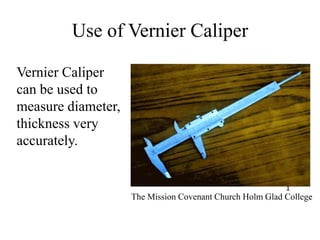
Use of Vernier Caliper
Vernier Caliper
can be used to
measure diameter,
thickness very
accurately.
The Mission Covenant Church Holm Glad College
1
2
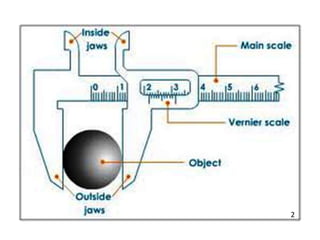
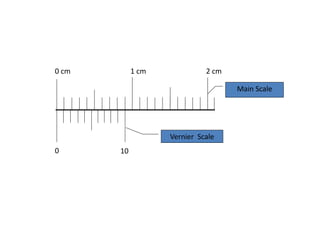
0 cm 2 cm1 cm
0 10
Main Scale
Vernier Scale
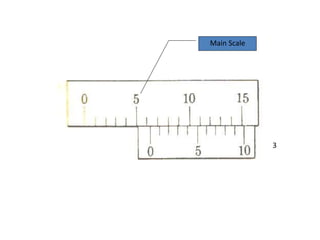
Main Scale
3
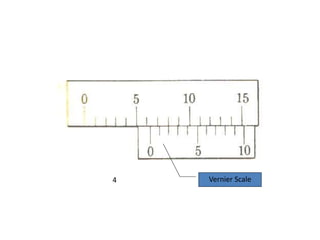
Vernier Scale4
How to read the result
of measuring by using
the Vernier caliper
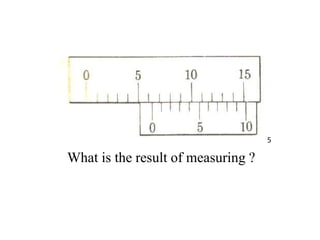
What is the result of measuring ?
5
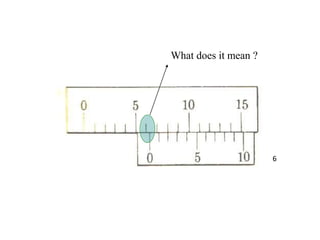
What does it mean ?
6
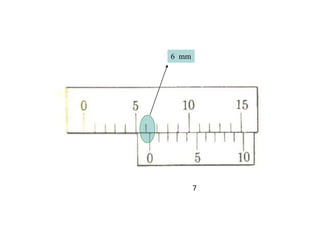
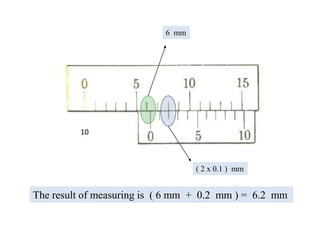
6 mm
7
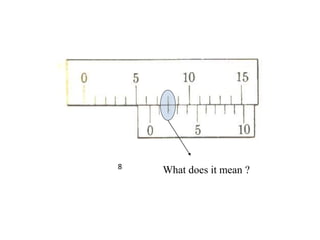
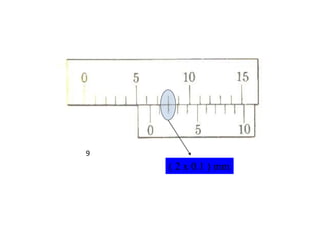
What does it mean ?8
( 2 x 0.1 ) mm
9
6 mm
( 2 x 0.1 ) mm
The result of measuring is ( 6 mm + 0.2 mm ) = 6.2 mm
10
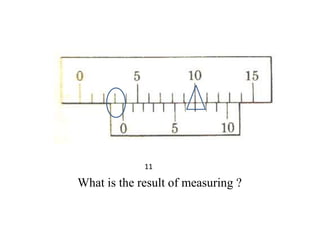
What is the result of measuring ?
11
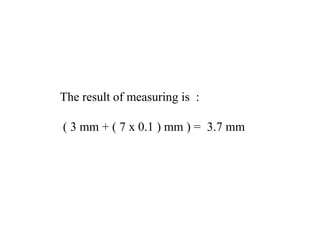
The result of measuring is :
( 3 mm + ( 7 x 0.1 ) mm ) = 3.7 mm
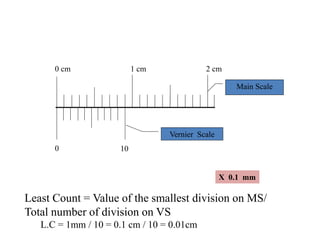
0 cm 2 cm1 cm
0 10
Main Scale
Vernier Scale
X 0.1 mm
Least Count = Value of the smallest division on MS/
Total number of division on VS
L.C = 1mm / 10 = 0.1 cm / 10 = 0.01cm
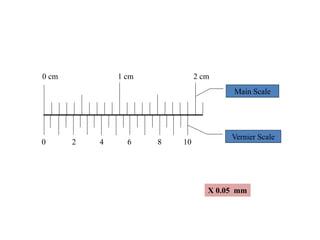
0 cm 2 cm1 cm
0 4 862 10
Main Scale
Vernier Scale
X 0.05 mm
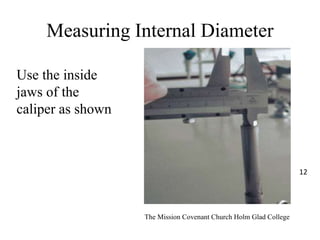
Measuring Internal Diameter
Use the inside
jaws of the
caliper as shown
The Mission Covenant Church Holm Glad College
12
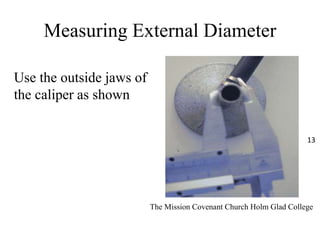
Measuring External Diameter
Use the outside jaws of
the caliper as shown
The Mission Covenant Church Holm Glad College
13
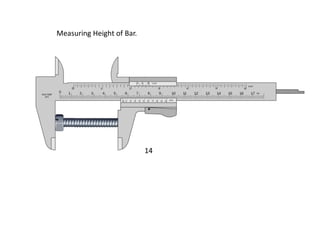
Measuring Height of Bar.
14
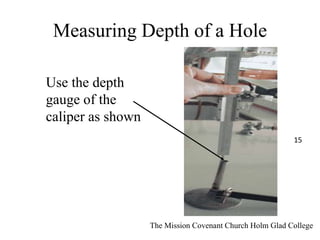
Measuring Depth of a Hole
Use the depth
gauge of the
caliper as shown
The Mission Covenant Church Holm Glad College
15
Measuring Instruments
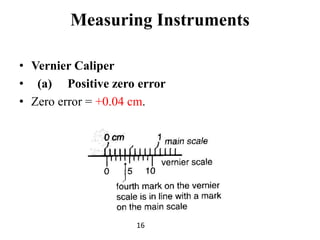
• Vernier Caliper
• (a) Positive zero error
• Zero error = +0.04 cm.
16
Measuring Instruments
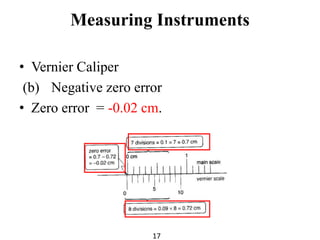
• Vernier Caliper
(b) Negative zero error
• Zero error = -0.02 cm.
17
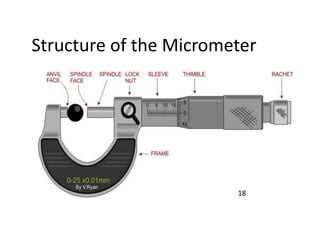
Structure of the Micrometer
18
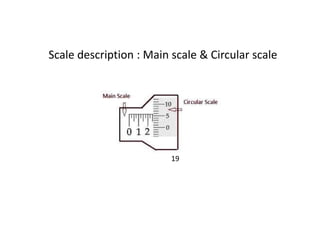
Scale description : Main scale & Circular scale
19
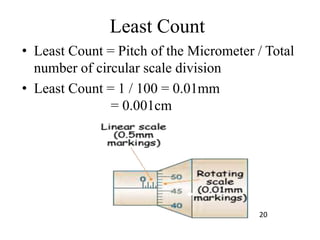
Least Count
• Least Count = Pitch of the Micrometer / Total
number of circular scale division
• Least Count = 1 / 100 = 0.01mm
= 0.001cm
20
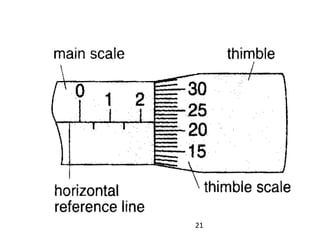
21
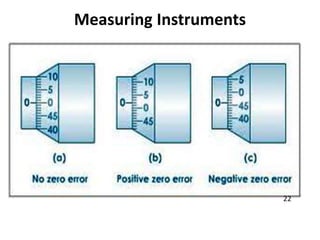
Measuring Instruments
22
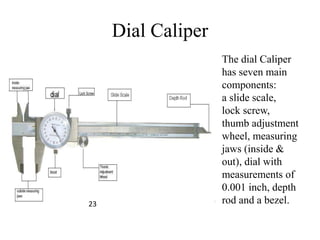
Dial Caliper
The dial Caliper
has seven main
components:
a slide scale,
lock screw,
thumb adjustment
wheel, measuring
jaws (inside &
out), dial with
measurements of
0.001 inch, depth
rod and a bezel.23
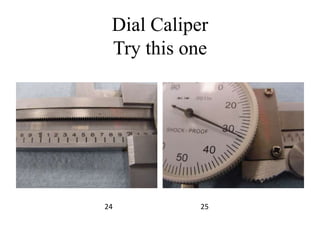
Dial Caliper
Try this one
24 25
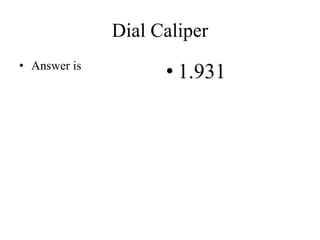
Dial Caliper
• Answer is
• 1.931
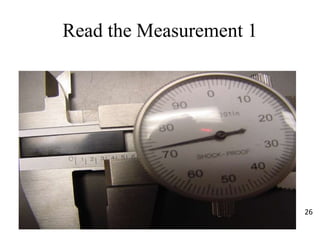
Read the Measurement 1
26
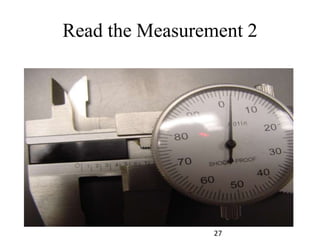
Read the Measurement 2
27
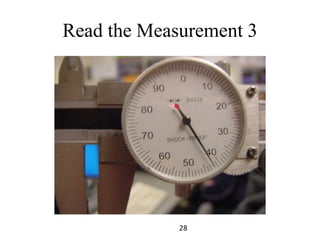
Read the Measurement 3
28
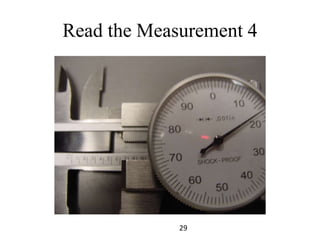
Read the Measurement 4
29
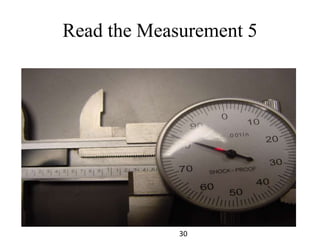
Read the Measurement 5
30
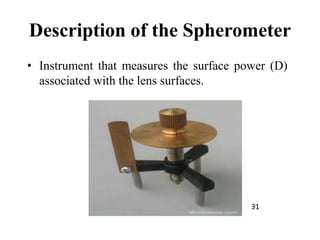
Description of the Spherometer
• Instrument that measures the surface power (D)
associated with the lens surfaces.
31
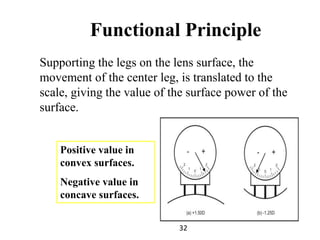
Functional Principle
Supporting the legs on the lens surface, the
movement of the center leg, is translated to the
scale, giving the value of the surface power of the
surface.
Positive value in
convex surfaces.
Negative value in
concave surfaces.
32
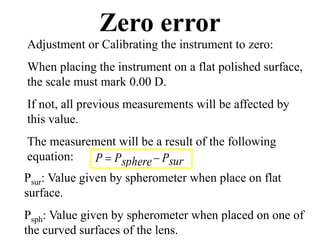
Zero error
Adjustment or Calibrating the instrument to zero:
When placing the instrument on a flat polished surface,
the scale must mark 0.00 D.
If not, all previous measurements will be affected by
this value.
The measurement will be a result of the following
equation:
Psur: Value given by spherometer when place on flat
surface.
Psph: Value given by spherometer when placed on one of
the curved surfaces of the lens.
surPspherePP 
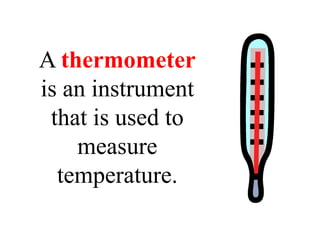
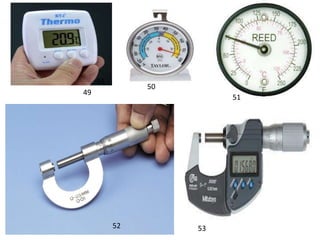
A thermometer
is an instrument
that is used to
measure
temperature.
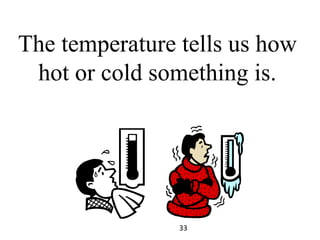
The temperature tells us how
hot or cold something is.
33
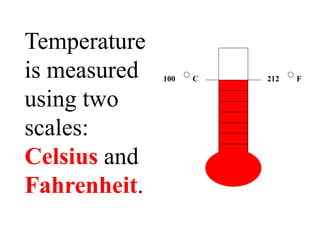
Temperature
is measured
using two
scales:
Celsius and
Fahrenheit.
212100 C F
Galvanometer
• The galvanometer is the "classic" device to
measure current
• Based on the fact that a wire carrying current
in a magnetic field feels a force
43
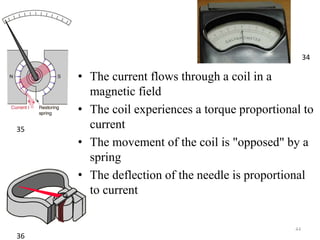
• The current flows through a coil in a
magnetic field
• The coil experiences a torque proportional to
current
• The movement of the coil is "opposed" by a
spring
• The deflection of the needle is proportional
to current
44
34
35
36
• Rsh = "shunt" resistance
• The current I divides itself between the
coil and the shunt
– I = IC + Ish
• By Ohms's law, Vab = IC RC = Ish Rsh
• Ish = IC (RC/Rsh)
• I = IC + Ish = IC (1 + RC/Rsh)
 If RC and Rsh are known, measuring IC is
equivalent to measuring I
• Furthermore, I is still proportional to IC, which is
proportional to the deflection of the needle
• Thus, by "switching in" different shunt resistances I
can effectively change the "range" of my current
measurement
37
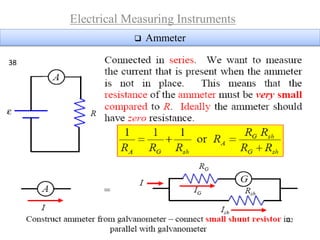
Electrical Measuring Instruments
 Ammeter
38
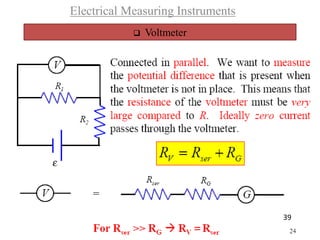
Electrical Measuring Instruments
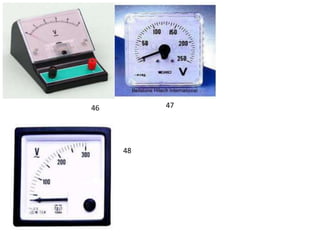
 Voltmeter
39
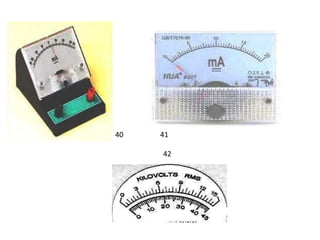
40 41
42
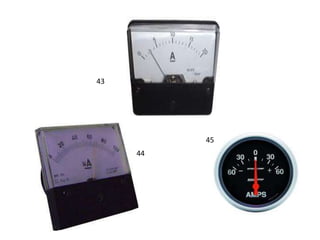
43
44
45
46 47
48
43
49
5352
50
51
REFERENCE BOOKS AUTHOR/PUBLICATION
ENGINEERING PHYSICS S S PATEL (ATUL PRAKASHAN)
MODERN ENGINEERING
PHYSICS
A S VASUDEVA
ENGINEERING PHYSICS K. RAJGOPALAN
Image reference links
1. http://www.slideshare.net/stootypal/vernier-caliper
2. http://www.tutorvista.com/content/physics/physics-i/measurement-and-
experimentation/vernier-callipers.php
3. To 11) http://i.imgur.com/2QqIQsU.png
12. http://postimg.org/image/56z59zrtp
13. http://postimg.org/image/hkbzgwhi5
14. http://www.muelaner.com/wp-content/uploads/2013/07/Calipers-Bolt2.png
15. http://postimg.org/image/8f3mn1e3h
16. http://i.imgur.com/V5pHuiR.png
17. http://i.imgur.com/7TShrLa.png
18. http://www.technologystudent.com/equip1/microm1.htm
19. http://www.indiastudychannel.com/attachments/Resources/143680-5126-Micrometergauge.jpg
20. http://www.cyberphysics.co.uk/practical/skills/micrometer2.gif
21. http://i.imgur.com/cxlIcvh.png
22. http://www.tutorvista.com/content/physics/physics-i/measurement-and-
experimentation/screw-gauge.php
23. http://0801.nccdn.net/1_5/2ff/292/391/dial-calipers.png
24. http://www.pixentral.com/pics/1CpY49KAqUFdhu88HhJTCL87z92J.png
25. http://i.share.pho.to/1b2ffae6_o.png
26. http://i.share.pho.to/dc6d8ee9_l.png
27. http://i.share.pho.to/7891c224_l.png
28. http://i.share.pho.to/38135259_o.png
29. http://i.share.pho.to/cb289234_o.png
30. http://i.share.pho.to/79e115ad_l.png
31. http://www.phys4arab.net/vb/showthread.php?t=30682
Image reference links
32. http://i.share.pho.to/9e2475b4_o.png
33. http://i.cubeupload.com/ERLcXH.png
34. To 36) http://hyperphysics.phy-astr.gsu.edu/hbase/magnetic/galvan.html
37. http://i.cubeupload.com/ERLcXH.png
38. http://i.cubeupload.com/7Kmkuj.png
39. http://i.cubeupload.com/pMmBAH.png
40. http://i.cubeupload.com/Z74xh1.png
41. http://cubeupload.com/im/M19NIc.png
42. http://cubeupload.com/im/CFIlLm.png
43. http://cubeupload.com/im/dk5I7m.png
44. http://i.cubeupload.com/xs7kyV.png
45. http://carcraftstore.com/images/products/thumb/AM3586.jpg
46. http://i.cubeupload.com/2zVJ6H.png
47. http://i.cubeupload.com/5pAyyo.png
48. http://cubeupload.com/im/UlwSGc.png
49. http://i1.olxthailand.com/df/0/ui/post/2014/10/02/8/t/f4c0fe31a19370caec10864f7b35c194.jp
eg
50. http://static.coleparmer.com/large_images/90000_53.jpg
51. http://www.entest.net/product_images/j/372/312FC__10343_thumb.jpg
52. http://dicoworldwide.com/picoasi-2.htm
53. http://imgur.com/lj2uzNU
END

Diploma sem 2 applied science physics-unit 1-chap 3 measuring instruments

  • 1.
    Measuring Instruments Course: Diploma Subject:Applied Science Physics Unit: I Chapter: III
  • 2.
    Use of VernierCaliper Vernier Caliper can be used to measure diameter, thickness very accurately. The Mission Covenant Church Holm Glad College 1
  • 3.
  • 4.
    0 cm 2cm1 cm 0 10 Main Scale Vernier Scale
  • 5.
  • 6.
  • 7.
    How to readthe result of measuring by using the Vernier caliper
  • 8.
    What is theresult of measuring ? 5
  • 9.
    What does itmean ? 6
  • 10.
  • 11.
    What does itmean ?8
  • 12.
    ( 2 x0.1 ) mm 9
  • 13.
    6 mm ( 2x 0.1 ) mm The result of measuring is ( 6 mm + 0.2 mm ) = 6.2 mm 10
  • 14.
    What is theresult of measuring ? 11
  • 15.
    The result ofmeasuring is : ( 3 mm + ( 7 x 0.1 ) mm ) = 3.7 mm
  • 16.
    0 cm 2cm1 cm 0 10 Main Scale Vernier Scale X 0.1 mm Least Count = Value of the smallest division on MS/ Total number of division on VS L.C = 1mm / 10 = 0.1 cm / 10 = 0.01cm
  • 17.
    0 cm 2cm1 cm 0 4 862 10 Main Scale Vernier Scale X 0.05 mm
  • 18.
    Measuring Internal Diameter Usethe inside jaws of the caliper as shown The Mission Covenant Church Holm Glad College 12
  • 19.
    Measuring External Diameter Usethe outside jaws of the caliper as shown The Mission Covenant Church Holm Glad College 13
  • 20.
  • 21.
    Measuring Depth ofa Hole Use the depth gauge of the caliper as shown The Mission Covenant Church Holm Glad College 15
  • 22.
    Measuring Instruments • VernierCaliper • (a) Positive zero error • Zero error = +0.04 cm. 16
  • 23.
    Measuring Instruments • VernierCaliper (b) Negative zero error • Zero error = -0.02 cm. 17
  • 24.
    Structure of theMicrometer 18
  • 25.
    Scale description :Main scale & Circular scale 19
  • 26.
    Least Count • LeastCount = Pitch of the Micrometer / Total number of circular scale division • Least Count = 1 / 100 = 0.01mm = 0.001cm 20
  • 27.
  • 28.
  • 29.
    Dial Caliper The dialCaliper has seven main components: a slide scale, lock screw, thumb adjustment wheel, measuring jaws (inside & out), dial with measurements of 0.001 inch, depth rod and a bezel.23
  • 30.
  • 31.
  • 32.
  • 33.
  • 34.
  • 35.
  • 36.
  • 37.
    Description of theSpherometer • Instrument that measures the surface power (D) associated with the lens surfaces. 31
  • 38.
    Functional Principle Supporting thelegs on the lens surface, the movement of the center leg, is translated to the scale, giving the value of the surface power of the surface. Positive value in convex surfaces. Negative value in concave surfaces. 32
  • 39.
    Zero error Adjustment orCalibrating the instrument to zero: When placing the instrument on a flat polished surface, the scale must mark 0.00 D. If not, all previous measurements will be affected by this value. The measurement will be a result of the following equation: Psur: Value given by spherometer when place on flat surface. Psph: Value given by spherometer when placed on one of the curved surfaces of the lens. surPspherePP 
  • 40.
    A thermometer is aninstrument that is used to measure temperature.
  • 41.
    The temperature tellsus how hot or cold something is. 33
  • 42.
  • 43.
    Galvanometer • The galvanometeris the "classic" device to measure current • Based on the fact that a wire carrying current in a magnetic field feels a force 43
  • 44.
    • The currentflows through a coil in a magnetic field • The coil experiences a torque proportional to current • The movement of the coil is "opposed" by a spring • The deflection of the needle is proportional to current 44 34 35 36
  • 45.
    • Rsh ="shunt" resistance • The current I divides itself between the coil and the shunt – I = IC + Ish • By Ohms's law, Vab = IC RC = Ish Rsh • Ish = IC (RC/Rsh) • I = IC + Ish = IC (1 + RC/Rsh)  If RC and Rsh are known, measuring IC is equivalent to measuring I • Furthermore, I is still proportional to IC, which is proportional to the deflection of the needle • Thus, by "switching in" different shunt resistances I can effectively change the "range" of my current measurement 37
  • 46.
  • 47.
  • 48.
  • 49.
  • 50.
  • 51.
  • 52.
    REFERENCE BOOKS AUTHOR/PUBLICATION ENGINEERINGPHYSICS S S PATEL (ATUL PRAKASHAN) MODERN ENGINEERING PHYSICS A S VASUDEVA ENGINEERING PHYSICS K. RAJGOPALAN
  • 53.
    Image reference links 1.http://www.slideshare.net/stootypal/vernier-caliper 2. http://www.tutorvista.com/content/physics/physics-i/measurement-and- experimentation/vernier-callipers.php 3. To 11) http://i.imgur.com/2QqIQsU.png 12. http://postimg.org/image/56z59zrtp 13. http://postimg.org/image/hkbzgwhi5 14. http://www.muelaner.com/wp-content/uploads/2013/07/Calipers-Bolt2.png 15. http://postimg.org/image/8f3mn1e3h 16. http://i.imgur.com/V5pHuiR.png 17. http://i.imgur.com/7TShrLa.png 18. http://www.technologystudent.com/equip1/microm1.htm 19. http://www.indiastudychannel.com/attachments/Resources/143680-5126-Micrometergauge.jpg 20. http://www.cyberphysics.co.uk/practical/skills/micrometer2.gif 21. http://i.imgur.com/cxlIcvh.png 22. http://www.tutorvista.com/content/physics/physics-i/measurement-and- experimentation/screw-gauge.php 23. http://0801.nccdn.net/1_5/2ff/292/391/dial-calipers.png 24. http://www.pixentral.com/pics/1CpY49KAqUFdhu88HhJTCL87z92J.png 25. http://i.share.pho.to/1b2ffae6_o.png 26. http://i.share.pho.to/dc6d8ee9_l.png 27. http://i.share.pho.to/7891c224_l.png 28. http://i.share.pho.to/38135259_o.png 29. http://i.share.pho.to/cb289234_o.png 30. http://i.share.pho.to/79e115ad_l.png 31. http://www.phys4arab.net/vb/showthread.php?t=30682
  • 54.
    Image reference links 32.http://i.share.pho.to/9e2475b4_o.png 33. http://i.cubeupload.com/ERLcXH.png 34. To 36) http://hyperphysics.phy-astr.gsu.edu/hbase/magnetic/galvan.html 37. http://i.cubeupload.com/ERLcXH.png 38. http://i.cubeupload.com/7Kmkuj.png 39. http://i.cubeupload.com/pMmBAH.png 40. http://i.cubeupload.com/Z74xh1.png 41. http://cubeupload.com/im/M19NIc.png 42. http://cubeupload.com/im/CFIlLm.png 43. http://cubeupload.com/im/dk5I7m.png 44. http://i.cubeupload.com/xs7kyV.png 45. http://carcraftstore.com/images/products/thumb/AM3586.jpg 46. http://i.cubeupload.com/2zVJ6H.png 47. http://i.cubeupload.com/5pAyyo.png 48. http://cubeupload.com/im/UlwSGc.png 49. http://i1.olxthailand.com/df/0/ui/post/2014/10/02/8/t/f4c0fe31a19370caec10864f7b35c194.jp eg 50. http://static.coleparmer.com/large_images/90000_53.jpg 51. http://www.entest.net/product_images/j/372/312FC__10343_thumb.jpg 52. http://dicoworldwide.com/picoasi-2.htm 53. http://imgur.com/lj2uzNU
  • 55.