EXPERIMENT NO. 2
MICROMETER SCREW GAUGE
Aim :-
To measure
1)The diameter of given wire & calculate it’s
area of Cross section.
2)Thickness of glass plate.
Apparatus:- Screw gauge , wire , glass plate.
INTRODUCTION
It is a device incorporating a calibrated screw widely used
for accurate measurement of components in mechanical
Engineering and machining telescopes or microscopes.
It has accuracy of 0.01 mm and is used to measure
objects no more than a few millimeters across.
The inner cylinder is graduated in mm and 1 mm while
the rotating barrel section is graduated from 0 to 100.
One turn of this will advance the jaws by 1 mm and so
one division on the barrel is equal to 0.01 mm.
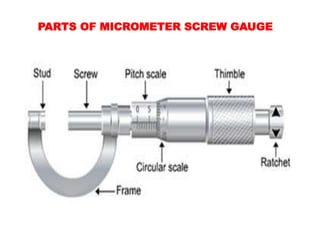
PARTS OF MICROMETER SCREW GAUGE
Frame :-
The C-shaped body that holds the anvil and barrel
in constant relation to each other.
Anvil:-
It remains stationary while the measured object is
held against it. It varies in shape depending on the
measurement task.
Sleeve, barrel, or stock :-
The stationary round component with the linear
scale on it ( main scale/pitch scale).
Screw :- It is heart of the micrometer. It is
inside the barrel.
Thimble :- The component that one's thumb
turns, Graduated markings on circular scale
changes.
Ratchet stop :- Device on end of handle that
limits applied pressure by slipping at a
calibrated torque.
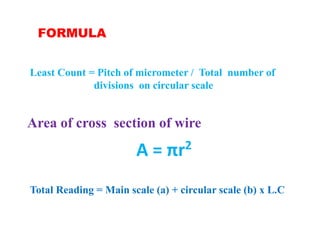
FORMULA
A = πr2
Area of cross section of wire
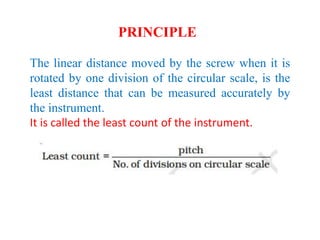
Least Count = Pitch of micrometer / Total number of
divisions on circular scale
Total Reading = Main scale (a) + circular scale (b) x L.C
ERROR IN MICROMETER SCREW GAUGE
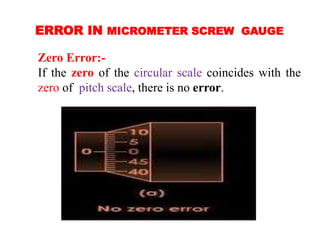
Zero Error:-
If the zero of the circular scale coincides with the
zero of pitch scale, there is no error.
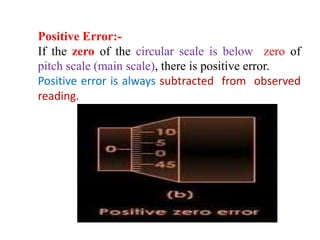
Positive Error:-
If the zero of the circular scale is below zero of
pitch scale (main scale), there is positive error.
Positive error is always subtracted from observed
reading.
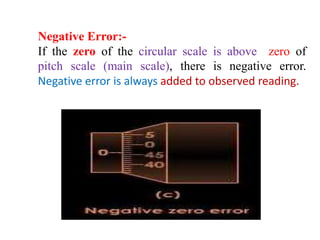
Negative Error:-
If the zero of the circular scale is above zero of
pitch scale (main scale), there is negative error.
Negative error is always added to observed reading.
OBSERVATIONS
Pitch = Distance moved by the screw in one complete
rotation
=1 mm .
Number of divisions on the circular scale = 100.
L.C = 1mm / 100 = 0.01mm = 0.001 cm.
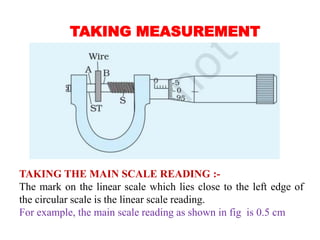
TAKING MEASUREMENT
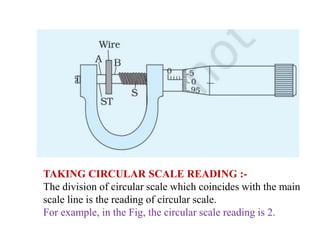
TAKING THE MAIN SCALE READING :-
The mark on the linear scale which lies close to the left edge of
the circular scale is the linear scale reading.
For example, the main scale reading as shown in fig is 0.5 cm
TAKING CIRCULAR SCALE READING :-
The division of circular scale which coincides with the main
scale line is the reading of circular scale.
For example, in the Fig, the circular scale reading is 2.
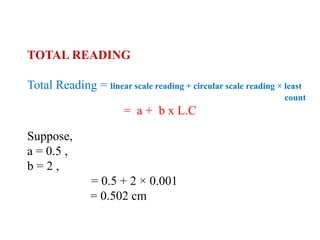
TOTAL READING
Total Reading = linear scale reading + circular scale reading × least
count
= a + b x L.C
Suppose,
a = 0.5 ,
b = 2 ,
= 0.5 + 2 × 0.001
= 0.502 cm
The linear distance moved by the screw when it is
rotated by one division of the circular scale, is the
least distance that can be measured accurately by
the instrument.
It is called the least count of the instrument.
PRINCIPLE
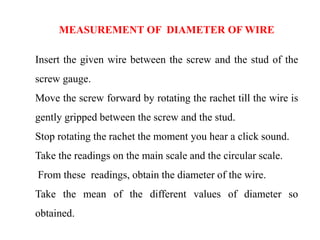
MEASUREMENT OF DIAMETER OF WIRE
Insert the given wire between the screw and the stud of the
screw gauge.
Move the screw forward by rotating the rachet till the wire is
gently gripped between the screw and the stud.
Stop rotating the rachet the moment you hear a click sound.
Take the readings on the main scale and the circular scale.
From these readings, obtain the diameter of the wire.
Take the mean of the different values of diameter so
obtained.
MEASUREMENT OF THICKNESS OF A GIVEN SHEET
Insert the given sheet between the studs of the screw gauge and
determine the thickness at five different positions.
Find the average thickness and calculate the correct thickness by
applying zero error.
Micrometer screw gauge

Micrometer screw gauge

  • 1.
  • 2.
    Aim :- To measure 1)Thediameter of given wire & calculate it’s area of Cross section. 2)Thickness of glass plate. Apparatus:- Screw gauge , wire , glass plate.
  • 3.
    INTRODUCTION It is adevice incorporating a calibrated screw widely used for accurate measurement of components in mechanical Engineering and machining telescopes or microscopes. It has accuracy of 0.01 mm and is used to measure objects no more than a few millimeters across. The inner cylinder is graduated in mm and 1 mm while the rotating barrel section is graduated from 0 to 100. One turn of this will advance the jaws by 1 mm and so one division on the barrel is equal to 0.01 mm.
  • 4.
  • 5.
    Frame :- The C-shapedbody that holds the anvil and barrel in constant relation to each other. Anvil:- It remains stationary while the measured object is held against it. It varies in shape depending on the measurement task. Sleeve, barrel, or stock :- The stationary round component with the linear scale on it ( main scale/pitch scale).
  • 6.
    Screw :- Itis heart of the micrometer. It is inside the barrel. Thimble :- The component that one's thumb turns, Graduated markings on circular scale changes. Ratchet stop :- Device on end of handle that limits applied pressure by slipping at a calibrated torque.
  • 7.
    FORMULA A = πr2 Areaof cross section of wire Least Count = Pitch of micrometer / Total number of divisions on circular scale Total Reading = Main scale (a) + circular scale (b) x L.C
  • 8.
    ERROR IN MICROMETERSCREW GAUGE Zero Error:- If the zero of the circular scale coincides with the zero of pitch scale, there is no error.
  • 9.
    Positive Error:- If thezero of the circular scale is below zero of pitch scale (main scale), there is positive error. Positive error is always subtracted from observed reading.
  • 10.
    Negative Error:- If thezero of the circular scale is above zero of pitch scale (main scale), there is negative error. Negative error is always added to observed reading.
  • 11.
    OBSERVATIONS Pitch = Distancemoved by the screw in one complete rotation =1 mm . Number of divisions on the circular scale = 100. L.C = 1mm / 100 = 0.01mm = 0.001 cm.
  • 12.
    TAKING MEASUREMENT TAKING THEMAIN SCALE READING :- The mark on the linear scale which lies close to the left edge of the circular scale is the linear scale reading. For example, the main scale reading as shown in fig is 0.5 cm
  • 13.
    TAKING CIRCULAR SCALEREADING :- The division of circular scale which coincides with the main scale line is the reading of circular scale. For example, in the Fig, the circular scale reading is 2.
  • 14.
    TOTAL READING Total Reading= linear scale reading + circular scale reading × least count = a + b x L.C Suppose, a = 0.5 , b = 2 , = 0.5 + 2 × 0.001 = 0.502 cm
  • 15.
    The linear distancemoved by the screw when it is rotated by one division of the circular scale, is the least distance that can be measured accurately by the instrument. It is called the least count of the instrument. PRINCIPLE
  • 16.
    MEASUREMENT OF DIAMETEROF WIRE Insert the given wire between the screw and the stud of the screw gauge. Move the screw forward by rotating the rachet till the wire is gently gripped between the screw and the stud. Stop rotating the rachet the moment you hear a click sound. Take the readings on the main scale and the circular scale. From these readings, obtain the diameter of the wire. Take the mean of the different values of diameter so obtained.
  • 17.
    MEASUREMENT OF THICKNESSOF A GIVEN SHEET Insert the given sheet between the studs of the screw gauge and determine the thickness at five different positions. Find the average thickness and calculate the correct thickness by applying zero error.