1
THE VERNIER
CALIPER
INSIGHTS OF PHYSICS
THE VERNIER CALIPER
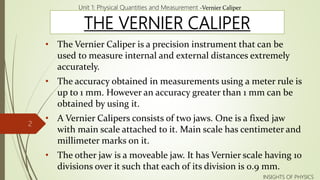
• The Vernier Caliper is a precision instrument that can be
used to measure internal and external distances extremely
accurately.
• The accuracy obtained in measurements using a meter rule is
up to 1 mm. However an accuracy greater than 1 mm can be
obtained by using it.
• A Vernier Calipers consists of two jaws. One is a fixed jaw
with main scale attached to it. Main scale has centimeter and
millimeter marks on it.
• The other jaw is a moveable jaw. It has Vernier scale having 10
divisions over it such that each of its division is 0.9 mm.
Unit 1: Physical Quantities and Measurement -Vernier Caliper
2
INSIGHTS OF PHYSICS
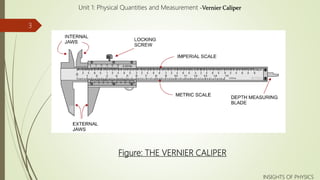
Figure: THE VERNIER CALIPER
Unit 1: Physical Quantities and Measurement -Vernier Caliper
3
INSIGHTS OF PHYSICS
Least Count Of Vernier Caliper
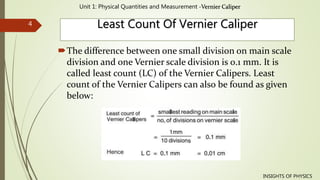
The difference between one small division on main scale
division and one Vernier scale division is 0.1 mm. It is
called least count (LC) of the Vernier Calipers. Least
count of the Vernier Calipers can also be found as given
below:
4
Unit 1: Physical Quantities and Measurement -Vernier Caliper
INSIGHTS OF PHYSICS
Working of a Vernier Calipers5
Unit 1: Physical Quantities and Measurement -Vernier Caliper
The sliding jaw runs on the main scale with the guiding
surface, which is accompanied by a Vernier scale, in which it
has a measuring tip on the left side.
When two measuring tip surfaces are in contact with each
other, the scale shows zero reading.
The finer adjustment of the movable jaw can be done by
adjusting screw.
First, the whole movable jaw assembly is adjusted so that the
two measuring tips just touch the part to be measured. Then
lockout B is tightened.
INSIGHTS OF PHYSICS
6
Unit 1: Physical Quantities and Measurement -Vernier Caliper
Final adjustment depending upon the sense of correct
feeling is made by adjusting screw, which makes the part
containing locking nut A and sliding jaw to move, as the
adjusting screw rotates on a screw which is in a way fixed to
the movable jaw.
After all, the final adjustment has been done, the locking
nut has also been tightened and the reading has been
noted. Measuring tips are designed so that they can be used
to measure external dimensions as well as internal
dimensions.
Working of a Vernier Calipers
INSIGHTS OF PHYSICS
Zero Error and Zero Correction
7
Unit 1: Physical Quantities and Measurement -Vernier Caliper
First of all find the error, if any, in the measuring
instrument. It is called the zero error of the
instrument.
 Knowing the zero error, necessary correction can be
made to find the correct measurement.
Such a correction is called zero correction of the
instrument.
Zero correction is the negative of zero error.
INSIGHTS OF PHYSICS
Zero Error and Zero Correction
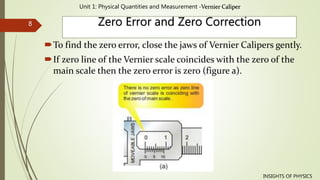
To find the zero error, close the jaws of Vernier Calipers gently.
If zero line of the Vernier scale coincides with the zero of the
main scale then the zero error is zero (figure a).
8
Unit 1: Physical Quantities and Measurement -Vernier Caliper
INSIGHTS OF PHYSICS
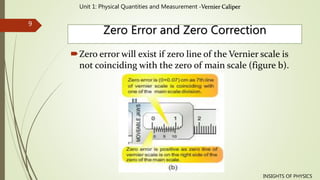
Zero error will exist if zero line of the Vernier scale is
not coinciding with the zero of main scale (figure b).
9
Unit 1: Physical Quantities and Measurement -Vernier Caliper
Zero Error and Zero Correction
INSIGHTS OF PHYSICS
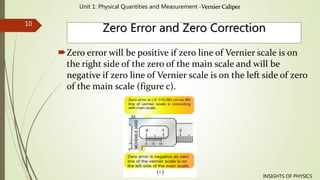
Zero error will be positive if zero line of Vernier scale is on
the right side of the zero of the main scale and will be
negative if zero line of Vernier scale is on the left side of zero
of the main scale (figure c).
10
Unit 1: Physical Quantities and Measurement -Vernier Caliper
Zero Error and Zero Correction
INSIGHTS OF PHYSICS
Taking a Reading on Vernier Calipers
Let us find the diameter of material using Vernier Callipers.
Place the material between jaws of the Vernier Callipers. Close
the jaws till they press the opposite sides of the object gently.
Note the complete divisions of main scale past the Vernier scale
zero in a tabular form. Next find the Vernier scale division that
is coinciding with any division on the main scale.
11
Unit 1: Physical Quantities and Measurement -Vernier Caliper
INSIGHTS OF PHYSICS
Taking a Reading on Vernier Calipers
Multiply it by least count of Vernier Callipers and add it in the
main scale reading. This is the diameter of material.
Add zero correction (Z.C) to get correct measurement.
Repeat the above procedure and record observations.
12
Unit 1: Physical Quantities and Measurement -Vernier Caliper
INSIGHTS OF PHYSICS
Advantages and Disadvantages of Vernier Scales
Advantages
1. Accuracy and Precision
2. Integrated Scales
3. Versatility
4. Durability
5. Cost
Disadvantages
1. Good Eyesight is Required
2. Knowledge of Vernier Calipers
is Required
3. Possibility of Errors
4. More Accurate Tools Available
13
Unit 1: Physical Quantities and Measurement -Vernier Caliper
INSIGHTS OF PHYSICS
QUICK QUIZ
What is the least count of the Vernier Callipers?
The least count of the Vernier caliper is 0.1mm or 0.01cm
What is the range of the Vernier Callipers used in your Physics
laboratory?
The range of the Vernier calipers used in physics laboratory is 12cm.
How many divisions are there on its Vernier scale?
Vernier scale have 10 divisions over it such that each of its division is 0.9
mm.
Why do we use zero correction?
Zero correction is used to get accurate and precise measurements.
14
Unit 1: Physical Quantities and Measurement -Vernier Caliper
INSIGHTS OF PHYSICS
INSIGHTS OF PHYSICS
Thank you
Physical Quantities and Measurement UNIT 1

The vernier caliper

  • 1.
  • 2.
    THE VERNIER CALIPER •The Vernier Caliper is a precision instrument that can be used to measure internal and external distances extremely accurately. • The accuracy obtained in measurements using a meter rule is up to 1 mm. However an accuracy greater than 1 mm can be obtained by using it. • A Vernier Calipers consists of two jaws. One is a fixed jaw with main scale attached to it. Main scale has centimeter and millimeter marks on it. • The other jaw is a moveable jaw. It has Vernier scale having 10 divisions over it such that each of its division is 0.9 mm. Unit 1: Physical Quantities and Measurement -Vernier Caliper 2 INSIGHTS OF PHYSICS
  • 3.
    Figure: THE VERNIERCALIPER Unit 1: Physical Quantities and Measurement -Vernier Caliper 3 INSIGHTS OF PHYSICS
  • 4.
    Least Count OfVernier Caliper The difference between one small division on main scale division and one Vernier scale division is 0.1 mm. It is called least count (LC) of the Vernier Calipers. Least count of the Vernier Calipers can also be found as given below: 4 Unit 1: Physical Quantities and Measurement -Vernier Caliper INSIGHTS OF PHYSICS
  • 5.
    Working of aVernier Calipers5 Unit 1: Physical Quantities and Measurement -Vernier Caliper The sliding jaw runs on the main scale with the guiding surface, which is accompanied by a Vernier scale, in which it has a measuring tip on the left side. When two measuring tip surfaces are in contact with each other, the scale shows zero reading. The finer adjustment of the movable jaw can be done by adjusting screw. First, the whole movable jaw assembly is adjusted so that the two measuring tips just touch the part to be measured. Then lockout B is tightened. INSIGHTS OF PHYSICS
  • 6.
    6 Unit 1: PhysicalQuantities and Measurement -Vernier Caliper Final adjustment depending upon the sense of correct feeling is made by adjusting screw, which makes the part containing locking nut A and sliding jaw to move, as the adjusting screw rotates on a screw which is in a way fixed to the movable jaw. After all, the final adjustment has been done, the locking nut has also been tightened and the reading has been noted. Measuring tips are designed so that they can be used to measure external dimensions as well as internal dimensions. Working of a Vernier Calipers INSIGHTS OF PHYSICS
  • 7.
    Zero Error andZero Correction 7 Unit 1: Physical Quantities and Measurement -Vernier Caliper First of all find the error, if any, in the measuring instrument. It is called the zero error of the instrument.  Knowing the zero error, necessary correction can be made to find the correct measurement. Such a correction is called zero correction of the instrument. Zero correction is the negative of zero error. INSIGHTS OF PHYSICS
  • 8.
    Zero Error andZero Correction To find the zero error, close the jaws of Vernier Calipers gently. If zero line of the Vernier scale coincides with the zero of the main scale then the zero error is zero (figure a). 8 Unit 1: Physical Quantities and Measurement -Vernier Caliper INSIGHTS OF PHYSICS
  • 9.
    Zero error willexist if zero line of the Vernier scale is not coinciding with the zero of main scale (figure b). 9 Unit 1: Physical Quantities and Measurement -Vernier Caliper Zero Error and Zero Correction INSIGHTS OF PHYSICS
  • 10.
    Zero error willbe positive if zero line of Vernier scale is on the right side of the zero of the main scale and will be negative if zero line of Vernier scale is on the left side of zero of the main scale (figure c). 10 Unit 1: Physical Quantities and Measurement -Vernier Caliper Zero Error and Zero Correction INSIGHTS OF PHYSICS
  • 11.
    Taking a Readingon Vernier Calipers Let us find the diameter of material using Vernier Callipers. Place the material between jaws of the Vernier Callipers. Close the jaws till they press the opposite sides of the object gently. Note the complete divisions of main scale past the Vernier scale zero in a tabular form. Next find the Vernier scale division that is coinciding with any division on the main scale. 11 Unit 1: Physical Quantities and Measurement -Vernier Caliper INSIGHTS OF PHYSICS
  • 12.
    Taking a Readingon Vernier Calipers Multiply it by least count of Vernier Callipers and add it in the main scale reading. This is the diameter of material. Add zero correction (Z.C) to get correct measurement. Repeat the above procedure and record observations. 12 Unit 1: Physical Quantities and Measurement -Vernier Caliper INSIGHTS OF PHYSICS
  • 13.
    Advantages and Disadvantagesof Vernier Scales Advantages 1. Accuracy and Precision 2. Integrated Scales 3. Versatility 4. Durability 5. Cost Disadvantages 1. Good Eyesight is Required 2. Knowledge of Vernier Calipers is Required 3. Possibility of Errors 4. More Accurate Tools Available 13 Unit 1: Physical Quantities and Measurement -Vernier Caliper INSIGHTS OF PHYSICS
  • 14.
    QUICK QUIZ What isthe least count of the Vernier Callipers? The least count of the Vernier caliper is 0.1mm or 0.01cm What is the range of the Vernier Callipers used in your Physics laboratory? The range of the Vernier calipers used in physics laboratory is 12cm. How many divisions are there on its Vernier scale? Vernier scale have 10 divisions over it such that each of its division is 0.9 mm. Why do we use zero correction? Zero correction is used to get accurate and precise measurements. 14 Unit 1: Physical Quantities and Measurement -Vernier Caliper INSIGHTS OF PHYSICS
  • 15.
    INSIGHTS OF PHYSICS Thankyou Physical Quantities and Measurement UNIT 1