WORKSHOP PRACTICE
LAB No. 2
Measuring Tools
Today’s LAB
 Measuring Tools
 Vernier Caliper
 Micrometer
 SWG
Measurement
 Measurement means to compare something
with standard.
 E.g. measuring length of a wire, diameter of a
cylinder, depth of any object.
 The SI unit of length is meter (base unit).
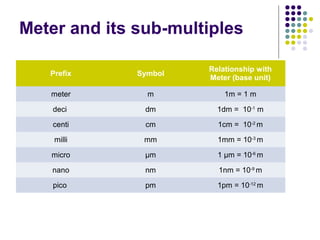
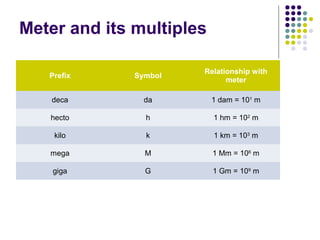
 Its multiples and sub-multiples are given in
the table.
Meter and its sub-multiples
Prefix Symbol
Relationship with
Meter (base unit)
meter m 1m = 1 m
deci dm 1dm = 10-1
m
centi cm 1cm = 10-2
m
milli mm 1mm = 10-3
m
micro µm 1 µm = 10-6
m
nano nm 1nm = 10-9
m
pico pm 1pm = 10-12
m
Meter and its multiples
Prefix Symbol
Relationship with
meter
deca da 1 dam = 101
m
hecto h 1 hm = 102
m
kilo k 1 km = 103
m
mega M 1 Mm = 106
m
giga G 1 Gm = 109
m
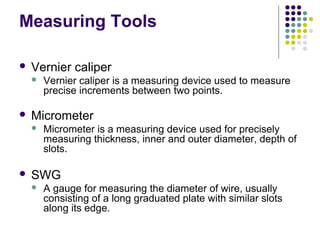
Measuring Tools
 Vernier caliper
 Vernier caliper is a measuring device used to measure
precise increments between two points.
 Micrometer
 Micrometer is a measuring device used for precisely
measuring thickness, inner and outer diameter, depth of
slots.
 SWG
 A gauge for measuring the diameter of wire, usually
consisting of a long graduated plate with similar slots
along its edge.
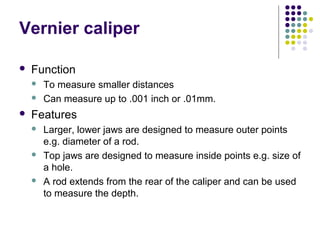
Vernier caliper
 Function
 To measure smaller distances
 Can measure up to .001 inch or .01mm.
 Features
 Larger, lower jaws are designed to measure outer points
e.g. diameter of a rod.
 Top jaws are designed to measure inside points e.g. size of
a hole.
 A rod extends from the rear of the caliper and can be used
to measure the depth.
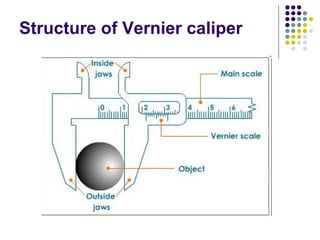
Structure of Vernier caliper
Structure of the Vernier caliper
 Main Scale
 Main scale is graduated in cm and mm.
 Vernier Scale
 It slides on the main scale.
 On Vernier scale 0.9cm is divided into 10 equal parts.
 Jaws
 Two inside jaws (Upper)
 Two outside jaws (Lower)
Least Count
 Least count (L.C) is the smallest reading we can
measure with the instrument.
 L.C = one main scale division – one
vernier scale division
L.C = 1mm – 0.09mm
L.C = 0.1mm = 0.01cm
 Least Count = Value of the smallest division on MS/
Total number of division on VS
L.C = 1mm / 10 = 0.1 cm / 10 = 0.01cm
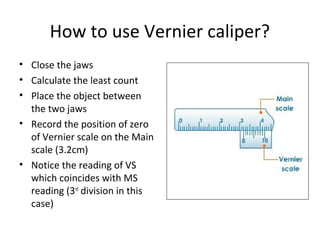
How to use Vernier caliper?
• Close the jaws
• Calculate the least count
• Place the object between
the two jaws
• Record the position of zero
of Vernier scale on the Main
scale (3.2cm)
• Notice the reading of VS
which coincides with MS
reading (3rd
division in this
case)
Reading of the Instrument
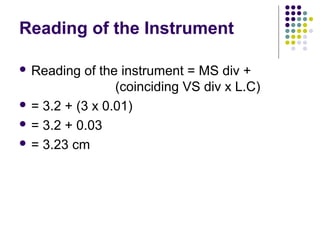
 Reading of the instrument = MS div +
(coinciding VS div x L.C)
 = 3.2 + (3 x 0.01)
 = 3.2 + 0.03
 = 3.23 cm
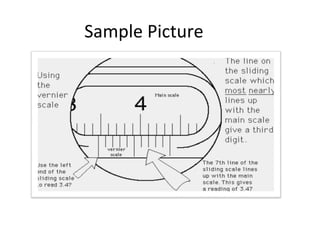
Sample Picture
To measure the depth
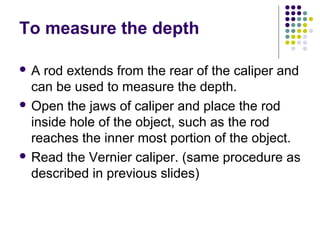
 A rod extends from the rear of the caliper and
can be used to measure the depth.
 Open the jaws of caliper and place the rod
inside hole of the object, such as the rod
reaches the inner most portion of the object.
 Read the Vernier caliper. (same procedure as
described in previous slides)
Micrometer
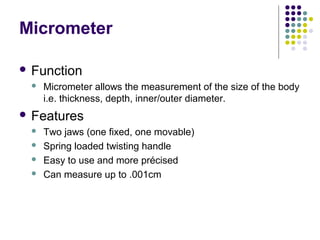
 Function
 Micrometer allows the measurement of the size of the body
i.e. thickness, depth, inner/outer diameter.
 Features
 Two jaws (one fixed, one movable)
 Spring loaded twisting handle
 Easy to use and more précised
 Can measure up to .001cm
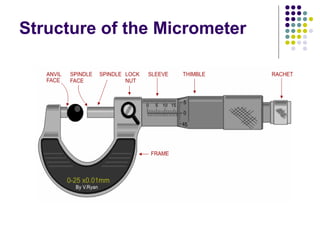
Structure of the Micrometer
Structure of Micrometer
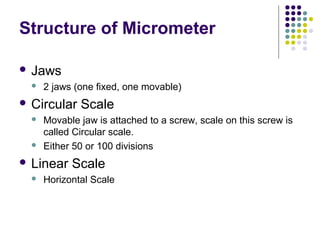
 Jaws
 2 jaws (one fixed, one movable)
 Circular Scale
 Movable jaw is attached to a screw, scale on this screw is
called Circular scale.
 Either 50 or 100 divisions
 Linear Scale
 Horizontal Scale
Structure of Micrometer
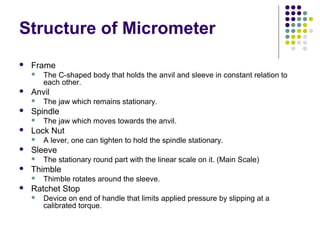
 Frame
 The C-shaped body that holds the anvil and sleeve in constant relation to
each other.
 Anvil
 The jaw which remains stationary.
 Spindle
 The jaw which moves towards the anvil.
 Lock Nut
 A lever, one can tighten to hold the spindle stationary.
 Sleeve
 The stationary round part with the linear scale on it. (Main Scale)
 Thimble
 Thimble rotates around the sleeve.
 Ratchet Stop
 Device on end of handle that limits applied pressure by slipping at a
calibrated torque.
Pitch of Micrometer
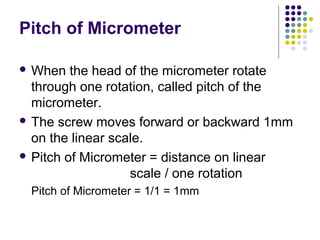
 When the head of the micrometer rotate
through one rotation, called pitch of the
micrometer.
 The screw moves forward or backward 1mm
on the linear scale.
 Pitch of Micrometer = distance on linear
scale / one rotation
Pitch of Micrometer = 1/1 = 1mm
Least Count
 Least Count = Pitch of the Micrometer / Total
number of circular scale division
 Least Count = 1 / 100 = 0.01mm
= 0.001cm
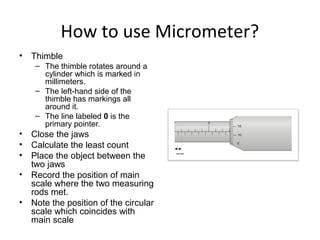
How to use Micrometer?
• Thimble
– The thimble rotates around a
cylinder which is marked in
millimeters.
– The left-hand side of the
thimble has markings all
around it.
– The line labeled 0 is the
primary pointer.
• Close the jaws
• Calculate the least count
• Place the object between the
two jaws
• Record the position of main
scale where the two measuring
rods met.
• Note the position of the circular
scale which coincides with
main scale
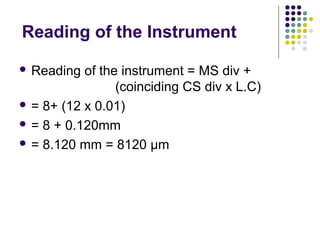
Reading of the Instrument
 Reading of the instrument = MS div +
(coinciding CS div x L.C)
 = 8+ (12 x 0.01)
 = 8 + 0.120mm
 = 8.120 mm = 8120 µm
Standard Wire Gauge (SWG)
 A gauge for measuring the diameter of wire, usually
consisting of a disk having variously sized slots in its
periphery or a long graduated plate with similar slots
along its edge.
 A standardized system of wire sizes.
 Wires are manufactured to standard sizes and
labeled with their SWG.
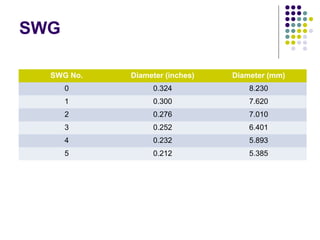
 As the SWG increases the diameter decreases.
SWG
SWG No. Diameter (inches) Diameter (mm)
0 0.324 8.230
1 0.300 7.620
2 0.276 7.010
3 0.252 6.401
4 0.232 5.893
5 0.212 5.385
Lab Reports
 Last date of submission of Lab 1 & 2 is
Wednesday, 4th
November till 1: 00 p.m. in
Workshop lab.

3773 -workshop practice

  • 1.
    WORKSHOP PRACTICE LAB No.2 Measuring Tools
  • 2.
    Today’s LAB  MeasuringTools  Vernier Caliper  Micrometer  SWG
  • 3.
    Measurement  Measurement meansto compare something with standard.  E.g. measuring length of a wire, diameter of a cylinder, depth of any object.  The SI unit of length is meter (base unit).  Its multiples and sub-multiples are given in the table.
  • 4.
    Meter and itssub-multiples Prefix Symbol Relationship with Meter (base unit) meter m 1m = 1 m deci dm 1dm = 10-1 m centi cm 1cm = 10-2 m milli mm 1mm = 10-3 m micro µm 1 µm = 10-6 m nano nm 1nm = 10-9 m pico pm 1pm = 10-12 m
  • 5.
    Meter and itsmultiples Prefix Symbol Relationship with meter deca da 1 dam = 101 m hecto h 1 hm = 102 m kilo k 1 km = 103 m mega M 1 Mm = 106 m giga G 1 Gm = 109 m
  • 6.
    Measuring Tools  Verniercaliper  Vernier caliper is a measuring device used to measure precise increments between two points.  Micrometer  Micrometer is a measuring device used for precisely measuring thickness, inner and outer diameter, depth of slots.  SWG  A gauge for measuring the diameter of wire, usually consisting of a long graduated plate with similar slots along its edge.
  • 7.
    Vernier caliper  Function To measure smaller distances  Can measure up to .001 inch or .01mm.  Features  Larger, lower jaws are designed to measure outer points e.g. diameter of a rod.  Top jaws are designed to measure inside points e.g. size of a hole.  A rod extends from the rear of the caliper and can be used to measure the depth.
  • 8.
  • 9.
    Structure of theVernier caliper  Main Scale  Main scale is graduated in cm and mm.  Vernier Scale  It slides on the main scale.  On Vernier scale 0.9cm is divided into 10 equal parts.  Jaws  Two inside jaws (Upper)  Two outside jaws (Lower)
  • 10.
    Least Count  Leastcount (L.C) is the smallest reading we can measure with the instrument.  L.C = one main scale division – one vernier scale division L.C = 1mm – 0.09mm L.C = 0.1mm = 0.01cm  Least Count = Value of the smallest division on MS/ Total number of division on VS L.C = 1mm / 10 = 0.1 cm / 10 = 0.01cm
  • 11.
    How to useVernier caliper? • Close the jaws • Calculate the least count • Place the object between the two jaws • Record the position of zero of Vernier scale on the Main scale (3.2cm) • Notice the reading of VS which coincides with MS reading (3rd division in this case)
  • 12.
    Reading of theInstrument  Reading of the instrument = MS div + (coinciding VS div x L.C)  = 3.2 + (3 x 0.01)  = 3.2 + 0.03  = 3.23 cm
  • 13.
  • 14.
    To measure thedepth  A rod extends from the rear of the caliper and can be used to measure the depth.  Open the jaws of caliper and place the rod inside hole of the object, such as the rod reaches the inner most portion of the object.  Read the Vernier caliper. (same procedure as described in previous slides)
  • 15.
    Micrometer  Function  Micrometerallows the measurement of the size of the body i.e. thickness, depth, inner/outer diameter.  Features  Two jaws (one fixed, one movable)  Spring loaded twisting handle  Easy to use and more précised  Can measure up to .001cm
  • 16.
    Structure of theMicrometer
  • 17.
    Structure of Micrometer Jaws  2 jaws (one fixed, one movable)  Circular Scale  Movable jaw is attached to a screw, scale on this screw is called Circular scale.  Either 50 or 100 divisions  Linear Scale  Horizontal Scale
  • 18.
    Structure of Micrometer Frame  The C-shaped body that holds the anvil and sleeve in constant relation to each other.  Anvil  The jaw which remains stationary.  Spindle  The jaw which moves towards the anvil.  Lock Nut  A lever, one can tighten to hold the spindle stationary.  Sleeve  The stationary round part with the linear scale on it. (Main Scale)  Thimble  Thimble rotates around the sleeve.  Ratchet Stop  Device on end of handle that limits applied pressure by slipping at a calibrated torque.
  • 19.
    Pitch of Micrometer When the head of the micrometer rotate through one rotation, called pitch of the micrometer.  The screw moves forward or backward 1mm on the linear scale.  Pitch of Micrometer = distance on linear scale / one rotation Pitch of Micrometer = 1/1 = 1mm
  • 20.
    Least Count  LeastCount = Pitch of the Micrometer / Total number of circular scale division  Least Count = 1 / 100 = 0.01mm = 0.001cm
  • 21.
    How to useMicrometer? • Thimble – The thimble rotates around a cylinder which is marked in millimeters. – The left-hand side of the thimble has markings all around it. – The line labeled 0 is the primary pointer. • Close the jaws • Calculate the least count • Place the object between the two jaws • Record the position of main scale where the two measuring rods met. • Note the position of the circular scale which coincides with main scale
  • 22.
    Reading of theInstrument  Reading of the instrument = MS div + (coinciding CS div x L.C)  = 8+ (12 x 0.01)  = 8 + 0.120mm  = 8.120 mm = 8120 µm
  • 23.
    Standard Wire Gauge(SWG)  A gauge for measuring the diameter of wire, usually consisting of a disk having variously sized slots in its periphery or a long graduated plate with similar slots along its edge.  A standardized system of wire sizes.  Wires are manufactured to standard sizes and labeled with their SWG.  As the SWG increases the diameter decreases.
  • 24.
    SWG SWG No. Diameter(inches) Diameter (mm) 0 0.324 8.230 1 0.300 7.620 2 0.276 7.010 3 0.252 6.401 4 0.232 5.893 5 0.212 5.385
  • 26.
    Lab Reports  Lastdate of submission of Lab 1 & 2 is Wednesday, 4th November till 1: 00 p.m. in Workshop lab.