Presented by:  Riel M. Casinillo   Faculty Measurement and Measuring Devices (Micrometer and Vernier Caliper)
What are we going to do today? 1) We are going to read and use the following instruments in measuring certain quantities: Micrometer Vernier Caliper
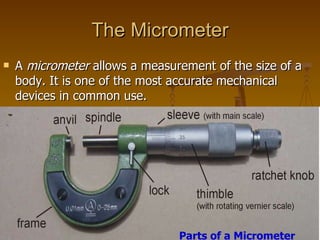
The Micrometer A  micrometer  allows a measurement of the size of a body. It is one of the most accurate mechanical devices in common use. Parts of a Micrometer
How to read and use the Micrometer?
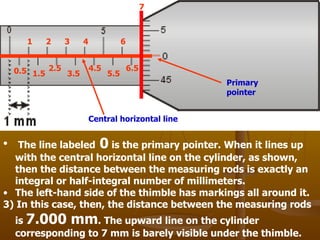
The line labeled  0  is the primary pointer. When it lines up with the central horizontal line on the cylinder, as shown, then the distance between the measuring rods is exactly an integral or half-integral number of millimeters. The left-hand side of the thimble has markings all around it.  3) In this case, then, the distance between the measuring rods is  7.000 mm . The upward line on the cylinder corresponding to 7 mm is barely visible under the thimble.  Primary pointer Central horizontal line 1 2 3 4 6 7 0.5 1.5 2.5 3.5 4.5 5.5 6.5
Remember!!! Report to 3 decimal places. Your instrument is capable of reading up to thousandths of a millimeter. ( That is why it is called a micrometer, 10 -6  of a meter).
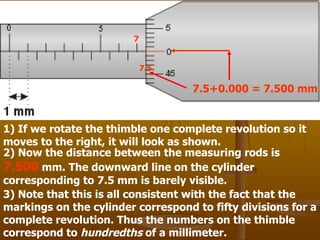
1) If we rotate the thimble one complete revolution so it moves to the right, it will look as shown. 2) Now the distance between the measuring rods is  7.500  mm. The downward line on the cylinder corresponding to 7.5 mm is barely visible. 3) Note that this is all consistent with the fact that the markings on the cylinder correspond to fifty divisions for a complete revolution. Thus the numbers on the thimble correspond to  hundredths  of a millimeter.  7 7.5 7.5+0.000 = 7.500 mm
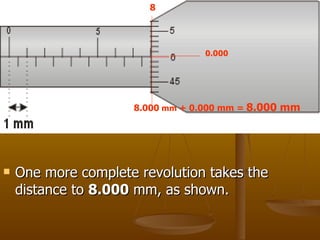
One more complete revolution takes the distance to  8.000  mm, as shown.  8 0.000 8.000  mm  + 0.000 mm =   8.000 mm
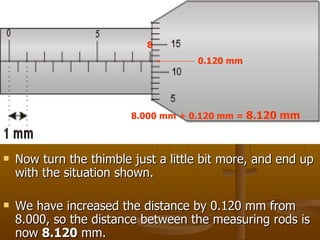
Now turn the thimble just a little bit more, and end up with the situation shown. We have increased the distance by 0.120 mm from 8.000, so the distance between the measuring rods is now  8.120  mm.  8 0.120 mm 8.000 mm + 0.120 mm =  8.120 mm
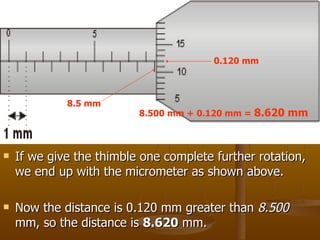
If we give the thimble one complete further rotation, we end up with the micrometer as shown above. Now the distance is 0.120 mm greater than  8.500  mm, so the distance is  8.620  mm.  8.5 mm  0.120 mm 8.500 mm + 0.120 mm =  8.620 mm
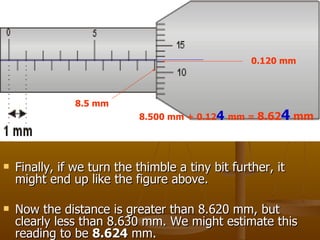
Finally, if we turn the thimble a tiny bit further, it might end up like the figure above. Now the distance is greater than 8.620 mm, but clearly less than 8.630 mm. We might estimate this reading to be  8.624  mm. 8.5 mm  0.120 mm 8.500 mm + 0.12 4   mm =  8.62 4  mm
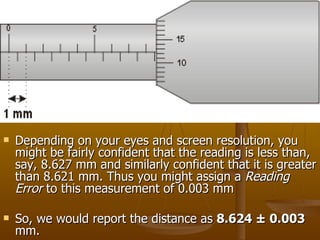
Depending on your eyes and screen resolution, you might be fairly confident that the reading is less than, say, 8.627 mm and similarly confident that it is greater than 8.621 mm. Thus you might assign a  Reading Error  to this measurement of 0.003 mm So, we would report the distance as  8.624 ± 0.003  mm.
Let us try!!!
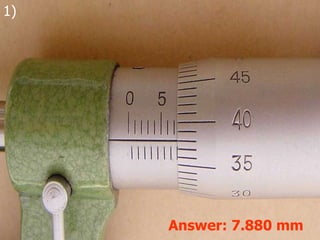
1) Answer: 7.880 mm
2) Answer: 7.721± 0.003 mm
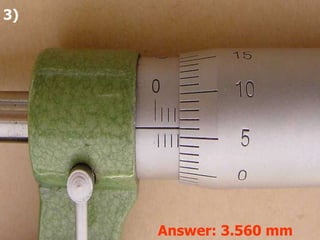
3) Answer: 3.560 mm
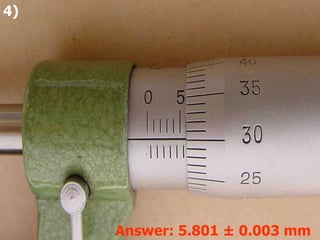
4) Answer: 5.801 ± 0.003 mm
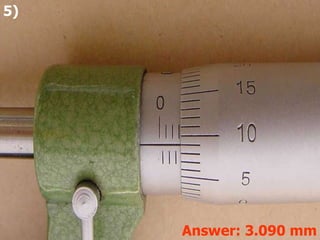
5) Answer: 3.090 mm
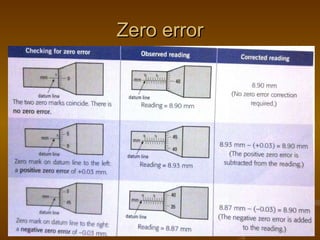
Zero error
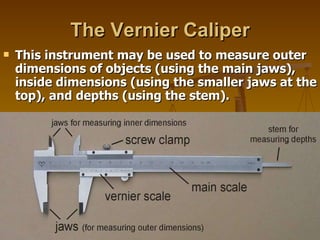
The Vernier Caliper This instrument may be used to measure outer dimensions of objects (using the main jaws), inside dimensions (using the smaller jaws at the top), and depths (using the stem).
How to read and use the Vernier Caliper?
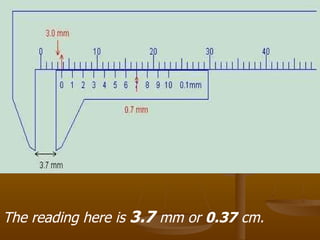
The reading here is  3.7  mm or  0.37  cm.
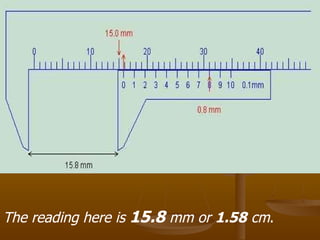
The reading here is  15.8  mm or  1.58  cm .
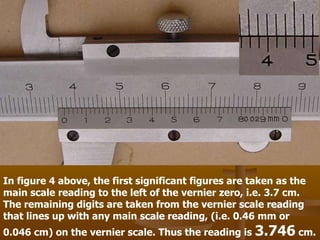
In figure 4 above, the first significant figures are taken as the main scale reading to the left of the vernier zero, i.e. 3.7 cm. The remaining digits are taken from the vernier scale reading that lines up with any main scale reading, (i.e. 0.46 mm or 0.046 cm) on the vernier scale. Thus the reading is  3.746  cm.
In figure above, the first significant figures are taken as the main scale reading to the left of the vernier zero, i.e. 3.4 cm. The remaining digit is taken from the vernier scale reading that lines up with any main scale reading, (i.e. 0.60 mm or 0.060 cm) on the vernier scale. Therefore the reading is 3.460 cm.
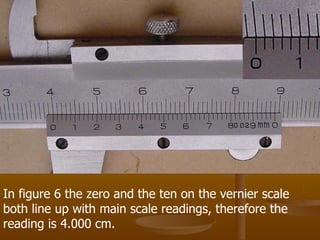
In figure 6 the zero and the ten on the vernier scale both line up with main scale readings, therefore the reading is 4.000 cm.
Let us try!!!
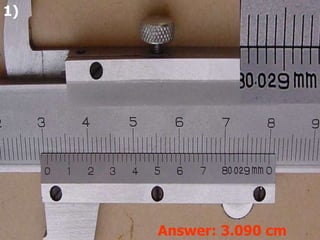
1) Answer: 3.090 cm
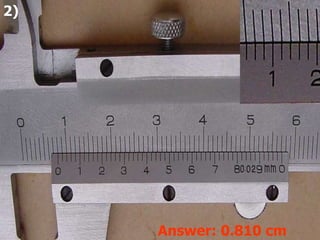
Answer: 0.810 cm 2)
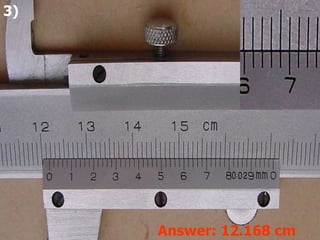
3) Answer: 12.168 cm
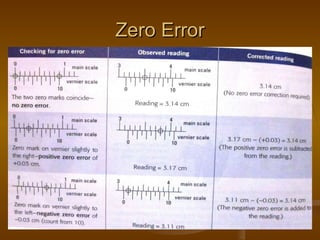
Zero Error
Okay, that is enough! Let us try to apply it in real life.
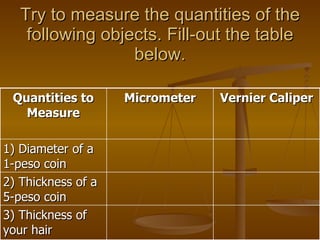
Try to measure the quantities of the following objects. Fill-out the table below. Quantities to Measure Micrometer Vernier Caliper 1) Diameter of a 1-peso coin 2) Thickness of a  5-peso coin 3) Thickness of your hair
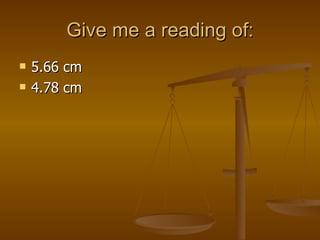
Give me a reading of: 5.66 cm 4.78 cm

Measurement.micrometer & vernier caliper

  • 1.
    Presented by: Riel M. Casinillo Faculty Measurement and Measuring Devices (Micrometer and Vernier Caliper)
  • 2.
    What are wegoing to do today? 1) We are going to read and use the following instruments in measuring certain quantities: Micrometer Vernier Caliper
  • 3.
    The Micrometer A micrometer allows a measurement of the size of a body. It is one of the most accurate mechanical devices in common use. Parts of a Micrometer
  • 4.
    How to readand use the Micrometer?
  • 5.
    The line labeled 0 is the primary pointer. When it lines up with the central horizontal line on the cylinder, as shown, then the distance between the measuring rods is exactly an integral or half-integral number of millimeters. The left-hand side of the thimble has markings all around it. 3) In this case, then, the distance between the measuring rods is 7.000 mm . The upward line on the cylinder corresponding to 7 mm is barely visible under the thimble. Primary pointer Central horizontal line 1 2 3 4 6 7 0.5 1.5 2.5 3.5 4.5 5.5 6.5
  • 6.
    Remember!!! Report to3 decimal places. Your instrument is capable of reading up to thousandths of a millimeter. ( That is why it is called a micrometer, 10 -6 of a meter).
  • 7.
    1) If werotate the thimble one complete revolution so it moves to the right, it will look as shown. 2) Now the distance between the measuring rods is 7.500 mm. The downward line on the cylinder corresponding to 7.5 mm is barely visible. 3) Note that this is all consistent with the fact that the markings on the cylinder correspond to fifty divisions for a complete revolution. Thus the numbers on the thimble correspond to hundredths of a millimeter. 7 7.5 7.5+0.000 = 7.500 mm
  • 8.
    One more completerevolution takes the distance to 8.000 mm, as shown. 8 0.000 8.000 mm + 0.000 mm = 8.000 mm
  • 9.
    Now turn thethimble just a little bit more, and end up with the situation shown. We have increased the distance by 0.120 mm from 8.000, so the distance between the measuring rods is now 8.120 mm. 8 0.120 mm 8.000 mm + 0.120 mm = 8.120 mm
  • 10.
    If we givethe thimble one complete further rotation, we end up with the micrometer as shown above. Now the distance is 0.120 mm greater than 8.500 mm, so the distance is 8.620 mm. 8.5 mm 0.120 mm 8.500 mm + 0.120 mm = 8.620 mm
  • 11.
    Finally, if weturn the thimble a tiny bit further, it might end up like the figure above. Now the distance is greater than 8.620 mm, but clearly less than 8.630 mm. We might estimate this reading to be 8.624 mm. 8.5 mm 0.120 mm 8.500 mm + 0.12 4 mm = 8.62 4 mm
  • 12.
    Depending on youreyes and screen resolution, you might be fairly confident that the reading is less than, say, 8.627 mm and similarly confident that it is greater than 8.621 mm. Thus you might assign a Reading Error to this measurement of 0.003 mm So, we would report the distance as 8.624 ± 0.003 mm.
  • 13.
  • 14.
  • 15.
  • 16.
  • 17.
    4) Answer: 5.801± 0.003 mm
  • 18.
  • 19.
  • 20.
    The Vernier CaliperThis instrument may be used to measure outer dimensions of objects (using the main jaws), inside dimensions (using the smaller jaws at the top), and depths (using the stem).
  • 21.
    How to readand use the Vernier Caliper?
  • 22.
    The reading hereis 3.7 mm or 0.37 cm.
  • 23.
    The reading hereis 15.8 mm or 1.58 cm .
  • 24.
    In figure 4above, the first significant figures are taken as the main scale reading to the left of the vernier zero, i.e. 3.7 cm. The remaining digits are taken from the vernier scale reading that lines up with any main scale reading, (i.e. 0.46 mm or 0.046 cm) on the vernier scale. Thus the reading is 3.746 cm.
  • 25.
    In figure above,the first significant figures are taken as the main scale reading to the left of the vernier zero, i.e. 3.4 cm. The remaining digit is taken from the vernier scale reading that lines up with any main scale reading, (i.e. 0.60 mm or 0.060 cm) on the vernier scale. Therefore the reading is 3.460 cm.
  • 26.
    In figure 6the zero and the ten on the vernier scale both line up with main scale readings, therefore the reading is 4.000 cm.
  • 27.
  • 28.
  • 29.
  • 30.
  • 31.
  • 32.
    Okay, that isenough! Let us try to apply it in real life.
  • 33.
    Try to measurethe quantities of the following objects. Fill-out the table below. Quantities to Measure Micrometer Vernier Caliper 1) Diameter of a 1-peso coin 2) Thickness of a 5-peso coin 3) Thickness of your hair
  • 34.
    Give me areading of: 5.66 cm 4.78 cm