TecH Lad
TecH
Lad
Measuring DevicesMeasuring Devices
Shalet K S
Assistant Professor
TecH Lad
TecH
Lad
Linear and AngularLinear and Angular
MeasurementMeasurement
The Linear Measurement includes
measurements of length, diameters,
heights and thickness
The Angular measurement includes the
measurement of angles or tapers
TecH Lad
TecH
Lad
DimensionsDimensions
A very common measurement is that of
dimensions, i.e., length, width, height of
an object
Dimensions of the measuring instruments
are classified as follows
◦ Low resolution devices (up to 0.25mm)
◦ Medium resolution devices (up to 0.025mm)
◦ High resolution devices (less than microns)
TecH Lad
TecH
Lad
Low resolution devicesLow resolution devices
Steel rule
Steel rule with assistance of
◦ Calipers
◦ Dividers &
◦ Surface gauges
Thickness gauges
TecH Lad
TecH
Lad
Medium resolution devicesMedium resolution devices
Micrometer
Micrometer with assistance of
◦ Telescoping
◦ Extendable ball gauges
Vernier calipers
Dial indicators
Microscope
TecH Lad
TecH
Lad
High resolution devicesHigh resolution devices
Gauge blocks
Gauge block with assistance of
◦ Mechanical comparator
◦ Electronic comparator
◦ Pneumatic comparator
◦ Optical flats
TecH Lad
TecH
Lad
Linear Measuring InstrumentsLinear Measuring Instruments
Vernier caliper
Micrometer
Slip gauge or gauge blocks
Optical flats
Interferometer
Comparators
TecH Lad
TecH
Lad
SLIP GAUGESLIP GAUGE
 These are high carbon steel hardened, ground
and lapped rectangular blocks, having cross
sectional area 0f 30 mm 10mm.
 Their opposite faces are flat, parallel and are
accurately the stated distance apart
•Universally accepted end standard of length in industry.
•A rectangular block made up of high grade hardened steel.
•Independent of any subsequent variation in size or shape
•Carefully finished by high grade lapping to a high degree of
finish, flatness and accuracy
The opposite faces are of such a high degree of surface
finish so that when the blocks are pressed together with a
slight twist by hand, they will wring together. They will
remain firmly attached to each other.
TecH Lad
TecH
Lad
Normal set
Special Set
Range Step Pieces
1.001 to 1.009 0.001 9
1.01 to 1.49 0.01 49
1.5 to 9.5 0.5 19
10 to 90 10 9
Total 86
Range Step Pieces
1.001 to 1.009 0.001 9
1.01 to 1.09 0.01 9
1.1 to 1.9 0.1 9
1 to 9 1 9
10 to 90 10 9
Total 45
TecH Lad
TecH
Lad
ClassificationClassification
AA slip gauges
A slip gauges and
B slip gauges
TecH Lad
TecH
Lad
AA slip gauges
◦ Master slip gauges
◦ Accurate to plus or minus two microns per
meter
A slip gauges
◦ Reference purpose
◦ Type A is guaranteed accurate up to plus or
minus four microns per meter
B slip gauges
◦ Working slip gauges
◦ Type 'B' for plus or minus eight microns per
meter
TecH Lad
TecH
Lad
ClassesClasses
Grade 2
Grade 1
Grade 0
Grade 00
Calibration grade
1) Grade 2
It is a workshop grade slip gauges used for setting
tools, cutters and checking dimensions roughly.
2) Grade 1
The grade 1 is used for precise work in tool rooms.
3) Grade 0
It is used as inspection grade of slip gauges mainly by
inspection department.
4) Grade 00
Grade 00 mainly used in high precision works in the
form of error detection in instruments.
5) Calibration grade
The actual size of the slip gauge is calibrated on a
chart supplied by the manufactures.
WRINGINGWRINGING
It is nothing but ,combining the faces of slip
gauges one over the other. Due to
adhesion property of slip gauges, they will
stick together. This is because of very high
degree of surface finish of the measuring
faces.
This process is called as wringing
The process of wringing involves fourThe process of wringing involves four
stepssteps
Wiping a clean gauge block across an oiled pad
Wiping any extra oil off the gauge block using a dry pad
l
The block is then slide perpendicularly across the other
block while applying moderate pressure until they form a
cruciform
Finally, the block is rotated until it is inline with the other
block
Applications of slip gauges :Applications of slip gauges :
(l) They are used to check the accuracy of vernier,
micrometers and other measuring devices.
(2) They are used to set the comparator to a specific
dimension.
(3) They are used for direct precise measurement
where the accuracy of work piece is important.
(4) They are frequently used with sine bar to measure
angle of work piece.
(5) They can be used to check gap between parallel
locations.
TEMPERATURETEMPERATURE
EFFECTSEFFECTS
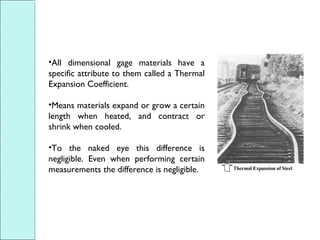
•All dimensional gage materials have a
specific attribute to them called a Thermal
Expansion Coefficient.
•Means materials expand or grow a certain
length when heated, and contract or
shrink when cooled.
•To the naked eye this difference is
negligible. Even when performing certain
measurements the difference is negligible.
TecH Lad
TecH
Lad
ComparatorsComparators
All measurements require the unknown quantity to be
compared with a known quantity, called a standard.
There are certain devices in which the standards are
separated from the instrument. It compares the
unknown length with the standard. Such measurement
is known as comparison measurement and the
instrument, which provides such comparison, is called a
comparator.
Comparators are generally used for linear
measurements.
TecH Lad
TecH
Lad
Characteristics of ComparatorsCharacteristics of Comparators
1. It should be compact.
2. It should be easy to handle.
3. It should give quick response or quick result.
4. It should be reliable, while in use.
5. There should be no effects of environment on the comparator.
6. Its weight must be less.
7. It must be cheaper.
8. It must be easily available in the market.
9. It should be sensitive as per the requirement.
10. The design should be robust.
11. It should be linear in scale so that it is easy to read and get
uniform response.
12. It should have less maintenance.
13. It should have hard contact point, with long life.
14. It should be free from backlash and wear.
TecH Lad
TecH
Lad
Types of ComparatorsTypes of Comparators
Mechanical comparators
Electrical comparators
Pneumatic comparators
TecH Lad
TecH
Lad
Mechanical comparatorsMechanical comparators
Initially, the comparator is adjusted to zero on its dial
with a standard job in position as shown in Figure(a).
The reading H1is taken with the help of a plunger.
Then the standard is replaced by the work - piece to be
checked and the reading H2 is taken.
If H1and H2 are different, then the change in the
dimension will be shown on the dial of the comparator.
TecH Lad
TecH
Lad
Types of Mechanical ComparatorsTypes of Mechanical Comparators
Dial indicator
Johanssons mikrokator
Mechanical optical comparator
Dial IndicatorDial Indicator
https://www.youtube.com/watch?v=Ja_XCJAg_l8
 The simplest type of mechanical comparator
 It consists of a base with a rigid column rising from its rear
 An arm mounted on this column and it carries a dial gauge at its
outer end
 The indicator is set at zero by the use of slip gauges
 The part to be checked is placed below the plunger
 The linear movement of the plunger is magnified by means of
mechanical means to a sizable rotation of the pointer
 This type is generally used for inspection of small precision
machined parts
 This comparator is ideal for the checking of components with a
tolerance of + 0.005 mm
With the plunger set to approximately mid position, the face dial is set to read‐
zero.
From this zero reference point, two rules
apply:
As the plunger moves out of the case, the needle travels counter clockwise‐ ...
giving a NEGATIVE reading.
As the plunger moves into the case, the needle travels clockwise...giving a
POSITIVE reading
1.Comparing two heights or distances between narrow limits.
2. To determine the errors in geometrical form such as ovality,
roundness and taper.
3. For taking accurate measurement of deformation such as
intension and compression.
4. To determine positional errors of surfaces such as parallelism,
squareness and alignment.
5.To check the alignment of lathe centers by using suitable
accurate bar between the centers.
ApplicationsApplications
Johansson MikrokatorJohansson Mikrokator
 A light pointer made of glass fixed to a thin twisted metal strip
 While one end of the strip is fixed to an adjustable cantilever
link, the other end is anchored to a bell crank lever
 Any linear motion of the plunger will result in a movement of
the bell crank lever, which exerts either a push or pull force on
the metal strip.
 Accordingly the glass pointer will rotate either clockwise or
anti clockwise depending on the direction of plunger‐
movement
 A calibrated scale is employed with the pointer, so that any
axial movement of the plunger can be conveniently recorded.
 The spring ensures that the plunger returns when the contact is
removed.
Advantages of Mechanical Comparator:
1. They do not require any external source of energy.
2. These are cheaper and portable.
3. These are of robust construction and compact design.
4. The simple linear scales are easy to read.
5.These are unaffected by variations due to external
source of energy such air, electricity etc.
Mechanical Optical ComparatorMechanical Optical Comparator
Principle:Principle:
In mechanical optical comparator, small variation in the
plunger movement is magnified: first by mechanical system
and then by optical system.
Construction:Construction:
The movement of the plunger is magnified by the
mechanical system using a pivoted lever. High optical
magnification is possible with a small movement of the
mirror.
 In mechanical optical comparators small displacements of the
measuring plunger are amplified first by a mechanical system
consisting of pivoted levers.
 The amplified mechanical move­ment is further amplified by a simple
optical system involving the projection of an image.
 The usual arrangement employed is such that the mechanical system
causes a plane reflector to tilt about an axis and the image of an
index is projected on a scale on the inner surface of a ground-glass
screen.
 Optical magnification pro­vides high degree of measuring precision
due to reduction of moving members and better wear resistance
qualities.
 Optical magnification is also free from friction, bending, wear etc.
 The whole system could be explained diagrammatically by Fig.
below, which gives very simple arrangement and explains the
principle of above comparator.
 In this system,
 Mechanical amplification= l2/l1
 and Optical amplification = l4/l3  * 2.
TecH Lad
TecH
Lad
Electrical comparatorsElectrical comparators
 The plunger is the sensing element, the movement of which displaces an
armature inside a pair of coils. Movement of the armature causes
change in inductance in the two coils, resulting in a net change in
inductance.
 This change causes imbalance in the bridge circuit, resulting in an
output.
 The output display device, whether it is analog or digital, is calibrated to
show the readings in units of length, that is, linear displacement.
Pneumatic comparatorsPneumatic comparators
In the set up shown in figure, the back pressure is let into a
bourdon tube, which undergone deflection depending on
the magnitude of air pressure. This deflection of the
bourdon tube is amplified by lever and gear arrangement
and indicated on a dial.
Advantages:Advantages:
1. It is cheaper, simple to operate and the cost is low.
2. It is free from mechanical hysteresis and wear.
3. The magnification can be obtained as high as 10,000 X.
4.The gauging member is not in direct contact with the work.
5. Indicating and measuring is done at two different places.
6. Tapers and ovality can be easily detected.
7. The method is self cleaning due to continuous flow of air
through the jets and this makes the method ideal to be used
on shop floor for online controls.
Linear Variable DifferentialLinear Variable Differential
Transformer (LVDT)Transformer (LVDT)
The term LVDT stands for the linear variable differential transformer. It
is the most widely used inductive transducer that covert the linear motion into
the electrical signals. The output across secondary of this transformer is the
differential so it is called so.
•The transformer consists of a primary winding P and two secondary winding
S1 and S2 wound on a cylindrical former (which is hollow in nature and will
contain core).
•Both the secondary windings have equal number of turns and are identically
placed on the either side of primary winding
•The primary winding is connected to an AC source which produces a flux in
the air gap and voltages are induced in secondary windings.
•A movable soft iron core is placed inside the former and displacement to be
measured is connected to the iron core.
•The iron core is generally of high permeability which helps in reducing
harmonics and high sensitivity of LVDT.
•The LVDT is placed inside a stainless steel housing because it will provide
electrostatic and electromagnetic shielding.
•The both the secondary windings are connected in such a way that resulted
output is the difference of the voltages of two windings.
ConstructionConstruction
CASE I When the core is at null position (for no displacement)
When the core is at null position then the flux linking with both the
secondary windings is equal so the induced emf is equal in both the
windings. So for no displacement the value of output Vout is zero as
V1 and V2 both are equal. So it shows that no displacement took
place.
CASE II When the core is moved to upward of null position (For
displacement to the upward of reference point) In the this case the
flux linking with secondary winding S1 is more as compared to flux
linking with S2. Due to this V1 will be more as that of V2. Due to this
output voltage Vout is positive.
CASE III When the core is moved to downward of Null position
(for displacement to the downward of reference point). In this case
magnitude of V2 will be more as that of V1. Due to this output Vout
will be negative and shows the output to downward of reference
point.
WorkingWorking
Strain GaugeStrain Gauge
(refer text book named “mechanical measurements and(refer text book named “mechanical measurements and
instruments & control” page number 219 – 229, 598 – 628)instruments & control” page number 219 – 229, 598 – 628)
DefinitionDefinition
A strain gauge is an example of passive transducer that converts a
mechanical displacement into a change of resistance.
A strain gauge is a thin, wafer-like device that can be attached to a
variety of materials to measure applied strain.
What is stress?What is stress?
Stress is defined as the force acting on a unit area within a
deformable body. Mathematically it is expressed as,
Suppose that the cross-sectional area of the column is A (m2) and
the ex-ternal force is P (N, Newton). Since external force= internal
force, stress, (sigma), is:σ
Strain is the amount of deformation of a body due to an applied
force. More specifically, strain ( ) is defined as the fractional change inε
length, as shown in Figure. The magnitude of measured strain is
very small. Therefore, strain is often expressed as micro strain
(με), which is ε×10.
What is strain?What is strain?
-6
Stress is defined as a force that can cause a change in an object or a physical
body while strain is the change in the form or shape of the object or physical
body on which stress is applied.
Gauge factorGauge factor
• The resistance of a wire is given by
where, R is the resistance, is the resistivity of wire which is a functionρ
of the wire material, L is the length of wire, and A is the cross-sectional
area of the wire.
• Taking logarithms of both sides, separating the terms and
differentiating each term, we get
• The above equation relates a small change in resistance to changes in
resistivity, length and cross-sectional area.
• The term dL/L is the axial strain, a.ε
• The term dA/A can be evaluated from the equation of the cross-
sectional area A=πD^2/4.
• Taking the logarithm and differentiating the above equation we get
• The term dD/D is known as the transverse strain, εt.
• Solid mechanics provides the following relationship between the axial
and transverse strain
where, v is known as Poisson’s ratio and it is the property of material.
• The negative sign indicates that as the wire becomes longer, the
transverse dimension decreases.
• Combining the above equations we get
• The above equation shows the relationship between the change in
resistance of the wire, strain, and the change in resistivity of the wire.
• The strain gage factor, S, is defined as
• Combining the above two equations we get
Types of strain gaugeTypes of strain gauge
Based on mounting :
•Bonded strain gauge
•Unbonded strain gauge
 A bonded strain-gage element, consisting of a metallic
wire, etched foil, vacuum-deposited film, or
semiconductor bar, is cemented to the strained
surface.
Bonded strain gaugeBonded strain gauge
 The unbonded strain gage consists of a wire stretched
between two points in an insulating medium such as air.
One end of the wire is fixed and the other end is
attached to a movable element.
Un - Bonded strain gaugeUn - Bonded strain gauge
A strain gage only
measures strain in one
direction
To get principal strains, it
is necessary to use a
strain rosette
A strain rosette is a cluster
of 3 strain gages
oriented at different
angles
Rosette strain gaugeRosette strain gauge
The set of equations relating rosette
measured strains to principal strains are:
⌧εa = εxcos2θa + εysin2θa + γxysinθacosθa
⌧εb = εxcos2θb + εysin2θb + γxysinθbcosθb
⌧εc = εxcos2θc + εysin2θc + γxysinθccosθc
⌧εa, εb, εc are the strains measured by the individual strain
gages in the rosette
The Wheatstone bridge is an electric circuit suitable for detection of
minute resistance changes. It is therefore used to measure resistance
changes of a strain gage. Condition for balanced condition is,
Wheatstone bridgeWheatstone bridge
Principle of strain measurementPrinciple of strain measurement
Thank you

Measuring devices

  • 1.
    TecH Lad TecH Lad Measuring DevicesMeasuringDevices Shalet K S Assistant Professor
  • 2.
    TecH Lad TecH Lad Linear andAngularLinear and Angular MeasurementMeasurement The Linear Measurement includes measurements of length, diameters, heights and thickness The Angular measurement includes the measurement of angles or tapers
  • 3.
    TecH Lad TecH Lad DimensionsDimensions A verycommon measurement is that of dimensions, i.e., length, width, height of an object Dimensions of the measuring instruments are classified as follows ◦ Low resolution devices (up to 0.25mm) ◦ Medium resolution devices (up to 0.025mm) ◦ High resolution devices (less than microns)
  • 4.
    TecH Lad TecH Lad Low resolutiondevicesLow resolution devices Steel rule Steel rule with assistance of ◦ Calipers ◦ Dividers & ◦ Surface gauges Thickness gauges
  • 5.
    TecH Lad TecH Lad Medium resolutiondevicesMedium resolution devices Micrometer Micrometer with assistance of ◦ Telescoping ◦ Extendable ball gauges Vernier calipers Dial indicators Microscope
  • 6.
    TecH Lad TecH Lad High resolutiondevicesHigh resolution devices Gauge blocks Gauge block with assistance of ◦ Mechanical comparator ◦ Electronic comparator ◦ Pneumatic comparator ◦ Optical flats
  • 7.
    TecH Lad TecH Lad Linear MeasuringInstrumentsLinear Measuring Instruments Vernier caliper Micrometer Slip gauge or gauge blocks Optical flats Interferometer Comparators
  • 8.
    TecH Lad TecH Lad SLIP GAUGESLIPGAUGE  These are high carbon steel hardened, ground and lapped rectangular blocks, having cross sectional area 0f 30 mm 10mm.  Their opposite faces are flat, parallel and are accurately the stated distance apart
  • 10.
    •Universally accepted endstandard of length in industry. •A rectangular block made up of high grade hardened steel. •Independent of any subsequent variation in size or shape •Carefully finished by high grade lapping to a high degree of finish, flatness and accuracy The opposite faces are of such a high degree of surface finish so that when the blocks are pressed together with a slight twist by hand, they will wring together. They will remain firmly attached to each other.
  • 11.
    TecH Lad TecH Lad Normal set SpecialSet Range Step Pieces 1.001 to 1.009 0.001 9 1.01 to 1.49 0.01 49 1.5 to 9.5 0.5 19 10 to 90 10 9 Total 86 Range Step Pieces 1.001 to 1.009 0.001 9 1.01 to 1.09 0.01 9 1.1 to 1.9 0.1 9 1 to 9 1 9 10 to 90 10 9 Total 45
  • 12.
    TecH Lad TecH Lad ClassificationClassification AA slipgauges A slip gauges and B slip gauges
  • 13.
    TecH Lad TecH Lad AA slipgauges ◦ Master slip gauges ◦ Accurate to plus or minus two microns per meter A slip gauges ◦ Reference purpose ◦ Type A is guaranteed accurate up to plus or minus four microns per meter B slip gauges ◦ Working slip gauges ◦ Type 'B' for plus or minus eight microns per meter
  • 14.
    TecH Lad TecH Lad ClassesClasses Grade 2 Grade1 Grade 0 Grade 00 Calibration grade
  • 15.
    1) Grade 2 Itis a workshop grade slip gauges used for setting tools, cutters and checking dimensions roughly. 2) Grade 1 The grade 1 is used for precise work in tool rooms. 3) Grade 0 It is used as inspection grade of slip gauges mainly by inspection department. 4) Grade 00 Grade 00 mainly used in high precision works in the form of error detection in instruments. 5) Calibration grade The actual size of the slip gauge is calibrated on a chart supplied by the manufactures.
  • 16.
    WRINGINGWRINGING It is nothingbut ,combining the faces of slip gauges one over the other. Due to adhesion property of slip gauges, they will stick together. This is because of very high degree of surface finish of the measuring faces. This process is called as wringing
  • 17.
    The process ofwringing involves fourThe process of wringing involves four stepssteps Wiping a clean gauge block across an oiled pad Wiping any extra oil off the gauge block using a dry pad l The block is then slide perpendicularly across the other block while applying moderate pressure until they form a cruciform Finally, the block is rotated until it is inline with the other block
  • 18.
    Applications of slipgauges :Applications of slip gauges : (l) They are used to check the accuracy of vernier, micrometers and other measuring devices. (2) They are used to set the comparator to a specific dimension. (3) They are used for direct precise measurement where the accuracy of work piece is important. (4) They are frequently used with sine bar to measure angle of work piece. (5) They can be used to check gap between parallel locations.
  • 19.
  • 20.
    •All dimensional gagematerials have a specific attribute to them called a Thermal Expansion Coefficient. •Means materials expand or grow a certain length when heated, and contract or shrink when cooled. •To the naked eye this difference is negligible. Even when performing certain measurements the difference is negligible.
  • 21.
    TecH Lad TecH Lad ComparatorsComparators All measurementsrequire the unknown quantity to be compared with a known quantity, called a standard. There are certain devices in which the standards are separated from the instrument. It compares the unknown length with the standard. Such measurement is known as comparison measurement and the instrument, which provides such comparison, is called a comparator. Comparators are generally used for linear measurements.
  • 22.
    TecH Lad TecH Lad Characteristics ofComparatorsCharacteristics of Comparators 1. It should be compact. 2. It should be easy to handle. 3. It should give quick response or quick result. 4. It should be reliable, while in use. 5. There should be no effects of environment on the comparator. 6. Its weight must be less. 7. It must be cheaper. 8. It must be easily available in the market. 9. It should be sensitive as per the requirement. 10. The design should be robust. 11. It should be linear in scale so that it is easy to read and get uniform response. 12. It should have less maintenance. 13. It should have hard contact point, with long life. 14. It should be free from backlash and wear.
  • 23.
    TecH Lad TecH Lad Types ofComparatorsTypes of Comparators Mechanical comparators Electrical comparators Pneumatic comparators
  • 24.
  • 25.
    Initially, the comparatoris adjusted to zero on its dial with a standard job in position as shown in Figure(a). The reading H1is taken with the help of a plunger. Then the standard is replaced by the work - piece to be checked and the reading H2 is taken. If H1and H2 are different, then the change in the dimension will be shown on the dial of the comparator.
  • 26.
    TecH Lad TecH Lad Types ofMechanical ComparatorsTypes of Mechanical Comparators Dial indicator Johanssons mikrokator Mechanical optical comparator
  • 27.
  • 28.
     The simplesttype of mechanical comparator  It consists of a base with a rigid column rising from its rear  An arm mounted on this column and it carries a dial gauge at its outer end  The indicator is set at zero by the use of slip gauges  The part to be checked is placed below the plunger  The linear movement of the plunger is magnified by means of mechanical means to a sizable rotation of the pointer  This type is generally used for inspection of small precision machined parts  This comparator is ideal for the checking of components with a tolerance of + 0.005 mm
  • 29.
    With the plungerset to approximately mid position, the face dial is set to read‐ zero. From this zero reference point, two rules apply: As the plunger moves out of the case, the needle travels counter clockwise‐ ... giving a NEGATIVE reading. As the plunger moves into the case, the needle travels clockwise...giving a POSITIVE reading
  • 30.
    1.Comparing two heightsor distances between narrow limits. 2. To determine the errors in geometrical form such as ovality, roundness and taper. 3. For taking accurate measurement of deformation such as intension and compression. 4. To determine positional errors of surfaces such as parallelism, squareness and alignment. 5.To check the alignment of lathe centers by using suitable accurate bar between the centers. ApplicationsApplications
  • 31.
  • 33.
     A lightpointer made of glass fixed to a thin twisted metal strip  While one end of the strip is fixed to an adjustable cantilever link, the other end is anchored to a bell crank lever  Any linear motion of the plunger will result in a movement of the bell crank lever, which exerts either a push or pull force on the metal strip.  Accordingly the glass pointer will rotate either clockwise or anti clockwise depending on the direction of plunger‐ movement  A calibrated scale is employed with the pointer, so that any axial movement of the plunger can be conveniently recorded.  The spring ensures that the plunger returns when the contact is removed.
  • 34.
    Advantages of MechanicalComparator: 1. They do not require any external source of energy. 2. These are cheaper and portable. 3. These are of robust construction and compact design. 4. The simple linear scales are easy to read. 5.These are unaffected by variations due to external source of energy such air, electricity etc.
  • 35.
  • 36.
    Principle:Principle: In mechanical opticalcomparator, small variation in the plunger movement is magnified: first by mechanical system and then by optical system. Construction:Construction: The movement of the plunger is magnified by the mechanical system using a pivoted lever. High optical magnification is possible with a small movement of the mirror.
  • 37.
     In mechanicaloptical comparators small displacements of the measuring plunger are amplified first by a mechanical system consisting of pivoted levers.  The amplified mechanical move­ment is further amplified by a simple optical system involving the projection of an image.  The usual arrangement employed is such that the mechanical system causes a plane reflector to tilt about an axis and the image of an index is projected on a scale on the inner surface of a ground-glass screen.  Optical magnification pro­vides high degree of measuring precision due to reduction of moving members and better wear resistance qualities.  Optical magnification is also free from friction, bending, wear etc.  The whole system could be explained diagrammatically by Fig. below, which gives very simple arrangement and explains the principle of above comparator.  In this system,  Mechanical amplification= l2/l1  and Optical amplification = l4/l3  * 2.
  • 38.
    TecH Lad TecH Lad Electrical comparatorsElectricalcomparators  The plunger is the sensing element, the movement of which displaces an armature inside a pair of coils. Movement of the armature causes change in inductance in the two coils, resulting in a net change in inductance.  This change causes imbalance in the bridge circuit, resulting in an output.  The output display device, whether it is analog or digital, is calibrated to show the readings in units of length, that is, linear displacement.
  • 40.
    Pneumatic comparatorsPneumatic comparators Inthe set up shown in figure, the back pressure is let into a bourdon tube, which undergone deflection depending on the magnitude of air pressure. This deflection of the bourdon tube is amplified by lever and gear arrangement and indicated on a dial.
  • 42.
    Advantages:Advantages: 1. It ischeaper, simple to operate and the cost is low. 2. It is free from mechanical hysteresis and wear. 3. The magnification can be obtained as high as 10,000 X. 4.The gauging member is not in direct contact with the work. 5. Indicating and measuring is done at two different places. 6. Tapers and ovality can be easily detected. 7. The method is self cleaning due to continuous flow of air through the jets and this makes the method ideal to be used on shop floor for online controls.
  • 43.
    Linear Variable DifferentialLinearVariable Differential Transformer (LVDT)Transformer (LVDT)
  • 44.
    The term LVDTstands for the linear variable differential transformer. It is the most widely used inductive transducer that covert the linear motion into the electrical signals. The output across secondary of this transformer is the differential so it is called so.
  • 45.
    •The transformer consistsof a primary winding P and two secondary winding S1 and S2 wound on a cylindrical former (which is hollow in nature and will contain core). •Both the secondary windings have equal number of turns and are identically placed on the either side of primary winding •The primary winding is connected to an AC source which produces a flux in the air gap and voltages are induced in secondary windings. •A movable soft iron core is placed inside the former and displacement to be measured is connected to the iron core. •The iron core is generally of high permeability which helps in reducing harmonics and high sensitivity of LVDT. •The LVDT is placed inside a stainless steel housing because it will provide electrostatic and electromagnetic shielding. •The both the secondary windings are connected in such a way that resulted output is the difference of the voltages of two windings. ConstructionConstruction
  • 46.
    CASE I Whenthe core is at null position (for no displacement) When the core is at null position then the flux linking with both the secondary windings is equal so the induced emf is equal in both the windings. So for no displacement the value of output Vout is zero as V1 and V2 both are equal. So it shows that no displacement took place. CASE II When the core is moved to upward of null position (For displacement to the upward of reference point) In the this case the flux linking with secondary winding S1 is more as compared to flux linking with S2. Due to this V1 will be more as that of V2. Due to this output voltage Vout is positive. CASE III When the core is moved to downward of Null position (for displacement to the downward of reference point). In this case magnitude of V2 will be more as that of V1. Due to this output Vout will be negative and shows the output to downward of reference point. WorkingWorking
  • 48.
    Strain GaugeStrain Gauge (refertext book named “mechanical measurements and(refer text book named “mechanical measurements and instruments & control” page number 219 – 229, 598 – 628)instruments & control” page number 219 – 229, 598 – 628)
  • 49.
    DefinitionDefinition A strain gaugeis an example of passive transducer that converts a mechanical displacement into a change of resistance. A strain gauge is a thin, wafer-like device that can be attached to a variety of materials to measure applied strain.
  • 50.
    What is stress?Whatis stress? Stress is defined as the force acting on a unit area within a deformable body. Mathematically it is expressed as, Suppose that the cross-sectional area of the column is A (m2) and the ex-ternal force is P (N, Newton). Since external force= internal force, stress, (sigma), is:σ
  • 51.
    Strain is theamount of deformation of a body due to an applied force. More specifically, strain ( ) is defined as the fractional change inε length, as shown in Figure. The magnitude of measured strain is very small. Therefore, strain is often expressed as micro strain (με), which is ε×10. What is strain?What is strain? -6 Stress is defined as a force that can cause a change in an object or a physical body while strain is the change in the form or shape of the object or physical body on which stress is applied.
  • 56.
    Gauge factorGauge factor •The resistance of a wire is given by where, R is the resistance, is the resistivity of wire which is a functionρ of the wire material, L is the length of wire, and A is the cross-sectional area of the wire. • Taking logarithms of both sides, separating the terms and differentiating each term, we get • The above equation relates a small change in resistance to changes in resistivity, length and cross-sectional area. • The term dL/L is the axial strain, a.ε • The term dA/A can be evaluated from the equation of the cross- sectional area A=πD^2/4. • Taking the logarithm and differentiating the above equation we get
  • 57.
    • The termdD/D is known as the transverse strain, εt. • Solid mechanics provides the following relationship between the axial and transverse strain where, v is known as Poisson’s ratio and it is the property of material. • The negative sign indicates that as the wire becomes longer, the transverse dimension decreases. • Combining the above equations we get • The above equation shows the relationship between the change in resistance of the wire, strain, and the change in resistivity of the wire. • The strain gage factor, S, is defined as • Combining the above two equations we get
  • 58.
    Types of straingaugeTypes of strain gauge Based on mounting : •Bonded strain gauge •Unbonded strain gauge
  • 59.
     A bondedstrain-gage element, consisting of a metallic wire, etched foil, vacuum-deposited film, or semiconductor bar, is cemented to the strained surface. Bonded strain gaugeBonded strain gauge
  • 60.
     The unbondedstrain gage consists of a wire stretched between two points in an insulating medium such as air. One end of the wire is fixed and the other end is attached to a movable element. Un - Bonded strain gaugeUn - Bonded strain gauge
  • 61.
    A strain gageonly measures strain in one direction To get principal strains, it is necessary to use a strain rosette A strain rosette is a cluster of 3 strain gages oriented at different angles Rosette strain gaugeRosette strain gauge
  • 62.
    The set ofequations relating rosette measured strains to principal strains are: ⌧εa = εxcos2θa + εysin2θa + γxysinθacosθa ⌧εb = εxcos2θb + εysin2θb + γxysinθbcosθb ⌧εc = εxcos2θc + εysin2θc + γxysinθccosθc ⌧εa, εb, εc are the strains measured by the individual strain gages in the rosette
  • 63.
    The Wheatstone bridgeis an electric circuit suitable for detection of minute resistance changes. It is therefore used to measure resistance changes of a strain gage. Condition for balanced condition is, Wheatstone bridgeWheatstone bridge
  • 64.
    Principle of strainmeasurementPrinciple of strain measurement
  • 67.