Metrology
The word metrologyderived from two
Greek words ; Metro means measurement
and Logy means science. Thus, Metrology
is the science of measurement
3.
3
Introduction
Metrology canbe defined as “ Comprehensive study of different measuring
instruments for finding precision, accuracy, possible sources of errors and methods of
elimination.
3
10
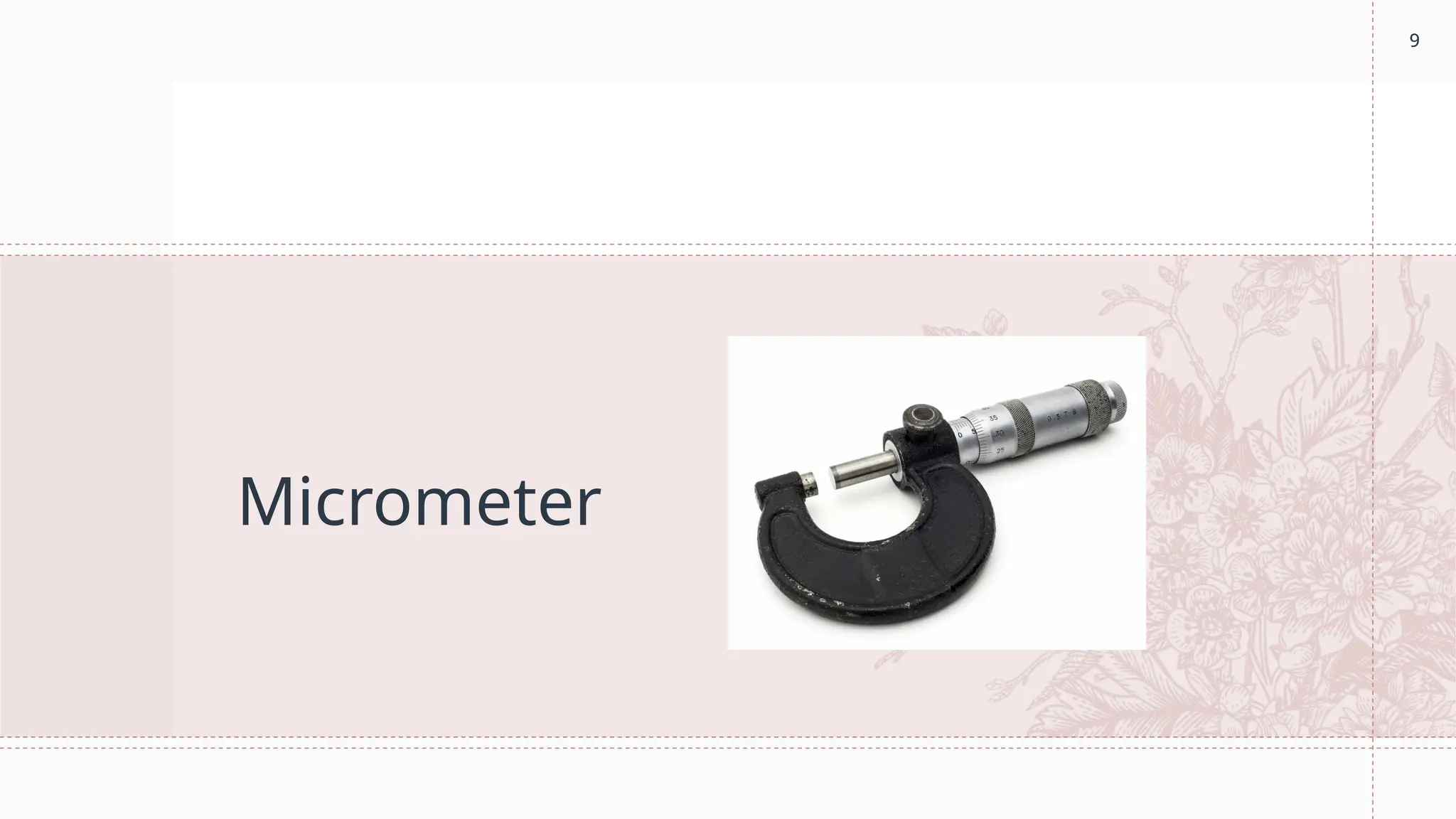
Micrometer
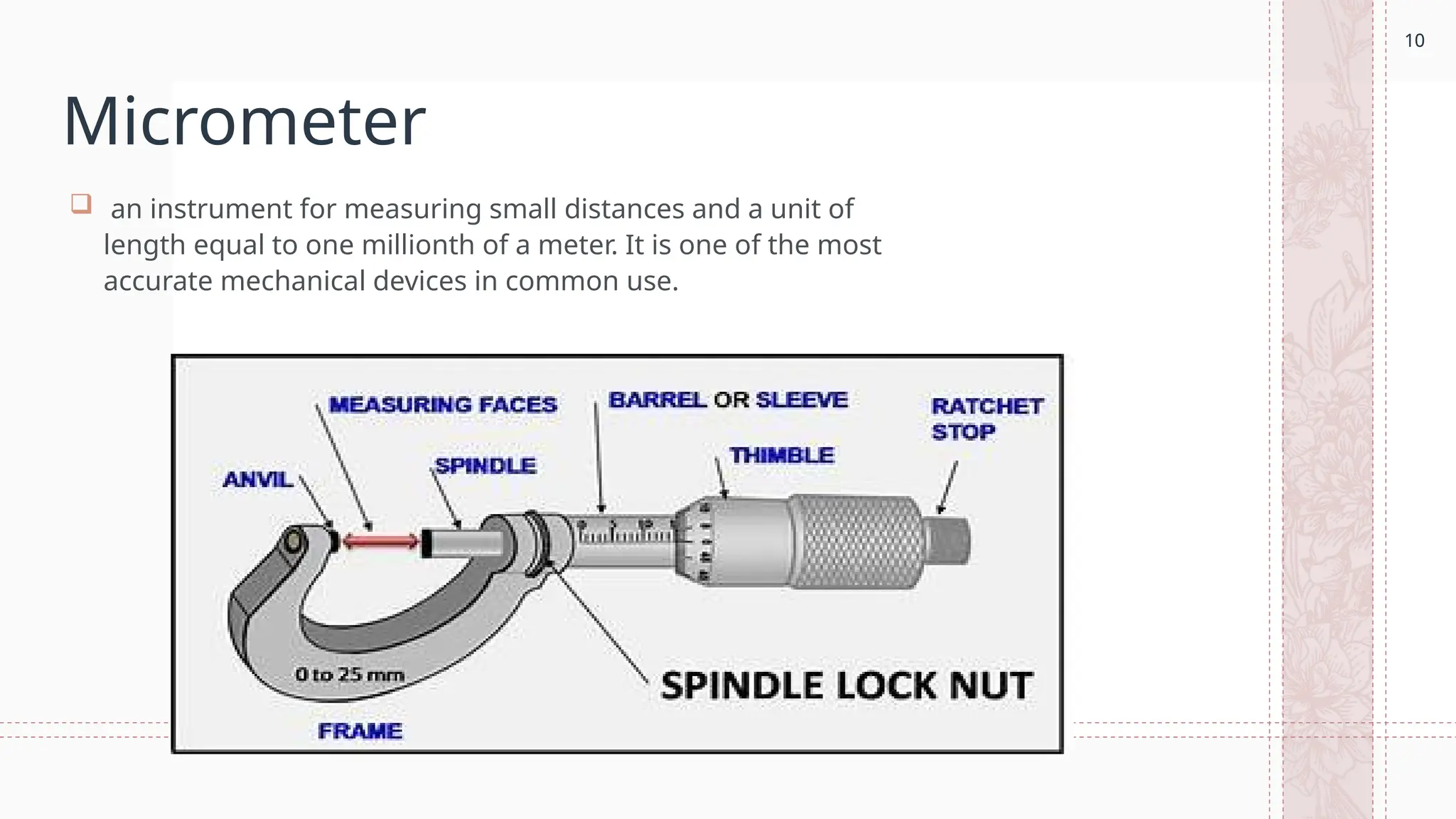
an instrumentfor measuring small distances and a unit of
length equal to one millionth of a meter. It is one of the most
accurate mechanical devices in common use.
10
11.
11
Parts of aMicrometer
A micrometer is composed of the following parts:
•Frame – It is the C-shaped body that holds the anvil and barrel in constant relation to each
other. The frame is heavy and has high thermal mass. To prevent substantial heating up, it is
covered by insulating plastic.
•Anvil – The anvil is the component that does not move therefore the object that needs to
measured will be held there.
•Barrel – Stationary round component with a linear scale on it and the thimble rotates around it.
The index line is also located on the sleeve for measurement readings
•Thimble - The thimble is also moveable rotating around the sleeve. The secondary scale is on
the thimble for higher resolution measurement. The surface is knurled for proper gripping while
rotating..
•Screw
– Found inside the barrel and is considered the heart of the micrometer.
•Locknut – Component that one can tighten to hold the spindle stationary.
•Spindle – The spindle also holds the object that needs to be measured but it moves by rotating
the thimble. The spindle should be placed firmly against the object. Internally, the spindle is
threaded and connects to a screw.
•Ratchet Stop – The device on the end of the handle that limits applied pressure by slipping at a
11
12.
12
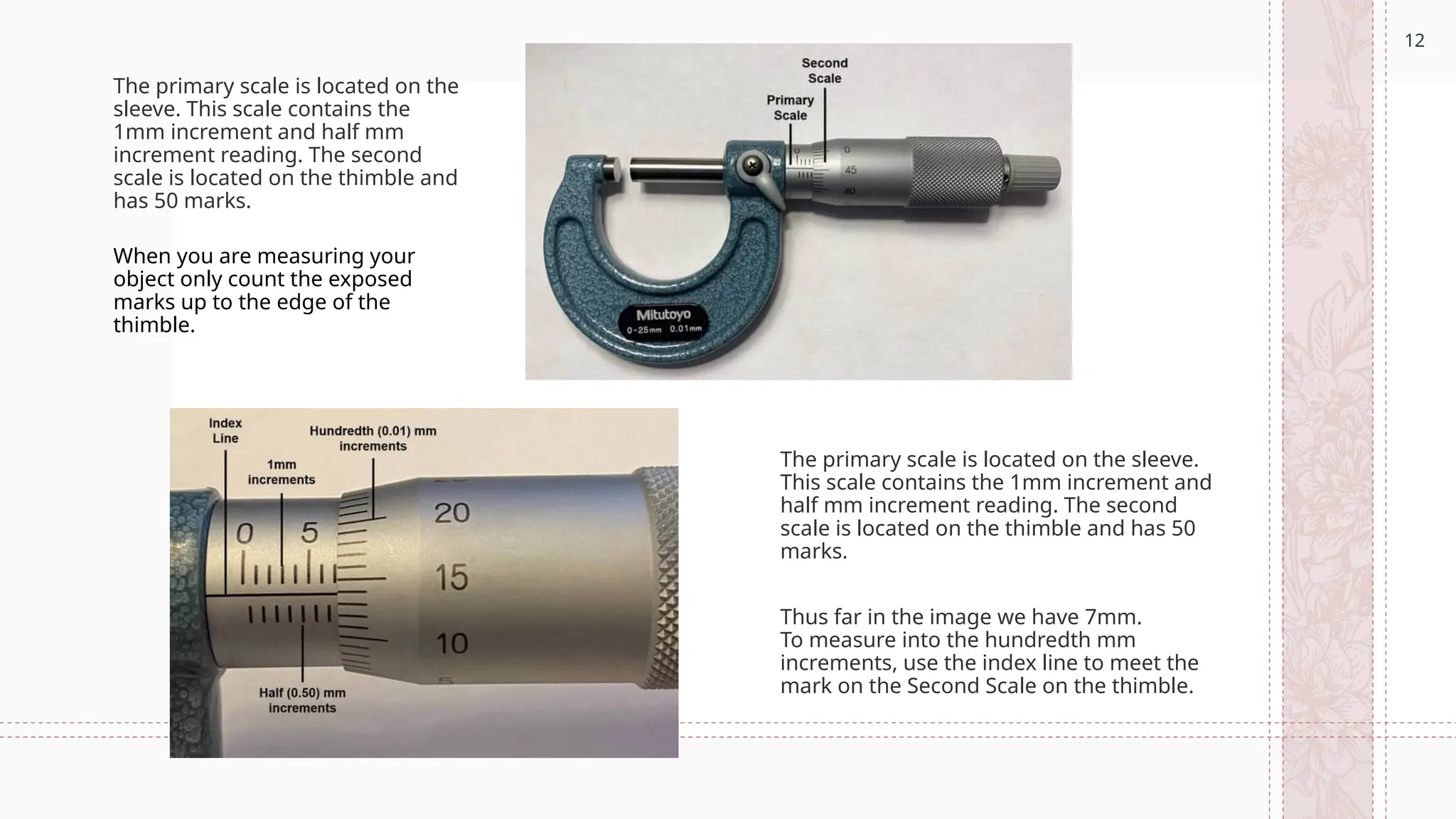
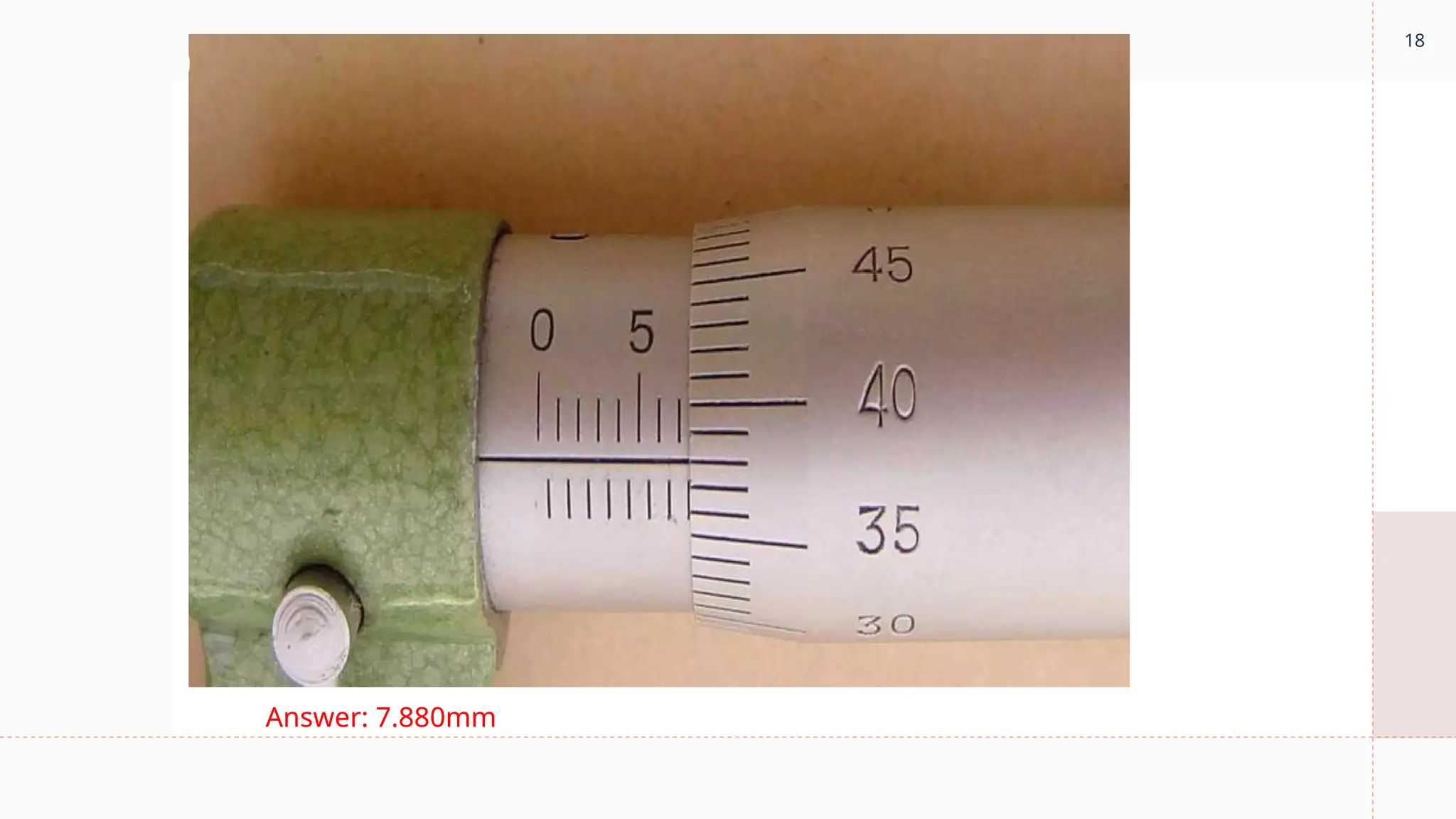
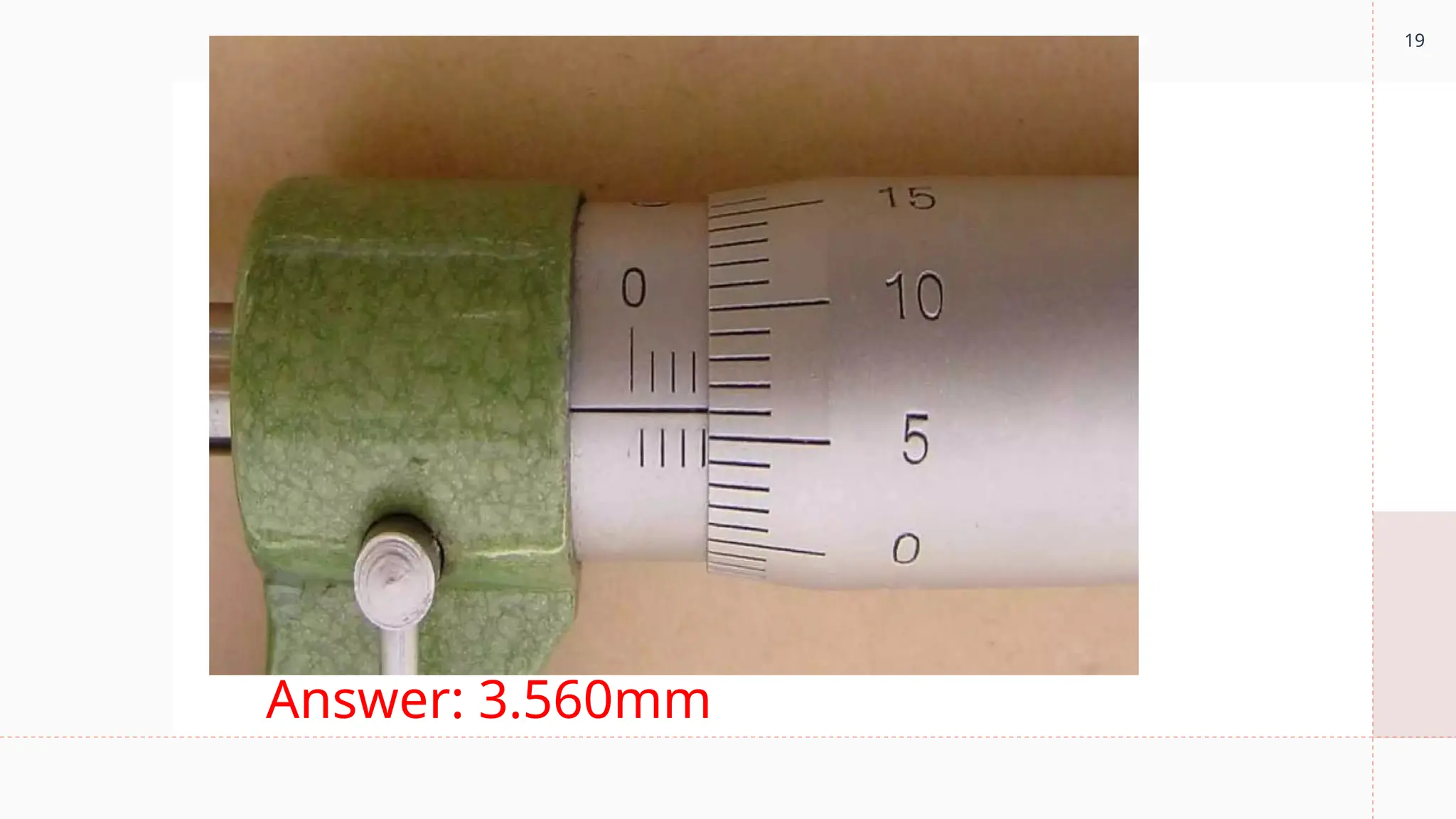
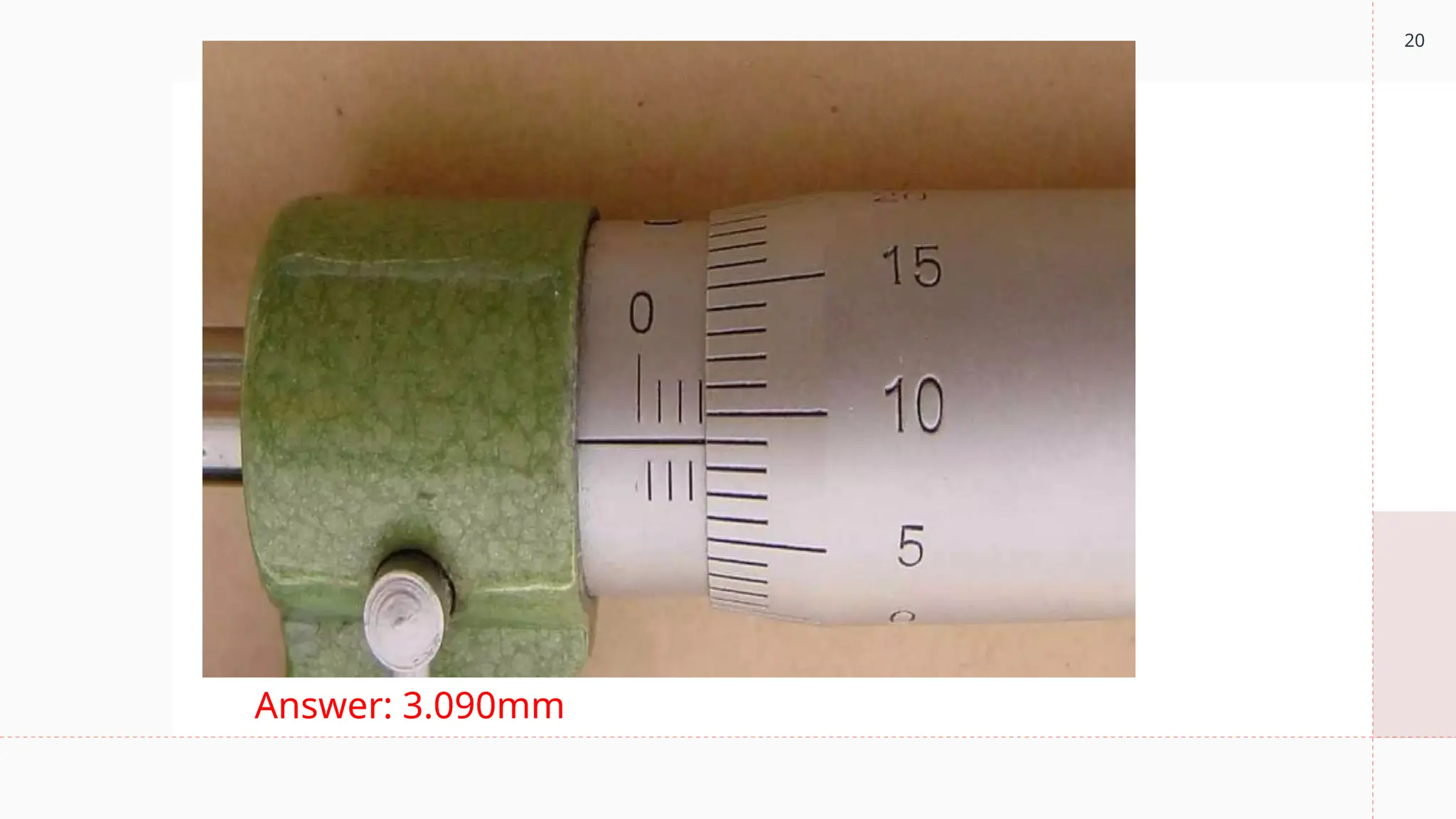
The primary scaleis located on the
sleeve. This scale contains the
1mm increment and half mm
increment reading. The second
scale is located on the thimble and
has 50 marks.
The primary scale is located on the sleeve.
This scale contains the 1mm increment and
half mm increment reading. The second
scale is located on the thimble and has 50
marks.
When you are measuring your
object only count the exposed
marks up to the edge of the
thimble.
Thus far in the image we have 7mm.
To measure into the hundredth mm
increments, use the index line to meet the
mark on the Second Scale on the thimble.
13.
13
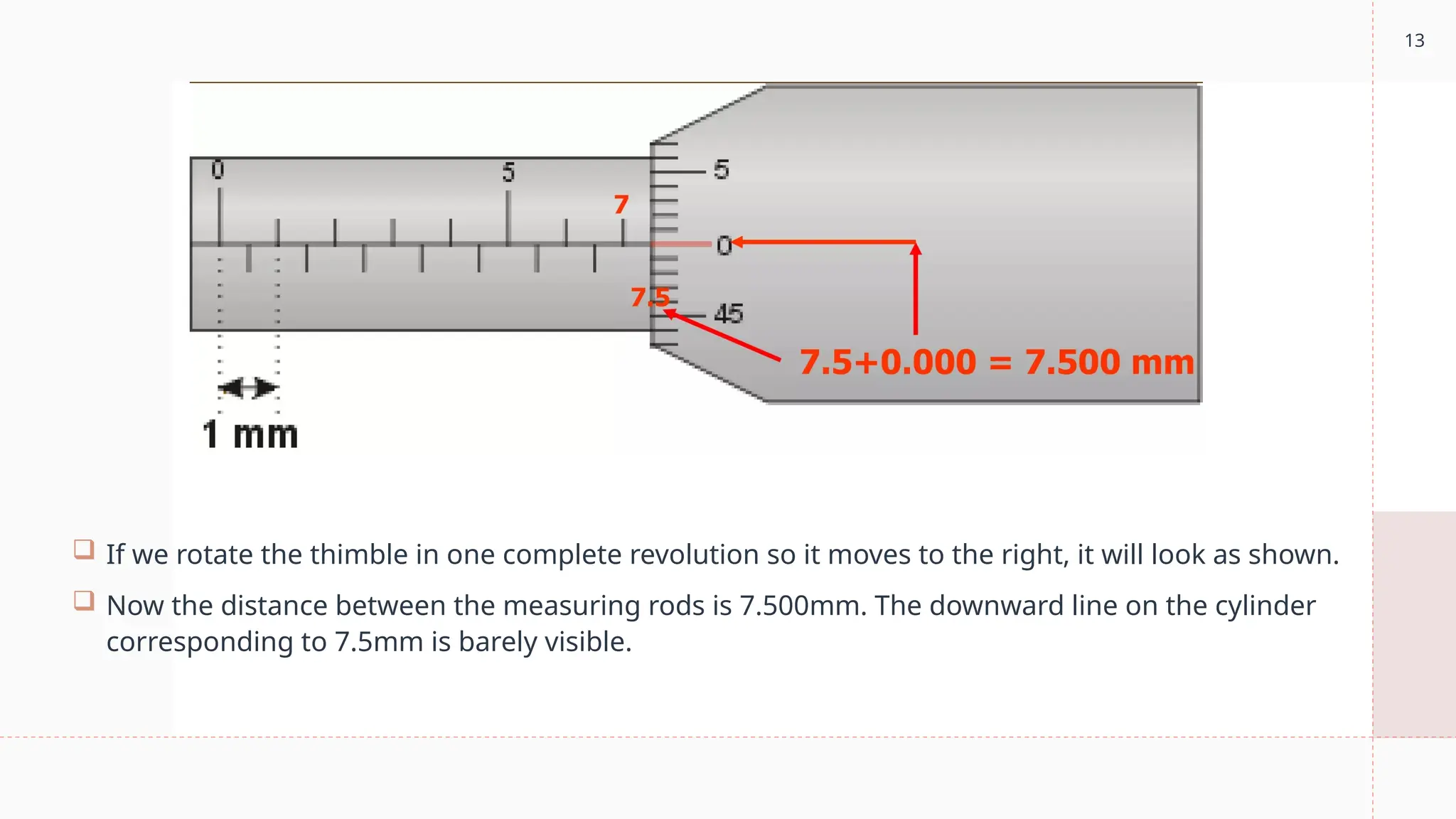
If werotate the thimble in one complete revolution so it moves to the right, it will look as shown.
Now the distance between the measuring rods is 7.500mm. The downward line on the cylinder
corresponding to 7.5mm is barely visible.
14.
14
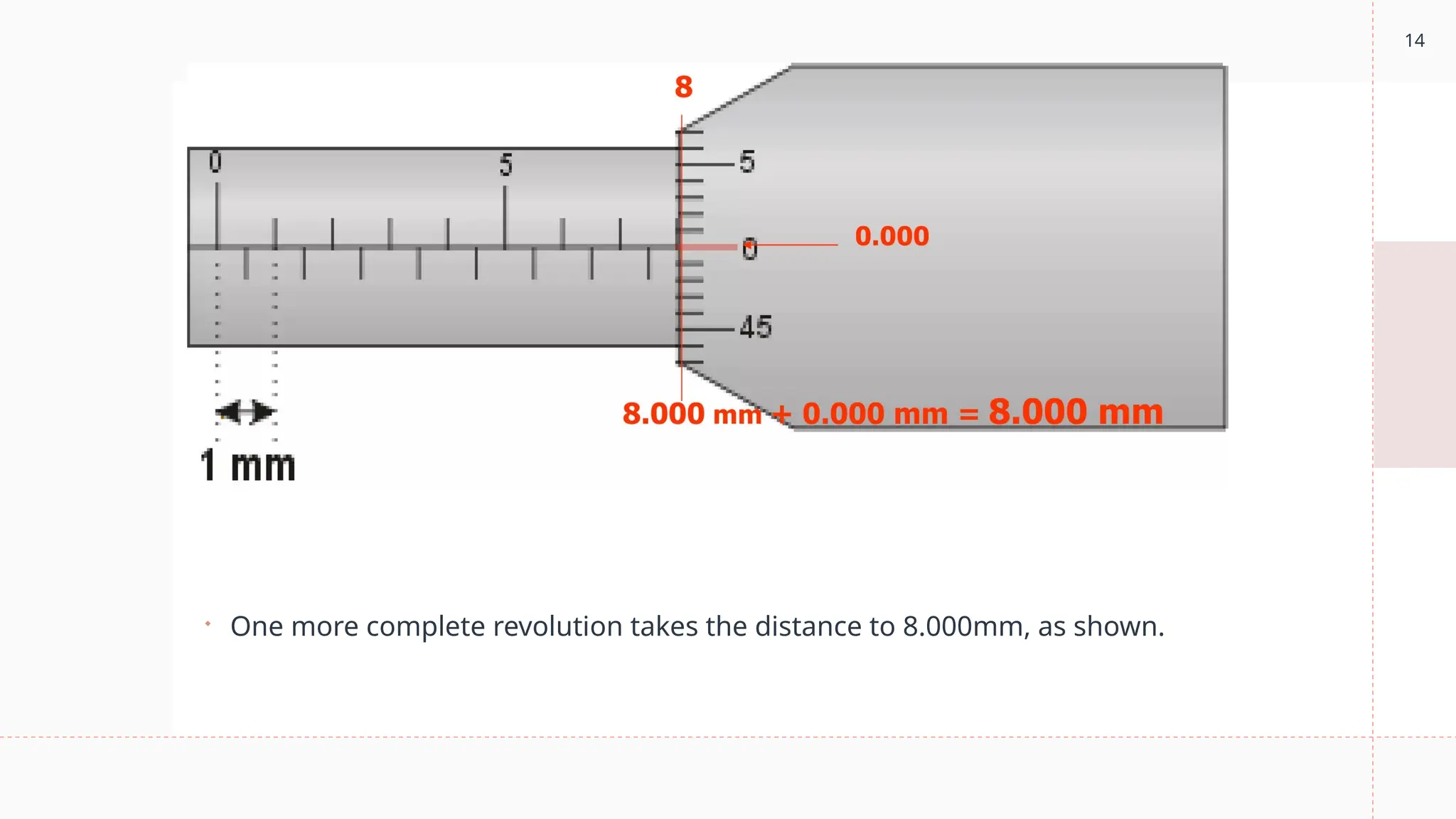
One morecomplete revolution takes the distance to 8.000mm, as shown.
15.
15
If youturn the thimble just a little bit more and end up with the situation shown.
We have increased the distance by 0.120mm from 8.000mm, so the distance
between the measuring rods is now 8.120mm
16.
16
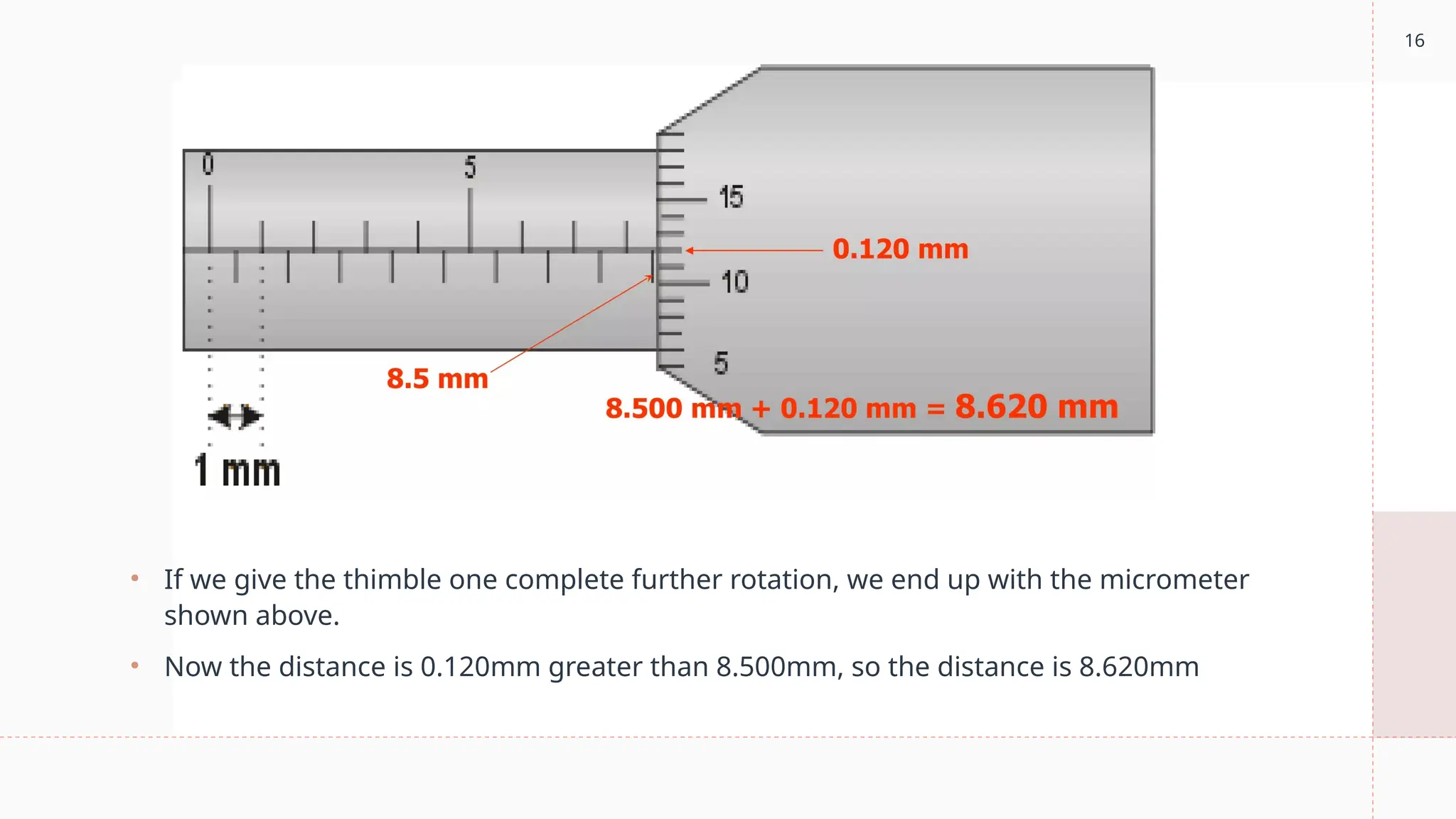
• If wegive the thimble one complete further rotation, we end up with the micrometer
shown above.
• Now the distance is 0.120mm greater than 8.500mm, so the distance is 8.620mm
22
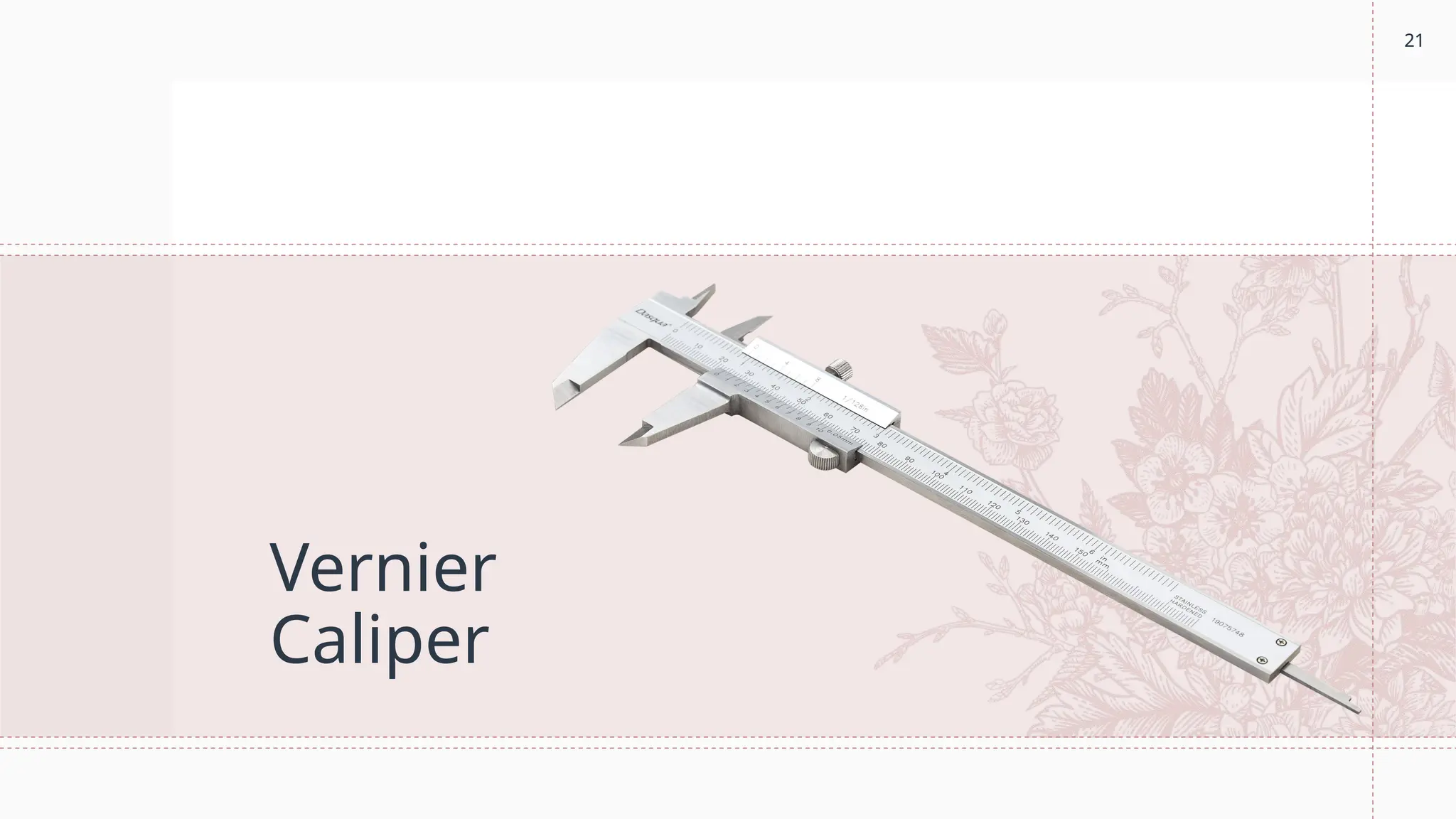
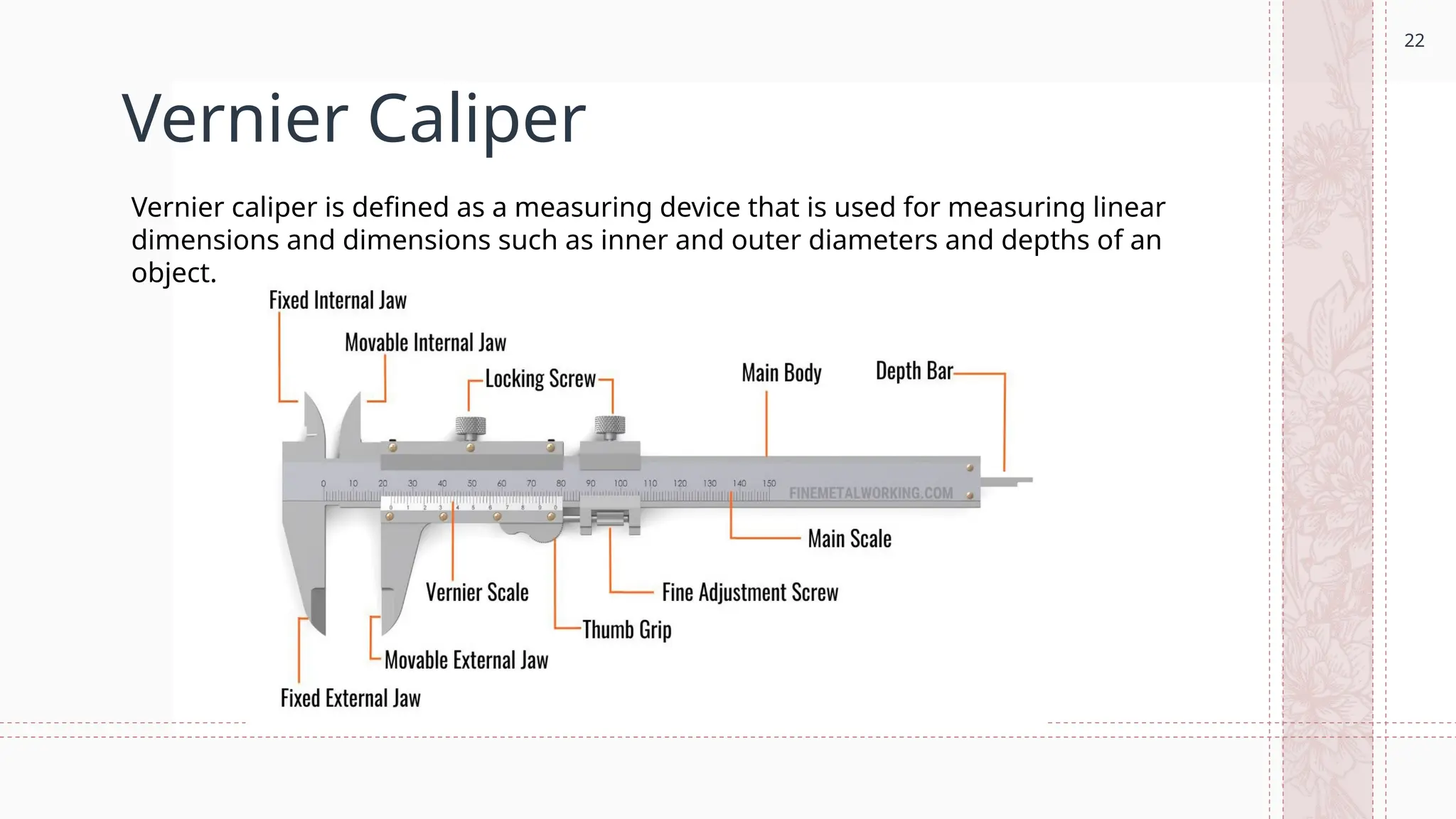
Vernier caliper isdefined as a measuring device that is used for measuring linear
dimensions and dimensions such as inner and outer diameters and depths of an
object.
Vernier Caliper
23.
23
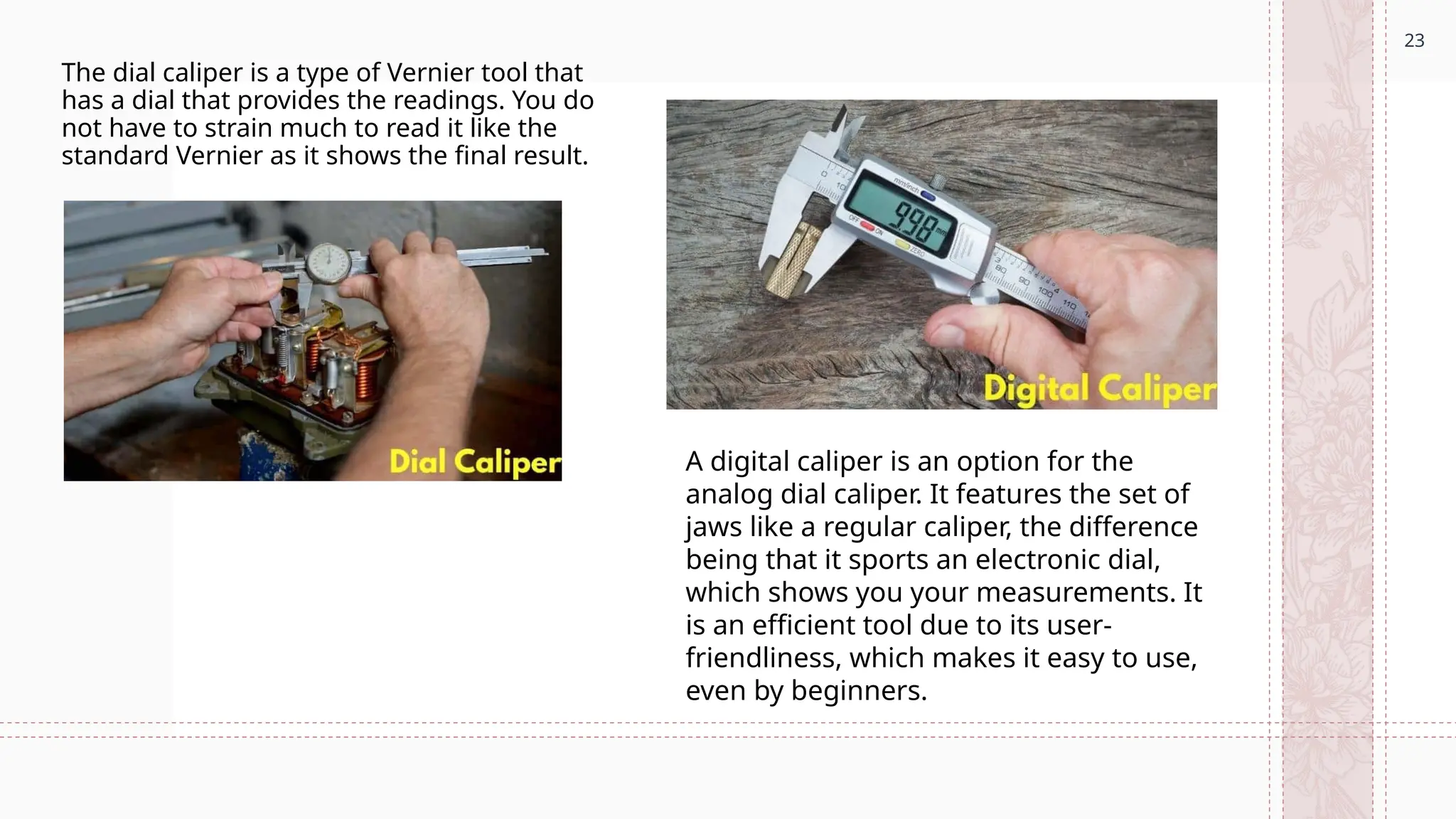
The dial caliperis a type of Vernier tool that
has a dial that provides the readings. You do
not have to strain much to read it like the
standard Vernier as it shows the final result.
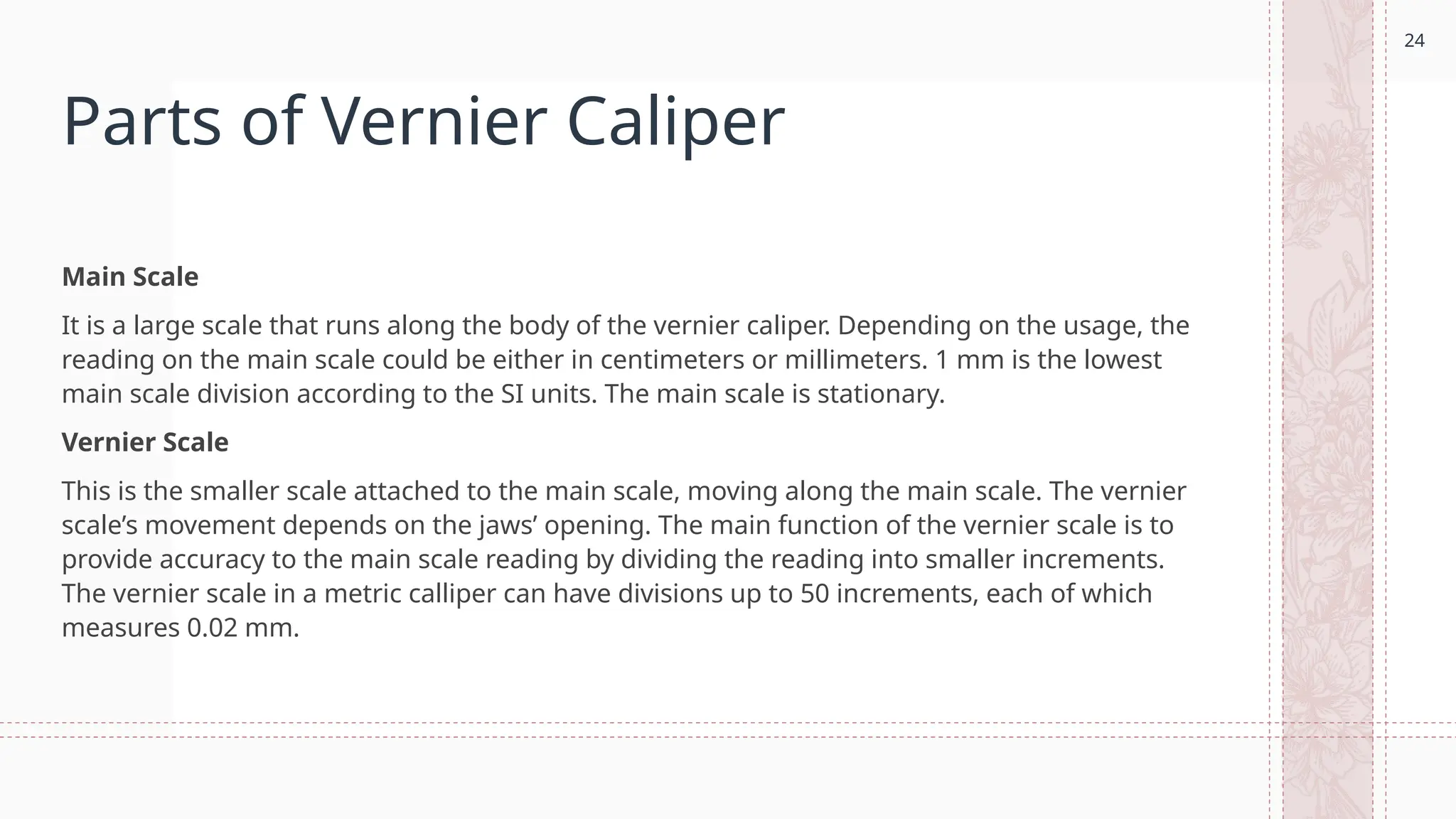
A digital caliper is an option for the
analog dial caliper. It features the set of
jaws like a regular caliper, the difference
being that it sports an electronic dial,
which shows you your measurements. It
is an efficient tool due to its user-
friendliness, which makes it easy to use,
even by beginners.
24.
24
Parts of VernierCaliper
Main Scale
It is a large scale that runs along the body of the vernier caliper. Depending on the usage, the
reading on the main scale could be either in centimeters or millimeters. 1 mm is the lowest
main scale division according to the SI units. The main scale is stationary.
Vernier Scale
This is the smaller scale attached to the main scale, moving along the main scale. The vernier
scale’s movement depends on the jaws’ opening. The main function of the vernier scale is to
provide accuracy to the main scale reading by dividing the reading into smaller increments.
The vernier scale in a metric calliper can have divisions up to 50 increments, each of which
measures 0.02 mm.
25.
25
Lower Jaws
These jawsare considered one of the most prominent features of vernier calliper. One of
the jaws is fixed and attached to the main scale. While the other jaw is movable and is
attached to the vernier scale. These jaws are designed mainly to grip the objects firmly.
The main function of the lower jaw is to measure the outer dimensions such as diameter,
width and length.
Upper Jaws
These jaws are similar to the lower jaws but are smaller than, the lower jaws. These jaws
are attached to the upper part of the vernier scale. One of the jaws is fixed, while the
other jaw is movable. The main function of the upper jaw is to measure the inner
dimensions of the objects. The jaws are opened until they touch the objects’ edges
before taking the reading. The inside diameters of objects such as hollow pipes and jars
can be measured using upper jaws.
Depth Rod
The depths of the jars can be measured using the depth rod. It is a thin rod located at
the end of the main scale. Using a depth rod for measuring is simple. The edge of the
main scale is placed on the object’s top surface. Then the jaws are slowly opened. The
opening of the jaws results in the extension of the depth rod. The jaws need to be
opened until the depth rod reaches the bottom of the object.
26.
26
Thumb Screw
This screwis located at the bottom of the vernier scale. The main function of the
thumbscrew is to provide grip to the users so that the sliding of the jaws becomes easy.
Lock Screw
The main use of the lock screw is to fix the position of the jaws once the object is firmly
fixed between the jaws. This also makes it easy to take proper readings.
27.
27
How to readand use Vernier Caliper?
• The first step is to measure nothing through which we can check if the main and the vernier
scales are aligned.
• When the main scale reading and the vernier scale reading are at zero, it means there is no
zero error.
• Now, place a ball between the two jaws of the vernier scale.
• Look at the 0 mark on the vernier scale lining with the main scale.
• That gives the main scale reading.
• Next, look for the point on the vernier scale, which is aligned with the main scale, which gives
the vernier scale reading.
• It is important to note that the readings will most of the time be in decimals.
• The number before the decimal point is the main scale reading, while the number after the
decimal point is the vernier scale reading.
28.
28
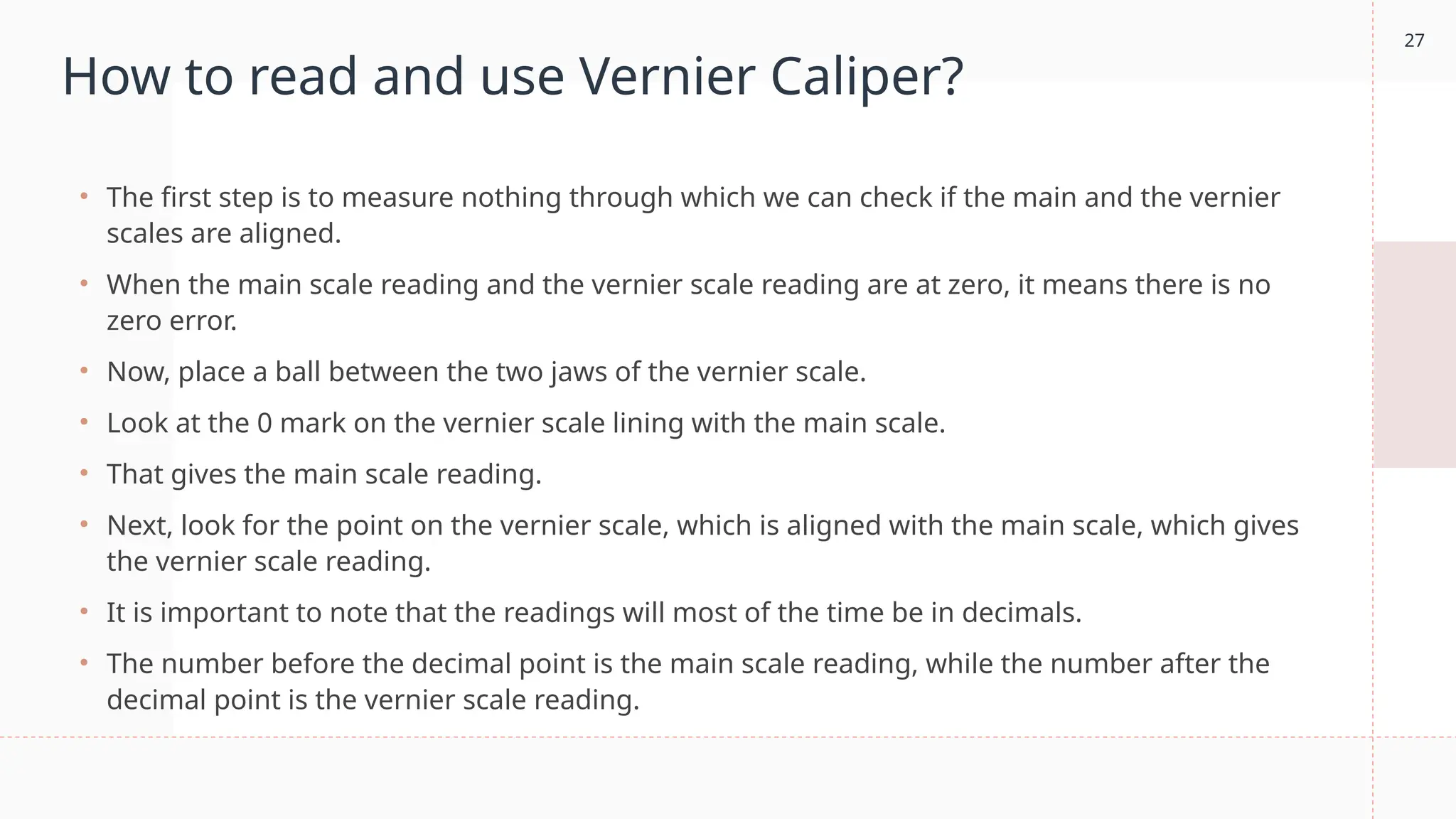
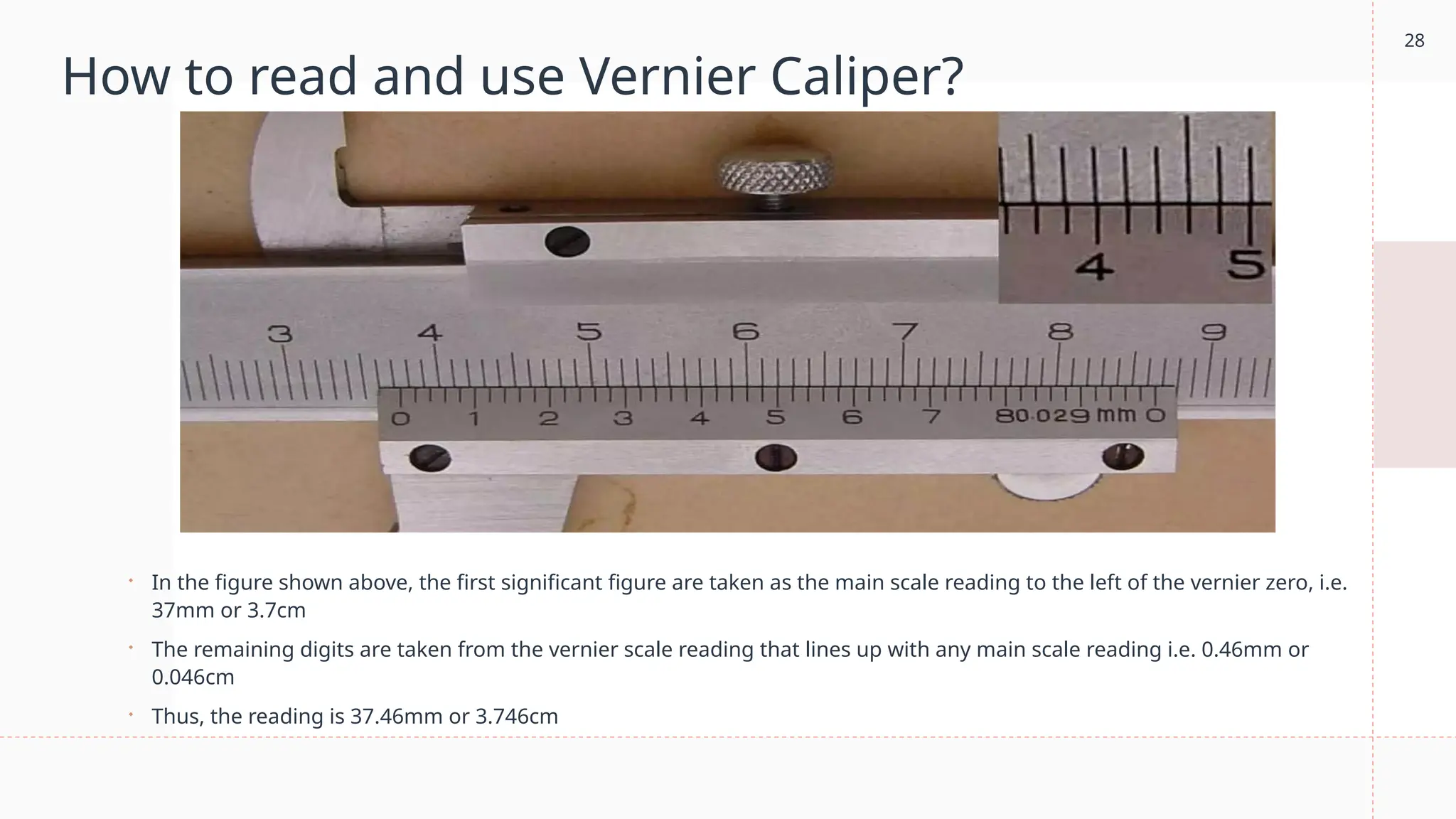
How to readand use Vernier Caliper?
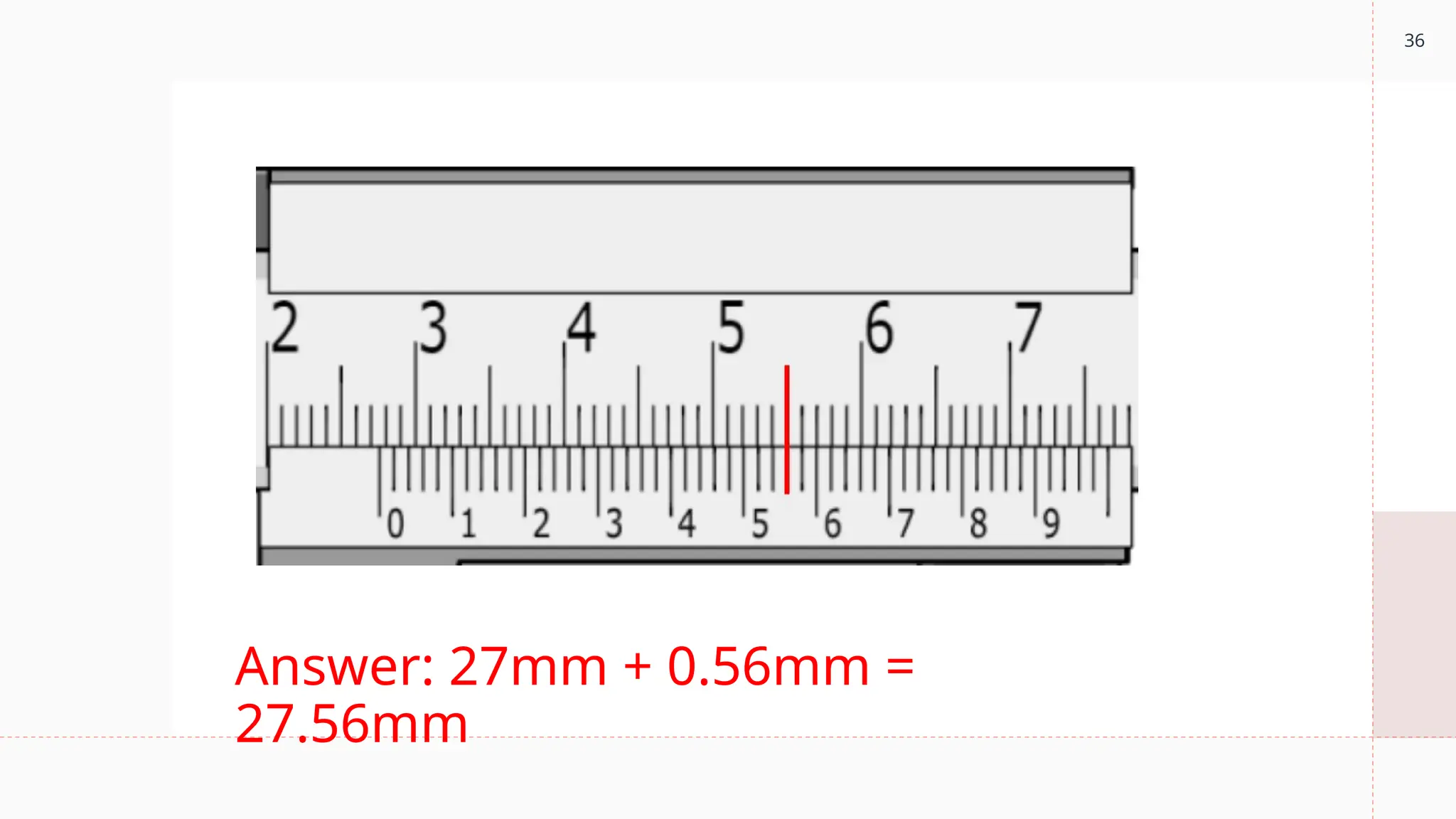
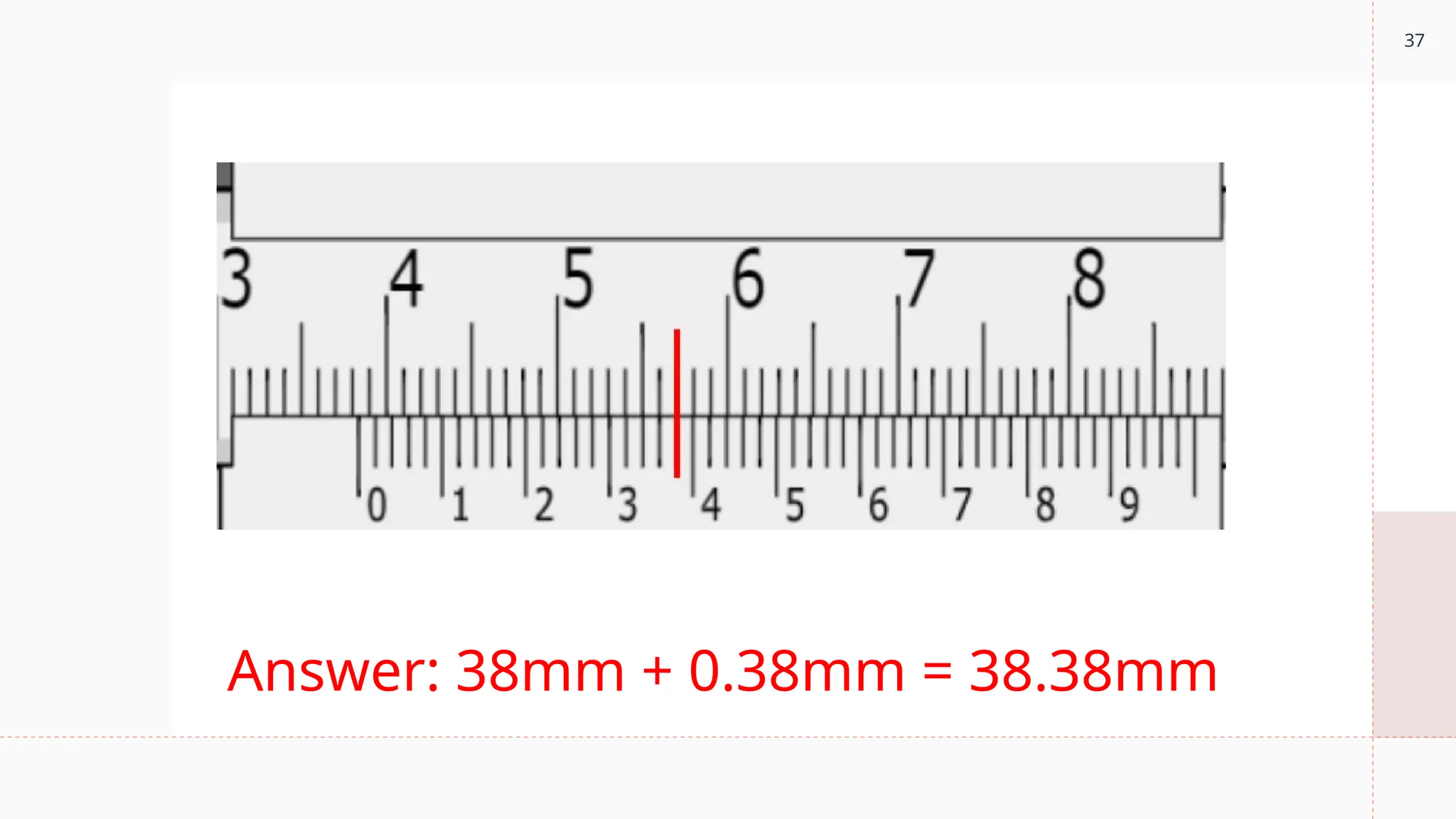
In the figure shown above, the first significant figure are taken as the main scale reading to the left of the vernier zero, i.e.
37mm or 3.7cm
The remaining digits are taken from the vernier scale reading that lines up with any main scale reading i.e. 0.46mm or
0.046cm
Thus, the reading is 37.46mm or 3.746cm
29.
29
In thefigure above, the first significant figures are taken as the main scale reading to the left of the vernier
zero, i.e. 34mm or 3.4cm
The remaining digits taken from the vernier scale reading that lines up with any main scale reading. i.e.
0.60mm or 0.060cm on the vernier scale.
Therefore, the reading is 34.60mm
30.
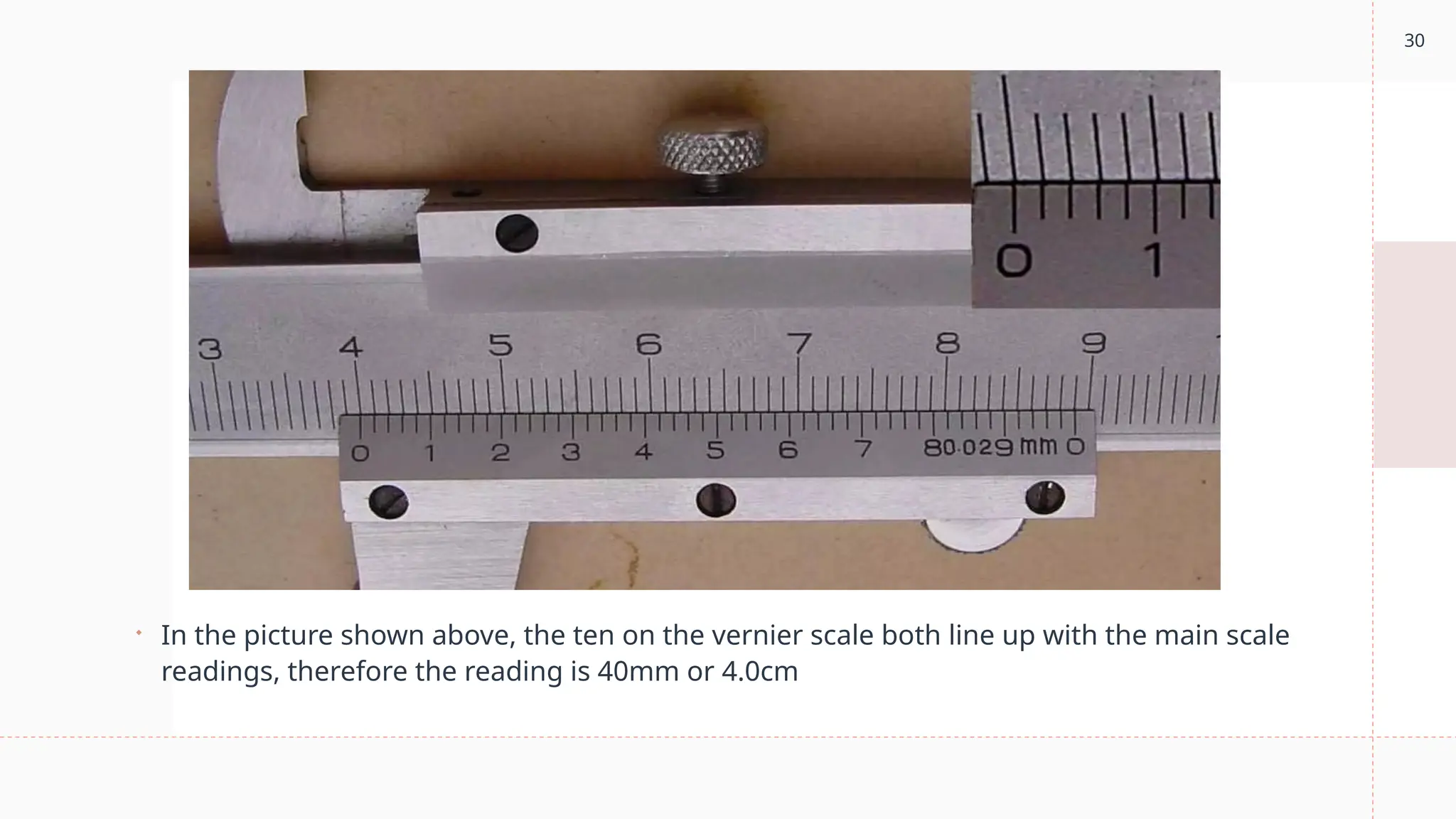
30
In thepicture shown above, the ten on the vernier scale both line up with the main scale
readings, therefore the reading is 40mm or 4.0cm
31.
31
In thefigure above, the first significant figures are taken as the main scale reading to the left of the vernier zero, i.e. 51mm or 5.1cm
The remaining digits taken from the vernier scale reading that lines up with any main scale reading. i.e. 0.60mm or 0.060cm on the vernier scale.
Therefore, the reading is 51.60mm
39
Quantities to
Measure
Micrometer VernierCaliper
Diameter of a 1-peso
coin
Thickness of a 5-pero
coin
Thickness of your hair
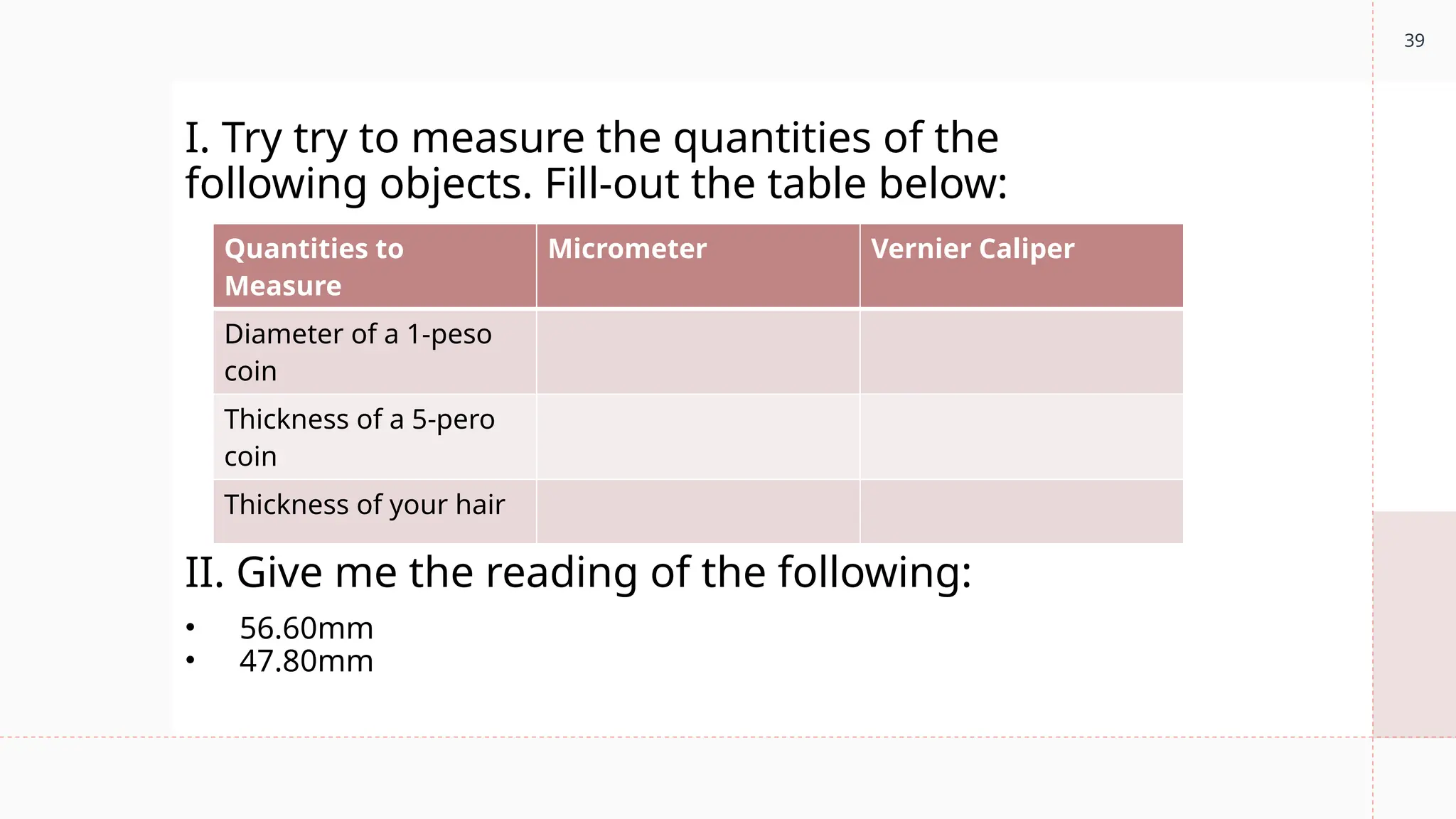
I. Try try to measure the quantities of the
following objects. Fill-out the table below:
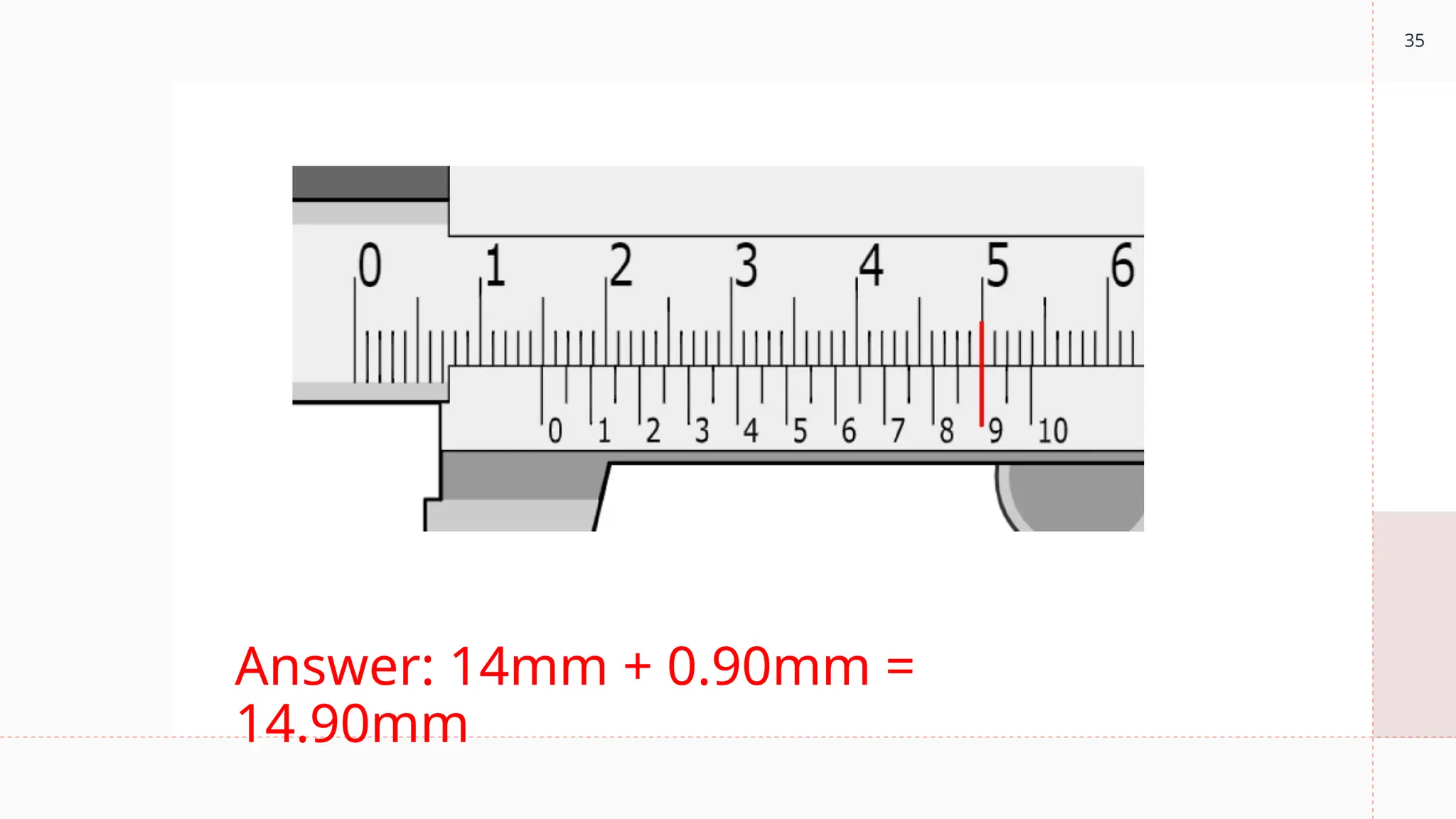
II. Give me the reading of the following:
• 56.60mm
• 47.80mm