Introduction

  British standards (BS) accepted as national
  guidelines for industry

  BS:
    Defines the standards for technical criteria,
    manufacturing and health and safety
    Simplifies and rationalises manufacturing
    Encourages interchangeability
    Enables effective communication


                                         Dimensional Tolerance
What is a dimensional tolerance?

  Virtually impossible to achieve exact required
  size of an item

  Permissible error = tolerance

  If the tolerance affects the overall size then it
  is called a dimensional tolerance


                                      Dimensional Tolerance
Factors affecting choice of DT

  Method of manufacture
    capability or accuracy of the process

  Size of item
    Small things have a smaller tolerance


  Allowable cost
    Smaller tolerance is more expensive


                                       Dimensional Tolerance
Desired quality
   Higher quality implies a smaller tolerance

Material characteristics
   Allowable expansion due to temperature
   variations

Interfaces
   Alignment and fit of a product


Standards
   Specified in various British Standards


                                       Dimensional Tolerance
Application of DT’s

  Can be applied in two ways:

1. General tolerances

  Applies to all dimensions in drawing

  Usually shown in the title block

  Usually applies to non-functional dimensions


                                         Dimensional Tolerance
2. Individual tolerances

   Tolerance for a particular dimension only

   Usually for functional (critical) dimensions


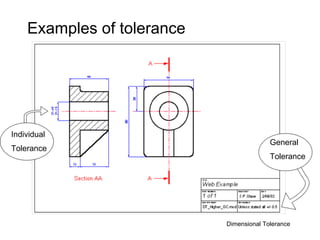
    Individual Tolerance             General Tolerance

                                            Dimensional Tolerance
Examples of tolerance


Individual
                                          General
Tolerance
                                          Tolerance


                            Dimensional Tolerance
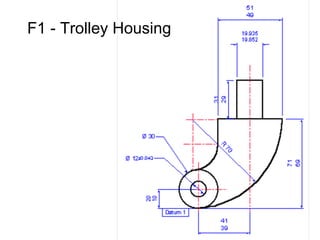
F1 - Trolley Housing


                       Dimensional Tolerance
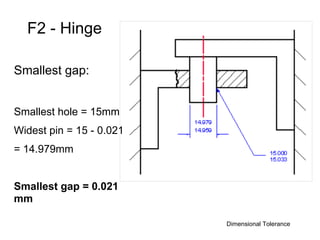
F2 - Hinge

Smallest gap:


Smallest hole = 15mm
Widest pin = 15 - 0.021
= 14.979mm


Smallest gap = 0.021
mm

                          Dimensional Tolerance
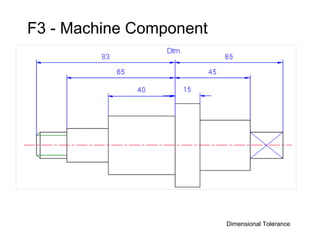
F3 - Machine Component


                         Dimensional Tolerance

Dimensional Tolerances

  • 1.
    Introduction Britishstandards (BS) accepted as national guidelines for industry BS: Defines the standards for technical criteria, manufacturing and health and safety Simplifies and rationalises manufacturing Encourages interchangeability Enables effective communication Dimensional Tolerance
  • 2.
    What is adimensional tolerance? Virtually impossible to achieve exact required size of an item Permissible error = tolerance If the tolerance affects the overall size then it is called a dimensional tolerance Dimensional Tolerance
  • 3.
    Factors affecting choiceof DT Method of manufacture capability or accuracy of the process Size of item Small things have a smaller tolerance Allowable cost Smaller tolerance is more expensive Dimensional Tolerance
  • 4.
    Desired quality Higher quality implies a smaller tolerance Material characteristics Allowable expansion due to temperature variations Interfaces Alignment and fit of a product Standards Specified in various British Standards Dimensional Tolerance
  • 5.
    Application of DT’s Can be applied in two ways: 1. General tolerances Applies to all dimensions in drawing Usually shown in the title block Usually applies to non-functional dimensions Dimensional Tolerance
  • 6.
    2. Individual tolerances Tolerance for a particular dimension only Usually for functional (critical) dimensions Individual Tolerance General Tolerance Dimensional Tolerance
  • 7.
    Examples of tolerance Individual General Tolerance Tolerance Dimensional Tolerance
  • 8.
    F1 - TrolleyHousing Dimensional Tolerance
  • 9.
    F2 - Hinge Smallestgap: Smallest hole = 15mm Widest pin = 15 - 0.021 = 14.979mm Smallest gap = 0.021 mm Dimensional Tolerance
  • 10.
    F3 - MachineComponent Dimensional Tolerance