Tolerancing
Engineering Graphics
Stephen W. Crown Ph.D.
Objective
• To learn how to effectively tolerance parts
such that parts function correctly and cost is
kept to a minimum
Tolerancing
• Definition: Allowance for specific variation in the
size and geometry of a part
• Why is tolerancing necessary?
– It is impossible to manufacture a part to an exact size or
geometry
– Since variation from the drawing is inevitable the
acceptable degree of variation must be specified
– Large variation may affect the functionality of the part
– Small variation will effect the cost of the part
• requires precise manufacturing
• requires inspection and the rejection of parts
Functionality
• Assemblies: Parts will often not fit together if their
dimensions do not fall with in a certain range of
values
• Interchangeability: If a replacement part is used it
must be a duplicate of of the original part within
certain limits of deviation
• The relationship between functionality and size or
shape of an object varies from part to part
– the usefulness of eyeglasses is extremely sensitive to
size and shape
– the usefulness of glass marbles are not very sensitive to
size and shape
Cost
• Cost generally increases with smaller tolerance
– There is generally a lower limit to this relationship
where larger tolerances do not affect cost
(!0.020 Vs !0.010)
– Small tolerances cause an exponential increase in cost
• Parts with small tolerances often require special
methods of manufacturing
• Parts with small tolerances often require greater
inspection and call for the rejection of parts
• Do not specify a smaller tolerance than is
necessary!
How Is Tolerance Specified?
• Size
– Limits specifying the allowed variation in each
dimension (length, width, height, diameter, etc.)
are given on the drawing
• Geometry
– Geometric Tolerancing
• Allows for specification of tolerance for the
geometry of a part separate from its size
• GDT (Geometric Dimensioning and Tolerancing)
uses special symbols to control different geometric
features of a part
General Tolerances
• A note may be placed on the drawing which
specifies the tolerance for all dimensions except
where individually specified
• ALL DECIMAL DIMENSIONS TO BE HELD
TO !0.020
• Several tolerances may be specified for
dimensions with a different number of decimal
places or for a different type of dimension such as
angles
• Specific tolerances given to a dimension on a
drawing always supersede general tolerances
Specific Tolerances
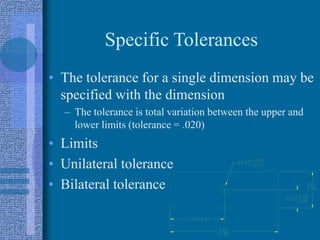
• The tolerance for a single dimension may be
specified with the dimension
– The tolerance is total variation between the upper and
lower limits (tolerance = .020)
• Limits
• Unilateral tolerance
• Bilateral tolerance
Tolerancing Holes and Shafts
• Terms
– Basic size: The size to which tolerances are applied
– Nominal size: The general size (0.261 { 1/4)
– Allowance
• The minimum space between two mating parts
• Based on the largest shaft and the smallest hole
• A negative number indicates that the parts must be
forced together
– Max. Clearance
• The maximum space between mating parts
• Based on the smallest shaft and the largest hole
Tolerancing Holes and Shafts
• Types of Fit
– Clearance fit
• The parts are toleranced such that the largest shaft is
smaller than the smallest hole
• The allowance is positive and greater than zero
– Transition fit
• The parts are toleranced such that the allowance is
negative and the max. clearance is positive
• The parts may be loose or forced together
– Interference fit
• The max. clearance is always negative
• The parts must always be forced together
Tolerancing Holes and Shafts
• Preferred fits: A specified system of fits for
holes and shafts for SI units
– Hole basis
• The minimum hole size equals the basic hole size
• Uses the symbol “H” in the tolerance specification
– Shaft basis
• The maximum shaft size equals the basic shaft size
• Uses the symbol “h” in the tolerance specification
Tolerancing Holes and Shafts
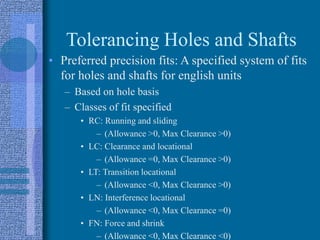
• Preferred precision fits: A specified system of fits
for holes and shafts for english units
– Based on hole basis
– Classes of fit specified
• RC: Running and sliding
– (Allowance >0, Max Clearance >0)
• LC: Clearance and locational
– (Allowance =0, Max Clearance >0)
• LT: Transition locational
– (Allowance <0, Max Clearance >0)
• LN: Interference locational
– (Allowance <0, Max Clearance =0)
• FN: Force and shrink
– (Allowance <0, Max Clearance <0)
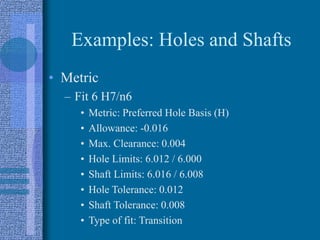
Examples: Holes and Shafts
• Metric
– Fit 6 H7/n6
• Metric: Preferred Hole Basis (H)
• Allowance: -0.016
• Max. Clearance: 0.004
• Hole Limits: 6.012 / 6.000
• Shaft Limits: 6.016 / 6.008
• Hole Tolerance: 0.012
• Shaft Tolerance: 0.008
• Type of fit: Transition
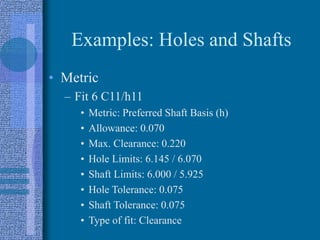
Examples: Holes and Shafts
• Metric
– Fit 6 C11/h11
• Metric: Preferred Shaft Basis (h)
• Allowance: 0.070
• Max. Clearance: 0.220
• Hole Limits: 6.145 / 6.070
• Shaft Limits: 6.000 / 5.925
• Hole Tolerance: 0.075
• Shaft Tolerance: 0.075
• Type of fit: Clearance
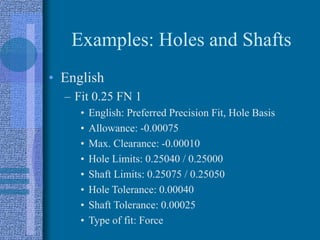
Examples: Holes and Shafts
• English
– Fit 0.25 FN 1
• English: Preferred Precision Fit, Hole Basis
• Allowance: -0.00075
• Max. Clearance: -0.00010
• Hole Limits: 0.25040 / 0.25000
• Shaft Limits: 0.25075 / 0.25050
• Hole Tolerance: 0.00040
• Shaft Tolerance: 0.00025
• Type of fit: Force
Example
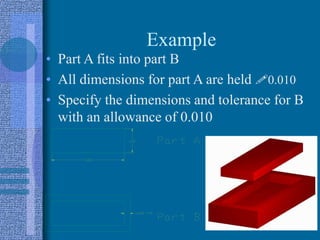
• Part A fits into part B
• All dimensions for part A are held !0.010
• Specify the dimensions and tolerance for B
with an allowance of 0.010
Example
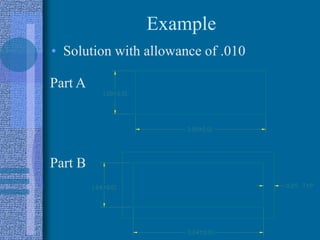
• Solution with allowance of .010
Part A
Part B
Example
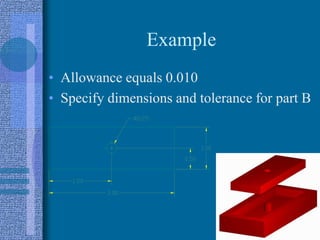
• Allowance equals 0.010
• Specify dimensions and tolerance for part B
Example
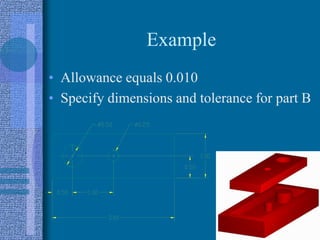
• Allowance equals 0.010
• Specify dimensions and tolerance for part B

4644847.ppt

  • 1.
  • 2.
    Objective • To learnhow to effectively tolerance parts such that parts function correctly and cost is kept to a minimum
  • 3.
    Tolerancing • Definition: Allowancefor specific variation in the size and geometry of a part • Why is tolerancing necessary? – It is impossible to manufacture a part to an exact size or geometry – Since variation from the drawing is inevitable the acceptable degree of variation must be specified – Large variation may affect the functionality of the part – Small variation will effect the cost of the part • requires precise manufacturing • requires inspection and the rejection of parts
  • 4.
    Functionality • Assemblies: Partswill often not fit together if their dimensions do not fall with in a certain range of values • Interchangeability: If a replacement part is used it must be a duplicate of of the original part within certain limits of deviation • The relationship between functionality and size or shape of an object varies from part to part – the usefulness of eyeglasses is extremely sensitive to size and shape – the usefulness of glass marbles are not very sensitive to size and shape
  • 5.
    Cost • Cost generallyincreases with smaller tolerance – There is generally a lower limit to this relationship where larger tolerances do not affect cost (!0.020 Vs !0.010) – Small tolerances cause an exponential increase in cost • Parts with small tolerances often require special methods of manufacturing • Parts with small tolerances often require greater inspection and call for the rejection of parts • Do not specify a smaller tolerance than is necessary!
  • 6.
    How Is ToleranceSpecified? • Size – Limits specifying the allowed variation in each dimension (length, width, height, diameter, etc.) are given on the drawing • Geometry – Geometric Tolerancing • Allows for specification of tolerance for the geometry of a part separate from its size • GDT (Geometric Dimensioning and Tolerancing) uses special symbols to control different geometric features of a part
  • 7.
    General Tolerances • Anote may be placed on the drawing which specifies the tolerance for all dimensions except where individually specified • ALL DECIMAL DIMENSIONS TO BE HELD TO !0.020 • Several tolerances may be specified for dimensions with a different number of decimal places or for a different type of dimension such as angles • Specific tolerances given to a dimension on a drawing always supersede general tolerances
  • 8.
    Specific Tolerances • Thetolerance for a single dimension may be specified with the dimension – The tolerance is total variation between the upper and lower limits (tolerance = .020) • Limits • Unilateral tolerance • Bilateral tolerance
  • 9.
    Tolerancing Holes andShafts • Terms – Basic size: The size to which tolerances are applied – Nominal size: The general size (0.261 { 1/4) – Allowance • The minimum space between two mating parts • Based on the largest shaft and the smallest hole • A negative number indicates that the parts must be forced together – Max. Clearance • The maximum space between mating parts • Based on the smallest shaft and the largest hole
  • 10.
    Tolerancing Holes andShafts • Types of Fit – Clearance fit • The parts are toleranced such that the largest shaft is smaller than the smallest hole • The allowance is positive and greater than zero – Transition fit • The parts are toleranced such that the allowance is negative and the max. clearance is positive • The parts may be loose or forced together – Interference fit • The max. clearance is always negative • The parts must always be forced together
  • 11.
    Tolerancing Holes andShafts • Preferred fits: A specified system of fits for holes and shafts for SI units – Hole basis • The minimum hole size equals the basic hole size • Uses the symbol “H” in the tolerance specification – Shaft basis • The maximum shaft size equals the basic shaft size • Uses the symbol “h” in the tolerance specification
  • 12.
    Tolerancing Holes andShafts • Preferred precision fits: A specified system of fits for holes and shafts for english units – Based on hole basis – Classes of fit specified • RC: Running and sliding – (Allowance >0, Max Clearance >0) • LC: Clearance and locational – (Allowance =0, Max Clearance >0) • LT: Transition locational – (Allowance <0, Max Clearance >0) • LN: Interference locational – (Allowance <0, Max Clearance =0) • FN: Force and shrink – (Allowance <0, Max Clearance <0)
  • 13.
    Examples: Holes andShafts • Metric – Fit 6 H7/n6 • Metric: Preferred Hole Basis (H) • Allowance: -0.016 • Max. Clearance: 0.004 • Hole Limits: 6.012 / 6.000 • Shaft Limits: 6.016 / 6.008 • Hole Tolerance: 0.012 • Shaft Tolerance: 0.008 • Type of fit: Transition
  • 14.
    Examples: Holes andShafts • Metric – Fit 6 C11/h11 • Metric: Preferred Shaft Basis (h) • Allowance: 0.070 • Max. Clearance: 0.220 • Hole Limits: 6.145 / 6.070 • Shaft Limits: 6.000 / 5.925 • Hole Tolerance: 0.075 • Shaft Tolerance: 0.075 • Type of fit: Clearance
  • 15.
    Examples: Holes andShafts • English – Fit 0.25 FN 1 • English: Preferred Precision Fit, Hole Basis • Allowance: -0.00075 • Max. Clearance: -0.00010 • Hole Limits: 0.25040 / 0.25000 • Shaft Limits: 0.25075 / 0.25050 • Hole Tolerance: 0.00040 • Shaft Tolerance: 0.00025 • Type of fit: Force
  • 16.
    Example • Part Afits into part B • All dimensions for part A are held !0.010 • Specify the dimensions and tolerance for B with an allowance of 0.010
  • 17.
    Example • Solution withallowance of .010 Part A Part B
  • 18.
    Example • Allowance equals0.010 • Specify dimensions and tolerance for part B
  • 19.
    Example • Allowance equals0.010 • Specify dimensions and tolerance for part B