Question
1. Many companies are now changing from the use of manual drawing to use of
CAD

a) State three advantages and three disadvantages of computer aided drawing
compared to that of manual drawing

Advantages- Speed, accuracy, less storage space required, electronic exchange of
information
Disadvantages- Cost of retraining, reluctance of older staff to change, removes
individual style, power cut then no work
b) Give two reasons why a few companies might still retain manual techniques
Cost of initial equipment, training cost/time of operator, range of work of company might
be too wide for one CAD package
Question
2. An architectural design company uses CAD layer specification when designing
buildings.

a) Describe what is meant by the term “layering”.
Layers is like having several sheets of clear film or paper on to which you can draw or
give information. Each sheet contains information or a drawing that can be removed or
switched off without changing the whole drawing.

b) State four possible layers that the company may use in its specification.
Foundations, floor plan, electrical wiring, plumbing and central heating

c) State two advantages of producing a drawing using a layer specification

Seperate drawings do not have to be generated for each of the users eg electricians,
plumbers etc.
The main drawing can be customised by turning on or off the relevant layers for the
appropriate client.
The drawings are less cluttered as irrelevant text and dimensions could be switched off.
Home designers could use the plan, without all the services information, to layout
furniture etc.
Question
3.

a) State three benefits of using standardised drawing conventions, eg British
Standards
The ability for all to understand each others drawings, reduces to a minimum any
confusion over symbols etc, ease of exchanging drawings and library symbols,
international understaing
b) Give two reasons why dimensional tolerances are used in production drawings.

To provide an appropriate fit of components, to enable more than one company to make
components for assembly, to enable the manufacture of spare parts.
Question
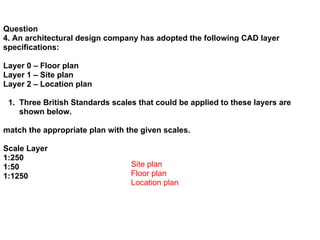
4. An architectural design company has adopted the following CAD layer
specifications:

Layer 0 – Floor plan
Layer 1 – Site plan
Layer 2 – Location plan

 1. Three British Standards scales that could be applied to these layers are
    shown below.

match the appropriate plan with the given scales.

Scale Layer
1:250
1:50                             Site plan
1:1250                           Floor plan
                                 Location plan
Question
5.

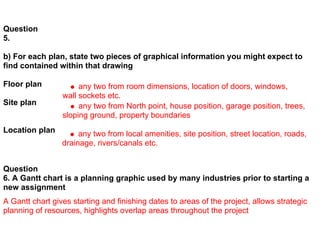
b) For each plan, state two pieces of graphical information you might expect to
find contained within that drawing

Floor plan            any two from room dimensions, location of doors, windows,
                 wall sockets etc.
Site plan             any two from North point, house position, garage position, trees,
                 sloping ground, property boundaries
Location plan         any two from local amenities, site position, street location, roads,
                 drainage, rivers/canals etc.


Question
6. A Gantt chart is a planning graphic used by many industries prior to starting a
new assignment
A Gantt chart gives starting and finishing dates to areas of the project, allows strategic
planning of resources, highlights overlap areas throughout the project
Question
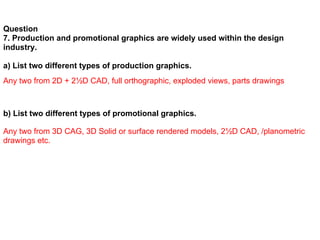
7. Production and promotional graphics are widely used within the design
industry.

a) List two different types of production graphics.
Any two from 2D + 2½D CAD, full orthographic, exploded views, parts drawings


b) List two different types of promotional graphics.

Any two from 3D CAG, 3D Solid or surface rendered models, 2½D CAD, /planometric
drawings etc.
Question
8.

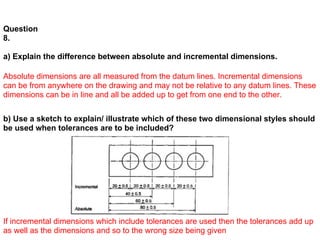
a) Explain the difference between absolute and incremental dimensions.

Absolute dimensions are all measured from the datum lines. Incremental dimensions
can be from anywhere on the drawing and may not be relative to any datum lines. These
dimensions can be in line and all be added up to get from one end to the other.


b) Use a sketch to explain/ illustrate which of these two dimensional styles should
be used when tolerances are to be included?


If incremental dimensions which include tolerances are used then the tolerances add up
as well as the dimensions and so to the wrong size being given
Question
9.

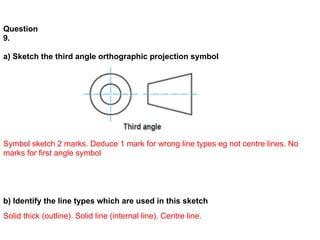
a) Sketch the third angle orthographic projection symbol


Symbol sketch 2 marks. Deduce 1 mark for wrong line types eg not centre lines. No
marks for first angle symbol


b) Identify the line types which are used in this sketch
Solid thick (outline). Solid line (internal line). Centre line.
Question
10. In the construction industry architects and planners use a variety of drawing
types. Explain what you would use the following types of plan for, and give two
items of information which you would expect to find on each type.

a) Site plans
Shows outline of a new site or building.
Indicates north, dimensions to boundaries, drainage, services, outline of building, access
roads, boundary limits.


b) Block (location) plan
Shows the area where the site plan is situated.
May show all the houses in the scheme
Shows surrounding buildings, north, access roads, main services.


c) Give two reasons why the construction industry uses Ordinance Survey Maps.
Ordinance survey maps are drawn to a convenient scale, show surrounding area, land
contours, existing buildings, trees, roads, rivers, etc.
Question
11. Why are the following types of drawings produced?

a) Exploded orthographic drawings
Exploded orthographics show details of individual components clearly, and the order in
which they are assembled
b) Sectional views
Sectional views show the details of internal surface without all the other details of the
component, and sectional assemblies show how components fit together
c) Measured two point perspective views
Measured two point perspective views give an accurate picture of how a building will
look. It gives the most realistic view of an object or building.
d) Planometric views
Planometric views are used by architects as a simple way of showing the inside of a
building by projecting from the plan.
e) Assembly drawings
Assembly drawings show all the components fitted together and allow a check that
everything will fit.
Question
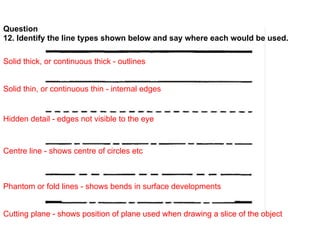
12. Identify the line types shown below and say where each would be used.

Solid thick, or continuous thick - outlines


Solid thin, or continuous thin - internal edges


Hidden detail - edges not visible to the eye


Centre line - shows centre of circles etc


Phantom or fold lines - shows bends in surface developments


Cutting plane - shows position of plane used when drawing a slice of the object
Question
13. State two industrial/commercial operators who would be likely to make use of
a surface development
Surface developments would be used by the packaging, or sheet metal working, pipe
fabrication etc.
Question
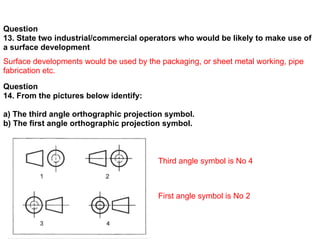
14. From the pictures below identify:

a) The third angle orthographic projection symbol.
b) The first angle orthographic projection symbol.


                                         Third angle symbol is No 4


                                         First angle symbol is No 2
Question
15. Give two examples of types of drawings which would be used in the
production stage of an assignment and explain why they would be used

Any two from orthographic, sectional, exploded, assembly, isometric, oblique,
planometric, etc.
Any relevant reason for each answer

Question
16. Scales are often used on drawings. How would you represent the following
scales?
a) A scale of half size                 1:2

b) A scale of one to one hundred        1 : 100

c) A scale of twice full size           2:1

Graphics Within Industry

  • 1.
    Question 1. Many companiesare now changing from the use of manual drawing to use of CAD a) State three advantages and three disadvantages of computer aided drawing compared to that of manual drawing Advantages- Speed, accuracy, less storage space required, electronic exchange of information Disadvantages- Cost of retraining, reluctance of older staff to change, removes individual style, power cut then no work b) Give two reasons why a few companies might still retain manual techniques Cost of initial equipment, training cost/time of operator, range of work of company might be too wide for one CAD package
  • 2.
    Question 2. An architecturaldesign company uses CAD layer specification when designing buildings. a) Describe what is meant by the term “layering”. Layers is like having several sheets of clear film or paper on to which you can draw or give information. Each sheet contains information or a drawing that can be removed or switched off without changing the whole drawing. b) State four possible layers that the company may use in its specification. Foundations, floor plan, electrical wiring, plumbing and central heating c) State two advantages of producing a drawing using a layer specification Seperate drawings do not have to be generated for each of the users eg electricians, plumbers etc. The main drawing can be customised by turning on or off the relevant layers for the appropriate client. The drawings are less cluttered as irrelevant text and dimensions could be switched off. Home designers could use the plan, without all the services information, to layout furniture etc.
  • 3.
    Question 3. a) State threebenefits of using standardised drawing conventions, eg British Standards The ability for all to understand each others drawings, reduces to a minimum any confusion over symbols etc, ease of exchanging drawings and library symbols, international understaing b) Give two reasons why dimensional tolerances are used in production drawings. To provide an appropriate fit of components, to enable more than one company to make components for assembly, to enable the manufacture of spare parts.
  • 4.
    Question 4. An architecturaldesign company has adopted the following CAD layer specifications: Layer 0 – Floor plan Layer 1 – Site plan Layer 2 – Location plan 1. Three British Standards scales that could be applied to these layers are shown below. match the appropriate plan with the given scales. Scale Layer 1:250 1:50 Site plan 1:1250 Floor plan Location plan
  • 5.
    Question 5. b) For eachplan, state two pieces of graphical information you might expect to find contained within that drawing Floor plan any two from room dimensions, location of doors, windows, wall sockets etc. Site plan any two from North point, house position, garage position, trees, sloping ground, property boundaries Location plan any two from local amenities, site position, street location, roads, drainage, rivers/canals etc. Question 6. A Gantt chart is a planning graphic used by many industries prior to starting a new assignment A Gantt chart gives starting and finishing dates to areas of the project, allows strategic planning of resources, highlights overlap areas throughout the project
  • 6.
    Question 7. Production andpromotional graphics are widely used within the design industry. a) List two different types of production graphics. Any two from 2D + 2½D CAD, full orthographic, exploded views, parts drawings b) List two different types of promotional graphics. Any two from 3D CAG, 3D Solid or surface rendered models, 2½D CAD, /planometric drawings etc.
  • 7.
    Question 8. a) Explain thedifference between absolute and incremental dimensions. Absolute dimensions are all measured from the datum lines. Incremental dimensions can be from anywhere on the drawing and may not be relative to any datum lines. These dimensions can be in line and all be added up to get from one end to the other. b) Use a sketch to explain/ illustrate which of these two dimensional styles should be used when tolerances are to be included? If incremental dimensions which include tolerances are used then the tolerances add up as well as the dimensions and so to the wrong size being given
  • 8.
    Question 9. a) Sketch thethird angle orthographic projection symbol Symbol sketch 2 marks. Deduce 1 mark for wrong line types eg not centre lines. No marks for first angle symbol b) Identify the line types which are used in this sketch Solid thick (outline). Solid line (internal line). Centre line.
  • 9.
    Question 10. In theconstruction industry architects and planners use a variety of drawing types. Explain what you would use the following types of plan for, and give two items of information which you would expect to find on each type. a) Site plans Shows outline of a new site or building. Indicates north, dimensions to boundaries, drainage, services, outline of building, access roads, boundary limits. b) Block (location) plan Shows the area where the site plan is situated. May show all the houses in the scheme Shows surrounding buildings, north, access roads, main services. c) Give two reasons why the construction industry uses Ordinance Survey Maps. Ordinance survey maps are drawn to a convenient scale, show surrounding area, land contours, existing buildings, trees, roads, rivers, etc.
  • 10.
    Question 11. Why arethe following types of drawings produced? a) Exploded orthographic drawings Exploded orthographics show details of individual components clearly, and the order in which they are assembled b) Sectional views Sectional views show the details of internal surface without all the other details of the component, and sectional assemblies show how components fit together c) Measured two point perspective views Measured two point perspective views give an accurate picture of how a building will look. It gives the most realistic view of an object or building. d) Planometric views Planometric views are used by architects as a simple way of showing the inside of a building by projecting from the plan. e) Assembly drawings Assembly drawings show all the components fitted together and allow a check that everything will fit.
  • 11.
    Question 12. Identify theline types shown below and say where each would be used. Solid thick, or continuous thick - outlines Solid thin, or continuous thin - internal edges Hidden detail - edges not visible to the eye Centre line - shows centre of circles etc Phantom or fold lines - shows bends in surface developments Cutting plane - shows position of plane used when drawing a slice of the object
  • 12.
    Question 13. State twoindustrial/commercial operators who would be likely to make use of a surface development Surface developments would be used by the packaging, or sheet metal working, pipe fabrication etc. Question 14. From the pictures below identify: a) The third angle orthographic projection symbol. b) The first angle orthographic projection symbol. Third angle symbol is No 4 First angle symbol is No 2
  • 13.
    Question 15. Give twoexamples of types of drawings which would be used in the production stage of an assignment and explain why they would be used Any two from orthographic, sectional, exploded, assembly, isometric, oblique, planometric, etc. Any relevant reason for each answer Question 16. Scales are often used on drawings. How would you represent the following scales? a) A scale of half size 1:2 b) A scale of one to one hundred 1 : 100 c) A scale of twice full size 2:1