UNIT 4
FORM MEASUREMENT
Principles and Methods of
straightness – Flatness measurement
– Thread measurement, gear
measurement, surface finish
measurement, Roundness
measurement – Applications.
APPLICATIONS
INTRODUCTION
• Threads are of prime importance, they are used as
fasteners.
• It is a helical groove, used to transmit force and
motion.
• In plain shaft, the hole assembly, the object of
dimensional control is to ensure a certain
consistency of fit.
• The performance of screw threads during their
assembly with nut depends upon a number of
parameters such as the condition of the machine
tool used for screw cutting, work material and
tool.
GEOMETRICAL FEATURES
• The measurement of
• Straightness
• Flatness
• Squareness
• Parallelism
• Roundness
• Circularity
• Cylindricity
FORM MEASUREMENT INCLUDES
• Screw thread measurement
• Gear measurement
• Radius measurement
• Surface Finish measurement
• Straightness measurement
• Flatness measurement
• roundness measurement
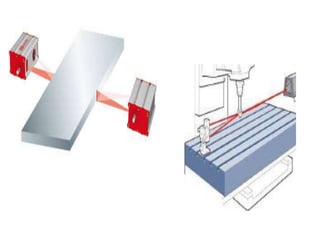
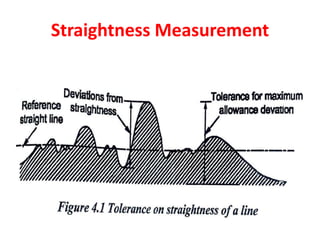
STRAIGHTNESS MEASUREMENT
• A line is said to be straight over a given length,
if the variation of the distance of its from two
planes perpendicular to each other and
parallel to the general direction of the line
remains within the specified tolerance limits.
• The tolerance on the straightness of a line is
defined as the maximum deviation in relation
to the reference straight line joining the two
extremities of the line to be checked.
• Important geometrical parameter of machines
• Example: shaping machine-guideways
• Shortest distance between the two lines –
straight line
• Ray of light, liquid level
• It is a qualitative measure of a surface
• Straightness measuring system should be in
line with functional point – called Bryan’s
principle
Straightness Measurement
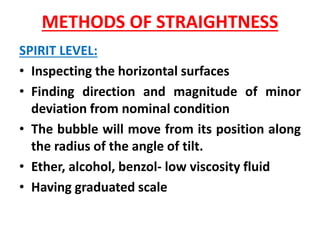
METHODS OF STRAIGHTNESS
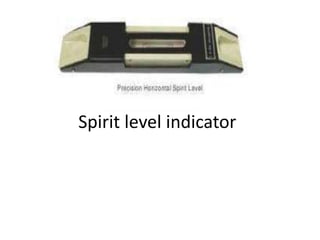
SPIRIT LEVEL:
• Inspecting the horizontal surfaces
• Finding direction and magnitude of minor
deviation from nominal condition
• The bubble will move from its position along
the radius of the angle of tilt.
• Ether, alcohol, benzol- low viscosity fluid
• Having graduated scale
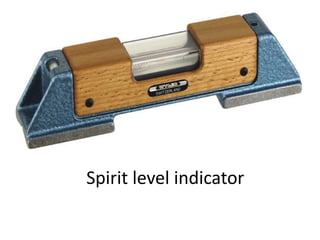
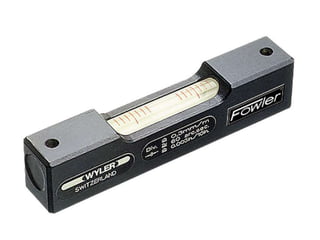
Spirit level indicator
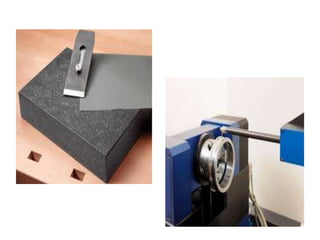
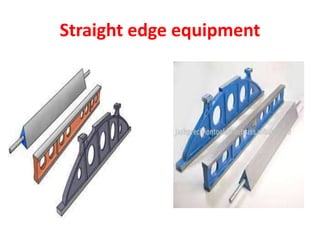
STRAIGHT EDGES:
• With the help of surface plates and sprit
levels straight edges are used for checking
straightness and flatness
• Flat – sectioned measuring instrument
• Made up of steels
• Straight edges are used for testing large areas
of surface
• Painted surfaces are used to measure
straightness
LASER MEASURING SYSTEM:
Straight edge equipment
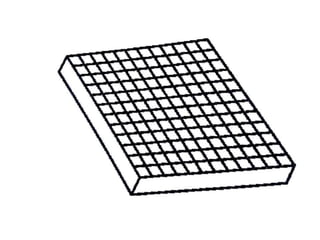
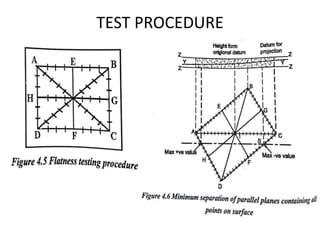
FLATNESS MEASUREMENT
• Minimum distance between the two planes,
which will cover all irregularities of the
surface to be tested
• Best-fit plane between two standard
reference plane one above and one below
the plane surface to be tested
• Deviation of the surface from the best fitting
plane
TEST PROCEDURE
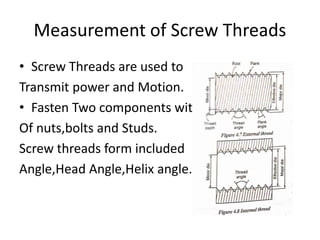
Measurement of Screw Threads
• Screw Threads are used to
Transmit power and Motion.
• Fasten Two components with help
Of nuts,bolts and Studs.
Screw threads form included
Angle,Head Angle,Helix angle.
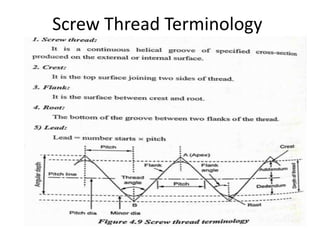
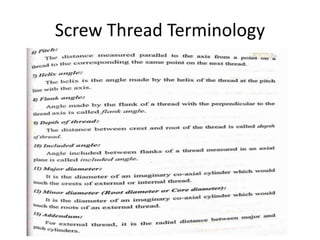
Screw Thread Terminology
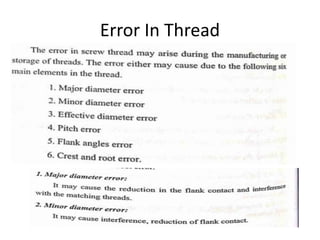
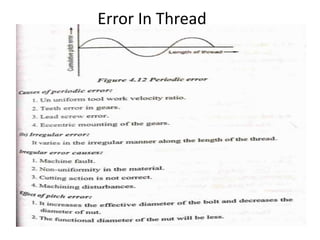
Error In Thread
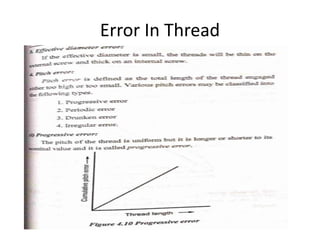
Error In Thread
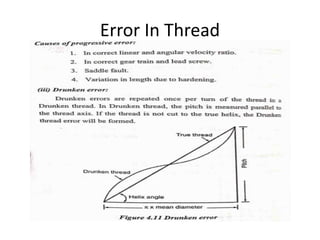
Error In Thread
Error In Thread
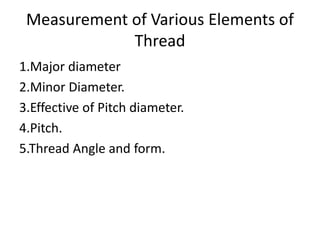
Measurement of Various Elements of
Thread
1.Major diameter
2.Minor Diameter.
3.Effective of Pitch diameter.
4.Pitch.
5.Thread Angle and form.
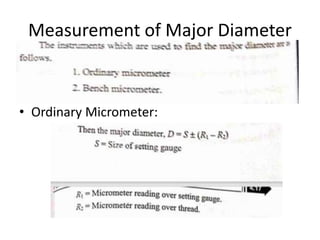
Measurement of Major Diameter
• Ordinary Micrometer:
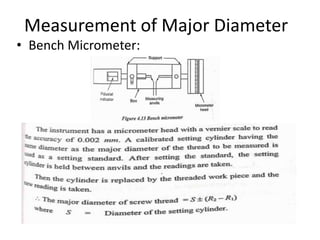
Measurement of Major Diameter
• Bench Micrometer:
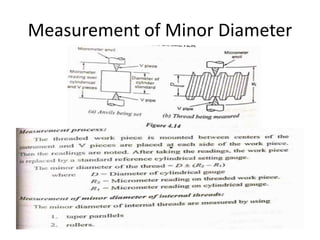
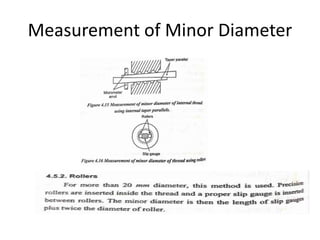
Measurement of Minor Diameter
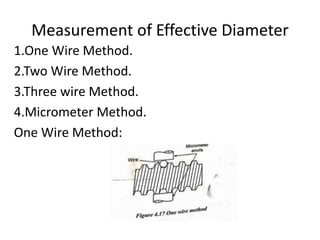
Measurement of Effective Diameter
1.One Wire Method.
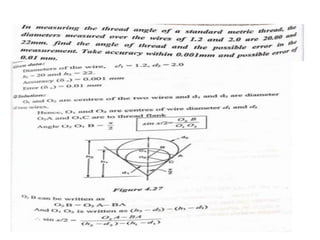
2.Two Wire Method.
3.Three wire Method.
4.Micrometer Method.
One Wire Method:
Measurement of Effective Diameter
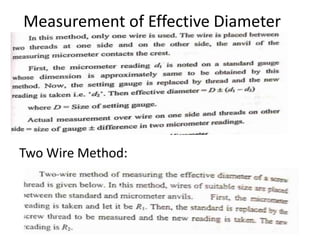
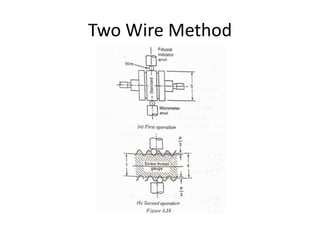
Two Wire Method:
Two Wire Method
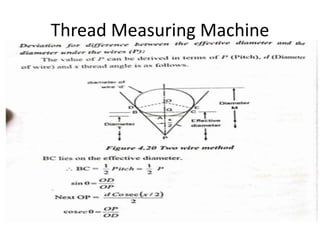
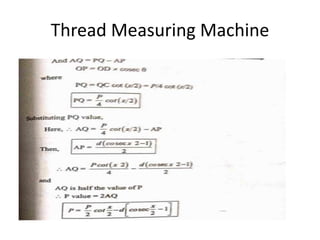
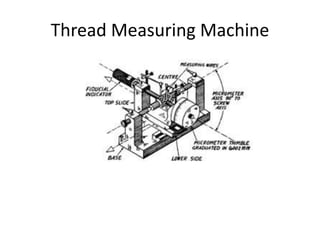
Thread Measuring Machine
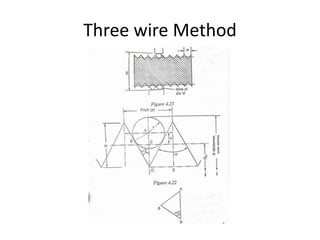
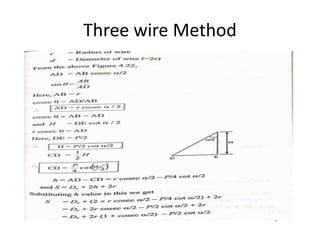
Three wire Method
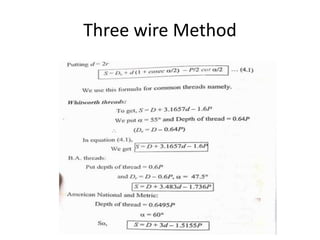
Three wire Method
Three wire Method
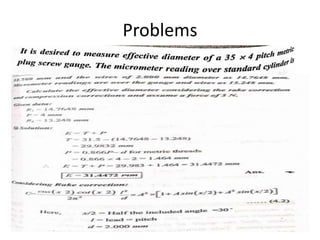
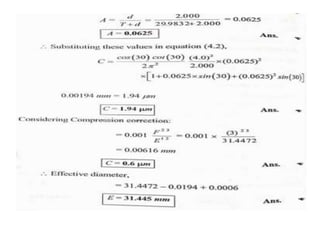
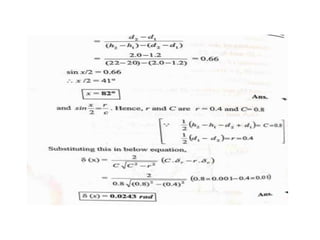
Problems
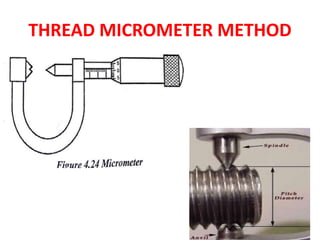
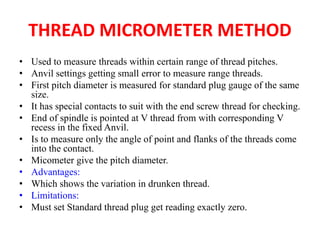
THREAD MICROMETER METHOD
• Used to measure threads within certain range of thread pitches.
• Anvil settings getting small error to measure range threads.
• First pitch diameter is measured for standard plug gauge of the same
size.
• It has special contacts to suit with the end screw thread for checking.
• End of spindle is pointed at V thread from with corresponding V
recess in the fixed Anvil.
• Is to measure only the angle of point and flanks of the threads come
into the contact.
• Micometer give the pitch diameter.
• Advantages:
• Which shows the variation in drunken thread.
• Limitations:
• Must set Standard thread plug get reading exactly zero.
PITCH MEASUREMENT
• Three methods,
1.Pitch Measuring Machine 2.Tool Makers microscope
3.Screw pitch gauge.
Pitch Measuring Machine
• Measurement is to move the stylus along the screen parallel to
the axis from one place to the next place.
• In this method is accurate method of measuring the pitch.
• Micrometer reading is set near zero on the scale.
• Indicator is moved along to bring the stylus and the indicator is
adjusted radially.
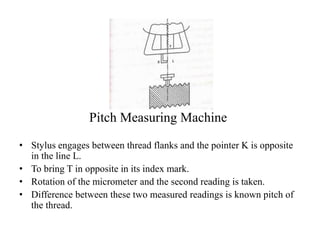
Pitch Measuring Machine
• Stylus engages between thread flanks and the pointer K is opposite
in the line L.
• To bring T in opposite in its index mark.
• Rotation of the micrometer and the second reading is taken.
• Difference between these two measured readings is known pitch of
the thread.
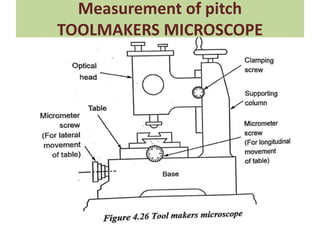
Measurement of pitch
TOOLMAKERS MICROSCOPE
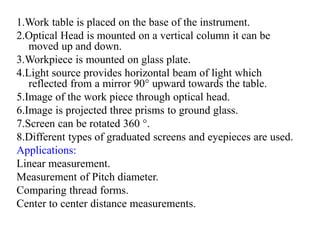
1.Work table is placed on the base of the instrument.
2.Optical Head is mounted on a vertical column it can be
moved up and down.
3.Workpiece is mounted on glass plate.
4.Light source provides horizontal beam of light which
reflected from a mirror 90° upward towards the table.
5.Image of the work piece through optical head.
6.Image is projected three prisms to ground glass.
7.Screen can be rotated 360 °.
8.Different types of graduated screens and eyepieces are used.
Applications:
Linear measurement.
Measurement of Pitch diameter.
Comparing thread forms.
Center to center distance measurements.
THREAD GAUGES
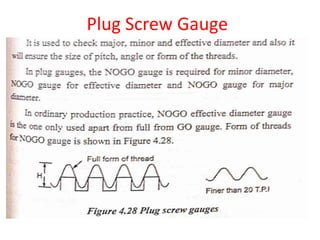
Plug Screw Gauge
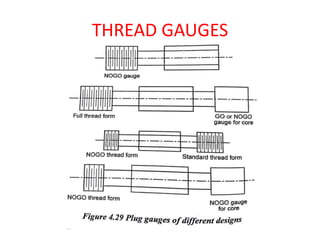
THREAD GAUGES
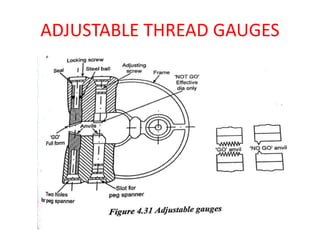
ADJUSTABLE THREAD GAUGES
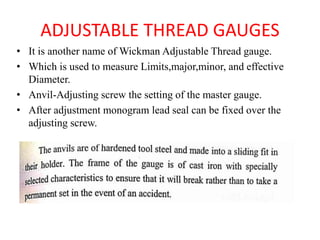
• It is another name of Wickman Adjustable Thread gauge.
• Which is used to measure Limits,major,minor, and effective
Diameter.
• Anvil-Adjusting screw the setting of the master gauge.
• After adjustment monogram lead seal can be fixed over the
adjusting screw.
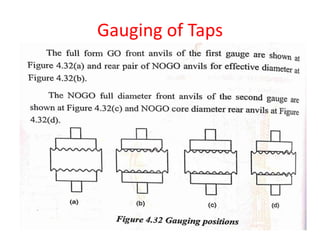
Gauging of Taps
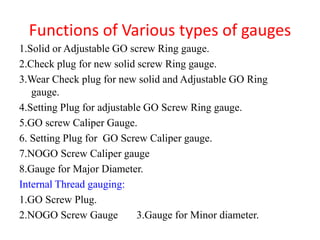
Functions of Various types of gauges
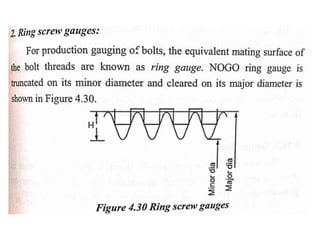
1.Solid or Adjustable GO screw Ring gauge.
2.Check plug for new solid screw Ring gauge.
3.Wear Check plug for new solid and Adjustable GO Ring
gauge.
4.Setting Plug for adjustable GO Screw Ring gauge.
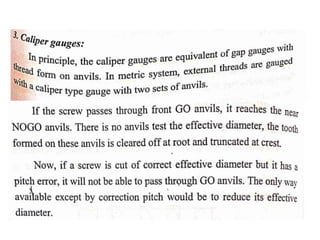
5.GO screw Caliper Gauge.
6. Setting Plug for GO Screw Caliper gauge.
7.NOGO Screw Caliper gauge
8.Gauge for Major Diameter.
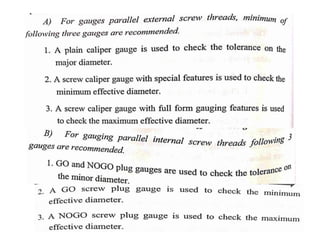
Internal Thread gauging:
1.GO Screw Plug.
2.NOGO Screw Gauge 3.Gauge for Minor diameter.
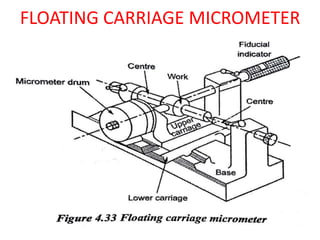
FLOATING CARRIAGE MICROMETER
• It consists of three major parts,
1.Base casting 2.Lower Carriage 3.Upper Carriage.
• Base has housing to support the work piece.
• Two V Grooves on the table lie parallel to the center.It’s support the
Lower gauge.
• Carriage has two conical pegs.
• One V Grooves resting upon a ball.
• Another one V Groove which lies on base ball.
• Upper surface of the lower carriage has Two V grooves on ball
bearings.
• Upper carriage floats at freely on the balls.It is called Floating
carriage.
• Movement allowed two directions which right angle to each other.
Measurement of Gears
• Gear is a mechanical drives which transmit power through
toothed wheel.
• Accuracy is very important to gear manufacturing.
• Transmission efficiency almost 99%.
• The gear blanks should be tested for the dimensional accuracy
and tooth thickness for the forms of gears.
• Two forms of gears are commonly.1.Involute 2.Cycloidal.
• Involute gear is also called as spur gear.
• Cycloidal gears are used to heavy and impact loads.
• Pressure angle is 25° to 14.5°
Measurement of Gears
Types of Gears:
1.Spur Gear.
2.Sprial Gear.
3.Helical Gear.
4.Bevel Gear.
5.Worm and worm wheel.
6.Rack and Pinion Gear.
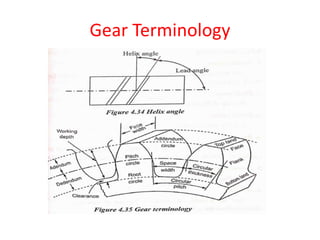
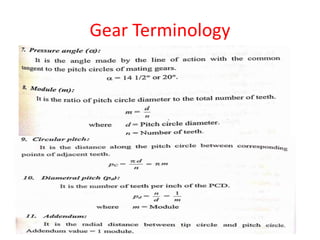
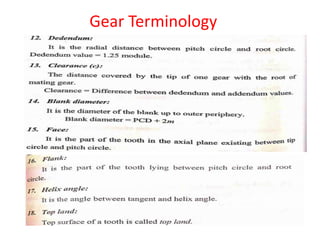
Gear Terminology
Gear Terminology
Gear Terminology
Gear Terminology
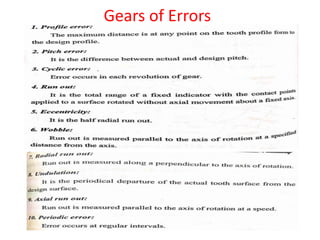
Gears of Errors
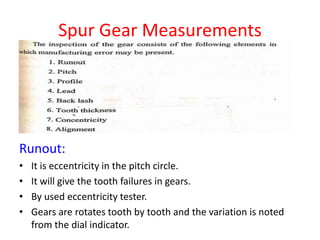
Spur Gear Measurements
Runout:
• It is eccentricity in the pitch circle.
• It will give the tooth failures in gears.
• By used eccentricity tester.
• Gears are rotates tooth by tooth and the variation is noted
from the dial indicator.
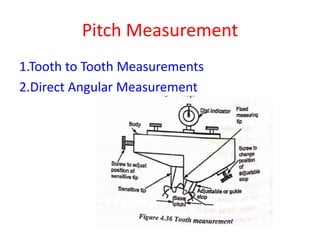
Pitch Measurement
1.Tooth to Tooth Measurements
2.Direct Angular Measurement
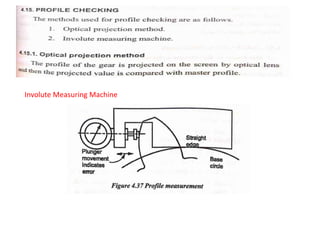
Involute Measuring Machine
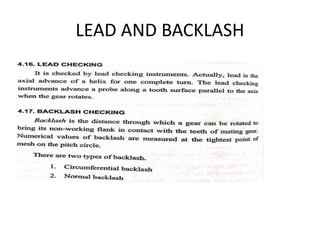
LEAD AND BACKLASH
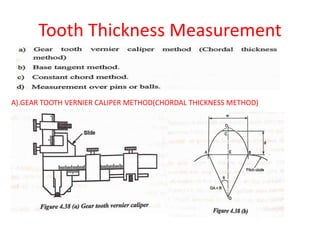
Tooth Thickness Measurement
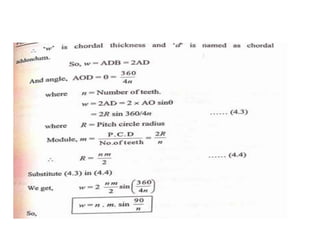
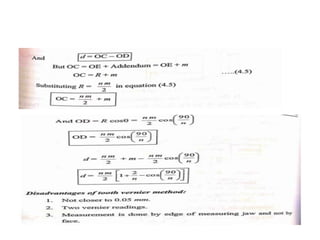
A).GEAR TOOTH VERNIER CALIPER METHOD(CHORDAL THICKNESS METHOD)
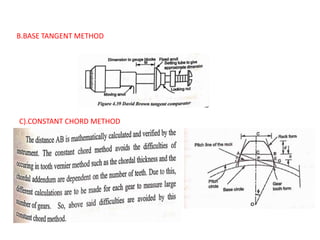
B.BASE TANGENT METHOD
C).CONSTANT CHORD METHOD
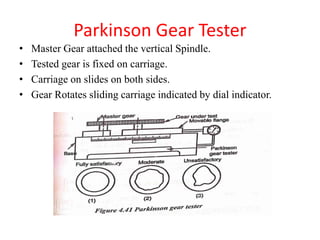
Parkinson Gear Tester
• Master Gear attached the vertical Spindle.
• Tested gear is fixed on carriage.
• Carriage on slides on both sides.
• Gear Rotates sliding carriage indicated by dial indicator.
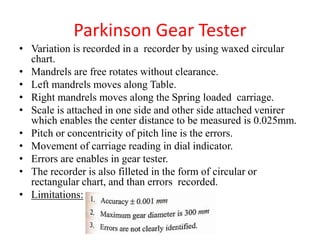
Parkinson Gear Tester
• Variation is recorded in a recorder by using waxed circular
chart.
• Mandrels are free rotates without clearance.
• Left mandrels moves along Table.
• Right mandrels moves along the Spring loaded carriage.
• Scale is attached in one side and other side attached venirer
which enables the center distance to be measured is 0.025mm.
• Pitch or concentricity of pitch line is the errors.
• Movement of carriage reading in dial indicator.
• Errors are enables in gear tester.
• The recorder is also filleted in the form of circular or
rectangular chart, and than errors recorded.
• Limitations:
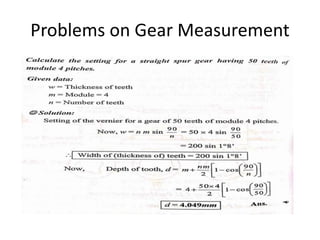
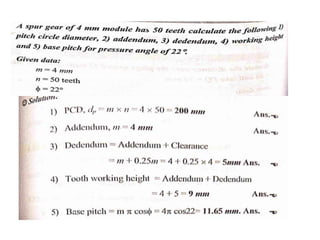
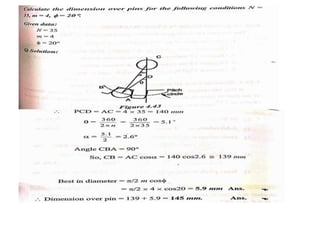
Problems on Gear Measurement
Gleason gear testing machine
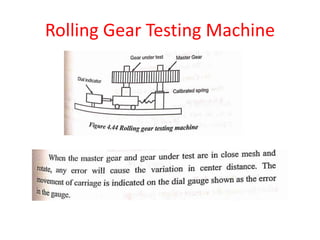
Rolling Gear Testing Machine
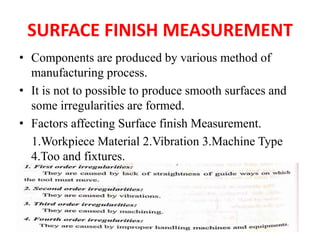
SURFACE FINISH MEASUREMENT
• Components are produced by various method of
manufacturing process.
• It is not to possible to produce smooth surfaces and
some irregularities are formed.
• Factors affecting Surface finish Measurement.
1.Workpiece Material 2.Vibration 3.Machine Type
4.Too and fixtures.
Elements of surface texture
Analysis of Surface Finish
Types:
1.The Average of Roughness method.
2.Peak valley height method.
3.From Factor.
The Average of Roughness method:
i).Centre Line Average.
ii).Root Mean square.
iii).Ten Point Method.
Analysis of Surface Finish
i).Centre Line Average.
Analysis of Surface Finish
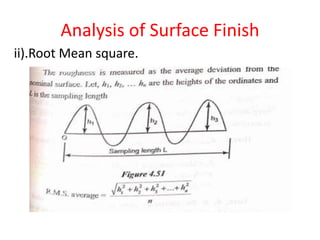
ii).Root Mean square.
Analysis of Surface Finish
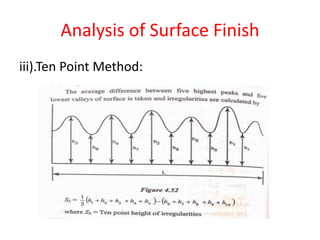
iii).Ten Point Method:
Analysis of Surface Finish
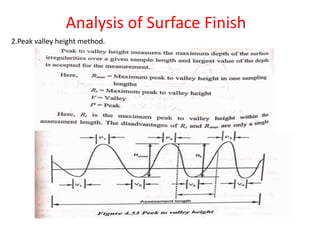
2.Peak valley height method.
Analysis of Surface Finish
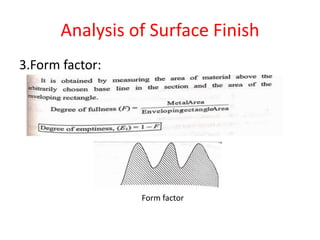
3.Form factor:
Form factor
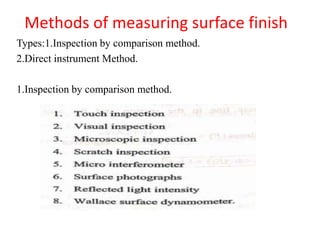
Methods of measuring surface finish
Types:1.Inspection by comparison method.
2.Direct instrument Method.
1.Inspection by comparison method.
Methods of measuring surface finish
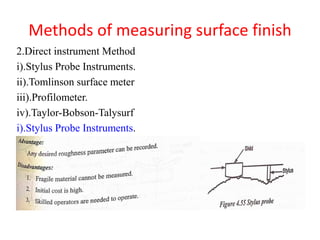
2.Direct instrument Method
i).Stylus Probe Instruments.
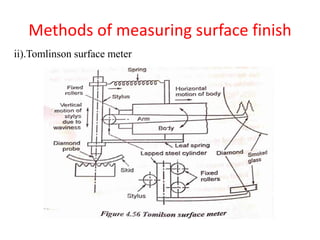
ii).Tomlinson surface meter
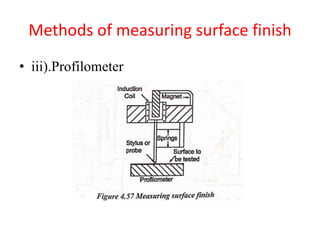
iii).Profilometer.
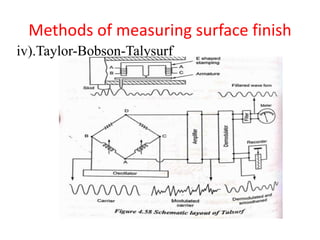
iv).Taylor-Bobson-Talysurf
i).Stylus Probe Instruments.
Methods of measuring surface finish
ii).Tomlinson surface meter
Methods of measuring surface finish
• iii).Profilometer
Methods of measuring surface finish
iv).Taylor-Bobson-Talysurf
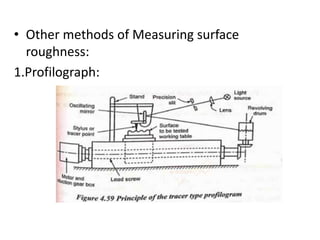
• Other methods of Measuring surface
roughness:
1.Profilograph:
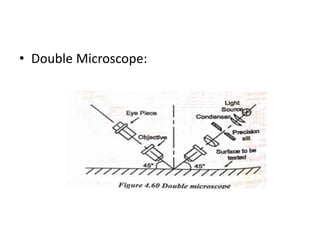
• Double Microscope:
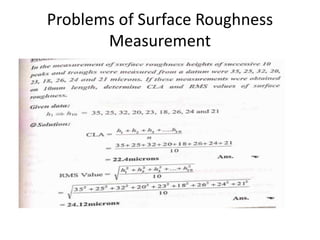
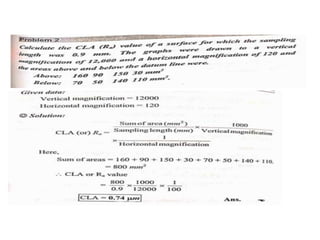
Problems of Surface Roughness
Measurement
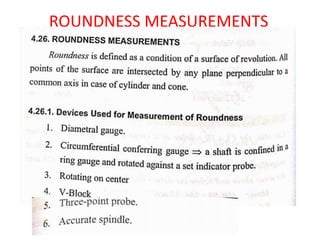
ROUNDNESS MEASUREMENTS
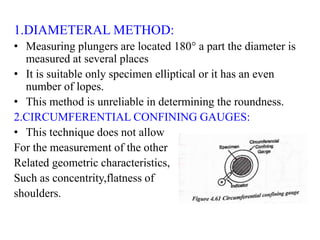
1.DIAMETERAL METHOD:
• Measuring plungers are located 180° a part the diameter is
measured at several places
• It is suitable only specimen elliptical or it has an even
number of lopes.
• This method is unreliable in determining the roundness.
2.CIRCUMFERENTIAL CONFINING GAUGES:
• This technique does not allow
For the measurement of the other
Related geometric characteristics,
Such as concentrity,flatness of
shoulders.
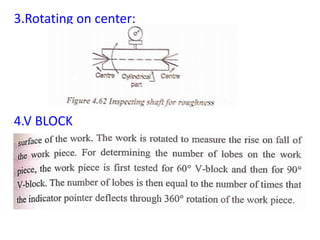
3.Rotating on center:
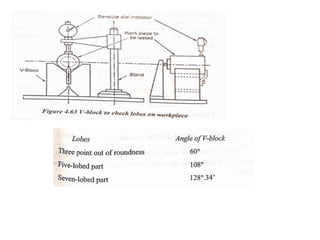
4.V BLOCK
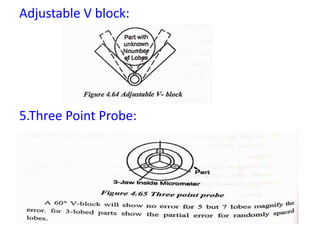
Adjustable V block:
5.Three Point Probe:
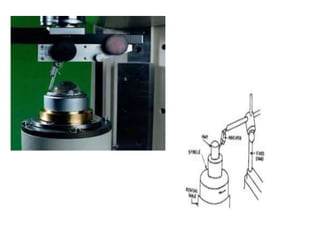
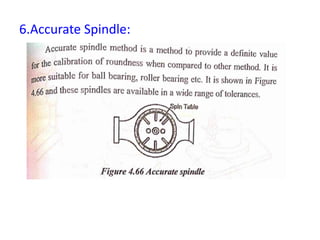
6.Accurate Spindle:
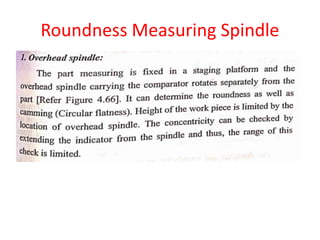
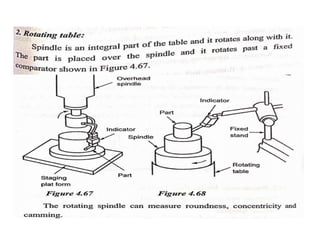
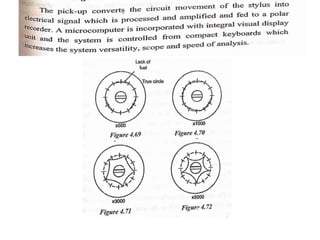
Roundness Measuring Spindle
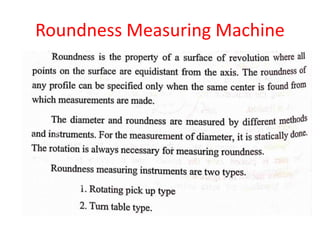
Roundness Measuring Machine
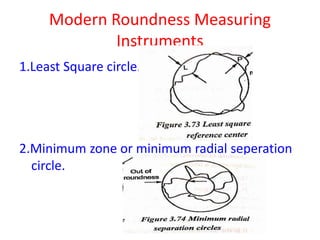
Modern Roundness Measuring
Instruments
1.Least Square circle.
2.Minimum zone or minimum radial seperation
circle.
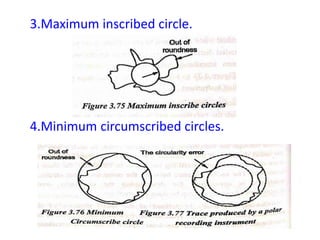
3.Maximum inscribed circle.
4.Minimum circumscribed circles.

UNIT IV

  • 1.
    UNIT 4 FORM MEASUREMENT Principlesand Methods of straightness – Flatness measurement – Thread measurement, gear measurement, surface finish measurement, Roundness measurement – Applications.
  • 2.
  • 8.
    INTRODUCTION • Threads areof prime importance, they are used as fasteners. • It is a helical groove, used to transmit force and motion. • In plain shaft, the hole assembly, the object of dimensional control is to ensure a certain consistency of fit. • The performance of screw threads during their assembly with nut depends upon a number of parameters such as the condition of the machine tool used for screw cutting, work material and tool.
  • 9.
    GEOMETRICAL FEATURES • Themeasurement of • Straightness • Flatness • Squareness • Parallelism • Roundness • Circularity • Cylindricity
  • 10.
    FORM MEASUREMENT INCLUDES •Screw thread measurement • Gear measurement • Radius measurement • Surface Finish measurement • Straightness measurement • Flatness measurement • roundness measurement
  • 11.
    STRAIGHTNESS MEASUREMENT • Aline is said to be straight over a given length, if the variation of the distance of its from two planes perpendicular to each other and parallel to the general direction of the line remains within the specified tolerance limits. • The tolerance on the straightness of a line is defined as the maximum deviation in relation to the reference straight line joining the two extremities of the line to be checked.
  • 12.
    • Important geometricalparameter of machines • Example: shaping machine-guideways • Shortest distance between the two lines – straight line • Ray of light, liquid level • It is a qualitative measure of a surface • Straightness measuring system should be in line with functional point – called Bryan’s principle
  • 13.
  • 14.
    METHODS OF STRAIGHTNESS SPIRITLEVEL: • Inspecting the horizontal surfaces • Finding direction and magnitude of minor deviation from nominal condition • The bubble will move from its position along the radius of the angle of tilt. • Ether, alcohol, benzol- low viscosity fluid • Having graduated scale
  • 15.
  • 17.
  • 18.
    STRAIGHT EDGES: • Withthe help of surface plates and sprit levels straight edges are used for checking straightness and flatness • Flat – sectioned measuring instrument • Made up of steels • Straight edges are used for testing large areas of surface • Painted surfaces are used to measure straightness LASER MEASURING SYSTEM:
  • 19.
  • 20.
    FLATNESS MEASUREMENT • Minimumdistance between the two planes, which will cover all irregularities of the surface to be tested • Best-fit plane between two standard reference plane one above and one below the plane surface to be tested • Deviation of the surface from the best fitting plane
  • 22.
  • 23.
    Measurement of ScrewThreads • Screw Threads are used to Transmit power and Motion. • Fasten Two components with help Of nuts,bolts and Studs. Screw threads form included Angle,Head Angle,Helix angle.
  • 24.
  • 25.
  • 26.
  • 27.
  • 28.
  • 29.
  • 30.
    Measurement of VariousElements of Thread 1.Major diameter 2.Minor Diameter. 3.Effective of Pitch diameter. 4.Pitch. 5.Thread Angle and form.
  • 31.
    Measurement of MajorDiameter • Ordinary Micrometer:
  • 32.
    Measurement of MajorDiameter • Bench Micrometer:
  • 33.
  • 34.
  • 35.
    Measurement of EffectiveDiameter 1.One Wire Method. 2.Two Wire Method. 3.Three wire Method. 4.Micrometer Method. One Wire Method:
  • 36.
    Measurement of EffectiveDiameter Two Wire Method:
  • 37.
  • 38.
  • 39.
  • 40.
  • 41.
  • 42.
  • 43.
  • 44.
  • 48.
  • 49.
    THREAD MICROMETER METHOD •Used to measure threads within certain range of thread pitches. • Anvil settings getting small error to measure range threads. • First pitch diameter is measured for standard plug gauge of the same size. • It has special contacts to suit with the end screw thread for checking. • End of spindle is pointed at V thread from with corresponding V recess in the fixed Anvil. • Is to measure only the angle of point and flanks of the threads come into the contact. • Micometer give the pitch diameter. • Advantages: • Which shows the variation in drunken thread. • Limitations: • Must set Standard thread plug get reading exactly zero.
  • 50.
    PITCH MEASUREMENT • Threemethods, 1.Pitch Measuring Machine 2.Tool Makers microscope 3.Screw pitch gauge. Pitch Measuring Machine • Measurement is to move the stylus along the screen parallel to the axis from one place to the next place. • In this method is accurate method of measuring the pitch. • Micrometer reading is set near zero on the scale. • Indicator is moved along to bring the stylus and the indicator is adjusted radially.
  • 51.
    Pitch Measuring Machine •Stylus engages between thread flanks and the pointer K is opposite in the line L. • To bring T in opposite in its index mark. • Rotation of the micrometer and the second reading is taken. • Difference between these two measured readings is known pitch of the thread.
  • 52.
  • 54.
    1.Work table isplaced on the base of the instrument. 2.Optical Head is mounted on a vertical column it can be moved up and down. 3.Workpiece is mounted on glass plate. 4.Light source provides horizontal beam of light which reflected from a mirror 90° upward towards the table. 5.Image of the work piece through optical head. 6.Image is projected three prisms to ground glass. 7.Screen can be rotated 360 °. 8.Different types of graduated screens and eyepieces are used. Applications: Linear measurement. Measurement of Pitch diameter. Comparing thread forms. Center to center distance measurements.
  • 55.
  • 56.
  • 57.
  • 61.
  • 62.
    ADJUSTABLE THREAD GAUGES •It is another name of Wickman Adjustable Thread gauge. • Which is used to measure Limits,major,minor, and effective Diameter. • Anvil-Adjusting screw the setting of the master gauge. • After adjustment monogram lead seal can be fixed over the adjusting screw.
  • 63.
  • 64.
    Functions of Varioustypes of gauges 1.Solid or Adjustable GO screw Ring gauge. 2.Check plug for new solid screw Ring gauge. 3.Wear Check plug for new solid and Adjustable GO Ring gauge. 4.Setting Plug for adjustable GO Screw Ring gauge. 5.GO screw Caliper Gauge. 6. Setting Plug for GO Screw Caliper gauge. 7.NOGO Screw Caliper gauge 8.Gauge for Major Diameter. Internal Thread gauging: 1.GO Screw Plug. 2.NOGO Screw Gauge 3.Gauge for Minor diameter.
  • 65.
  • 66.
    FLOATING CARRIAGE MICROMETER •It consists of three major parts, 1.Base casting 2.Lower Carriage 3.Upper Carriage. • Base has housing to support the work piece. • Two V Grooves on the table lie parallel to the center.It’s support the Lower gauge. • Carriage has two conical pegs. • One V Grooves resting upon a ball. • Another one V Groove which lies on base ball. • Upper surface of the lower carriage has Two V grooves on ball bearings. • Upper carriage floats at freely on the balls.It is called Floating carriage. • Movement allowed two directions which right angle to each other.
  • 67.
    Measurement of Gears •Gear is a mechanical drives which transmit power through toothed wheel. • Accuracy is very important to gear manufacturing. • Transmission efficiency almost 99%. • The gear blanks should be tested for the dimensional accuracy and tooth thickness for the forms of gears. • Two forms of gears are commonly.1.Involute 2.Cycloidal. • Involute gear is also called as spur gear. • Cycloidal gears are used to heavy and impact loads. • Pressure angle is 25° to 14.5°
  • 68.
    Measurement of Gears Typesof Gears: 1.Spur Gear. 2.Sprial Gear. 3.Helical Gear. 4.Bevel Gear. 5.Worm and worm wheel. 6.Rack and Pinion Gear.
  • 69.
  • 70.
  • 71.
  • 72.
  • 73.
  • 74.
    Spur Gear Measurements Runout: •It is eccentricity in the pitch circle. • It will give the tooth failures in gears. • By used eccentricity tester. • Gears are rotates tooth by tooth and the variation is noted from the dial indicator.
  • 75.
    Pitch Measurement 1.Tooth toTooth Measurements 2.Direct Angular Measurement
  • 76.
  • 77.
  • 78.
    Tooth Thickness Measurement A).GEARTOOTH VERNIER CALIPER METHOD(CHORDAL THICKNESS METHOD)
  • 81.
  • 83.
    Parkinson Gear Tester •Master Gear attached the vertical Spindle. • Tested gear is fixed on carriage. • Carriage on slides on both sides. • Gear Rotates sliding carriage indicated by dial indicator.
  • 84.
    Parkinson Gear Tester •Variation is recorded in a recorder by using waxed circular chart. • Mandrels are free rotates without clearance. • Left mandrels moves along Table. • Right mandrels moves along the Spring loaded carriage. • Scale is attached in one side and other side attached venirer which enables the center distance to be measured is 0.025mm. • Pitch or concentricity of pitch line is the errors. • Movement of carriage reading in dial indicator. • Errors are enables in gear tester. • The recorder is also filleted in the form of circular or rectangular chart, and than errors recorded. • Limitations:
  • 85.
    Problems on GearMeasurement
  • 88.
  • 89.
  • 90.
    SURFACE FINISH MEASUREMENT •Components are produced by various method of manufacturing process. • It is not to possible to produce smooth surfaces and some irregularities are formed. • Factors affecting Surface finish Measurement. 1.Workpiece Material 2.Vibration 3.Machine Type 4.Too and fixtures.
  • 91.
  • 92.
  • 93.
    Analysis of SurfaceFinish Types: 1.The Average of Roughness method. 2.Peak valley height method. 3.From Factor. The Average of Roughness method: i).Centre Line Average. ii).Root Mean square. iii).Ten Point Method.
  • 94.
    Analysis of SurfaceFinish i).Centre Line Average.
  • 95.
    Analysis of SurfaceFinish ii).Root Mean square.
  • 96.
    Analysis of SurfaceFinish iii).Ten Point Method:
  • 97.
    Analysis of SurfaceFinish 2.Peak valley height method.
  • 98.
    Analysis of SurfaceFinish 3.Form factor: Form factor
  • 99.
    Methods of measuringsurface finish Types:1.Inspection by comparison method. 2.Direct instrument Method. 1.Inspection by comparison method.
  • 100.
    Methods of measuringsurface finish 2.Direct instrument Method i).Stylus Probe Instruments. ii).Tomlinson surface meter iii).Profilometer. iv).Taylor-Bobson-Talysurf i).Stylus Probe Instruments.
  • 101.
    Methods of measuringsurface finish ii).Tomlinson surface meter
  • 102.
    Methods of measuringsurface finish • iii).Profilometer
  • 103.
    Methods of measuringsurface finish iv).Taylor-Bobson-Talysurf
  • 104.
    • Other methodsof Measuring surface roughness: 1.Profilograph:
  • 105.
  • 106.
    Problems of SurfaceRoughness Measurement
  • 108.
  • 109.
    1.DIAMETERAL METHOD: • Measuringplungers are located 180° a part the diameter is measured at several places • It is suitable only specimen elliptical or it has an even number of lopes. • This method is unreliable in determining the roundness. 2.CIRCUMFERENTIAL CONFINING GAUGES: • This technique does not allow For the measurement of the other Related geometric characteristics, Such as concentrity,flatness of shoulders.
  • 110.
  • 112.
  • 113.
  • 114.
  • 116.
  • 118.
    Modern Roundness Measuring Instruments 1.LeastSquare circle. 2.Minimum zone or minimum radial seperation circle.
  • 119.