Open
Reproducible
Research
Challenges and
Opportunities
Dr. Markus Konkol,
Open Science Officer
@MarkusKonkol
Agenda and learning objectives
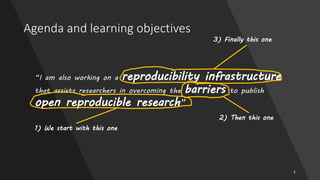
“I am also working on a reproducibility infrastructure
that assists researchers in overcoming the barriers to publish
open reproducible research”
3) Finally this one
2) Then this one
1) We start with this one
2
Open Reproducible Research
Goodman, S. N., Fanelli, D., & Ioannidis, J. P. (2016). What does research reproducibility mean? Science Translational Medicine 8(341),
341ps12-341ps12. https://doi.org/10.1126/scitranslmed.aaf5027
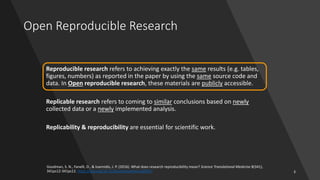
Reproducible research refers to achieving exactly the same results (e.g. tables,
figures, numbers) as reported in the paper by using the same source code and
data. In Open reproducible research, these materials are publicly accessible.
Replicable research refers to coming to similar conclusions based on newly
collected data or a newly implemented analysis.
Replicability & reproducibility are essential for scientific work.
3
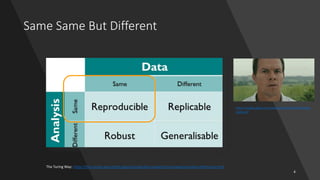
Same Same But Different
https://media.giphy.com/media/3oz8xZvvOZRmKay4xy
/giphy.gif
The Turing Way: https://the-turing-way.netlify.app/reproducible-research/overview/overview-definitions.html
4
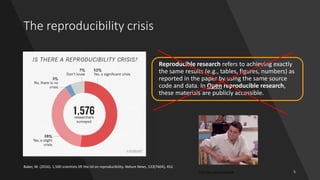
Baker, M. (2016). 1,500 scientists lift the lid on reproducibility. Nature News, 533(7604), 452.
The reproducibility crisis
Reproducible research refers to achieving exactly
the same results (e.g., tables, figures, numbers) as
reported in the paper by using the same source
code and data. In Open reproducible research,
these materials are publicly accessible.
From: https://gph.is/g/4DAnQjB 5
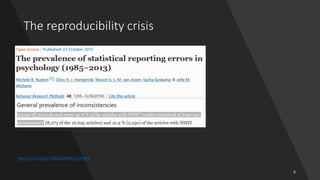
The reproducibility crisis
6
https://doi.org/10.3758/s13428-015-0664-2
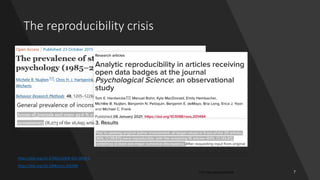
The reproducibility crisis
From: https://gph.is/g/4DAnQjB 7
https://doi.org/10.3758/s13428-015-0664-2
https://doi.org/10.1098/rsos.201494
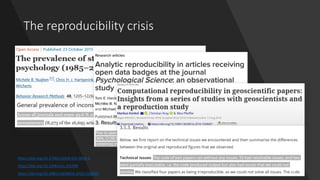
The reproducibility crisis
From: https://gph.is/g/4DAnQjB 8
https://doi.org/10.3758/s13428-015-0664-2
https://doi.org/10.1098/rsos.201494
https://doi.org/10.1080/13658816.2018.1508687
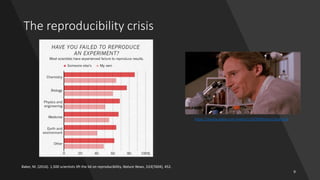
Baker, M. (2016). 1,500 scientists lift the lid on reproducibility. Nature News, 533(7604), 452.
The reproducibility crisis
https://media.giphy.com/media/z1GQ9t8FxipnG/giphy.gif
9
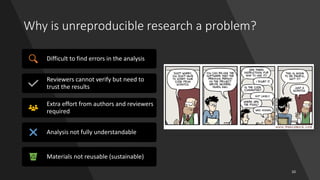
Difficult to find errors in the analysis
Reviewers cannot verify but need to
trust the results
Extra effort from authors and reviewers
required
Analysis not fully understandable
Materials not reusable (sustainable)
Why is unreproducible research a problem?
10
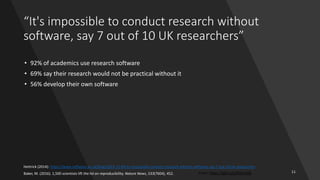
“It's impossible to conduct research without
software, say 7 out of 10 UK researchers”
From: https://gph.is/g/4DAnQjB
Hettrick (2014): https://www.software.ac.uk/blog/2014-12-04-its-impossible-conduct-research-without-software-say-7-out-10-uk-researchers
Baker, M. (2016). 1,500 scientists lift the lid on reproducibility. Nature News, 533(7604), 452.
• 92% of academics use research software
• 69% say their research would not be practical without it
• 56% develop their own software
11
12
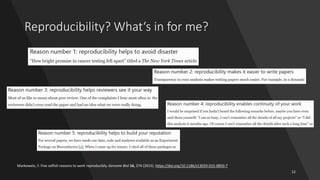
Reproducibility? What‘s in for me?
Markowetz, F. Five selfish reasons to work reproducibly. Genome Biol 16, 274 (2015). https://doi.org/10.1186/s13059-015-0850-7
13
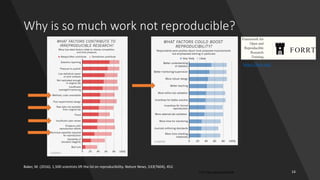
Why is so much work not reproducible?
What do you think?
Please go to https://www.menti.com/ and make a suggestion. Code: 54 44 07 9
Why is so much work not reproducible?
From: https://gph.is/g/4DAnQjB
Baker, M. (2016). 1,500 scientists lift the lid on reproducibility. Nature News, 533(7604), 452.
https://forrt.org/
14
Why is so much work not reproducible?
• Losing competitive advantages – publish materials after paper acceptance, use embargoes
• Prepare code and data – make it reusable to increase your impact
• Code not worth publishing – it can be gold to someone else
• Proprietary software – use open source software and scripting languages (R, Python)
• Missing supporting tools – there are quite a few
• Licensing – ask for support
• Not yet relevant – this will change!
Publish or Perish
Journal Impact Factors
h-index 15
https://osf.io/dztvq/
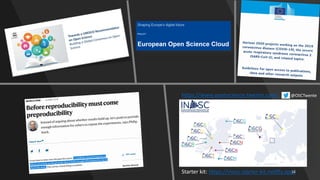
Starter kit: https://inosc-starter-kit.netlify.app/
https://www.openscience-twente.com/ @OSCTwente
16
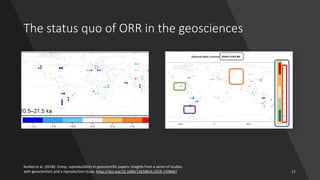
The status quo of ORR in the geosciences
Konkol et al. (2018): Comp. reproducibility in geoscientific papers: Insights from a series of studies
with geoscientists and a reproduction study. https://doi.org/10.1080/13658816.2018.1508687 17
18
Why are the two maps not identical?
Please go to https://www.menti.com/ and make a suggestion. Code: 54 44 07 9
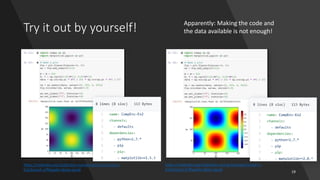
Try it out by yourself!
https://mybinder.org/v2/gh/alan-turing-institute/CompEnv-
Ex2/branch-a?filepath=demo.ipynb
https://mybinder.org/v2/gh/alan-turing-institute/CompEnv-
Ex2/branch-b?filepath=demo.ipynb
Apparently: Making the code and
the data available is not enough!
19
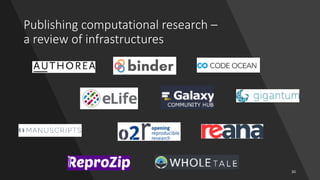
Publishing computational research –
a review of infrastructures
20
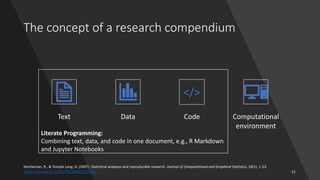
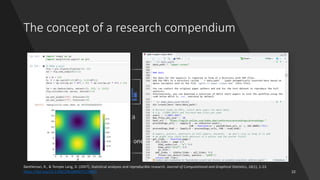
The concept of a research compendium
Gentleman, R., & Temple Lang, D. (2007). Statistical analyses and reproducible research. Journal of Computational and Graphical Statistics, 16(1), 1-23.
https://doi.org/10.1198/106186007X178663
Text Data Code Computational
environment
</>
Literate Programming:
Combining text, data, and code in one document, e.g., R Markdown
and Jupyter Notebooks
21
The concept of a research compendium
Gentleman, R., & Temple Lang, D. (2007). Statistical analyses and reproducible research. Journal of Computational and Graphical Statistics, 16(1), 1-23.
https://doi.org/10.1198/106186007X178663
Text Data Code Computational
environment
</>
Literate Programming:
Combining text, data, and code in one document, e.g., R Markdown
and Jupyter Notebooks
22
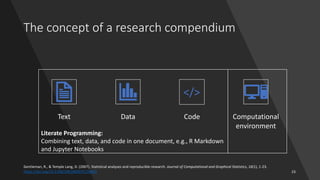
The concept of a research compendium
Gentleman, R., & Temple Lang, D. (2007). Statistical analyses and reproducible research. Journal of Computational and Graphical Statistics, 16(1), 1-23.
https://doi.org/10.1198/106186007X178663
Text Data Code Computational
environment
</>
Literate Programming:
Combining text, data, and code in one document, e.g., R Markdown
and Jupyter Notebooks
23
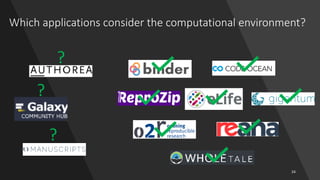
Which applications consider the computational environment?
?
?
?
24
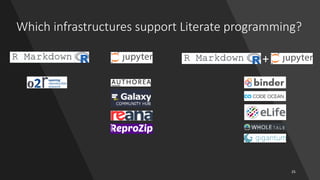
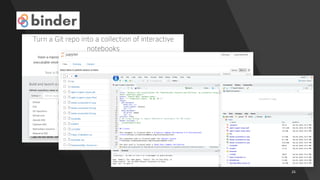
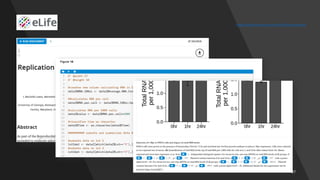
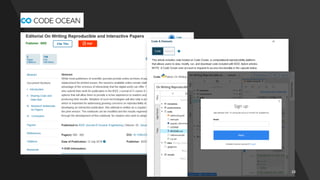
Which infrastructures support Literate programming?
+
25
26
27
https://elifesciences.org/articles/30274/executable
28
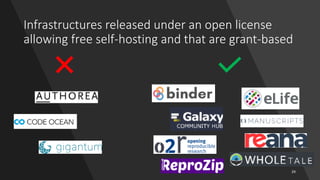
Infrastructures released under an open license
allowing free self-hosting and that are grant-based
29
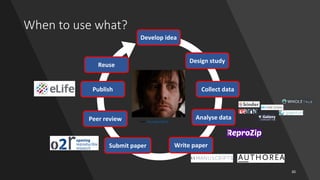
When to use what?
Develop idea
Write paper
Publish
Reuse
Collect data
Analyse data
Design study
Submit paper
Peer review From: http://gph.is/2f0rJlS
30
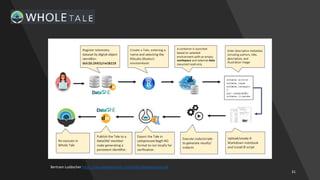
31
Bertram Ludäscher https://reusableresearch.com/slides/bludaescher.pdf
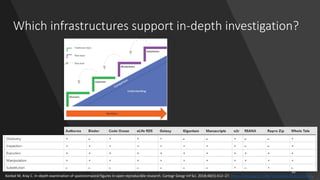
Which infrastructures support in-depth investigation?
Konkol M, Kray C. In-depth examination of spatiotemporal figures in open reproducible research. Cartogr Geogr Inf Sci. 2018;46(5):412–27. https://doi.org/10.1080/15230406.2018.1512421.
32
33
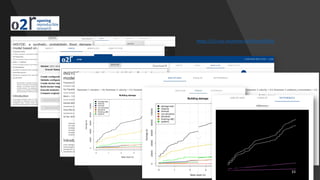
https://o2r.uni-muenster.de/#/erc/bDSxE
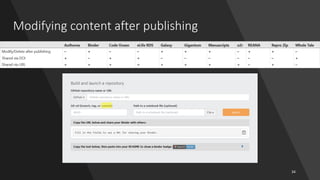
Modifying content after publishing
34
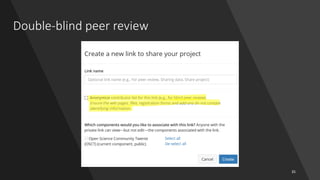
Double-blind peer review
35
Which infrastructures support sensitive data?
https://media.giphy.com/media/2
6hkhPJ5hmdD87HYA/giphy.gif
https://media.giphy.com/media/c
krRT65e5xvEaygrTh/giphy.gif
https://media.giphy.com/media/IS
OckXUybVfQ4/giphy.gif
36
How to get ready for ORR?
• Start with your own workspace (e.g. naming of files, folder structure)
• Learn a scripting language (R, Python)
• Learn a notebook format (R Markdown/Jupyter Notebooks)
• Learn a software for versioning (git)
• Some effort at the beginning, pays off for the rest of your career
“Openness is not all-or-nothing […] Fully open research is a long-term goal, not a
switch we should expect to flip overnight.” (MCKIERNAN, 2016)
37

Digital Scholar Webinar: Open reproducible research

  • 1.
  • 2.
    Agenda and learningobjectives “I am also working on a reproducibility infrastructure that assists researchers in overcoming the barriers to publish open reproducible research” 3) Finally this one 2) Then this one 1) We start with this one 2
  • 3.
    Open Reproducible Research Goodman,S. N., Fanelli, D., & Ioannidis, J. P. (2016). What does research reproducibility mean? Science Translational Medicine 8(341), 341ps12-341ps12. https://doi.org/10.1126/scitranslmed.aaf5027 Reproducible research refers to achieving exactly the same results (e.g. tables, figures, numbers) as reported in the paper by using the same source code and data. In Open reproducible research, these materials are publicly accessible. Replicable research refers to coming to similar conclusions based on newly collected data or a newly implemented analysis. Replicability & reproducibility are essential for scientific work. 3
  • 4.
    Same Same ButDifferent https://media.giphy.com/media/3oz8xZvvOZRmKay4xy /giphy.gif The Turing Way: https://the-turing-way.netlify.app/reproducible-research/overview/overview-definitions.html 4
  • 5.
    Baker, M. (2016).1,500 scientists lift the lid on reproducibility. Nature News, 533(7604), 452. The reproducibility crisis Reproducible research refers to achieving exactly the same results (e.g., tables, figures, numbers) as reported in the paper by using the same source code and data. In Open reproducible research, these materials are publicly accessible. From: https://gph.is/g/4DAnQjB 5
  • 6.
  • 7.
    The reproducibility crisis From:https://gph.is/g/4DAnQjB 7 https://doi.org/10.3758/s13428-015-0664-2 https://doi.org/10.1098/rsos.201494
  • 8.
    The reproducibility crisis From:https://gph.is/g/4DAnQjB 8 https://doi.org/10.3758/s13428-015-0664-2 https://doi.org/10.1098/rsos.201494 https://doi.org/10.1080/13658816.2018.1508687
  • 9.
    Baker, M. (2016).1,500 scientists lift the lid on reproducibility. Nature News, 533(7604), 452. The reproducibility crisis https://media.giphy.com/media/z1GQ9t8FxipnG/giphy.gif 9
  • 10.
    Difficult to finderrors in the analysis Reviewers cannot verify but need to trust the results Extra effort from authors and reviewers required Analysis not fully understandable Materials not reusable (sustainable) Why is unreproducible research a problem? 10
  • 11.
    “It's impossible toconduct research without software, say 7 out of 10 UK researchers” From: https://gph.is/g/4DAnQjB Hettrick (2014): https://www.software.ac.uk/blog/2014-12-04-its-impossible-conduct-research-without-software-say-7-out-10-uk-researchers Baker, M. (2016). 1,500 scientists lift the lid on reproducibility. Nature News, 533(7604), 452. • 92% of academics use research software • 69% say their research would not be practical without it • 56% develop their own software 11
  • 12.
    12 Reproducibility? What‘s infor me? Markowetz, F. Five selfish reasons to work reproducibly. Genome Biol 16, 274 (2015). https://doi.org/10.1186/s13059-015-0850-7
  • 13.
    13 Why is somuch work not reproducible? What do you think? Please go to https://www.menti.com/ and make a suggestion. Code: 54 44 07 9
  • 14.
    Why is somuch work not reproducible? From: https://gph.is/g/4DAnQjB Baker, M. (2016). 1,500 scientists lift the lid on reproducibility. Nature News, 533(7604), 452. https://forrt.org/ 14
  • 15.
    Why is somuch work not reproducible? • Losing competitive advantages – publish materials after paper acceptance, use embargoes • Prepare code and data – make it reusable to increase your impact • Code not worth publishing – it can be gold to someone else • Proprietary software – use open source software and scripting languages (R, Python) • Missing supporting tools – there are quite a few • Licensing – ask for support • Not yet relevant – this will change! Publish or Perish Journal Impact Factors h-index 15 https://osf.io/dztvq/
  • 16.
  • 17.
    The status quoof ORR in the geosciences Konkol et al. (2018): Comp. reproducibility in geoscientific papers: Insights from a series of studies with geoscientists and a reproduction study. https://doi.org/10.1080/13658816.2018.1508687 17
  • 18.
    18 Why are thetwo maps not identical? Please go to https://www.menti.com/ and make a suggestion. Code: 54 44 07 9
  • 19.
    Try it outby yourself! https://mybinder.org/v2/gh/alan-turing-institute/CompEnv- Ex2/branch-a?filepath=demo.ipynb https://mybinder.org/v2/gh/alan-turing-institute/CompEnv- Ex2/branch-b?filepath=demo.ipynb Apparently: Making the code and the data available is not enough! 19
  • 20.
    Publishing computational research– a review of infrastructures 20
  • 21.
    The concept ofa research compendium Gentleman, R., & Temple Lang, D. (2007). Statistical analyses and reproducible research. Journal of Computational and Graphical Statistics, 16(1), 1-23. https://doi.org/10.1198/106186007X178663 Text Data Code Computational environment </> Literate Programming: Combining text, data, and code in one document, e.g., R Markdown and Jupyter Notebooks 21
  • 22.
    The concept ofa research compendium Gentleman, R., & Temple Lang, D. (2007). Statistical analyses and reproducible research. Journal of Computational and Graphical Statistics, 16(1), 1-23. https://doi.org/10.1198/106186007X178663 Text Data Code Computational environment </> Literate Programming: Combining text, data, and code in one document, e.g., R Markdown and Jupyter Notebooks 22
  • 23.
    The concept ofa research compendium Gentleman, R., & Temple Lang, D. (2007). Statistical analyses and reproducible research. Journal of Computational and Graphical Statistics, 16(1), 1-23. https://doi.org/10.1198/106186007X178663 Text Data Code Computational environment </> Literate Programming: Combining text, data, and code in one document, e.g., R Markdown and Jupyter Notebooks 23
  • 24.
    Which applications considerthe computational environment? ? ? ? 24
  • 25.
    Which infrastructures supportLiterate programming? + 25
  • 26.
  • 27.
  • 28.
  • 29.
    Infrastructures released underan open license allowing free self-hosting and that are grant-based 29
  • 30.
    When to usewhat? Develop idea Write paper Publish Reuse Collect data Analyse data Design study Submit paper Peer review From: http://gph.is/2f0rJlS 30
  • 31.
  • 32.
    Which infrastructures supportin-depth investigation? Konkol M, Kray C. In-depth examination of spatiotemporal figures in open reproducible research. Cartogr Geogr Inf Sci. 2018;46(5):412–27. https://doi.org/10.1080/15230406.2018.1512421. 32
  • 33.
  • 34.
  • 35.
  • 36.
    Which infrastructures supportsensitive data? https://media.giphy.com/media/2 6hkhPJ5hmdD87HYA/giphy.gif https://media.giphy.com/media/c krRT65e5xvEaygrTh/giphy.gif https://media.giphy.com/media/IS OckXUybVfQ4/giphy.gif 36
  • 37.
    How to getready for ORR? • Start with your own workspace (e.g. naming of files, folder structure) • Learn a scripting language (R, Python) • Learn a notebook format (R Markdown/Jupyter Notebooks) • Learn a software for versioning (git) • Some effort at the beginning, pays off for the rest of your career “Openness is not all-or-nothing […] Fully open research is a long-term goal, not a switch we should expect to flip overnight.” (MCKIERNAN, 2016) 37