Systematic Review Processes, Teams,&
Experiences
Methods: Searching & Systematic Reviews
Mark MacEachern & PF Anderson; October 31, 2017
For Dentistry 610; University of Michigan
Introduction
Objectives
◻ Understand the importance of literature searches
◻ Learn how to construct effective searches for clinical
and research projects
◻ Learn reporting and citation management strategies
and resources
Why is it important to search well?
◻ Support evidence-based decision-making
◻ Avoid biases in research projects and clinical decisions
◻ Missed studies can undermine clinical decisions and
research findings
◻ Save yourself time by leveraging resource features
◻ Keep current on new trends, developments
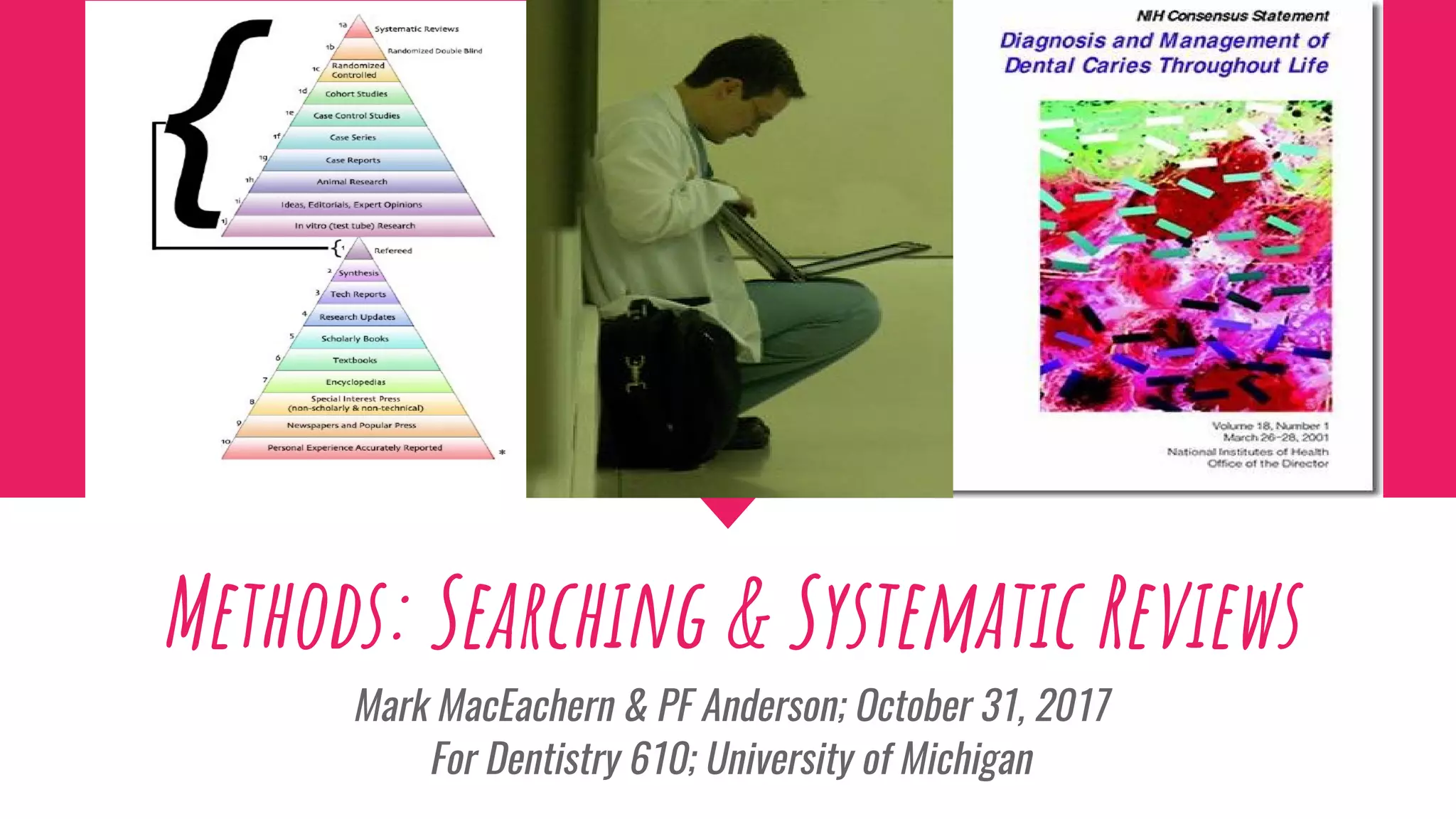
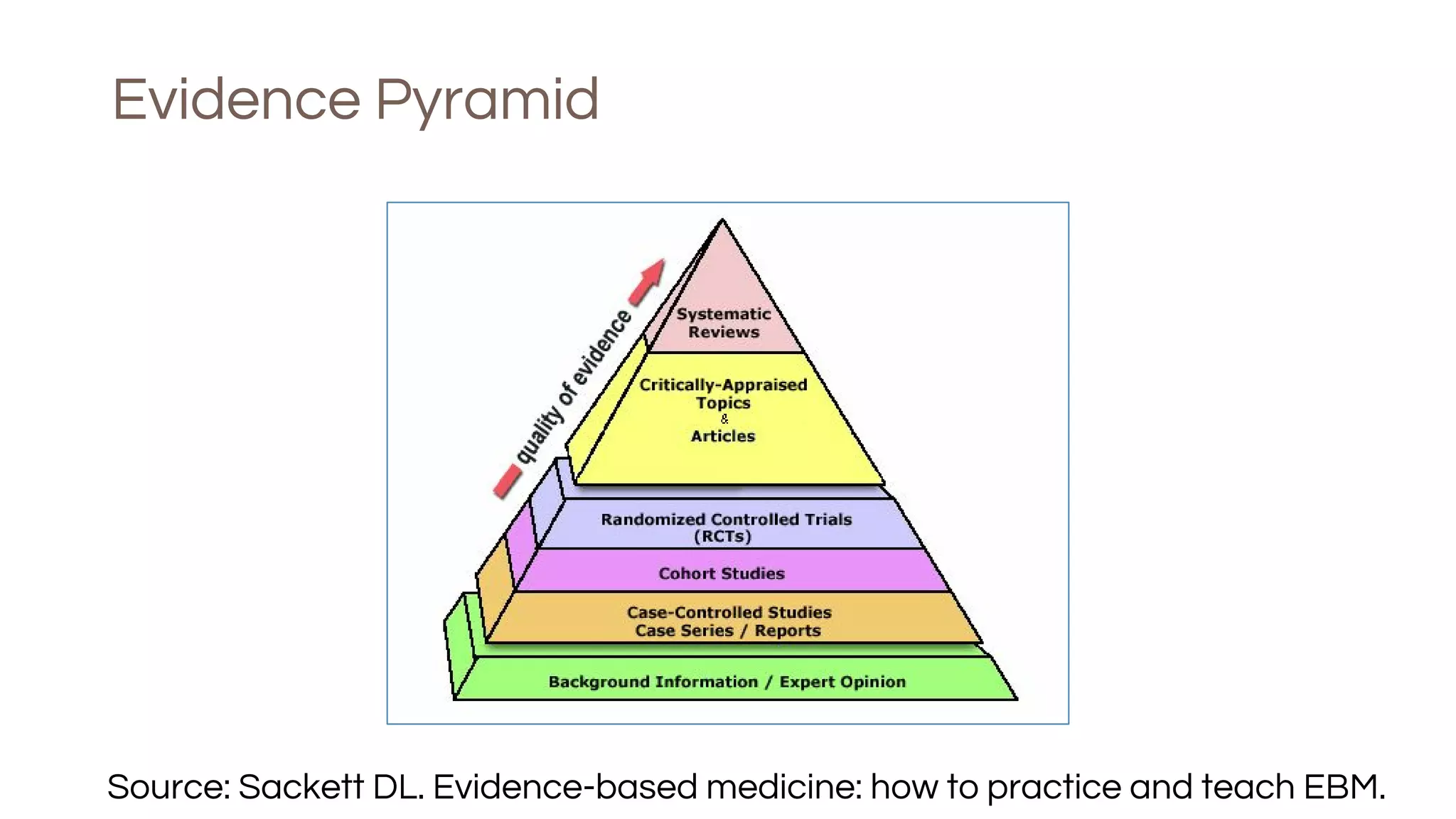
Evidence Pyramid
Source: Sackett DL. Evidence-based medicine: how to practice and teach EBM.
Search Construction
What to expect?
◻ Expect the search to be iterative
◻ Expect 1000s of results
◻ Expect to search multiple databases
◻ EMBASE, PubMed, ERIC, PsycINFO, etc.
◻ Expect the search process to take awhile
◻ Expect to publish search strategy and search methodology
◻ Expect to consult someone with appropriate search expertise
Search construction
1. Identify search terms
2. Use Boolean
3. Use combination of keywords and controlled terms
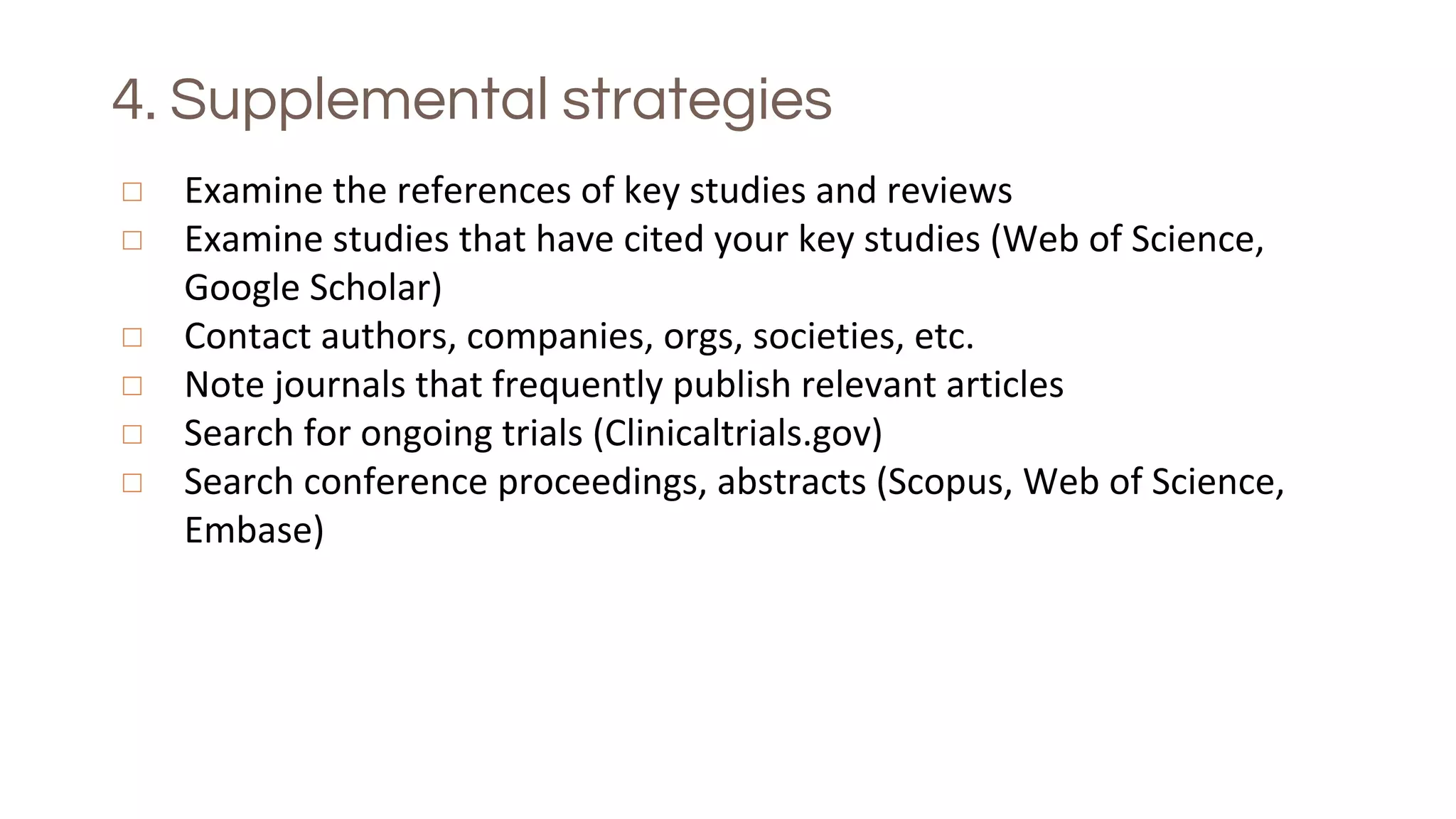
4. Supplemental strategies
1. Identifying search terms
Question/hypothesis:
◻ Real time ultrasonography and in implant and oral surgery
What are the major concepts?
◻ Ultrasonography (ultrasound, ultrasonic imaging, echography, etc.)
◻ Dental implants (types of implants, implant names, etc.)
◻ Oral surgery (surgery, surgeries, surgical, specific procedures
and types of surgery, etc.)
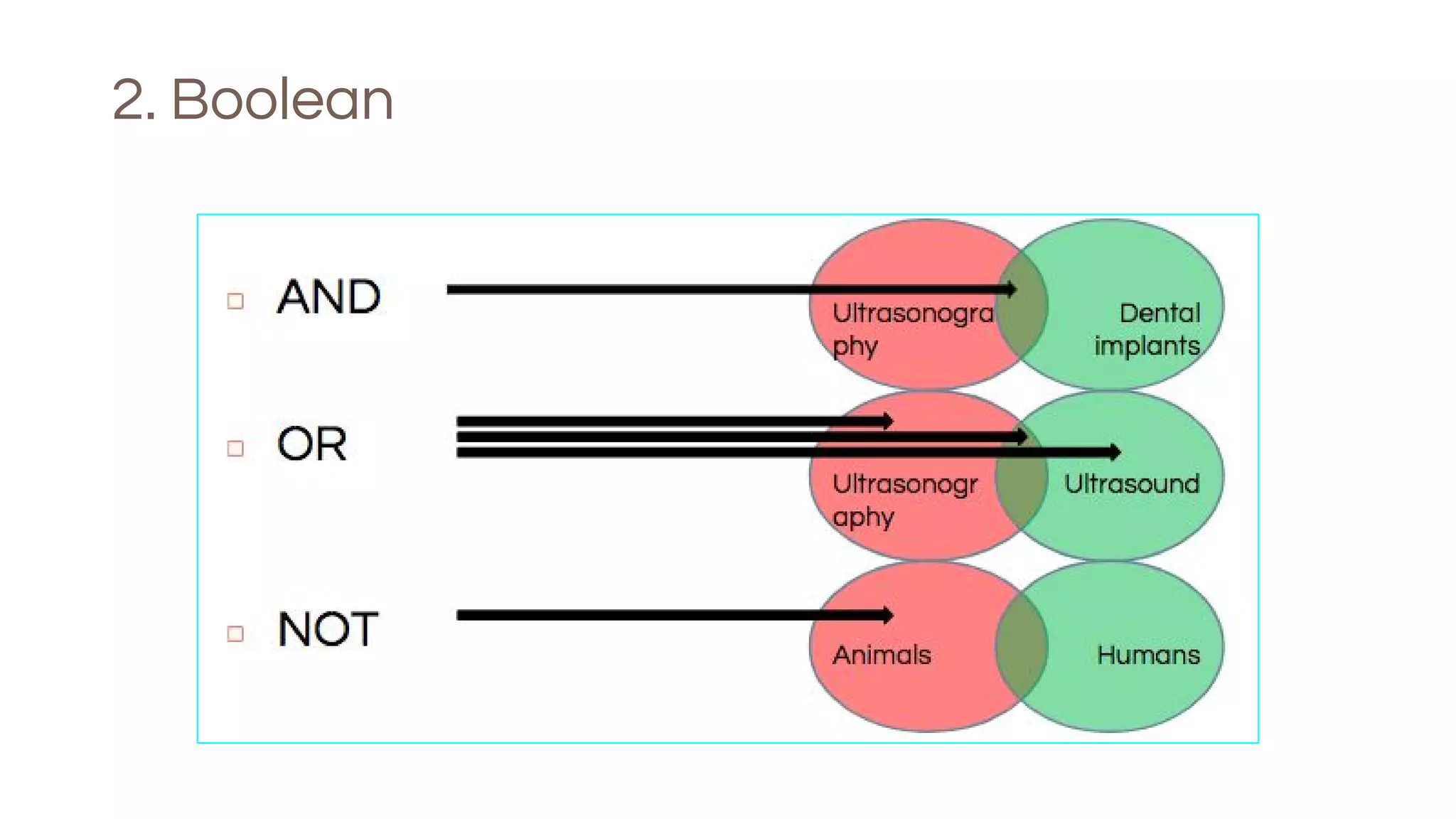
2. Boolean
2. Boolean
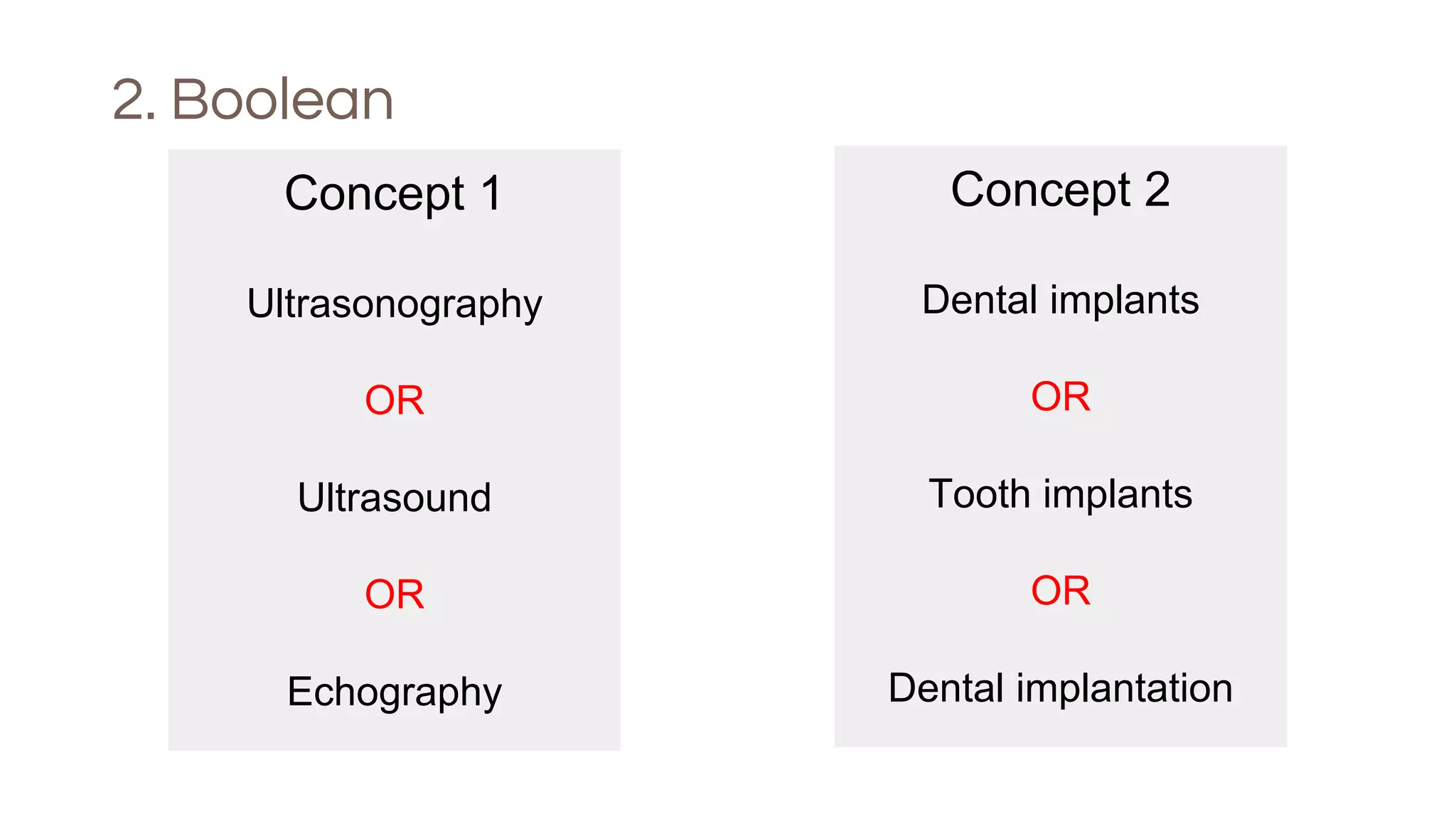
Concept 1
Ultrasonography
OR
Ultrasound
OR
Echography
Concept 2
Dental implants
OR
Tooth implants
OR
Dental implantation
2. Boolean
Concept 1
Ultrasonography
OR
Ultrasound
OR
Echography
Concept 2
Dental implants
OR
Tooth implants
OR
Dental implantation
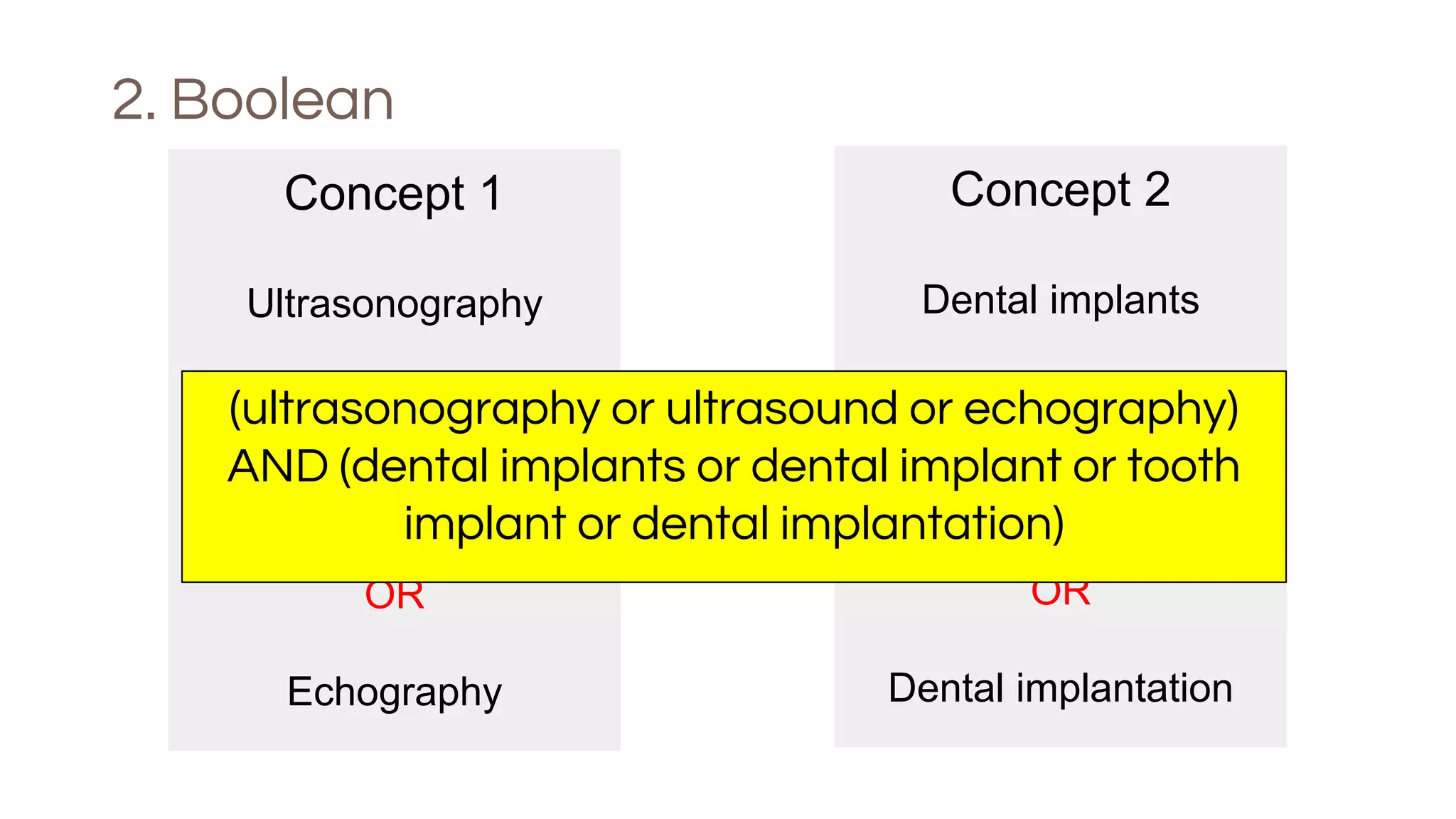
(ultrasonography or ultrasound or echography)
AND (dental implants or dental implant or tooth
implant or dental implantation)
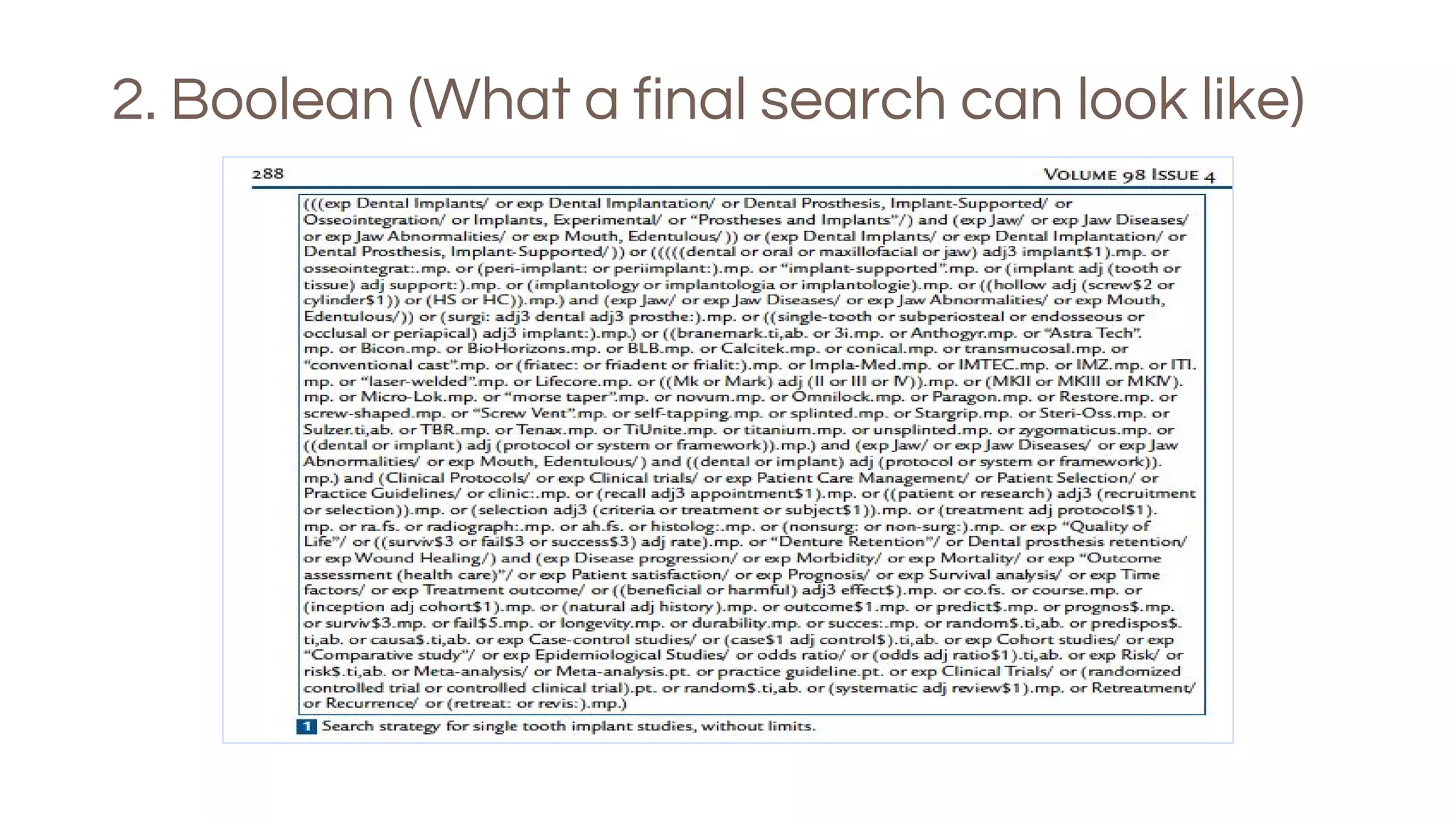
2. Boolean (What a final search can look like)
3. Keywords vs controlled vocabulary
Keywords
Controlled
vocabulary
3. Keywords vs controlled vocabulary
Keywords
Controlled
vocabulary
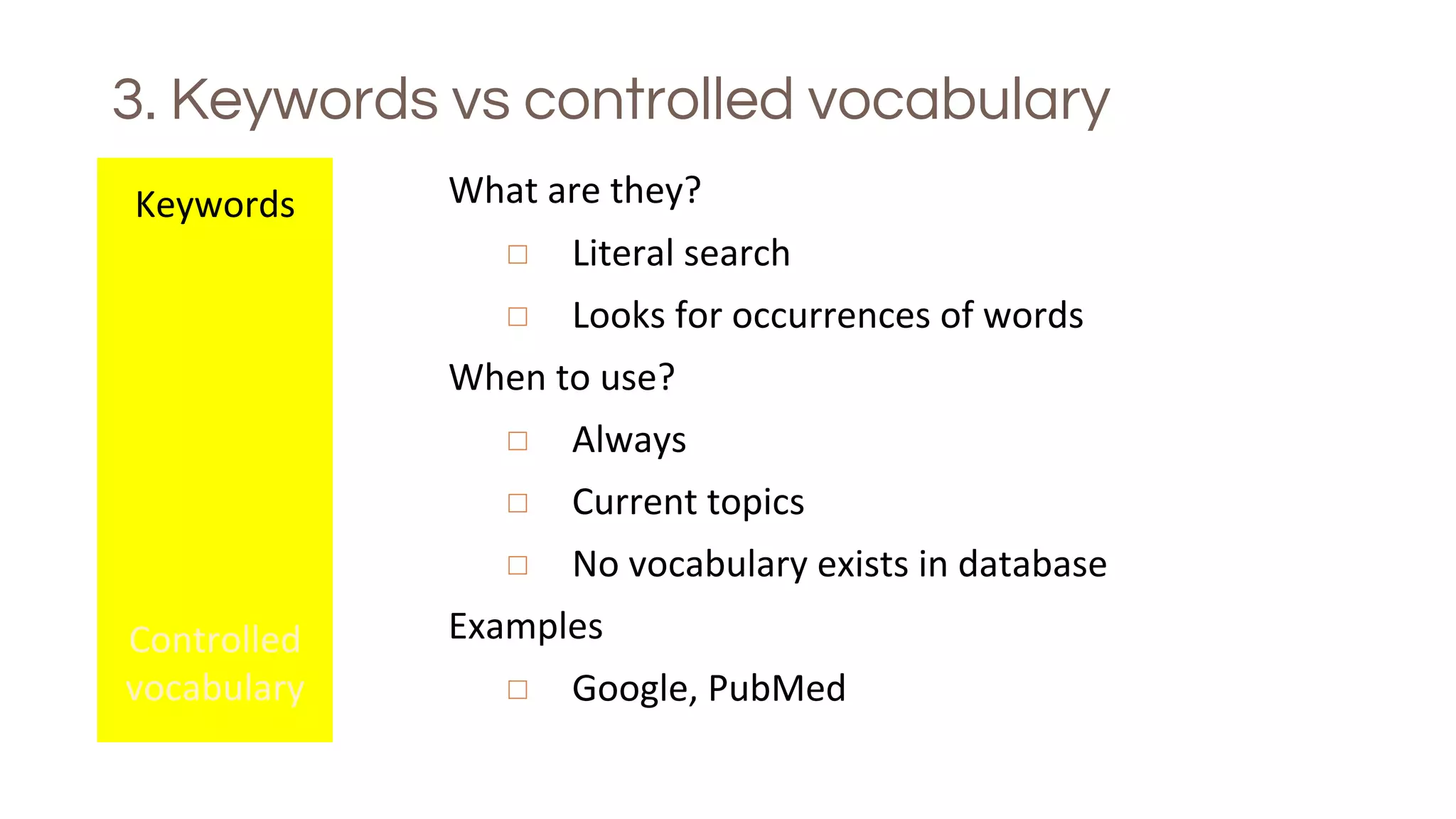
What are they?
◻ Literal search
◻ Looks for occurrences of words
When to use?
◻ Always
◻ Current topics
◻ No vocabulary exists in database
Examples
◻ Google, PubMed
3. Keywords vs controlled vocabulary
Keywords
Controlled
vocabulary
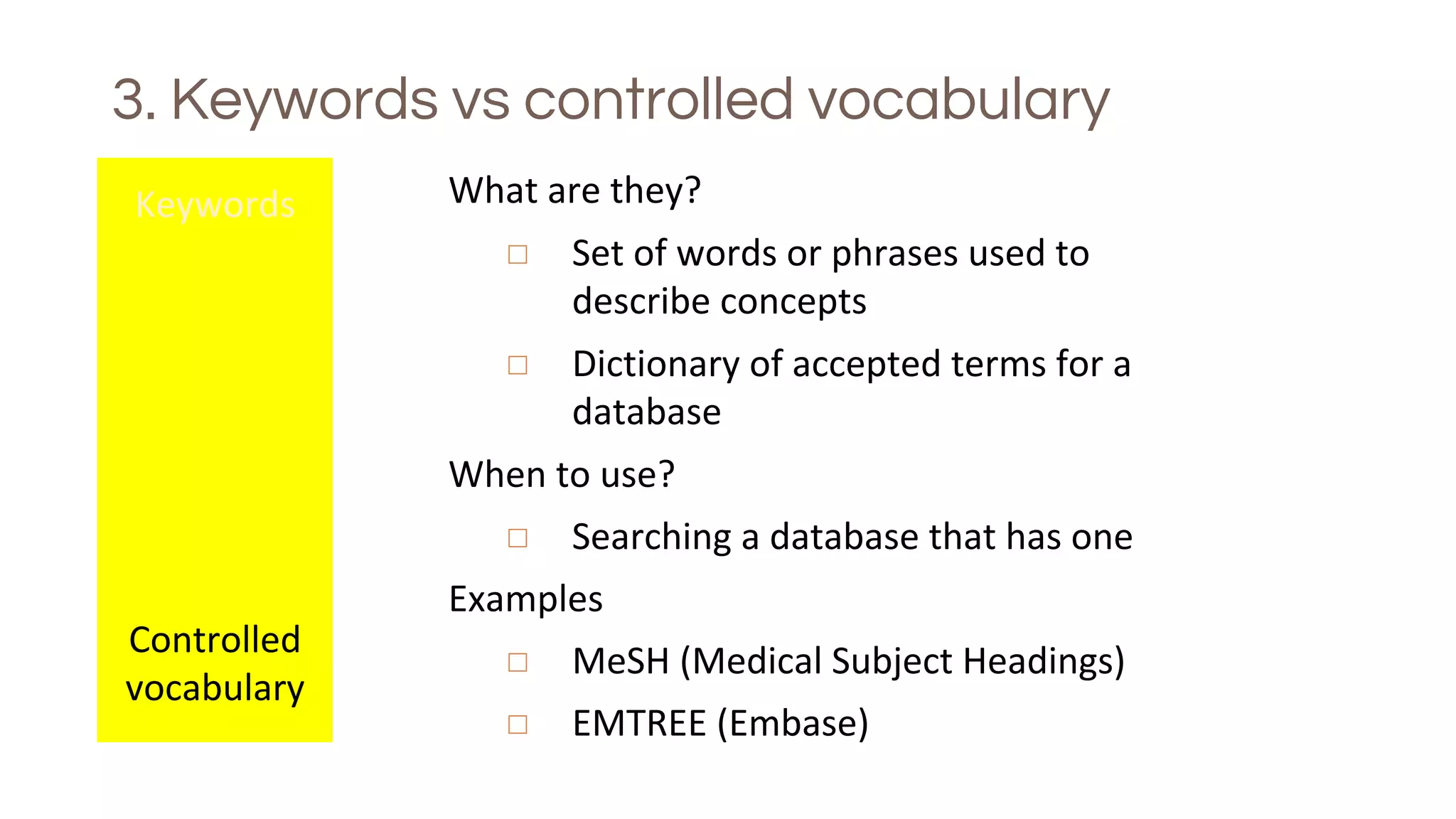
What are they?
◻ Set of words or phrases used to
describe concepts
◻ Dictionary of accepted terms for a
database
When to use?
◻ Searching a database that has one
Examples
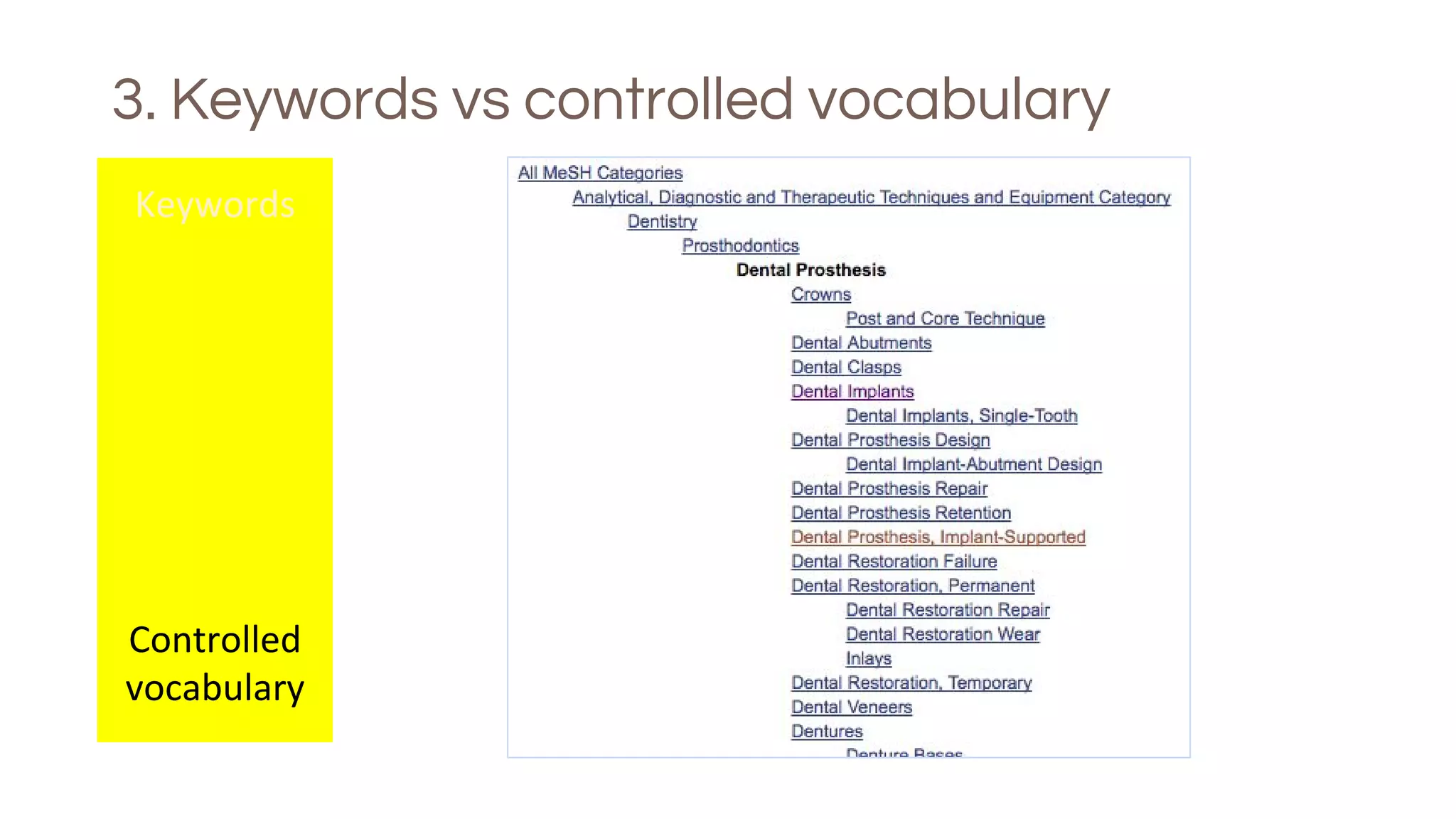
◻ MeSH (Medical Subject Headings)
◻ EMTREE (Embase)
3. Keywords vs controlled vocabulary
Keywords
Controlled
vocabulary
4. Supplemental strategies
◻ Examine the references of key studies and reviews
◻ Examine studies that have cited your key studies (Web of Science,
Google Scholar)
◻ Contact authors, companies, orgs, societies, etc.
◻ Note journals that frequently publish relevant articles
◻ Search for ongoing trials (Clinicaltrials.gov)
◻ Search conference proceedings, abstracts (Scopus, Web of Science,
Embase)
MeSH & MeSH Database
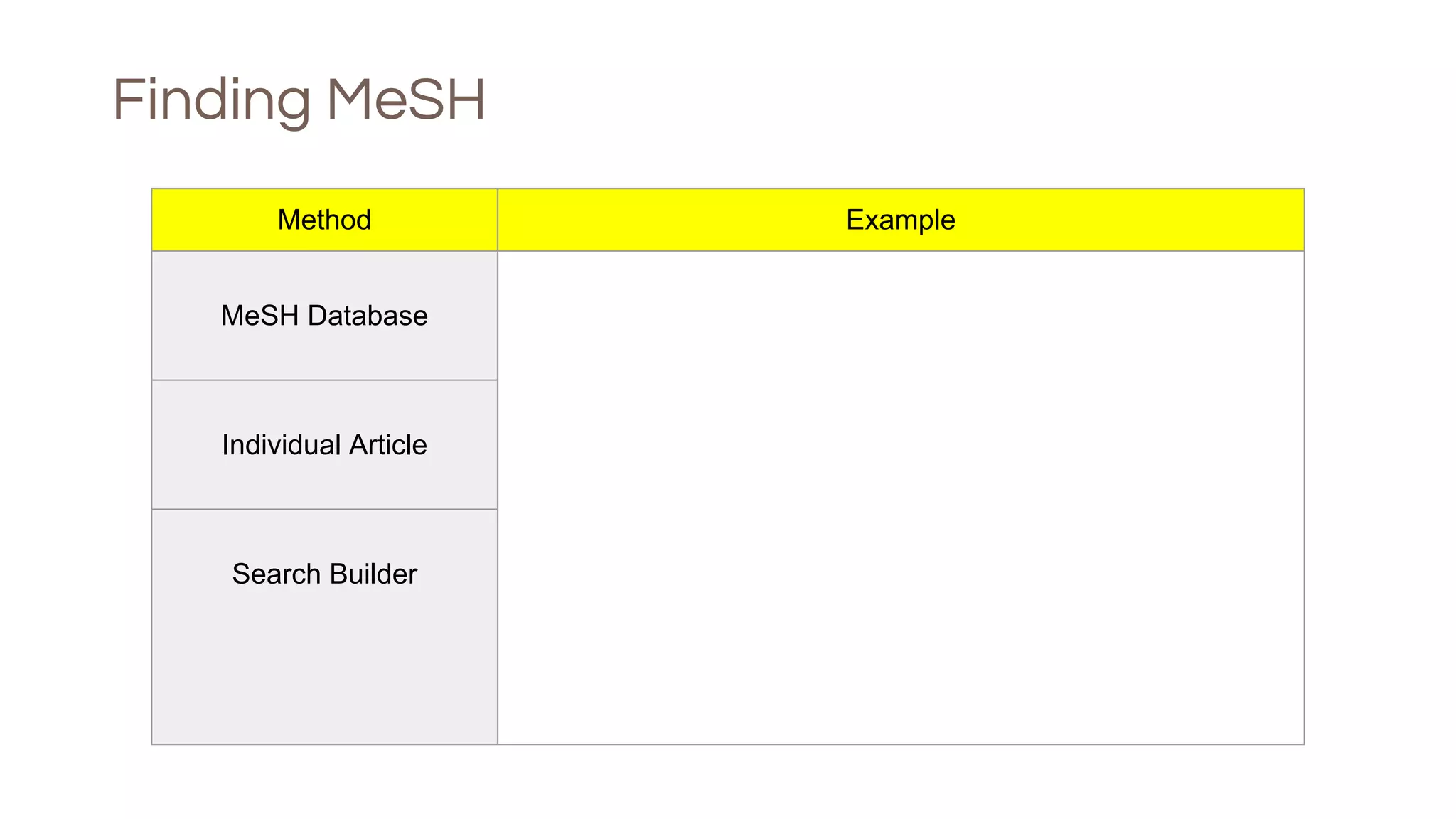
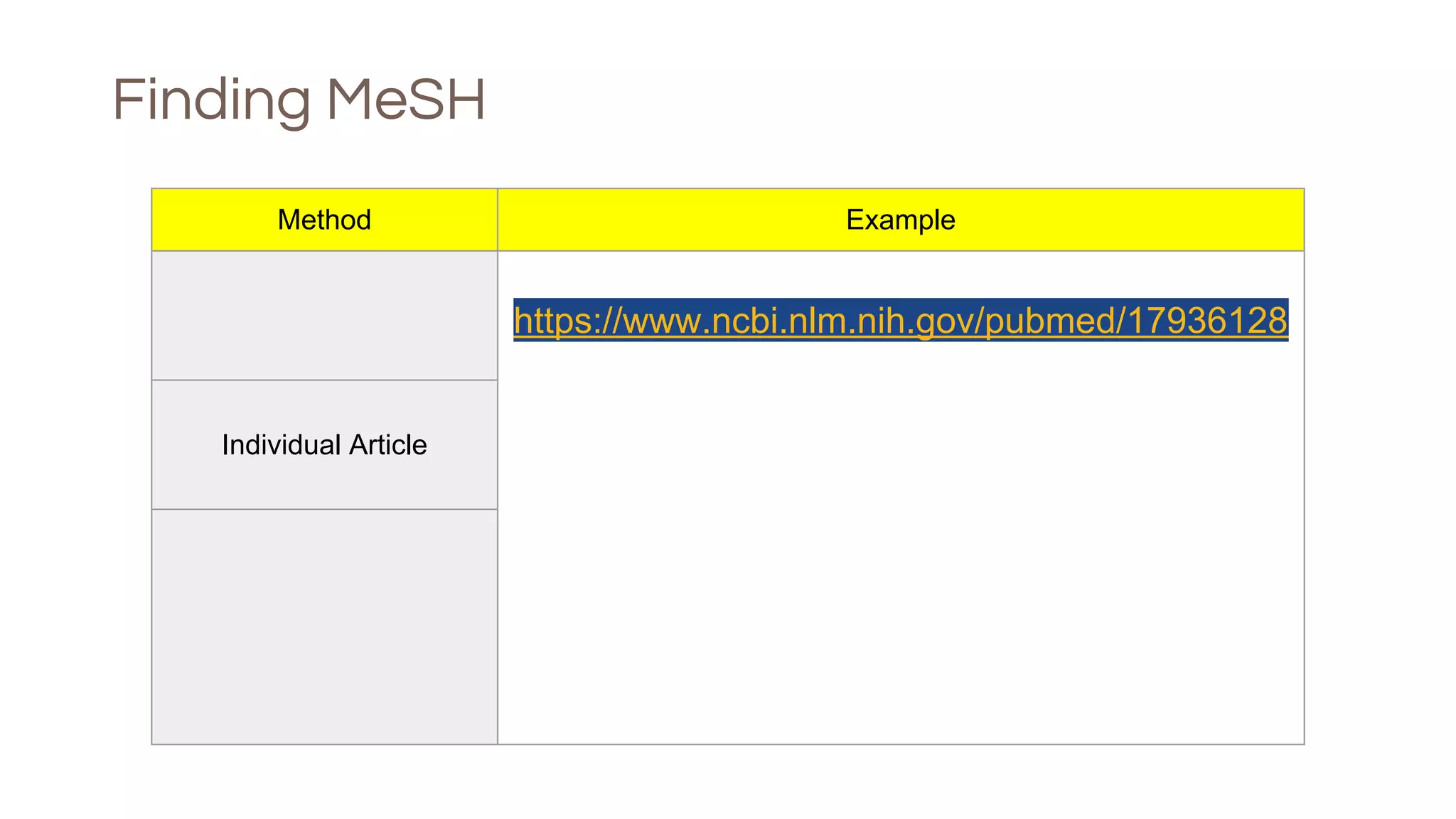
Finding MeSH
Method Example
MeSH Database
Individual Article
Search Builder
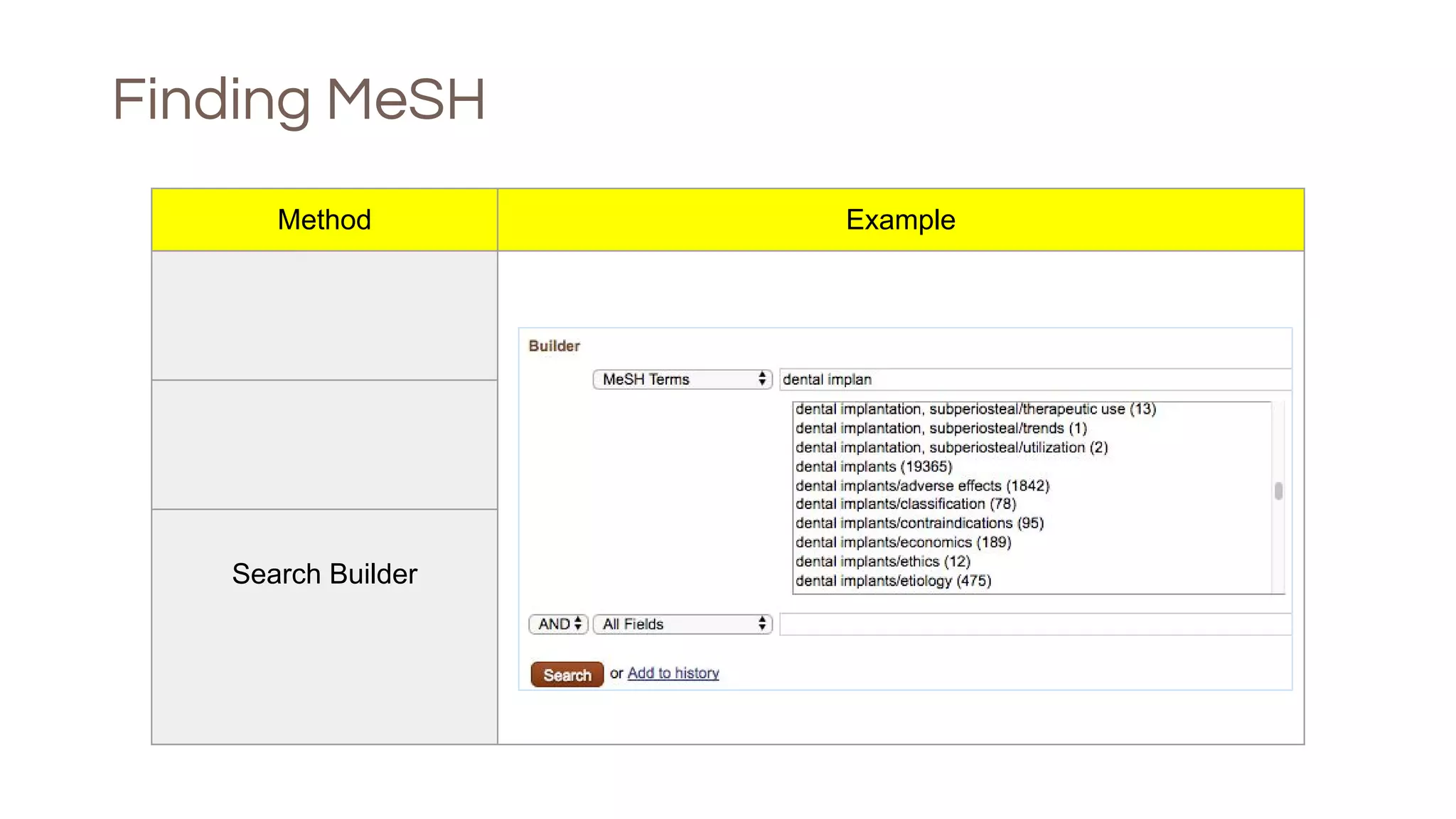
Finding MeSH
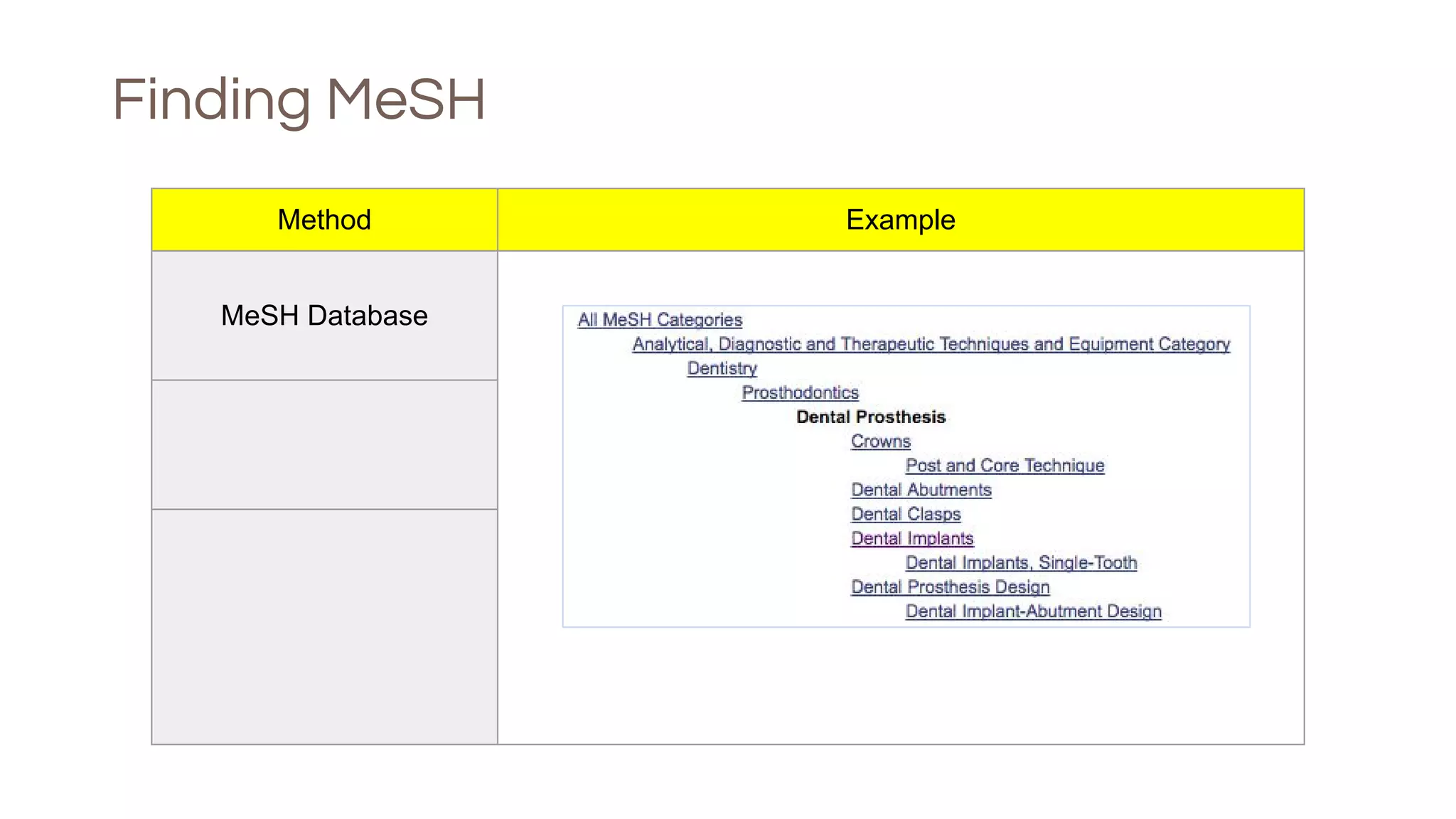
Method Example
MeSH Database
Individual Article
Search Builder
Finding MeSH
Method Example
MeSH Database https://www.ncbi.nlm.nih.gov/pubmed/17936128
Individual Article
Search Builder
Finding MeSH
Method Example
MeSH Database
Individual Article
Search Builder
Activity: MeSH
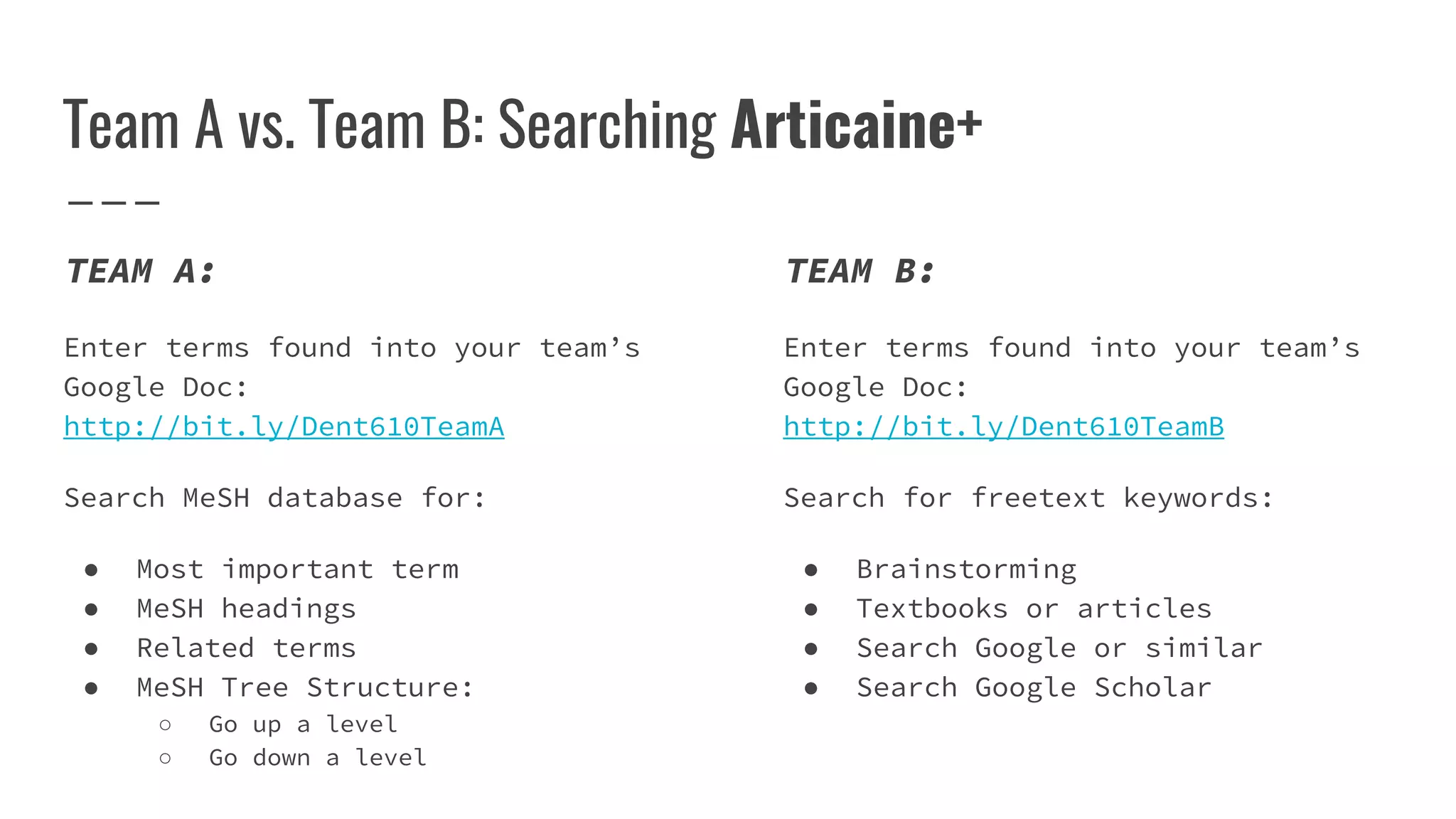
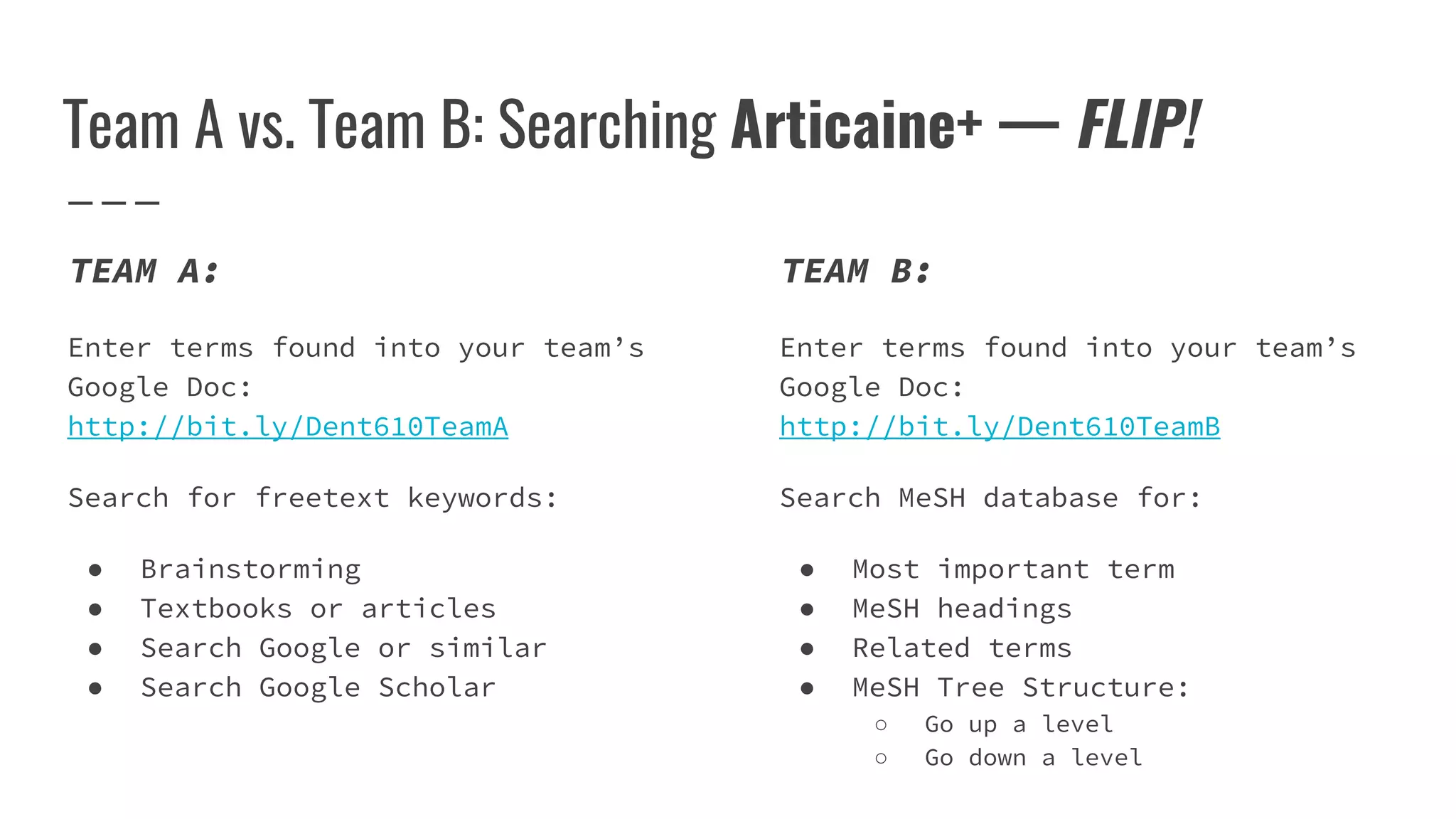
Team A vs. Team B: Searching Articaine+
TEAM A:
Enter terms found into your team’s
Google Doc:
http://bit.ly/Dent610TeamA
Search MeSH database for:
● Most important term
● MeSH headings
● Related terms
● MeSH Tree Structure:
○ Go up a level
○ Go down a level
TEAM B:
Enter terms found into your team’s
Google Doc:
http://bit.ly/Dent610TeamB
Search for freetext keywords:
● Brainstorming
● Textbooks or articles
● Search Google or similar
● Search Google Scholar
Team A vs. Team B: Searching Articaine+ — FLIP!
TEAM B:
Enter terms found into your team’s
Google Doc:
http://bit.ly/Dent610TeamB
Search MeSH database for:
● Most important term
● MeSH headings
● Related terms
● MeSH Tree Structure:
○ Go up a level
○ Go down a level
TEAM A:
Enter terms found into your team’s
Google Doc:
http://bit.ly/Dent610TeamA
Search for freetext keywords:
● Brainstorming
● Textbooks or articles
● Search Google or similar
● Search Google Scholar
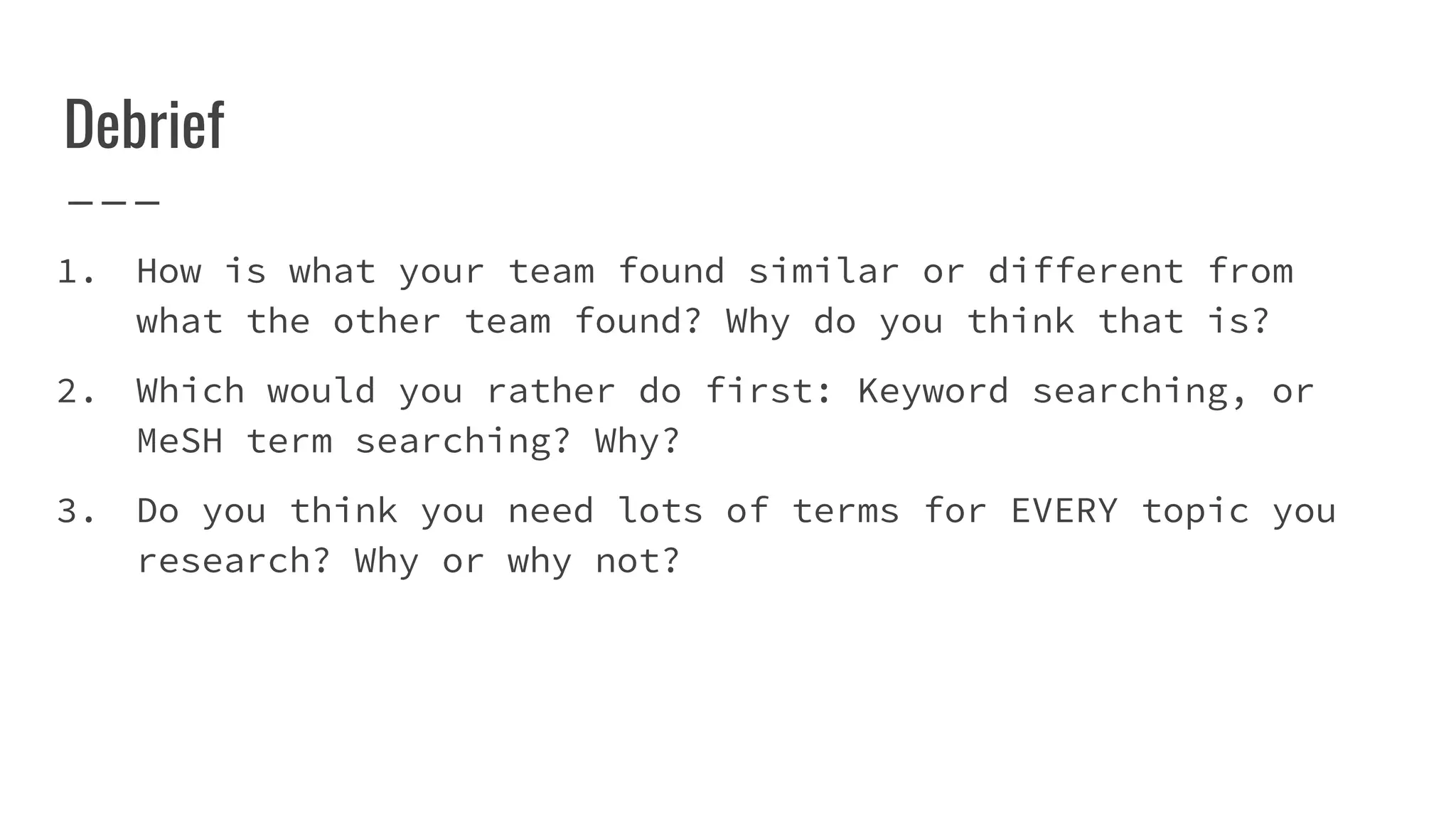
Debrief
1. How is what your team found similar or different from
what the other team found? Why do you think that is?
2. Which would you rather do first: Keyword searching, or
MeSH term searching? Why?
3. Do you think you need lots of terms for EVERY topic you
research? Why or why not?
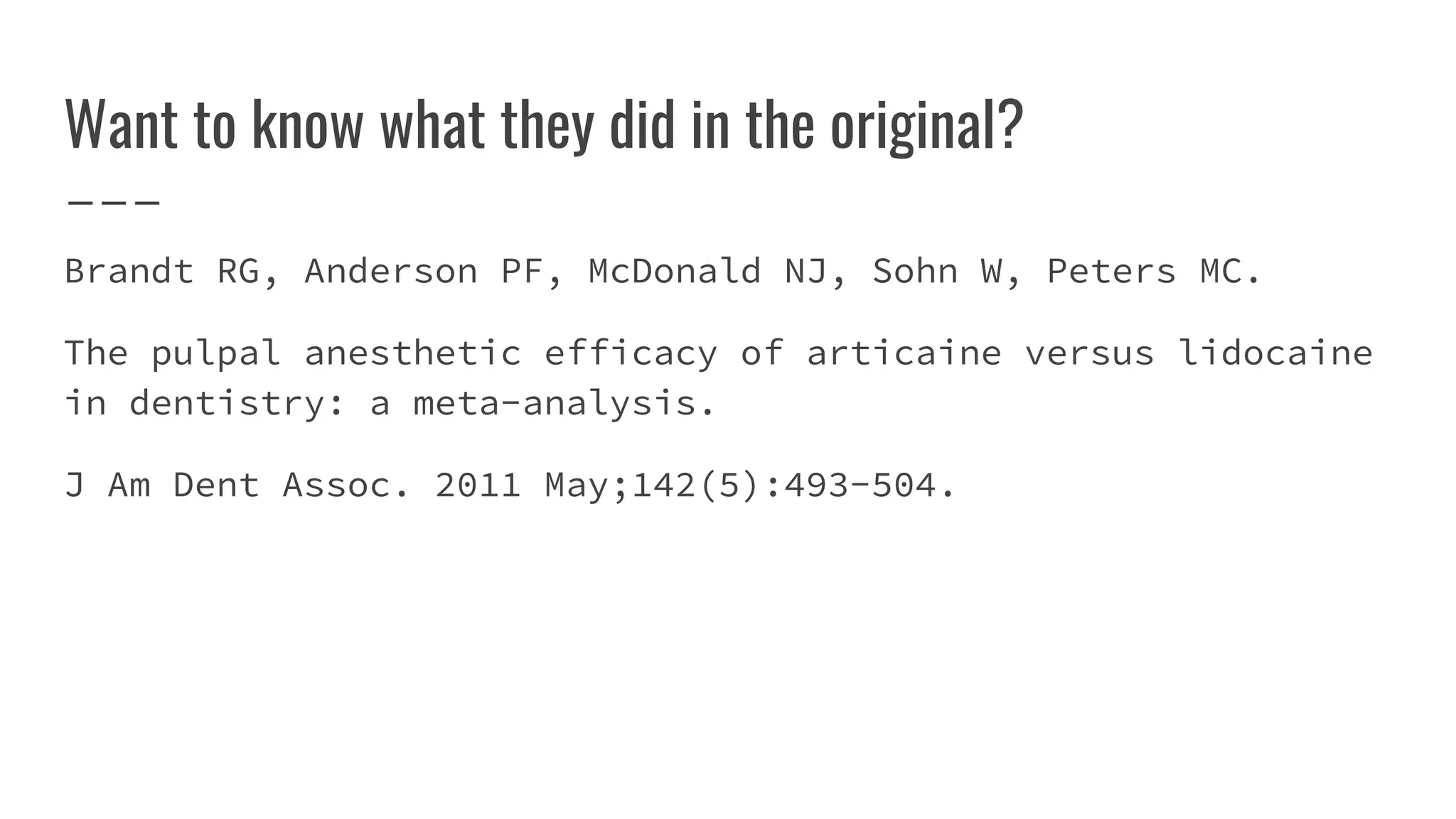
Want to know what they did in the original?
Brandt RG, Anderson PF, McDonald NJ, Sohn W, Peters MC.
The pulpal anesthetic efficacy of articaine versus lidocaine
in dentistry: a meta-analysis.
J Am Dent Assoc. 2011 May;142(5):493-504.
Sentinel Articles (vs. Seminal)
What is a Seminal Article?
Highly significant
Influential
Important
By a leader in defining the research in the field
“Key studies”
What is a Sentinel Article? (VALIDATION)
● Remember – purpose is for validating search, NOT proving
you know the best articles on the topic (that would be
seminal articles)
● On topic, not broader or narrower
● Well-indexed with appropriate terms
● Representative of citations that would be retrieved by a
well-done search
● Each sentinel article must represent ALL desired concepts
in the search
● Articles selected must meet ALL inclusion and exclusion
criteria.
Choosing Sentinel Articles
How many articles? 3-5. No more than ten.
Verify appropriateness of selected sentinels.
Neither very recent (current year) or old (before 1985)
● Articles old enough to have MeSH assigned.
● New enough to have complete indexing
MeSH Tips (What to do if there is NO HEADING)
Earlier term mappings prior to assignment of
a MeSH term are often:
● presenting symptom or diagnosis
● anatomical area
TMJD Example:
TMJD = temporomandibular joint disorder
= (Temporomandibular joint [anatomical area]
+ ("myofacial pain" OR "Bone Diseases")
[presenting symptom OR diagnosis]
Image: Frank Gaillard. Normal anatomy of the Temporomandibular joint. 14 Jan
2009. http://commons.wikimedia.org/wiki/File:Temporomandibular_joint.png
MeSH & Sentinels
Verify sentinel citations
in MEDLINE
Save file with full
citations (abstract, MeSH
headings, everything)
Make duplicate file to
process
Analyse MeSH Terms
● retain topical terms
● retain methodology terms
● retain non-MeSH terms
such as publication type
and registry numbers
(but separate from core
concept terms)
Activity: Terms
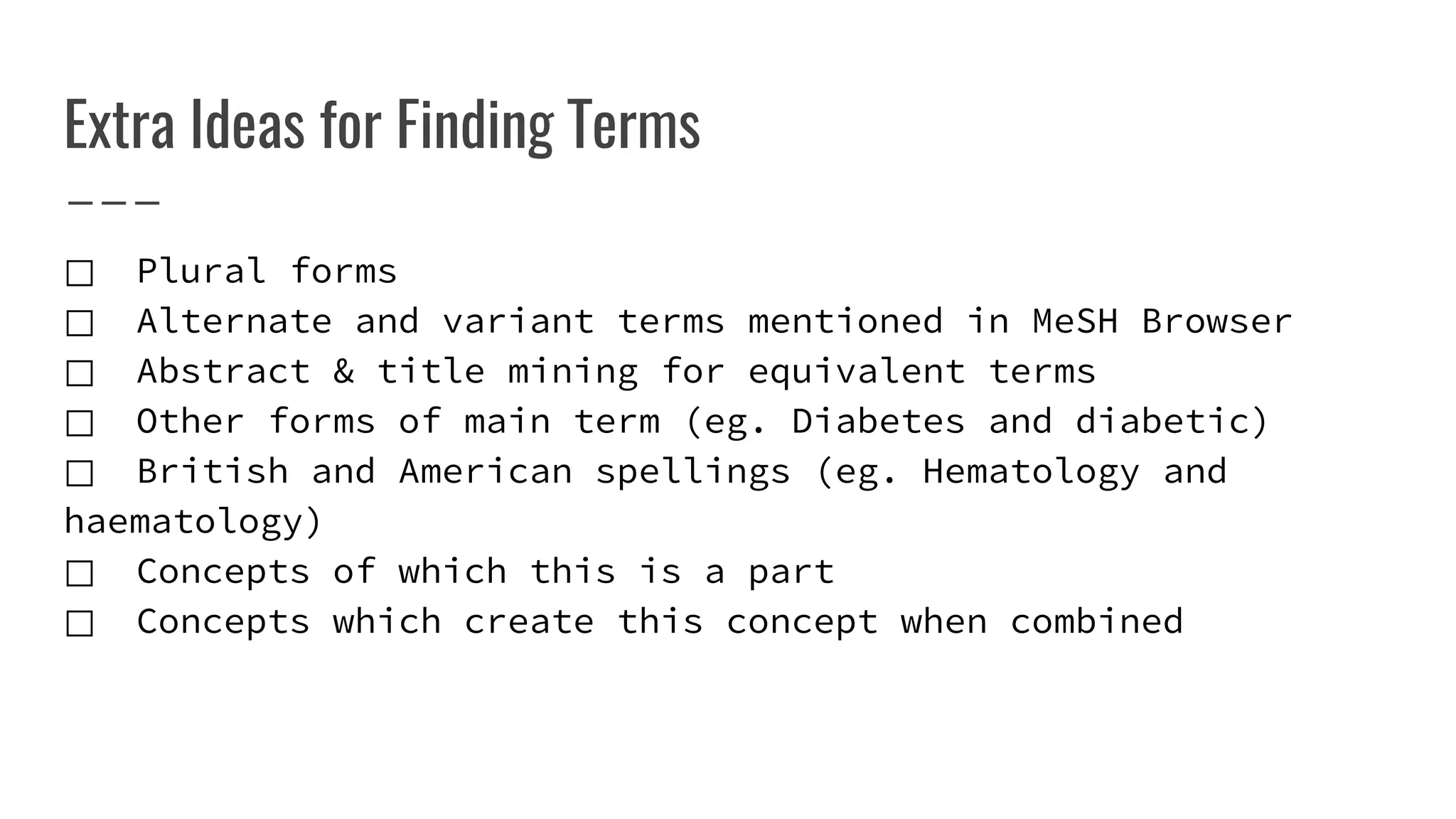
Extra Ideas for Finding Terms
⃞ Plural forms
⃞ Alternate and variant terms mentioned in MeSH Browser
⃞ Abstract & title mining for equivalent terms
⃞ Other forms of main term (eg. Diabetes and diabetic)
⃞ British and American spellings (eg. Hematology and
haematology)
⃞ Concepts of which this is a part
⃞ Concepts which create this concept when combined
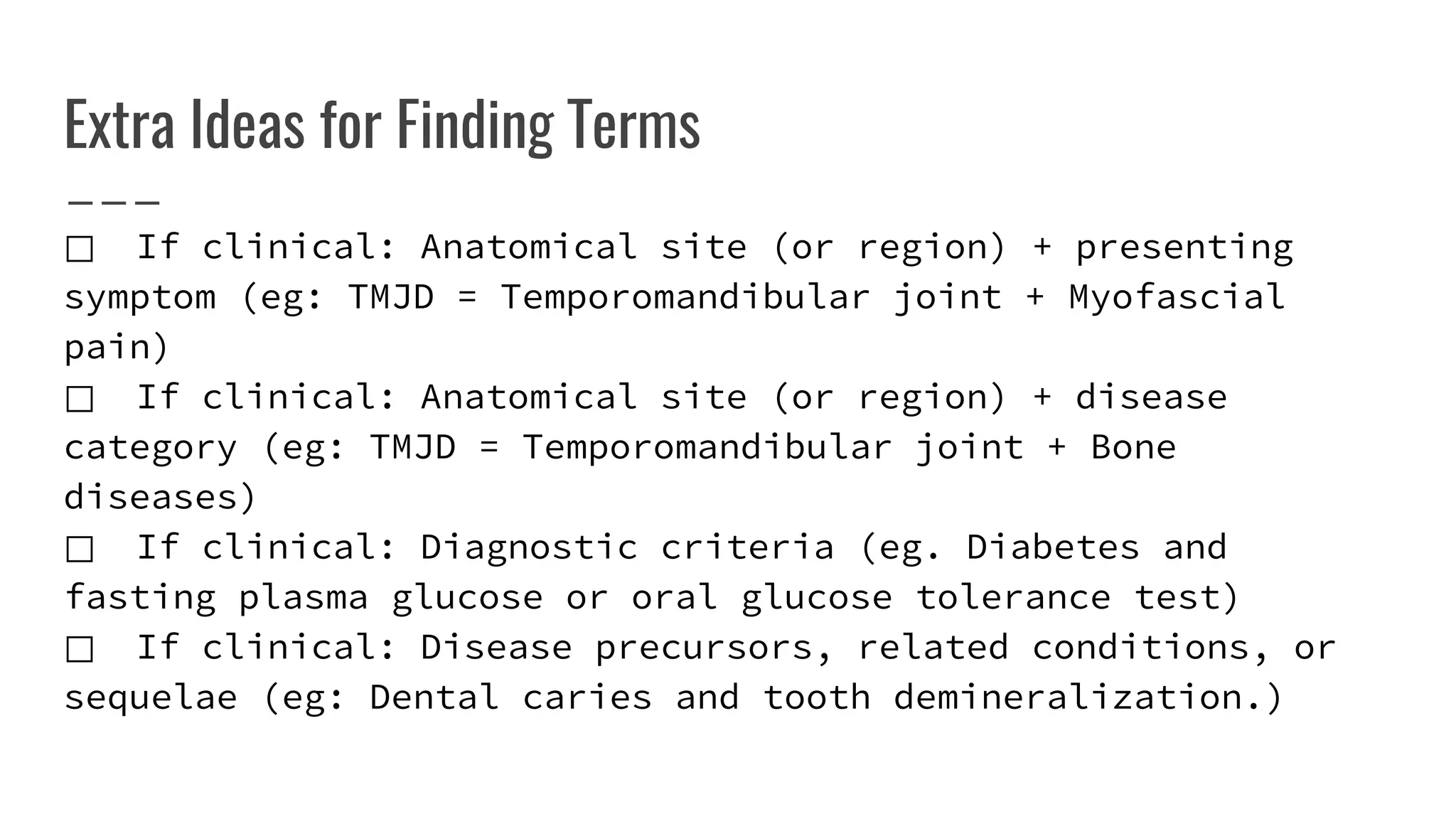
Extra Ideas for Finding Terms
⃞ If clinical: Anatomical site (or region) + presenting
symptom (eg: TMJD = Temporomandibular joint + Myofascial
pain)
⃞ If clinical: Anatomical site (or region) + disease
category (eg: TMJD = Temporomandibular joint + Bone
diseases)
⃞ If clinical: Diagnostic criteria (eg. Diabetes and
fasting plasma glucose or oral glucose tolerance test)
⃞ If clinical: Disease precursors, related conditions, or
sequelae (eg: Dental caries and tooth demineralization.)
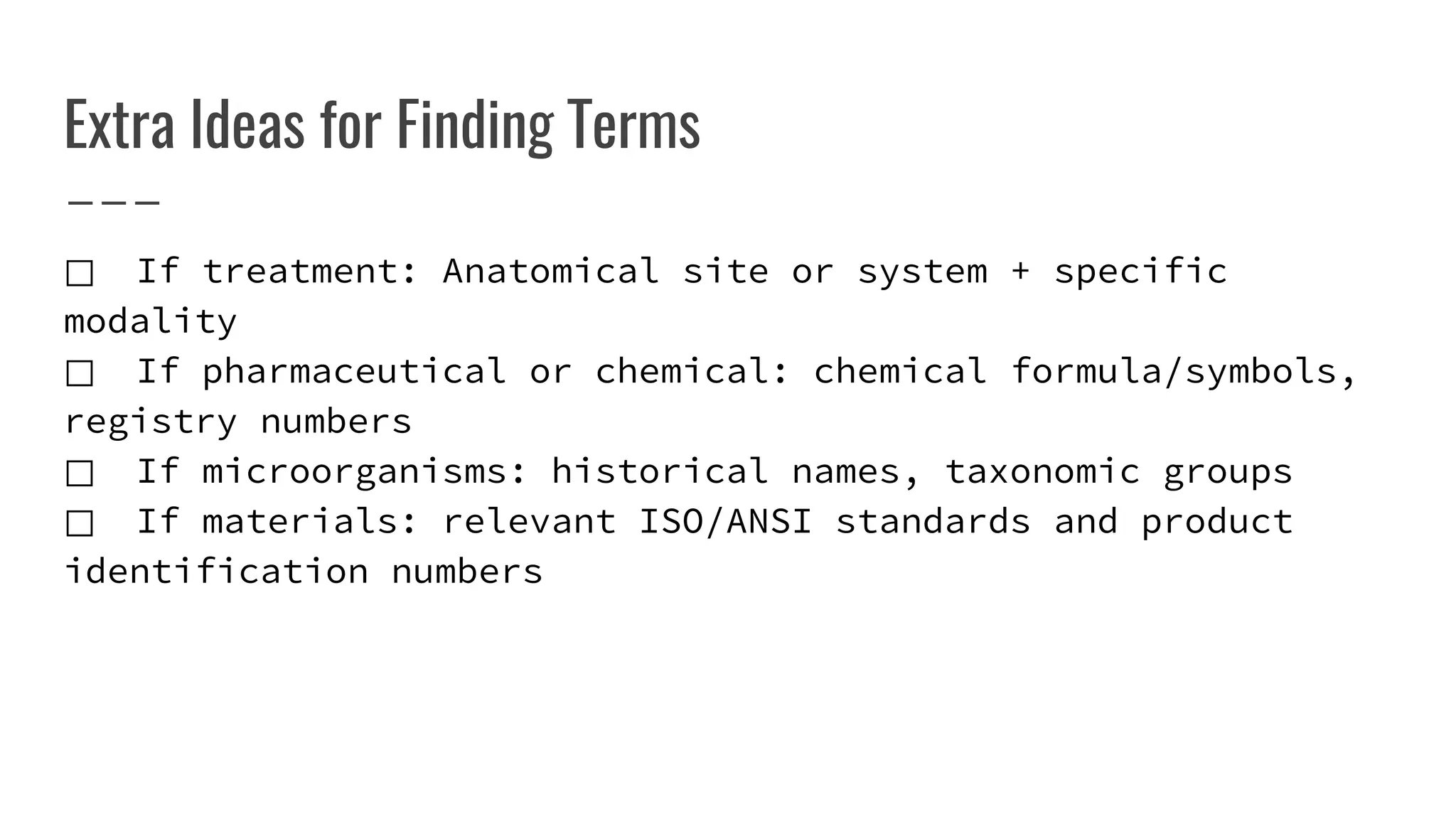
Extra Ideas for Finding Terms
⃞ If treatment: Anatomical site or system + specific
modality
⃞ If pharmaceutical or chemical: chemical formula/symbols,
registry numbers
⃞ If microorganisms: historical names, taxonomic groups
⃞ If materials: relevant ISO/ANSI standards and product
identification numbers
What Do You Think?
1. Did you find anything different from the first time?
2. Was it useful or not? How do you know?
3. Do you have ideas for other ways you might find terms?
Process, Methods, Teams
Example Process
Team meets: Define topic, overview
literature base, suggest
inclusion/exclusion criteria,
discuss methodology & timeline.
Librarian: Generates data for the
team; FRIAR/MEMORABLE/SECT
Topic experts: Review data at 3-4
levels (title, abstract, article,
[request additional information]),
achieve consensus
Handsearching (librarian generates
list, experts implement)
Determine level of evidence for
remaining research
Generate review tables
Share findings (Publication)
Strength of evidence available
(strong, weak, inadequate); suggest
directions for future research to
fill gaps in research base
Example: Cochrane Review Teams
Clinical expert(s) [2+]: Initiates, defines, selects topic.
Partner and collaborate in review to prevent bias.
Statistician: Provides methodological oversight, ensures
process quality for entire project.
Librarian: Provides methodological oversight, ensues process
quality for information search process.
Healthcare Consumer: Provides insight into the priorities
for research, information conduit for relating priorities
and findings between consumers and clinicians.
Expectations of the Librarian Role
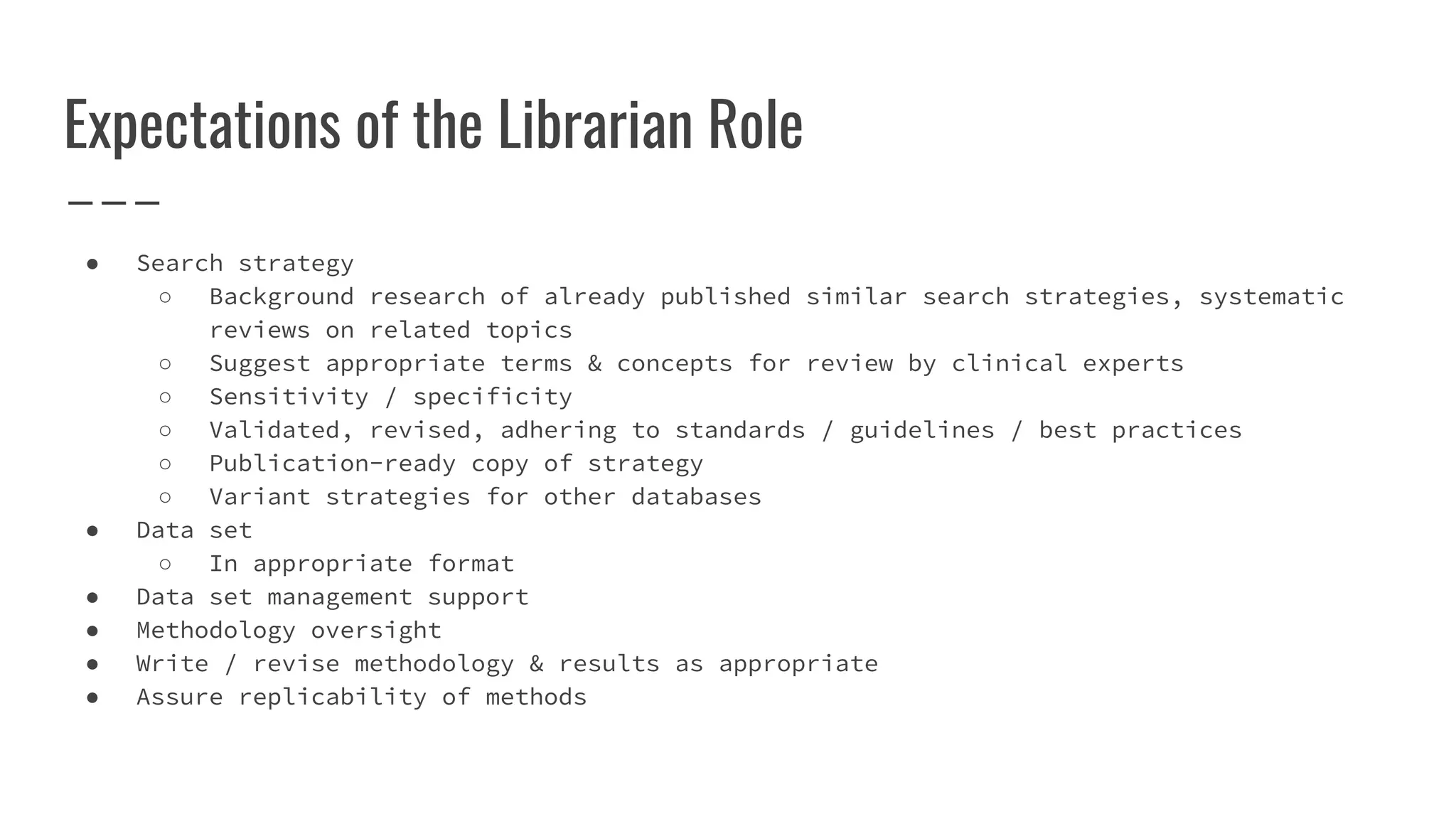
● Search strategy
○ Background research of already published similar search strategies, systematic
reviews on related topics
○ Suggest appropriate terms & concepts for review by clinical experts
○ Sensitivity / specificity
○ Validated, revised, adhering to standards / guidelines / best practices
○ Publication-ready copy of strategy
○ Variant strategies for other databases
● Data set
○ In appropriate format
● Data set management support
● Methodology oversight
● Write / revise methodology & results as appropriate
● Assure replicability of methods
Standard Team Process vs. Reality
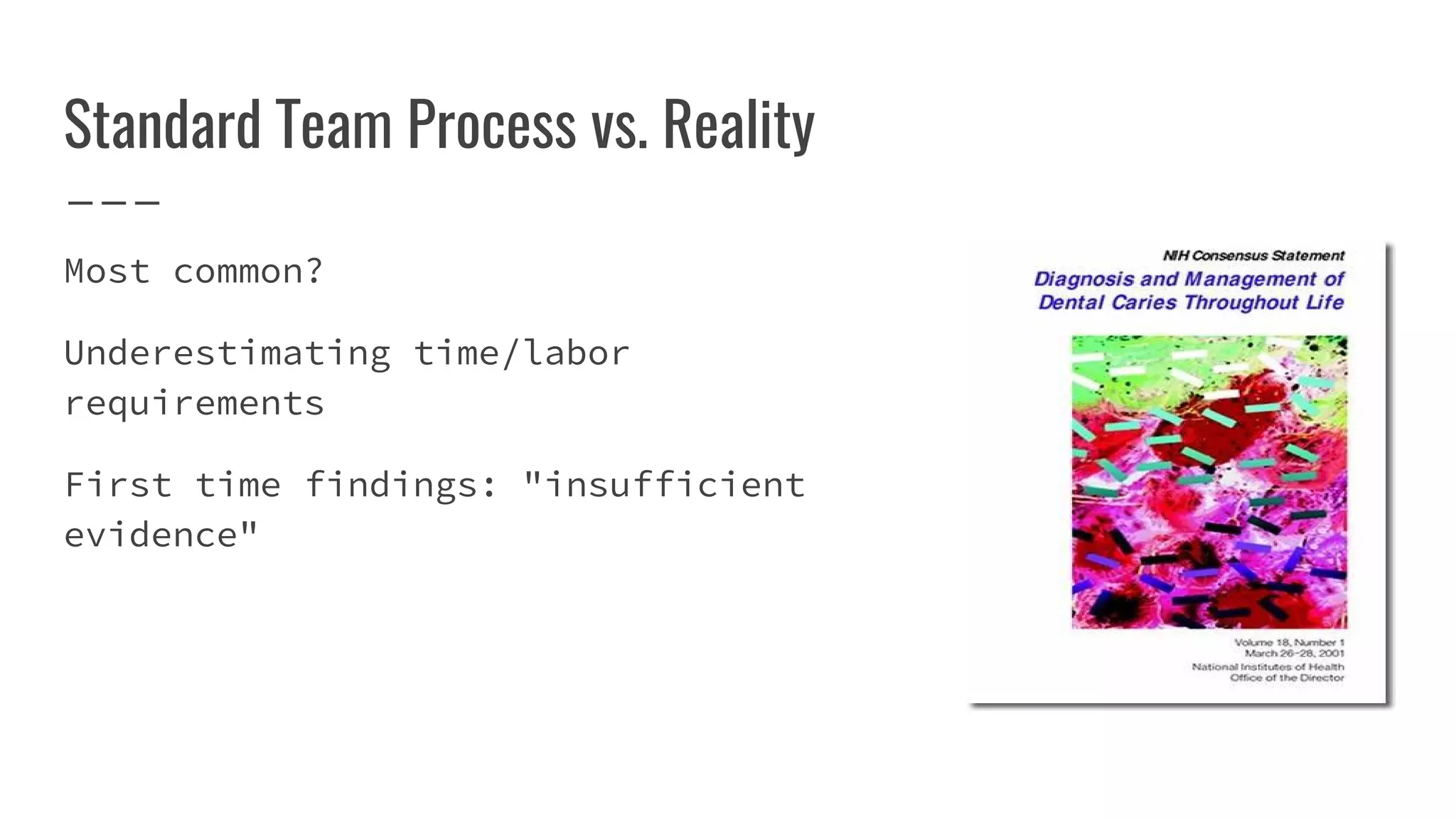
Most common?
Underestimating time/labor
requirements
First time findings: "insufficient
evidence"
Build-A-Search
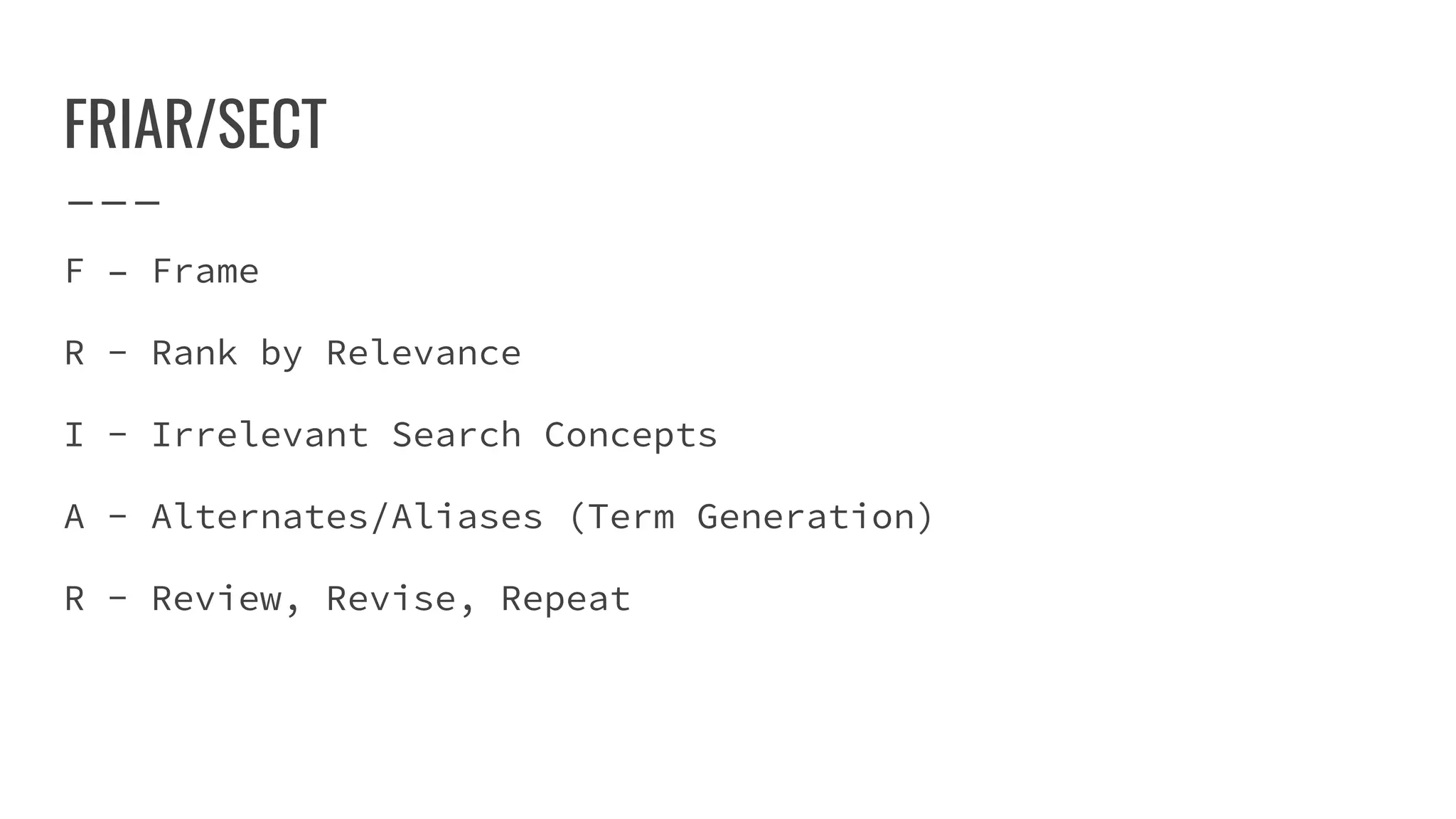
FRIAR/SECT
F – Frame
R - Rank by Relevance
I - Irrelevant Search Concepts
A - Alternates/Aliases (Term Generation)
R - Review, Revise, Repeat
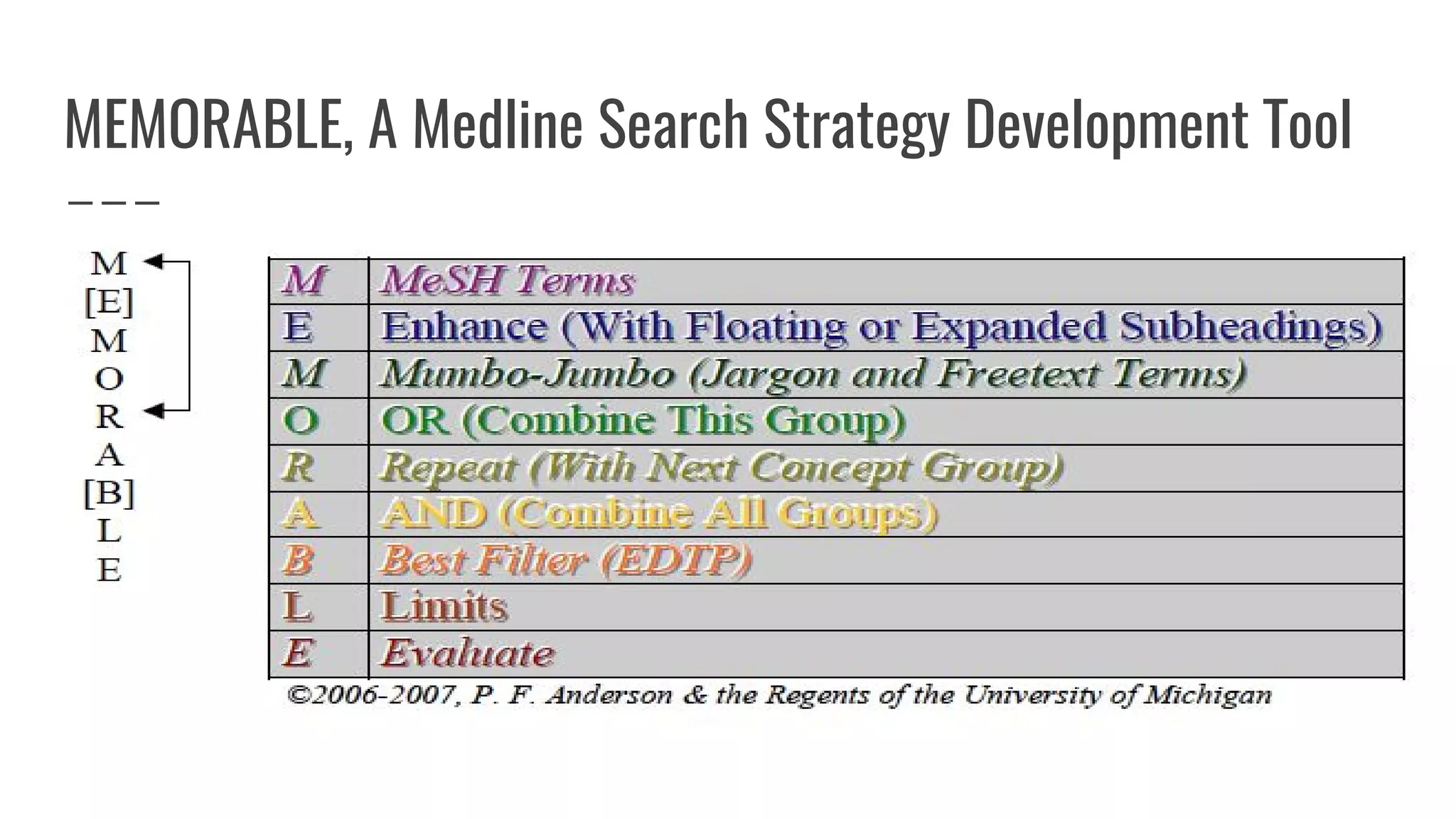
MEMORABLE, A Medline Search Strategy Development Tool
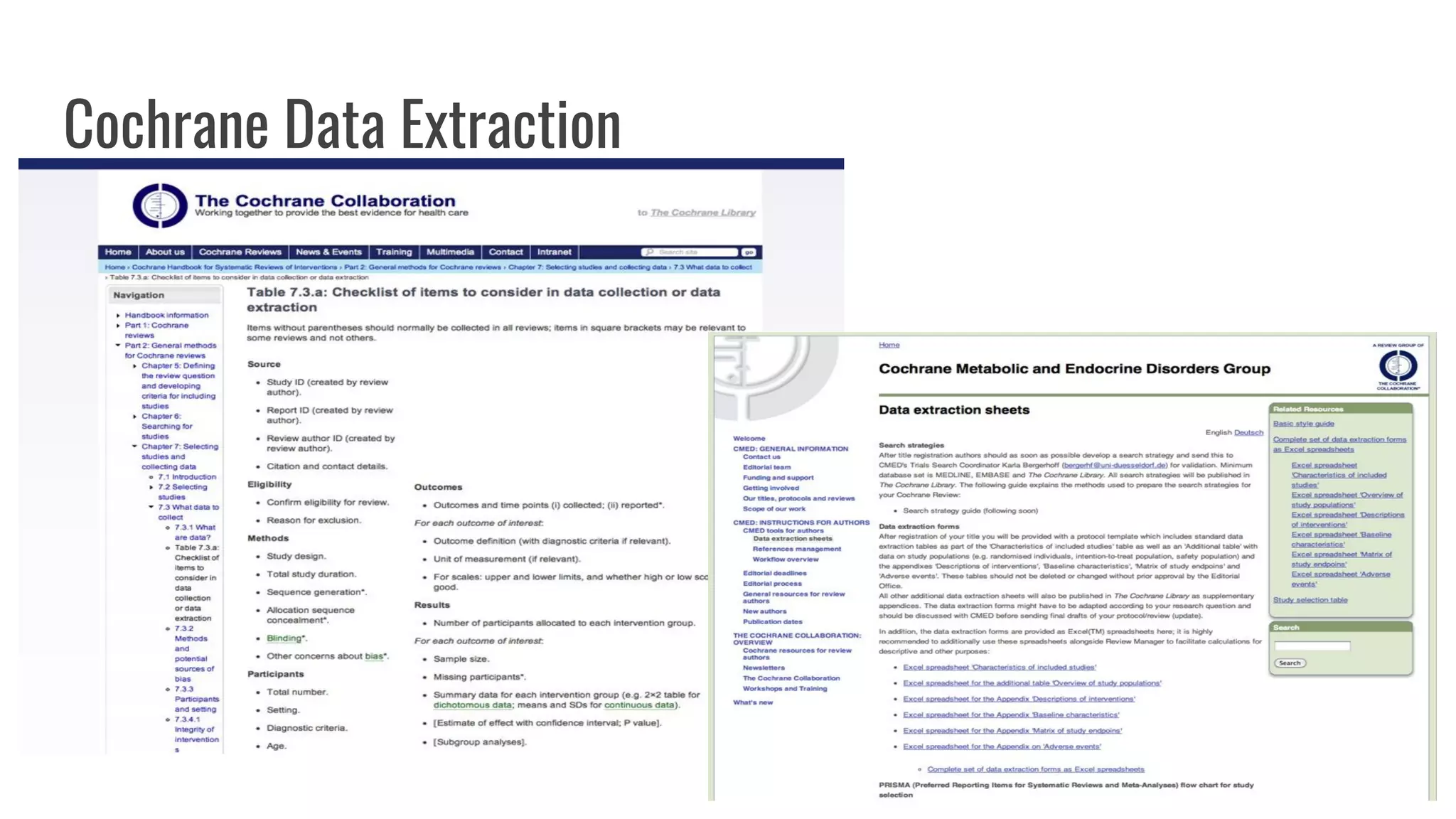
Data Extraction
Cochrane Data Extraction
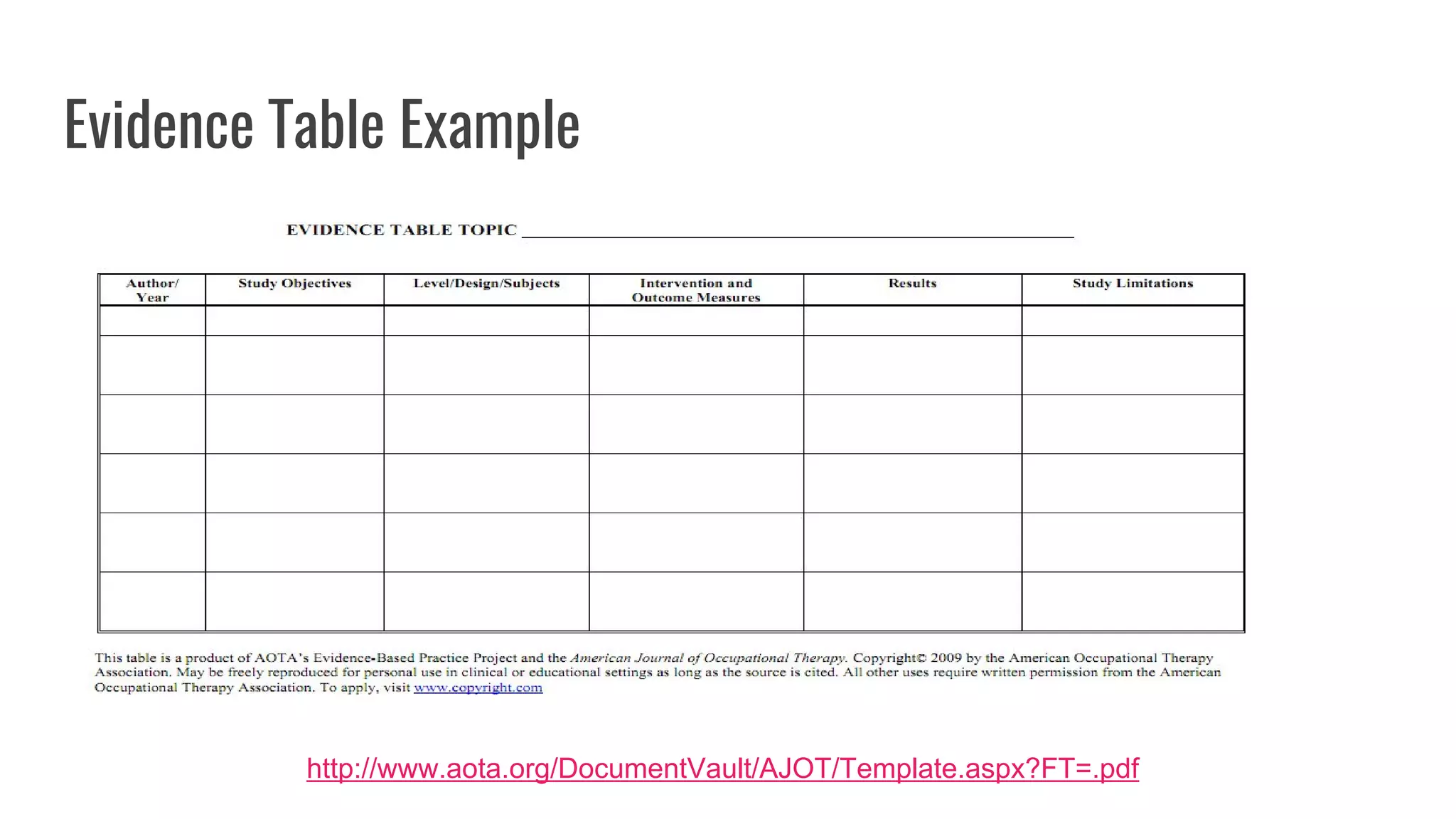
Evidence Table Example
● Levels of evidence
● Participant
characteristics
● Study
characteristics
● Intervention and
outcome
measurements
● Results
● Study limitations
● Inclusion/Exclusion
criteria
http://www.aota.org/DocumentVault/AJOT/Template.aspx?FT=.pdf
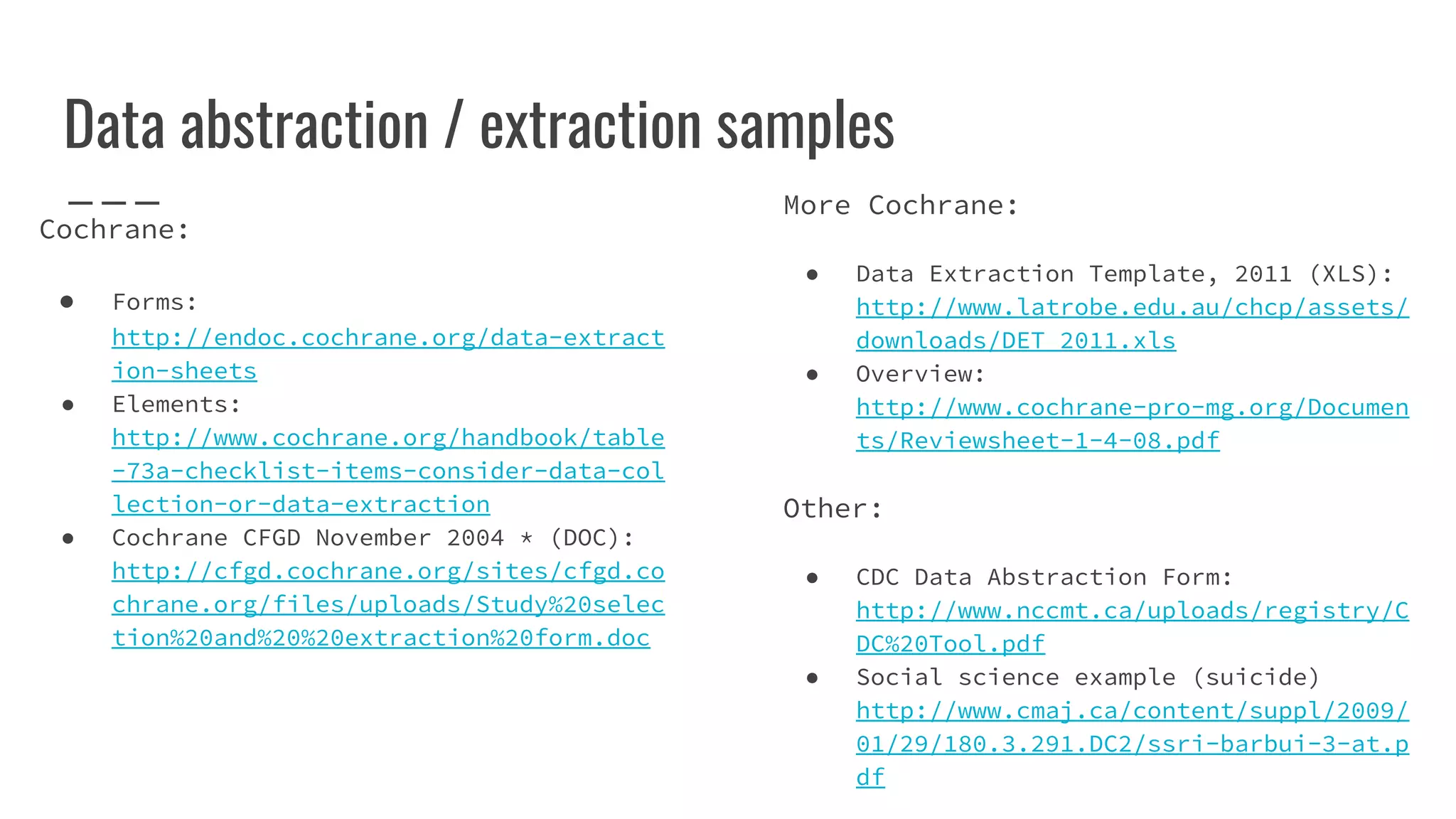
Data abstraction / extraction samples
Cochrane:
● Forms:
http://endoc.cochrane.org/data-extract
ion-sheets
● Elements:
http://www.cochrane.org/handbook/table
-73a-checklist-items-consider-data-col
lection-or-data-extraction
● Cochrane CFGD November 2004 * (DOC):
http://cfgd.cochrane.org/sites/cfgd.co
chrane.org/files/uploads/Study%20selec
tion%20and%20%20extraction%20form.doc
More Cochrane:
● Data Extraction Template, 2011 (XLS):
http://www.latrobe.edu.au/chcp/assets/
downloads/DET_2011.xls
● Overview:
http://www.cochrane-pro-mg.org/Documen
ts/Reviewsheet-1-4-08.pdf
Other:
● CDC Data Abstraction Form:
http://www.nccmt.ca/uploads/registry/C
DC%20Tool.pdf
● Social science example (suicide)
http://www.cmaj.ca/content/suppl/2009/
01/29/180.3.291.DC2/ssri-barbui-3-at.p
df
Other Resources
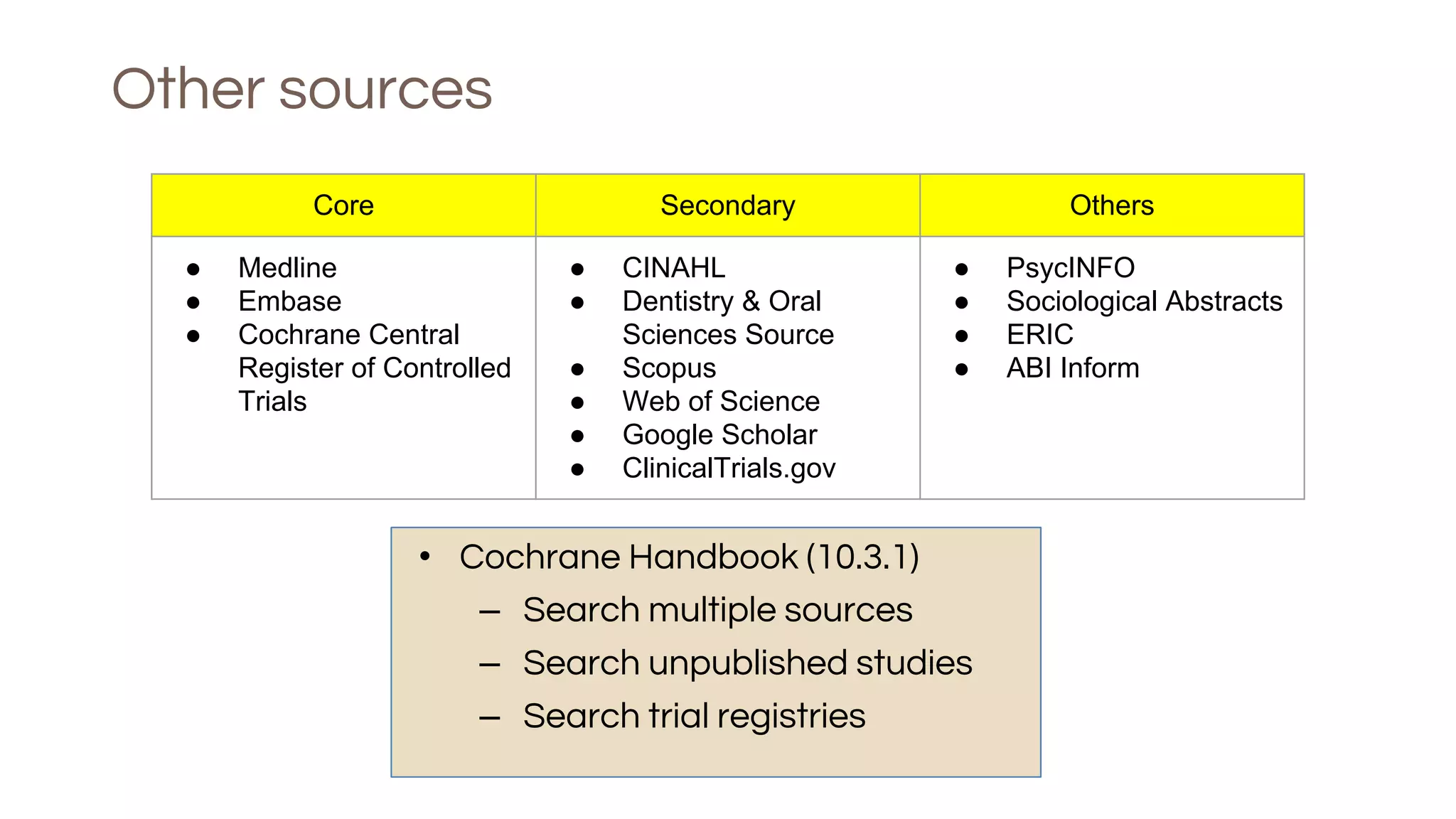
Other sources
Core Secondary Others
● Medline
● Embase
● Cochrane Central
Register of Controlled
Trials
● CINAHL
● Dentistry & Oral
Sciences Source
● Scopus
● Web of Science
● Google Scholar
● ClinicalTrials.gov
● PsycINFO
● Sociological Abstracts
● ERIC
● ABI Inform
• Cochrane Handbook (10.3.1)
– Search multiple sources
– Search unpublished studies
– Search trial registries
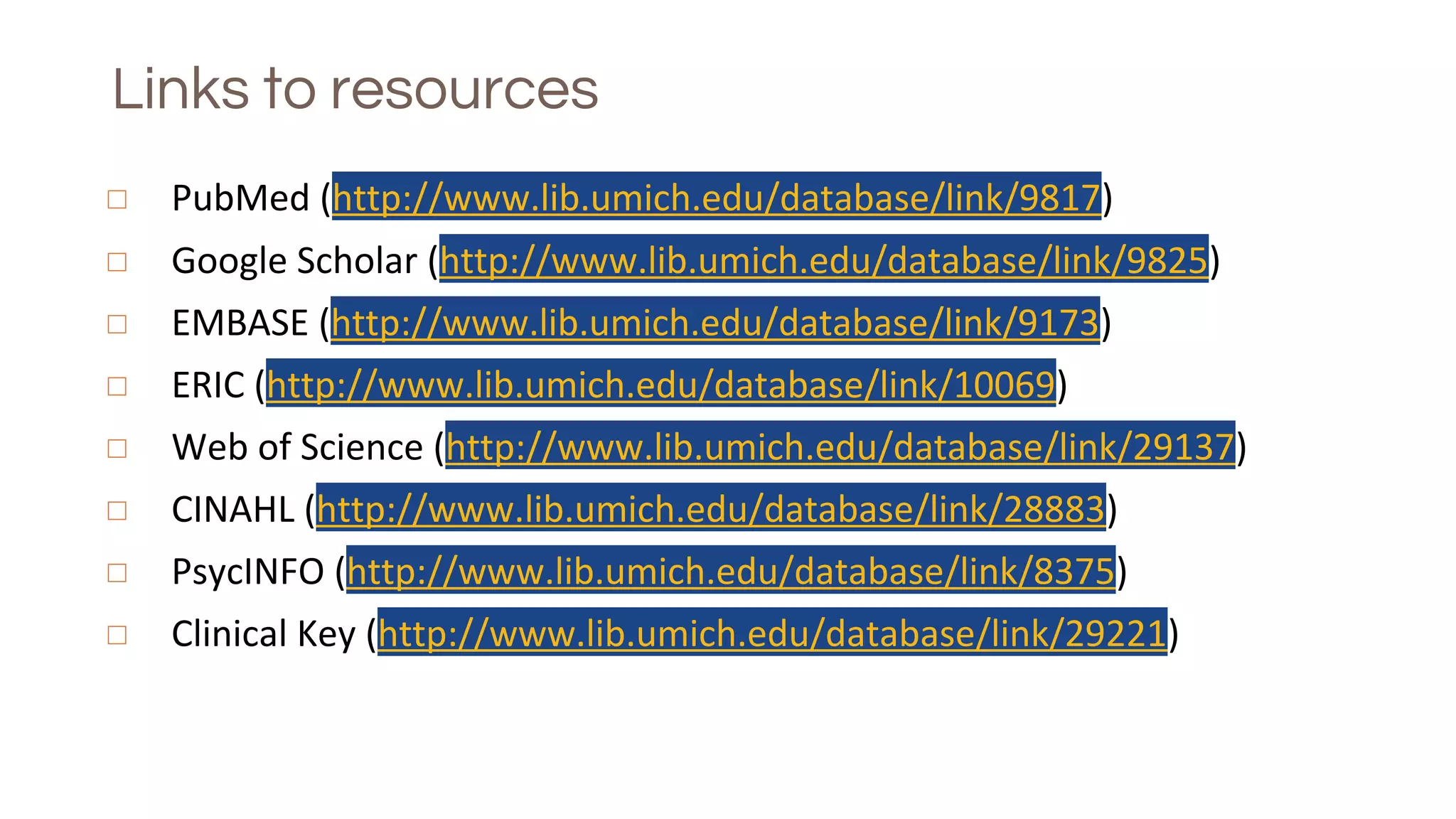
Links to resources
◻ PubMed (http://www.lib.umich.edu/database/link/9817)
◻ Google Scholar (http://www.lib.umich.edu/database/link/9825)
◻ EMBASE (http://www.lib.umich.edu/database/link/9173)
◻ ERIC (http://www.lib.umich.edu/database/link/10069)
◻ Web of Science (http://www.lib.umich.edu/database/link/29137)
◻ CINAHL (http://www.lib.umich.edu/database/link/28883)
◻ PsycINFO (http://www.lib.umich.edu/database/link/8375)
◻ Clinical Key (http://www.lib.umich.edu/database/link/29221)
Documenting / Reporting
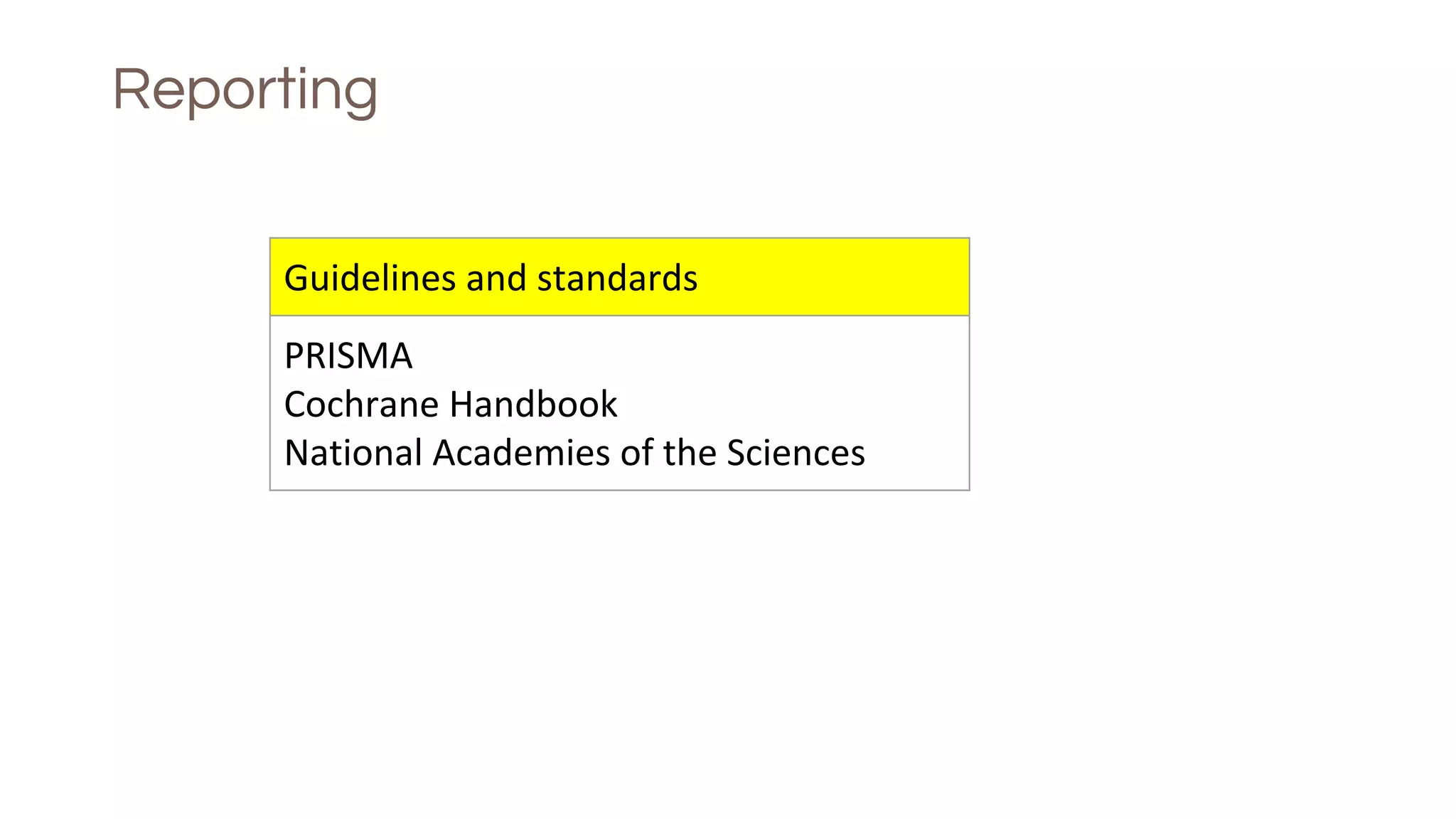
Reporting
Guidelines and standards
PRISMA
Cochrane Handbook
National Academies of the Sciences
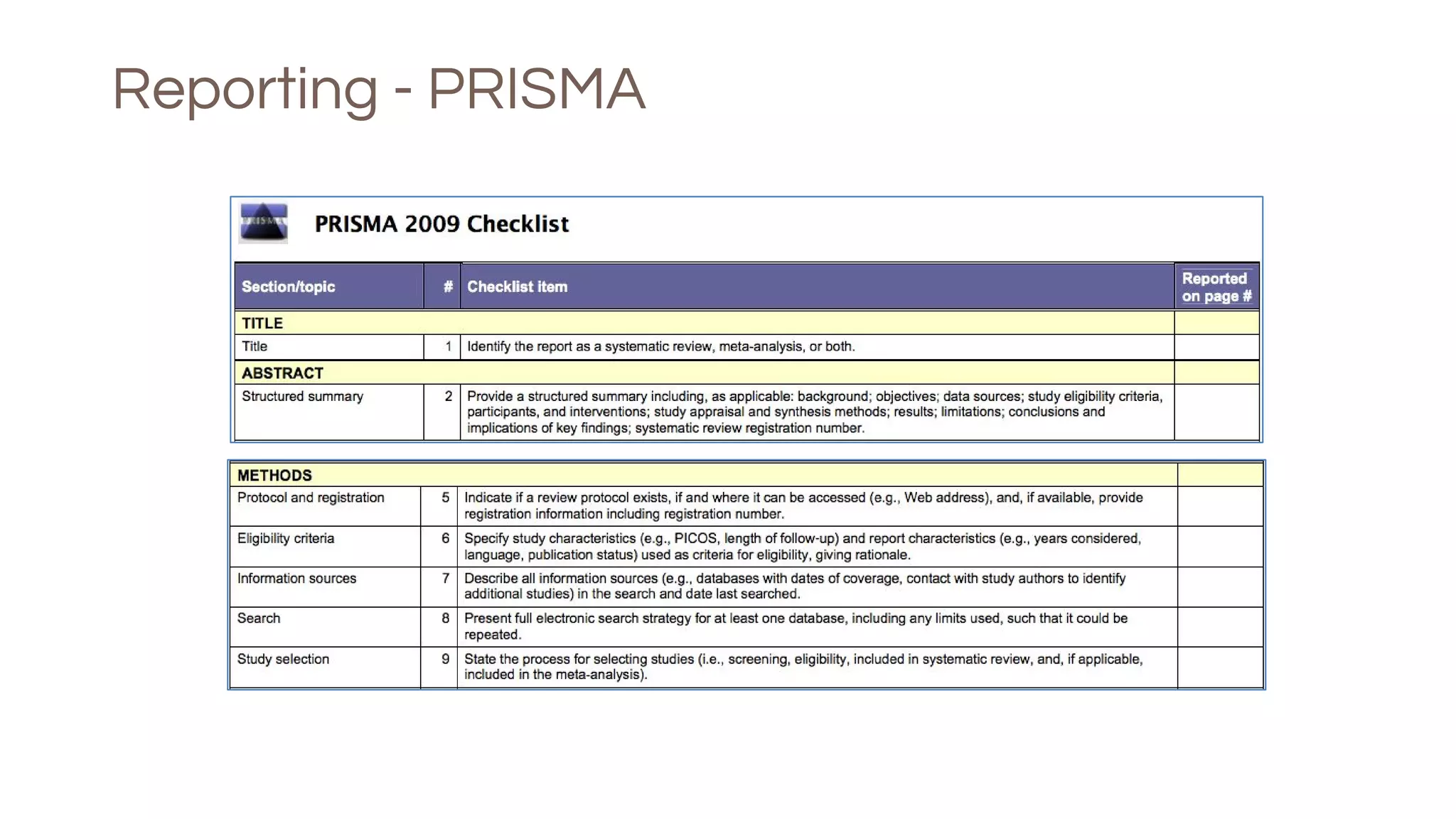
Reporting - PRISMA
Reporting - Cochrane Handbook
◻ See Cochrane Handbook
■ http://handbook-5-1.cochrane.org/
■ Section 6.6
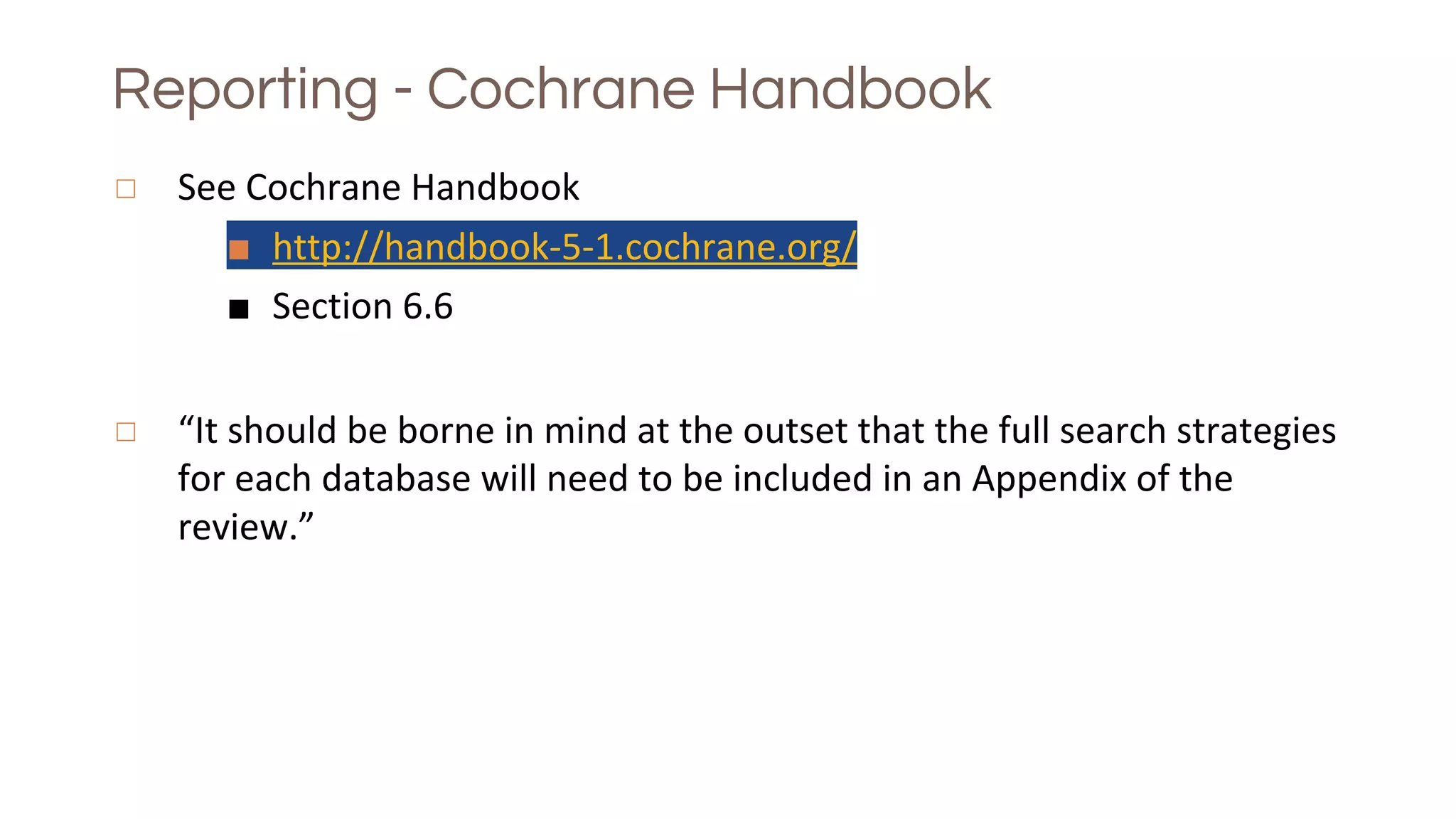
◻ “It should be borne in mind at the outset that the full search strategies
for each database will need to be included in an Appendix of the
review.”
Reporting - Cochrane Handbook
◻ See Cochrane Handbook
■ http://handbook-5-1.cochrane.org/
■ Section 6.6
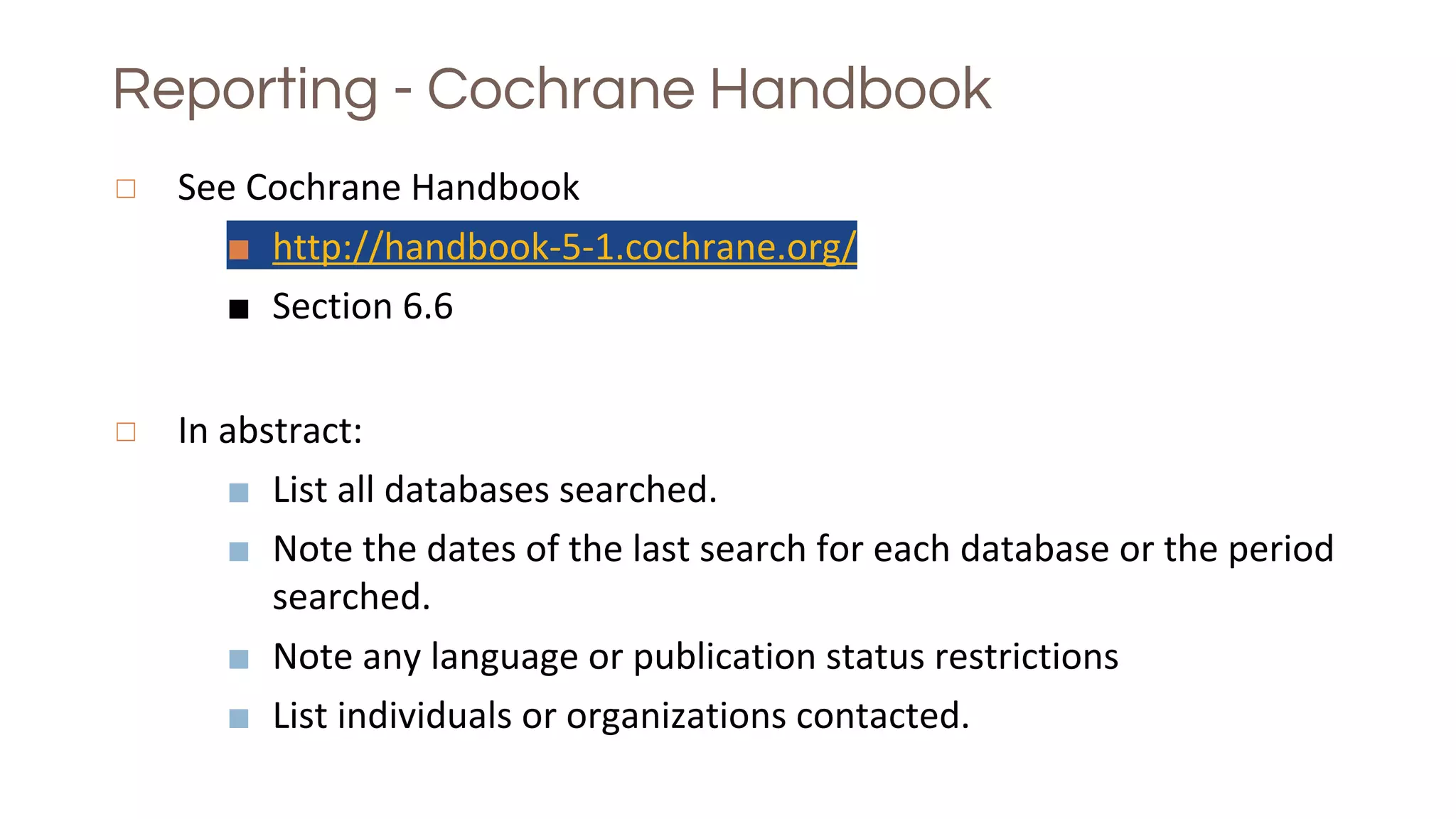
◻ In abstract:
■ List all databases searched.
■ Note the dates of the last search for each database or the period
searched.
■ Note any language or publication status restrictions
■ List individuals or organizations contacted.
Reporting - Cochrane Handbook
◻ See Cochrane Handbook
■ http://handbook-5-1.cochrane.org/
■ Section 6.6
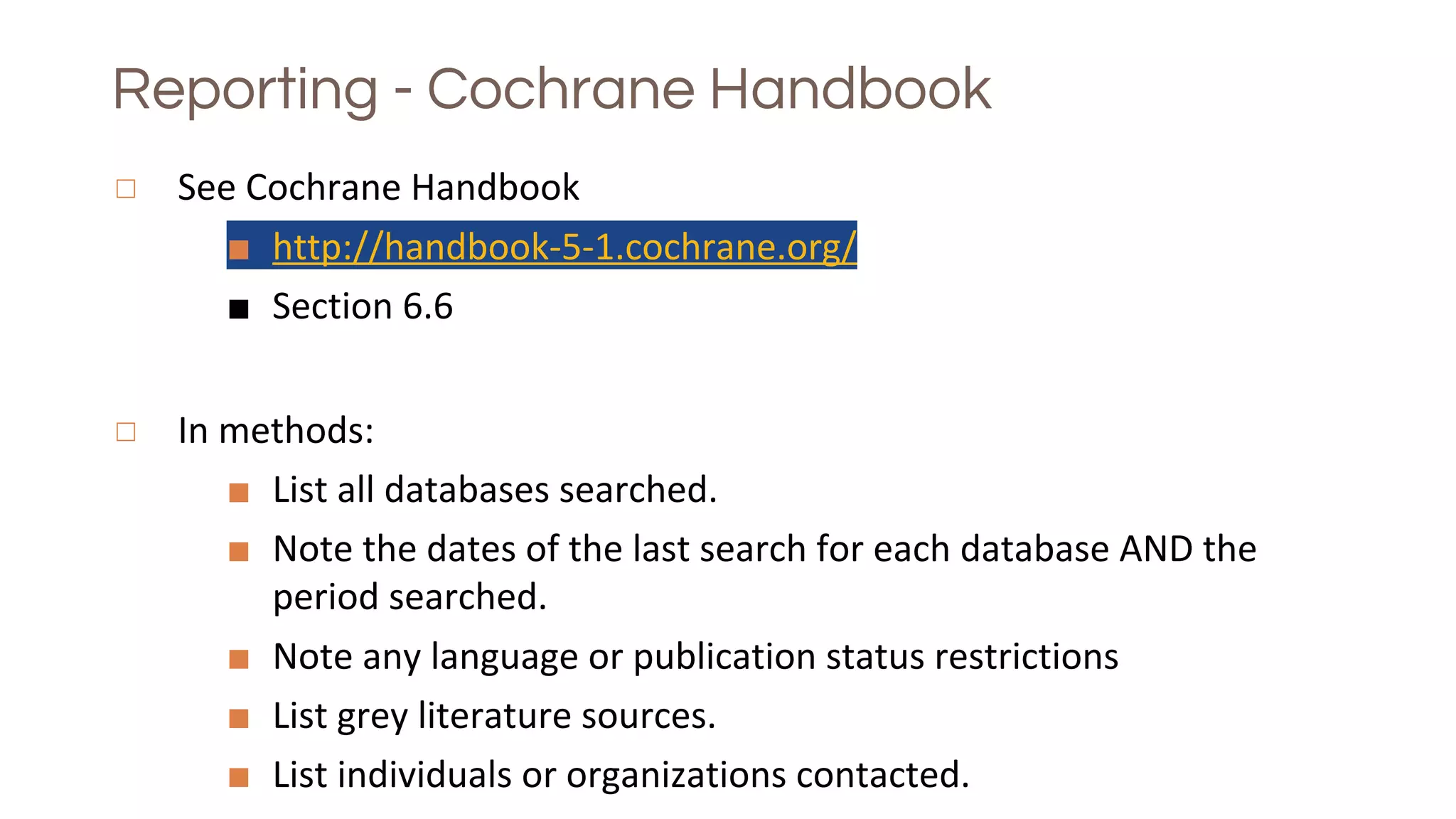
◻ In methods:
■ List all databases searched.
■ Note the dates of the last search for each database AND the
period searched.
■ Note any language or publication status restrictions
■ List grey literature sources.
■ List individuals or organizations contacted.
Reporting - Cochrane Handbook
◻ See Cochrane Handbook
■ http://handbook-5-1.cochrane.org/
■ Section 6.6
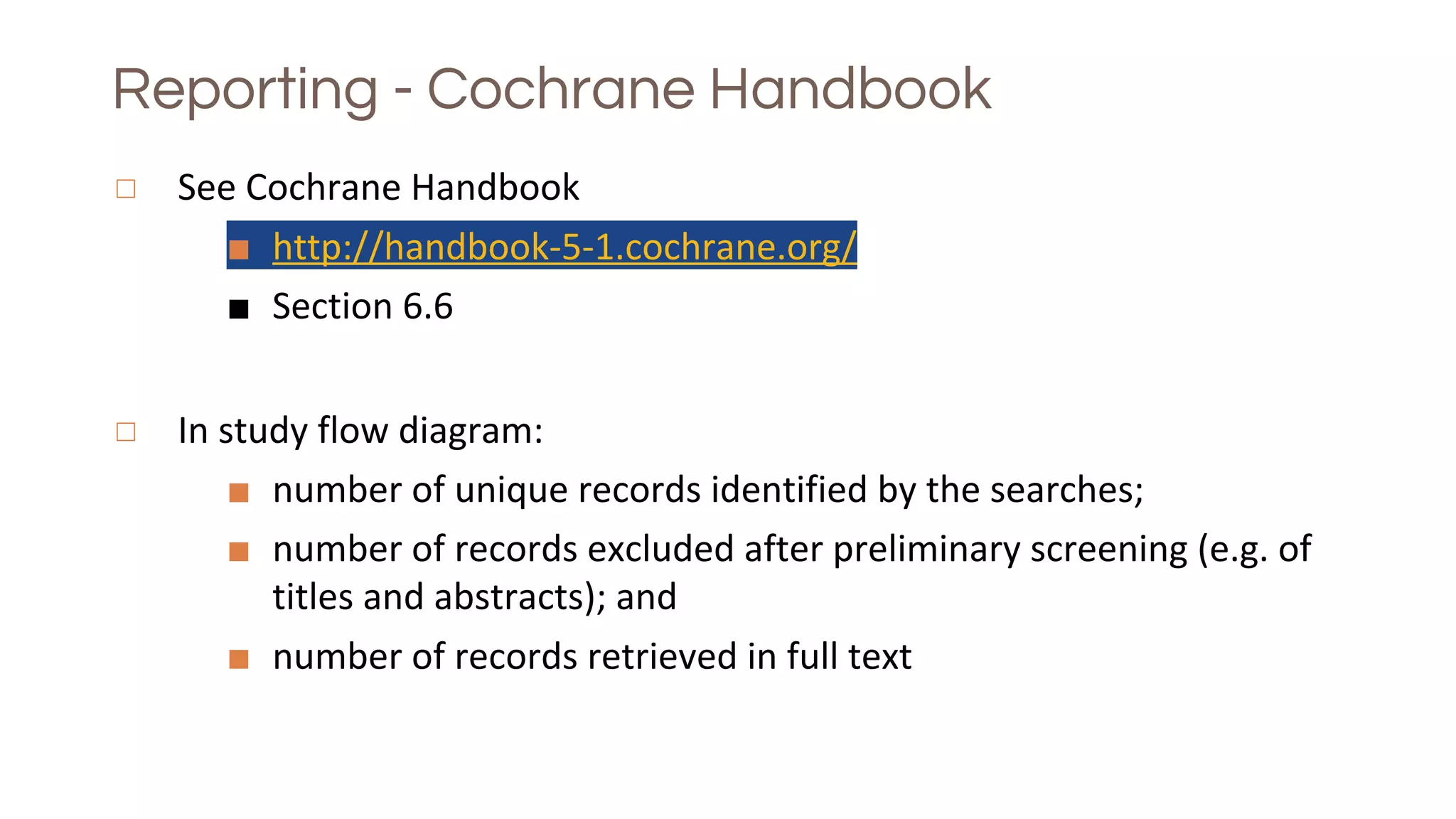
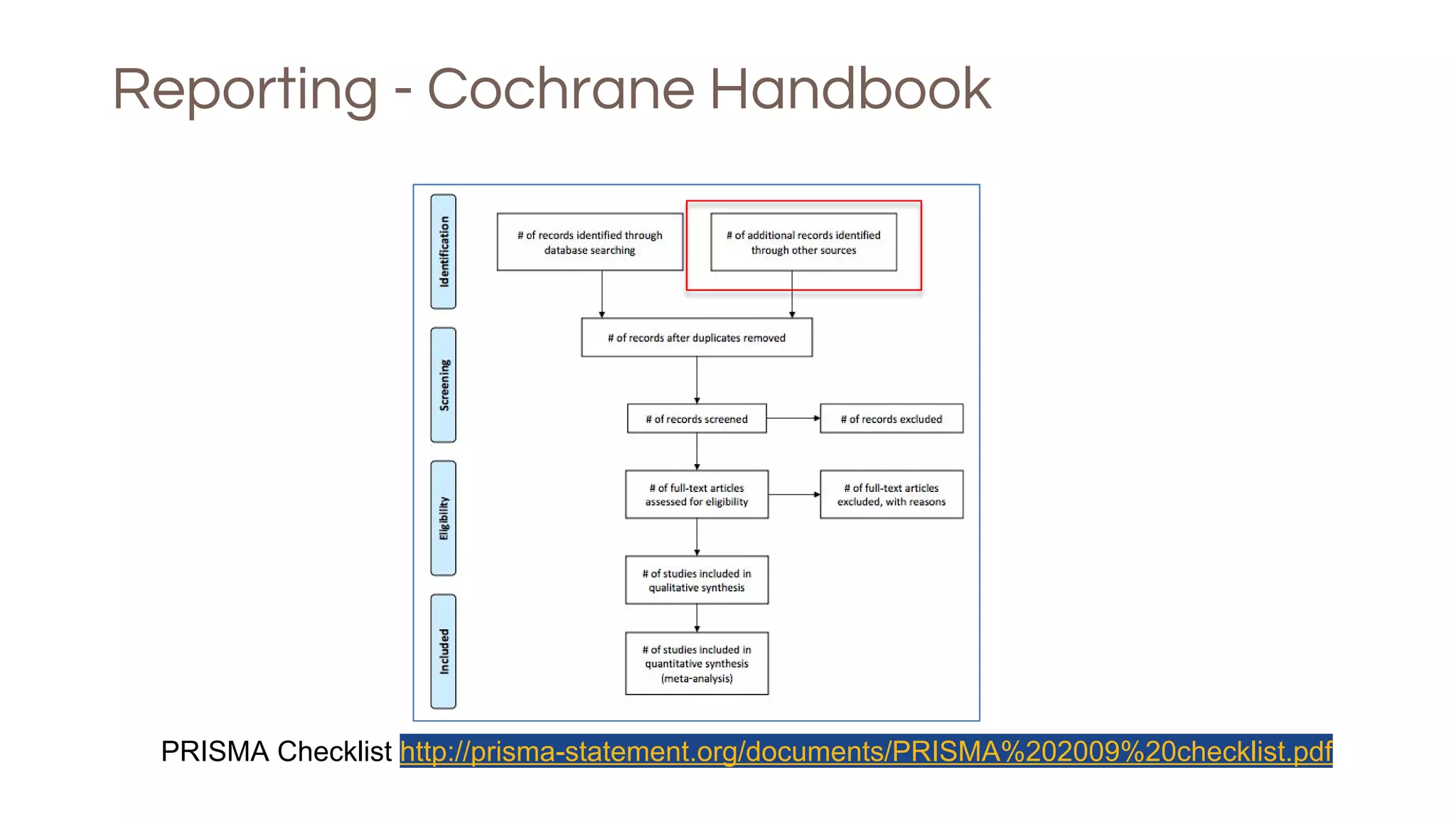
◻ In study flow diagram:
■ number of unique records identified by the searches;
■ number of records excluded after preliminary screening (e.g. of
titles and abstracts); and
■ number of records retrieved in full text
Reporting - Cochrane Handbook
PRISMA Checklist http://prisma-statement.org/documents/PRISMA%202009%20checklist.pdf
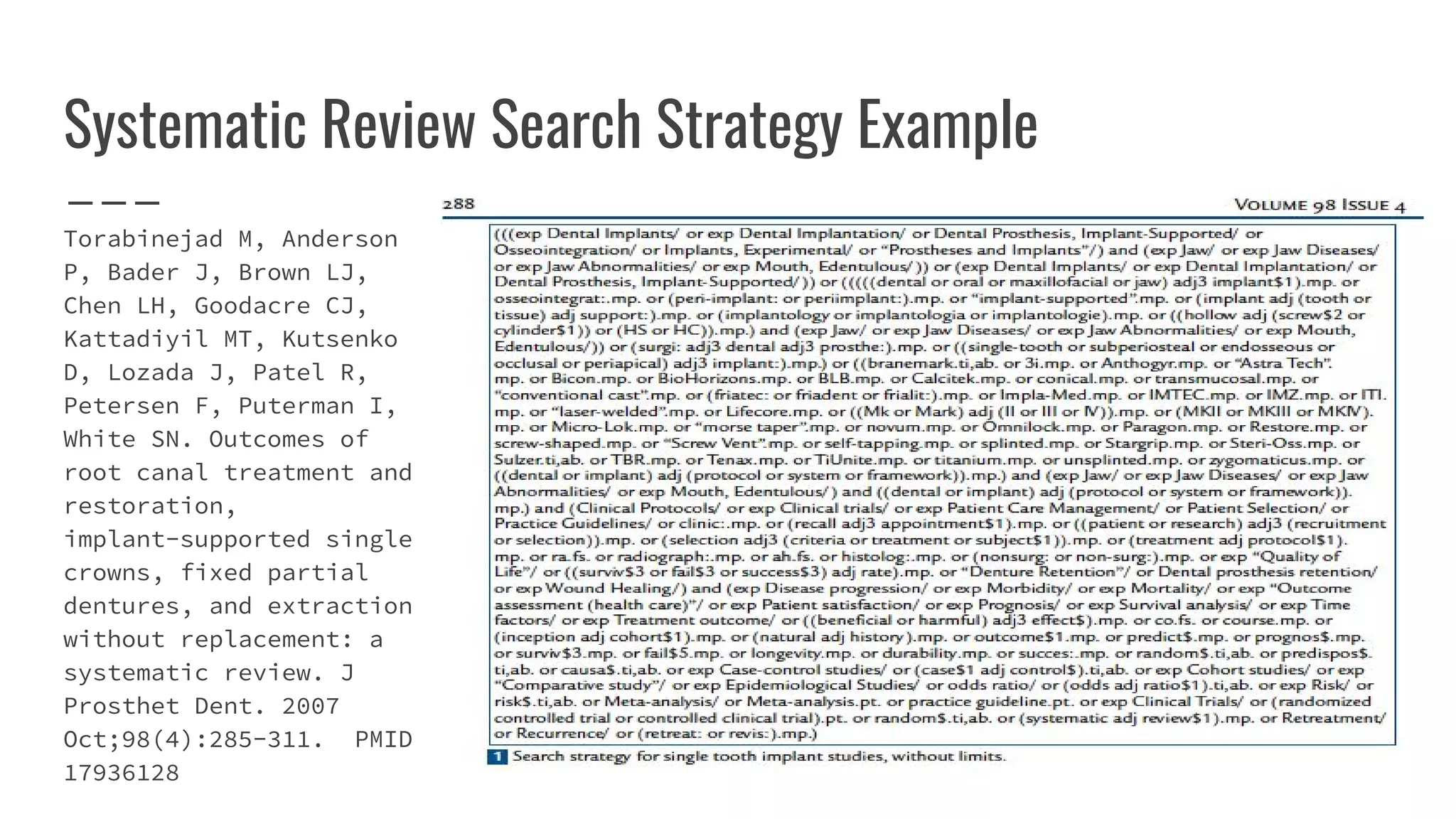
Systematic Review Search Strategy Example
Torabinejad M, Anderson
P, Bader J, Brown LJ,
Chen LH, Goodacre CJ,
Kattadiyil MT, Kutsenko
D, Lozada J, Patel R,
Petersen F, Puterman I,
White SN. Outcomes of
root canal treatment and
restoration,
implant-supported single
crowns, fixed partial
dentures, and extraction
without replacement: a
systematic review. J
Prosthet Dent. 2007
Oct;98(4):285-311. PMID:
17936128
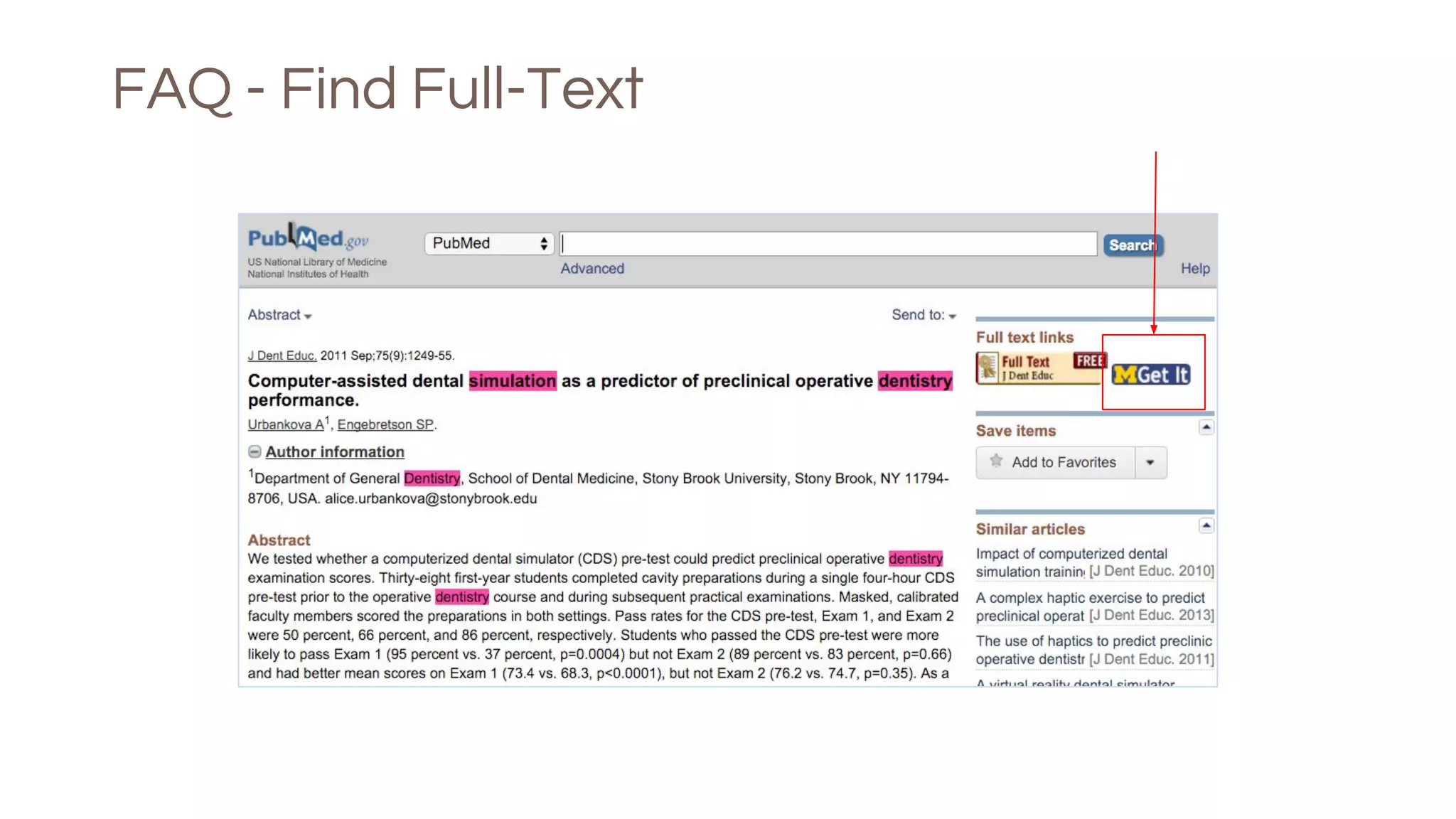
FAQ - Find Full-Text
FAQ - Save searches
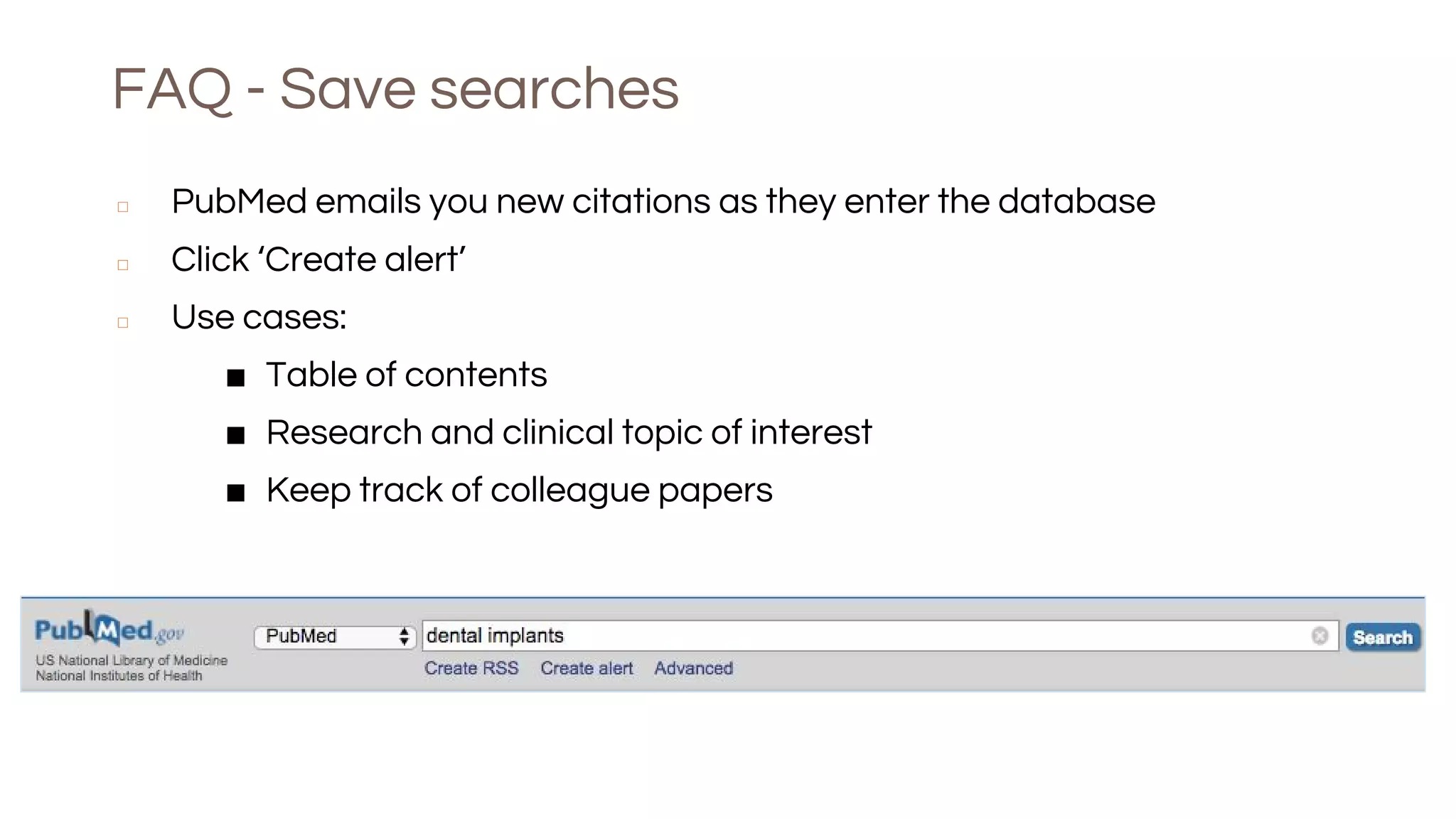
◻ PubMed emails you new citations as they enter the database
◻ Click ‘Create alert’
◻ Use cases:
■ Table of contents
■ Research and clinical topic of interest
■ Keep track of colleague papers
Slides at: http://slideshare.net/umhealthscienceslibraries/
Session guide: http://guides.lib.umich.edu/dent610
Contact:
Mark MacEachern: markmac@umich.edu
Patricia F. Anderson: pfa@umich.edu
Tyler Nix: tnix@umich.edu

Methods: Searching & Systematic Reviews

  • 1.
    Systematic Review Processes,Teams,& Experiences Methods: Searching & Systematic Reviews Mark MacEachern & PF Anderson; October 31, 2017 For Dentistry 610; University of Michigan
  • 2.
  • 3.
    Objectives ◻ Understand theimportance of literature searches ◻ Learn how to construct effective searches for clinical and research projects ◻ Learn reporting and citation management strategies and resources
  • 4.
    Why is itimportant to search well? ◻ Support evidence-based decision-making ◻ Avoid biases in research projects and clinical decisions ◻ Missed studies can undermine clinical decisions and research findings ◻ Save yourself time by leveraging resource features ◻ Keep current on new trends, developments
  • 5.
    Evidence Pyramid Source: SackettDL. Evidence-based medicine: how to practice and teach EBM.
  • 6.
  • 7.
    What to expect? ◻Expect the search to be iterative ◻ Expect 1000s of results ◻ Expect to search multiple databases ◻ EMBASE, PubMed, ERIC, PsycINFO, etc. ◻ Expect the search process to take awhile ◻ Expect to publish search strategy and search methodology ◻ Expect to consult someone with appropriate search expertise
  • 8.
    Search construction 1. Identifysearch terms 2. Use Boolean 3. Use combination of keywords and controlled terms 4. Supplemental strategies
  • 9.
    1. Identifying searchterms Question/hypothesis: ◻ Real time ultrasonography and in implant and oral surgery What are the major concepts? ◻ Ultrasonography (ultrasound, ultrasonic imaging, echography, etc.) ◻ Dental implants (types of implants, implant names, etc.) ◻ Oral surgery (surgery, surgeries, surgical, specific procedures and types of surgery, etc.)
  • 10.
  • 11.
    2. Boolean Concept 1 Ultrasonography OR Ultrasound OR Echography Concept2 Dental implants OR Tooth implants OR Dental implantation
  • 12.
    2. Boolean Concept 1 Ultrasonography OR Ultrasound OR Echography Concept2 Dental implants OR Tooth implants OR Dental implantation (ultrasonography or ultrasound or echography) AND (dental implants or dental implant or tooth implant or dental implantation)
  • 13.
    2. Boolean (Whata final search can look like)
  • 14.
    3. Keywords vscontrolled vocabulary Keywords Controlled vocabulary
  • 15.
    3. Keywords vscontrolled vocabulary Keywords Controlled vocabulary What are they? ◻ Literal search ◻ Looks for occurrences of words When to use? ◻ Always ◻ Current topics ◻ No vocabulary exists in database Examples ◻ Google, PubMed
  • 16.
    3. Keywords vscontrolled vocabulary Keywords Controlled vocabulary What are they? ◻ Set of words or phrases used to describe concepts ◻ Dictionary of accepted terms for a database When to use? ◻ Searching a database that has one Examples ◻ MeSH (Medical Subject Headings) ◻ EMTREE (Embase)
  • 17.
    3. Keywords vscontrolled vocabulary Keywords Controlled vocabulary
  • 18.
    4. Supplemental strategies ◻Examine the references of key studies and reviews ◻ Examine studies that have cited your key studies (Web of Science, Google Scholar) ◻ Contact authors, companies, orgs, societies, etc. ◻ Note journals that frequently publish relevant articles ◻ Search for ongoing trials (Clinicaltrials.gov) ◻ Search conference proceedings, abstracts (Scopus, Web of Science, Embase)
  • 19.
    MeSH & MeSHDatabase
  • 20.
    Finding MeSH Method Example MeSHDatabase Individual Article Search Builder
  • 21.
    Finding MeSH Method Example MeSHDatabase Individual Article Search Builder
  • 22.
    Finding MeSH Method Example MeSHDatabase https://www.ncbi.nlm.nih.gov/pubmed/17936128 Individual Article Search Builder
  • 23.
    Finding MeSH Method Example MeSHDatabase Individual Article Search Builder
  • 24.
  • 25.
    Team A vs.Team B: Searching Articaine+ TEAM A: Enter terms found into your team’s Google Doc: http://bit.ly/Dent610TeamA Search MeSH database for: ● Most important term ● MeSH headings ● Related terms ● MeSH Tree Structure: ○ Go up a level ○ Go down a level TEAM B: Enter terms found into your team’s Google Doc: http://bit.ly/Dent610TeamB Search for freetext keywords: ● Brainstorming ● Textbooks or articles ● Search Google or similar ● Search Google Scholar
  • 26.
    Team A vs.Team B: Searching Articaine+ — FLIP! TEAM B: Enter terms found into your team’s Google Doc: http://bit.ly/Dent610TeamB Search MeSH database for: ● Most important term ● MeSH headings ● Related terms ● MeSH Tree Structure: ○ Go up a level ○ Go down a level TEAM A: Enter terms found into your team’s Google Doc: http://bit.ly/Dent610TeamA Search for freetext keywords: ● Brainstorming ● Textbooks or articles ● Search Google or similar ● Search Google Scholar
  • 27.
    Debrief 1. How iswhat your team found similar or different from what the other team found? Why do you think that is? 2. Which would you rather do first: Keyword searching, or MeSH term searching? Why? 3. Do you think you need lots of terms for EVERY topic you research? Why or why not?
  • 28.
    Want to knowwhat they did in the original? Brandt RG, Anderson PF, McDonald NJ, Sohn W, Peters MC. The pulpal anesthetic efficacy of articaine versus lidocaine in dentistry: a meta-analysis. J Am Dent Assoc. 2011 May;142(5):493-504.
  • 29.
  • 30.
    What is aSeminal Article? Highly significant Influential Important By a leader in defining the research in the field “Key studies”
  • 31.
    What is aSentinel Article? (VALIDATION) ● Remember – purpose is for validating search, NOT proving you know the best articles on the topic (that would be seminal articles) ● On topic, not broader or narrower ● Well-indexed with appropriate terms ● Representative of citations that would be retrieved by a well-done search ● Each sentinel article must represent ALL desired concepts in the search ● Articles selected must meet ALL inclusion and exclusion criteria.
  • 32.
    Choosing Sentinel Articles Howmany articles? 3-5. No more than ten. Verify appropriateness of selected sentinels. Neither very recent (current year) or old (before 1985) ● Articles old enough to have MeSH assigned. ● New enough to have complete indexing
  • 33.
    MeSH Tips (Whatto do if there is NO HEADING) Earlier term mappings prior to assignment of a MeSH term are often: ● presenting symptom or diagnosis ● anatomical area TMJD Example: TMJD = temporomandibular joint disorder = (Temporomandibular joint [anatomical area] + ("myofacial pain" OR "Bone Diseases") [presenting symptom OR diagnosis] Image: Frank Gaillard. Normal anatomy of the Temporomandibular joint. 14 Jan 2009. http://commons.wikimedia.org/wiki/File:Temporomandibular_joint.png
  • 34.
    MeSH & Sentinels Verifysentinel citations in MEDLINE Save file with full citations (abstract, MeSH headings, everything) Make duplicate file to process Analyse MeSH Terms ● retain topical terms ● retain methodology terms ● retain non-MeSH terms such as publication type and registry numbers (but separate from core concept terms)
  • 35.
  • 36.
    Extra Ideas forFinding Terms ⃞ Plural forms ⃞ Alternate and variant terms mentioned in MeSH Browser ⃞ Abstract & title mining for equivalent terms ⃞ Other forms of main term (eg. Diabetes and diabetic) ⃞ British and American spellings (eg. Hematology and haematology) ⃞ Concepts of which this is a part ⃞ Concepts which create this concept when combined
  • 37.
    Extra Ideas forFinding Terms ⃞ If clinical: Anatomical site (or region) + presenting symptom (eg: TMJD = Temporomandibular joint + Myofascial pain) ⃞ If clinical: Anatomical site (or region) + disease category (eg: TMJD = Temporomandibular joint + Bone diseases) ⃞ If clinical: Diagnostic criteria (eg. Diabetes and fasting plasma glucose or oral glucose tolerance test) ⃞ If clinical: Disease precursors, related conditions, or sequelae (eg: Dental caries and tooth demineralization.)
  • 38.
    Extra Ideas forFinding Terms ⃞ If treatment: Anatomical site or system + specific modality ⃞ If pharmaceutical or chemical: chemical formula/symbols, registry numbers ⃞ If microorganisms: historical names, taxonomic groups ⃞ If materials: relevant ISO/ANSI standards and product identification numbers
  • 39.
    What Do YouThink? 1. Did you find anything different from the first time? 2. Was it useful or not? How do you know? 3. Do you have ideas for other ways you might find terms?
  • 40.
  • 41.
    Example Process Team meets:Define topic, overview literature base, suggest inclusion/exclusion criteria, discuss methodology & timeline. Librarian: Generates data for the team; FRIAR/MEMORABLE/SECT Topic experts: Review data at 3-4 levels (title, abstract, article, [request additional information]), achieve consensus Handsearching (librarian generates list, experts implement) Determine level of evidence for remaining research Generate review tables Share findings (Publication) Strength of evidence available (strong, weak, inadequate); suggest directions for future research to fill gaps in research base
  • 42.
    Example: Cochrane ReviewTeams Clinical expert(s) [2+]: Initiates, defines, selects topic. Partner and collaborate in review to prevent bias. Statistician: Provides methodological oversight, ensures process quality for entire project. Librarian: Provides methodological oversight, ensues process quality for information search process. Healthcare Consumer: Provides insight into the priorities for research, information conduit for relating priorities and findings between consumers and clinicians.
  • 43.
    Expectations of theLibrarian Role ● Search strategy ○ Background research of already published similar search strategies, systematic reviews on related topics ○ Suggest appropriate terms & concepts for review by clinical experts ○ Sensitivity / specificity ○ Validated, revised, adhering to standards / guidelines / best practices ○ Publication-ready copy of strategy ○ Variant strategies for other databases ● Data set ○ In appropriate format ● Data set management support ● Methodology oversight ● Write / revise methodology & results as appropriate ● Assure replicability of methods
  • 44.
    Standard Team Processvs. Reality Most common? Underestimating time/labor requirements First time findings: "insufficient evidence"
  • 45.
  • 46.
    FRIAR/SECT F – Frame R- Rank by Relevance I - Irrelevant Search Concepts A - Alternates/Aliases (Term Generation) R - Review, Revise, Repeat
  • 47.
    MEMORABLE, A MedlineSearch Strategy Development Tool
  • 48.
  • 49.
  • 50.
    Evidence Table Example ●Levels of evidence ● Participant characteristics ● Study characteristics ● Intervention and outcome measurements ● Results ● Study limitations ● Inclusion/Exclusion criteria http://www.aota.org/DocumentVault/AJOT/Template.aspx?FT=.pdf
  • 51.
    Data abstraction /extraction samples Cochrane: ● Forms: http://endoc.cochrane.org/data-extract ion-sheets ● Elements: http://www.cochrane.org/handbook/table -73a-checklist-items-consider-data-col lection-or-data-extraction ● Cochrane CFGD November 2004 * (DOC): http://cfgd.cochrane.org/sites/cfgd.co chrane.org/files/uploads/Study%20selec tion%20and%20%20extraction%20form.doc More Cochrane: ● Data Extraction Template, 2011 (XLS): http://www.latrobe.edu.au/chcp/assets/ downloads/DET_2011.xls ● Overview: http://www.cochrane-pro-mg.org/Documen ts/Reviewsheet-1-4-08.pdf Other: ● CDC Data Abstraction Form: http://www.nccmt.ca/uploads/registry/C DC%20Tool.pdf ● Social science example (suicide) http://www.cmaj.ca/content/suppl/2009/ 01/29/180.3.291.DC2/ssri-barbui-3-at.p df
  • 52.
  • 53.
    Other sources Core SecondaryOthers ● Medline ● Embase ● Cochrane Central Register of Controlled Trials ● CINAHL ● Dentistry & Oral Sciences Source ● Scopus ● Web of Science ● Google Scholar ● ClinicalTrials.gov ● PsycINFO ● Sociological Abstracts ● ERIC ● ABI Inform • Cochrane Handbook (10.3.1) – Search multiple sources – Search unpublished studies – Search trial registries
  • 54.
    Links to resources ◻PubMed (http://www.lib.umich.edu/database/link/9817) ◻ Google Scholar (http://www.lib.umich.edu/database/link/9825) ◻ EMBASE (http://www.lib.umich.edu/database/link/9173) ◻ ERIC (http://www.lib.umich.edu/database/link/10069) ◻ Web of Science (http://www.lib.umich.edu/database/link/29137) ◻ CINAHL (http://www.lib.umich.edu/database/link/28883) ◻ PsycINFO (http://www.lib.umich.edu/database/link/8375) ◻ Clinical Key (http://www.lib.umich.edu/database/link/29221)
  • 55.
  • 56.
    Reporting Guidelines and standards PRISMA CochraneHandbook National Academies of the Sciences
  • 57.
  • 58.
    Reporting - CochraneHandbook ◻ See Cochrane Handbook ■ http://handbook-5-1.cochrane.org/ ■ Section 6.6 ◻ “It should be borne in mind at the outset that the full search strategies for each database will need to be included in an Appendix of the review.”
  • 59.
    Reporting - CochraneHandbook ◻ See Cochrane Handbook ■ http://handbook-5-1.cochrane.org/ ■ Section 6.6 ◻ In abstract: ■ List all databases searched. ■ Note the dates of the last search for each database or the period searched. ■ Note any language or publication status restrictions ■ List individuals or organizations contacted.
  • 60.
    Reporting - CochraneHandbook ◻ See Cochrane Handbook ■ http://handbook-5-1.cochrane.org/ ■ Section 6.6 ◻ In methods: ■ List all databases searched. ■ Note the dates of the last search for each database AND the period searched. ■ Note any language or publication status restrictions ■ List grey literature sources. ■ List individuals or organizations contacted.
  • 61.
    Reporting - CochraneHandbook ◻ See Cochrane Handbook ■ http://handbook-5-1.cochrane.org/ ■ Section 6.6 ◻ In study flow diagram: ■ number of unique records identified by the searches; ■ number of records excluded after preliminary screening (e.g. of titles and abstracts); and ■ number of records retrieved in full text
  • 62.
    Reporting - CochraneHandbook PRISMA Checklist http://prisma-statement.org/documents/PRISMA%202009%20checklist.pdf
  • 63.
    Systematic Review SearchStrategy Example Torabinejad M, Anderson P, Bader J, Brown LJ, Chen LH, Goodacre CJ, Kattadiyil MT, Kutsenko D, Lozada J, Patel R, Petersen F, Puterman I, White SN. Outcomes of root canal treatment and restoration, implant-supported single crowns, fixed partial dentures, and extraction without replacement: a systematic review. J Prosthet Dent. 2007 Oct;98(4):285-311. PMID: 17936128
  • 64.
    FAQ - FindFull-Text
  • 65.
    FAQ - Savesearches ◻ PubMed emails you new citations as they enter the database ◻ Click ‘Create alert’ ◻ Use cases: ■ Table of contents ■ Research and clinical topic of interest ■ Keep track of colleague papers
  • 66.
    Slides at: http://slideshare.net/umhealthscienceslibraries/ Sessionguide: http://guides.lib.umich.edu/dent610 Contact: Mark MacEachern: markmac@umich.edu Patricia F. Anderson: pfa@umich.edu Tyler Nix: tnix@umich.edu