



Robin Featherstone, MLIS
Liaison Librarian (Medicine)
Life Sciences Library
How to Conduct a Systematic
Search in PubMed
How to Conduct a Systematic
Search in PubMed
Genevieve Gore, MLIS
Liaison Librarian (Medicine)
Life Sciences Library
Slides: http://www.slideshare.net/featherr
ObjectivesObjectives
By the end of today’s class, you will be able to:
1.Identify subject headings using the MeSH
Database
2.Construct a search strategy
3.Run your search using the PubMed Advanced
Search Builder
A review of a clearly formulated question that
uses systematic and explicit methods to identify,
select, and critically appraise relevant research,
and to collect and analyse data from the studies
that are included in the review.
From: Cochrane Collaboration (2012). Glossary: Systematic Review. Accessed Jun 4, 2013: http://www.cochrane.org/glossary/5#term423
What’s a Systematic Review?What’s a Systematic Review?
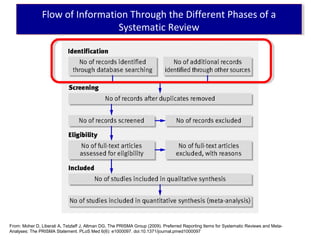
From: Moher D, Liberati A, Tetzlaff J, Altman DG, The PRISMA Group (2009). Preferred Reporting Items for Systematic Reviews and Meta-
Analyses: The PRISMA Statement. PLoS Med 6(6): e1000097. doi:10.1371/journal.pmed1000097
Flow of Information Through the Different Phases of a
Systematic Review
Flow of Information Through the Different Phases of a
Systematic Review
Systematic reviews of interventions require a
thorough, objective and reproducible search of a
range of sources to identify as many relevant
studies as possible (within resource limits).
From: Cochrane Handbook (2012). Section 6: Searching for Studies. Accessed Jun 4, 2013: http://www.cochrane-handbook.org/
What’s a Systematic Search?What’s a Systematic Search?
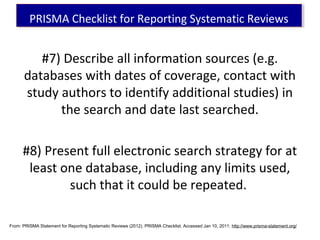
#7) Describe all information sources (e.g.
databases with dates of coverage, contact with
study authors to identify additional studies) in
the search and date last searched.
#8) Present full electronic search strategy for at
least one database, including any limits used,
such that it could be repeated.
PRISMA Checklist for Reporting Systematic ReviewsPRISMA Checklist for Reporting Systematic Reviews
From: PRISMA Statement for Reporting Systematic Reviews (2012). PRISMA Checklist. Accessed Jan 10, 2011: http://www.prisma-statement.org/
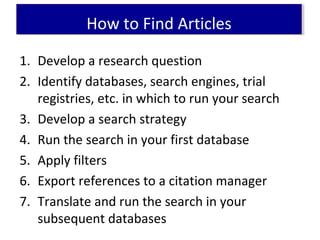
1. Develop a research question
2. Identify databases, search engines, trial
registries, etc. in which to run your search
3. Develop a search strategy
4. Run the search in your first database
5. Apply filters
6. Export references to a citation manager
7. Translate and run the search in your
subsequent databases
How to Find ArticlesHow to Find Articles
Develop a Research Question
You’re applying for a grant to support your
research on infections in arthritis patients
Think of a question related to this topic...
ScenarioScenario
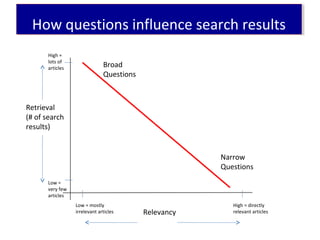
Relevancy
Retrieval
(# of search
results)
Broad
Questions
Narrow
Questions
High =
lots of
articles
Low =
very few
articles
High = directly
relevant articles
Low = mostly
irrelevant articles
How questions influence search resultsHow questions influence search results
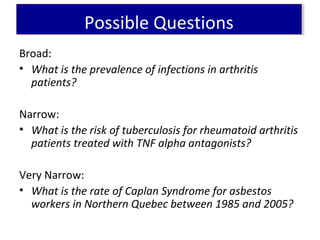
Broad:
• What is the prevalence of infections in arthritis
patients?
Narrow:
• What is the risk of tuberculosis for rheumatoid arthritis
patients treated with TNF alpha antagonists?
Very Narrow:
• What is the rate of Caplan Syndrome for asbestos
workers in Northern Quebec between 1985 and 2005?
Possible QuestionsPossible Questions
Decide Where to SearchDecide Where to Search
• Consult library subject guides
http://www.mcgill.ca/library/library-findinfo/subjects/health
• Talk to a librarian
Develop a Search Strategy
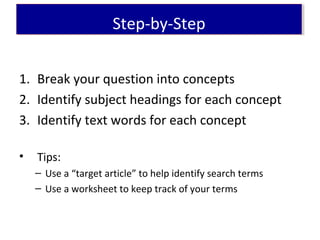
1. Break your question into concepts
2. Identify subject headings for each concept
3. Identify text words for each concept
• Tips:
– Use a “target article” to help identify search terms
– Use a worksheet to keep track of your terms
Step-by-StepStep-by-Step
Which concepts are contained in the question:
What is the risk of tuberculosis for
rheumatoid arthritis patients treated with
TNF alpha antagonists?
Break into PICO ConceptsBreak into PICO Concepts
PICOPICO
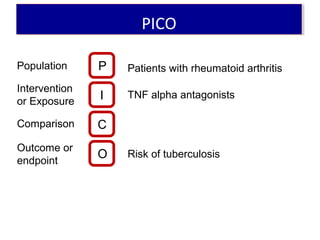
P
I
C
O
Patients with rheumatoid arthritis
TNF alpha antagonists
Risk of tuberculosis
Population
Intervention
or Exposure
Comparison
Outcome or
endpoint
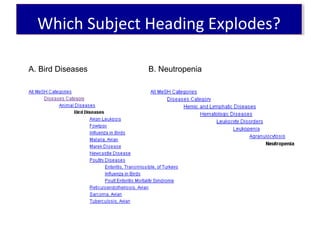
What is MeSH?
A. Bird Diseases B. Neutropenia
Which Subject Heading Explodes?Which Subject Heading Explodes?
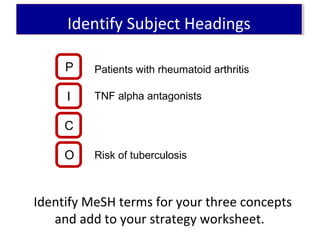
Identify MeSH terms for your three concepts
and add to your strategy worksheet.
Identify Subject HeadingsIdentify Subject Headings
P
I
C
O
Patients with rheumatoid arthritis
TNF alpha antagonists
Risk of tuberculosis
AND AND
OR
"Arthritis, Rheumatoid"[Mesh]
"Tumor Necrosis Factor-
alpha"[Mesh]
"Tuberculosis"[Mesh]
OR
"Mycobacterium
tuberculosis"[Mesh]
OR
OR
OR
Concept #1 Concept #2 Concept #3
Subject
Headings
Text
Words
Search StrategySearch Strategy
BREAK – 15 mins
Why?
1.Not all citations have subject headings
2.Indexers are only human (they make mistakes)
Next: Identify Text WordsNext: Identify Text Words
AND AND
OR
"Arthritis, Rheumatoid"[Mesh]
"Tumor Necrosis Factor-
alpha"[Mesh]
"Tuberculosis"[Mesh]
OR
"Mycobacterium
tuberculosis"[Mesh]
OR
"rheumatoid arthritis"[tw] “tumor necrosis factor alpha”[tw]
OR "tumour necrosis factor
alpha"[tw] OR “tumor necrosis
factor a”[tw] OR "tumour necrosis
factor a"[tw ]
tuberculosis[tw]
OR
“TNF A”[tw] OR “TNF alpha”[tw]
OR TNFA[tw] OR TNFalpha[tw]
OR
Etanercept[tw] OR Infliximab
[tw] OR Adalimumab[tw]
Concept #1 Concept #2 Concept #3
Subject
Headings
Text
Words
Search StrategySearch Strategy
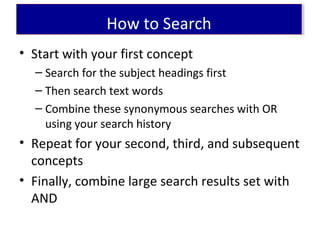
• Start with your first concept
– Search for the subject headings first
– Then search text words
– Combine these synonymous searches with OR
using your search history
• Repeat for your second, third, and subsequent
concepts
• Finally, combine large search results set with
AND
How to SearchHow to Search
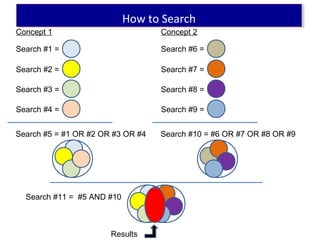
Search #2 =
Search #3 =
Search #4 =
Search #5 = #1 OR #2 OR #3 OR #4
Search #1 =
Concept 1
Search #6 =
Search #7 =
Search #8 =
Search #9 =
Concept 2
Search #10 = #6 OR #7 OR #8 OR #9
Search #11 = #5 AND #10
Results
How to SearchHow to Search
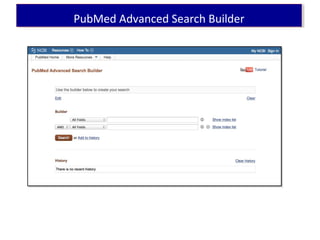
PubMed Advanced Search BuilderPubMed Advanced Search Builder
Run the search
AND AND
OR
"Arthritis, Rheumatoid"[Mesh]
"Tumor Necrosis Factor-
alpha"[Mesh]
"Tuberculosis"[Mesh]
OR
"Mycobacterium
tuberculosis"[Mesh]
OR
"rheumatoid arthritis"[tw] “tumor necrosis factor alpha”[tw]
OR "tumour necrosis factor
alpha"[tw] OR “tumor necrosis
factor a”[tw] OR "tumour necrosis
factor a"[tw]
tuberculosis[tw]
OR
“TNF A”[tw] OR “TNF alpha”[tw]
OR TNFA[tw] OR TNFalpha[tw]
OR
Etanercept[tw] OR
Infliximab[tw] OR
Adalimumab[tw]
Concept #1 Concept #2 Concept #3
Subject
Headings
Text
Words
Search StrategySearch Strategy
Applying filters
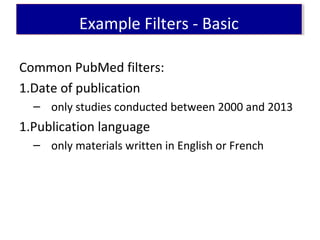
Example Filters - BasicExample Filters - Basic
Common PubMed filters:
1.Date of publication
– only studies conducted between 2000 and 2013
1.Publication language
– only materials written in English or French
Apply to your combined search result set:
– English and French Language
Practice: Apply Basic FiltersPractice: Apply Basic Filters
Sample:
•Cochrane Highly Sensitive Search Strategy for
identifying randomized trials in MEDLINE
(PubMed format)
Advanced FiltersAdvanced Filters
Practice: Advanced FilterPractice: Advanced Filter
Add this line to your search history:
•[#of your final search set] NOT (Animals[mesh]
NOT Humans[mesh])
What does this advanced filter do? Why not just
use the basic PubMed filter for human studies?
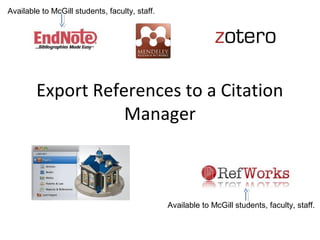
Export References to a Citation
Manager
Available to McGill students, faculty, staff.
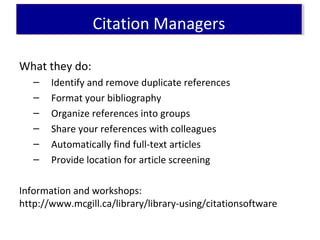
What they do:
– Identify and remove duplicate references
– Format your bibliography
– Organize references into groups
– Share your references with colleagues
– Automatically find full-text articles
– Provide location for article screening
Information and workshops:
http://www.mcgill.ca/library/library-using/citationsoftware
Citation ManagersCitation Managers
Next steps
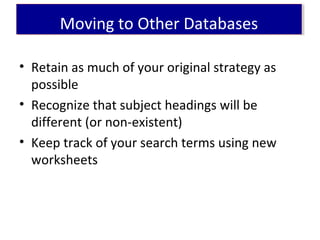
• Retain as much of your original strategy as
possible
• Recognize that subject headings will be
different (or non-existent)
• Keep track of your search terms using new
worksheets
Moving to Other DatabasesMoving to Other Databases
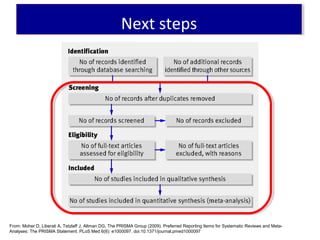
From: Moher D, Liberati A, Tetzlaff J, Altman DG, The PRISMA Group (2009). Preferred Reporting Items for Systematic Reviews and Meta-
Analyses: The PRISMA Statement. PLoS Med 6(6): e1000097. doi:10.1371/journal.pmed1000097
Next stepsNext steps
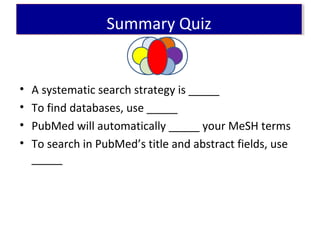
• A systematic search strategy is _____
• To find databases, use _____
• PubMed will automatically _____ your MeSH terms
• To search in PubMed’s title and abstract fields, use
_____
Summary QuizSummary Quiz
Where to go for HelpWhere to go for Help
Robin Featherstone
Liaison Librarian
Life Sciences Library,
McGill University
514-398-4475
ext. 09844
robin.featherstone@mcgill.ca
Anesthesia, Cardiology, Dermatology,
Endocrinology & Metabolism,
Gastroenterology, Hematology, Internal
Medicine, Medical Education, Nephrology,
Neurology & Neurosurgery, Obstetrics &
Gynecology, Oncology, Ophthalmology,
Orthopedics, Otolaryngology, Respiratory
Medicine, Surgery,
Undergraduate Medicine, Urology
Genevieve Gore
Liaison Librarian
Life Sciences Library,
McGill University
514-398-3472
genevieve.gore@mcgill.ca
Epidemiology, Biostatistics ,& Occupational
Health, Family Medicine, Infectious
Diseases, Pediatrics, Public Health
ResourcesResources
Systematic review guidelines:
Cochrane Handbook for Systematic Reviews of Interventions
http://www.cochrane-handbook.org/
PRISMA (Preferred Reporting Items of Systematic Reviews and Meta-Analyses)
http://www.prisma-statement.org/statement.htm
Systematic Reviews: CRD’s Guidance for Undertaking Reviews in Health Care
http://www.york.ac.uk/inst/crd/SysRev/!SSL!/WebHelp/SysRev3.htm
IOM (Institute of Medicine). Finding what works in health care: Standards for
Systematic Reviews
http://www.iom.edu/Reports/2011/Finding-What-Works-in-Health-Care-Standards-
for-Systematic-Reviews.aspx
Systematic Reviews: A Guide to Library Resources at McGill
http://wikisites.mcgill.ca/systematicreview/index.php/Main_Page
Citation management:
Getting help with EndNote
http://www.mcgill.ca/library/library-using/citationsoftware/endnote/help
QuestionsQuestions

Clinical Epidemiology - Systematic PubMed Searching Workshop

  • 1.
    Robin Featherstone, MLIS LiaisonLibrarian (Medicine) Life Sciences Library How to Conduct a Systematic Search in PubMed How to Conduct a Systematic Search in PubMed Genevieve Gore, MLIS Liaison Librarian (Medicine) Life Sciences Library Slides: http://www.slideshare.net/featherr
  • 2.
    ObjectivesObjectives By the endof today’s class, you will be able to: 1.Identify subject headings using the MeSH Database 2.Construct a search strategy 3.Run your search using the PubMed Advanced Search Builder
  • 3.
    A review ofa clearly formulated question that uses systematic and explicit methods to identify, select, and critically appraise relevant research, and to collect and analyse data from the studies that are included in the review. From: Cochrane Collaboration (2012). Glossary: Systematic Review. Accessed Jun 4, 2013: http://www.cochrane.org/glossary/5#term423 What’s a Systematic Review?What’s a Systematic Review?
  • 4.
    From: Moher D,Liberati A, Tetzlaff J, Altman DG, The PRISMA Group (2009). Preferred Reporting Items for Systematic Reviews and Meta- Analyses: The PRISMA Statement. PLoS Med 6(6): e1000097. doi:10.1371/journal.pmed1000097 Flow of Information Through the Different Phases of a Systematic Review Flow of Information Through the Different Phases of a Systematic Review
  • 5.
    Systematic reviews ofinterventions require a thorough, objective and reproducible search of a range of sources to identify as many relevant studies as possible (within resource limits). From: Cochrane Handbook (2012). Section 6: Searching for Studies. Accessed Jun 4, 2013: http://www.cochrane-handbook.org/ What’s a Systematic Search?What’s a Systematic Search?
  • 6.
    #7) Describe allinformation sources (e.g. databases with dates of coverage, contact with study authors to identify additional studies) in the search and date last searched. #8) Present full electronic search strategy for at least one database, including any limits used, such that it could be repeated. PRISMA Checklist for Reporting Systematic ReviewsPRISMA Checklist for Reporting Systematic Reviews From: PRISMA Statement for Reporting Systematic Reviews (2012). PRISMA Checklist. Accessed Jan 10, 2011: http://www.prisma-statement.org/
  • 7.
    1. Develop aresearch question 2. Identify databases, search engines, trial registries, etc. in which to run your search 3. Develop a search strategy 4. Run the search in your first database 5. Apply filters 6. Export references to a citation manager 7. Translate and run the search in your subsequent databases How to Find ArticlesHow to Find Articles
  • 8.
  • 9.
    You’re applying fora grant to support your research on infections in arthritis patients Think of a question related to this topic... ScenarioScenario
  • 10.
    Relevancy Retrieval (# of search results) Broad Questions Narrow Questions High= lots of articles Low = very few articles High = directly relevant articles Low = mostly irrelevant articles How questions influence search resultsHow questions influence search results
  • 11.
    Broad: • What isthe prevalence of infections in arthritis patients? Narrow: • What is the risk of tuberculosis for rheumatoid arthritis patients treated with TNF alpha antagonists? Very Narrow: • What is the rate of Caplan Syndrome for asbestos workers in Northern Quebec between 1985 and 2005? Possible QuestionsPossible Questions
  • 12.
    Decide Where toSearchDecide Where to Search • Consult library subject guides http://www.mcgill.ca/library/library-findinfo/subjects/health • Talk to a librarian
  • 13.
  • 14.
    1. Break yourquestion into concepts 2. Identify subject headings for each concept 3. Identify text words for each concept • Tips: – Use a “target article” to help identify search terms – Use a worksheet to keep track of your terms Step-by-StepStep-by-Step
  • 15.
    Which concepts arecontained in the question: What is the risk of tuberculosis for rheumatoid arthritis patients treated with TNF alpha antagonists? Break into PICO ConceptsBreak into PICO Concepts
  • 16.
    PICOPICO P I C O Patients with rheumatoidarthritis TNF alpha antagonists Risk of tuberculosis Population Intervention or Exposure Comparison Outcome or endpoint
  • 17.
  • 18.
    A. Bird DiseasesB. Neutropenia Which Subject Heading Explodes?Which Subject Heading Explodes?
  • 19.
    Identify MeSH termsfor your three concepts and add to your strategy worksheet. Identify Subject HeadingsIdentify Subject Headings P I C O Patients with rheumatoid arthritis TNF alpha antagonists Risk of tuberculosis
  • 20.
    AND AND OR "Arthritis, Rheumatoid"[Mesh] "TumorNecrosis Factor- alpha"[Mesh] "Tuberculosis"[Mesh] OR "Mycobacterium tuberculosis"[Mesh] OR OR OR Concept #1 Concept #2 Concept #3 Subject Headings Text Words Search StrategySearch Strategy
  • 21.
  • 22.
    Why? 1.Not all citationshave subject headings 2.Indexers are only human (they make mistakes) Next: Identify Text WordsNext: Identify Text Words
  • 23.
    AND AND OR "Arthritis, Rheumatoid"[Mesh] "TumorNecrosis Factor- alpha"[Mesh] "Tuberculosis"[Mesh] OR "Mycobacterium tuberculosis"[Mesh] OR "rheumatoid arthritis"[tw] “tumor necrosis factor alpha”[tw] OR "tumour necrosis factor alpha"[tw] OR “tumor necrosis factor a”[tw] OR "tumour necrosis factor a"[tw ] tuberculosis[tw] OR “TNF A”[tw] OR “TNF alpha”[tw] OR TNFA[tw] OR TNFalpha[tw] OR Etanercept[tw] OR Infliximab [tw] OR Adalimumab[tw] Concept #1 Concept #2 Concept #3 Subject Headings Text Words Search StrategySearch Strategy
  • 24.
    • Start withyour first concept – Search for the subject headings first – Then search text words – Combine these synonymous searches with OR using your search history • Repeat for your second, third, and subsequent concepts • Finally, combine large search results set with AND How to SearchHow to Search
  • 25.
    Search #2 = Search#3 = Search #4 = Search #5 = #1 OR #2 OR #3 OR #4 Search #1 = Concept 1 Search #6 = Search #7 = Search #8 = Search #9 = Concept 2 Search #10 = #6 OR #7 OR #8 OR #9 Search #11 = #5 AND #10 Results How to SearchHow to Search
  • 26.
    PubMed Advanced SearchBuilderPubMed Advanced Search Builder
  • 27.
  • 28.
    AND AND OR "Arthritis, Rheumatoid"[Mesh] "TumorNecrosis Factor- alpha"[Mesh] "Tuberculosis"[Mesh] OR "Mycobacterium tuberculosis"[Mesh] OR "rheumatoid arthritis"[tw] “tumor necrosis factor alpha”[tw] OR "tumour necrosis factor alpha"[tw] OR “tumor necrosis factor a”[tw] OR "tumour necrosis factor a"[tw] tuberculosis[tw] OR “TNF A”[tw] OR “TNF alpha”[tw] OR TNFA[tw] OR TNFalpha[tw] OR Etanercept[tw] OR Infliximab[tw] OR Adalimumab[tw] Concept #1 Concept #2 Concept #3 Subject Headings Text Words Search StrategySearch Strategy
  • 29.
  • 30.
    Example Filters -BasicExample Filters - Basic Common PubMed filters: 1.Date of publication – only studies conducted between 2000 and 2013 1.Publication language – only materials written in English or French
  • 31.
    Apply to yourcombined search result set: – English and French Language Practice: Apply Basic FiltersPractice: Apply Basic Filters
  • 32.
    Sample: •Cochrane Highly SensitiveSearch Strategy for identifying randomized trials in MEDLINE (PubMed format) Advanced FiltersAdvanced Filters
  • 33.
    Practice: Advanced FilterPractice:Advanced Filter Add this line to your search history: •[#of your final search set] NOT (Animals[mesh] NOT Humans[mesh]) What does this advanced filter do? Why not just use the basic PubMed filter for human studies?
  • 34.
    Export References toa Citation Manager Available to McGill students, faculty, staff. Available to McGill students, faculty, staff.
  • 35.
    What they do: –Identify and remove duplicate references – Format your bibliography – Organize references into groups – Share your references with colleagues – Automatically find full-text articles – Provide location for article screening Information and workshops: http://www.mcgill.ca/library/library-using/citationsoftware Citation ManagersCitation Managers
  • 36.
  • 37.
    • Retain asmuch of your original strategy as possible • Recognize that subject headings will be different (or non-existent) • Keep track of your search terms using new worksheets Moving to Other DatabasesMoving to Other Databases
  • 38.
    From: Moher D,Liberati A, Tetzlaff J, Altman DG, The PRISMA Group (2009). Preferred Reporting Items for Systematic Reviews and Meta- Analyses: The PRISMA Statement. PLoS Med 6(6): e1000097. doi:10.1371/journal.pmed1000097 Next stepsNext steps
  • 39.
    • A systematicsearch strategy is _____ • To find databases, use _____ • PubMed will automatically _____ your MeSH terms • To search in PubMed’s title and abstract fields, use _____ Summary QuizSummary Quiz
  • 40.
    Where to gofor HelpWhere to go for Help Robin Featherstone Liaison Librarian Life Sciences Library, McGill University 514-398-4475 ext. 09844 robin.featherstone@mcgill.ca Anesthesia, Cardiology, Dermatology, Endocrinology & Metabolism, Gastroenterology, Hematology, Internal Medicine, Medical Education, Nephrology, Neurology & Neurosurgery, Obstetrics & Gynecology, Oncology, Ophthalmology, Orthopedics, Otolaryngology, Respiratory Medicine, Surgery, Undergraduate Medicine, Urology Genevieve Gore Liaison Librarian Life Sciences Library, McGill University 514-398-3472 genevieve.gore@mcgill.ca Epidemiology, Biostatistics ,& Occupational Health, Family Medicine, Infectious Diseases, Pediatrics, Public Health
  • 41.
    ResourcesResources Systematic review guidelines: CochraneHandbook for Systematic Reviews of Interventions http://www.cochrane-handbook.org/ PRISMA (Preferred Reporting Items of Systematic Reviews and Meta-Analyses) http://www.prisma-statement.org/statement.htm Systematic Reviews: CRD’s Guidance for Undertaking Reviews in Health Care http://www.york.ac.uk/inst/crd/SysRev/!SSL!/WebHelp/SysRev3.htm IOM (Institute of Medicine). Finding what works in health care: Standards for Systematic Reviews http://www.iom.edu/Reports/2011/Finding-What-Works-in-Health-Care-Standards- for-Systematic-Reviews.aspx Systematic Reviews: A Guide to Library Resources at McGill http://wikisites.mcgill.ca/systematicreview/index.php/Main_Page Citation management: Getting help with EndNote http://www.mcgill.ca/library/library-using/citationsoftware/endnote/help
  • 42.