STEPS IN
RESEARCH
PROCESS
DR. MAHESWARI JAIKUMAR
STEPS IN RESEARCH
PROCESS
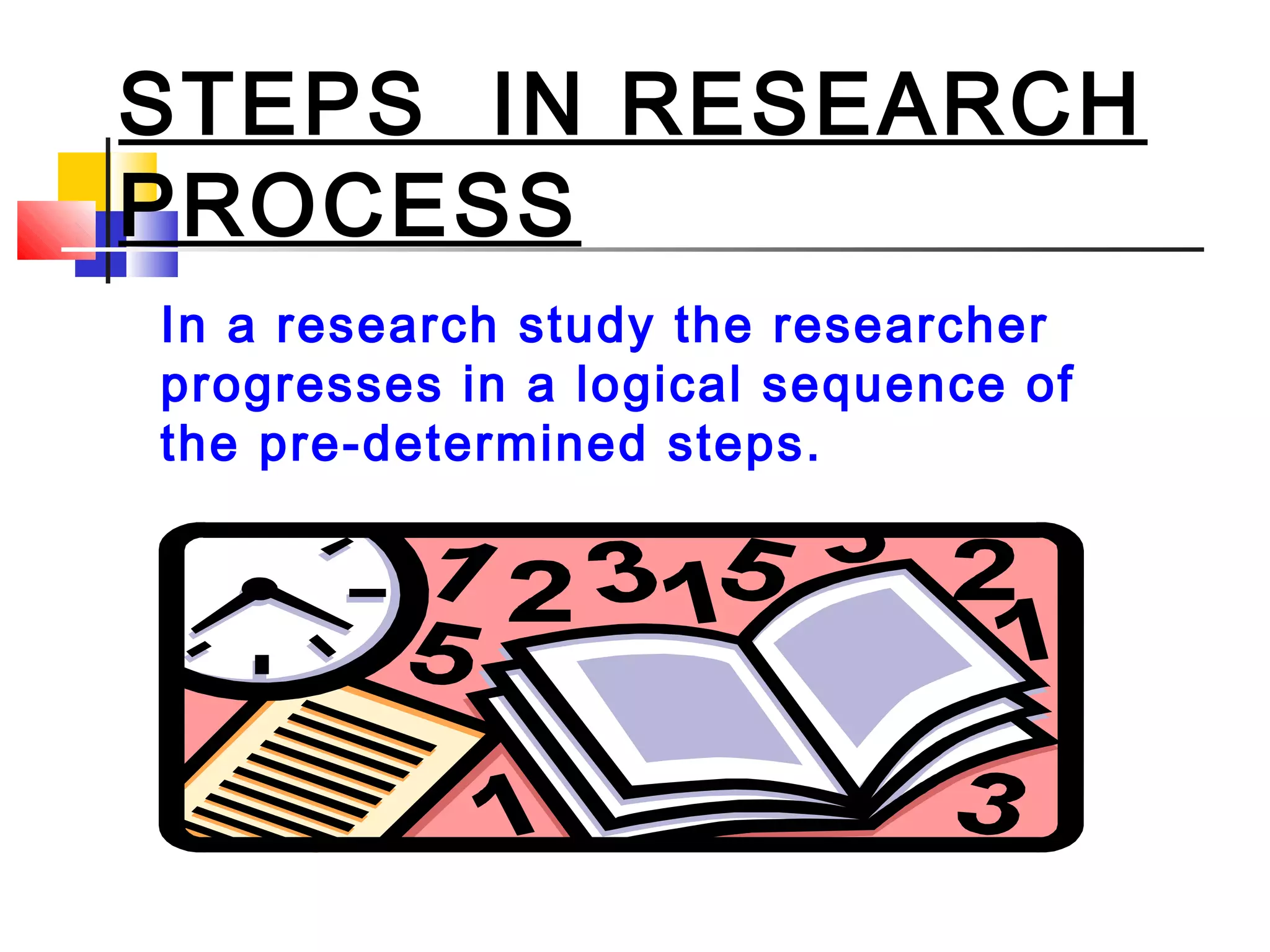
In a research study the researcher
progresses in a logical sequence of
the pre-determined steps.
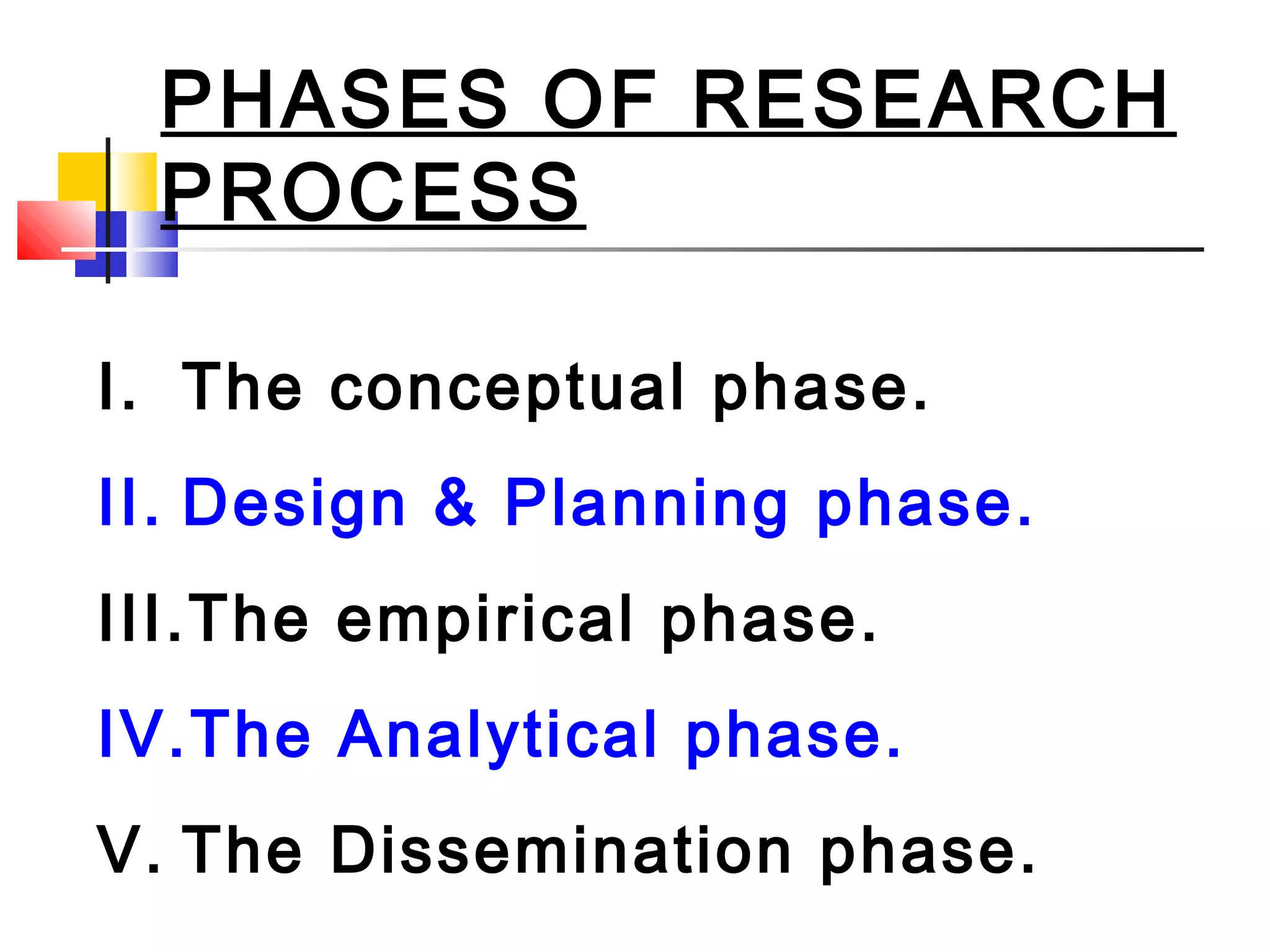
PHASES OF RESEARCH
PROCESS
I. The conceptual phase.
II. Design & Planning phase.
III.The empirical phase.
IV.The Analytical phase.
V. The Dissemination phase.
THE CONCEPTUAL
PHASE.
1.Formulating & delimiting the
problem
2.ROL.
3.Defining theoretical
framework.
4.Formulating hypothesis
DESIGNING &
PLANNING PHASE
1.Selecting research design.
2.Identification of the population
to be studied.
3.Specification of material &
methods of research variables.
4.Designing the sampling
plan
5.Finalizing & reviewing
research plan.
6.Pilot study.
THE EMPIRICAL
PHASE.
1.Collection of data.
2.Tabulation of data for
analysis.
ANALYTICAL
PHASE.
1. Analysing the data.
2. Interpreting the results.
DISSEMINATION
PHASE
1.communicating the
findings.
2.utilization of the study
findings.
THE CONCEPTUAL
PHASE.
FORMULATING & DELIMITING THE
PROBLEM.
1.Develop a good research Question.
2.The RQ should have good clinical
significance, practicability, & satisfy the
ethical dimensions
3.A good RQ should satisfy the requisites of
the methodological dimensions.
ROL
1.Quantitative R is typically
conducted within the context of the
previous knowledge.
2.The ROL provides the foundation
upon which to base the new
knowledge.
3.ROL sometimes precedes the
delineation of the problem.
DEFINING THE
THEORITICAL FRAMEWORK.
When RQ / R is carried out in
the context of theoretical
framework, it can be used as a
basis for generating predictions
that can be tested through
empirical research.
FORMULATING
HYPOTHESIS
1.Hypothesis is a statement of
researcher’s expectations
about relationships between
the variables of investigation.
2.Hypothesis predicts the
outcomes.
THE DESIGN &
PLANNING PHASE.
In the design phase the
researcher makes a number
of decisions about the
methods to be used to
address the RQ.
IDENTIFYING THE
POPULATION TO BE
STUDIED.
1.The term population refers to the
aggregate or totality of all the
objects, members that conform to a
set of specifications.
2.The researcher identifies the
population during the planning
phase.
3.The researcher must know the
characteristics of the study
SPECIFYING METHODS TO
MEASURE THE RESEARCH
VARIABLES.
1.The researcher must develop a
method to observe & measure
research variable as accurately as
possible.
2. A variety of quantitative data
collection approaches exist,
e.g..bio-physiological
measurements, self reports,
observation.
3.Data collection methods vary
depending on the RQ &
methodology.
4.The task of measuring
research variables & TO
DEVELOP DATA COLLECTION
PLAN IS A COMPLEX PROCESS
DESIGNING THE
SAMPLING PLAN.
1.As entire population cannot be studied
researcher uses a small fraction of the
population.-sample.
2.The researcher employs many
methods to obtain the sample.
3.In applying the methods the
researcher ensures representativeness
of the selected sample.
4.Methods of sampling include-
probability & non-probability sampling
FINALIZING & RE-VIEWING
THE RESEARCH PLAN.
1.Researchers must finalize the
research plan by individuals,
groups before the actual
implementation.
2.The researcher must have their
research plan approved by special
committees as to ensure that the
plan does not violate ethical
CONDUCTING PILOT STUDY &
REVISION.
1.The primary focus of the pilot study
is to assess the adequacy of the data
collection plan.
2.The researcher needs to know the
adequacy of the technical equipment.
3.The tool for data collection is
validated & is termed as pre-testing.
4.Pilot study should be carried out
with care as a major study.
5.The pilot study subjects should
be chosen from the same
population as of the main study.
THE EMPIRICAL
PHASE.COLLECTING THE DATA.
1.The researcher establishes plans &
specifies the procedure for data
collection.
(when,where,how,from whom, consent
etc.)
2.Collection of data involves clerical &
administrative works.
3.The researcher ensures confidentiality of
SELECTION OF
RESEARCH DESIGN.
1.Research design is the overall
plan to obtain answers to RQ.
2.The design specifies the
various types of R approaches
that will adopted.
3.As to how the researcher plans
to implement specific controls to
enhance the interpretability of the
results.
4.There are two major types of
research –Experimental & Non
experimental.
PREPARING THE DATA
FOR ANALYSIS.
1.The investigator, transforms the data
collected into manageable form (coding)
& categorize the collected data into
meaningful categories.
2.The above said may be done manually
or by transferring the information on to
computer files.
ANALYTICAL PHASE
ANALYSING THE DATA.
1.The data collected do not answer our
RQ.
2.The data needs to be processed &
analyses in orderly & coherent fashion.
3.Quantitative information is generally
analyzed through statistical procedures.
3.It involves usage of broad range
techniques. E.g., Descriptive & Analytical
statistics.
INTERPRETING THE
RESULTS.
1.Before communicating the results, they
must be organized & interpreted.
2.This helps to examine the implications
of findings within a broader context.
3.The researcher reflects, supports
his /h her finding with the consistency of
the existing literature.
THE DISSEMINATION
PHASE.
1.The results of research finding are of
not use if they are not communicated.
2.The final task of the project is to
prepare research report.
3.The reports could take various forms
as papers, dissertations, journal
articles,professional conferences.
UTIZATION OF
RESEARCH FINDING.
The concluding step of a
high quality study is to plan
for utilization in the real
world.
BREAKDOWN OF RESEARCH WORK.
CALENDER MONTH
TASKS
THANK YOU.

STEPS IN RESEARCH PROCESS

  • 1.
  • 2.
    STEPS IN RESEARCH PROCESS Ina research study the researcher progresses in a logical sequence of the pre-determined steps.
  • 3.
    PHASES OF RESEARCH PROCESS I.The conceptual phase. II. Design & Planning phase. III.The empirical phase. IV.The Analytical phase. V. The Dissemination phase.
  • 4.
    THE CONCEPTUAL PHASE. 1.Formulating &delimiting the problem 2.ROL. 3.Defining theoretical framework. 4.Formulating hypothesis
  • 5.
    DESIGNING & PLANNING PHASE 1.Selectingresearch design. 2.Identification of the population to be studied. 3.Specification of material & methods of research variables.
  • 6.
    4.Designing the sampling plan 5.Finalizing& reviewing research plan. 6.Pilot study.
  • 7.
    THE EMPIRICAL PHASE. 1.Collection ofdata. 2.Tabulation of data for analysis.
  • 8.
    ANALYTICAL PHASE. 1. Analysing thedata. 2. Interpreting the results.
  • 9.
  • 10.
    THE CONCEPTUAL PHASE. FORMULATING &DELIMITING THE PROBLEM. 1.Develop a good research Question. 2.The RQ should have good clinical significance, practicability, & satisfy the ethical dimensions 3.A good RQ should satisfy the requisites of the methodological dimensions.
  • 11.
    ROL 1.Quantitative R istypically conducted within the context of the previous knowledge. 2.The ROL provides the foundation upon which to base the new knowledge. 3.ROL sometimes precedes the delineation of the problem.
  • 12.
    DEFINING THE THEORITICAL FRAMEWORK. WhenRQ / R is carried out in the context of theoretical framework, it can be used as a basis for generating predictions that can be tested through empirical research.
  • 13.
    FORMULATING HYPOTHESIS 1.Hypothesis is astatement of researcher’s expectations about relationships between the variables of investigation. 2.Hypothesis predicts the outcomes.
  • 14.
    THE DESIGN & PLANNINGPHASE. In the design phase the researcher makes a number of decisions about the methods to be used to address the RQ.
  • 15.
    IDENTIFYING THE POPULATION TOBE STUDIED. 1.The term population refers to the aggregate or totality of all the objects, members that conform to a set of specifications. 2.The researcher identifies the population during the planning phase. 3.The researcher must know the characteristics of the study
  • 16.
    SPECIFYING METHODS TO MEASURETHE RESEARCH VARIABLES. 1.The researcher must develop a method to observe & measure research variable as accurately as possible. 2. A variety of quantitative data collection approaches exist, e.g..bio-physiological measurements, self reports, observation.
  • 17.
    3.Data collection methodsvary depending on the RQ & methodology. 4.The task of measuring research variables & TO DEVELOP DATA COLLECTION PLAN IS A COMPLEX PROCESS
  • 18.
    DESIGNING THE SAMPLING PLAN. 1.Asentire population cannot be studied researcher uses a small fraction of the population.-sample. 2.The researcher employs many methods to obtain the sample. 3.In applying the methods the researcher ensures representativeness of the selected sample. 4.Methods of sampling include- probability & non-probability sampling
  • 19.
    FINALIZING & RE-VIEWING THERESEARCH PLAN. 1.Researchers must finalize the research plan by individuals, groups before the actual implementation. 2.The researcher must have their research plan approved by special committees as to ensure that the plan does not violate ethical
  • 20.
    CONDUCTING PILOT STUDY& REVISION. 1.The primary focus of the pilot study is to assess the adequacy of the data collection plan. 2.The researcher needs to know the adequacy of the technical equipment. 3.The tool for data collection is validated & is termed as pre-testing.
  • 21.
    4.Pilot study shouldbe carried out with care as a major study. 5.The pilot study subjects should be chosen from the same population as of the main study.
  • 22.
    THE EMPIRICAL PHASE.COLLECTING THEDATA. 1.The researcher establishes plans & specifies the procedure for data collection. (when,where,how,from whom, consent etc.) 2.Collection of data involves clerical & administrative works. 3.The researcher ensures confidentiality of
  • 23.
    SELECTION OF RESEARCH DESIGN. 1.Researchdesign is the overall plan to obtain answers to RQ. 2.The design specifies the various types of R approaches that will adopted.
  • 24.
    3.As to howthe researcher plans to implement specific controls to enhance the interpretability of the results. 4.There are two major types of research –Experimental & Non experimental.
  • 25.
    PREPARING THE DATA FORANALYSIS. 1.The investigator, transforms the data collected into manageable form (coding) & categorize the collected data into meaningful categories. 2.The above said may be done manually or by transferring the information on to computer files.
  • 26.
    ANALYTICAL PHASE ANALYSING THEDATA. 1.The data collected do not answer our RQ. 2.The data needs to be processed & analyses in orderly & coherent fashion. 3.Quantitative information is generally analyzed through statistical procedures. 3.It involves usage of broad range techniques. E.g., Descriptive & Analytical statistics.
  • 27.
    INTERPRETING THE RESULTS. 1.Before communicatingthe results, they must be organized & interpreted. 2.This helps to examine the implications of findings within a broader context. 3.The researcher reflects, supports his /h her finding with the consistency of the existing literature.
  • 28.
    THE DISSEMINATION PHASE. 1.The resultsof research finding are of not use if they are not communicated. 2.The final task of the project is to prepare research report. 3.The reports could take various forms as papers, dissertations, journal articles,professional conferences.
  • 29.
    UTIZATION OF RESEARCH FINDING. Theconcluding step of a high quality study is to plan for utilization in the real world.
  • 30.
    BREAKDOWN OF RESEARCHWORK. CALENDER MONTH TASKS
  • 31.