What is the reproducibility crisis
in science and what can we do
about it?
Dorothy V. M. Bishop
Professor of Developmental Neuropsychology
University of Oxford
@deevybee
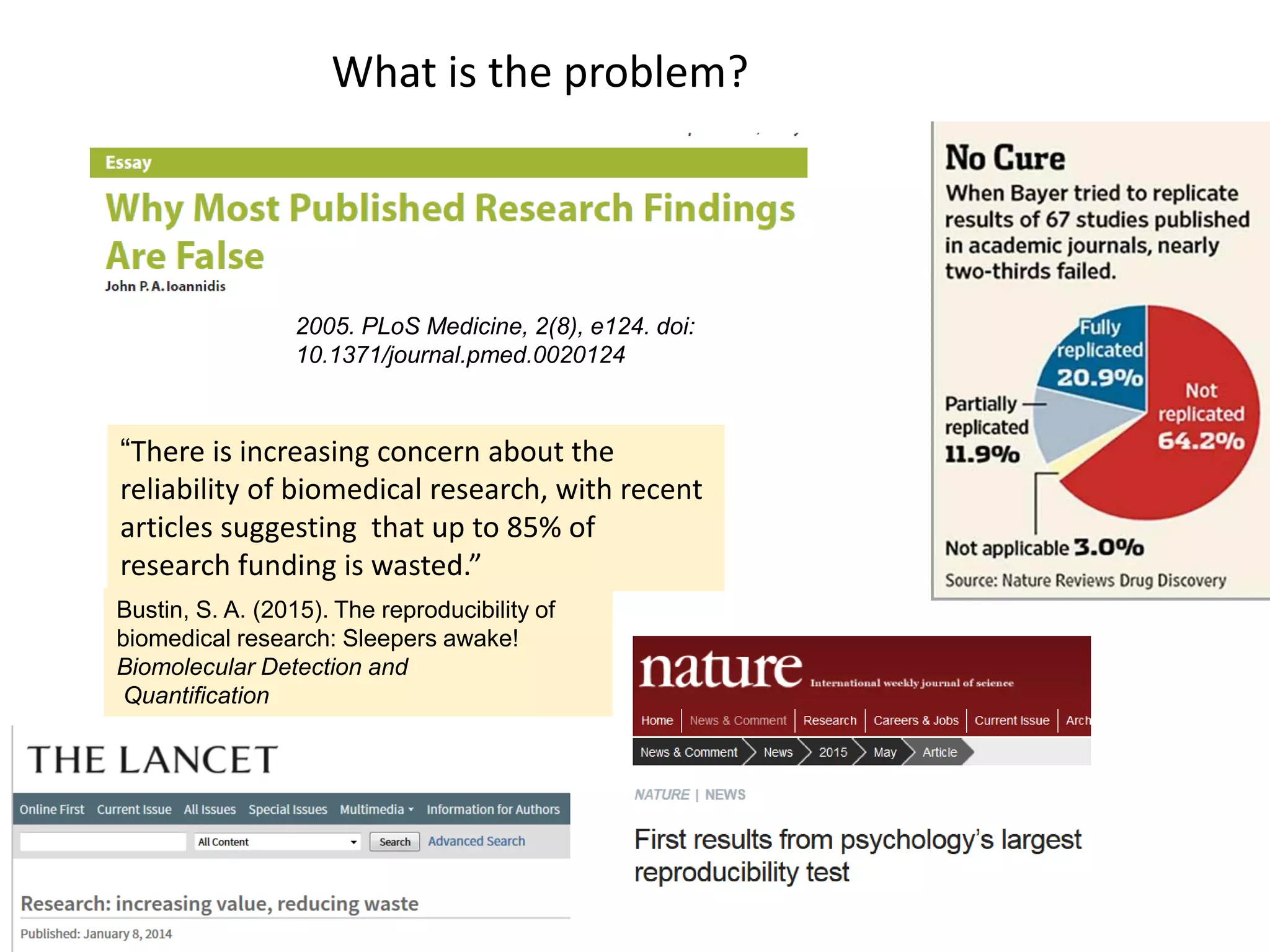
What is the problem?
“There is increasing concern about the
reliability of biomedical research, with recent
articles suggesting that up to 85% of
research funding is wasted.”
Bustin, S. A. (2015). The reproducibility of
biomedical research: Sleepers awake!
Biomolecular Detection and
Quantification
2005. PLoS Medicine, 2(8), e124. doi:
10.1371/journal.pmed.0020124
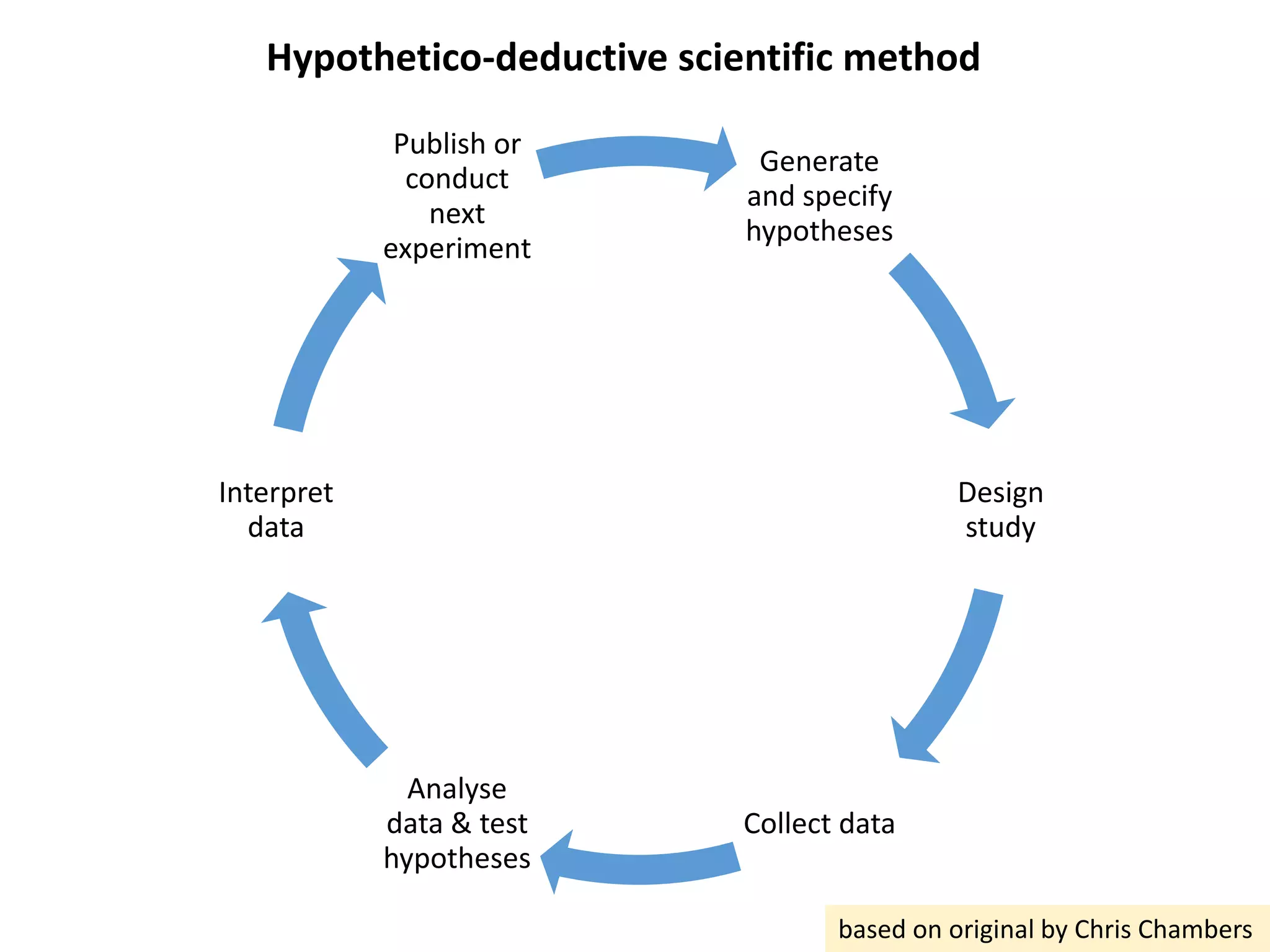
Generate
and specify
hypotheses
Design
study
Collect data
Analyse
data & test
hypotheses
Interpret
data
Publish or
conduct
next
experiment
Hypothetico-deductive scientific method
based on original by Chris Chambers
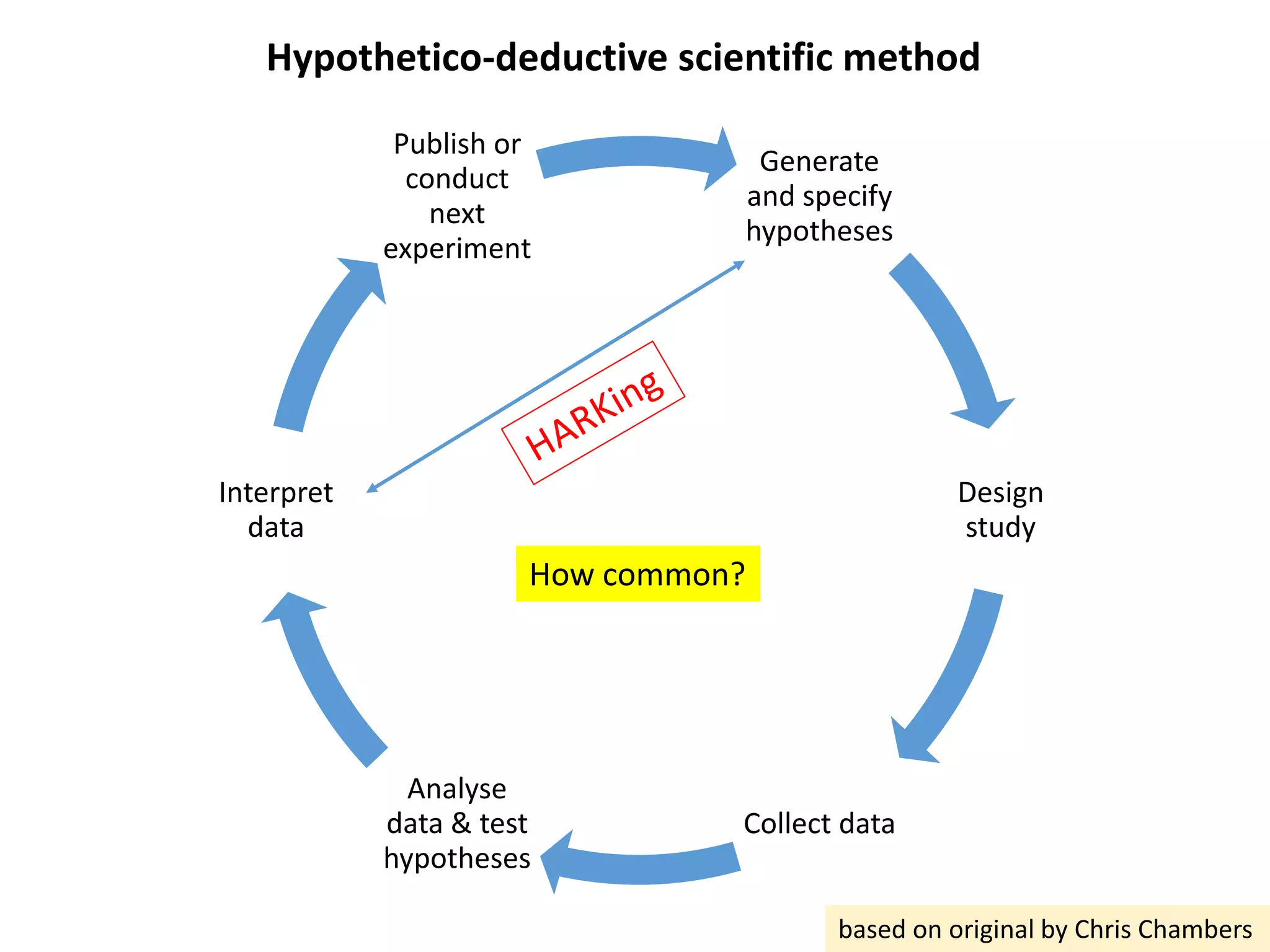
Generate
and specify
hypotheses
Design
study
Collect data
Analyse
data & test
hypotheses
Interpret
data
Publish or
conduct
next
experiment
Hypothetico-deductive scientific method
based on original by Chris Chambers
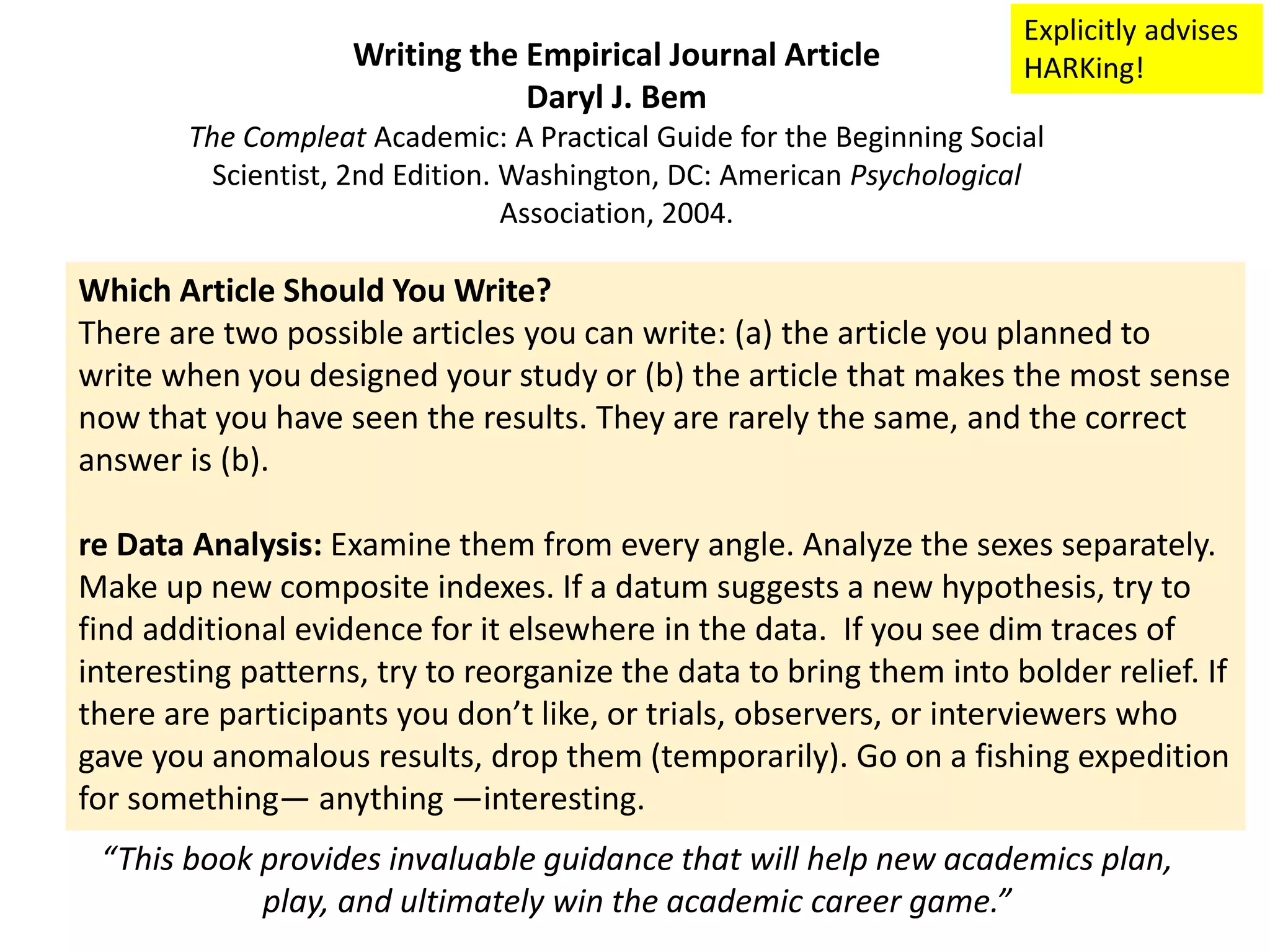
How common?
Which Article Should You Write?
There are two possible articles you can write: (a) the article you planned to
write when you designed your study or (b) the article that makes the most sense
now that you have seen the results. They are rarely the same, and the correct
answer is (b).
re Data Analysis: Examine them from every angle. Analyze the sexes separately.
Make up new composite indexes. If a datum suggests a new hypothesis, try to
find additional evidence for it elsewhere in the data. If you see dim traces of
interesting patterns, try to reorganize the data to bring them into bolder relief. If
there are participants you don’t like, or trials, observers, or interviewers who
gave you anomalous results, drop them (temporarily). Go on a fishing expedition
for something— anything —interesting.
Writing the Empirical Journal Article
Daryl J. Bem
The Compleat Academic: A Practical Guide for the Beginning Social
Scientist, 2nd Edition. Washington, DC: American Psychological
Association, 2004.
“This book provides invaluable guidance that will help new academics plan,
play, and ultimately win the academic career game.”
Explicitly advises
HARKing!
Generate
and specify
hypotheses
Design
study
Collect data
Analyse
data & test
hypotheses
Interpret
data
Publish or
conduct
next
experiment
Hypothetico-deductive scientific method
based on original by Chris Chambers
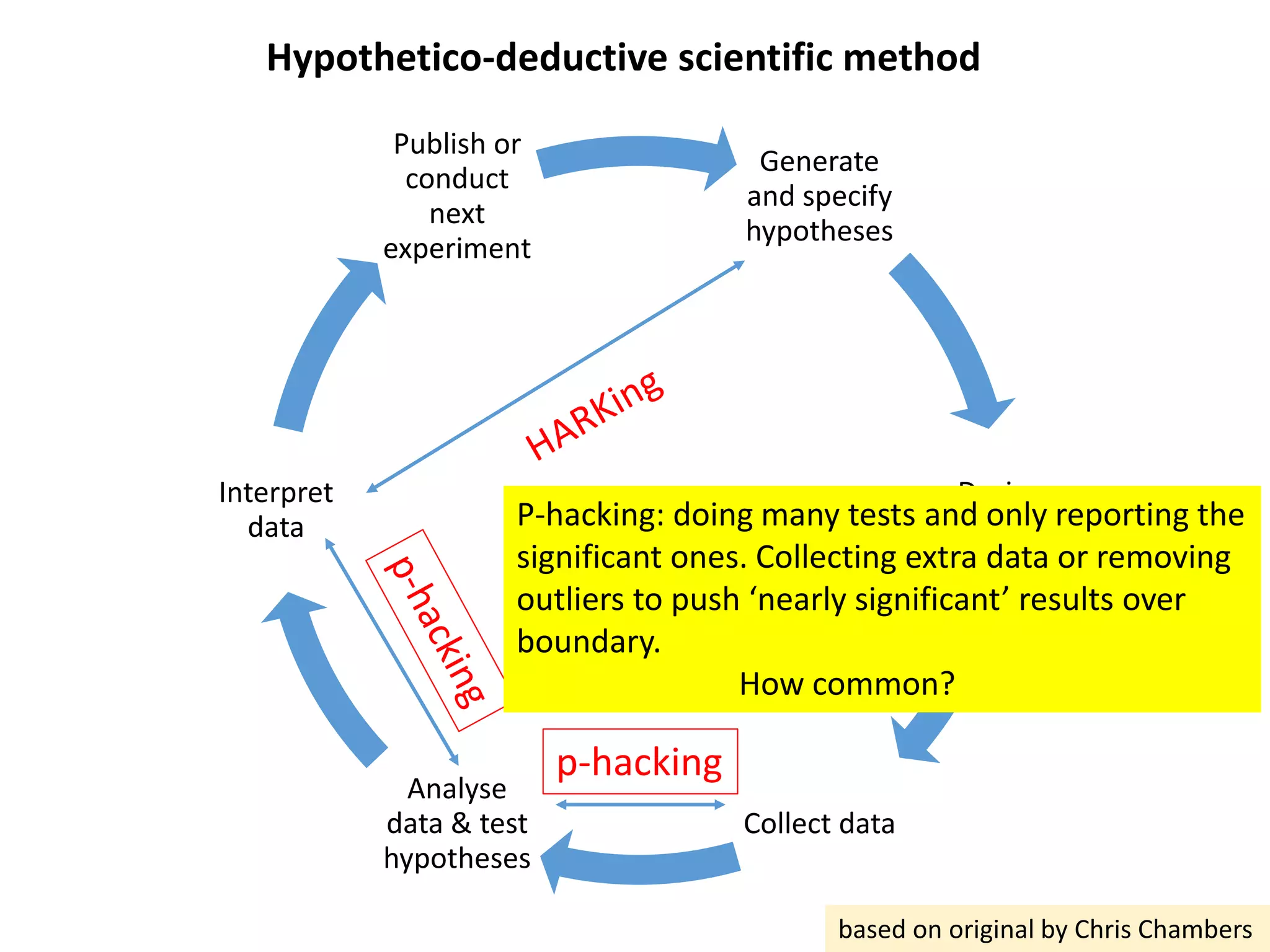
p-hacking
P-hacking: doing many tests and only reporting the
significant ones. Collecting extra data or removing
outliers to push ‘nearly significant’ results over
boundary.
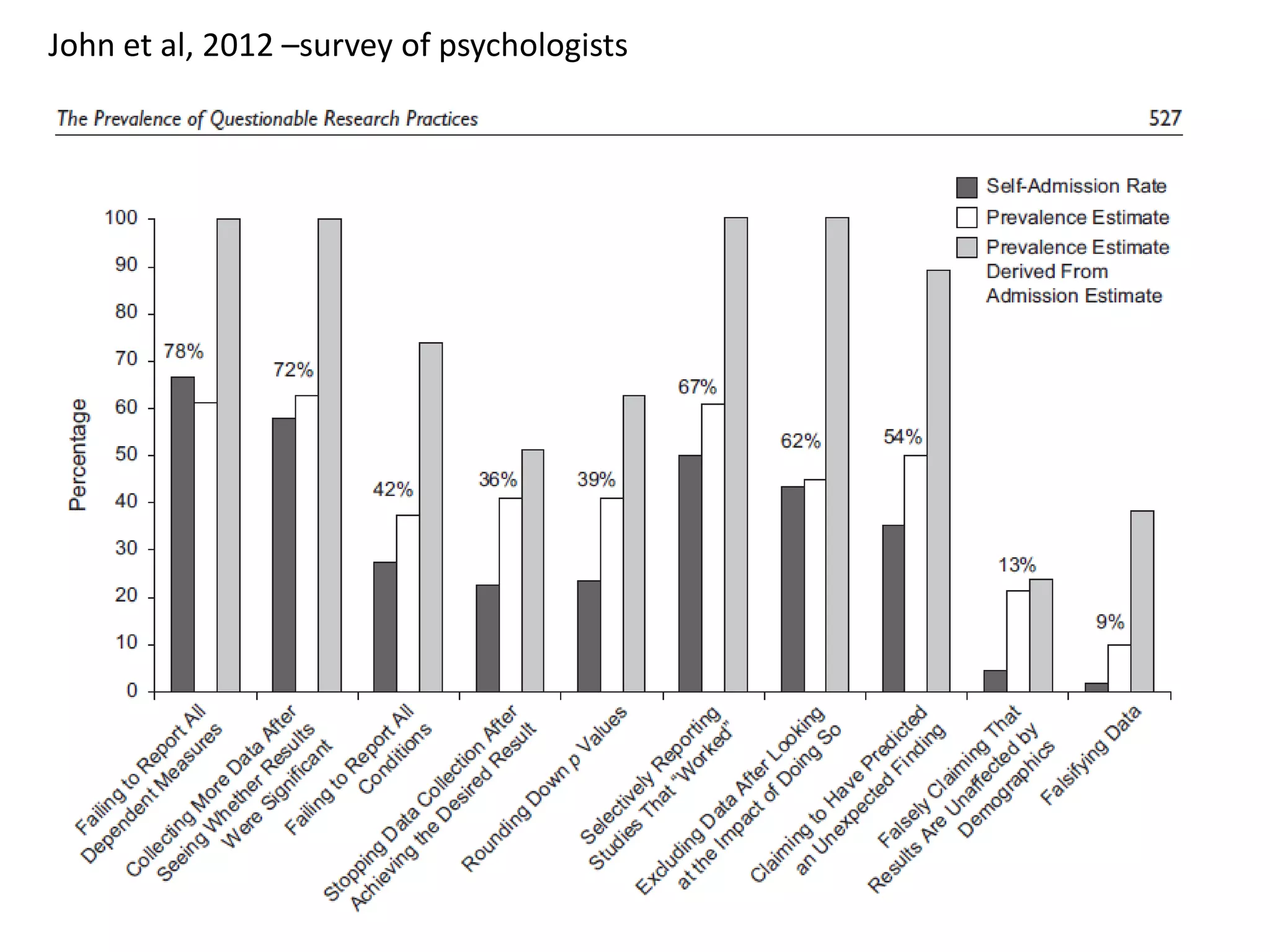
How common?
John et al, 2012 –survey of psychologists
Generate
and specify
hypotheses
Design
study
Collect data
Analyse
data & test
hypotheses
Interpret
data
Publish or
conduct
next
experiment
Hypothetico-deductive scientific method
based on original by Chris Chambers
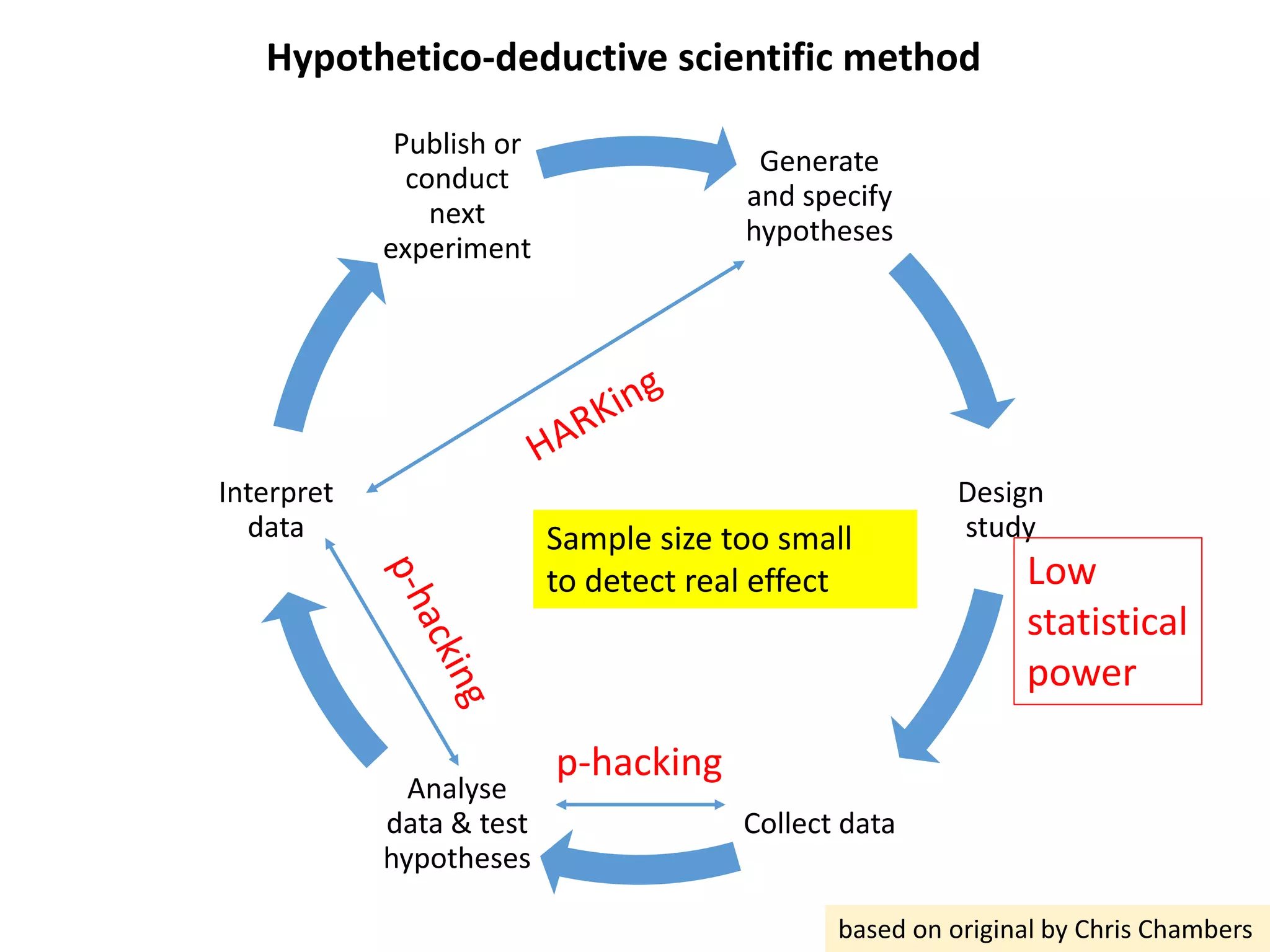
p-hacking
Low
statistical
power
Sample size too small
to detect real effect
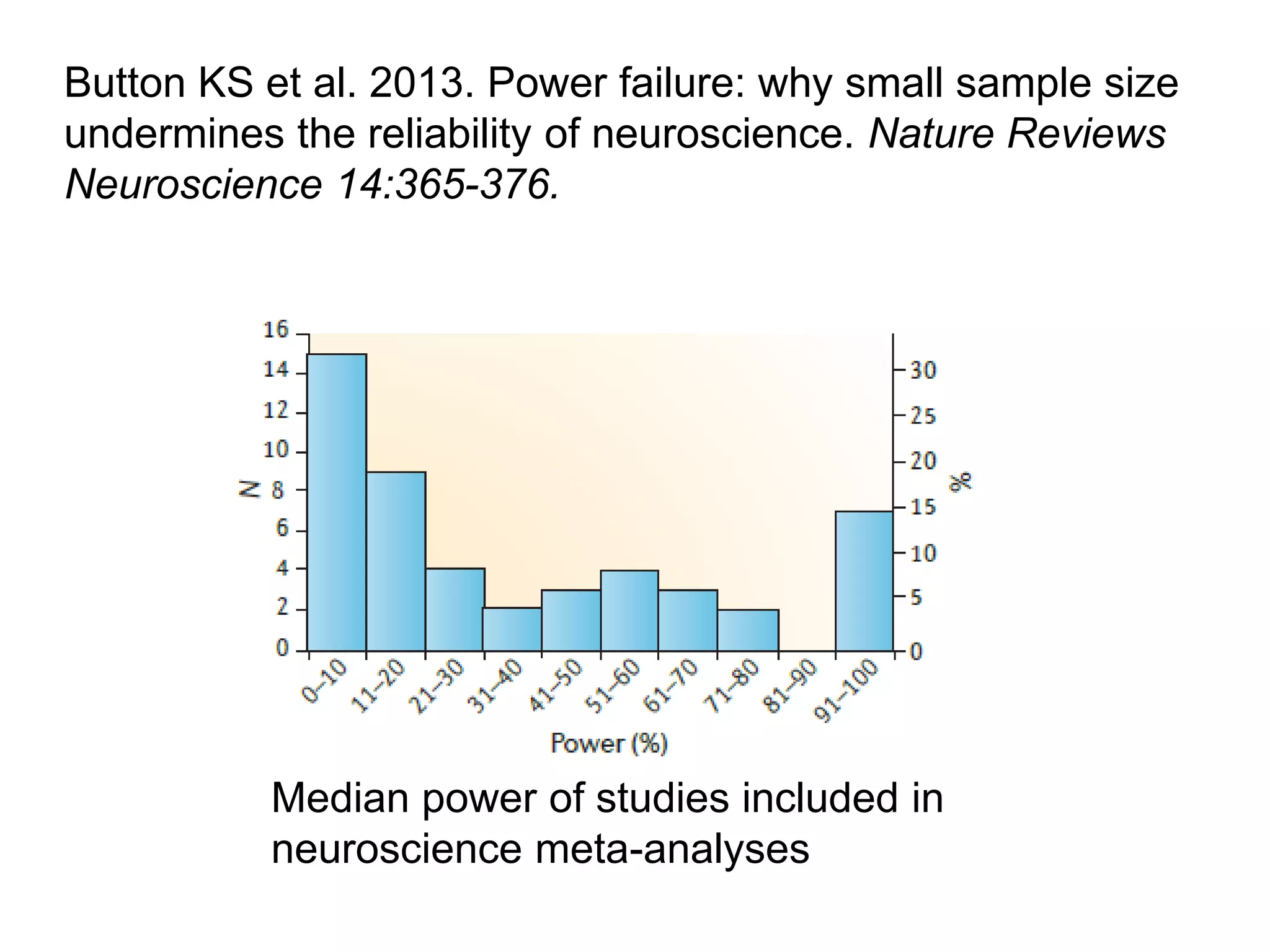
Button KS et al. 2013. Power failure: why small sample size
undermines the reliability of neuroscience. Nature Reviews
Neuroscience 14:365-376.
Median power of studies included in
neuroscience meta-analyses
Generate
and specify
hypotheses
Design
study
Collect data
Analyse
data & test
hypotheses
Interpret
data
Publish or
conduct
next
experiment
Hypothetico-deductive scientific method
based on original by Chris Chambers
p-hacking
Low
statistical
power
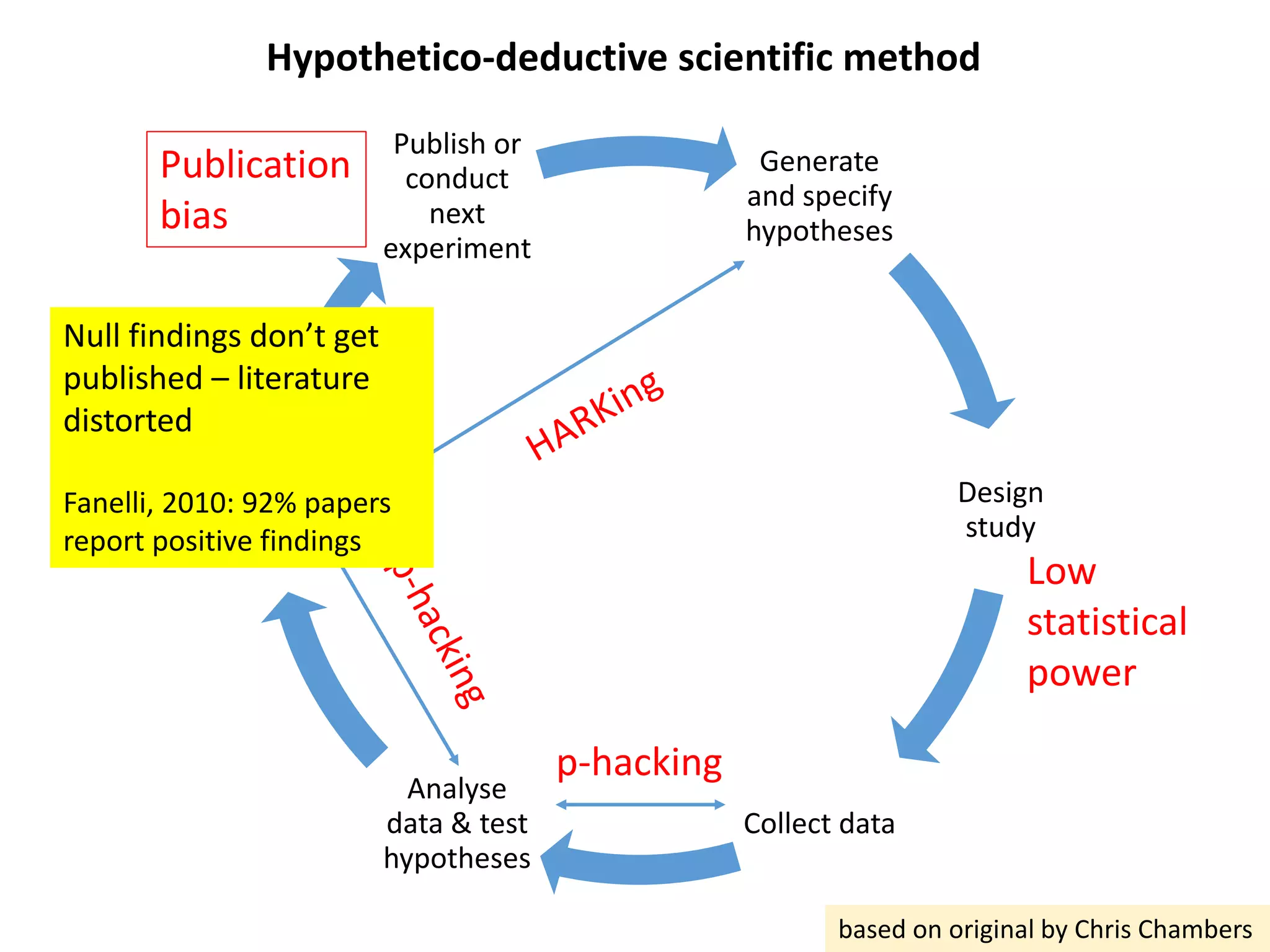
Publication
bias
Null findings don’t get
published – literature
distorted
Fanelli, 2010: 92% papers
report positive findings
Generate
and specify
hypotheses
Design
study
Collect data
Analyse
data & test
hypotheses
Interpret
data
Publish or
conduct
next
experiment
Hypothetico-deductive scientific method
p-hacking
Low
statistical
power
Publication
bias
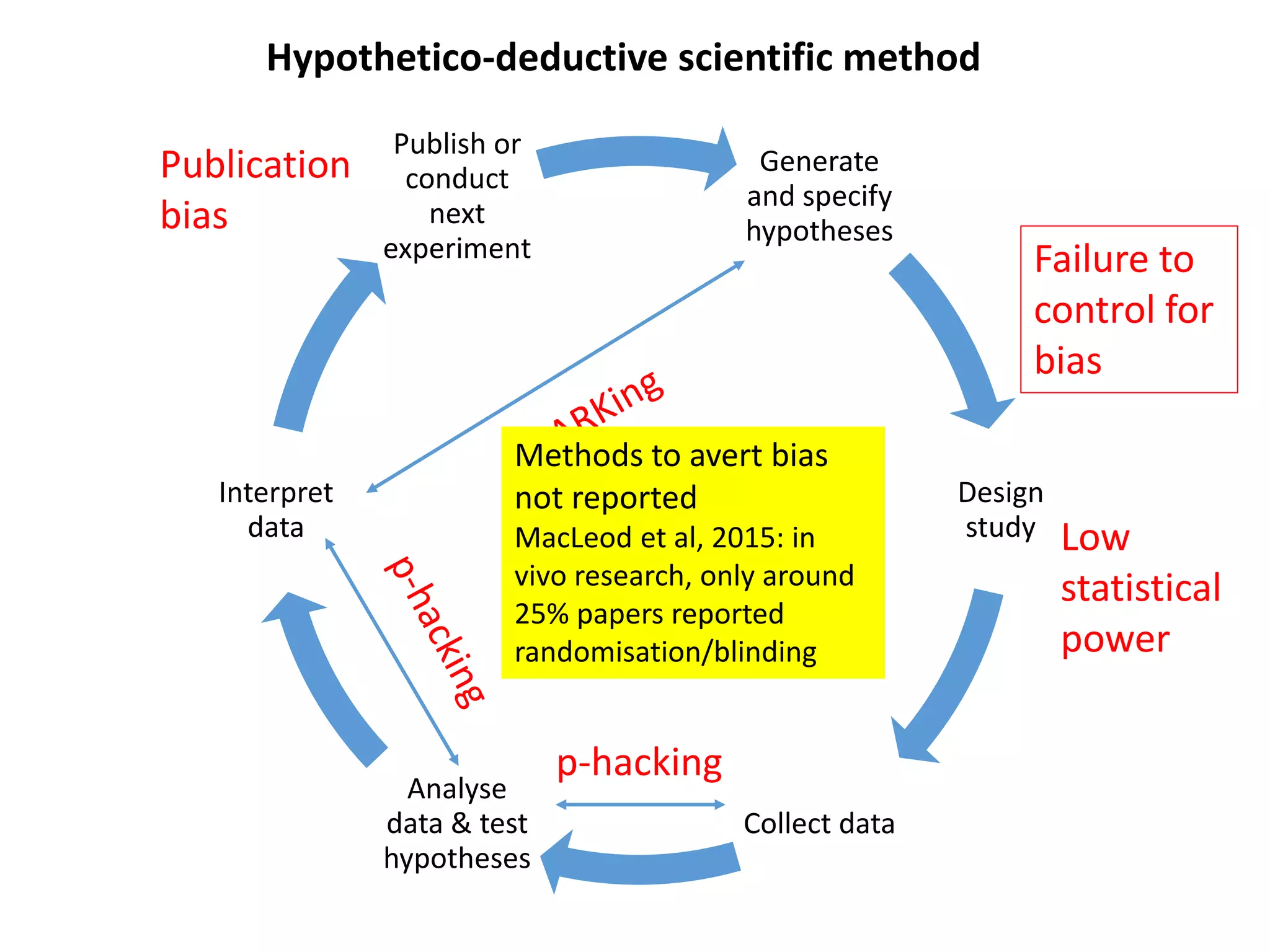
Methods to avert bias
not reported
MacLeod et al, 2015: in
vivo research, only around
25% papers reported
randomisation/blinding
Failure to
control for
bias
Generate
and specify
hypotheses
Design
study
Collect data
Analyse
data & test
hypotheses
Interpret
data
Publish or
conduct
next
experiment
Hypothetico-deductive scientific method
p-hacking
Low
statistical
power
Publication
bias
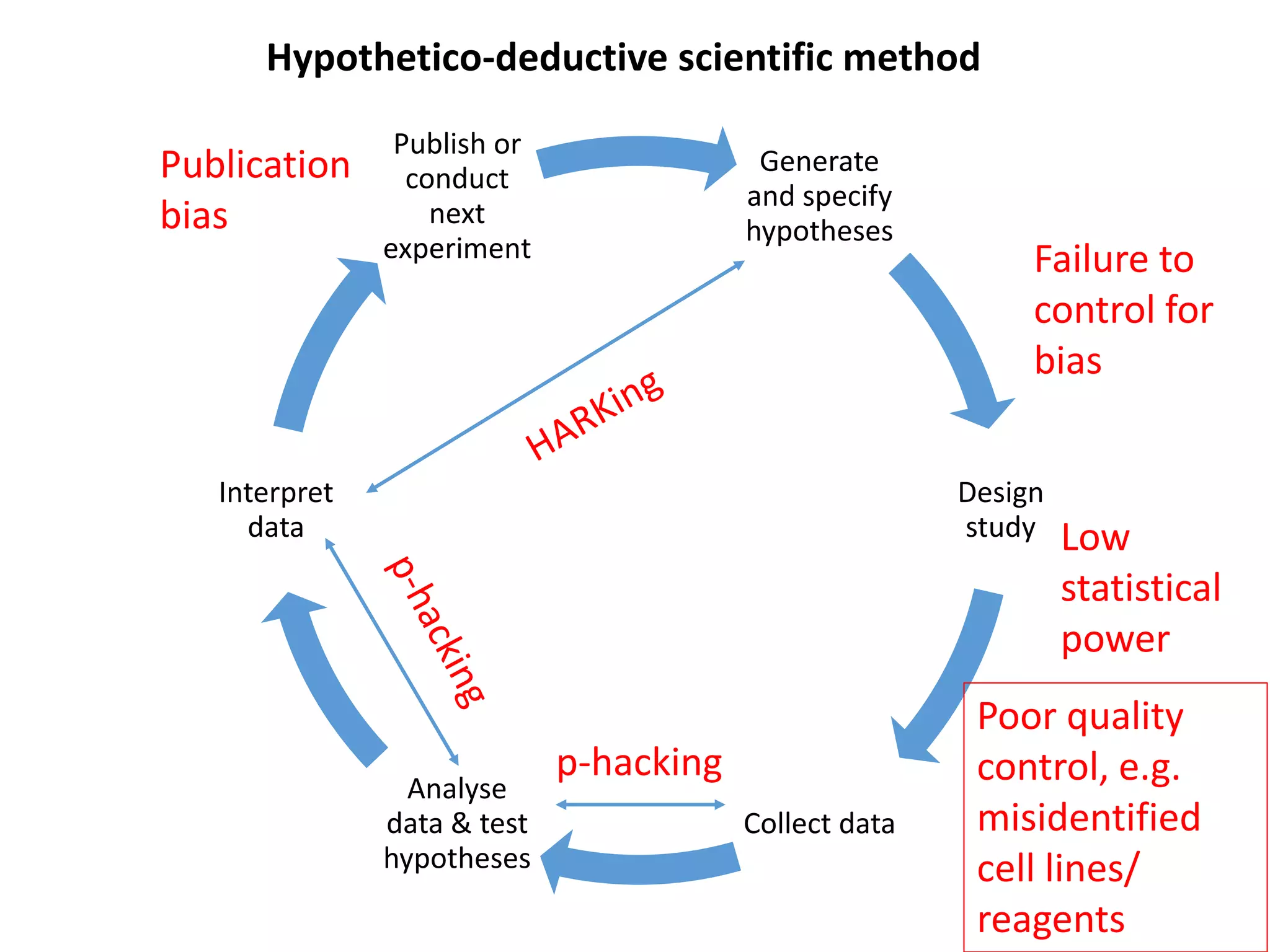
Failure to
control for
bias
Poor quality
control, e.g.
misidentified
cell lines/
reagents
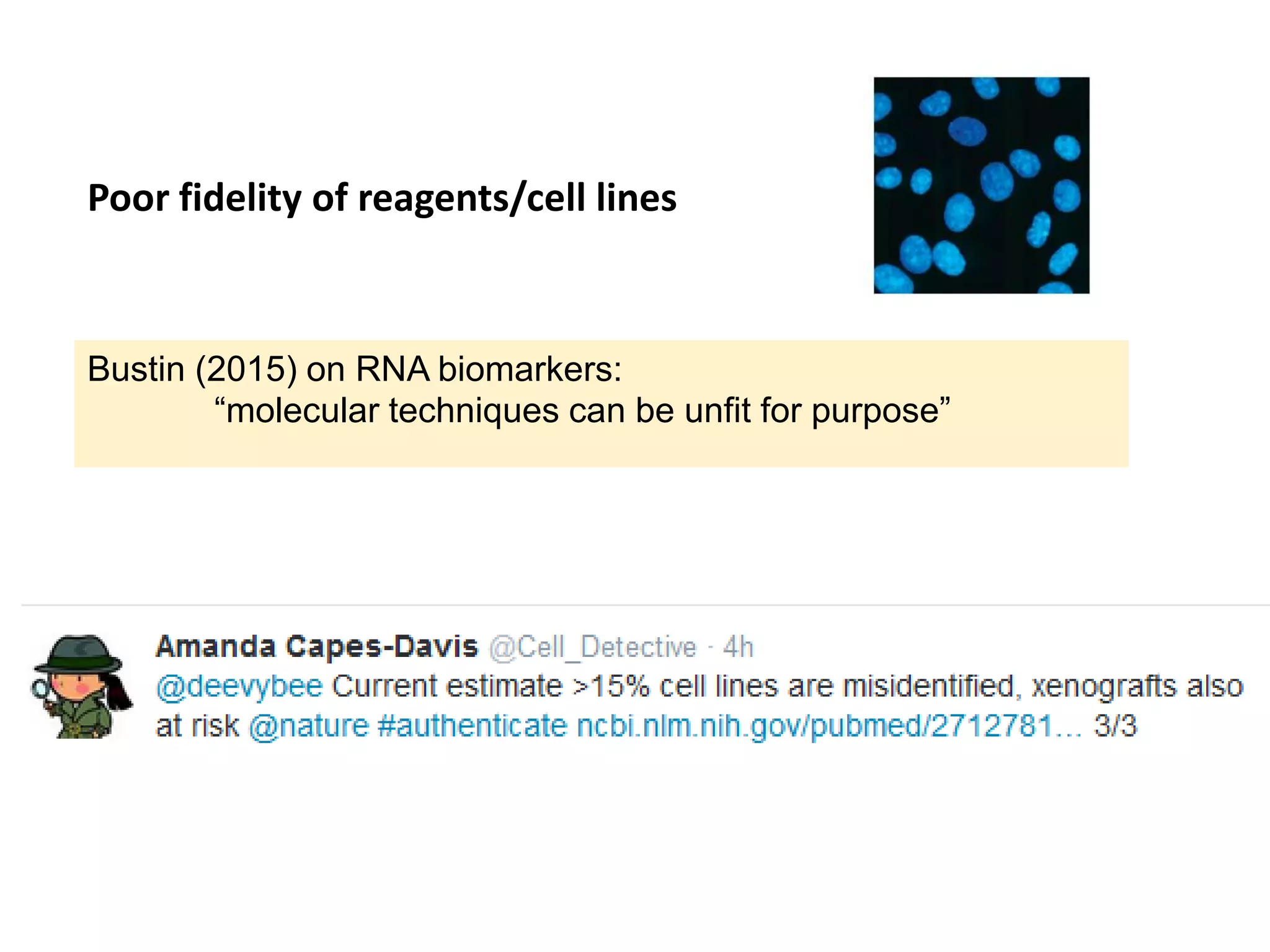
Bustin (2015) on RNA biomarkers:
“molecular techniques can be unfit for purpose”
Poor fidelity of reagents/cell lines
None of this is new!
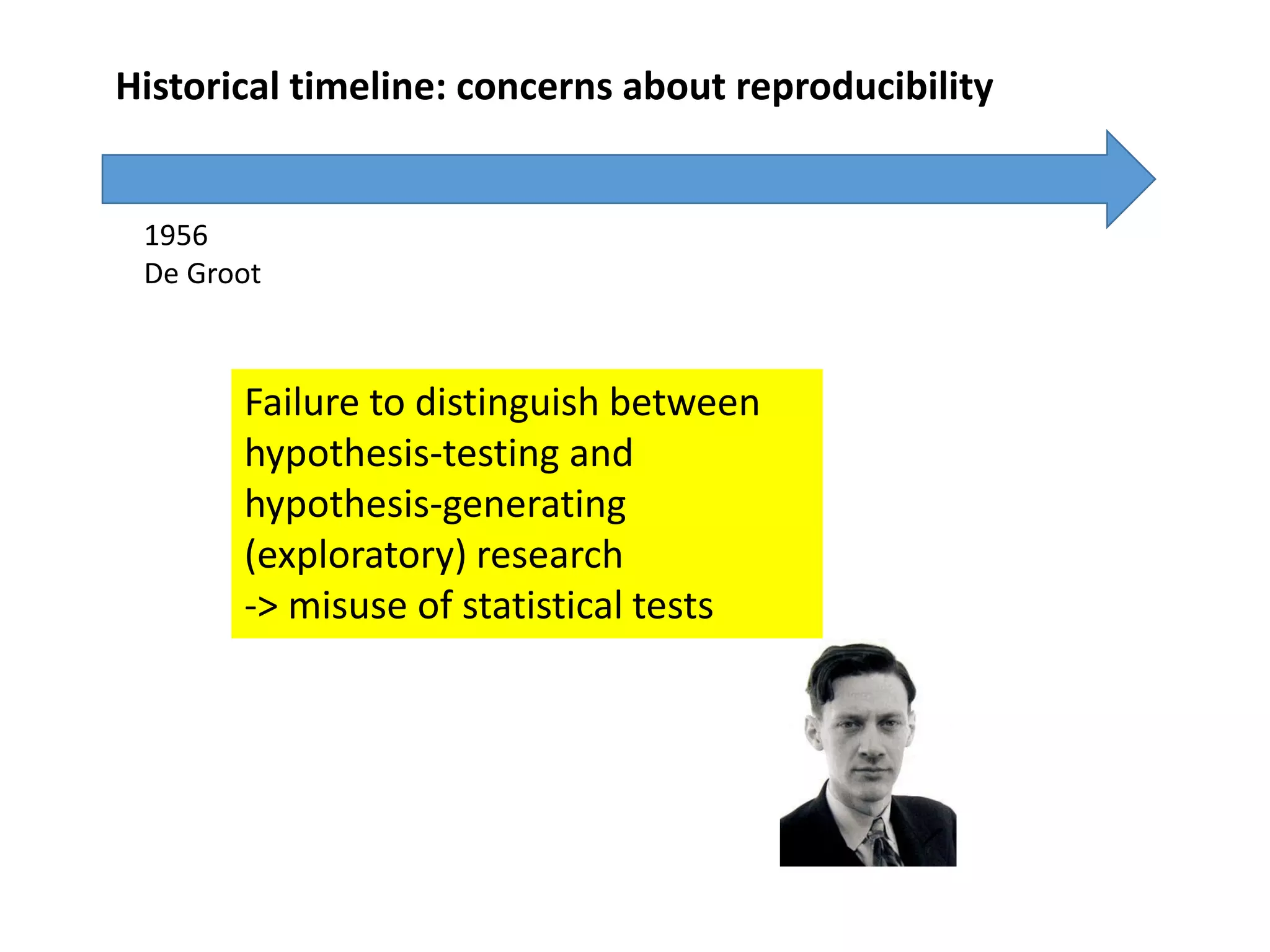
1956
De Groot
Failure to distinguish between
hypothesis-testing and
hypothesis-generating
(exploratory) research
-> misuse of statistical tests
Historical timeline: concerns about reproducibility
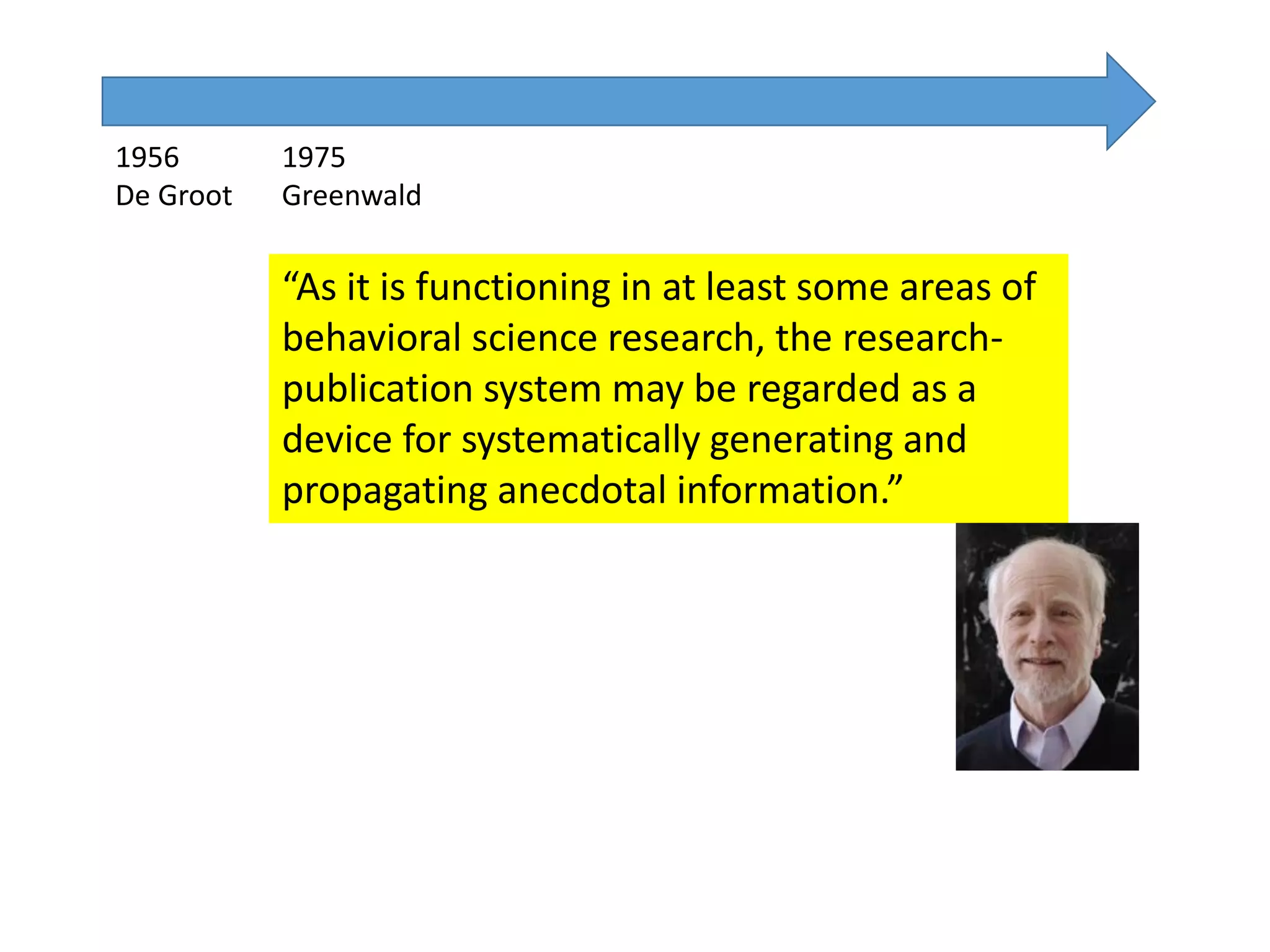
1956
De Groot
1975
Greenwald
“As it is functioning in at least some areas of
behavioral science research, the research-
publication system may be regarded as a
device for systematically generating and
propagating anecdotal information.”
1956
De Groot
1975
Greenwald
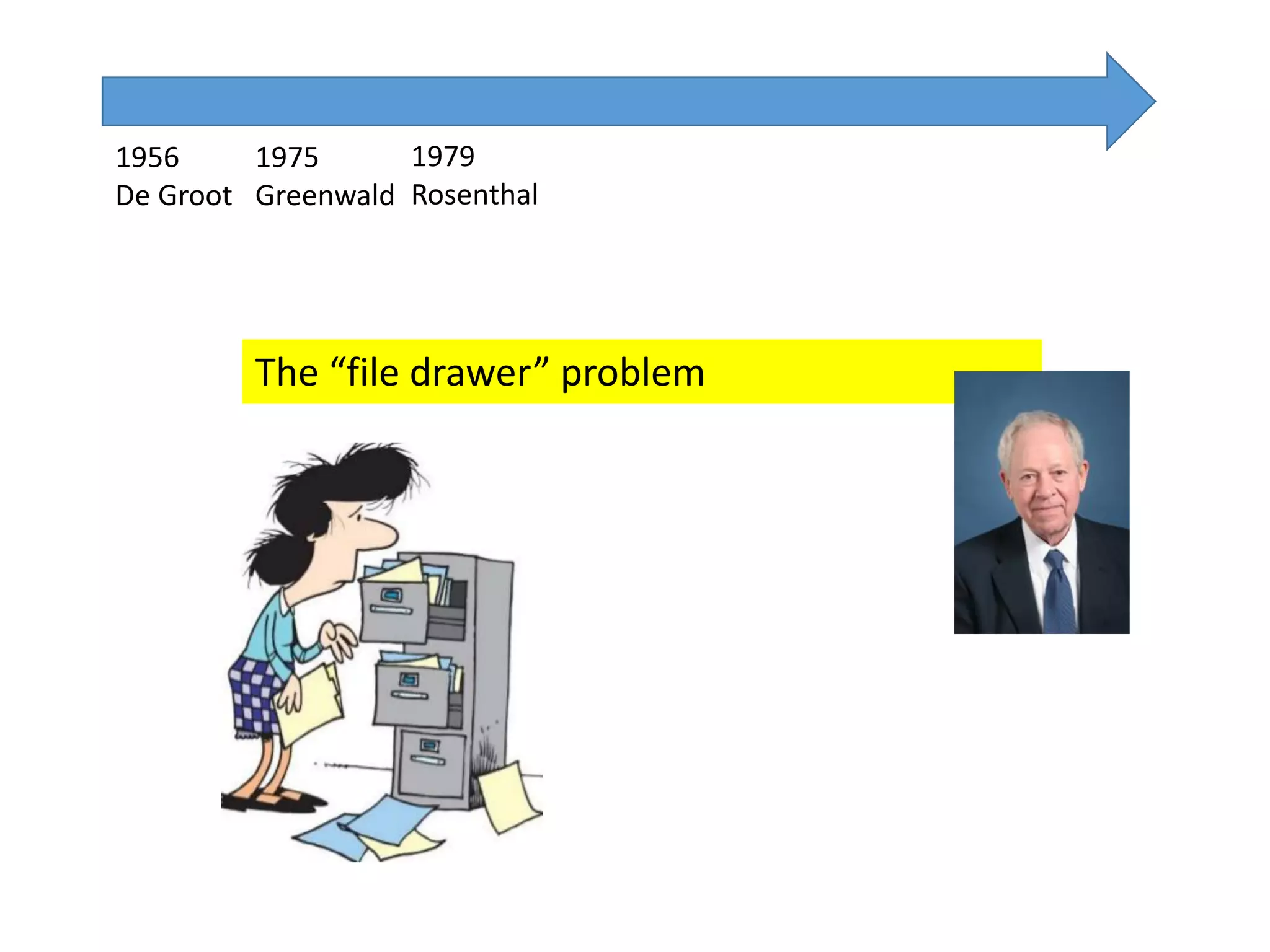
The “file drawer” problem
1979
Rosenthal
1956
De Groot
1975
Greenwald
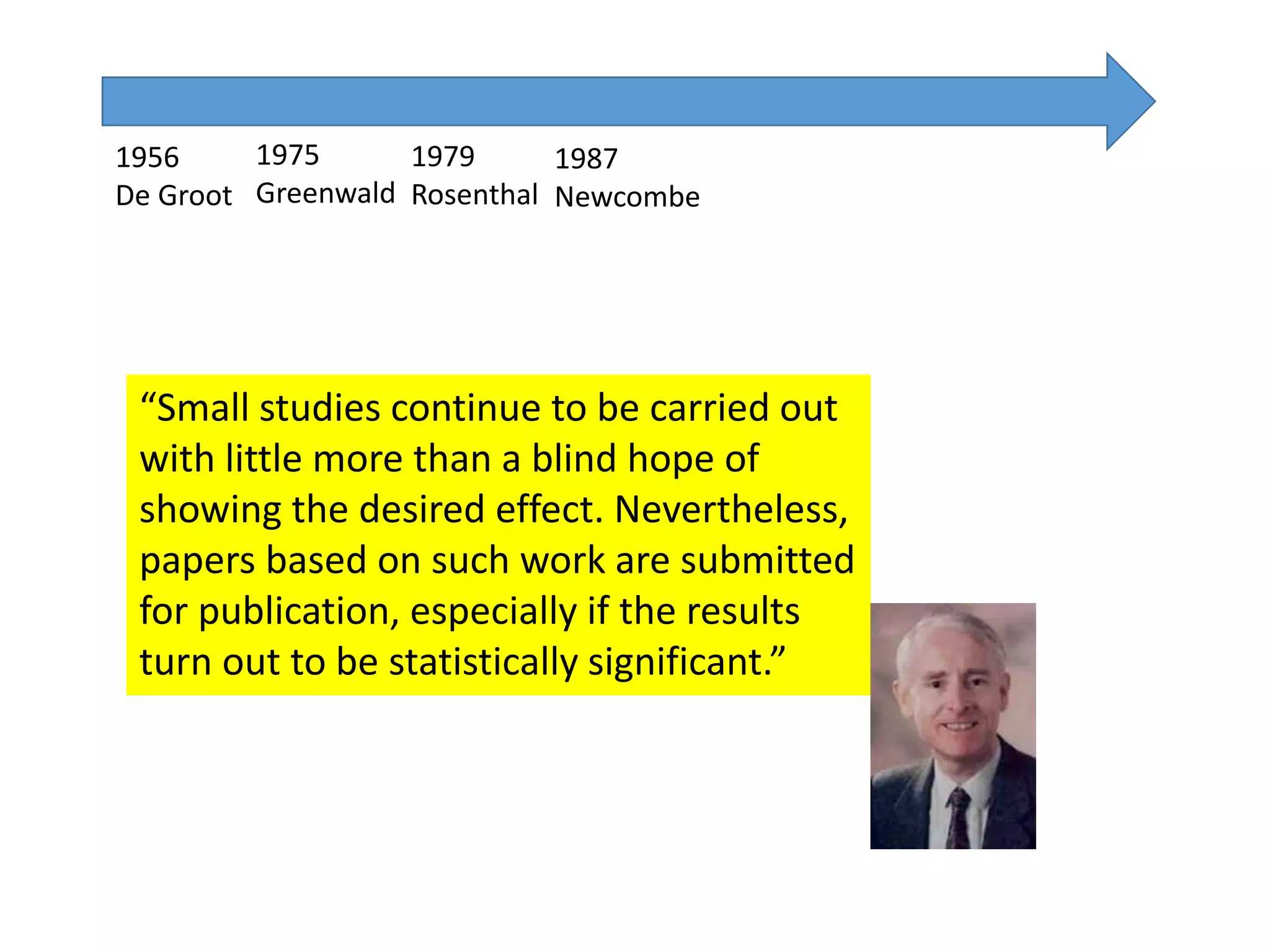
1987
Newcombe
“Small studies continue to be carried out
with little more than a blind hope of
showing the desired effect. Nevertheless,
papers based on such work are submitted
for publication, especially if the results
turn out to be statistically significant.”
1979
Rosenthal
1956
De Groot
1975
Greenwald
1987
Newcombe
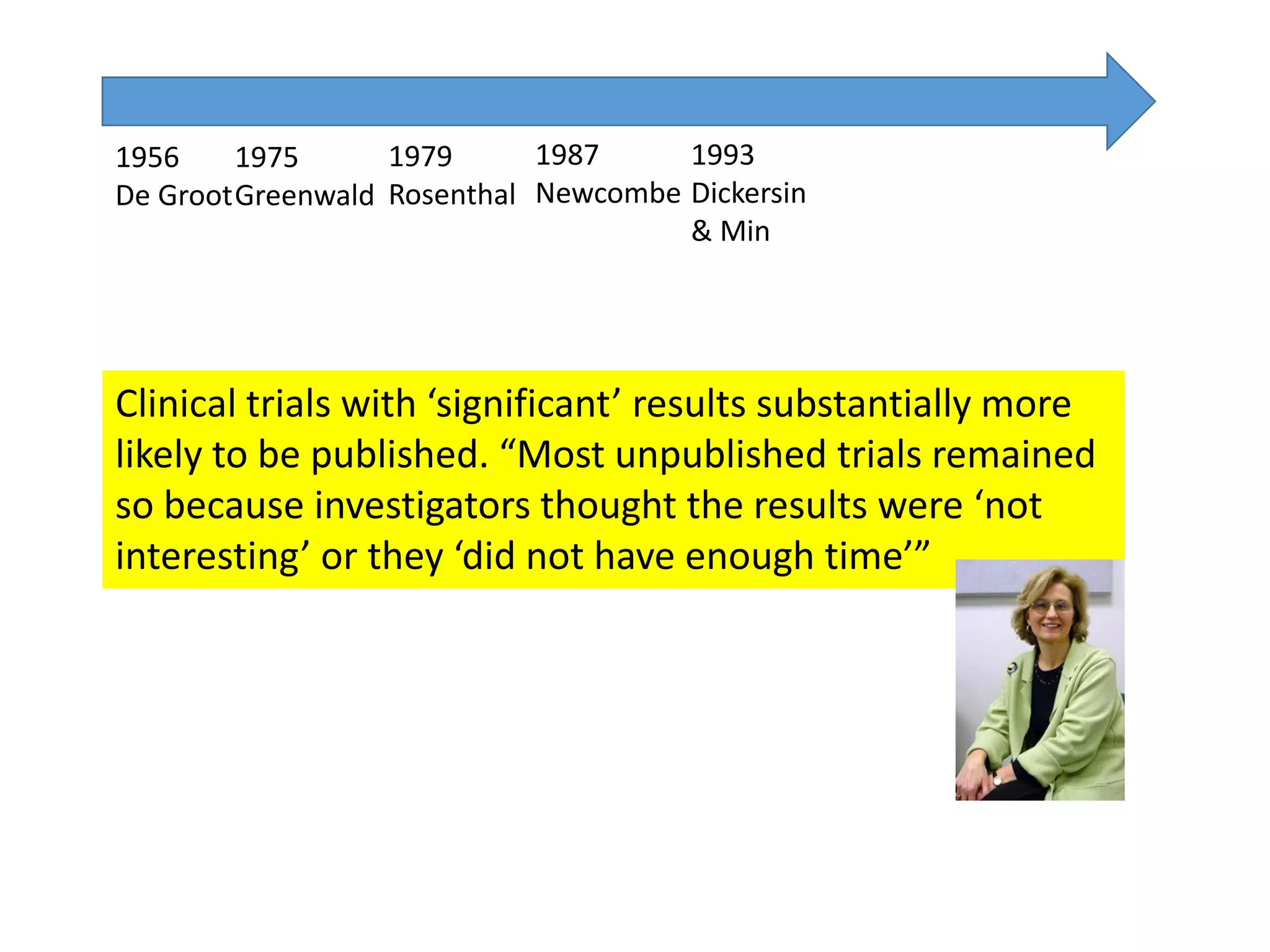
1993
Dickersin
& Min
Clinical trials with ‘significant’ results substantially more
likely to be published. “Most unpublished trials remained
so because investigators thought the results were ‘not
interesting’ or they ‘did not have enough time’”
1979
Rosenthal
1956
De Groot
1975
Greenwald
1987
Newcombe
1993
Dickersin
& Min
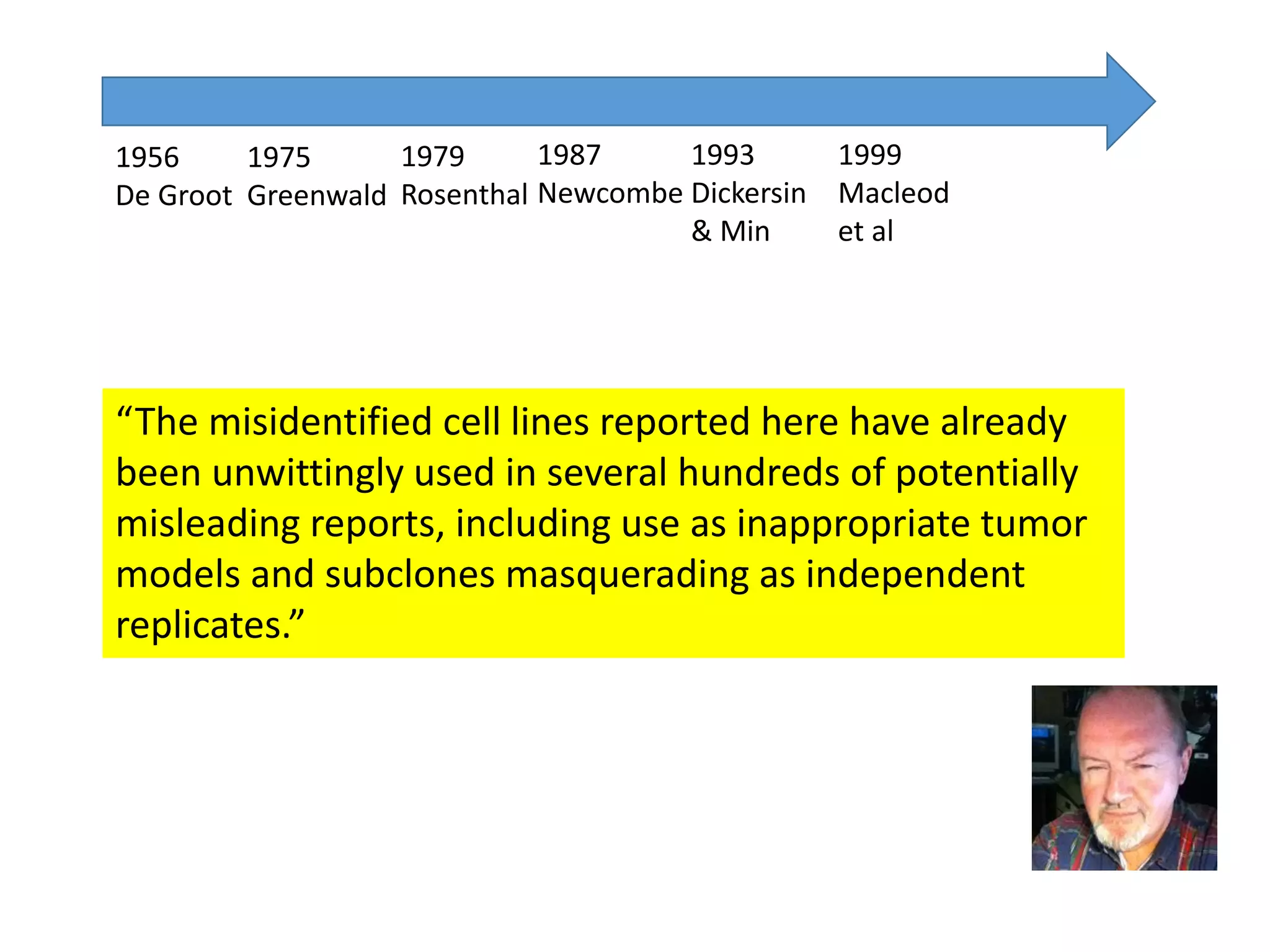
“The misidentified cell lines reported here have already
been unwittingly used in several hundreds of potentially
misleading reports, including use as inappropriate tumor
models and subclones masquerading as independent
replicates.”
1999
Macleod
et al
1979
Rosenthal
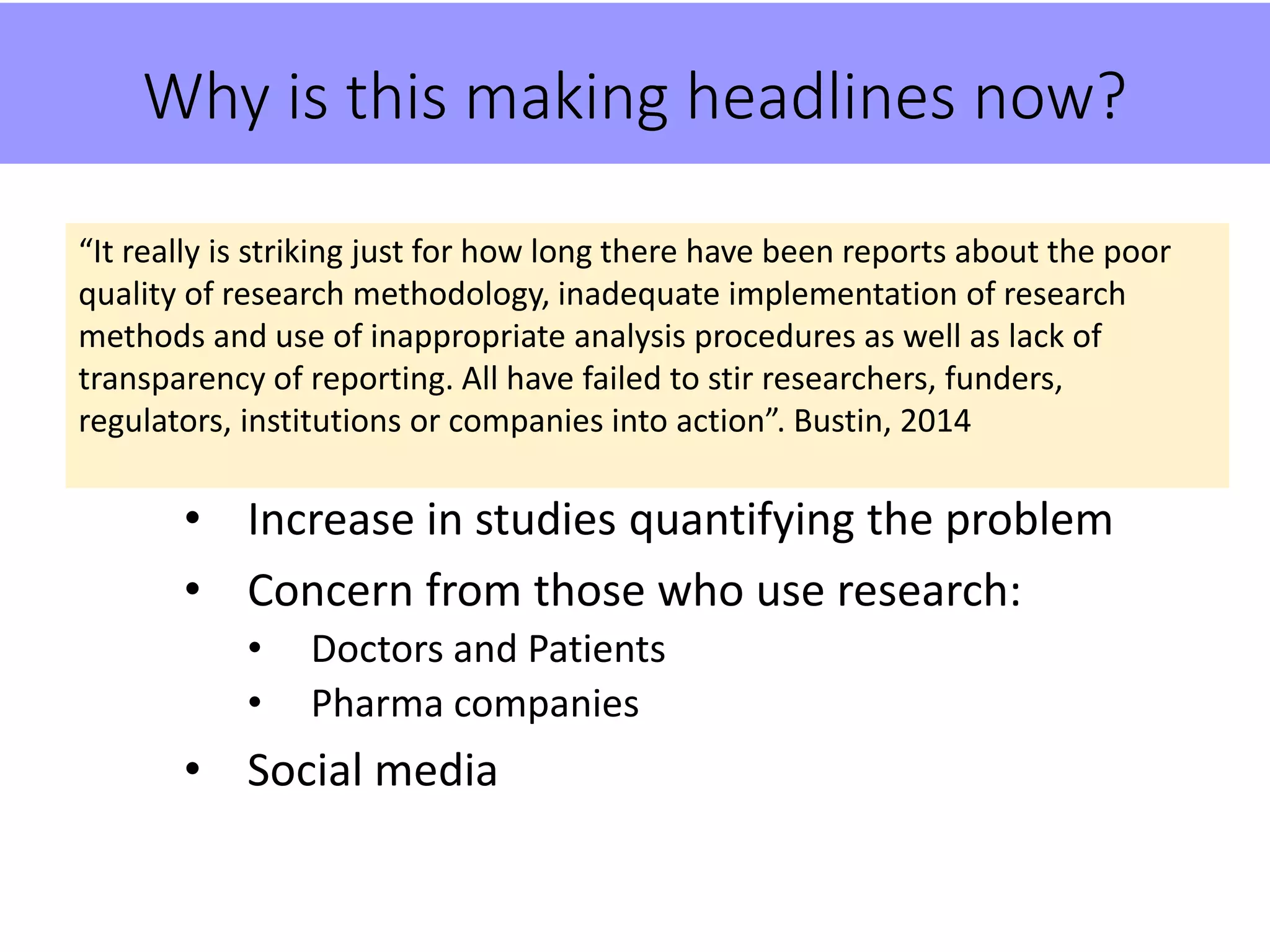
Why is this making headlines now?
• Increase in studies quantifying the problem
• Concern from those who use research:
• Doctors and Patients
• Pharma companies
• Social media
“It really is striking just for how long there have been reports about the poor
quality of research methodology, inadequate implementation of research
methods and use of inappropriate analysis procedures as well as lack of
transparency of reporting. All have failed to stir researchers, funders,
regulators, institutions or companies into action”. Bustin, 2014
Failure to appreciate power of ‘the prepared mind’
Natural instinct is to look for consistent evidence, not disproof
Problems caused by researchers: 1
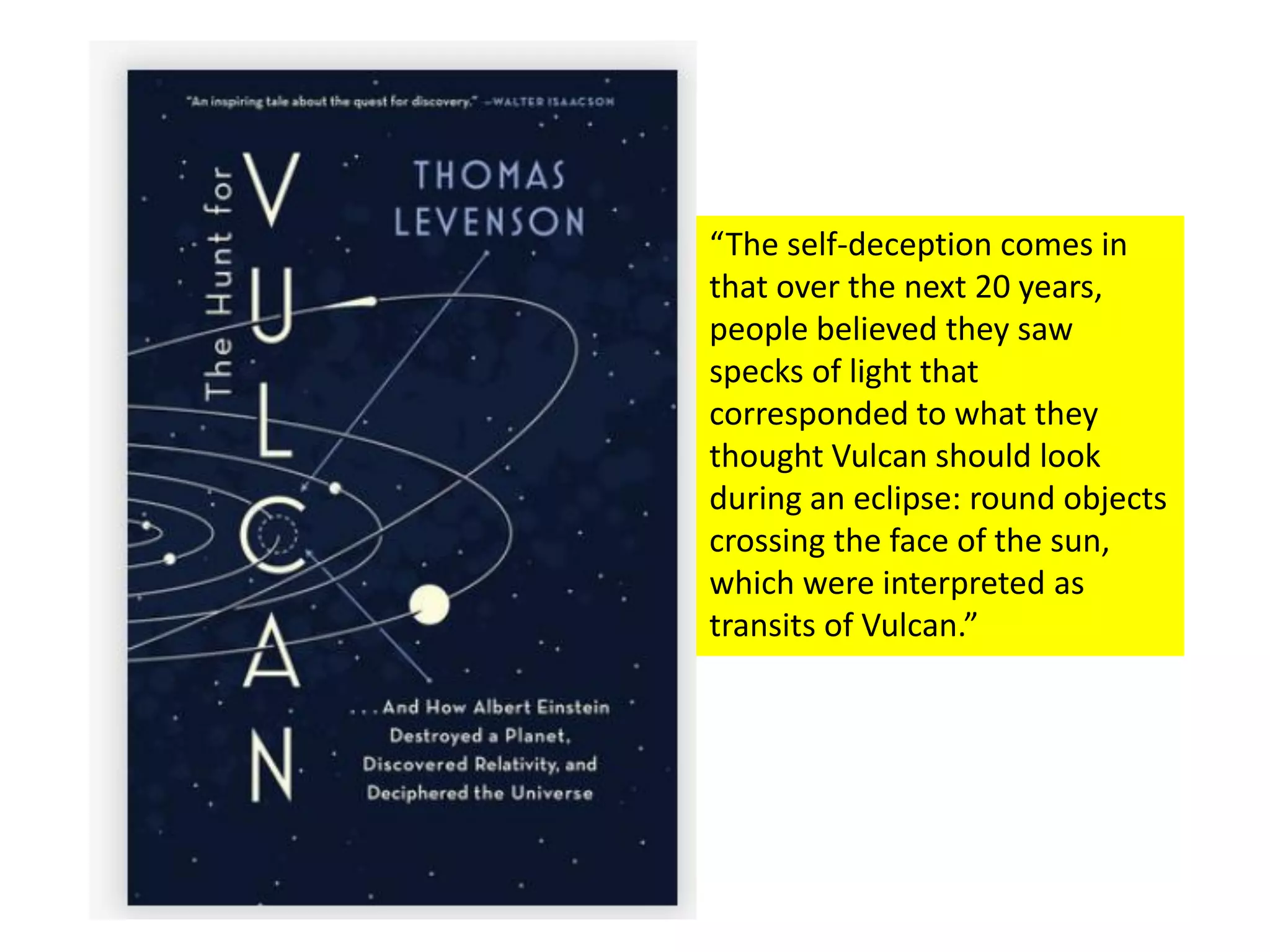
“The self-deception comes in
that over the next 20 years,
people believed they saw
specks of light that
corresponded to what they
thought Vulcan should look
during an eclipse: round objects
crossing the face of the sun,
which were interpreted as
transits of Vulcan.”
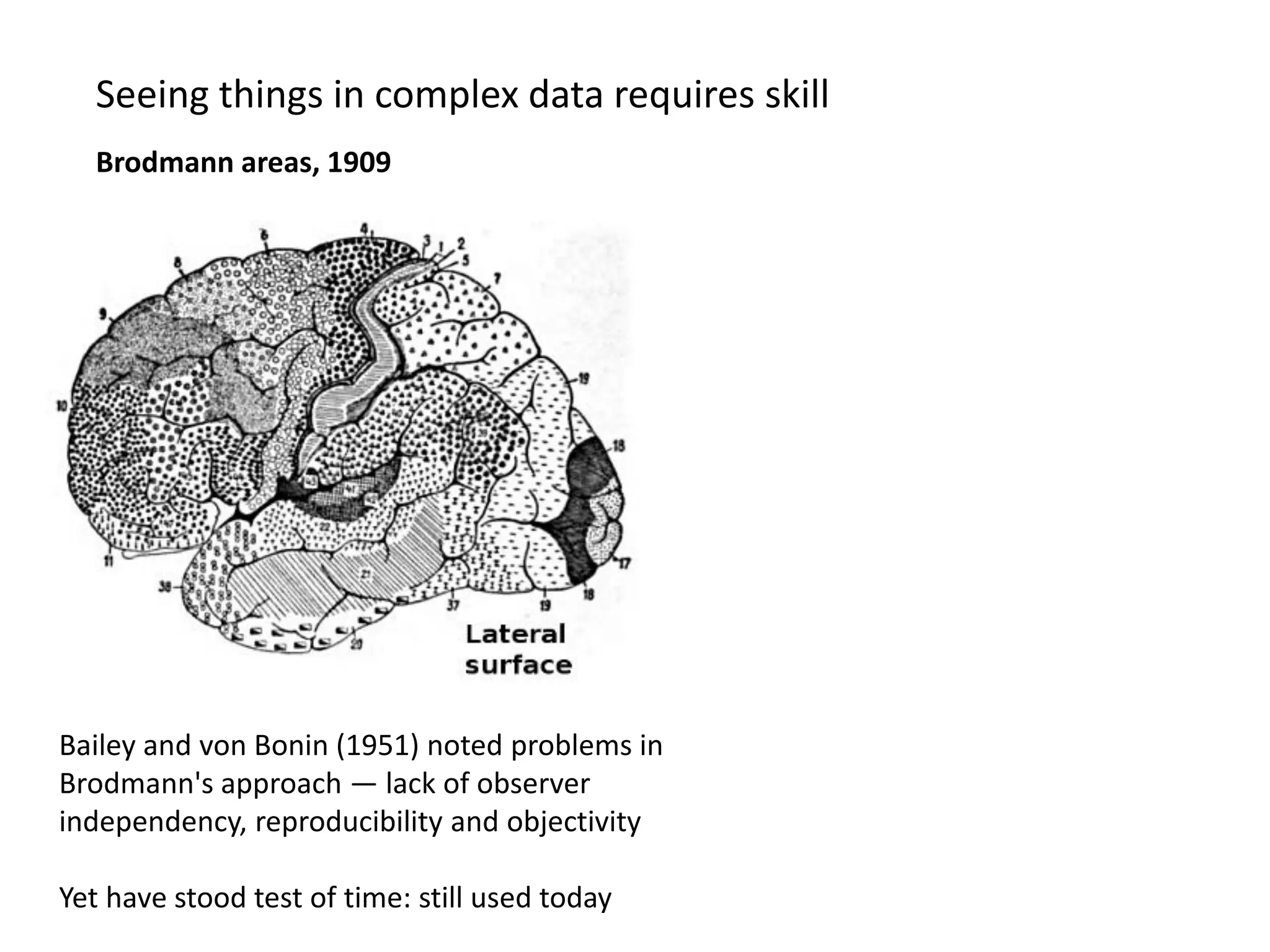
Seeing things in complex data requires skill
Bailey and von Bonin (1951) noted problems in
Brodmann's approach — lack of observer
independency, reproducibility and objectivity
Yet have stood test of time: still used today
Brodmann areas, 1909
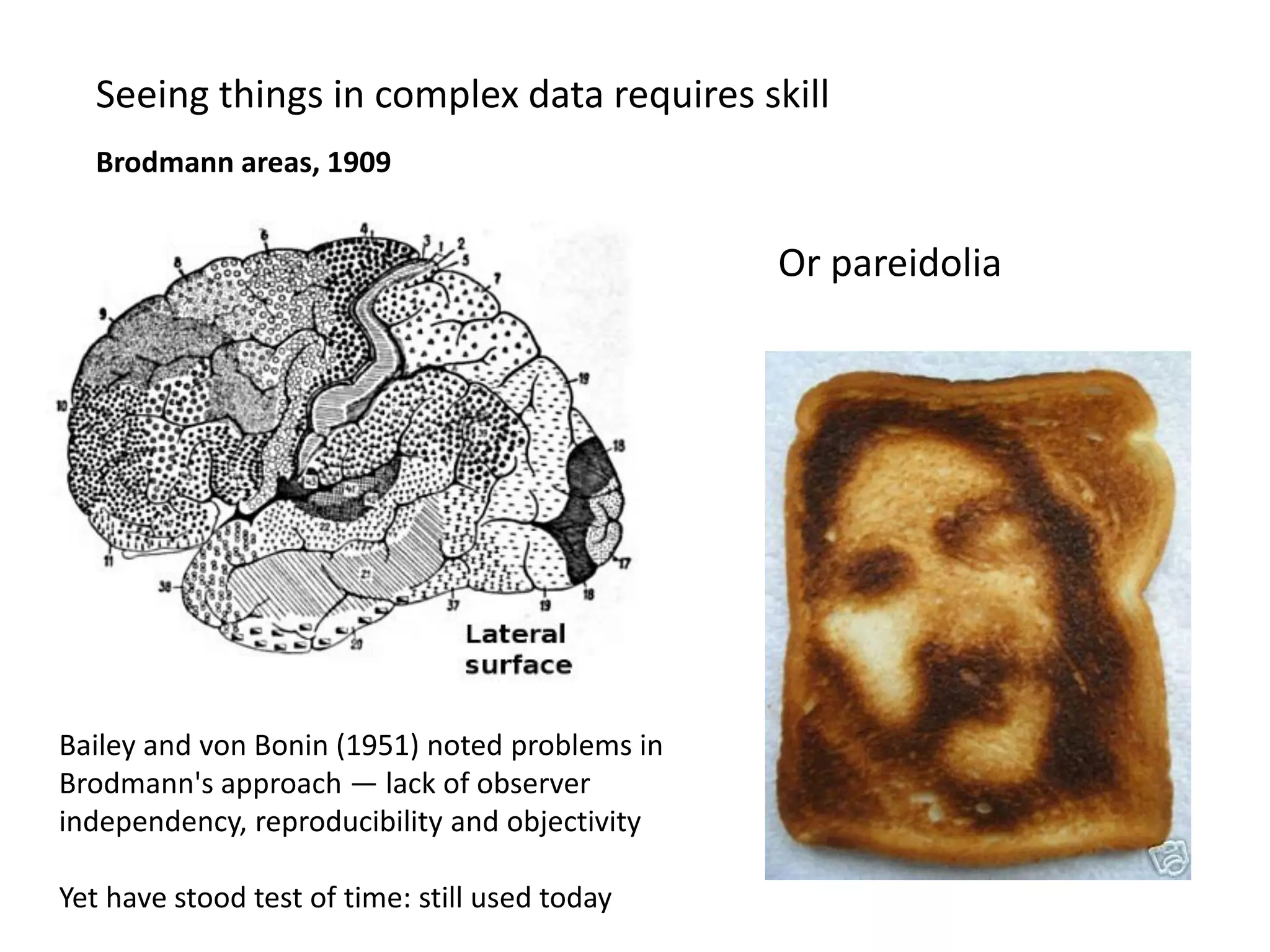
Seeing things in complex data requires skill
Or pareidolia
Bailey and von Bonin (1951) noted problems in
Brodmann's approach — lack of observer
independency, reproducibility and objectivity
Yet have stood test of time: still used today
Brodmann areas, 1909
Discusses failure so replicate studies on preferential
looking in babies – role of experimenter expertise
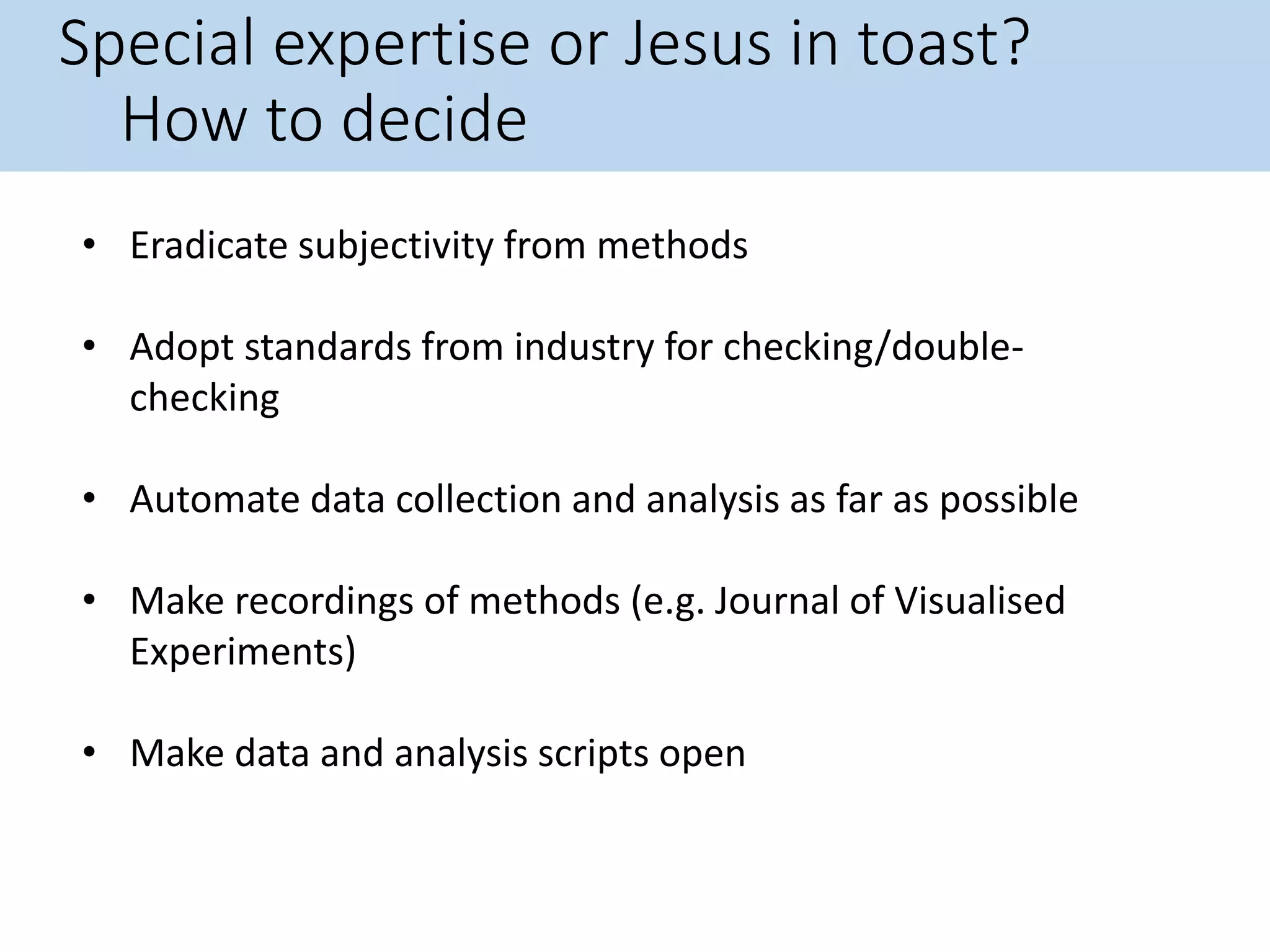
Special expertise or Jesus in toast?
How to decide
• Eradicate subjectivity from methods
• Adopt standards from industry for checking/double-
checking
• Automate data collection and analysis as far as possible
• Make recordings of methods (e.g. Journal of Visualised
Experiments)
• Make data and analysis scripts open
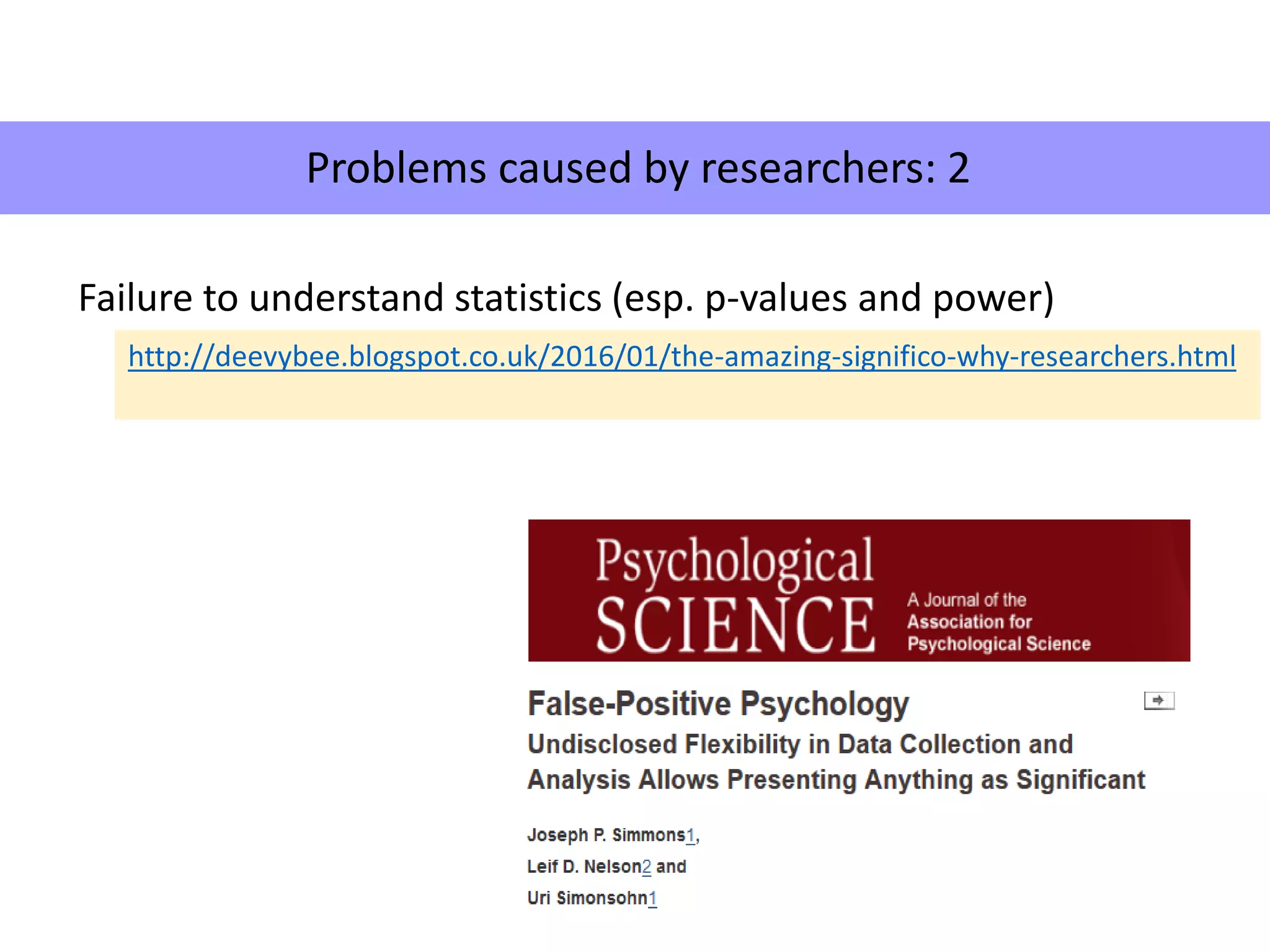
Failure to understand statistics (esp. p-values and power)
http://deevybee.blogspot.co.uk/2016/01/the-amazing-significo-why-researchers.html
Problems caused by researchers: 2
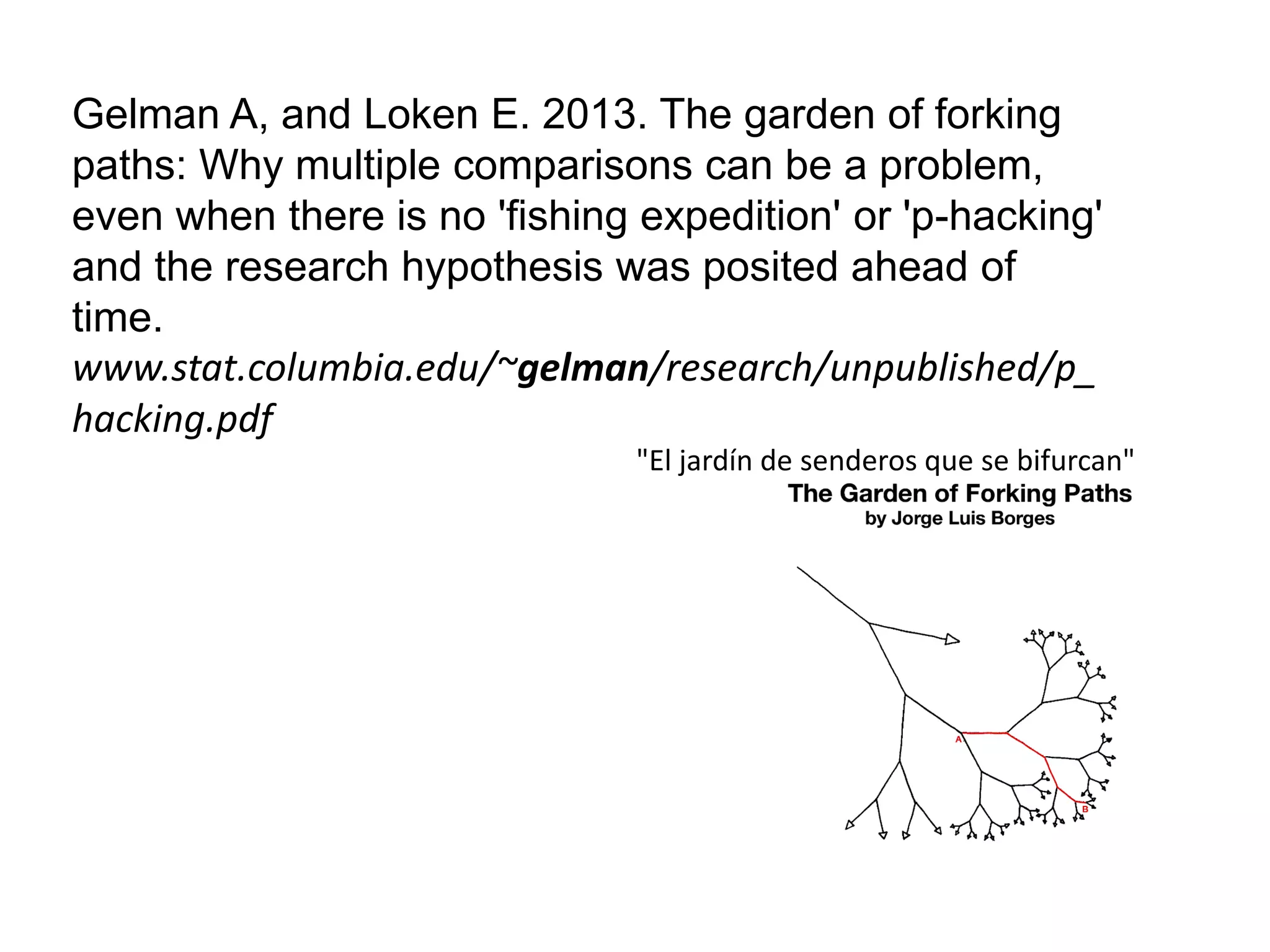
Gelman A, and Loken E. 2013. The garden of forking
paths: Why multiple comparisons can be a problem,
even when there is no 'fishing expedition' or 'p-hacking'
and the research hypothesis was posited ahead of
time.
www.stat.columbia.edu/~gelman/research/unpublished/p_
hacking.pdf
"El jardín de senderos que se bifurcan"
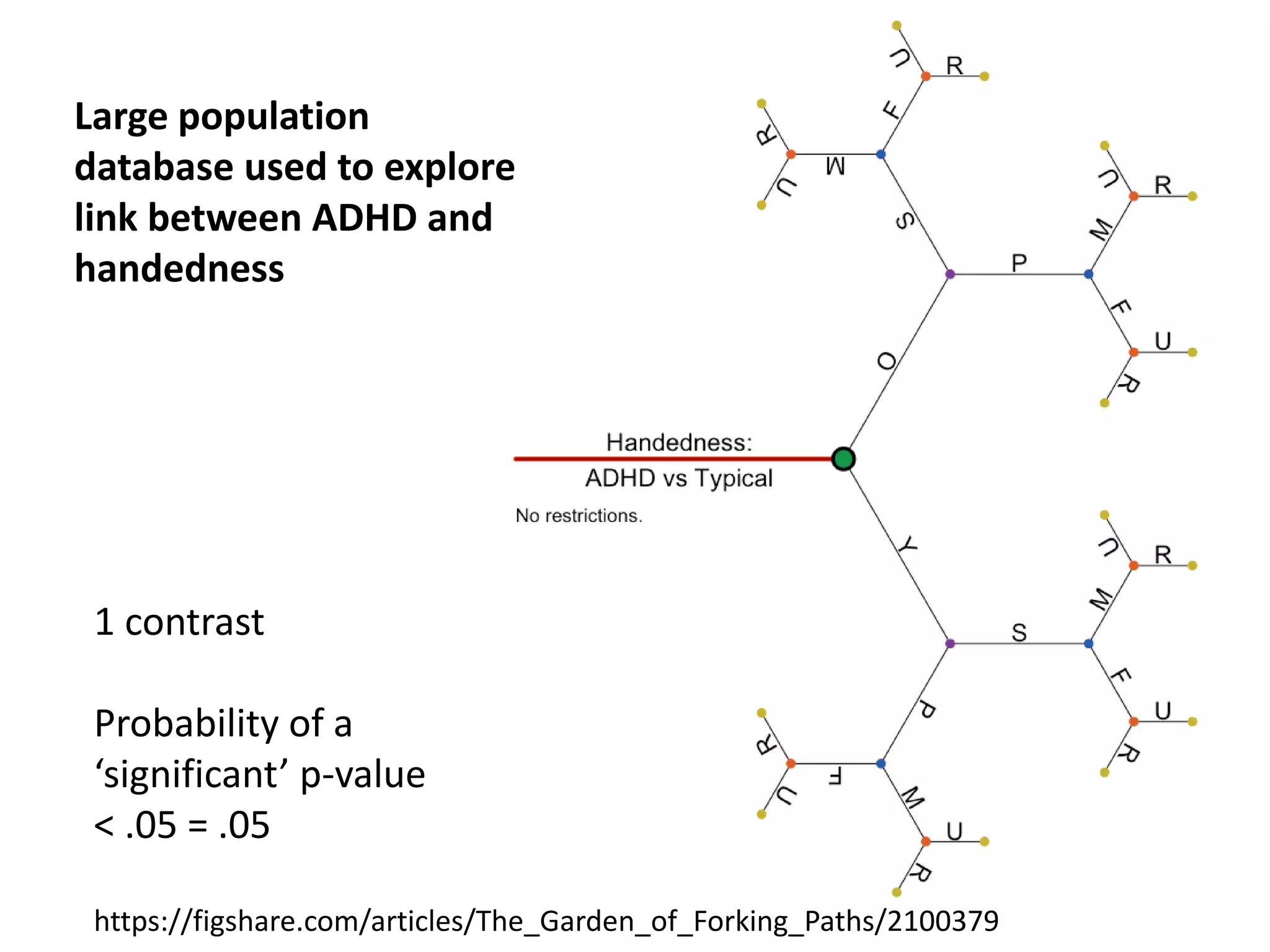
1 contrast
Probability of a
‘significant’ p-value
< .05 = .05
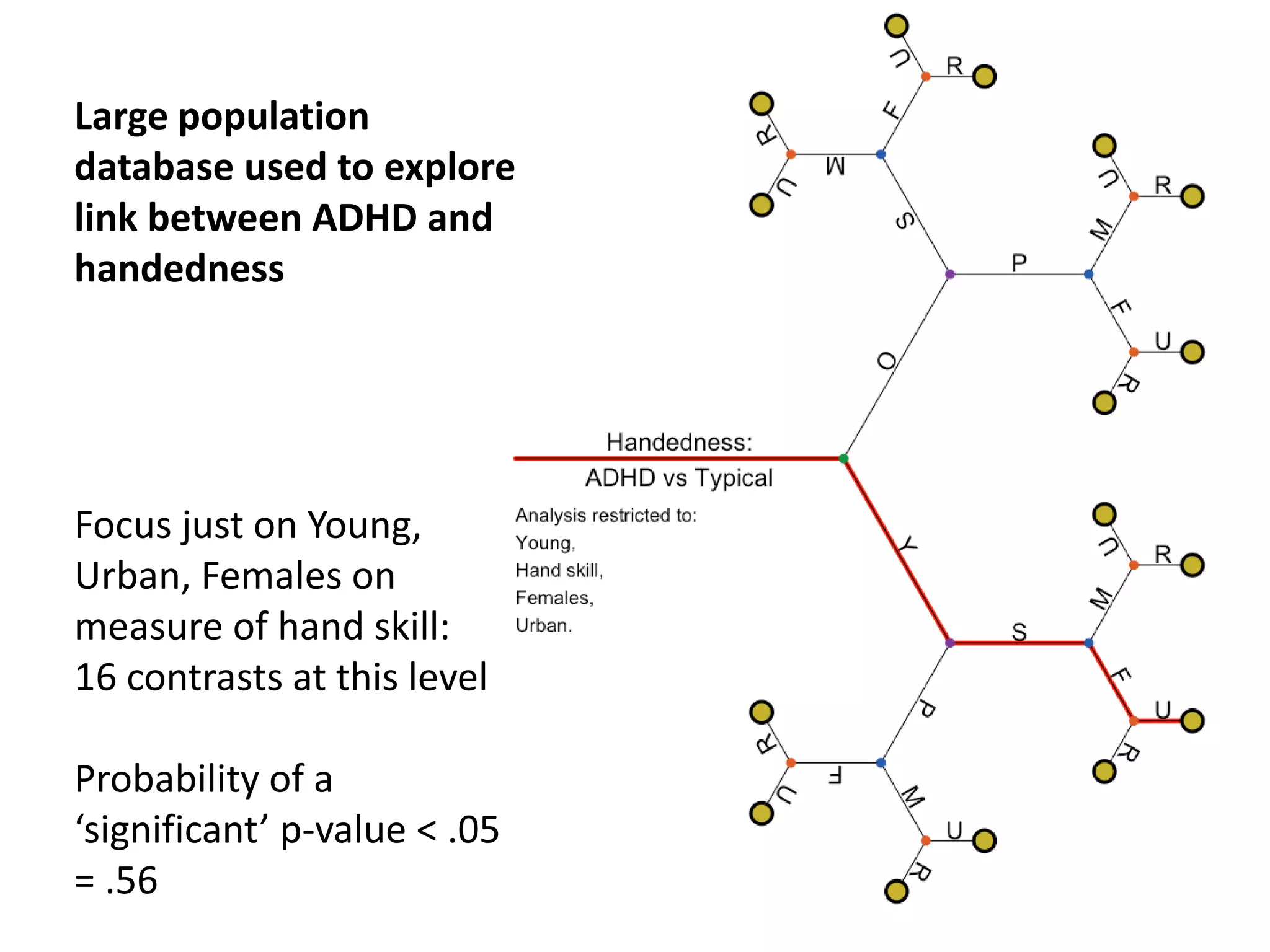
Large population
database used to explore
link between ADHD and
handedness
https://figshare.com/articles/The_Garden_of_Forking_Paths/2100379
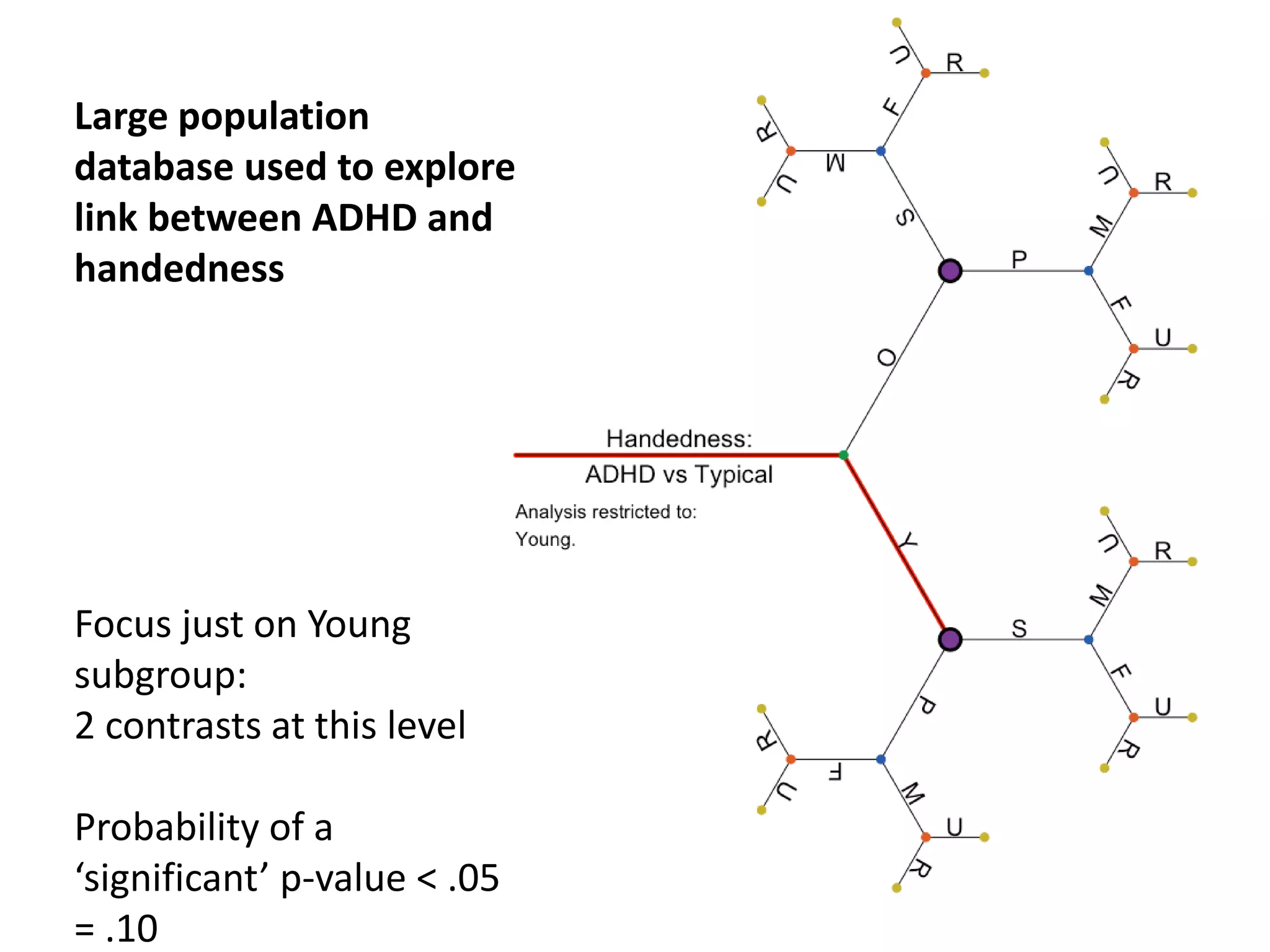
Focus just on Young
subgroup:
2 contrasts at this level
Probability of a
‘significant’ p-value < .05
= .10
Large population
database used to explore
link between ADHD and
handedness
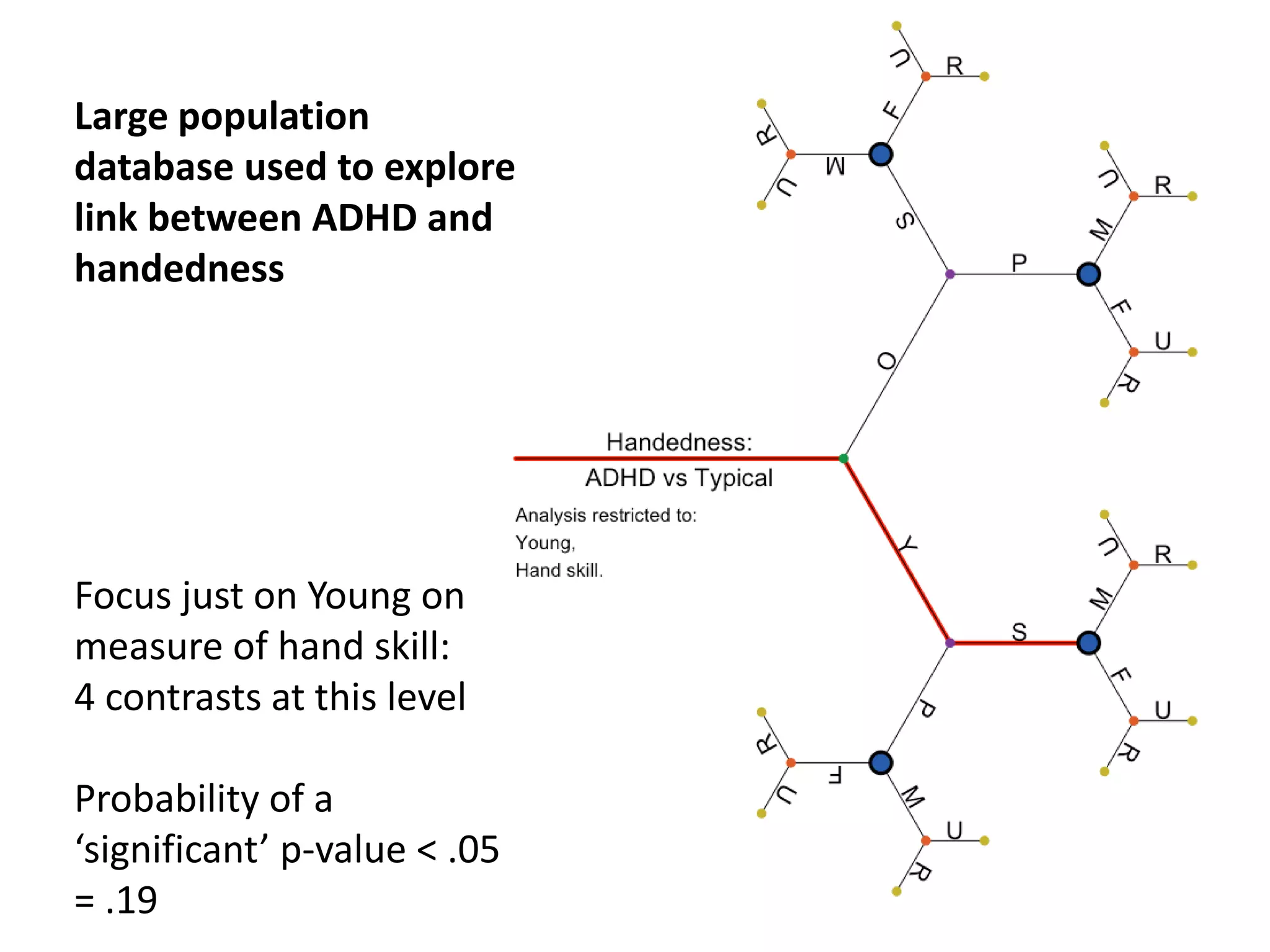
Focus just on Young on
measure of hand skill:
4 contrasts at this level
Probability of a
‘significant’ p-value < .05
= .19
Large population
database used to explore
link between ADHD and
handedness
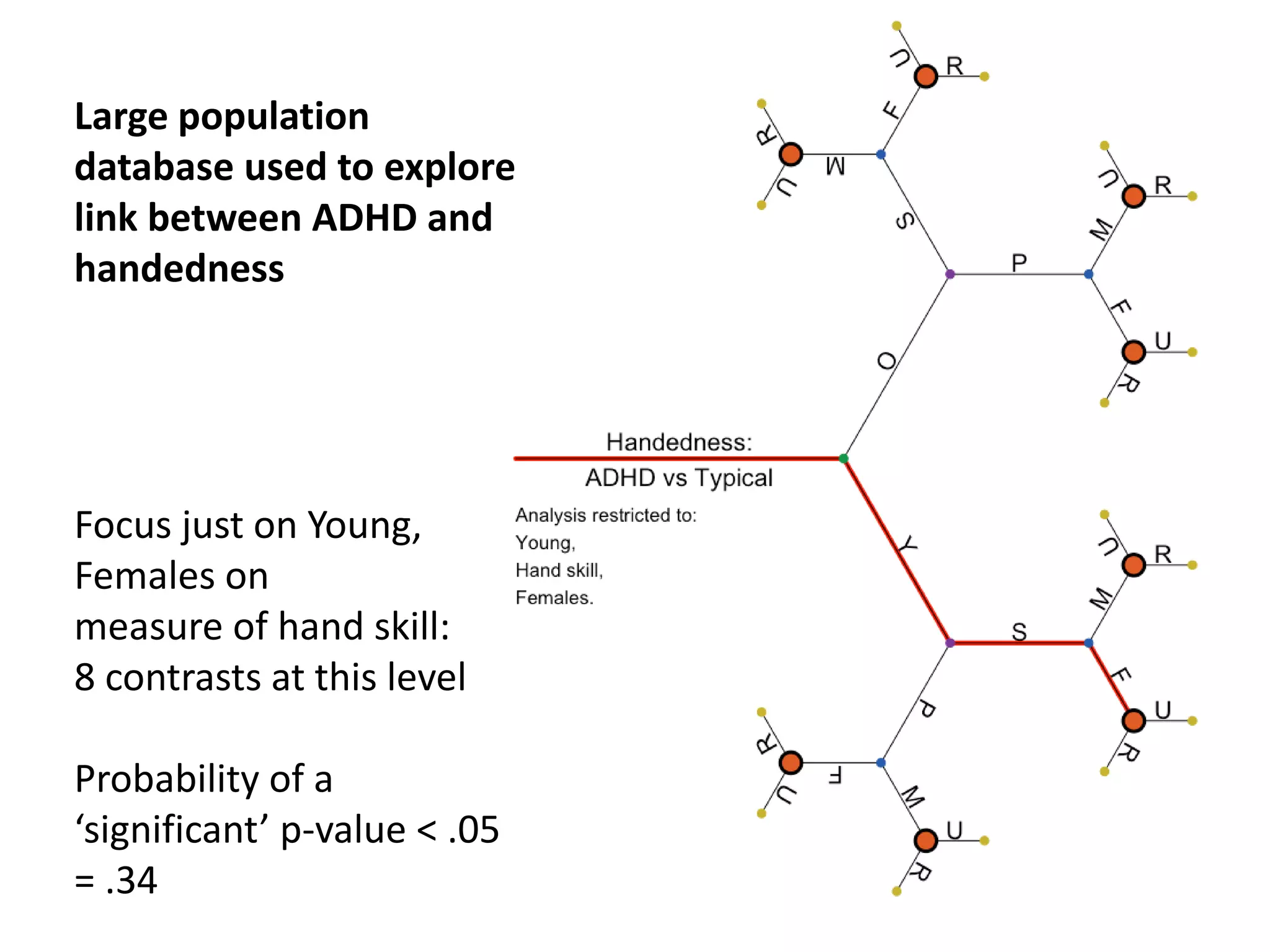
Focus just on Young,
Females on
measure of hand skill:
8 contrasts at this level
Probability of a
‘significant’ p-value < .05
= .34
Large population
database used to explore
link between ADHD and
handedness
Focus just on Young,
Urban, Females on
measure of hand skill:
16 contrasts at this level
Probability of a
‘significant’ p-value < .05
= .56
Large population
database used to explore
link between ADHD and
handedness
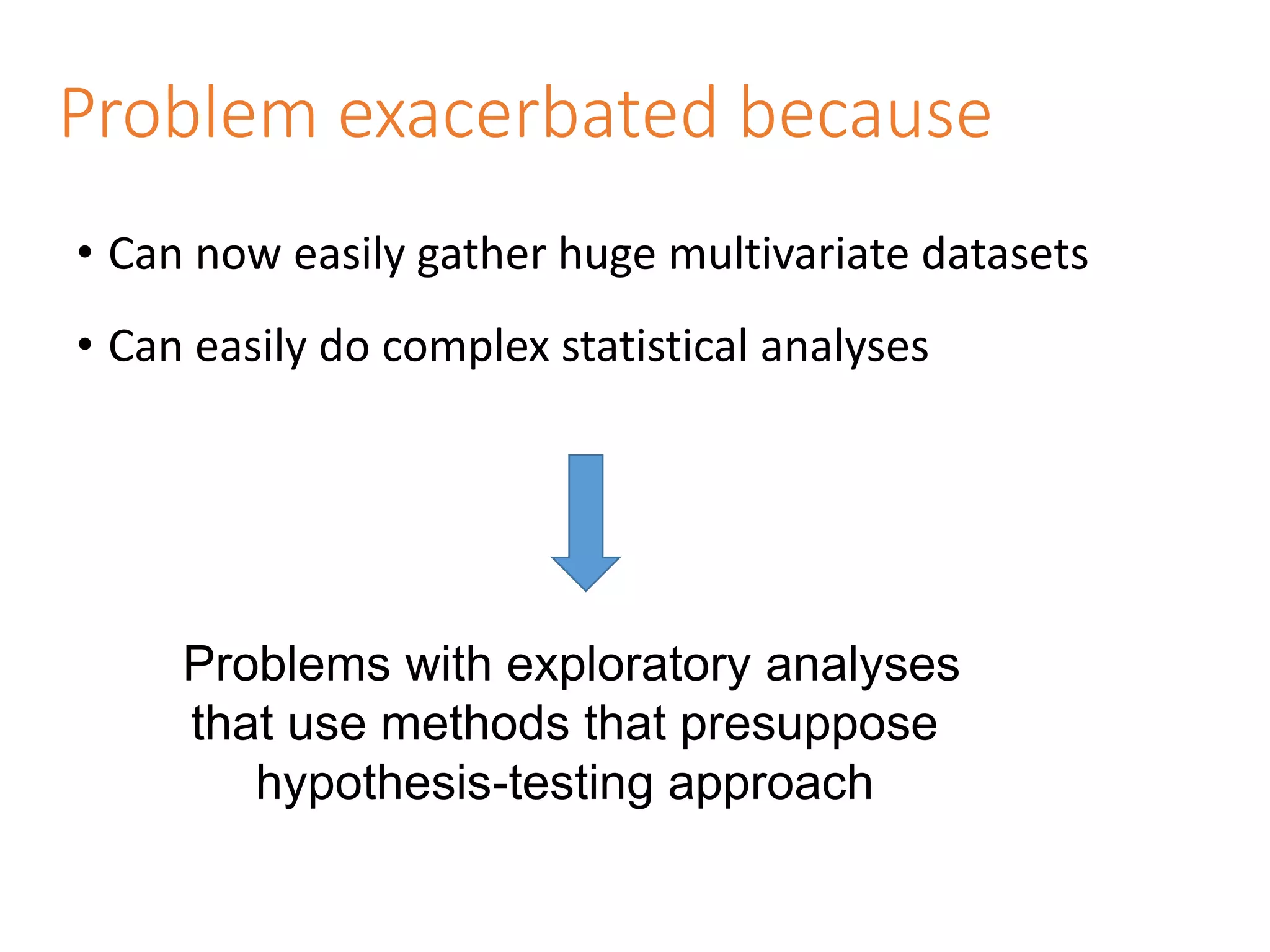
Problem exacerbated because
• Can now easily gather huge multivariate datasets
• Can easily do complex statistical analyses
Problems with exploratory analyses
that use methods that presuppose
hypothesis-testing approach
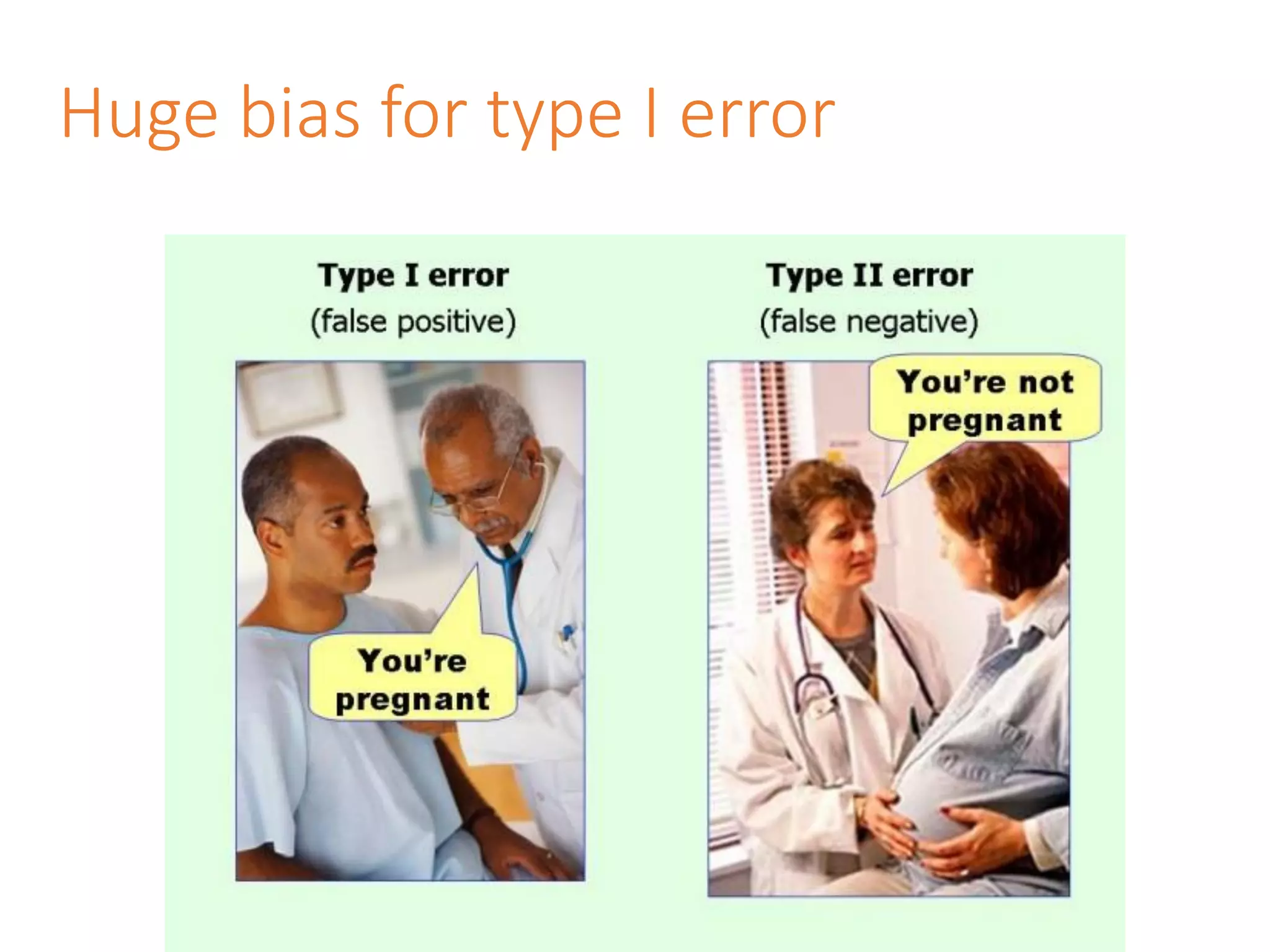
Huge bias for type I error
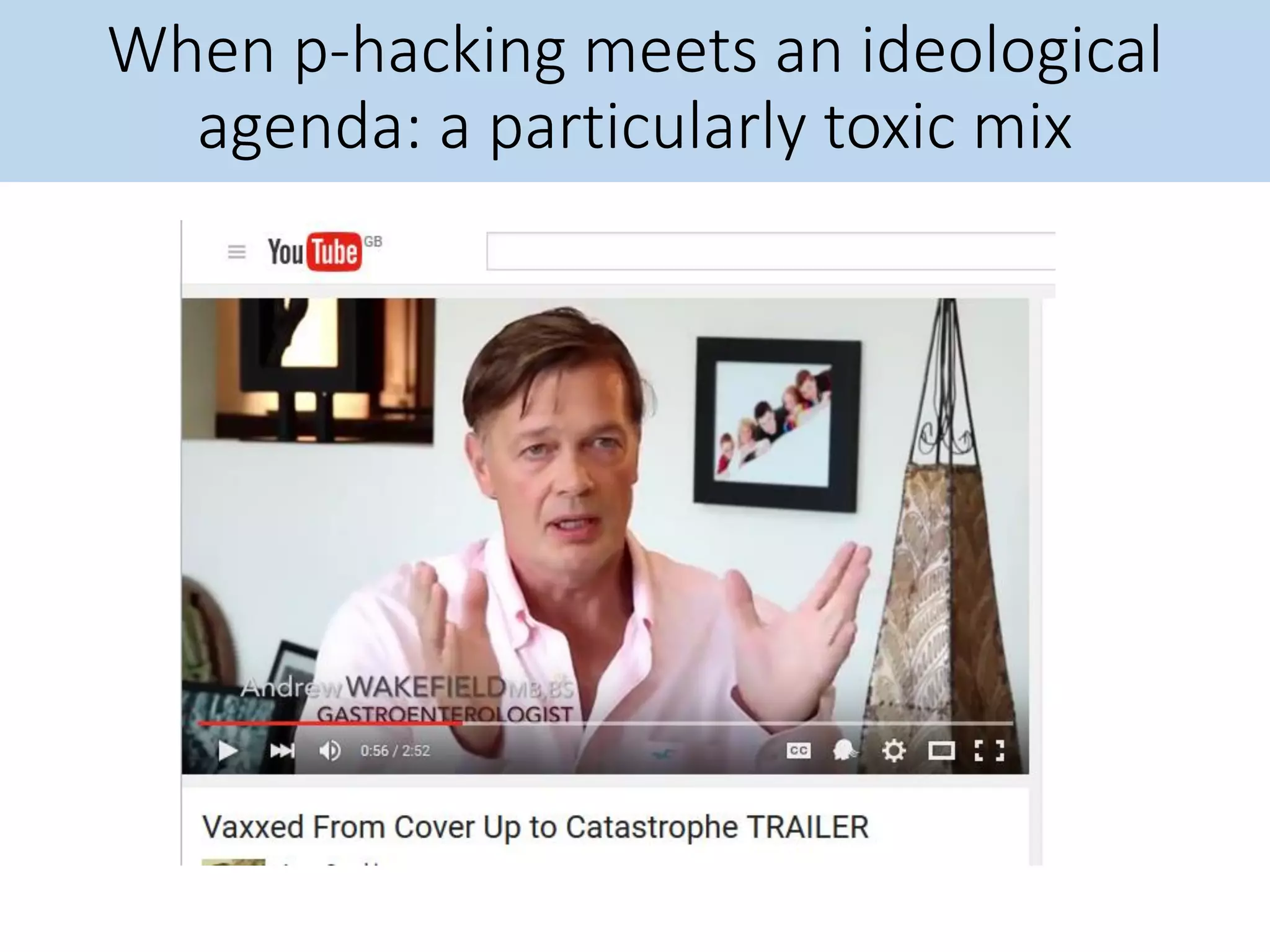
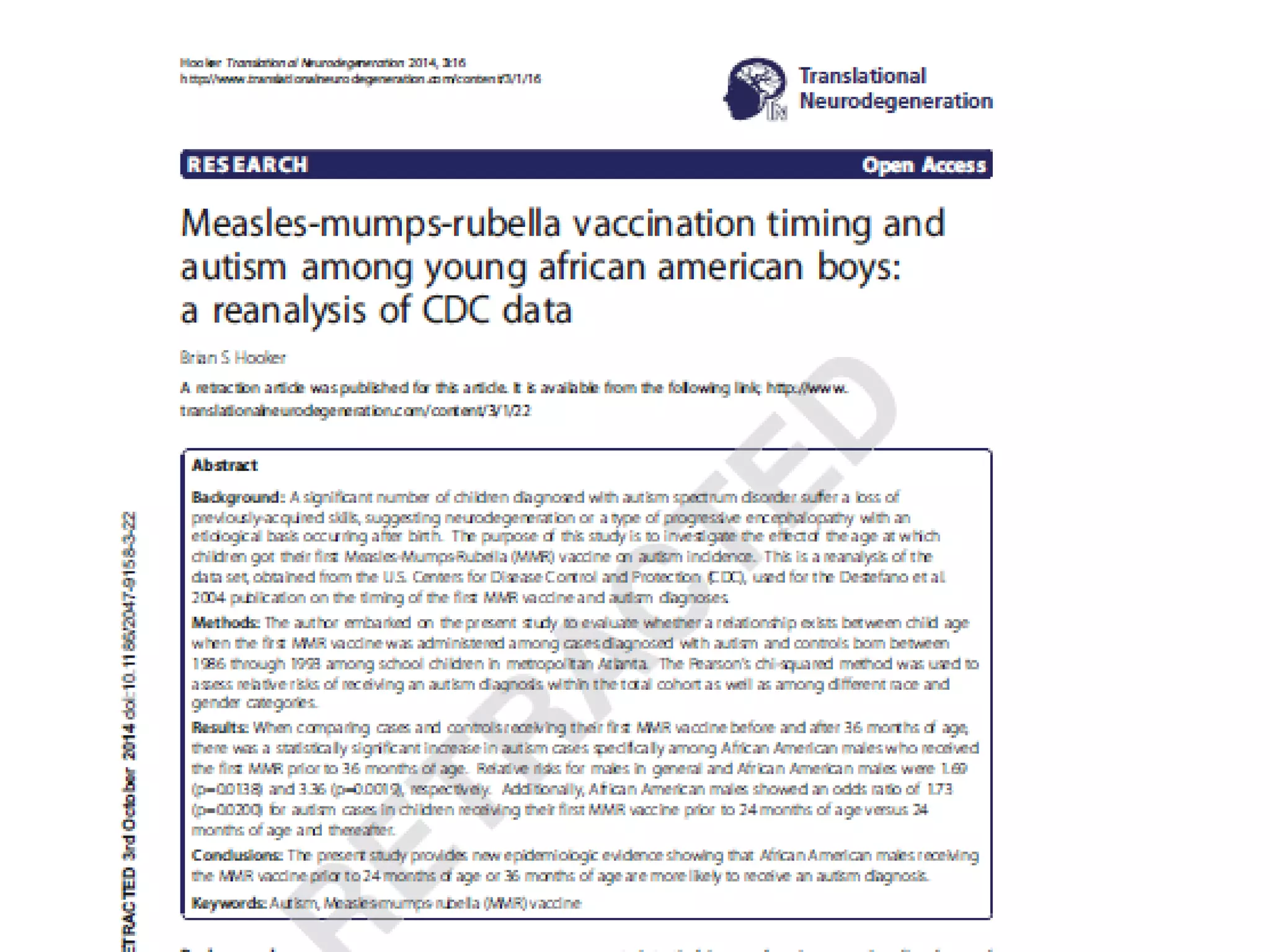
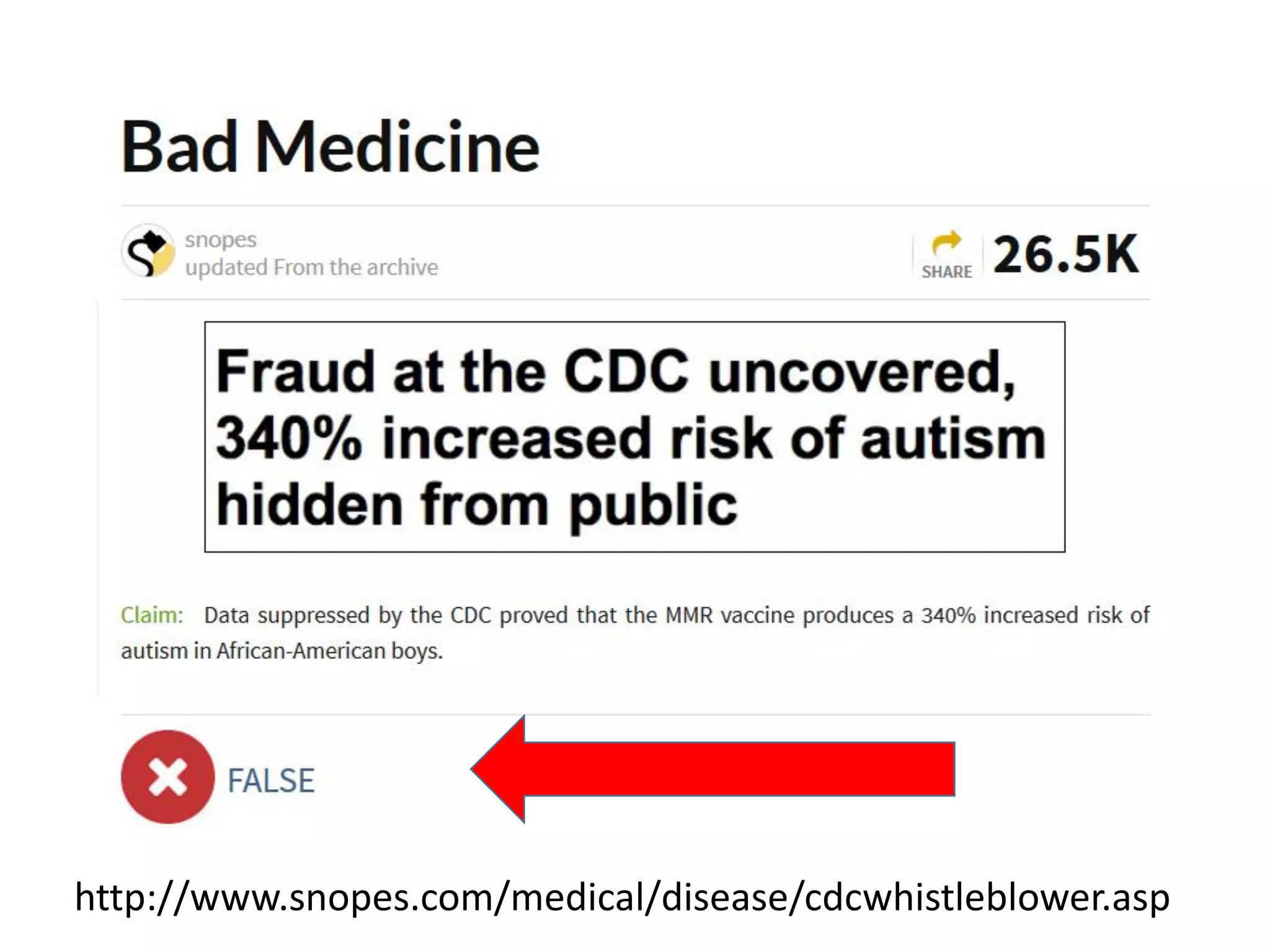
When p-hacking meets an ideological
agenda: a particularly toxic mix
http://www.snopes.com/medical/disease/cdcwhistleblower.asp
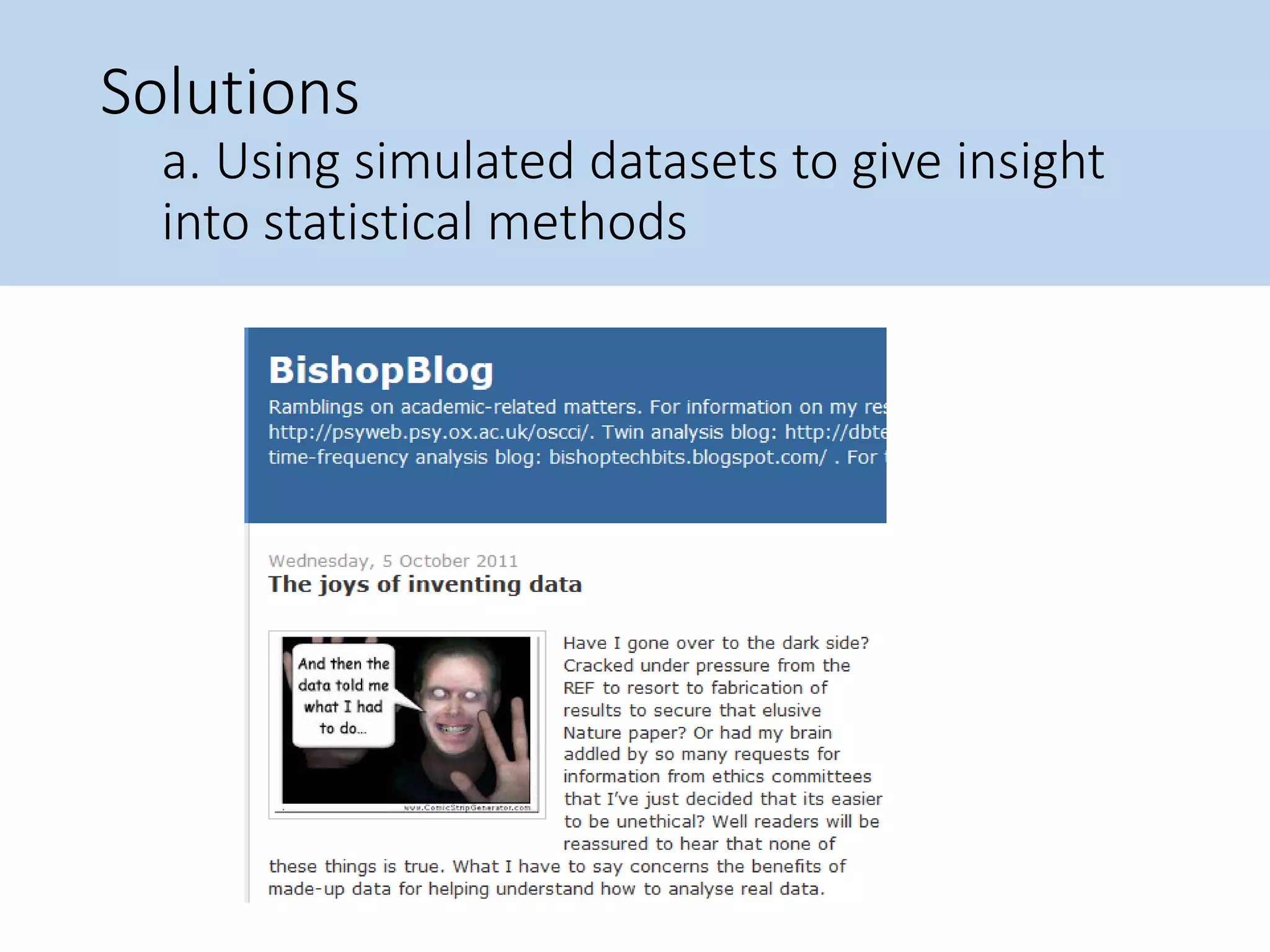
Solutions
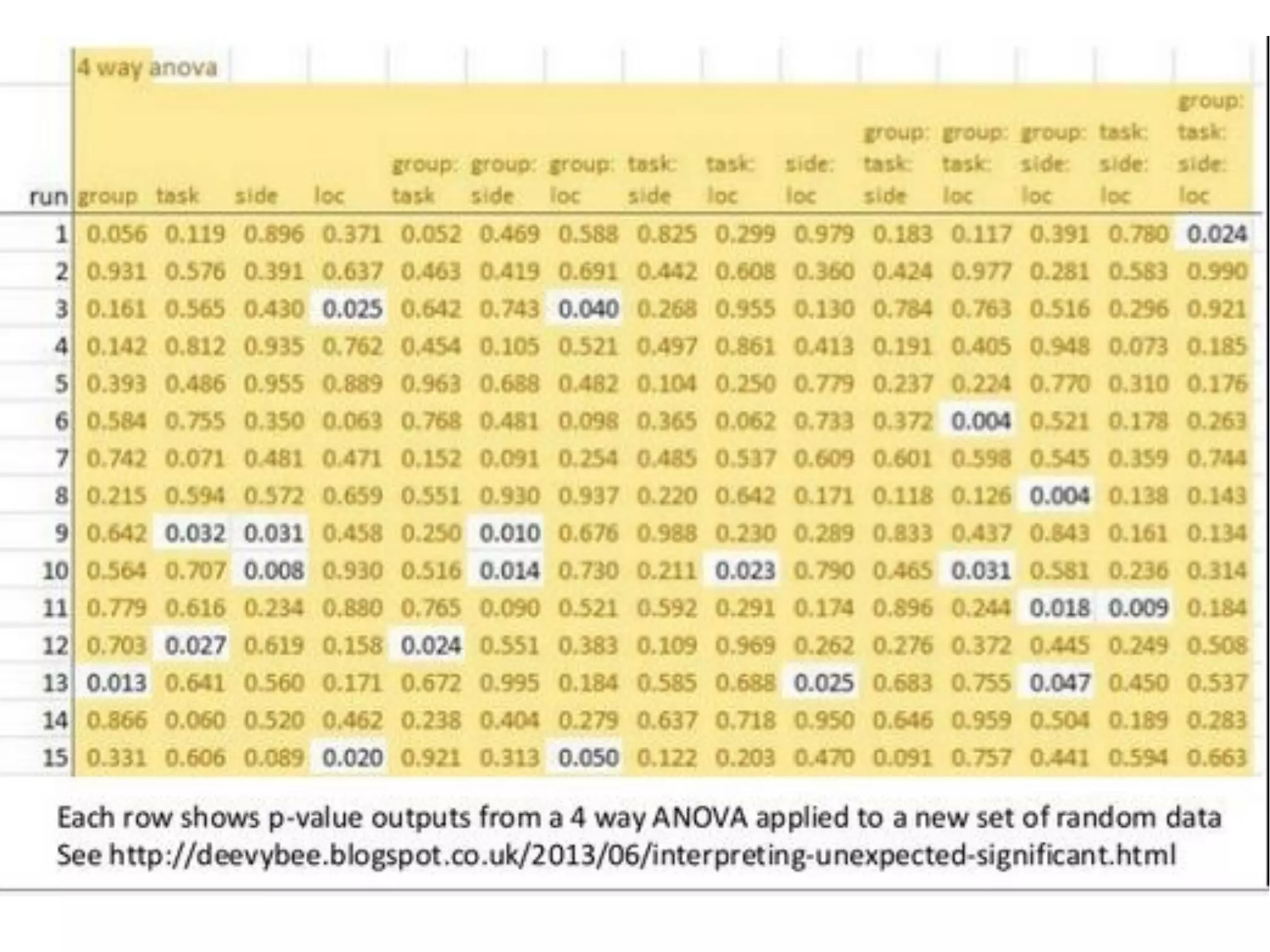
a. Using simulated datasets to give insight
into statistical methods
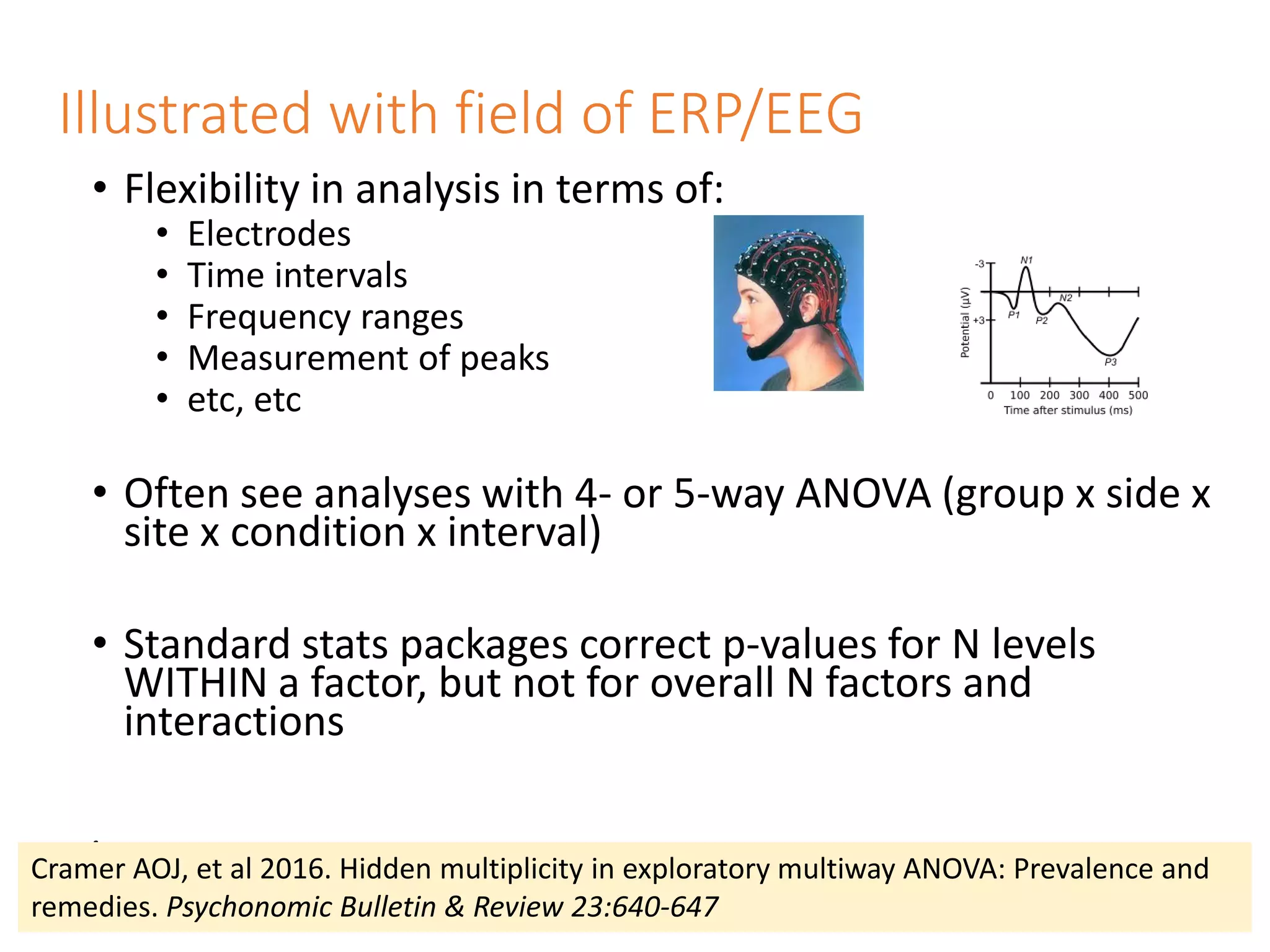
Illustrated with field of ERP/EEG
• Flexibility in analysis in terms of:
• Electrodes
• Time intervals
• Frequency ranges
• Measurement of peaks
• etc, etc
• Often see analyses with 4- or 5-way ANOVA (group x side x
site x condition x interval)
• Standard stats packages correct p-values for N levels
WITHIN a factor, but not for overall N factors and
interactions
.
Cramer AOJ, et al 2016. Hidden multiplicity in exploratory multiway ANOVA: Prevalence and
remedies. Psychonomic Bulletin & Review 23:640-647
Solutions
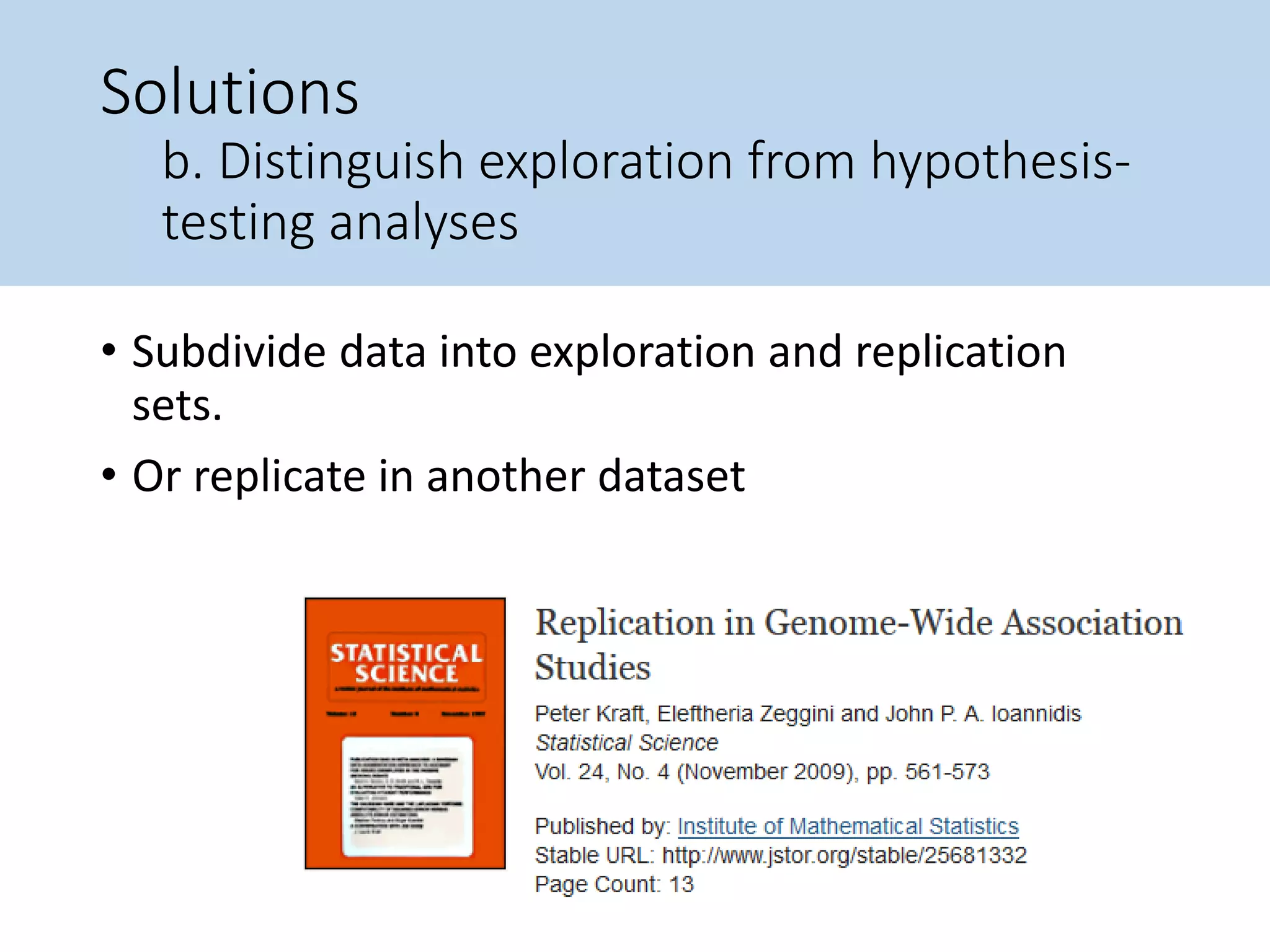
b. Distinguish exploration from hypothesis-
testing analyses
• Subdivide data into exploration and replication
sets.
• Or replicate in another dataset
Solutions
c. Masked data
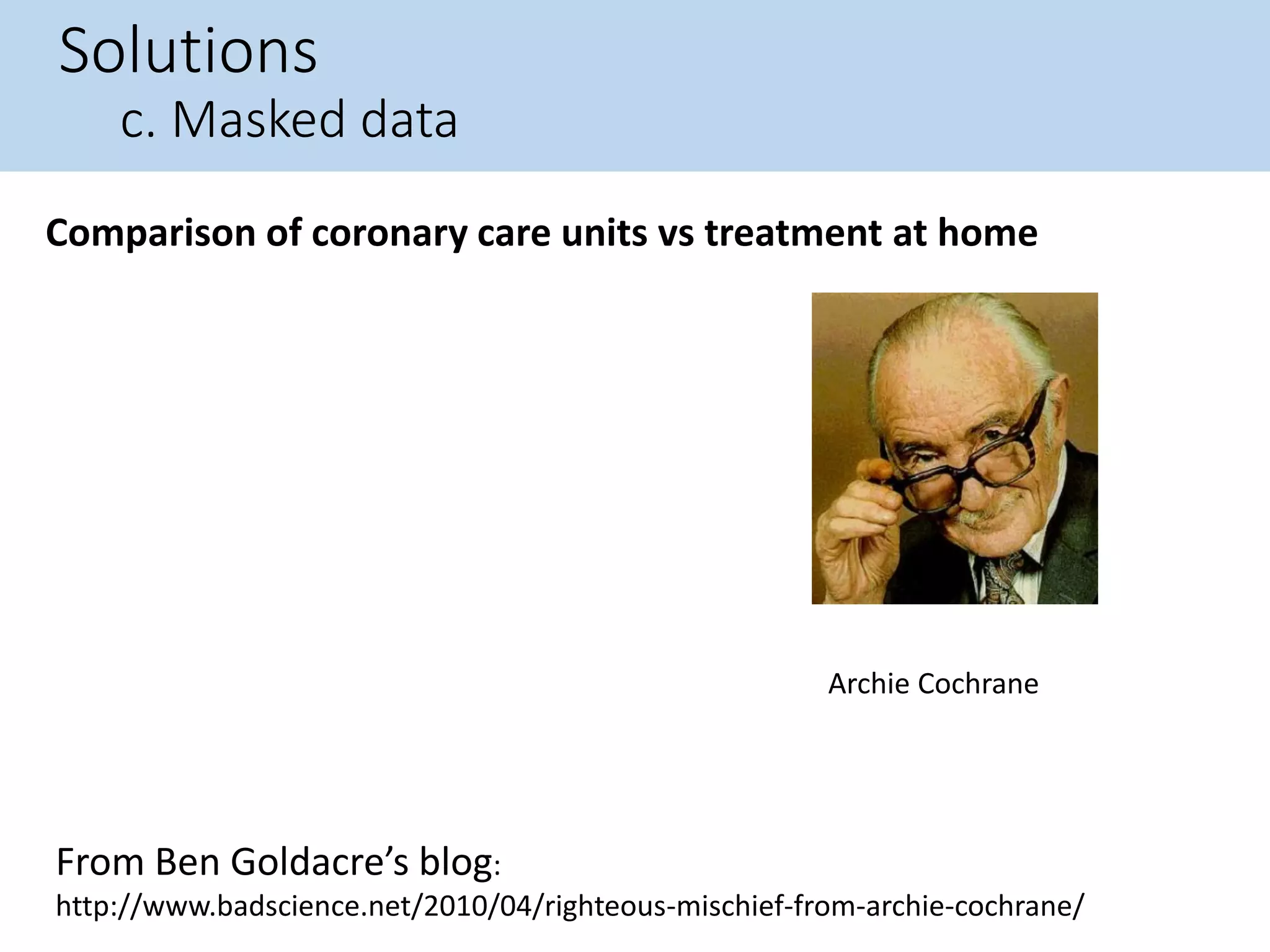
Comparison of coronary care units vs treatment at home
From Ben Goldacre’s blog:
http://www.badscience.net/2010/04/righteous-mischief-from-archie-cochrane/
Archie Cochrane
Solutions
c. Masked data
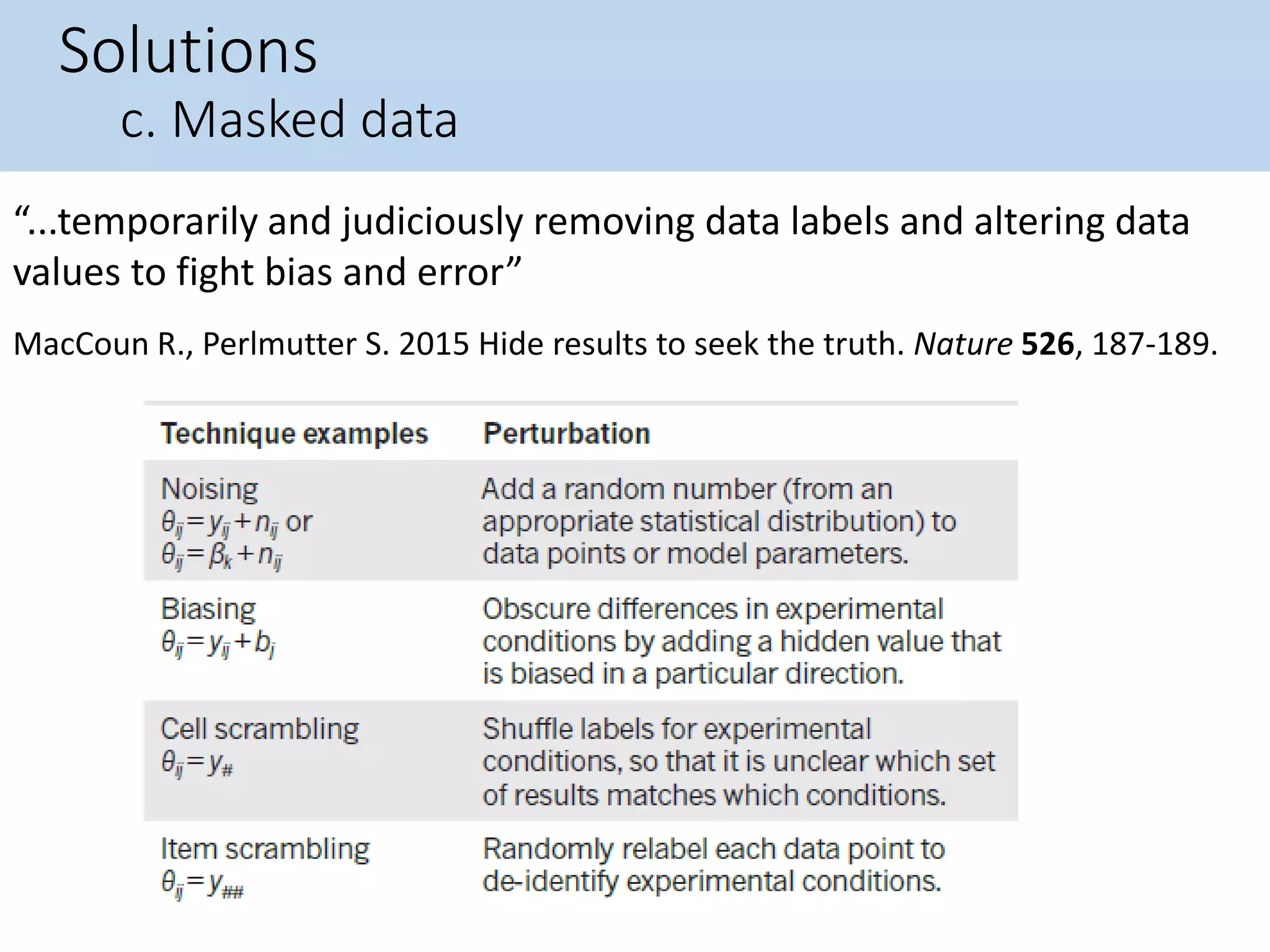
MacCoun R., Perlmutter S. 2015 Hide results to seek the truth. Nature 526, 187-189.
“...temporarily and judiciously removing data labels and altering data
values to fight bias and error”
Solutions
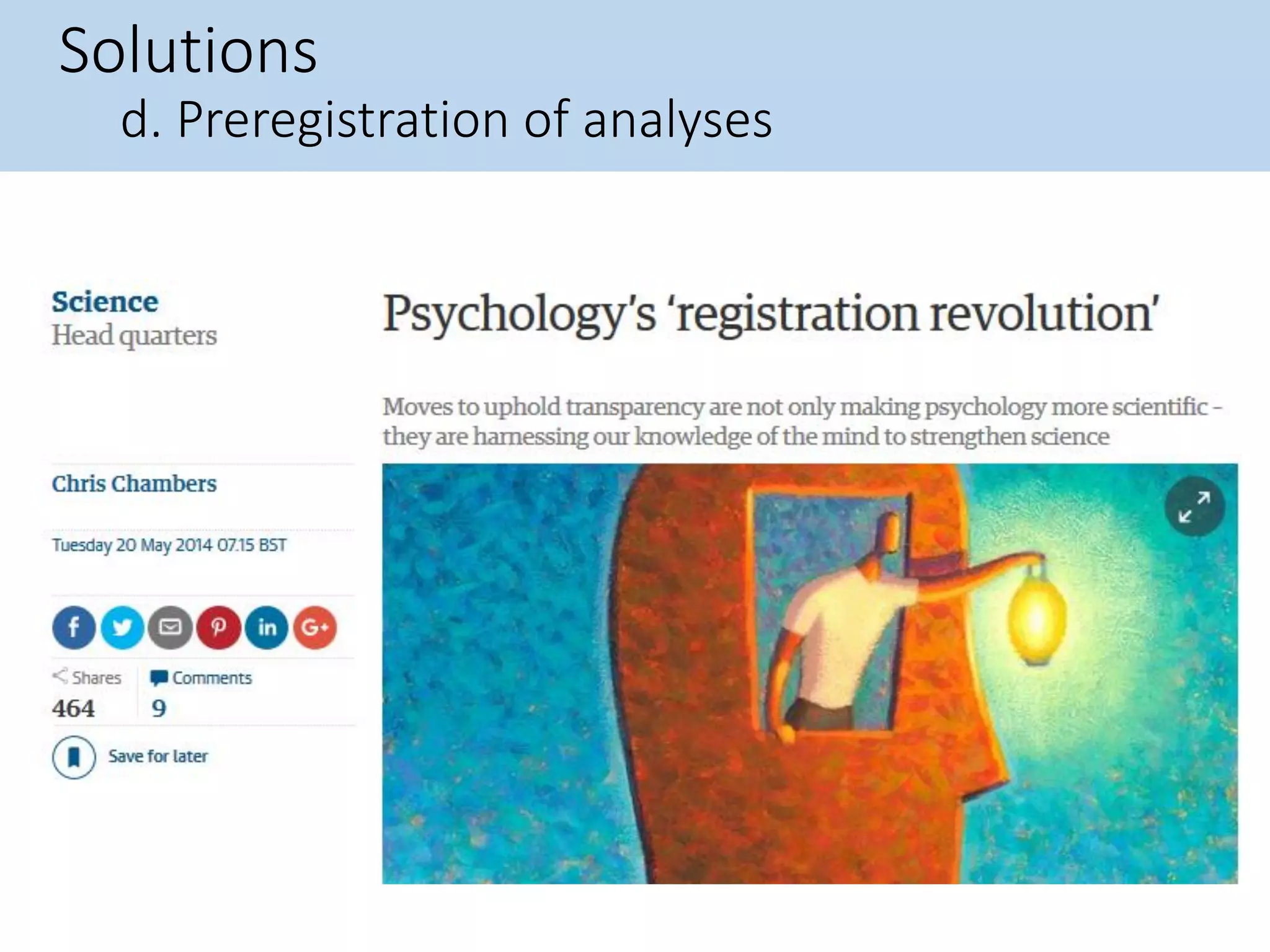
d. Preregistration of analyses
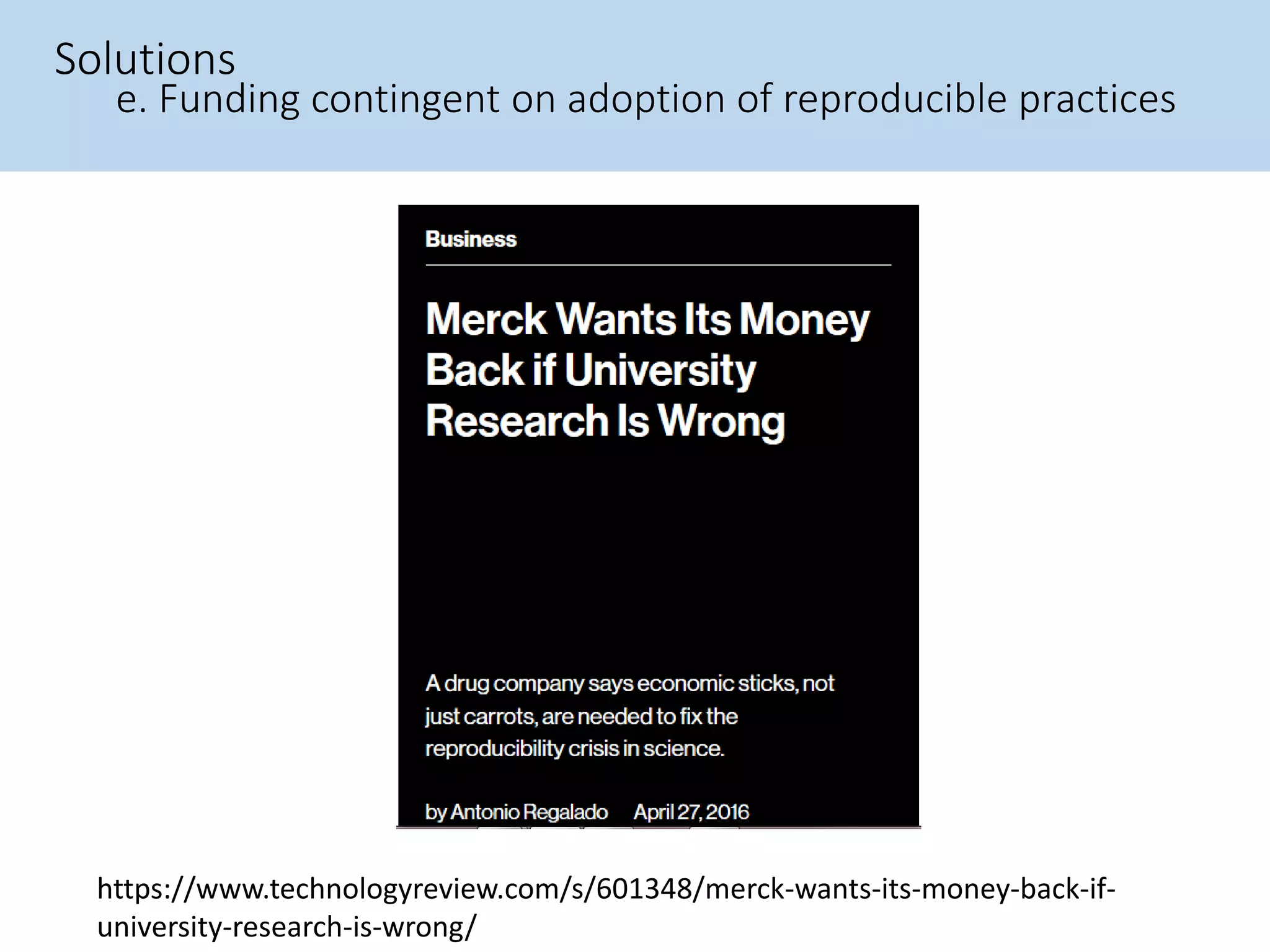
https://www.technologyreview.com/s/601348/merck-wants-its-money-back-if-
university-research-is-wrong/
Solutions
e. Funding contingent on adoption of reproducible practices
• Reluctance to collaborate with competitors
• Reluctance to share data
• Fabricated data
Problems caused by researchers. 3
Solutions to these may require changes to incentive structures, which
leads us to....
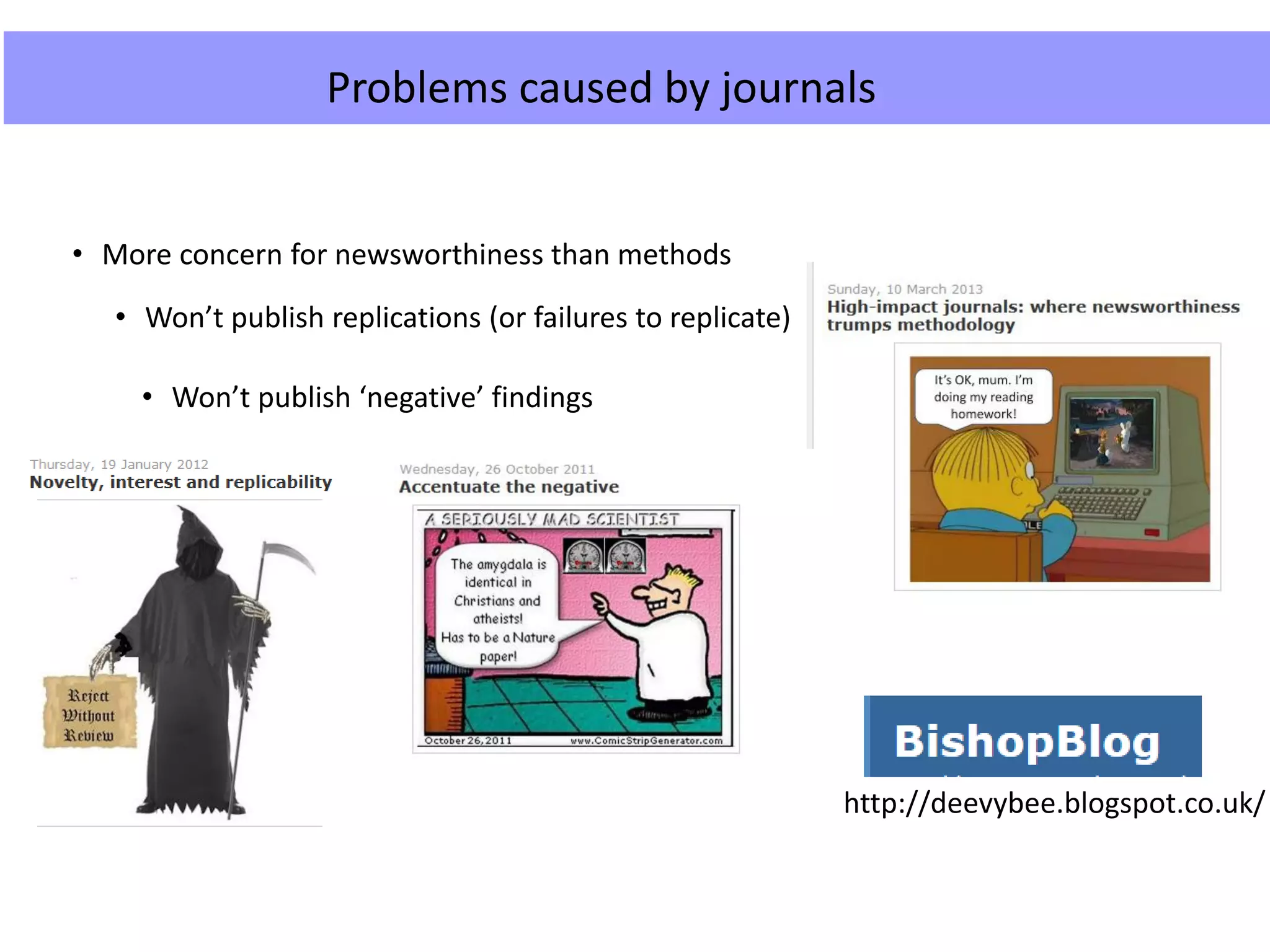
http://deevybee.blogspot.co.uk/
Problems caused by journals
• More concern for newsworthiness than methods
• Won’t publish replications (or failures to replicate)
• Won’t publish ‘negative’ findings
• Reward those with most grant income
• Reward according to journal impact factor
Problems caused by institutions
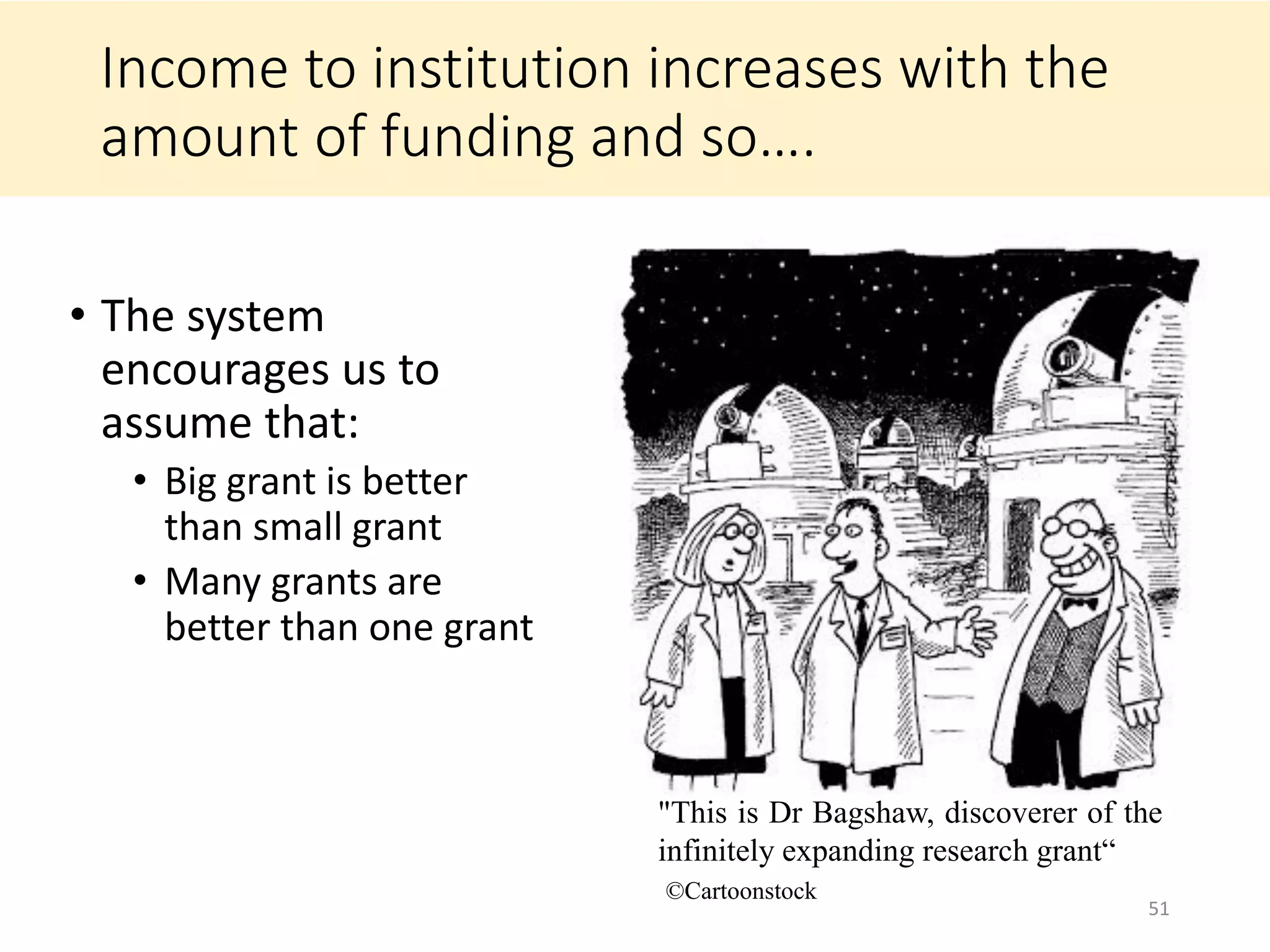
Income to institution increases with the
amount of funding and so….
• The system
encourages us to
assume that:
• Big grant is better
than small grant
• Many grants are
better than one grant
51
"This is Dr Bagshaw, discoverer of the
infinitely expanding research grant“
©Cartoonstock
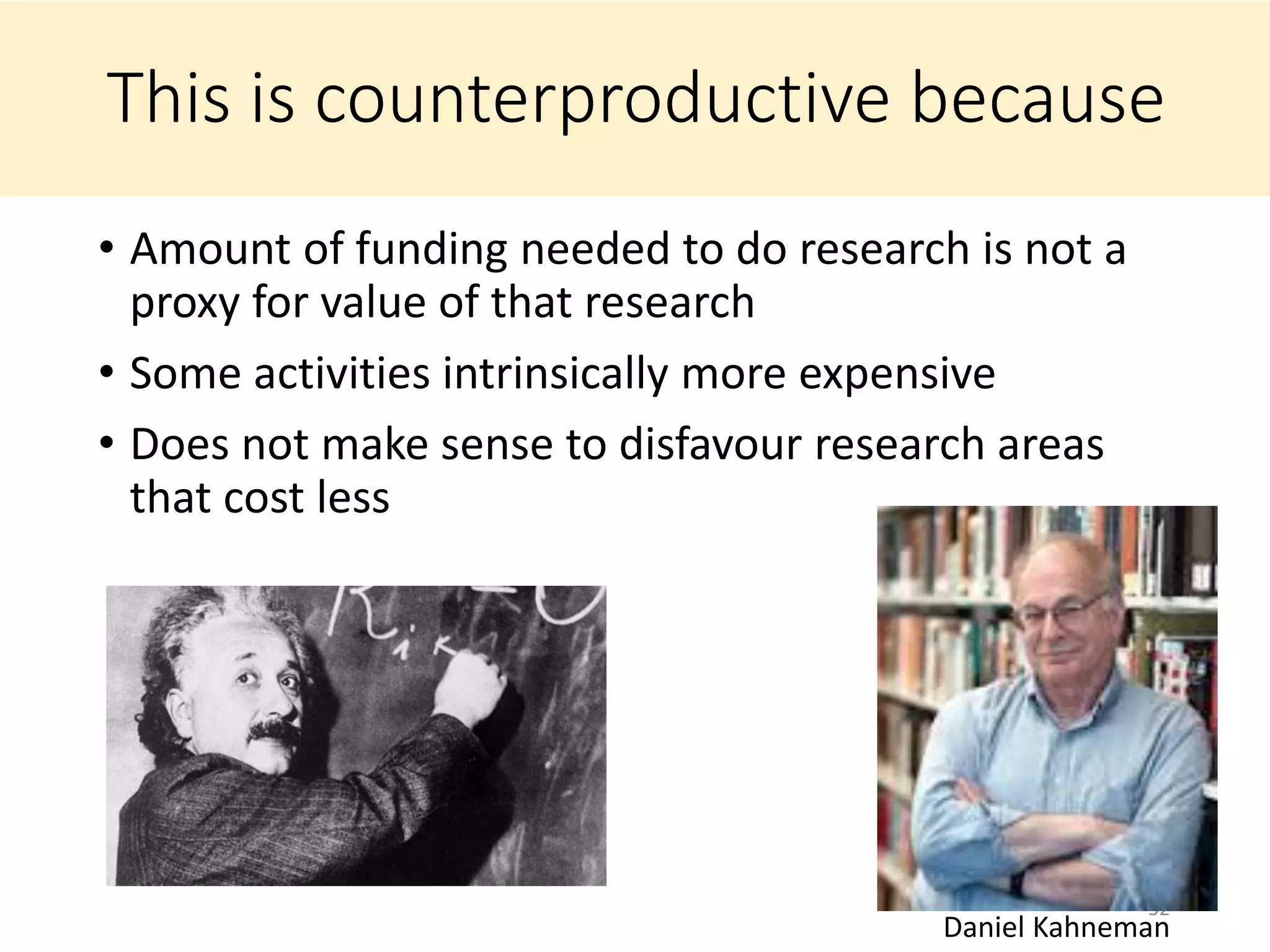
This is counterproductive because
• Amount of funding needed to do research is not a
proxy for value of that research
• Some activities intrinsically more expensive
• Does not make sense to disfavour research areas
that cost less
52
Daniel Kahneman
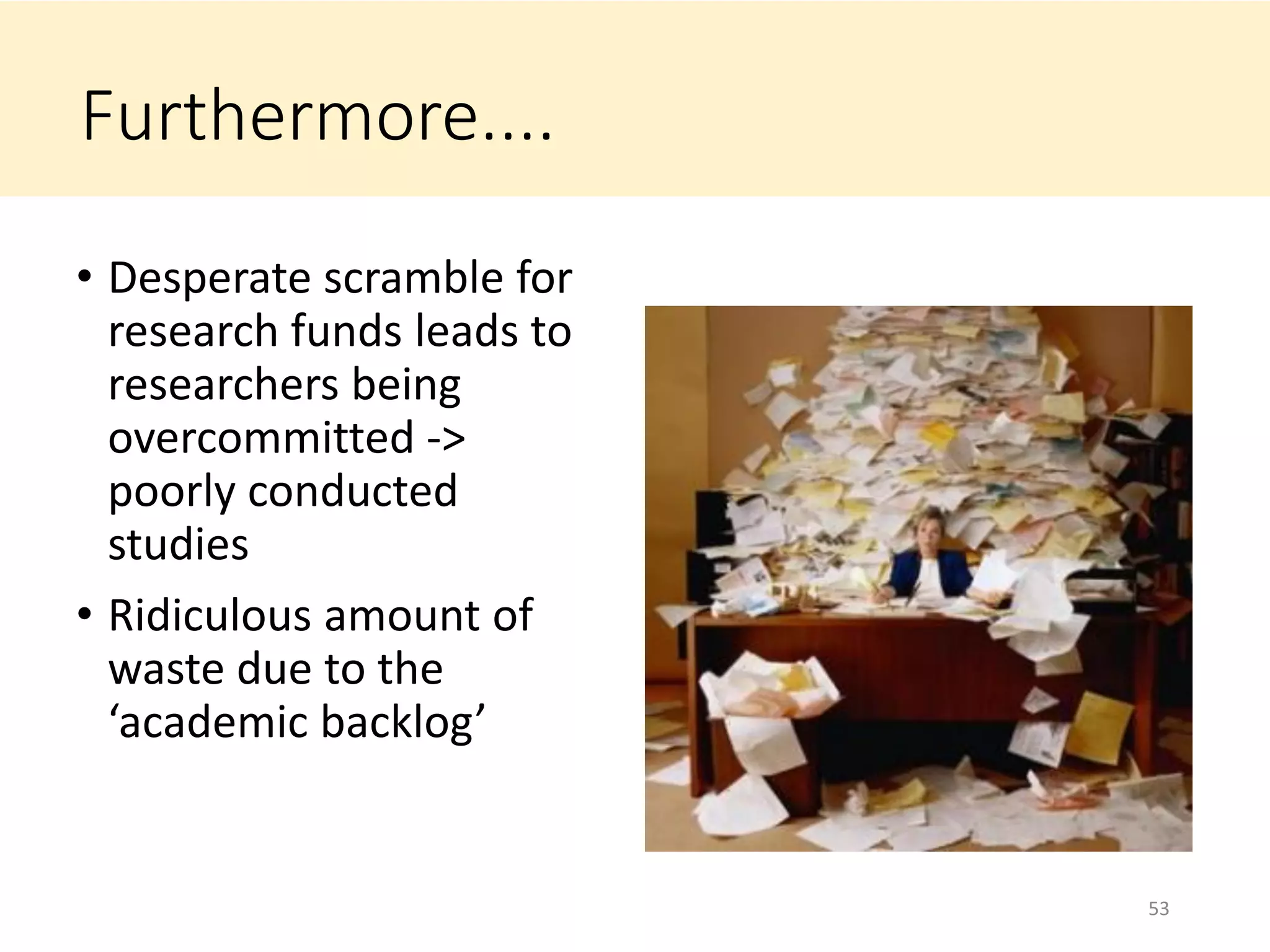
Furthermore....
• Desperate scramble for
research funds leads to
researchers being
overcommitted ->
poorly conducted
studies
• Ridiculous amount of
waste due to the
‘academic backlog’
53
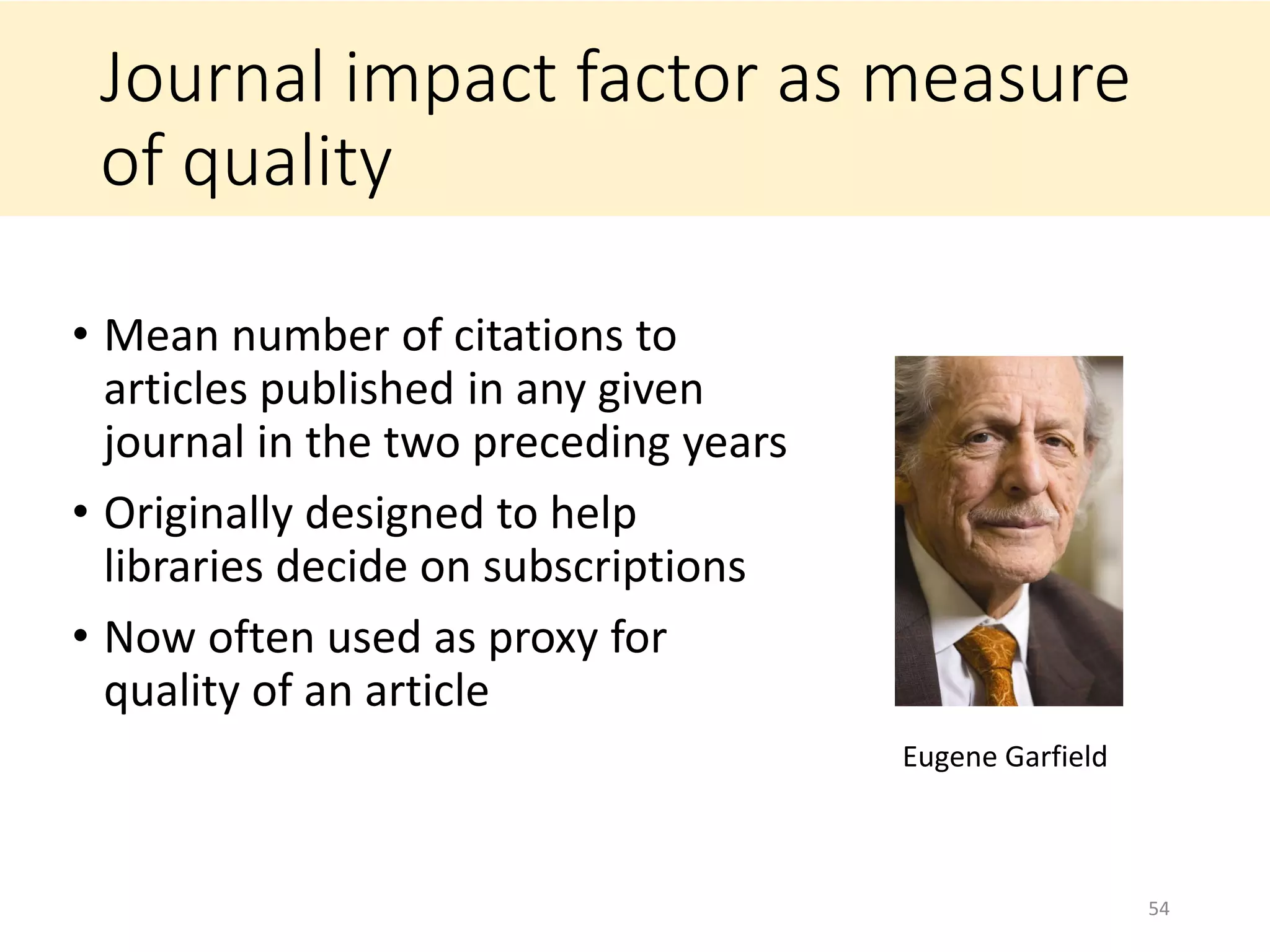
Journal impact factor as measure
of quality
• Mean number of citations to
articles published in any given
journal in the two preceding years
• Originally designed to help
libraries decide on subscriptions
• Now often used as proxy for
quality of an article
54
Eugene Garfield
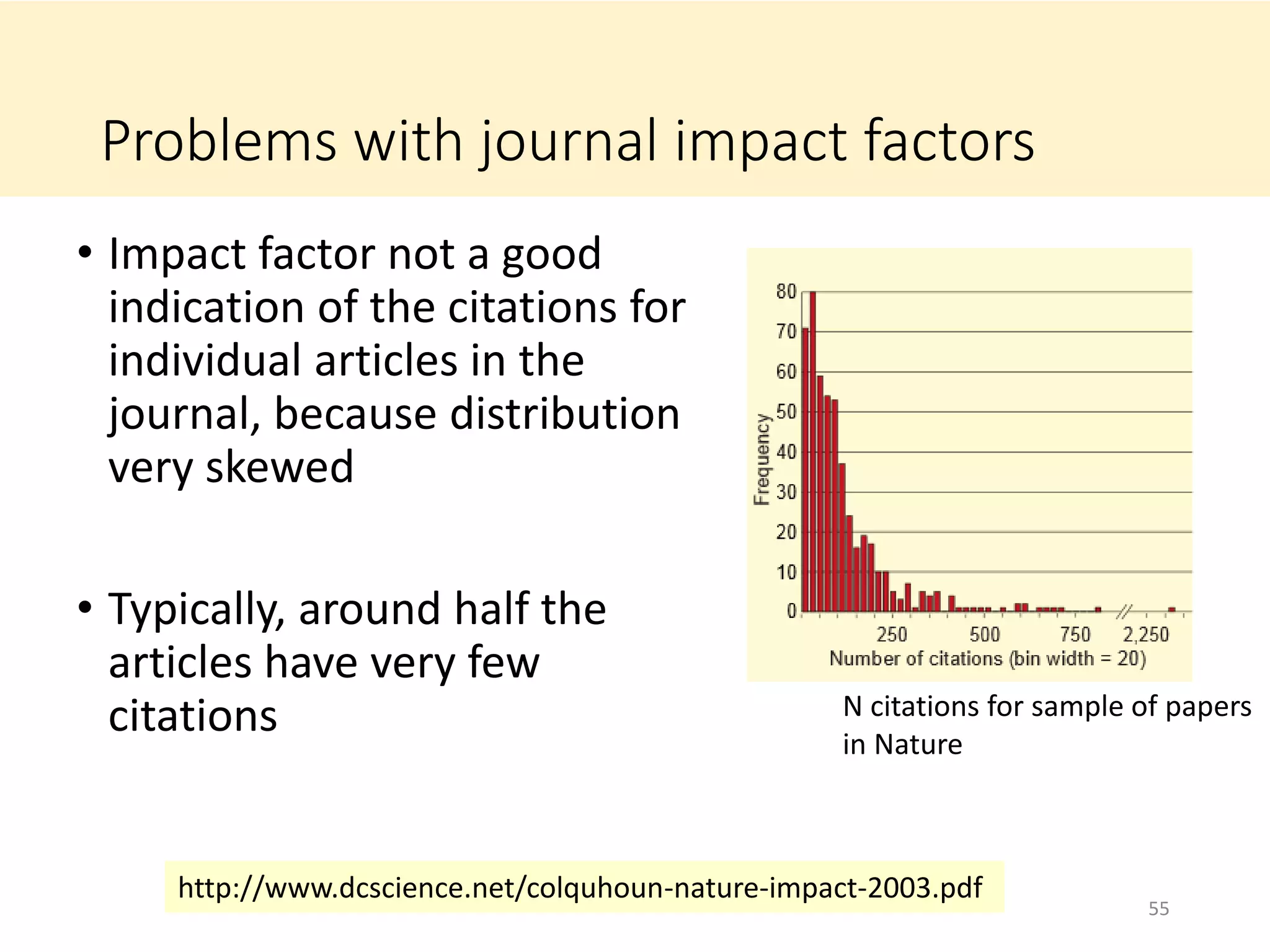
Problems with journal impact factors
• Impact factor not a good
indication of the citations for
individual articles in the
journal, because distribution
very skewed
• Typically, around half the
articles have very few
citations
55
http://www.dcscience.net/colquhoun-nature-impact-2003.pdf
N citations for sample of papers
in Nature
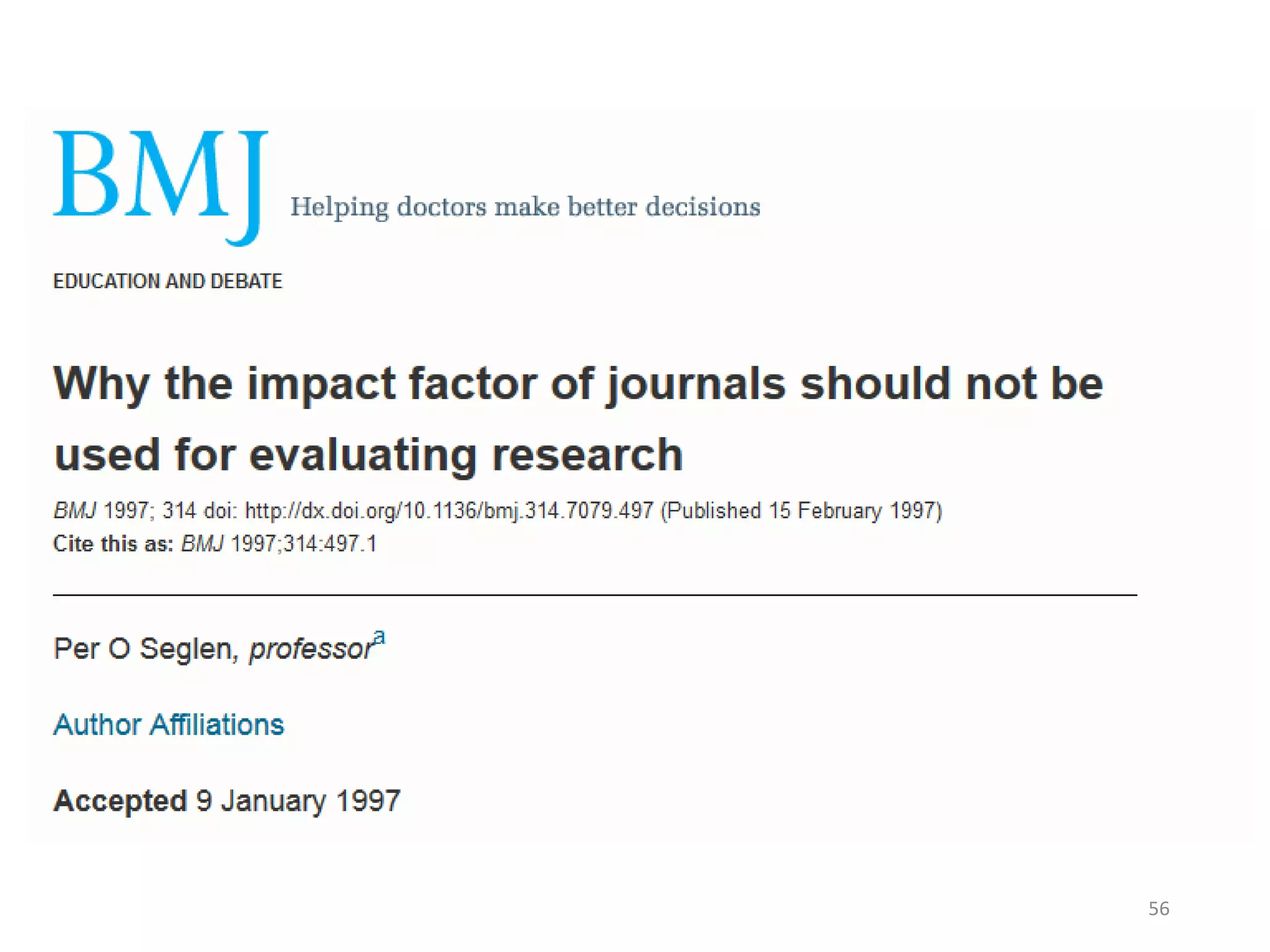
56
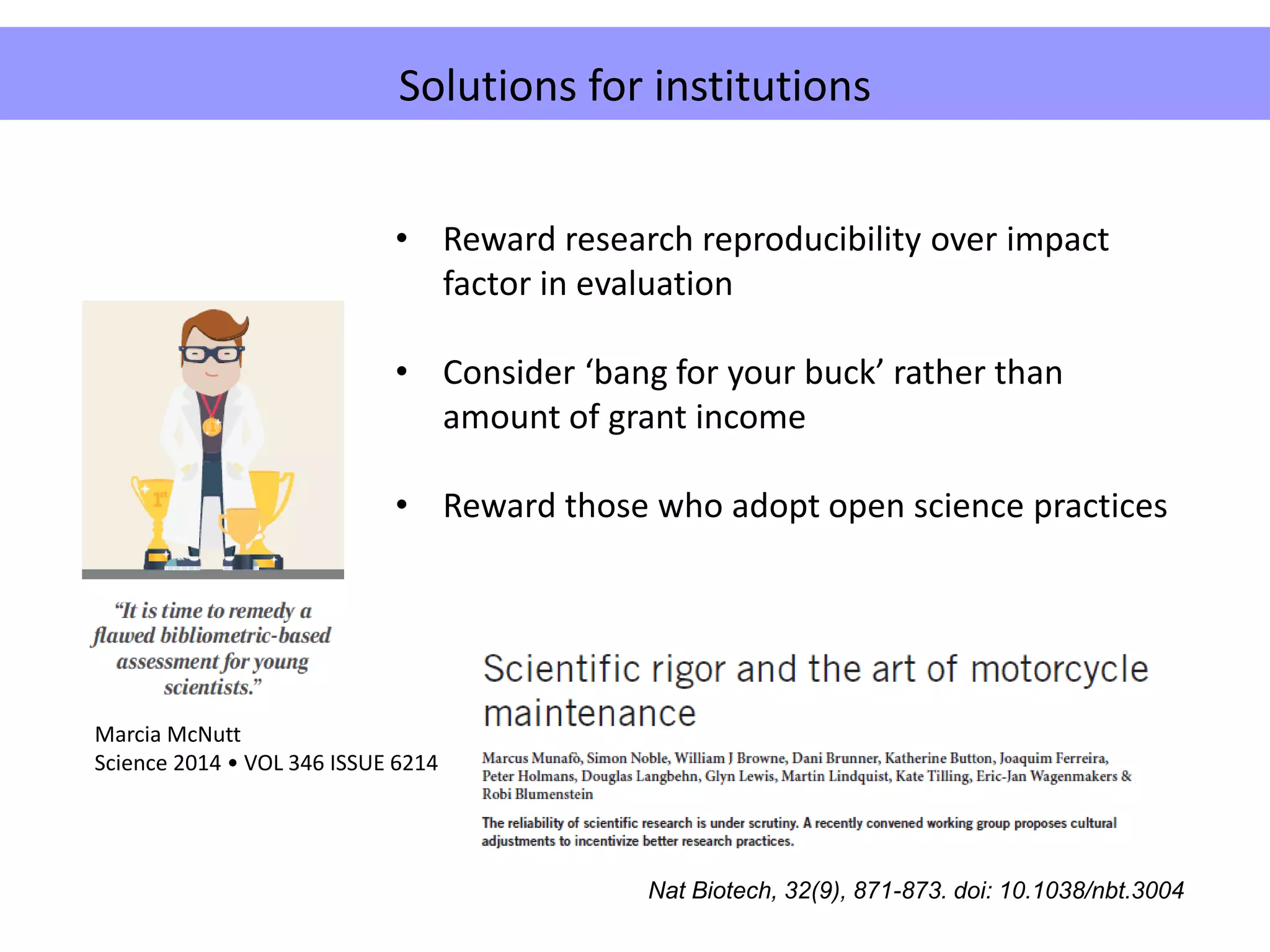
Problems caused by employers
• Reward research reproducibility over impact
factor in evaluation
• Consider ‘bang for your buck’ rather than
amount of grant income
• Reward those who adopt open science practices
Solutions for institutions
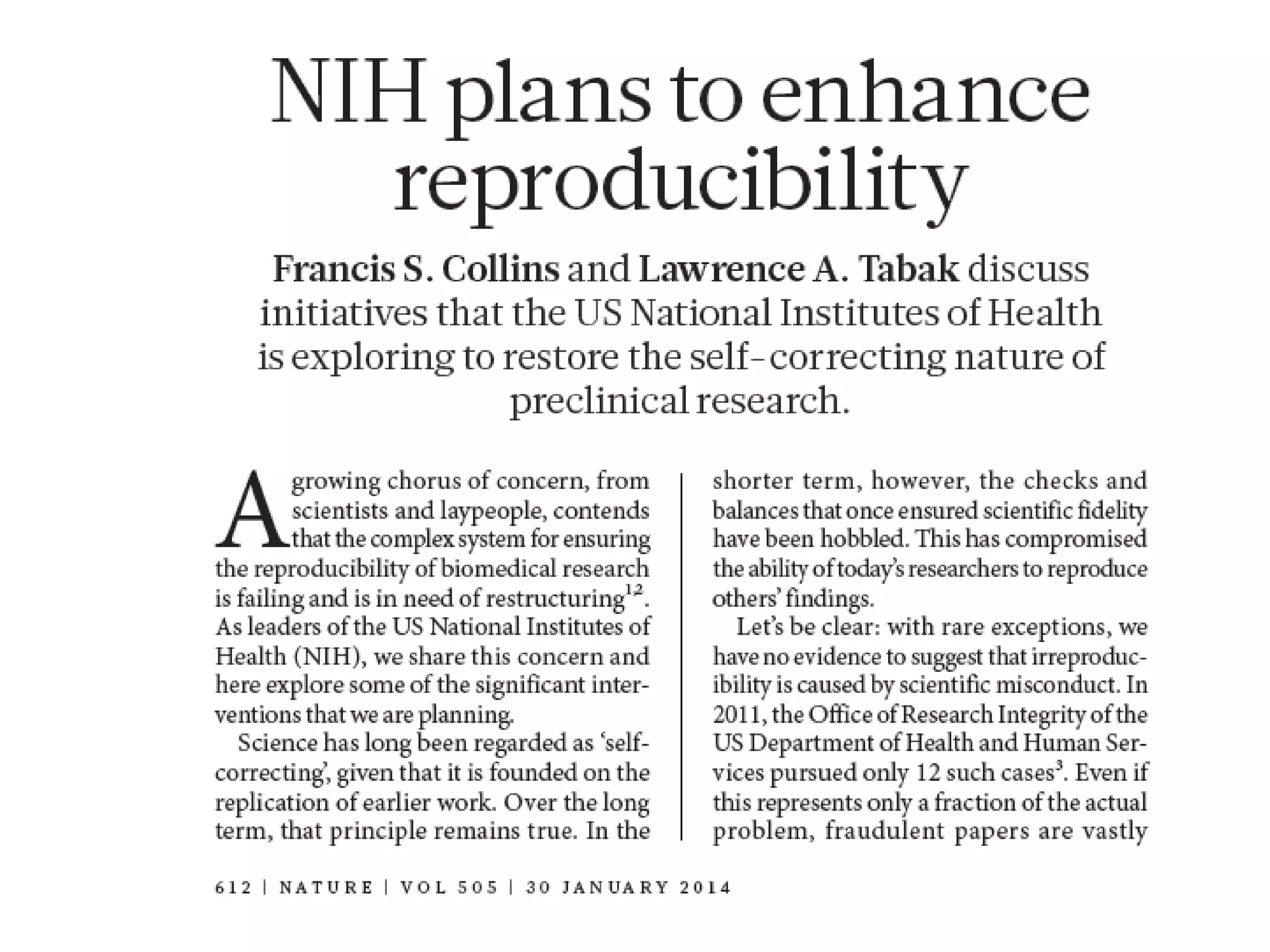
Nat Biotech, 32(9), 871-873. doi: 10.1038/nbt.3004
Marcia McNutt
Science 2014 • VOL 346 ISSUE 6214
Problems caused by funders
• Don’t require that all data reported
Though growing interest in data sharing
• No interest in funding replications
• No interest in funding systematic reviews
Problems caused by funders
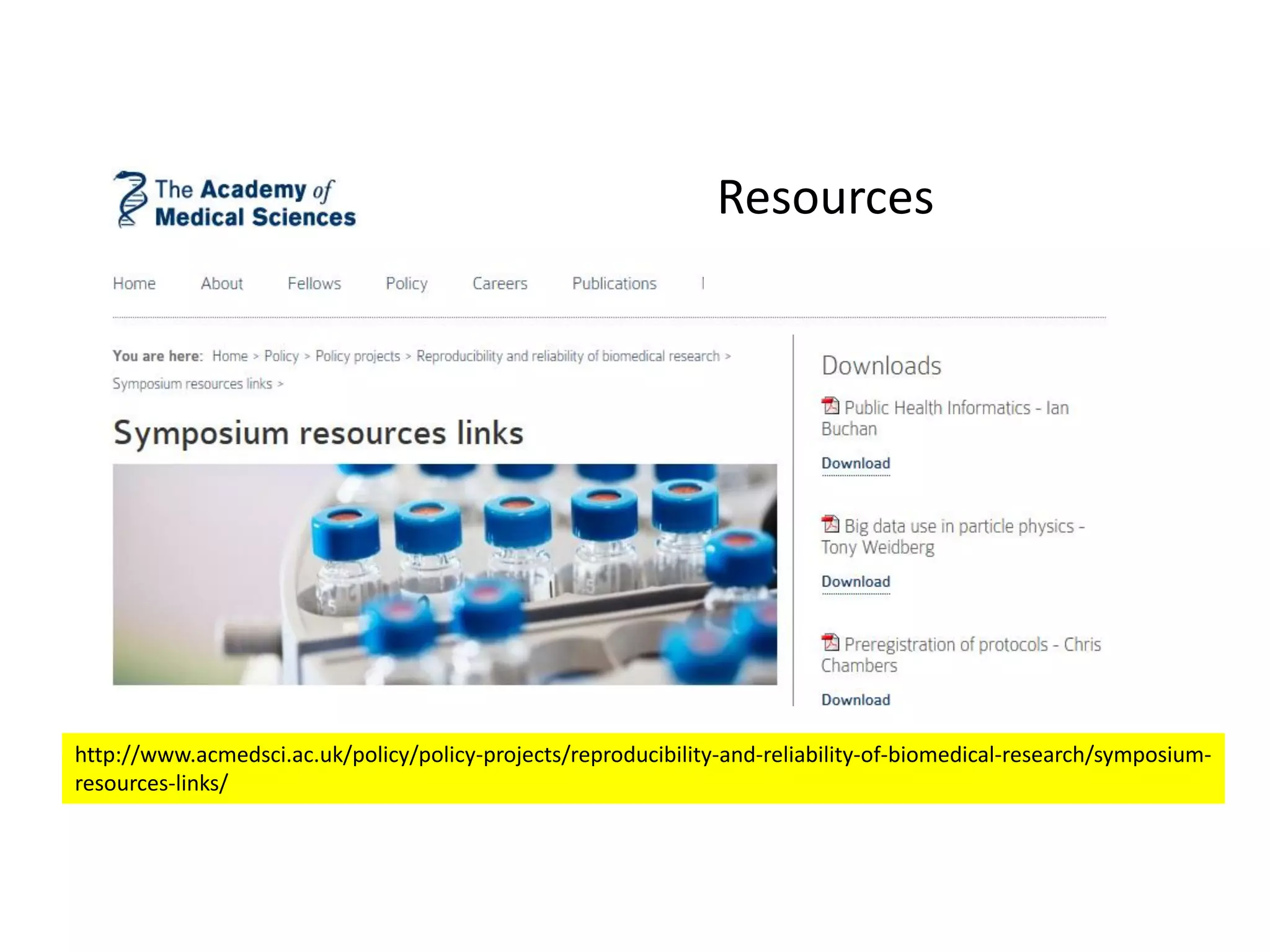
http://www.acmedsci.ac.uk/policy/policy-projects/reproducibility-and-reliability-of-biomedical-research/symposium-
resources-links/
Resources

What is the reproducibility crisis in science and what can we do about it?

  • 1.
    What is thereproducibility crisis in science and what can we do about it? Dorothy V. M. Bishop Professor of Developmental Neuropsychology University of Oxford @deevybee
  • 2.
    What is theproblem? “There is increasing concern about the reliability of biomedical research, with recent articles suggesting that up to 85% of research funding is wasted.” Bustin, S. A. (2015). The reproducibility of biomedical research: Sleepers awake! Biomolecular Detection and Quantification 2005. PLoS Medicine, 2(8), e124. doi: 10.1371/journal.pmed.0020124
  • 3.
    Generate and specify hypotheses Design study Collect data Analyse data& test hypotheses Interpret data Publish or conduct next experiment Hypothetico-deductive scientific method based on original by Chris Chambers
  • 4.
    Generate and specify hypotheses Design study Collect data Analyse data& test hypotheses Interpret data Publish or conduct next experiment Hypothetico-deductive scientific method based on original by Chris Chambers How common?
  • 5.
    Which Article ShouldYou Write? There are two possible articles you can write: (a) the article you planned to write when you designed your study or (b) the article that makes the most sense now that you have seen the results. They are rarely the same, and the correct answer is (b). re Data Analysis: Examine them from every angle. Analyze the sexes separately. Make up new composite indexes. If a datum suggests a new hypothesis, try to find additional evidence for it elsewhere in the data. If you see dim traces of interesting patterns, try to reorganize the data to bring them into bolder relief. If there are participants you don’t like, or trials, observers, or interviewers who gave you anomalous results, drop them (temporarily). Go on a fishing expedition for something— anything —interesting. Writing the Empirical Journal Article Daryl J. Bem The Compleat Academic: A Practical Guide for the Beginning Social Scientist, 2nd Edition. Washington, DC: American Psychological Association, 2004. “This book provides invaluable guidance that will help new academics plan, play, and ultimately win the academic career game.” Explicitly advises HARKing!
  • 6.
    Generate and specify hypotheses Design study Collect data Analyse data& test hypotheses Interpret data Publish or conduct next experiment Hypothetico-deductive scientific method based on original by Chris Chambers p-hacking P-hacking: doing many tests and only reporting the significant ones. Collecting extra data or removing outliers to push ‘nearly significant’ results over boundary. How common?
  • 7.
    John et al,2012 –survey of psychologists
  • 8.
    Generate and specify hypotheses Design study Collect data Analyse data& test hypotheses Interpret data Publish or conduct next experiment Hypothetico-deductive scientific method based on original by Chris Chambers p-hacking Low statistical power Sample size too small to detect real effect
  • 9.
    Button KS etal. 2013. Power failure: why small sample size undermines the reliability of neuroscience. Nature Reviews Neuroscience 14:365-376. Median power of studies included in neuroscience meta-analyses
  • 10.
    Generate and specify hypotheses Design study Collect data Analyse data& test hypotheses Interpret data Publish or conduct next experiment Hypothetico-deductive scientific method based on original by Chris Chambers p-hacking Low statistical power Publication bias Null findings don’t get published – literature distorted Fanelli, 2010: 92% papers report positive findings
  • 11.
    Generate and specify hypotheses Design study Collect data Analyse data& test hypotheses Interpret data Publish or conduct next experiment Hypothetico-deductive scientific method p-hacking Low statistical power Publication bias Methods to avert bias not reported MacLeod et al, 2015: in vivo research, only around 25% papers reported randomisation/blinding Failure to control for bias
  • 12.
    Generate and specify hypotheses Design study Collect data Analyse data& test hypotheses Interpret data Publish or conduct next experiment Hypothetico-deductive scientific method p-hacking Low statistical power Publication bias Failure to control for bias Poor quality control, e.g. misidentified cell lines/ reagents
  • 13.
    Bustin (2015) onRNA biomarkers: “molecular techniques can be unfit for purpose” Poor fidelity of reagents/cell lines
  • 14.
    None of thisis new!
  • 15.
    1956 De Groot Failure todistinguish between hypothesis-testing and hypothesis-generating (exploratory) research -> misuse of statistical tests Historical timeline: concerns about reproducibility
  • 16.
    1956 De Groot 1975 Greenwald “As itis functioning in at least some areas of behavioral science research, the research- publication system may be regarded as a device for systematically generating and propagating anecdotal information.”
  • 17.
    1956 De Groot 1975 Greenwald The “filedrawer” problem 1979 Rosenthal
  • 18.
    1956 De Groot 1975 Greenwald 1987 Newcombe “Small studiescontinue to be carried out with little more than a blind hope of showing the desired effect. Nevertheless, papers based on such work are submitted for publication, especially if the results turn out to be statistically significant.” 1979 Rosenthal
  • 19.
    1956 De Groot 1975 Greenwald 1987 Newcombe 1993 Dickersin & Min Clinicaltrials with ‘significant’ results substantially more likely to be published. “Most unpublished trials remained so because investigators thought the results were ‘not interesting’ or they ‘did not have enough time’” 1979 Rosenthal
  • 20.
    1956 De Groot 1975 Greenwald 1987 Newcombe 1993 Dickersin & Min “Themisidentified cell lines reported here have already been unwittingly used in several hundreds of potentially misleading reports, including use as inappropriate tumor models and subclones masquerading as independent replicates.” 1999 Macleod et al 1979 Rosenthal
  • 21.
    Why is thismaking headlines now? • Increase in studies quantifying the problem • Concern from those who use research: • Doctors and Patients • Pharma companies • Social media “It really is striking just for how long there have been reports about the poor quality of research methodology, inadequate implementation of research methods and use of inappropriate analysis procedures as well as lack of transparency of reporting. All have failed to stir researchers, funders, regulators, institutions or companies into action”. Bustin, 2014
  • 22.
    Failure to appreciatepower of ‘the prepared mind’ Natural instinct is to look for consistent evidence, not disproof Problems caused by researchers: 1
  • 23.
    “The self-deception comesin that over the next 20 years, people believed they saw specks of light that corresponded to what they thought Vulcan should look during an eclipse: round objects crossing the face of the sun, which were interpreted as transits of Vulcan.”
  • 24.
    Seeing things incomplex data requires skill Bailey and von Bonin (1951) noted problems in Brodmann's approach — lack of observer independency, reproducibility and objectivity Yet have stood test of time: still used today Brodmann areas, 1909
  • 25.
    Seeing things incomplex data requires skill Or pareidolia Bailey and von Bonin (1951) noted problems in Brodmann's approach — lack of observer independency, reproducibility and objectivity Yet have stood test of time: still used today Brodmann areas, 1909
  • 26.
    Discusses failure soreplicate studies on preferential looking in babies – role of experimenter expertise
  • 27.
    Special expertise orJesus in toast? How to decide • Eradicate subjectivity from methods • Adopt standards from industry for checking/double- checking • Automate data collection and analysis as far as possible • Make recordings of methods (e.g. Journal of Visualised Experiments) • Make data and analysis scripts open
  • 28.
    Failure to understandstatistics (esp. p-values and power) http://deevybee.blogspot.co.uk/2016/01/the-amazing-significo-why-researchers.html Problems caused by researchers: 2
  • 29.
    Gelman A, andLoken E. 2013. The garden of forking paths: Why multiple comparisons can be a problem, even when there is no 'fishing expedition' or 'p-hacking' and the research hypothesis was posited ahead of time. www.stat.columbia.edu/~gelman/research/unpublished/p_ hacking.pdf "El jardín de senderos que se bifurcan"
  • 30.
    1 contrast Probability ofa ‘significant’ p-value < .05 = .05 Large population database used to explore link between ADHD and handedness https://figshare.com/articles/The_Garden_of_Forking_Paths/2100379
  • 31.
    Focus just onYoung subgroup: 2 contrasts at this level Probability of a ‘significant’ p-value < .05 = .10 Large population database used to explore link between ADHD and handedness
  • 32.
    Focus just onYoung on measure of hand skill: 4 contrasts at this level Probability of a ‘significant’ p-value < .05 = .19 Large population database used to explore link between ADHD and handedness
  • 33.
    Focus just onYoung, Females on measure of hand skill: 8 contrasts at this level Probability of a ‘significant’ p-value < .05 = .34 Large population database used to explore link between ADHD and handedness
  • 34.
    Focus just onYoung, Urban, Females on measure of hand skill: 16 contrasts at this level Probability of a ‘significant’ p-value < .05 = .56 Large population database used to explore link between ADHD and handedness
  • 35.
    Problem exacerbated because •Can now easily gather huge multivariate datasets • Can easily do complex statistical analyses Problems with exploratory analyses that use methods that presuppose hypothesis-testing approach
  • 36.
    Huge bias fortype I error
  • 37.
    When p-hacking meetsan ideological agenda: a particularly toxic mix
  • 39.
  • 40.
    Solutions a. Using simulateddatasets to give insight into statistical methods
  • 41.
    Illustrated with fieldof ERP/EEG • Flexibility in analysis in terms of: • Electrodes • Time intervals • Frequency ranges • Measurement of peaks • etc, etc • Often see analyses with 4- or 5-way ANOVA (group x side x site x condition x interval) • Standard stats packages correct p-values for N levels WITHIN a factor, but not for overall N factors and interactions . Cramer AOJ, et al 2016. Hidden multiplicity in exploratory multiway ANOVA: Prevalence and remedies. Psychonomic Bulletin & Review 23:640-647
  • 43.
    Solutions b. Distinguish explorationfrom hypothesis- testing analyses • Subdivide data into exploration and replication sets. • Or replicate in another dataset
  • 44.
    Solutions c. Masked data Comparisonof coronary care units vs treatment at home From Ben Goldacre’s blog: http://www.badscience.net/2010/04/righteous-mischief-from-archie-cochrane/ Archie Cochrane
  • 45.
    Solutions c. Masked data MacCounR., Perlmutter S. 2015 Hide results to seek the truth. Nature 526, 187-189. “...temporarily and judiciously removing data labels and altering data values to fight bias and error”
  • 46.
  • 47.
  • 48.
    • Reluctance tocollaborate with competitors • Reluctance to share data • Fabricated data Problems caused by researchers. 3 Solutions to these may require changes to incentive structures, which leads us to....
  • 49.
    http://deevybee.blogspot.co.uk/ Problems caused byjournals • More concern for newsworthiness than methods • Won’t publish replications (or failures to replicate) • Won’t publish ‘negative’ findings
  • 50.
    • Reward thosewith most grant income • Reward according to journal impact factor Problems caused by institutions
  • 51.
    Income to institutionincreases with the amount of funding and so…. • The system encourages us to assume that: • Big grant is better than small grant • Many grants are better than one grant 51 "This is Dr Bagshaw, discoverer of the infinitely expanding research grant“ ©Cartoonstock
  • 52.
    This is counterproductivebecause • Amount of funding needed to do research is not a proxy for value of that research • Some activities intrinsically more expensive • Does not make sense to disfavour research areas that cost less 52 Daniel Kahneman
  • 53.
    Furthermore.... • Desperate scramblefor research funds leads to researchers being overcommitted -> poorly conducted studies • Ridiculous amount of waste due to the ‘academic backlog’ 53
  • 54.
    Journal impact factoras measure of quality • Mean number of citations to articles published in any given journal in the two preceding years • Originally designed to help libraries decide on subscriptions • Now often used as proxy for quality of an article 54 Eugene Garfield
  • 55.
    Problems with journalimpact factors • Impact factor not a good indication of the citations for individual articles in the journal, because distribution very skewed • Typically, around half the articles have very few citations 55 http://www.dcscience.net/colquhoun-nature-impact-2003.pdf N citations for sample of papers in Nature
  • 56.
  • 57.
    Problems caused byemployers • Reward research reproducibility over impact factor in evaluation • Consider ‘bang for your buck’ rather than amount of grant income • Reward those who adopt open science practices Solutions for institutions Nat Biotech, 32(9), 871-873. doi: 10.1038/nbt.3004 Marcia McNutt Science 2014 • VOL 346 ISSUE 6214
  • 58.
    Problems caused byfunders • Don’t require that all data reported Though growing interest in data sharing • No interest in funding replications • No interest in funding systematic reviews Problems caused by funders
  • 60.