EVOLUTION OF
RESEARCH
The ‘’Research’’Meaning
• The word research is derived from
the Middle French "recherche", which
means "to go about seeking’’
• The term itself being derived from the Old
French term "recerchier" a compound
word from "re-" + "cerchier", or "sercher",
meaning 'search'
2
Definition
One definition of research is used by
the OECD
• Research is "creative and systematic work
undertaken to increase the stock
of knowledge
• Including knowledge of humans, culture
and society, and the use of this stock of
knowledge to devise new applications.
3
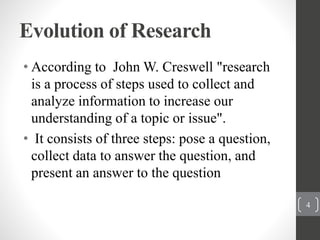
Evolution of Research
• According to John W. Creswell "research
is a process of steps used to collect and
analyze information to increase our
understanding of a topic or issue".
• It consists of three steps: pose a question,
collect data to answer the question, and
present an answer to the question
4
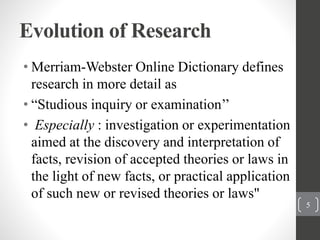
Evolution of Research
• Merriam-Webster Online Dictionary defines
research in more detail as
• “Studious inquiry or examination’’
• Especially : investigation or experimentation
aimed at the discovery and interpretation of
facts, revision of accepted theories or laws in
the light of new facts, or practical application
of such new or revised theories or laws"
5
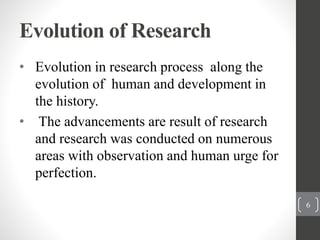
Evolution of Research
• Evolution in research process along the
evolution of human and development in
the history.
• The advancements are result of research
and research was conducted on numerous
areas with observation and human urge for
perfection.
6
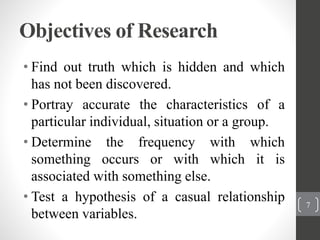
Objectives of Research
• Find out truth which is hidden and which
has not been discovered.
• Portray accurate the characteristics of a
particular individual, situation or a group.
• Determine the frequency with which
something occurs or with which it is
associated with something else.
• Test a hypothesis of a casual relationship
between variables.
7
Milestones of Development
There are some stages that evolved the
concept of research evolution .
• Agricultural practices ( animal farming and
crop farming)
• Industrialization
• Cure / remedies for diseases
• Mechanization of agriculture/ green
revolution
• Technological advancement 8
Types of Research
Original research
• Original research is research that is not
exclusively based on a summary, review or
synthesis of earlier publications on the
subject of research.
• The purpose of the original research is to
produce new knowledge, rather than to
present the existing knowledge in a new
form.
9
Scientific research
• Scientific research is a systematic way of
gathering data and harnessing curiosity.
• The research
provides scientific information and
theories for the explanation of
the nature and the properties of the world.
10
Conti…
• Empirical
• One time research/ longitudinal
• Field setting research
• Clinical/ laboratory
• Historical
• Conclusion oriented
• Decision oriented
11
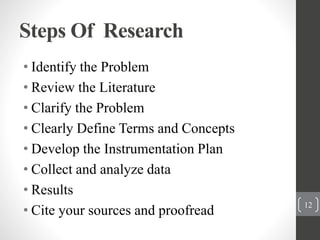
Steps Of Research
• Identify the Problem
• Review the Literature
• Clarify the Problem
• Clearly Define Terms and Concepts
• Develop the Instrumentation Plan
• Collect and analyze data
• Results
• Cite your sources and proofread
12
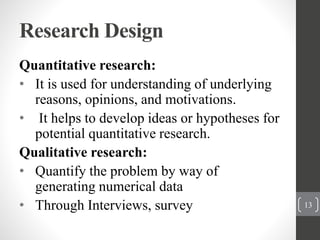
Research Design
Quantitative research:
• It is used for understanding of underlying
reasons, opinions, and motivations.
• It helps to develop ideas or hypotheses for
potential quantitative research.
Qualitative research:
• Quantify the problem by way of
generating numerical data
• Through Interviews, survey 13
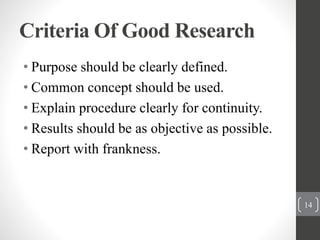
Criteria Of Good Research
• Purpose should be clearly defined.
• Common concept should be used.
• Explain procedure clearly for continuity.
• Results should be as objective as possible.
• Report with frankness.
14
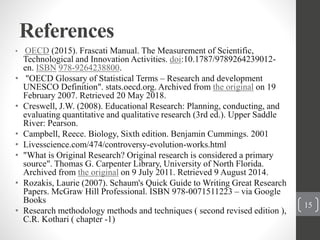
References
• OECD (2015). Frascati Manual. The Measurement of Scientific,
Technological and Innovation Activities. doi:10.1787/9789264239012-
en. ISBN 978-9264238800.
• "OECD Glossary of Statistical Terms – Research and development
UNESCO Definition". stats.oecd.org. Archived from the original on 19
February 2007. Retrieved 20 May 2018.
• Creswell, J.W. (2008). Educational Research: Planning, conducting, and
evaluating quantitative and qualitative research (3rd ed.). Upper Saddle
River: Pearson.
• Campbell, Reece. Biology, Sixth edition. Benjamin Cummings. 2001
• Livesscience.com/474/controversy-evolution-works.html
• "What is Original Research? Original research is considered a primary
source". Thomas G. Carpenter Library, University of North Florida.
Archived from the original on 9 July 2011. Retrieved 9 August 2014.
• Rozakis, Laurie (2007). Schaum's Quick Guide to Writing Great Research
Papers. McGraw Hill Professional. ISBN 978-0071511223 – via Google
Books
• Research methodology methods and techniques ( second revised edition ),
C.R. Kothari ( chapter -1)
15

Evolution of research

  • 1.
  • 2.
    The ‘’Research’’Meaning • Theword research is derived from the Middle French "recherche", which means "to go about seeking’’ • The term itself being derived from the Old French term "recerchier" a compound word from "re-" + "cerchier", or "sercher", meaning 'search' 2
  • 3.
    Definition One definition ofresearch is used by the OECD • Research is "creative and systematic work undertaken to increase the stock of knowledge • Including knowledge of humans, culture and society, and the use of this stock of knowledge to devise new applications. 3
  • 4.
    Evolution of Research •According to John W. Creswell "research is a process of steps used to collect and analyze information to increase our understanding of a topic or issue". • It consists of three steps: pose a question, collect data to answer the question, and present an answer to the question 4
  • 5.
    Evolution of Research •Merriam-Webster Online Dictionary defines research in more detail as • “Studious inquiry or examination’’ • Especially : investigation or experimentation aimed at the discovery and interpretation of facts, revision of accepted theories or laws in the light of new facts, or practical application of such new or revised theories or laws" 5
  • 6.
    Evolution of Research •Evolution in research process along the evolution of human and development in the history. • The advancements are result of research and research was conducted on numerous areas with observation and human urge for perfection. 6
  • 7.
    Objectives of Research •Find out truth which is hidden and which has not been discovered. • Portray accurate the characteristics of a particular individual, situation or a group. • Determine the frequency with which something occurs or with which it is associated with something else. • Test a hypothesis of a casual relationship between variables. 7
  • 8.
    Milestones of Development Thereare some stages that evolved the concept of research evolution . • Agricultural practices ( animal farming and crop farming) • Industrialization • Cure / remedies for diseases • Mechanization of agriculture/ green revolution • Technological advancement 8
  • 9.
    Types of Research Originalresearch • Original research is research that is not exclusively based on a summary, review or synthesis of earlier publications on the subject of research. • The purpose of the original research is to produce new knowledge, rather than to present the existing knowledge in a new form. 9
  • 10.
    Scientific research • Scientificresearch is a systematic way of gathering data and harnessing curiosity. • The research provides scientific information and theories for the explanation of the nature and the properties of the world. 10
  • 11.
    Conti… • Empirical • Onetime research/ longitudinal • Field setting research • Clinical/ laboratory • Historical • Conclusion oriented • Decision oriented 11
  • 12.
    Steps Of Research •Identify the Problem • Review the Literature • Clarify the Problem • Clearly Define Terms and Concepts • Develop the Instrumentation Plan • Collect and analyze data • Results • Cite your sources and proofread 12
  • 13.
    Research Design Quantitative research: •It is used for understanding of underlying reasons, opinions, and motivations. • It helps to develop ideas or hypotheses for potential quantitative research. Qualitative research: • Quantify the problem by way of generating numerical data • Through Interviews, survey 13
  • 14.
    Criteria Of GoodResearch • Purpose should be clearly defined. • Common concept should be used. • Explain procedure clearly for continuity. • Results should be as objective as possible. • Report with frankness. 14
  • 15.
    References • OECD (2015).Frascati Manual. The Measurement of Scientific, Technological and Innovation Activities. doi:10.1787/9789264239012- en. ISBN 978-9264238800. • "OECD Glossary of Statistical Terms – Research and development UNESCO Definition". stats.oecd.org. Archived from the original on 19 February 2007. Retrieved 20 May 2018. • Creswell, J.W. (2008). Educational Research: Planning, conducting, and evaluating quantitative and qualitative research (3rd ed.). Upper Saddle River: Pearson. • Campbell, Reece. Biology, Sixth edition. Benjamin Cummings. 2001 • Livesscience.com/474/controversy-evolution-works.html • "What is Original Research? Original research is considered a primary source". Thomas G. Carpenter Library, University of North Florida. Archived from the original on 9 July 2011. Retrieved 9 August 2014. • Rozakis, Laurie (2007). Schaum's Quick Guide to Writing Great Research Papers. McGraw Hill Professional. ISBN 978-0071511223 – via Google Books • Research methodology methods and techniques ( second revised edition ), C.R. Kothari ( chapter -1) 15