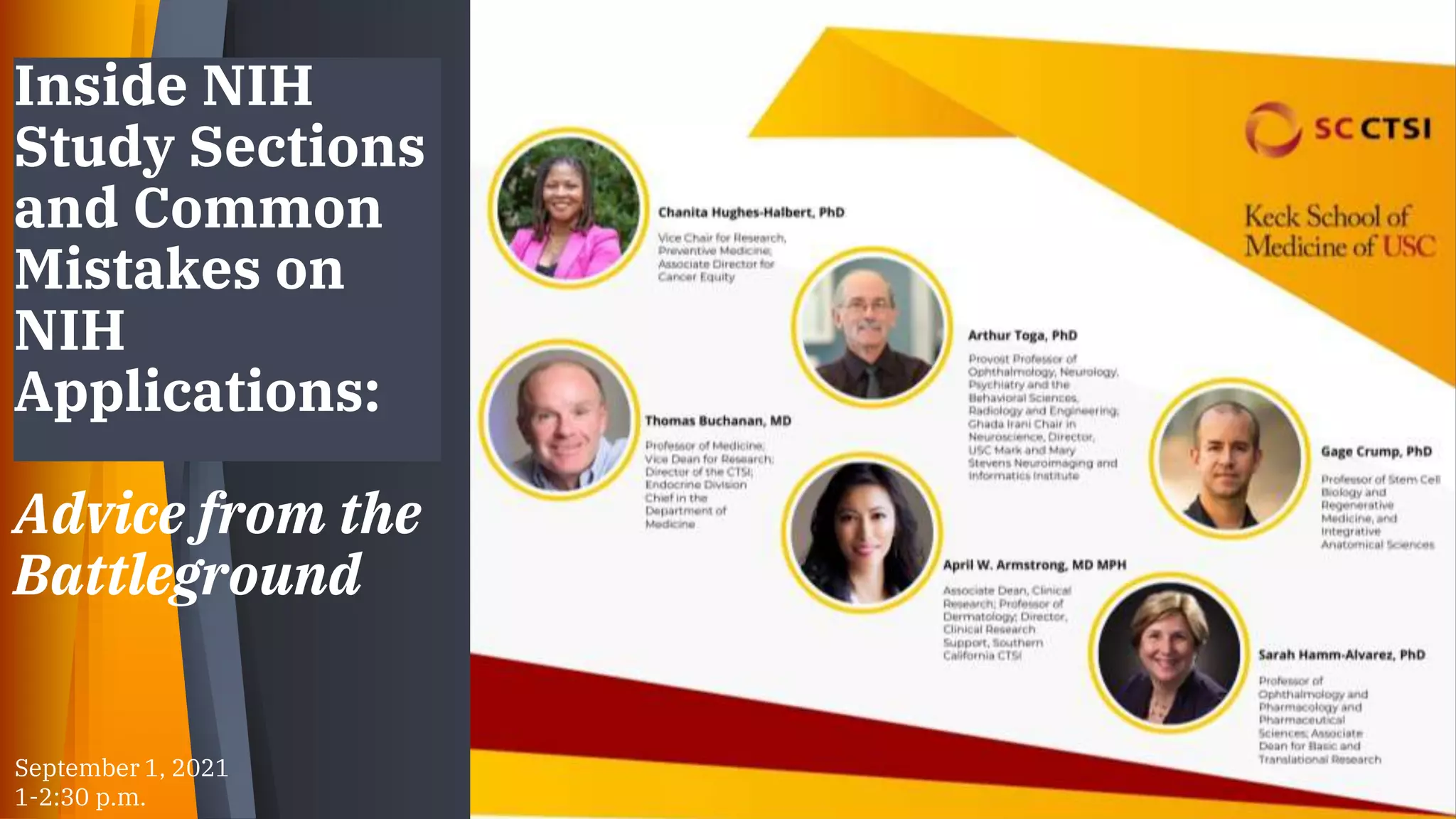
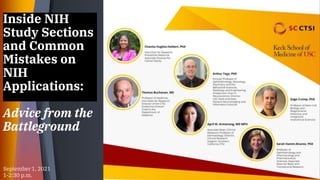
Inside NIH
Study Sections
and Common
Mistakes on
NIH
Applications:
Advice from the
Battleground
September 1, 2021
1-2:30 p.m.
3
Agenda
Welcome and Introduction of Agenda: April Armstrong
Part 1 (40 minutes)
“The Inside Scoop on NIH Study Sections” by Chanita
Hughes-Halbert
“How to think like a reviewer” by Arthur Toga
“Strategies for grant renewal” by Gage Crump
Part 2 (50 minutes)
Panel Discussion: Thomas Buchanan, Sarah Hamm-
Alvarez, Chanita Hughes-Halbert, Art Toga, Gage
Crump, and April Armstrong
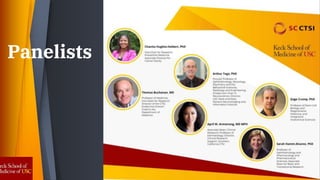
Panelists
5
•Please submit questions using the Q&A
feature anytime throughout the meeting
•Please do not use the chat feature
•This meeting will be recorded and posted
online
The Inside
Scoop on NIH
Study Sections
Chanita Hughes Halbert, PhD
Department of Population and Public
Health Sciences
Norris Comprehensive Cancer
Center
University of Southern California
hughesha@usc.edu
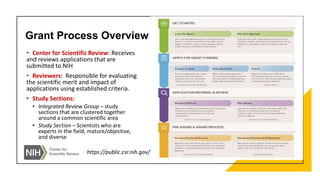
Grant Process Overview
• Center for Scientific Review: Receives
and reviews applications that are
submitted to NIH
• Reviewers: Responsible for evaluating
the scientific merit and impact of
applications using established criteria.
• Study Sections:
• Integrated Review Group – study
sections that are clustered together
around a common scientific area
• Study Section – Scientists who are
experts in the field, mature/objective,
and diverse
https://public.csr.nih.gov/
Key Principles of NIH Peer Review
• NIH provides oversight of the process
• Fair
• Objective
• Study sections evaluate scientific merit
• Scientists who are experts in the field,
mature/objective, and diverse
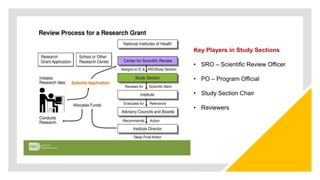
Key Players in Study Sections
• SRO – Scientific Review Officer
• PO – Program Official
• Study Section Chair
• Reviewers
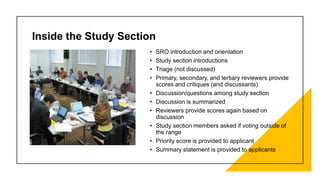
• SRO introduction and orientation
• Study section introductions
• Triage (not discussed)
• Primary, secondary, and tertiary reviewers provide
scores and critiques (and discussants)
• Discussion/questions among study section
• Discussion is summarized
• Reviewers provide scores again based on
discussion
• Study section members asked if voting outside of
the range
• Priority score is provided to applicant
• Summary statement is provided to applicants
Inside the Study Section
Q&A Session with Dr.
Hughes-Halbert (2
minutes)
12
Arthur W. Toga
www.ini.usc.edu
CIA
Think Like a Reviewer
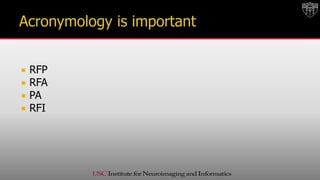
 RFP
 RFA
 PA
 RFI
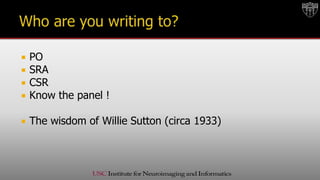
 PO
 SRA
 CSR
 Know the panel !
 The wisdom of Willie Sutton (circa 1933)
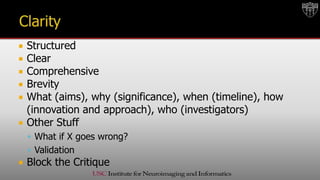
 Structured
 Clear
 Comprehensive
 Brevity
 What (aims), why (significance), when (timeline), how
(innovation and approach), who (investigators)
 Other Stuff
 What if X goes wrong?
 Validation
 Block the Critique
 Graphics not Groans
 Bullets, Bold and Beautiful
1. Triage and Nerf
2. Arguments and Rebuttals
3. Déjà vu all over again
 If she says ‘that is nice dear…’
 Pass the elevator test
 iCRAP
Q&A Session with Dr.
Toga (2 minutes)
20
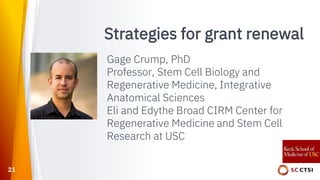
Strategies for grant renewal
Gage Crump, PhD
Professor, Stem Cell Biology and
Regenerative Medicine, Integrative
Anatomical Sciences
Eli and Edythe Broad CIRM Center for
Regenerative Medicine and Stem Cell
Research at USC
21
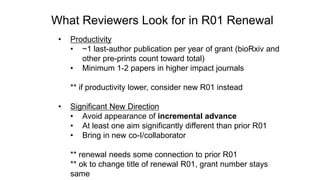
What Reviewers Look for in R01 Renewal
• Productivity
• ~1 last-author publication per year of grant (bioRxiv and
other pre-prints count toward total)
• Minimum 1-2 papers in higher impact journals
** if productivity lower, consider new R01 instead
• Significant New Direction
• Avoid appearance of incremental advance
• At least one aim significantly different than prior R01
• Bring in new co-I/collaborator
** renewal needs some connection to prior R01
** ok to change title of renewal R01, grant number stays
same
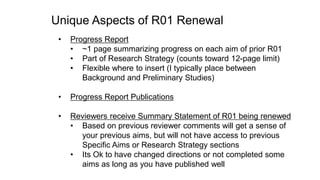
Unique Aspects of R01 Renewal
• Progress Report
• ~1 page summarizing progress on each aim of prior R01
• Part of Research Strategy (counts toward 12-page limit)
• Flexible where to insert (I typically place between
Background and Preliminary Studies)
• Progress Report Publications
• Reviewers receive Summary Statement of R01 being renewed
• Based on previous reviewer comments will get a sense of
your previous aims, but will not have access to previous
Specific Aims or Research Strategy sections
• Its Ok to have changed directions or not completed some
aims as long as you have published well
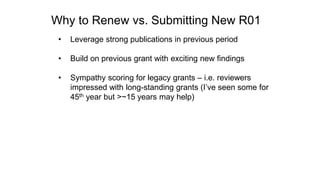
Why to Renew vs. Submitting New R01
• Leverage strong publications in previous period
• Build on previous grant with exciting new findings
• Sympathy scoring for legacy grants – i.e. reviewers
impressed with long-standing grants (I’ve seen some for
45th year but >~15 years may help)
Q&A Session with Dr.
Crump (2 minutes)
25
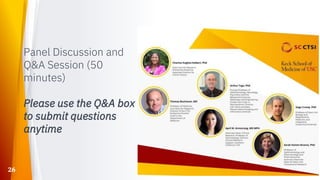
Panel Discussion and
Q&A Session (50
minutes)
Please use the Q&A box
to submit questions
anytime
26
What is your general
approach to reviewing grants
for study section?
• What do you look at most
closely?
• Are there sections you place
less emphasis?
• How might your approach
be different if you are
primary vs secondary
reviewer?
27
What is your general
approach to reviewing grants
for study section?
• What do you look at most
closely?
• Are there sections you
place less emphasis?
• How might your approach
be different if you are
primary vs secondary
reviewer?
28
What is your general
approach to reviewing grants
for study section?
• What do you look at most
closely?
• Are there sections you place
less emphasis?
• How might your approach
be different if you are
primary vs secondary
reviewer?
29
30
2. Common Mistakes on NIH Research
Applications and How to Avoid them:
• Specific Aims
• Research Strategy
• Significance
• Innovation
• Approach
• Preliminary studies
• Overall strategy
• Methodology and analysis
2. Common Mistakes on NIH Research
Applications and How to Avoid them:
• Specific Aims
• Research Strategy
• Significance
• Innovation
• Approach
• Preliminary studies
• Overall strategy
• Methodology and analysis
2. Common Mistakes on NIH Research
Applications and How to Avoid them:
• Specific Aims
• Research Strategy
• Significance
• Innovation
• Approach
• Preliminary studies
• Overall strategy
• Methodology and analysis
2. Common Mistakes on NIH Research
Applications and How to Avoid them:
• Specific Aims
• Research Strategy
• Significance
• Innovation
• Approach
• Preliminary studies
• Overall strategy
• Methodology and analysis
2. Common Mistakes on NIH Research
Applications and How to Avoid them:
• Specific Aims
• Research Strategy
• Significance
• Innovation
• Approach
• Preliminary studies
• Overall strategy
• Methodology and analysis
2. Common Mistakes on NIH Research
Applications and How to Avoid them:
• Specific Aims
• Research Strategy
• Significance
• Innovation
• Approach
• Preliminary studies
• Overall strategy
• Methodology and analysis
Summary Statement
3. The Summary Statement: Now what?
a.What is the role of your program officer in
assistant with your interpretation or response to
a statement?
b.How do you read and interpret it – what matters
most? Least?
c. Whether and how do you construct a response
and revision?
d.What should you do about inaccuracies?
3. The Summary Statement: Now what?
a. What is the role of your program officer in
assistant with your interpretation or response to a
statement?
b.How do you read and interpret it – what matters
most? Least?
c. Whether and how do you construct a response
and revision?
d.What should you do about inaccuracies?
Your feedback matters.
Please complete the post meeting survey.
Inside NIH
Study Sections
and Common
Mistakes on
NIH
Applications:
Advice from the
Battleground
September 1, 2021
1-2:30 p.m.

Advice from the Battleground: Inside NIH Study Sections and Common Mistakes on NIH Applications

  • 1.
    Inside NIH Study Sections andCommon Mistakes on NIH Applications: Advice from the Battleground September 1, 2021 1-2:30 p.m.
  • 2.
    3 Agenda Welcome and Introductionof Agenda: April Armstrong Part 1 (40 minutes) “The Inside Scoop on NIH Study Sections” by Chanita Hughes-Halbert “How to think like a reviewer” by Arthur Toga “Strategies for grant renewal” by Gage Crump Part 2 (50 minutes) Panel Discussion: Thomas Buchanan, Sarah Hamm- Alvarez, Chanita Hughes-Halbert, Art Toga, Gage Crump, and April Armstrong
  • 3.
  • 4.
    5 •Please submit questionsusing the Q&A feature anytime throughout the meeting •Please do not use the chat feature •This meeting will be recorded and posted online
  • 5.
    The Inside Scoop onNIH Study Sections Chanita Hughes Halbert, PhD Department of Population and Public Health Sciences Norris Comprehensive Cancer Center University of Southern California hughesha@usc.edu
  • 6.
    Grant Process Overview •Center for Scientific Review: Receives and reviews applications that are submitted to NIH • Reviewers: Responsible for evaluating the scientific merit and impact of applications using established criteria. • Study Sections: • Integrated Review Group – study sections that are clustered together around a common scientific area • Study Section – Scientists who are experts in the field, mature/objective, and diverse https://public.csr.nih.gov/
  • 7.
    Key Principles ofNIH Peer Review • NIH provides oversight of the process • Fair • Objective • Study sections evaluate scientific merit • Scientists who are experts in the field, mature/objective, and diverse
  • 8.
    Key Players inStudy Sections • SRO – Scientific Review Officer • PO – Program Official • Study Section Chair • Reviewers
  • 9.
    • SRO introductionand orientation • Study section introductions • Triage (not discussed) • Primary, secondary, and tertiary reviewers provide scores and critiques (and discussants) • Discussion/questions among study section • Discussion is summarized • Reviewers provide scores again based on discussion • Study section members asked if voting outside of the range • Priority score is provided to applicant • Summary statement is provided to applicants Inside the Study Section
  • 10.
    Q&A Session withDr. Hughes-Halbert (2 minutes) 12
  • 11.
  • 12.
  • 13.
     PO  SRA CSR  Know the panel !  The wisdom of Willie Sutton (circa 1933)
  • 14.
     Structured  Clear Comprehensive  Brevity  What (aims), why (significance), when (timeline), how (innovation and approach), who (investigators)  Other Stuff  What if X goes wrong?  Validation  Block the Critique
  • 15.
     Graphics notGroans  Bullets, Bold and Beautiful
  • 16.
    1. Triage andNerf 2. Arguments and Rebuttals 3. Déjà vu all over again
  • 17.
     If shesays ‘that is nice dear…’  Pass the elevator test  iCRAP
  • 18.
    Q&A Session withDr. Toga (2 minutes) 20
  • 19.
    Strategies for grantrenewal Gage Crump, PhD Professor, Stem Cell Biology and Regenerative Medicine, Integrative Anatomical Sciences Eli and Edythe Broad CIRM Center for Regenerative Medicine and Stem Cell Research at USC 21
  • 20.
    What Reviewers Lookfor in R01 Renewal • Productivity • ~1 last-author publication per year of grant (bioRxiv and other pre-prints count toward total) • Minimum 1-2 papers in higher impact journals ** if productivity lower, consider new R01 instead • Significant New Direction • Avoid appearance of incremental advance • At least one aim significantly different than prior R01 • Bring in new co-I/collaborator ** renewal needs some connection to prior R01 ** ok to change title of renewal R01, grant number stays same
  • 21.
    Unique Aspects ofR01 Renewal • Progress Report • ~1 page summarizing progress on each aim of prior R01 • Part of Research Strategy (counts toward 12-page limit) • Flexible where to insert (I typically place between Background and Preliminary Studies) • Progress Report Publications • Reviewers receive Summary Statement of R01 being renewed • Based on previous reviewer comments will get a sense of your previous aims, but will not have access to previous Specific Aims or Research Strategy sections • Its Ok to have changed directions or not completed some aims as long as you have published well
  • 22.
    Why to Renewvs. Submitting New R01 • Leverage strong publications in previous period • Build on previous grant with exciting new findings • Sympathy scoring for legacy grants – i.e. reviewers impressed with long-standing grants (I’ve seen some for 45th year but >~15 years may help)
  • 23.
    Q&A Session withDr. Crump (2 minutes) 25
  • 24.
    Panel Discussion and Q&ASession (50 minutes) Please use the Q&A box to submit questions anytime 26
  • 25.
    What is yourgeneral approach to reviewing grants for study section? • What do you look at most closely? • Are there sections you place less emphasis? • How might your approach be different if you are primary vs secondary reviewer? 27
  • 26.
    What is yourgeneral approach to reviewing grants for study section? • What do you look at most closely? • Are there sections you place less emphasis? • How might your approach be different if you are primary vs secondary reviewer? 28
  • 27.
    What is yourgeneral approach to reviewing grants for study section? • What do you look at most closely? • Are there sections you place less emphasis? • How might your approach be different if you are primary vs secondary reviewer? 29
  • 28.
    30 2. Common Mistakeson NIH Research Applications and How to Avoid them: • Specific Aims • Research Strategy • Significance • Innovation • Approach • Preliminary studies • Overall strategy • Methodology and analysis
  • 29.
    2. Common Mistakeson NIH Research Applications and How to Avoid them: • Specific Aims • Research Strategy • Significance • Innovation • Approach • Preliminary studies • Overall strategy • Methodology and analysis
  • 30.
    2. Common Mistakeson NIH Research Applications and How to Avoid them: • Specific Aims • Research Strategy • Significance • Innovation • Approach • Preliminary studies • Overall strategy • Methodology and analysis
  • 31.
    2. Common Mistakeson NIH Research Applications and How to Avoid them: • Specific Aims • Research Strategy • Significance • Innovation • Approach • Preliminary studies • Overall strategy • Methodology and analysis
  • 32.
    2. Common Mistakeson NIH Research Applications and How to Avoid them: • Specific Aims • Research Strategy • Significance • Innovation • Approach • Preliminary studies • Overall strategy • Methodology and analysis
  • 33.
    2. Common Mistakeson NIH Research Applications and How to Avoid them: • Specific Aims • Research Strategy • Significance • Innovation • Approach • Preliminary studies • Overall strategy • Methodology and analysis
  • 34.
  • 35.
    3. The SummaryStatement: Now what? a.What is the role of your program officer in assistant with your interpretation or response to a statement? b.How do you read and interpret it – what matters most? Least? c. Whether and how do you construct a response and revision? d.What should you do about inaccuracies?
  • 36.
    3. The SummaryStatement: Now what? a. What is the role of your program officer in assistant with your interpretation or response to a statement? b.How do you read and interpret it – what matters most? Least? c. Whether and how do you construct a response and revision? d.What should you do about inaccuracies?
  • 37.
    Your feedback matters. Pleasecomplete the post meeting survey.
  • 38.
    Inside NIH Study Sections andCommon Mistakes on NIH Applications: Advice from the Battleground September 1, 2021 1-2:30 p.m.

Editor's Notes

  • #7 Who is discussed first. What percentage gets discussed in each category? Discussion of new investigators. --over ambitious --over interpretation -- wait until the last minute --need to give the grant to the worst enemy --the younger the reviewers, the harder they are. --needs to be a coherent story without loose ends --innovative but not too innovative --what is innovation? Conceptual innovation: Eistein: being a genius is looking at something that everyone else is looking at but seeing it in a different way. Unique perspective Scientific innovation: you’ve got the goods. Technical innovation: technology. Investigators: you need an investigative team. It’s about team. Science is a team sport. Resubmission– Timing when to prepare and how many to submit. Terrible mistakes, and what to do. R03 or R21 doesn’t have ESI privilege. Approach section– twice the space for alternative approach as the actual approach.