Research Data Management and Reproducibility
Aim:- To highlight how research data management can
help with reproducibility.
Judith Carr, Research Data Manager
Co-ordinator - Gary Jeffers, Research Data Officer
Photo by Aron Visuals on Unsplash
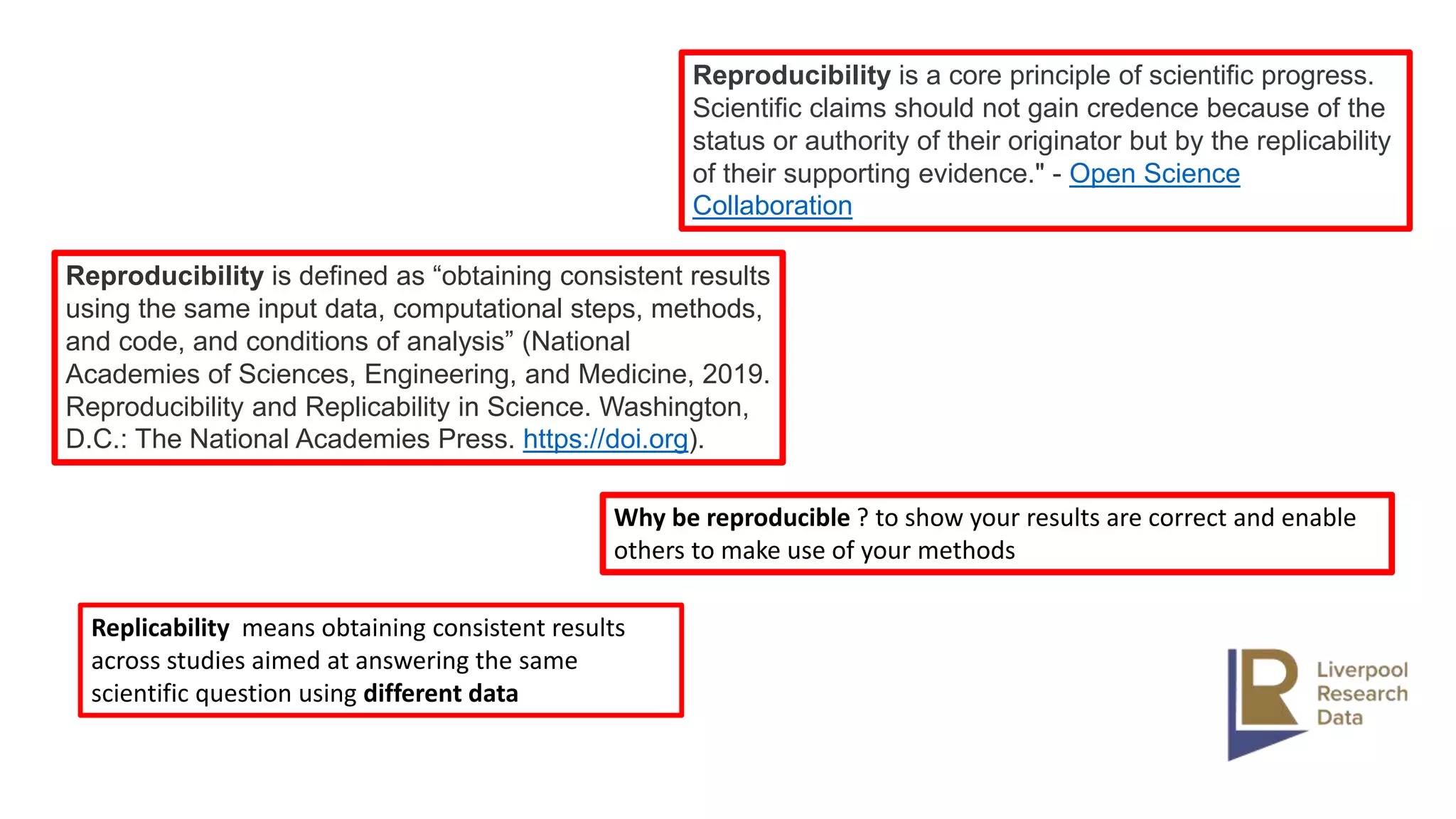
Reproducibility is defined as “obtaining consistent results
using the same input data, computational steps, methods,
and code, and conditions of analysis” (National
Academies of Sciences, Engineering, and Medicine, 2019.
Reproducibility and Replicability in Science. Washington,
D.C.: The National Academies Press. https://doi.org).
Why be reproducible ? to show your results are correct and enable
others to make use of your methods
Reproducibility is a core principle of scientific progress.
Scientific claims should not gain credence because of the
status or authority of their originator but by the replicability
of their supporting evidence." - Open Science
Collaboration
Replicability means obtaining consistent results
across studies aimed at answering the same
scientific question using different data
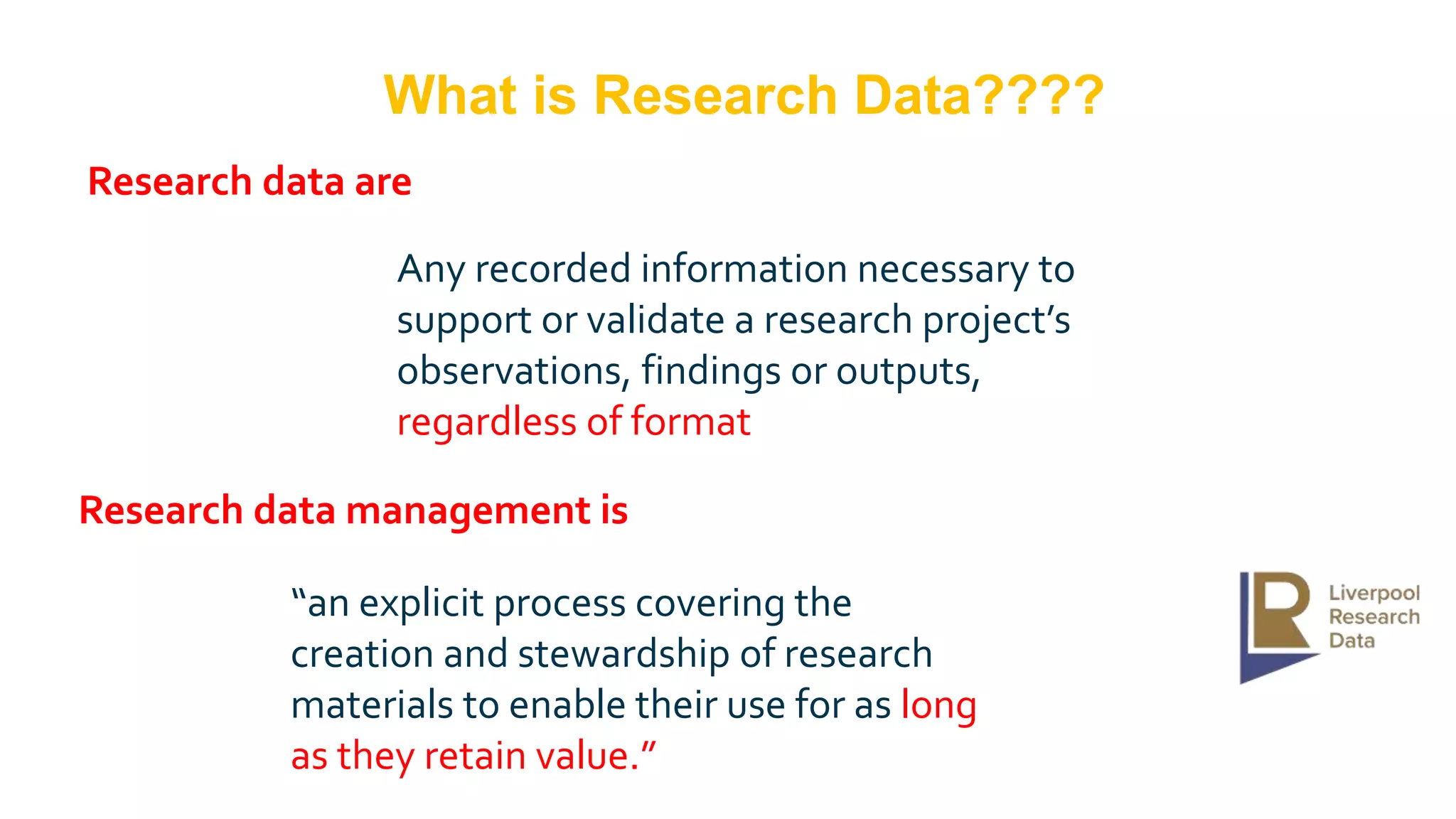
“an explicit process covering the
creation and stewardship of research
materials to enable their use for as long
as they retain value.”
Research data are
Research data management is
Any recorded information necessary to
support or validate a research project’s
observations, findings or outputs,
regardless of format
What is Research Data????
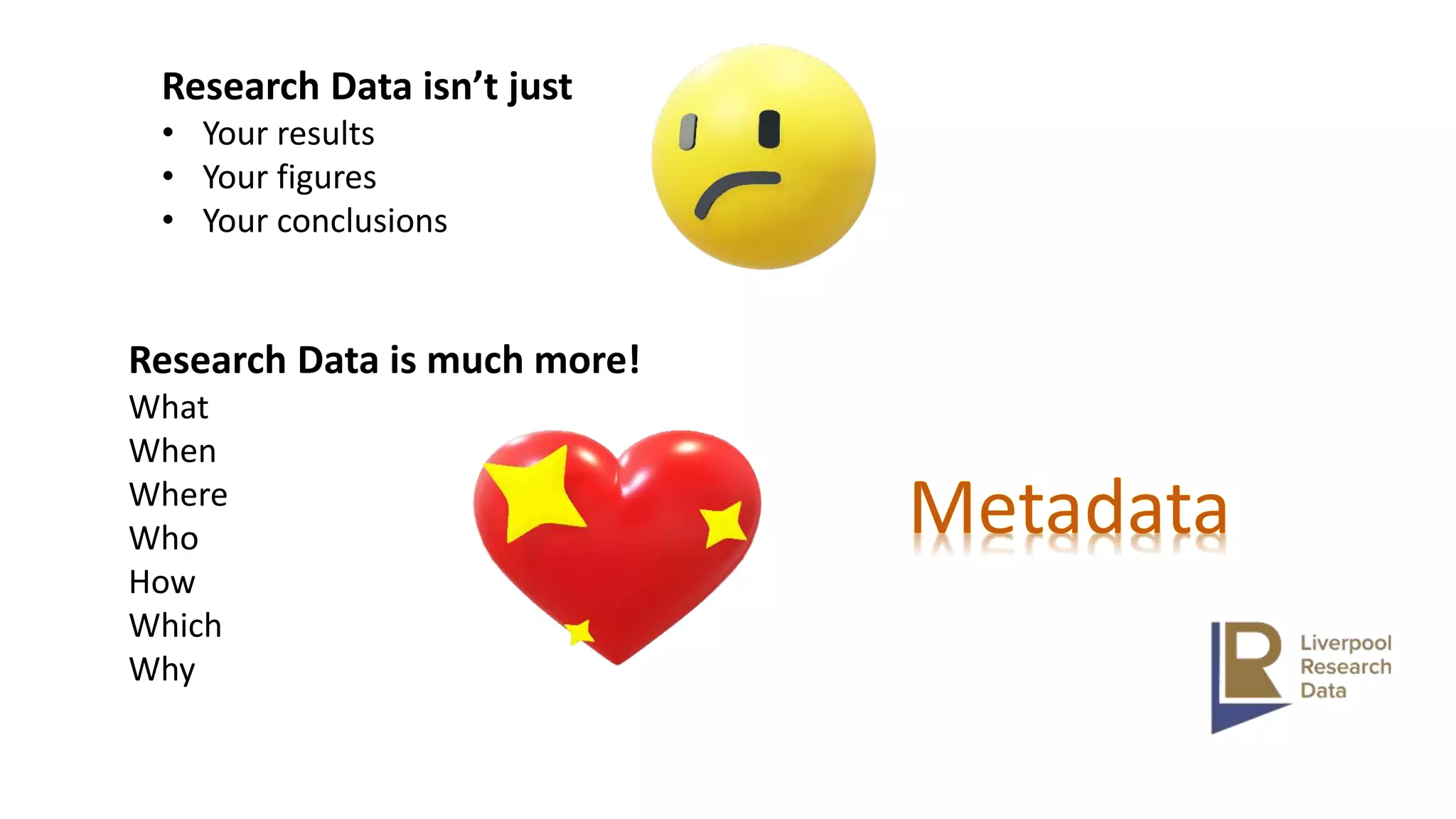
Research Data isn’t just
• Your results
• Your figures
• Your conclusions
Research Data is much more!
What
When
Where
Who
How
Which
Why
To Illustrate
Metadata and sharing Covid-19 research
Schriml, L.M., Chuvochina, M., Davies, N. et al. COVID-19
pandemic reveals the peril of ignoring metadata standards. Sci
Data 7, 188 (2020). https://doi.org/10.1038/s41597-020-0524-5
Prof Bill Greenhalf UoL video https://www.liverpool.ac.uk/library/research-data-
management/reproducibility-and-ukrn/
https://youtu.be/FpCrY7x5nEE
cea + from The Netherlands [CC BY 2.0]
• Don’t drown in data/information
• Don’t rely on your memory
• Avoids repetitive reading, testing, analysing
• Helps you find your data/information
• Helps you to explain what you have done
• Helps when collaborating – ask management questions
first
• Versioning, shows progress, thought process,
development
• No one size fits all
Planning
Photo by Derick McKinney on Unsplash
Not the most exciting part of research!
• For some might be as simple as filing, learning
data descriptions or metadata vocabulary
• It might mean a lot of conversations about
what, how and where data is collected
• If you start out with a plan, then you avoid
delays further down the line. Plan to share as
well
www.Liverpool.ac.uk/rdm
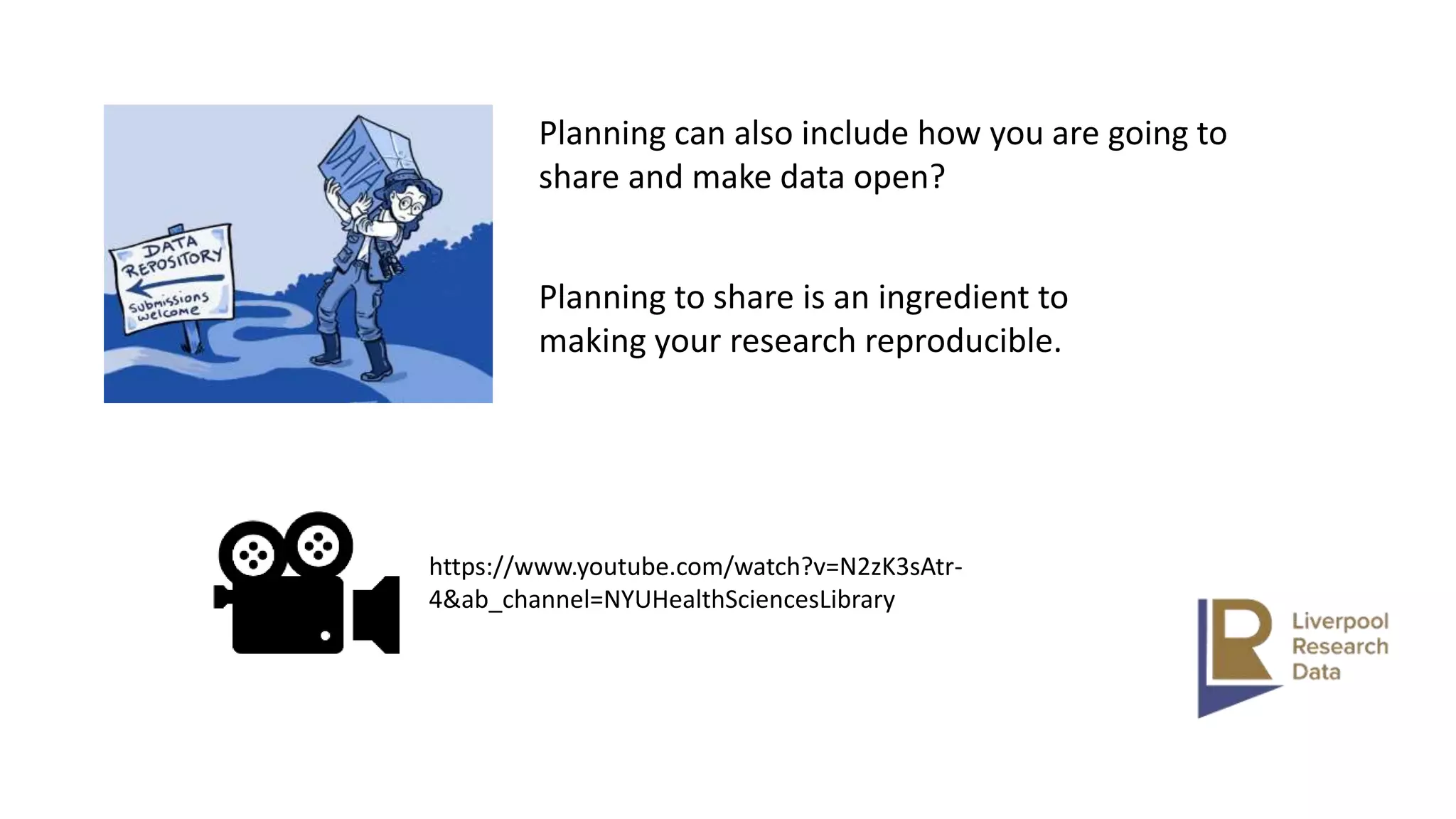
Planning can also include how you are going to
share and make data open?
Planning to share is an ingredient to
making your research reproducible.
https://www.youtube.com/watch?v=N2zK3sAtr-
4&ab_channel=NYUHealthSciencesLibrary
SangyaPundir •CC BY-SA 4.0
https://www.youtube.com/watch?v=5OeCrQE3HhE&ab_chann
el=MaastrichtUniversity
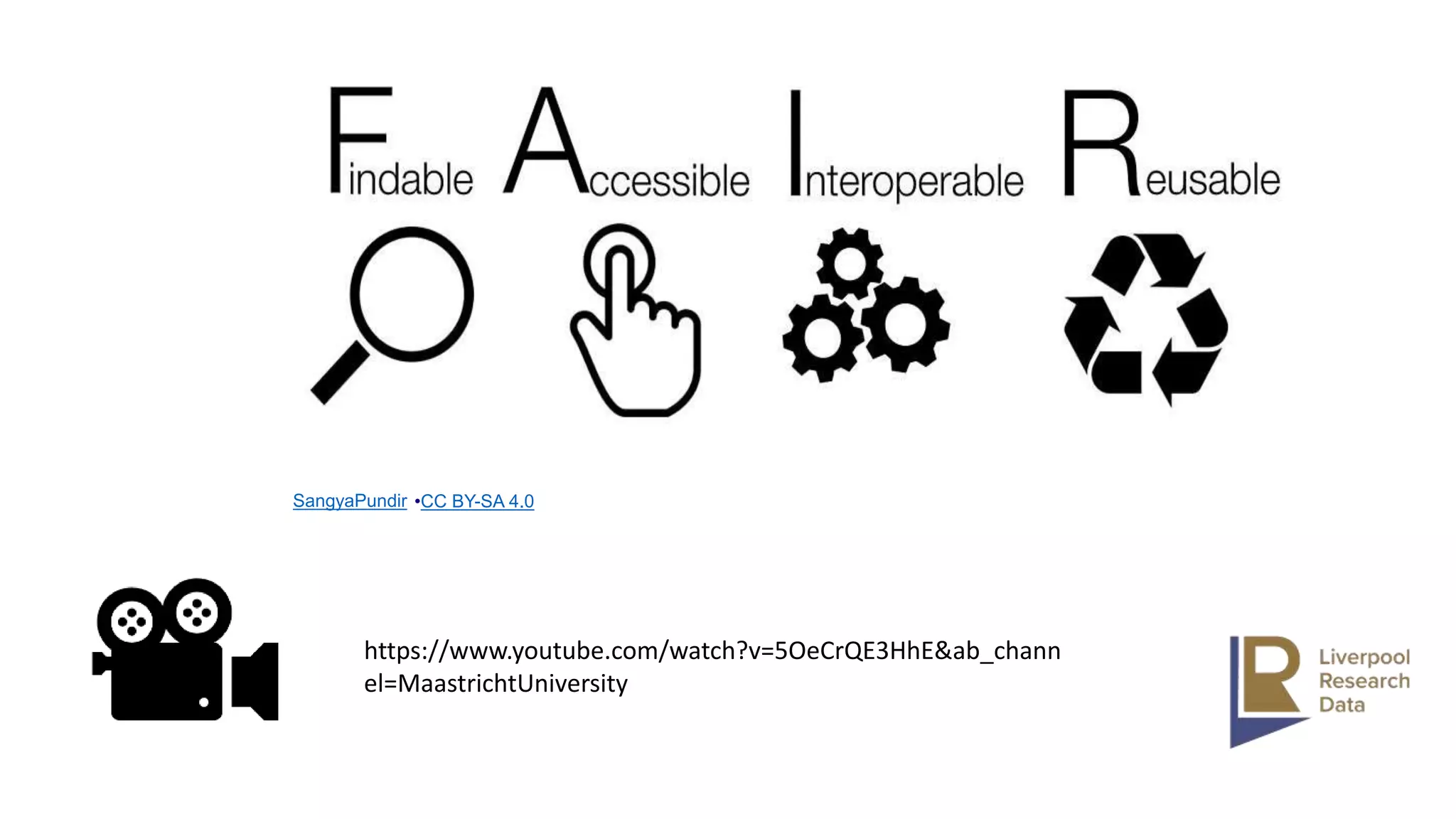
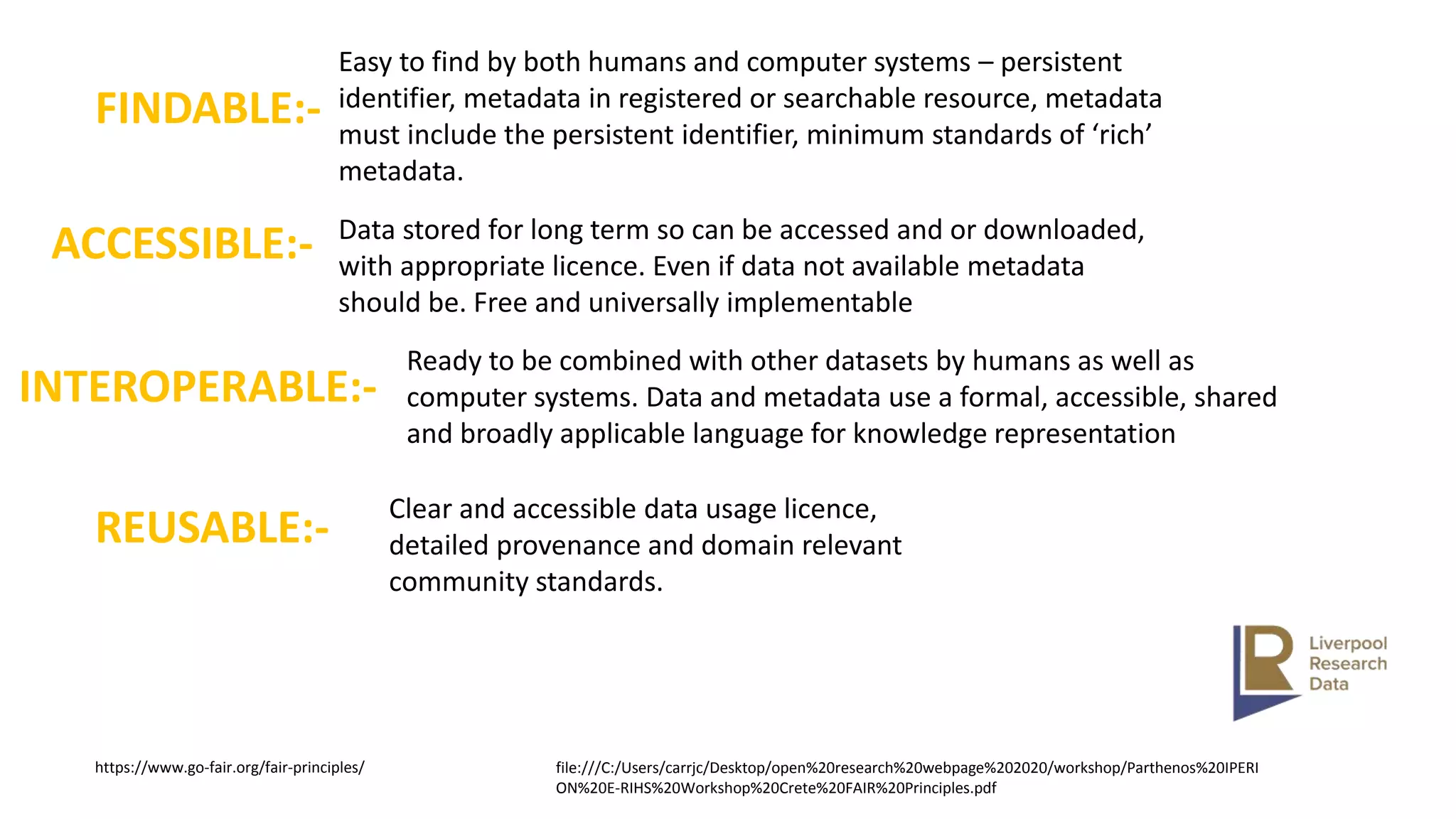
FINDABLE:-
Easy to find by both humans and computer systems – persistent
identifier, metadata in registered or searchable resource, metadata
must include the persistent identifier, minimum standards of ‘rich’
metadata.
ACCESSIBLE:- Data stored for long term so can be accessed and or downloaded,
with appropriate licence. Even if data not available metadata
should be. Free and universally implementable
INTEROPERABLE:-
Ready to be combined with other datasets by humans as well as
computer systems. Data and metadata use a formal, accessible, shared
and broadly applicable language for knowledge representation
REUSABLE:-
Clear and accessible data usage licence,
detailed provenance and domain relevant
community standards.
https://www.go-fair.org/fair-principles/ file:///C:/Users/carrjc/Desktop/open%20research%20webpage%202020/workshop/Parthenos%20IPERI
ON%20E-RIHS%20Workshop%20Crete%20FAIR%20Principles.pdf
To conclude
PLAN from the beginning, be flexible but note down changes and
why. Plan to share, think about what you would need to know if
you wanted to use your own research data in years to come
DMP online use this resource, use funder templates, ask
questions of your collaborators at the beginning
Metadata ask those questions, who, what, where, why, when,
which – have readme files and protocols, whatever helps
FAIR might not mean open but consider openness and
transparency within team and with collaborators.
Webpages:- www.Liverpool.ac.uk/rdm
Thank You – Any questions???????

Research Data Management and Reproducibility

  • 1.
    Research Data Managementand Reproducibility Aim:- To highlight how research data management can help with reproducibility. Judith Carr, Research Data Manager Co-ordinator - Gary Jeffers, Research Data Officer Photo by Aron Visuals on Unsplash
  • 2.
    Reproducibility is definedas “obtaining consistent results using the same input data, computational steps, methods, and code, and conditions of analysis” (National Academies of Sciences, Engineering, and Medicine, 2019. Reproducibility and Replicability in Science. Washington, D.C.: The National Academies Press. https://doi.org). Why be reproducible ? to show your results are correct and enable others to make use of your methods Reproducibility is a core principle of scientific progress. Scientific claims should not gain credence because of the status or authority of their originator but by the replicability of their supporting evidence." - Open Science Collaboration Replicability means obtaining consistent results across studies aimed at answering the same scientific question using different data
  • 3.
    “an explicit processcovering the creation and stewardship of research materials to enable their use for as long as they retain value.” Research data are Research data management is Any recorded information necessary to support or validate a research project’s observations, findings or outputs, regardless of format What is Research Data????
  • 4.
    Research Data isn’tjust • Your results • Your figures • Your conclusions Research Data is much more! What When Where Who How Which Why
  • 5.
    To Illustrate Metadata andsharing Covid-19 research Schriml, L.M., Chuvochina, M., Davies, N. et al. COVID-19 pandemic reveals the peril of ignoring metadata standards. Sci Data 7, 188 (2020). https://doi.org/10.1038/s41597-020-0524-5 Prof Bill Greenhalf UoL video https://www.liverpool.ac.uk/library/research-data- management/reproducibility-and-ukrn/ https://youtu.be/FpCrY7x5nEE
  • 6.
    cea + fromThe Netherlands [CC BY 2.0] • Don’t drown in data/information • Don’t rely on your memory • Avoids repetitive reading, testing, analysing • Helps you find your data/information • Helps you to explain what you have done • Helps when collaborating – ask management questions first • Versioning, shows progress, thought process, development • No one size fits all Planning
  • 7.
    Photo by DerickMcKinney on Unsplash Not the most exciting part of research! • For some might be as simple as filing, learning data descriptions or metadata vocabulary • It might mean a lot of conversations about what, how and where data is collected • If you start out with a plan, then you avoid delays further down the line. Plan to share as well www.Liverpool.ac.uk/rdm
  • 8.
    Planning can alsoinclude how you are going to share and make data open? Planning to share is an ingredient to making your research reproducible. https://www.youtube.com/watch?v=N2zK3sAtr- 4&ab_channel=NYUHealthSciencesLibrary
  • 9.
    SangyaPundir •CC BY-SA4.0 https://www.youtube.com/watch?v=5OeCrQE3HhE&ab_chann el=MaastrichtUniversity
  • 10.
    FINDABLE:- Easy to findby both humans and computer systems – persistent identifier, metadata in registered or searchable resource, metadata must include the persistent identifier, minimum standards of ‘rich’ metadata. ACCESSIBLE:- Data stored for long term so can be accessed and or downloaded, with appropriate licence. Even if data not available metadata should be. Free and universally implementable INTEROPERABLE:- Ready to be combined with other datasets by humans as well as computer systems. Data and metadata use a formal, accessible, shared and broadly applicable language for knowledge representation REUSABLE:- Clear and accessible data usage licence, detailed provenance and domain relevant community standards. https://www.go-fair.org/fair-principles/ file:///C:/Users/carrjc/Desktop/open%20research%20webpage%202020/workshop/Parthenos%20IPERI ON%20E-RIHS%20Workshop%20Crete%20FAIR%20Principles.pdf
  • 11.
    To conclude PLAN fromthe beginning, be flexible but note down changes and why. Plan to share, think about what you would need to know if you wanted to use your own research data in years to come DMP online use this resource, use funder templates, ask questions of your collaborators at the beginning Metadata ask those questions, who, what, where, why, when, which – have readme files and protocols, whatever helps FAIR might not mean open but consider openness and transparency within team and with collaborators.
  • 12.

Editor's Notes

  • #4 These definitions are very useful and it good to remember that this is any kind of data.
  • #10 9