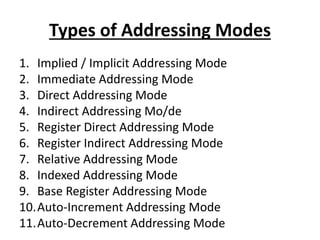
The document discusses different types of addressing modes used in computer instructions, including implied, immediate, direct, indirect, register direct, register indirect, relative, indexed, base register, auto-increment, and auto-decrement addressing modes. It provides examples and explanations of each addressing mode type.
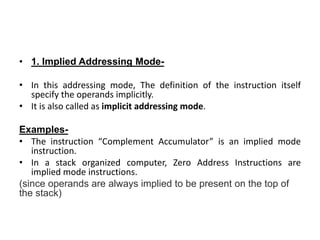
• 1. ImpliedAddressing Mode-
• In this addressing mode, The definition of the instruction itself
specify the operands implicitly.
• It is also called as implicit addressing mode.
Examples-
• The instruction “Complement Accumulator” is an implied mode
instruction.
• In a stack organized computer, Zero Address Instructions are
implied mode instructions.
(since operands are always implied to be present on the top of
the stack)
5.
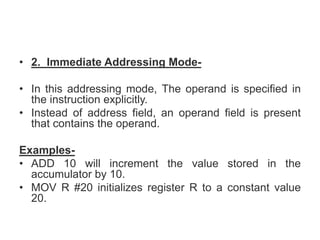
• 2. ImmediateAddressing Mode-
• In this addressing mode, The operand is specified in
the instruction explicitly.
• Instead of address field, an operand field is present
that contains the operand.
Examples-
• ADD 10 will increment the value stored in the
accumulator by 10.
• MOV R #20 initializes register R to a constant value
20.
6.
• 3. DirectAddressing Mode-
• In this addressing mode, The address field of the
instruction contains the effective address of the
operand.
• Only one reference to memory is required to fetch
the operand.
• It is also called as absolute addressing mode.
Example-
• ADD X will increment the value stored in the accumulator
by the value stored at memory location X.
• AC ← AC + [X]
7.
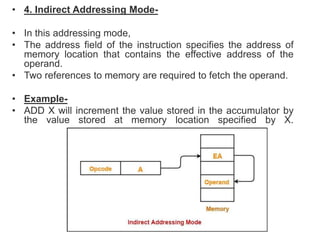
• 4. IndirectAddressing Mode-
• In this addressing mode,
• The address field of the instruction specifies the address of
memory location that contains the effective address of the
operand.
• Two references to memory are required to fetch the operand.
• Example-
• ADD X will increment the value stored in the accumulator by
the value stored at memory location specified by X.
8.
• 5. RegisterDirect Addressing Mode-
• In this addressing mode,
• The operand is contained in a register set.
• The address field of the instruction refers to a CPU register
that contains the operand.
• No reference to memory is required to fetch the operand.
• Example-
• ADD R will increment the value stored in the accumulator by
the content of register R.
• AC ← AC + [R]
9.
• 6. RegisterIndirect Addressing Mode-
• In this addressing mode,
• The address field of the instruction refers to a CPU register
that contains the effective address of the operand.
• Only one reference to memory is required to fetch the
operand.
• Example-
• ADD R will increment the value stored in the accumulator by
the content of memory location specified in register R.
• AC ← AC + [[R]]
10.
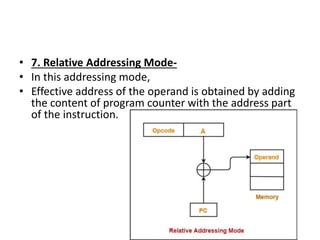
• 7. RelativeAddressing Mode-
• In this addressing mode,
• Effective address of the operand is obtained by adding
the content of program counter with the address part
of the instruction.
11.
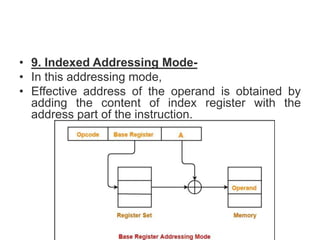
• 9. IndexedAddressing Mode-
• In this addressing mode,
• Effective address of the operand is obtained by
adding the content of index register with the
address part of the instruction.
12.
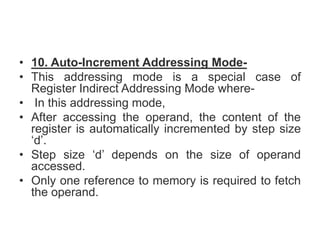
• 10. Auto-IncrementAddressing Mode-
• This addressing mode is a special case of
Register Indirect Addressing Mode where-
• In this addressing mode,
• After accessing the operand, the content of the
register is automatically incremented by step size
‘d’.
• Step size ‘d’ depends on the size of operand
accessed.
• Only one reference to memory is required to fetch
the operand.
13.
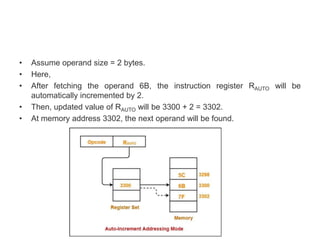
• Assume operandsize = 2 bytes.
• Here,
• After fetching the operand 6B, the instruction register RAUTO will be
automatically incremented by 2.
• Then, updated value of RAUTO will be 3300 + 2 = 3302.
• At memory address 3302, the next operand will be found.
14.
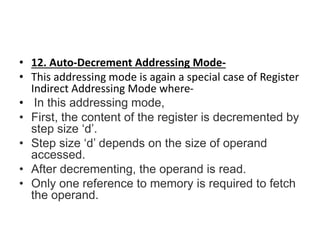
• 12. Auto-DecrementAddressing Mode-
• This addressing mode is again a special case of Register
Indirect Addressing Mode where-
• In this addressing mode,
• First, the content of the register is decremented by
step size ‘d’.
• Step size ‘d’ depends on the size of operand
accessed.
• After decrementing, the operand is read.
• Only one reference to memory is required to fetch
the operand.
15.
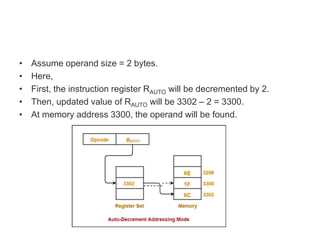
• Assume operandsize = 2 bytes.
• Here,
• First, the instruction register RAUTO will be decremented by 2.
• Then, updated value of RAUTO will be 3302 – 2 = 3300.
• At memory address 3300, the operand will be found.