Batch (014)
 MUHAMMAD ASIM (14093122-007)
 INZMAM TAHIR (14093122-005)
 YASIR ALI (14093122-006)
 ADNAN ASLAM (14093122-003)
 BILAL AMJAD (14093122-004)
 UMAR RASHEED (14093122-002)
PRESENTATION
 In chapter 7 ,we saw how to learn multiplication
and division by shifting the bits in a byte or
word.
 Left and right shift can be used for multiplying
and dividing respectively by powers of 2.
 Process of multiplication and division is different
for signed and unsigned numbers and there are
different instructions used for signed and
unsigned multiplication and division.
 One of the most useful applications of
multiplication and division is to implement
decimal input and output.
 In the case of unsigned multiplication, using
instruction MUL .
 The syntax of this instruction is
MUL source
 Example
AL=128 BL=255
1 0 0 0 0 0 0 0 1 1 1 1 1 1 1 1
0 1 1 1 1 1 1 1 1 0 0 0 0 0 0 0
AX=32640
 In the case of signed multiplication, using
instruction IMUL .
 The syntax of this instruction is
IMUL source
 Example
AL=128 BL=-1
1 0 0 0 0 0 0 0 1 1 1 1 1 1 1 1
0 1 1 1 1 1 1 1 1 0 0 0 0 0 0 0
AX=32640
 In byte multiplication one number is
contained in the source and the other is
assumed to be in AL.
 The 16-bit product will be in AX.
 The source may be a byte register or
memory byte but not a constant.
Multiplicand
Multiplier
Result
AL
AX
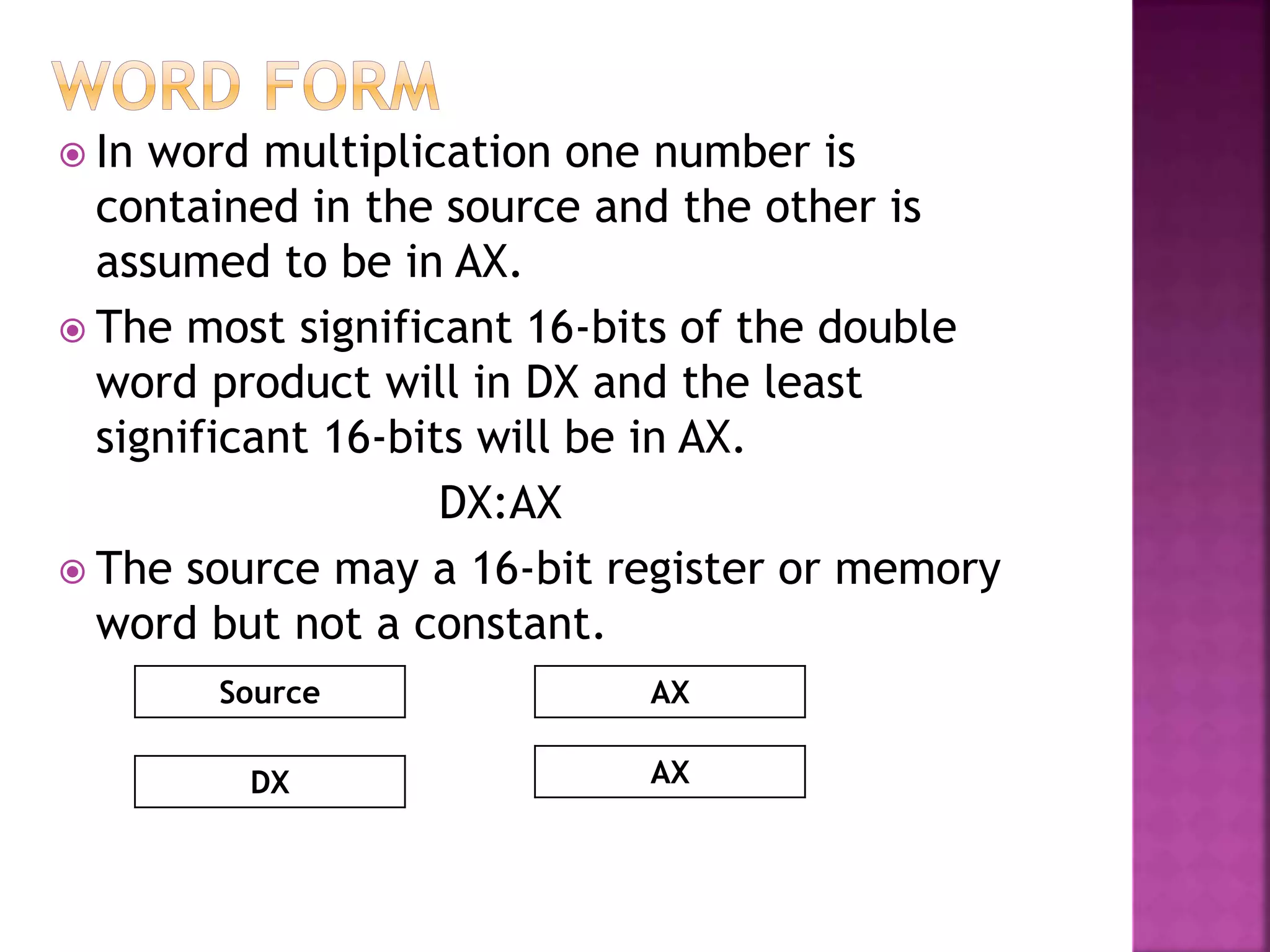
 In word multiplication one number is
contained in the source and the other is
assumed to be in AX.
 The most significant 16-bits of the double
word product will in DX and the least
significant 16-bits will be in AX.
DX:AX
 The source may a 16-bit register or memory
word but not a constant.
Source AX
DX AX
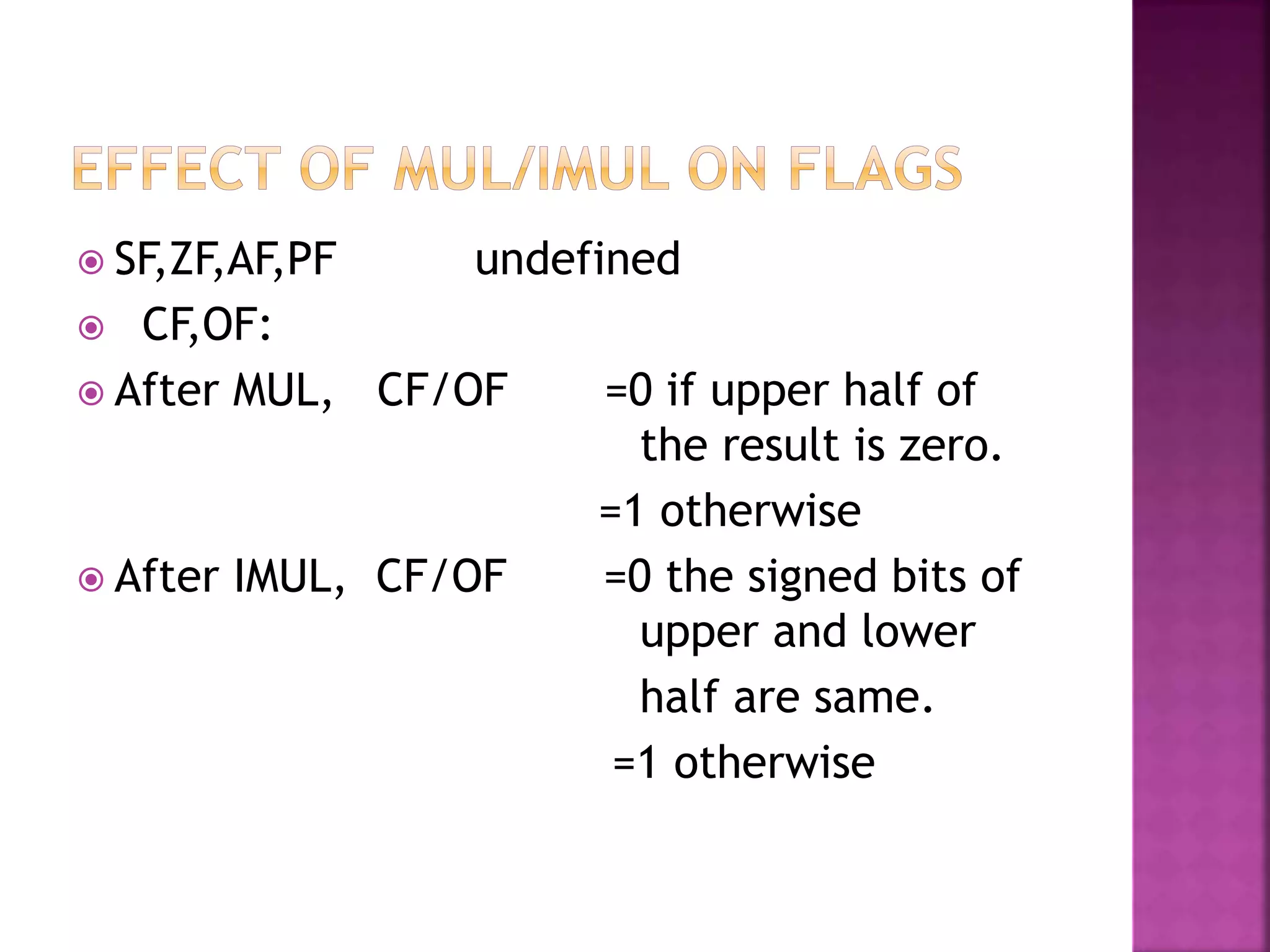
 SF,ZF,AF,PF undefined
 CF,OF:
 After MUL, CF/OF =0 if upper half of
the result is zero.
=1 otherwise
 After IMUL, CF/OF =0 the signed bits of
upper and lower
half are same.
=1 otherwise
F F h BL
8 0 h AL
MUL BL IMUL BL
8 07 F
AH AL
1
CF/OF CF/OF
F F h BL
8 0 h AL
8 00 0
AH AL
1
0 0 0 1 h AX
F F F F h BX
MUL BX IMUL BX
F F F F0 0 0 0
DX AX
0
CF/OF
0 0 0 1 h AX
F F F F h BX
F F F FF F F F
DX AX
0
CF/OF
 Translate the high level language assignment
statement A= 5*A-12*B into assembly
code remember A and B are word variable.
 sol:
MOV AX = 5 ;AX =5
IMUL A ;AX=5*A
MOV A , AX ;A=5*A
MOV AX, 12 ;AX=12
IMUL B ;AX=12*B
SUB A , AX ;A=5*A-12*B
 When division is performed we obtain two
results the quotient and the remainder.
 In division there are separate instructions for
signed and unsigned division.
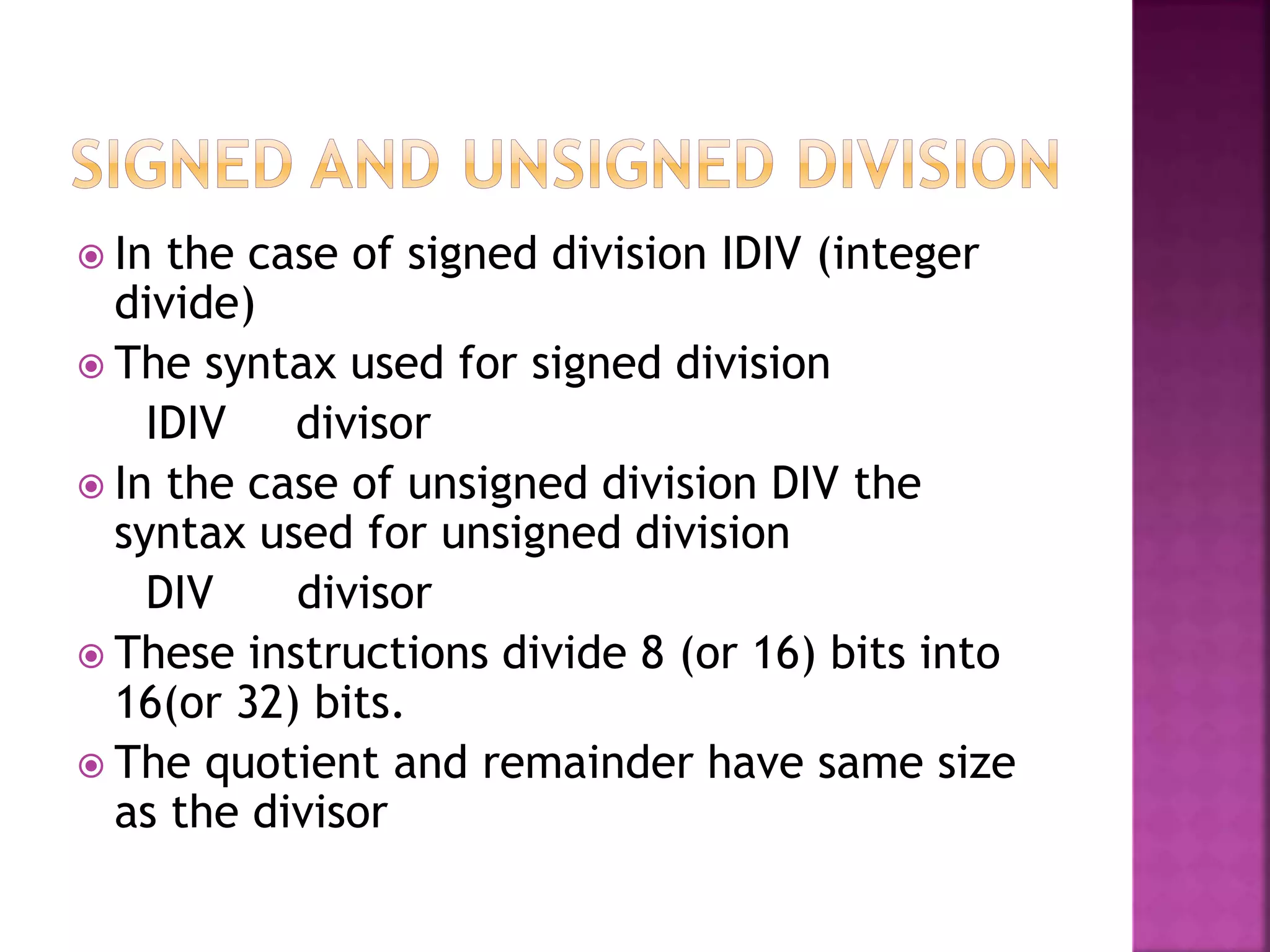
 In the case of signed division IDIV (integer
divide)
 The syntax used for signed division
IDIV divisor
 In the case of unsigned division DIV the
syntax used for unsigned division
DIV divisor
 These instructions divide 8 (or 16) bits into
16(or 32) bits.
 The quotient and remainder have same size
as the divisor
 In this case the divisor is an 8-bit register or
memory byte.
 The 16-bit dividend is assume to be in AX.
 After division, 8bit quotient is in AL and 8-bit
remainder is in AH.
 The divisor may not be a constant.
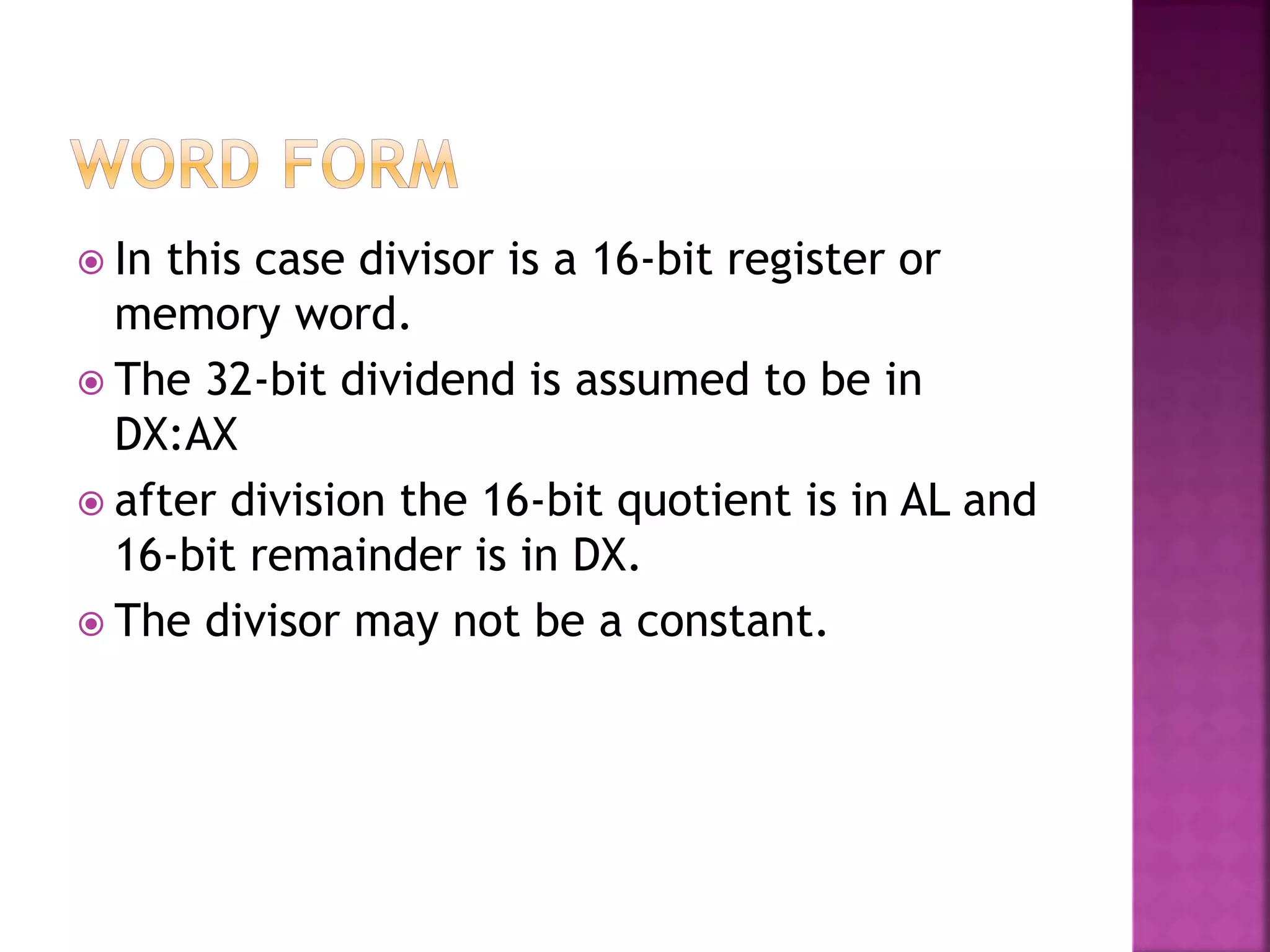
 In this case divisor is a 16-bit register or
memory word.
 The 32-bit dividend is assumed to be in
DX:AX
 after division the 16-bit quotient is in AL and
16-bit remainder is in DX.
 The divisor may not be a constant.
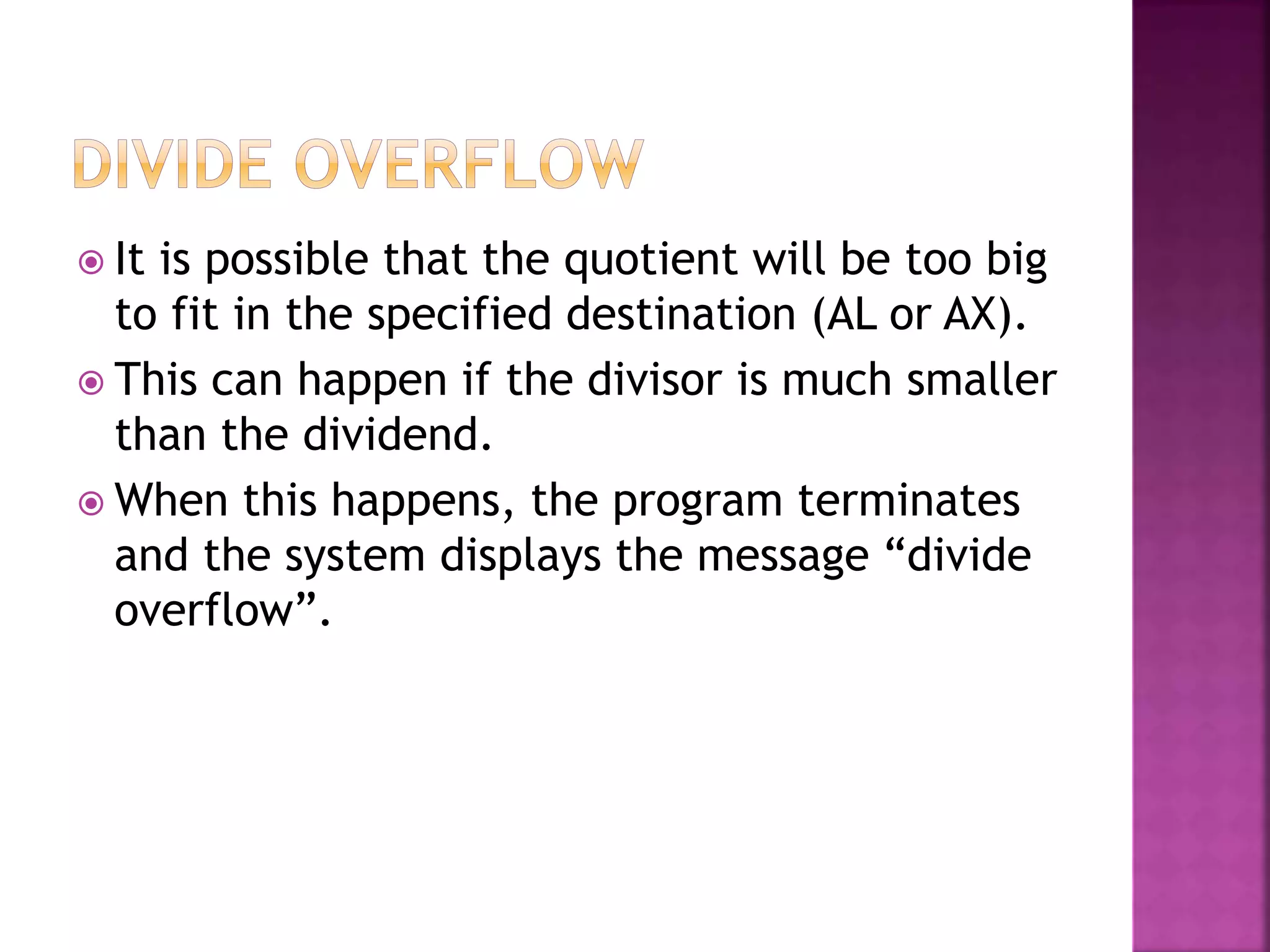
 It is possible that the quotient will be too big
to fit in the specified destination (AL or AX).
 This can happen if the divisor is much smaller
than the dividend.
 When this happens, the program terminates
and the system displays the message “divide
overflow”.
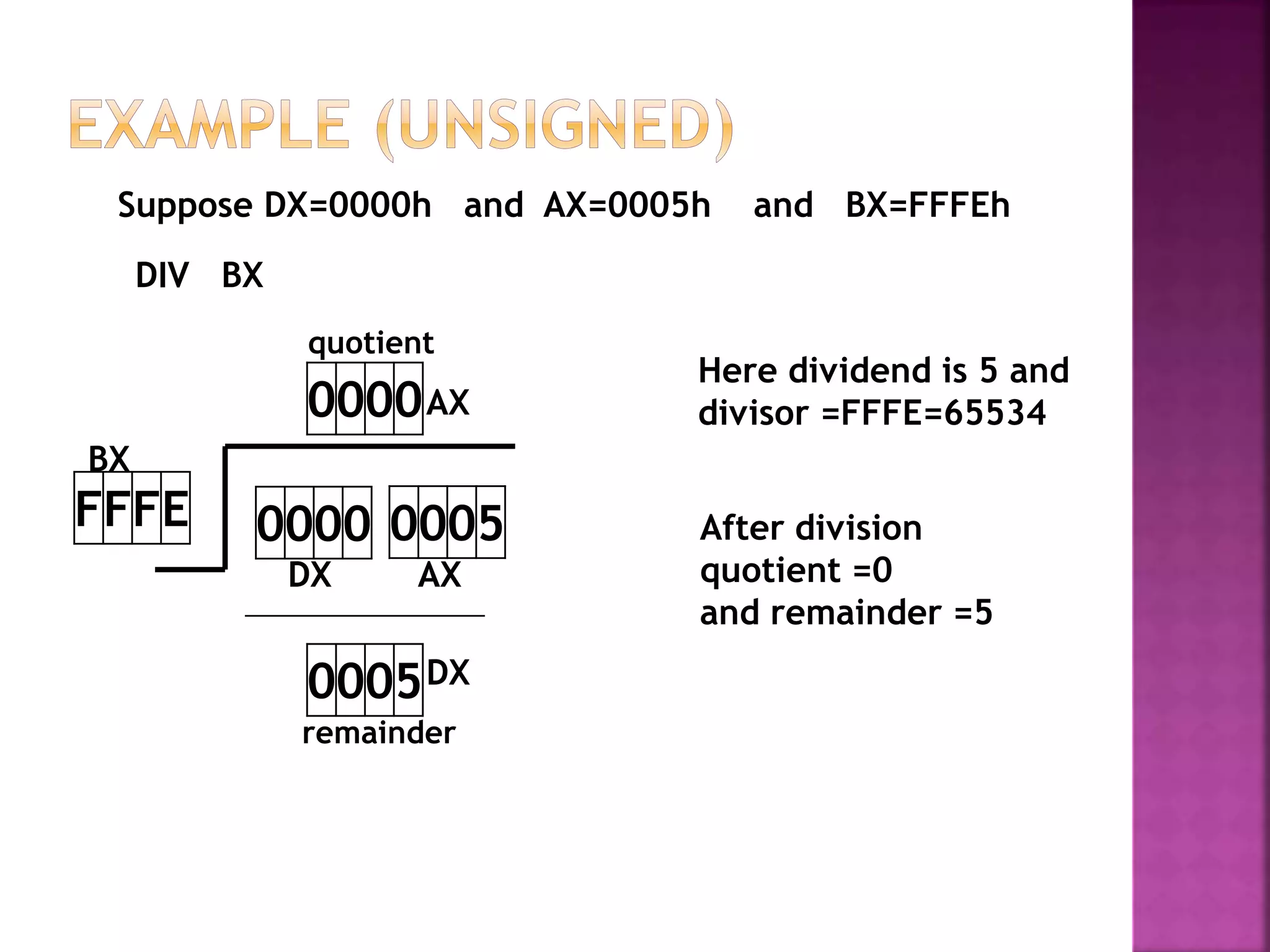
Suppose DX=0000h and AX=0005h and BX=FFFEh
00050000
DX AX
FFFE
BX
0005
0000AX
DX
quotient
remainder
DIV BX
Here dividend is 5 and
divisor =FFFE=65534
After division
quotient =0
and remainder =5
IDIV BX
00050000
DX AX
FFFE
BX
0001
FFFEAX
DX
quotient
remainder
Here in the case of signed
divisor = FFFE = -2 and
dividend =5
After division quotient=-2
and remainder=1
suppose DX=FFFFh and AX=FFFBh and BX=0002h
FFFBFFFF
DX AX
0002
BX
FFFF
FFFEAX
DX
quotient
remainder
DX:AX = FFFFFFFBh = -5,
BX = 2.
IDIV DX
-5 divided by 2 gives a
quotient of -2 = FFFEh and a
remainder of -1 = FFFFh.
FFFBFFFF
DX AX
0002
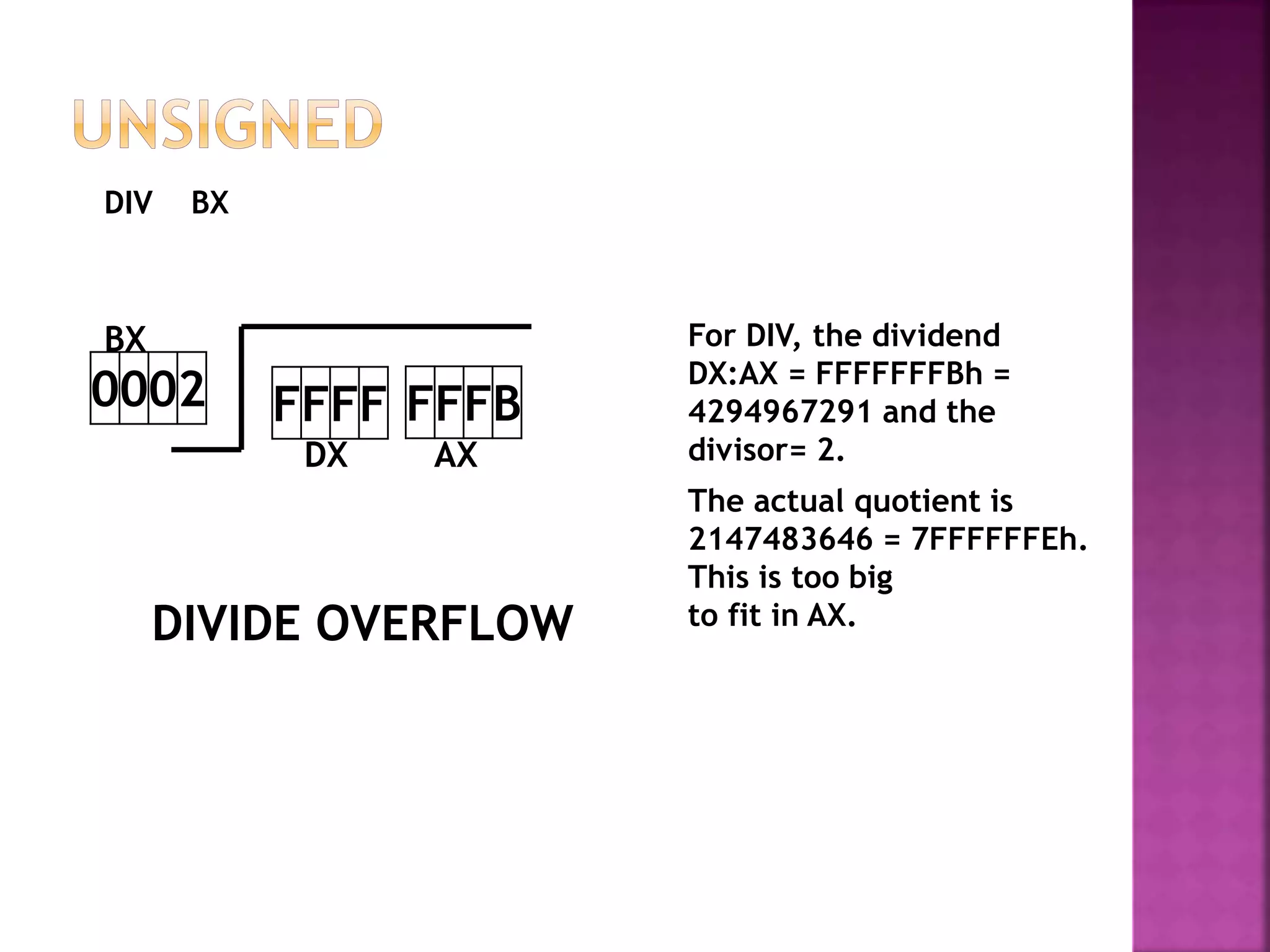
BX For DIV, the dividend
DX:AX = FFFFFFFBh =
4294967291 and the
divisor= 2.
DIVIDE OVERFLOW
DIV BX
The actual quotient is
2147483646 = 7FFFFFFEh.
This is too big
to fit in AX.
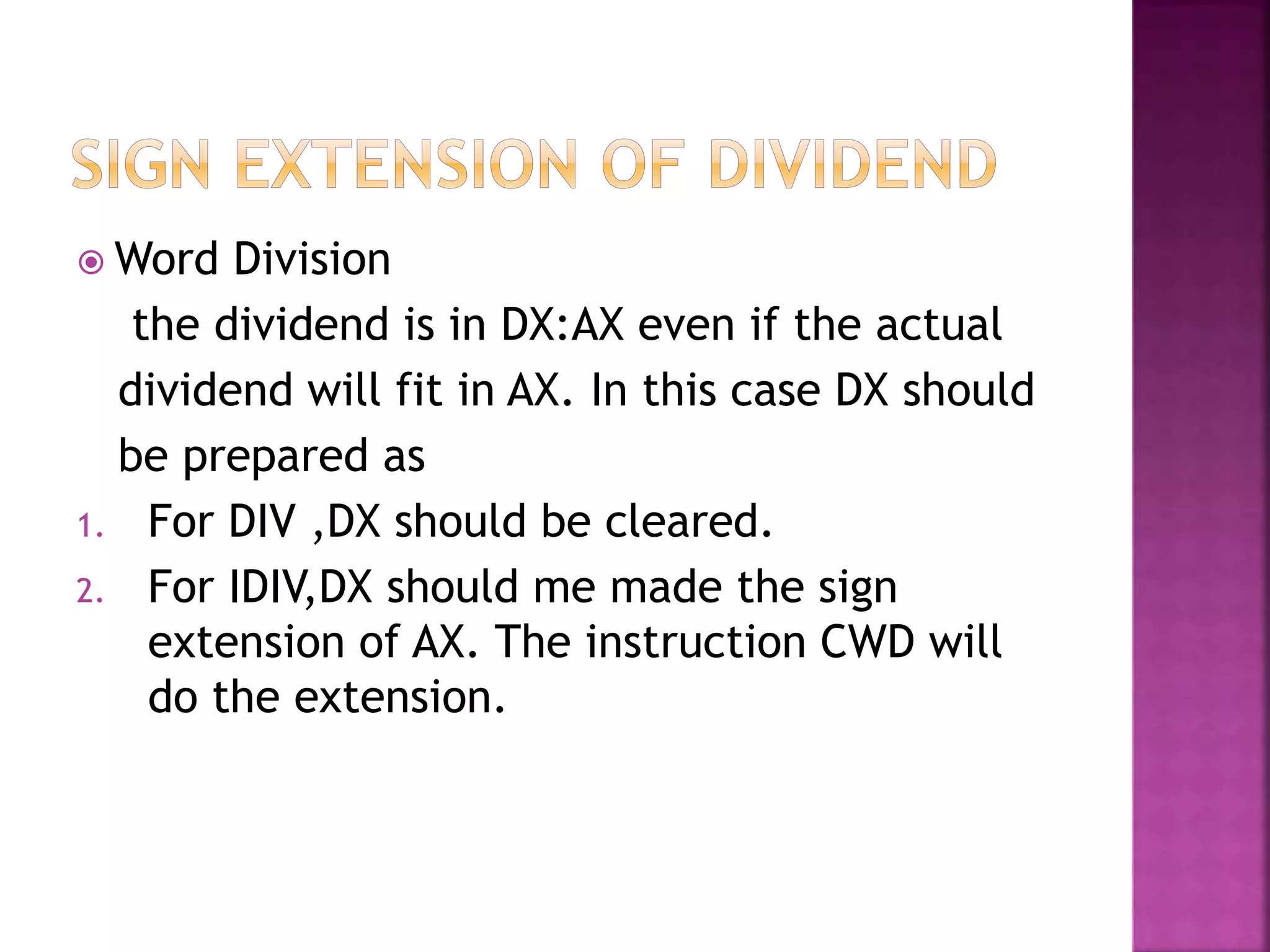
 Word Division
the dividend is in DX:AX even if the actual
dividend will fit in AX. In this case DX should
be prepared as
1. For DIV ,DX should be cleared.
2. For IDIV,DX should me made the sign
extension of AX. The instruction CWD will
do the extension.
 Divide -1250 by 7
Sol:-
MOV AX,-1250 ;AX gets dividend
CWD ;extend sign to DX
MOV BX,7 ;BX has divisor
IDIV BX ;AX get quot. DX has rem.
 The dividend is in AX. If the actual dividend
is a byte then AH should be prepared as
1. For DIV,AH should be cleared.
2. For IDIV,AH should the sign extension of AL.
the instruction CWB will do the extension.
 Divide the signed value of the byte variable
XBYTE by -7
 Sol:-
MOV AL,XBYTE ;AL has dividend
CBW ;extend sign to AH
MOV BL,-7 ;BL has divisor
IDIV BL ;AL has quot. AH has rem.
 There is no effect of CBW and CWD on the
flags.

assembly language programming organization of IBM PC chapter 9 part-1(MULTIPLICATION AND DIVISION IN ASSEMBLY LANGUAGE)

  • 2.
  • 4.
     MUHAMMAD ASIM(14093122-007)  INZMAM TAHIR (14093122-005)  YASIR ALI (14093122-006)  ADNAN ASLAM (14093122-003)  BILAL AMJAD (14093122-004)  UMAR RASHEED (14093122-002)
  • 5.
  • 6.
     In chapter7 ,we saw how to learn multiplication and division by shifting the bits in a byte or word.  Left and right shift can be used for multiplying and dividing respectively by powers of 2.  Process of multiplication and division is different for signed and unsigned numbers and there are different instructions used for signed and unsigned multiplication and division.  One of the most useful applications of multiplication and division is to implement decimal input and output.
  • 7.
     In thecase of unsigned multiplication, using instruction MUL .  The syntax of this instruction is MUL source  Example AL=128 BL=255 1 0 0 0 0 0 0 0 1 1 1 1 1 1 1 1 0 1 1 1 1 1 1 1 1 0 0 0 0 0 0 0 AX=32640
  • 8.
     In thecase of signed multiplication, using instruction IMUL .  The syntax of this instruction is IMUL source  Example AL=128 BL=-1 1 0 0 0 0 0 0 0 1 1 1 1 1 1 1 1 0 1 1 1 1 1 1 1 1 0 0 0 0 0 0 0 AX=32640
  • 9.
     In bytemultiplication one number is contained in the source and the other is assumed to be in AL.  The 16-bit product will be in AX.  The source may be a byte register or memory byte but not a constant. Multiplicand Multiplier Result AL AX
  • 10.
     In wordmultiplication one number is contained in the source and the other is assumed to be in AX.  The most significant 16-bits of the double word product will in DX and the least significant 16-bits will be in AX. DX:AX  The source may a 16-bit register or memory word but not a constant. Source AX DX AX
  • 11.
     SF,ZF,AF,PF undefined CF,OF:  After MUL, CF/OF =0 if upper half of the result is zero. =1 otherwise  After IMUL, CF/OF =0 the signed bits of upper and lower half are same. =1 otherwise
  • 12.
    F F hBL 8 0 h AL MUL BL IMUL BL 8 07 F AH AL 1 CF/OF CF/OF F F h BL 8 0 h AL 8 00 0 AH AL 1
  • 13.
    0 0 01 h AX F F F F h BX MUL BX IMUL BX F F F F0 0 0 0 DX AX 0 CF/OF 0 0 0 1 h AX F F F F h BX F F F FF F F F DX AX 0 CF/OF
  • 14.
     Translate thehigh level language assignment statement A= 5*A-12*B into assembly code remember A and B are word variable.  sol: MOV AX = 5 ;AX =5 IMUL A ;AX=5*A MOV A , AX ;A=5*A MOV AX, 12 ;AX=12 IMUL B ;AX=12*B SUB A , AX ;A=5*A-12*B
  • 15.
     When divisionis performed we obtain two results the quotient and the remainder.  In division there are separate instructions for signed and unsigned division.
  • 16.
     In thecase of signed division IDIV (integer divide)  The syntax used for signed division IDIV divisor  In the case of unsigned division DIV the syntax used for unsigned division DIV divisor  These instructions divide 8 (or 16) bits into 16(or 32) bits.  The quotient and remainder have same size as the divisor
  • 17.
     In thiscase the divisor is an 8-bit register or memory byte.  The 16-bit dividend is assume to be in AX.  After division, 8bit quotient is in AL and 8-bit remainder is in AH.  The divisor may not be a constant.
  • 18.
     In thiscase divisor is a 16-bit register or memory word.  The 32-bit dividend is assumed to be in DX:AX  after division the 16-bit quotient is in AL and 16-bit remainder is in DX.  The divisor may not be a constant.
  • 19.
     It ispossible that the quotient will be too big to fit in the specified destination (AL or AX).  This can happen if the divisor is much smaller than the dividend.  When this happens, the program terminates and the system displays the message “divide overflow”.
  • 20.
    Suppose DX=0000h andAX=0005h and BX=FFFEh 00050000 DX AX FFFE BX 0005 0000AX DX quotient remainder DIV BX Here dividend is 5 and divisor =FFFE=65534 After division quotient =0 and remainder =5
  • 21.
    IDIV BX 00050000 DX AX FFFE BX 0001 FFFEAX DX quotient remainder Herein the case of signed divisor = FFFE = -2 and dividend =5 After division quotient=-2 and remainder=1
  • 22.
    suppose DX=FFFFh andAX=FFFBh and BX=0002h FFFBFFFF DX AX 0002 BX FFFF FFFEAX DX quotient remainder DX:AX = FFFFFFFBh = -5, BX = 2. IDIV DX -5 divided by 2 gives a quotient of -2 = FFFEh and a remainder of -1 = FFFFh.
  • 23.
    FFFBFFFF DX AX 0002 BX ForDIV, the dividend DX:AX = FFFFFFFBh = 4294967291 and the divisor= 2. DIVIDE OVERFLOW DIV BX The actual quotient is 2147483646 = 7FFFFFFEh. This is too big to fit in AX.
  • 24.
     Word Division thedividend is in DX:AX even if the actual dividend will fit in AX. In this case DX should be prepared as 1. For DIV ,DX should be cleared. 2. For IDIV,DX should me made the sign extension of AX. The instruction CWD will do the extension.
  • 25.
     Divide -1250by 7 Sol:- MOV AX,-1250 ;AX gets dividend CWD ;extend sign to DX MOV BX,7 ;BX has divisor IDIV BX ;AX get quot. DX has rem.
  • 26.
     The dividendis in AX. If the actual dividend is a byte then AH should be prepared as 1. For DIV,AH should be cleared. 2. For IDIV,AH should the sign extension of AL. the instruction CWB will do the extension.
  • 27.
     Divide thesigned value of the byte variable XBYTE by -7  Sol:- MOV AL,XBYTE ;AL has dividend CBW ;extend sign to AH MOV BL,-7 ;BL has divisor IDIV BL ;AL has quot. AH has rem.  There is no effect of CBW and CWD on the flags.