The presentation by Md. Ashikur Rahman Khan covers set-associative mapping cache, which is a combination of direct and associative mapping for data storage in CPU caches. It explains the process of cache indexing, searching for desired addresses, and the calculations involved in defining cache size, number of lines, and sets. Examples illustrate the use of set-associative mapping with various address sizes and configurations.
SET-ASSOCIATIVE MAPPING
• Set-associativemapping is a combination of direct
and associative mapping
• The cache lines are grouped into sets
• The number of lines in a set can vary from 2 to 16
• The data can be stored in any of the lines in the set
6.
SET-ASSOCIATIVE MAPPING
• Whenthe processor wants an address, it indexes to
the set and then searches the tag fields of all lines
in the set for the desired address
• n= cache size/line size=number of lines
• B= log2(line size)=bit for offset
• W= number of lines/set
• S= n/w=number of sets
7.
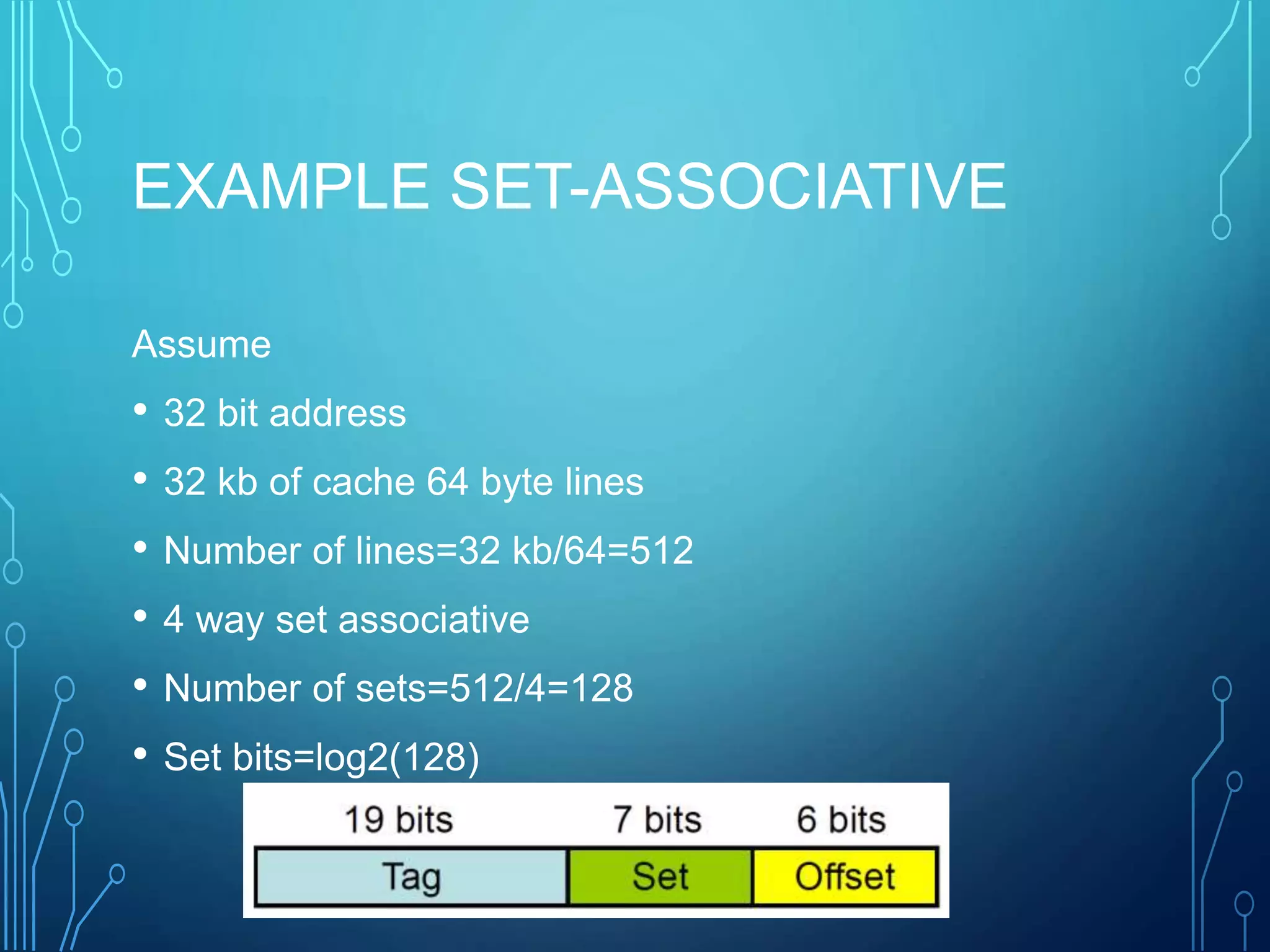
EXAMPLE SET-ASSOCIATIVE
Assume
• 32bit address
• 32 kb of cache 64 byte lines
• Number of lines=32 kb/64=512
• 4 way set associative
• Number of sets=512/4=128
• Set bits=log2(128)
8.
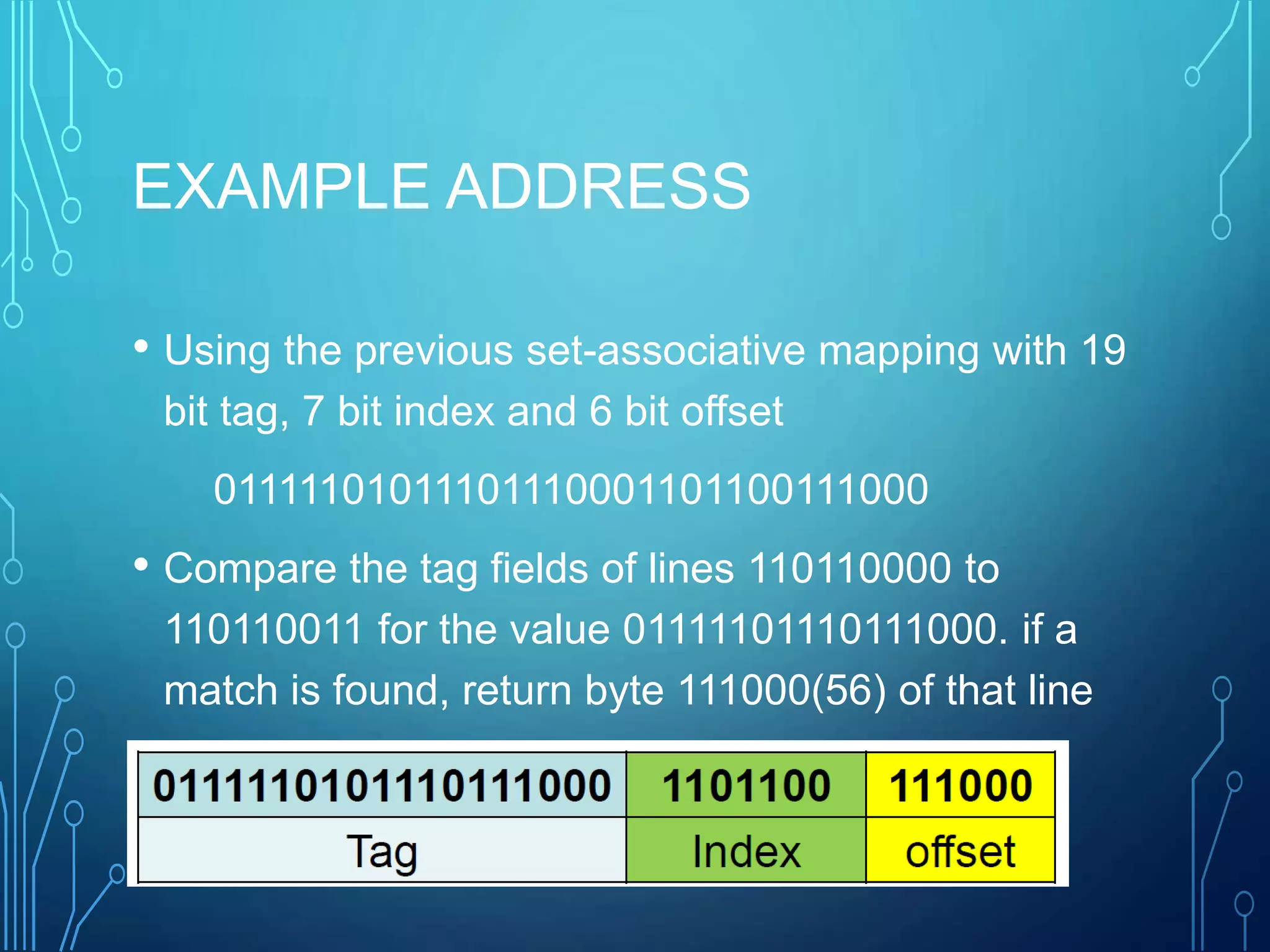
EXAMPLE ADDRESS
• Usingthe previous set-associative mapping with 19
bit tag, 7 bit index and 6 bit offset
01111101011101110001101100111000
• Compare the tag fields of lines 110110000 to
110110011 for the value 01111101110111000. if a
match is found, return byte 111000(56) of that line
9.
2 WAY SETASSOCIATIVE
• 24 bit address
• 128k bytes of cache
• 16 byte cache lines
• A. tag=8, set=12, offset=4
• B. tag=16, set=4, offset=4
• C. tag=12, set=8, offset=4
• D. tag=10, set=10, offset=4