ORGANISATION
OF
CACHE MEMORY
NAME: KOMAL BHAT
What is Cache Memory?
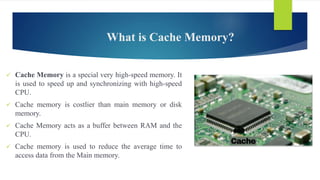
 Cache Memory is a special very high-speed memory. It
is used to speed up and synchronizing with high-speed
CPU.
 Cache memory is costlier than main memory or disk
memory.
 Cache Memory acts as a buffer between RAM and the
CPU.
 Cache memory is used to reduce the average time to
access data from the Main memory.
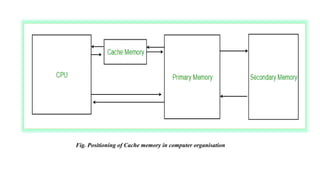
Fig. Positioning of Cache memory in computer organisation
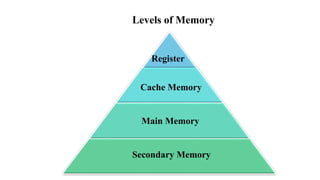
Register
Cache Memory
Main Memory
Secondary Memory
Levels of Memory
Cache Mapping
There are three different types of mapping used for the purpose of
cache memory:
 Direct Mapping
o The simplest technique, which maps each block of main memory
into only one possible cache line.
o Assign each memory block to a specific line in the cache.
o If a line is previously taken up by a memory block ,the old block is
trashed.
An address space is split into two parts index field and a tag field.
Direct mapping`s performance is directly proportional to the Hit ratio
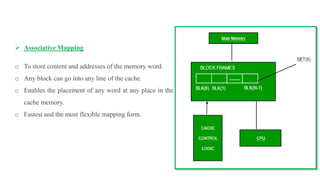
 Associative Mapping
o To store content and addresses of the memory word.
o Any block can go into any line of the cache.
o Enables the placement of any word at any place in the
cache memory.
o Fastest and the most flexible mapping form.
 Set-associative Mapping
o Enhanced form of direct mapping
o Addresses the problem of possible thrashing in
the direct mapping method.
o Instead of having exactly one line that a block can
map to in the cache, it groups a few lines together
creating a set. Then a block in memory can map to
any one of the lines of a specific set.
o Allows each word that is present in the cache can
have two or more words in the main memory for
the same index address.
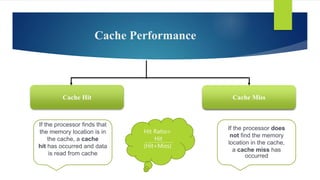
Cache Performance
Cache Hit Cache Miss
If the processor finds that
the memory location is in
the cache, a cache
hit has occurred and data
is read from cache
If the processor does
not find the memory
location in the cache,
a cache miss has
occurred
Hit Ratio=
Hit
(Hit+Miss)
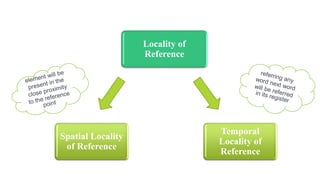
Spatial Locality
of Reference
Locality of
Reference
Temporal
Locality of
Reference
Organisation  of cache memory

Organisation of cache memory

  • 1.
  • 2.
    What is CacheMemory?  Cache Memory is a special very high-speed memory. It is used to speed up and synchronizing with high-speed CPU.  Cache memory is costlier than main memory or disk memory.  Cache Memory acts as a buffer between RAM and the CPU.  Cache memory is used to reduce the average time to access data from the Main memory.
  • 3.
    Fig. Positioning ofCache memory in computer organisation
  • 4.
  • 5.
    Cache Mapping There arethree different types of mapping used for the purpose of cache memory:  Direct Mapping o The simplest technique, which maps each block of main memory into only one possible cache line. o Assign each memory block to a specific line in the cache. o If a line is previously taken up by a memory block ,the old block is trashed. An address space is split into two parts index field and a tag field. Direct mapping`s performance is directly proportional to the Hit ratio
  • 6.
     Associative Mapping oTo store content and addresses of the memory word. o Any block can go into any line of the cache. o Enables the placement of any word at any place in the cache memory. o Fastest and the most flexible mapping form.
  • 7.
     Set-associative Mapping oEnhanced form of direct mapping o Addresses the problem of possible thrashing in the direct mapping method. o Instead of having exactly one line that a block can map to in the cache, it groups a few lines together creating a set. Then a block in memory can map to any one of the lines of a specific set. o Allows each word that is present in the cache can have two or more words in the main memory for the same index address.
  • 8.
    Cache Performance Cache HitCache Miss If the processor finds that the memory location is in the cache, a cache hit has occurred and data is read from cache If the processor does not find the memory location in the cache, a cache miss has occurred Hit Ratio= Hit (Hit+Miss)
  • 9.
    Spatial Locality of Reference Localityof Reference Temporal Locality of Reference