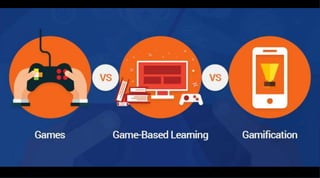
Games
Games are digital interactions that are fun and rewarding.
These applications keep us highly engaged in practicing
behaviors and thought processes in a simulated environment.
Very few find farming exciting, but through gameplay Farmville
kept millions entertained.
Game-Based Learning
The terms Games and Game-Based-Learning may be used
interchangeably by some, but they are not the same. When you
add elements of game theory, or game play, into your learning,
and the game becomes challenging with an aim to accomplish a
specified set of short term or long term goals, you have
created game-based learning.
Game-Based Learning
As a designer I often blend rules of classic games like
Monopoly or Solitaire into my learning. Interweaving games
and learning objectives to make it fun, lending a purpose and
defining the consequences of the game mechanics.
Gamification
Unlike game-based learning that uses rules, challenges,
goals, and time factors as motivational challenges,
gamification employs five commonly used mechanics—
Points, Badges, Levels, Leaderboards, and Challenges.
Applying Gamification
At the core of gamification is a “participation-and-reward”
system. Businesses use gamification to drive desired user
behaviors that are advantageous to their brand. It allows
companies to adapt to various user behaviors and motivations.
Gamification Examples
• A popular example of Gamification is Deloitte’s Leadership
Academy, which uses ranks, rewards, missions and leader
boards as one of the ways to encourage its employees and
client companies to log on, take courses and continue
corporate training despite busy work schedules.
It is Important to Distinguish Games,
Game-Based Learning, and Gamification
While Games are for fun, Game-based learning is a type of
game play that has defined learning outcomes. Gamification on
the other hand, utilizes the experience of fun along with
intrinsic motivation and rewards to engage and captivate
individual participants.
“It is important to know the distinction
between games, gamification, and game-
based eLearning, so that you can not only
choose the approach that better
serves your eLearning objectives and
goals, but also better meets the
needs of your learners.”
In a career spanning more than a decade, she has designed learning modules for
web-based and Instructor-Led-training, and designed mobile based and game based
learning modules. Sharbori has a passion for social work, volunteering to train
underprivileged women and war widows (AWWA), and is an avid learner,
observer, traveler, and art enthusiast.
ABOUT THE AUTHOR
Sharbori Chakraborty has a Postgraduate degree in
Mass Communication, and PGDBA in HR from Symbiosis.
We help organizations rapidly transform talent by focusing on Learning
for Performance.
A global, award-winning learning and training solutions company for
almost 20 years, InfoPro provides performance improvement strategies,
blended learning solutions, and managed training programs.
ABOUT INFOPRO LEARNING
For more information, visit www.infoprolearning.com
One of the world’s leading providers of learning and training solutions.
ThankYou For Reading
To read more, visit www.infoprolearning.com/blog

Differences Between Games, Game-Based Learning & Gamification

  • 2.
    Games Games are digitalinteractions that are fun and rewarding. These applications keep us highly engaged in practicing behaviors and thought processes in a simulated environment. Very few find farming exciting, but through gameplay Farmville kept millions entertained.
  • 3.
    Game-Based Learning The termsGames and Game-Based-Learning may be used interchangeably by some, but they are not the same. When you add elements of game theory, or game play, into your learning, and the game becomes challenging with an aim to accomplish a specified set of short term or long term goals, you have created game-based learning.
  • 4.
    Game-Based Learning As adesigner I often blend rules of classic games like Monopoly or Solitaire into my learning. Interweaving games and learning objectives to make it fun, lending a purpose and defining the consequences of the game mechanics.
  • 5.
    Gamification Unlike game-based learningthat uses rules, challenges, goals, and time factors as motivational challenges, gamification employs five commonly used mechanics— Points, Badges, Levels, Leaderboards, and Challenges.
  • 6.
    Applying Gamification At thecore of gamification is a “participation-and-reward” system. Businesses use gamification to drive desired user behaviors that are advantageous to their brand. It allows companies to adapt to various user behaviors and motivations.
  • 7.
    Gamification Examples • Apopular example of Gamification is Deloitte’s Leadership Academy, which uses ranks, rewards, missions and leader boards as one of the ways to encourage its employees and client companies to log on, take courses and continue corporate training despite busy work schedules.
  • 8.
    It is Importantto Distinguish Games, Game-Based Learning, and Gamification While Games are for fun, Game-based learning is a type of game play that has defined learning outcomes. Gamification on the other hand, utilizes the experience of fun along with intrinsic motivation and rewards to engage and captivate individual participants.
  • 9.
    “It is importantto know the distinction between games, gamification, and game- based eLearning, so that you can not only choose the approach that better serves your eLearning objectives and goals, but also better meets the needs of your learners.”
  • 10.
    In a careerspanning more than a decade, she has designed learning modules for web-based and Instructor-Led-training, and designed mobile based and game based learning modules. Sharbori has a passion for social work, volunteering to train underprivileged women and war widows (AWWA), and is an avid learner, observer, traveler, and art enthusiast. ABOUT THE AUTHOR Sharbori Chakraborty has a Postgraduate degree in Mass Communication, and PGDBA in HR from Symbiosis.
  • 11.
    We help organizationsrapidly transform talent by focusing on Learning for Performance. A global, award-winning learning and training solutions company for almost 20 years, InfoPro provides performance improvement strategies, blended learning solutions, and managed training programs. ABOUT INFOPRO LEARNING For more information, visit www.infoprolearning.com One of the world’s leading providers of learning and training solutions.
  • 12.
    ThankYou For Reading Toread more, visit www.infoprolearning.com/blog