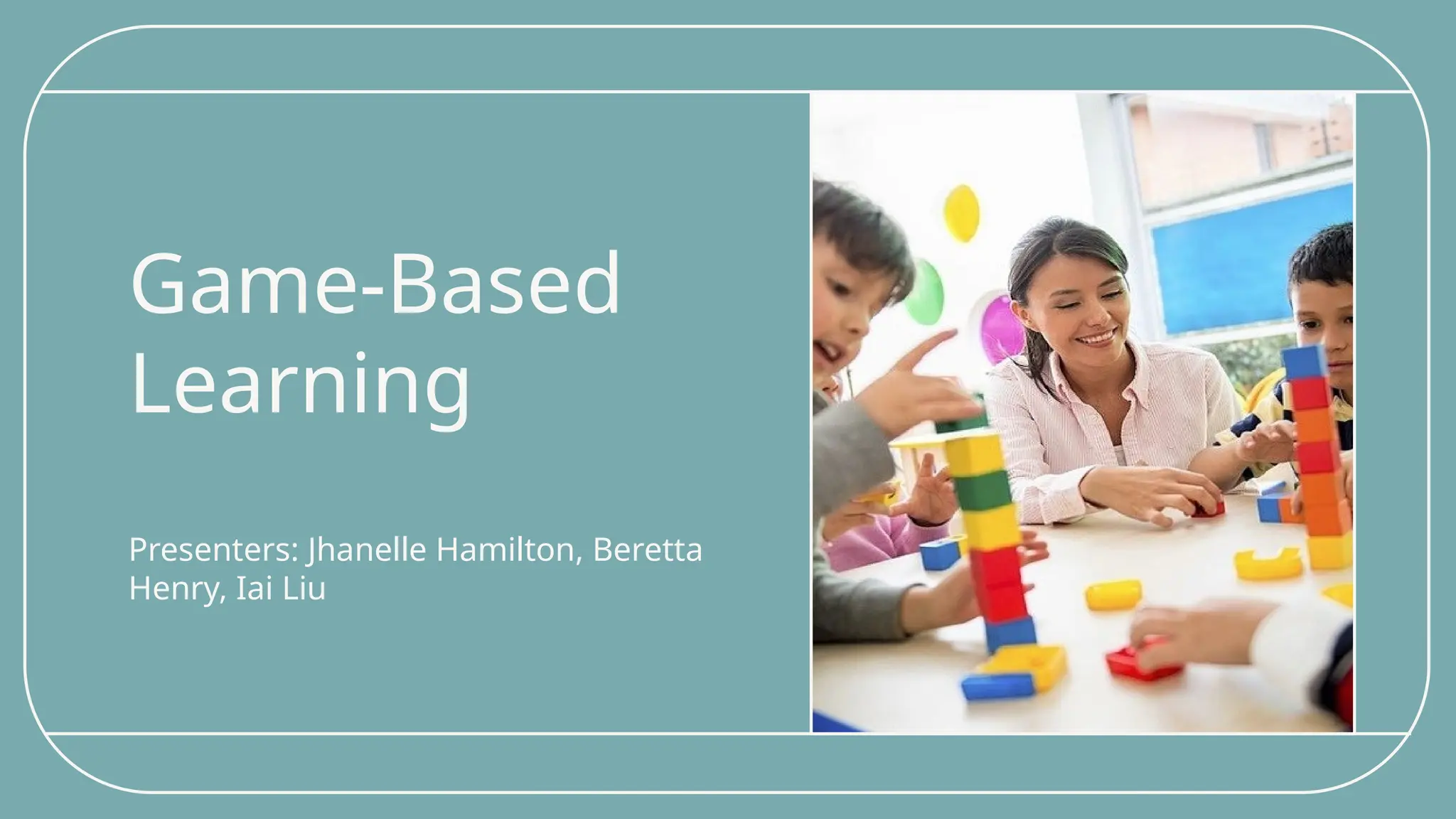
Game-Based
Learning
Presenters: Jhanelle Hamilton, Beretta
Henry, Iai Liu
Presentation Contents
Game-Based Learning
Examples of Game-Based Learning
Benefits of Game-Based Learning
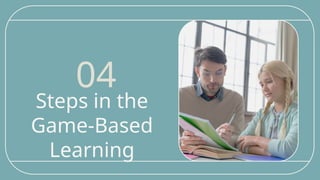
Steps in the Game-Based
Learning
01
02
03
04
Effectiveness of Game-Based
Learning in the Classroom
05
OBJECTIVES
At the end of this presentation, our Trainee teachers in attendance should
be able to:
Explain the Game- Based Learning
State examples of the Game- Based Learning
State the benefits of the Game- Based Learning
Outline the steps in the Game- Based Learning
Describe how the Game- Based Learning can be used effectively in the
classroom.
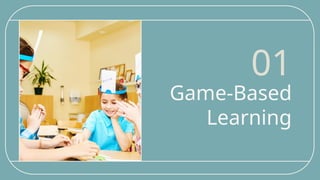
Game-Based
Learning
01
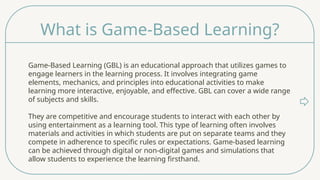
What is Game-Based Learning?
Game-Based Learning (GBL) is an educational approach that utilizes games to
engage learners in the learning process. It involves integrating game
elements, mechanics, and principles into educational activities to make
learning more interactive, enjoyable, and effective. GBL can cover a wide range
of subjects and skills.
They are competitive and encourage students to interact with each other by
using entertainment as a learning tool. This type of learning often involves
materials and activities in which students are put on separate teams and they
compete in adherence to specific rules or expectations. Game-based learning
can be achieved through digital or non-digital games and simulations that
allow students to experience the learning firsthand.
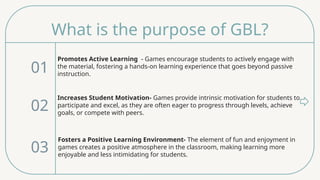
What is the purpose of GBL?
Promotes Active Learning - Games encourage students to actively engage with
the material, fostering a hands-on learning experience that goes beyond passive
instruction.
01
02
03
Increases Student Motivation- Games provide intrinsic motivation for students to
participate and excel, as they are often eager to progress through levels, achieve
goals, or compete with peers.
Fosters a Positive Learning Environment- The element of fun and enjoyment in
games creates a positive atmosphere in the classroom, making learning more
enjoyable and less intimidating for students.
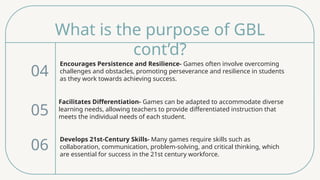
What is the purpose of GBL
cont’d?
Encourages Persistence and Resilience- Games often involve overcoming
challenges and obstacles, promoting perseverance and resilience in students
as they work towards achieving success.
04
05
06
Facilitates Differentiation- Games can be adapted to accommodate diverse
learning needs, allowing teachers to provide differentiated instruction that
meets the individual needs of each student.
Develops 21st-Century Skills- Many games require skills such as
collaboration, communication, problem-solving, and critical thinking, which
are essential for success in the 21st century workforce.
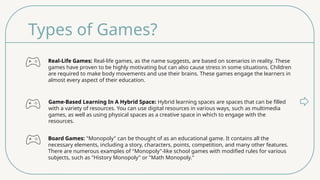
Types of Games?
Real-Life Games: Real-life games, as the name suggests, are based on scenarios in reality. These
games have proven to be highly motivating but can also cause stress in some situations. Children
are required to make body movements and use their brains. These games engage the learners in
almost every aspect of their education.
Game-Based Learning In A Hybrid Space: Hybrid learning spaces are spaces that can be filled
with a variety of resources. You can use digital resources in various ways, such as multimedia
games, as well as using physical spaces as a creative space in which to engage with the
resources.
Board Games: "Monopoly" can be thought of as an educational game. It contains all the
necessary elements, including a story, characters, points, competition, and many other features.
There are numerous examples of "Monopoly"-like school games with modified rules for various
subjects, such as "History Monopoly" or "Math Monopoly."
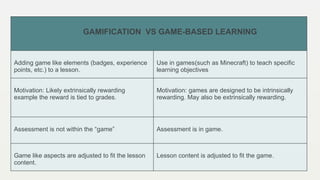
GAMIFICATION VS GAME-BASED LEARNING
Adding game like elements (badges, experience
points, etc.) to a lesson.
Use in games(such as Minecraft) to teach specific
learning objectives
Motivation: Likely extrinsically rewarding
example the reward is tied to grades.
Motivation: games are designed to be intrinsically
rewarding. May also be extrinsically rewarding.
Assessment is not within the “game” Assessment is in game.
Game like aspects are adjusted to fit the lesson
content.
Lesson content is adjusted to fit the game.
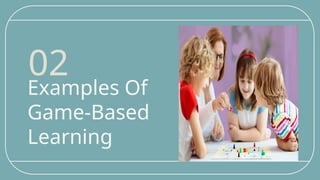
Examples Of
Game-Based
Learning
02
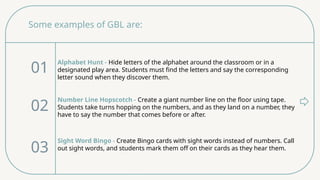
Some examples of GBL are:
Alphabet Hunt - Hide letters of the alphabet around the classroom or in a
designated play area. Students must find the letters and say the corresponding
letter sound when they discover them.
01
02
03
Number Line Hopscotch - Create a giant number line on the floor using tape.
Students take turns hopping on the numbers, and as they land on a number, they
have to say the number that comes before or after.
Sight Word Bingo - Create Bingo cards with sight words instead of numbers. Call
out sight words, and students mark them off on their cards as they hear them.
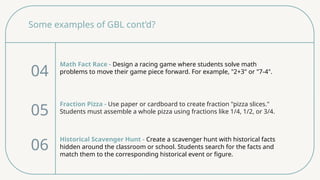
Some examples of GBL cont’d?
Math Fact Race - Design a racing game where students solve math
problems to move their game piece forward. For example, "2+3" or "7-4".
04
05
06
Fraction Pizza - Use paper or cardboard to create fraction "pizza slices."
Students must assemble a whole pizza using fractions like 1/4, 1/2, or 3/4.
Historical Scavenger Hunt - Create a scavenger hunt with historical facts
hidden around the classroom or school. Students search for the facts and
match them to the corresponding historical event or figure.
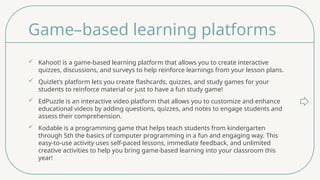
Game–based learning platforms
 Kahoot! is a game-based learning platform that allows you to create interactive
quizzes, discussions, and surveys to help reinforce learnings from your lesson plans.
 Quizlet’s platform lets you create flashcards, quizzes, and study games for your
students to reinforce material or just to have a fun study game!
 EdPuzzle is an interactive video platform that allows you to customize and enhance
educational videos by adding questions, quizzes, and notes to engage students and
assess their comprehension.
 Kodable is a programming game that helps teach students from kindergarten
through 5th the basics of computer programming in a fun and engaging way. This
easy-to-use activity uses self-paced lessons, immediate feedback, and unlimited
creative activities to help you bring game-based learning into your classroom this
year!
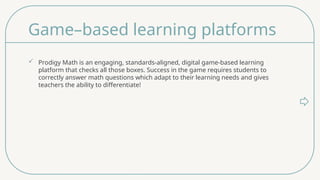
Game–based learning platforms
 Prodigy Math is an engaging, standards-aligned, digital game-based learning
platform that checks all those boxes. Success in the game requires students to
correctly answer math questions which adapt to their learning needs and gives
teachers the ability to differentiate!
Benefits of
the Game-
Based
Learning
03
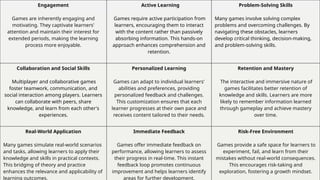
Engagement
Games are inherently engaging and
motivating. They captivate learners'
attention and maintain their interest for
extended periods, making the learning
process more enjoyable.
Active Learning
Games require active participation from
learners, encouraging them to interact
with the content rather than passively
absorbing information. This hands-on
approach enhances comprehension and
retention.
Problem-Solving Skills
Many games involve solving complex
problems and overcoming challenges. By
navigating these obstacles, learners
develop critical thinking, decision-making,
and problem-solving skills.
Collaboration and Social Skills
Multiplayer and collaborative games
foster teamwork, communication, and
social interaction among players. Learners
can collaborate with peers, share
knowledge, and learn from each other's
experiences.
Personalized Learning
Games can adapt to individual learners'
abilities and preferences, providing
personalized feedback and challenges.
This customization ensures that each
learner progresses at their own pace and
receives content tailored to their needs.
Retention and Mastery
The interactive and immersive nature of
games facilitates better retention of
knowledge and skills. Learners are more
likely to remember information learned
through gameplay and achieve mastery
over time.
Real-World Application
Many games simulate real-world scenarios
and tasks, allowing learners to apply their
knowledge and skills in practical contexts.
This bridging of theory and practice
enhances the relevance and applicability of
learning outcomes.
Immediate Feedback
Games offer immediate feedback on
performance, allowing learners to assess
their progress in real-time. This instant
feedback loop promotes continuous
improvement and helps learners identify
areas for further development.
Risk-Free Environment
Games provide a safe space for learners to
experiment, fail, and learn from their
mistakes without real-world consequences.
This encourages risk-taking and
exploration, fostering a growth mindset.
04
Steps in the
Game-Based
Learning
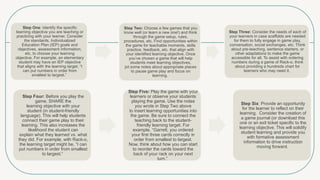
Step One: Identify the specific
learning objective you are teaching or
practicing with your learner. Consider
the standards, Individualized
Education Plan (IEP) goals and
objectives, assessment information,
etc. to choose your learning
objective. For example, an elementary
student may have an IEP objective
that aligns with the learning target, “I
can put numbers in order from
smallest to largest.”
Step Two: Choose a few games that you
know well (or learn a new one!) and think
through the game setup, rules,
procedures, etc. Find opportunities within
the game for teachable moments, skills
practice, feedback, etc. that align with
your identified learning objective. Once
you’ve chosen a game that will help
students meet learning objectives,
jot some notes about appropriate places
to pause game play and focus on
learning.
Step Three: Consider the needs of each of
your learners in case scaffolds are needed
for them to fully engage in game play,
conversation, social exchanges, etc. Think
about pre-teaching, sentence starters, or
other adaptations to make the game
accessible for all. To assist with ordering
numbers during a game of Rack-o, think
about providing a hundreds chart for
learners who may need it.
Step Four: Before you play the
game, SHARE the
learning objective with your
student (in student-friendly
language). This will help students
connect their game play to their
learning. This also increases the
likelihood the student can
explain what they learned vs. what
they did. For example, with Rack-o,
the learning target might be, “I can
put numbers in order from smallest
to largest.”
Step Five: Play the game with your
learners or observe your students
playing the game. Use the notes
you wrote in Step Two above
to insert learning opportunities into
the game. Be sure to connect the
teaching back to the student-
friendly learning target. For
example, “Garrett, you ordered
your first three cards correctly in
order from smallest to largest.
Now, think about how you can start
to reorder the cards toward the
back of your rack on your next
turn.”
Step Six: Provide an opportunity
for the learner to reflect on their
learning. Consider the creation of
a game journal (or download this
one or an exit ticket specific to the
learning objective. This will solidify
student learning and provide you
with formative assessment
information to drive instruction
moving forward.
Role of the Teacher in GBL
● The teacher or facilitator plays a critical role in ensuring that the game-based
learning environment is conducive to learning. This includes selecting
appropriate games that align with the learning objectives, as well as designing
effective game-based learning activities that promote learning.
● The teacher or facilitator must ensure that the game-based learning activities
are accessible and inclusive for all students, regardless of their learning needs
or abilities.
● The teacher or facilitator must also play an active role in guiding and
supporting students throughout the learning process. This includes providing
clear instructions and guidance on how to play the game, as well as providing
feedback and support to help students overcome any challenges or difficulties
they may encounter.
Role of the Teacher in GBL
● The teacher or facilitator should encourage collaboration and communication
among students, as this can help to promote a deeper understanding of the
concepts being taught.
● The role of the teacher or facilitator in game-based learning is to promote
reflection and metacognition. This means encouraging students to reflect on
their learning experiences and think critically about how they can apply what
they have learned to other contexts. (Soqqle 2023)
Role of the Student in GBL
• Observer: Even when not actively playing, students can learn from observing
others engage with the game. By watching gameplay demonstrations, tutorials,
or peer interactions, students can gain insights and learn from the experiences
of others.
• Problem Solver: Games often present challenges or problems that students
must solve to progress. In this role, students analyze situations, apply critical
thinking skills, and develop strategies to overcome obstacles within the game.
• Decision Maker: Games frequently present players with choices that have
consequences for their progress or outcomes within the game world. As
decision makers, students must weigh their options, consider potential
outcomes, and make informed choices.
Role of the Student in GBL
• Explorer: Students can take on the role of explorers, delving into the virtual
world of the game to discover new areas, uncover hidden items or information,
and learn through exploration and experimentation.
• Reflective Learner: After playing a game or completing a game-based learning
activity, students can reflect on their experiences, identify what they learned,
and consider how they can apply that knowledge in other contexts. Reflection
encourages metacognition and deepens understanding.
Effectiveness
05
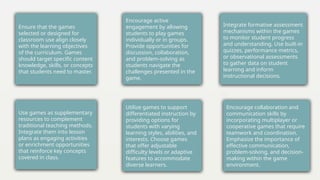
Ensure that the games
selected or designed for
classroom use align closely
with the learning objectives
of the curriculum. Games
should target specific content
knowledge, skills, or concepts
that students need to master.
Use games as supplementary
resources to complement
traditional teaching methods.
Integrate them into lesson
plans as engaging activities
or enrichment opportunities
that reinforce key concepts
covered in class.
Encourage active
engagement by allowing
students to play games
individually or in groups.
Provide opportunities for
discussion, collaboration,
and problem-solving as
students navigate the
challenges presented in the
game.
Utilize games to support
differentiated instruction by
providing options for
students with varying
learning styles, abilities, and
interests. Choose games
that offer adjustable
difficulty levels or adaptive
features to accommodate
diverse learners.
Integrate formative assessment
mechanisms within the games
to monitor student progress
and understanding. Use built-in
quizzes, performance metrics,
or observational assessments
to gather data on student
learning and inform
instructional decisions.
.
Encourage collaboration and
communication skills by
incorporating multiplayer or
cooperative games that require
teamwork and coordination.
Emphasize the importance of
effective communication,
problem-solving, and decision-
making within the game
environment.
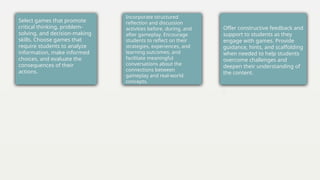
Select games that promote
critical thinking, problem-
solving, and decision-making
skills. Choose games that
require students to analyze
information, make informed
choices, and evaluate the
consequences of their
actions.
Incorporate structured
reflection and discussion
activities before, during, and
after gameplay. Encourage
students to reflect on their
strategies, experiences, and
learning outcomes, and
facilitate meaningful
conversations about the
connections between
gameplay and real-world
concepts.
Offer constructive feedback and
support to students as they
engage with games. Provide
guidance, hints, and scaffolding
when needed to help students
overcome challenges and
deepen their understanding of
the content.
.
Bibliographical References
Adipat, S., Laksana, K., Busayanon, K., Ausawasowan, A., & Adipat, B. (2021). Engaging
Students in the Learning Process with Game-Based Learning: The Fundamental Concepts.
International Journal of Technology in Education, 4(3), 542–552.
https://doi.org/10.46328/ijte.169
Game-Based Learning: A Beginners Guide For Elementary Teachers | Kodable. (n.d.).
Www.kodable.com.https://www.kodable.com/learn/game-based-learning-guide-for-
elementary-teachers
Nisbet, J. (2021, June 21). Understanding Game-Based Learning: Benefits, Potential Drawbacks
and Where to Begin. Www.prodigygame.com. https://www.prodigygame.com/main-
en/blog/game-based-learning/
Six Steps Toward Game-Based Learning in the Special Education Classroom. (n.d.). Teaching
Channel. Retrieved February 27, 2024, from https://www.teachingchannel.com/k12-
hub/blog/game-based-learning/
Tamosevicius, R. (2022, November 22). Why Is Game-Based Learning Important?
ELearning Industry. https://elearningindustry.com/why-is-game-based-learning-important
The Role of Teachers and Facilitators in Guiding and Supporting Game-Based Learning. (n.d.).
Www.linkedin.com. Retrieved February 27, 2024, from
https://www.linkedin.com/pulse/role-teachers-facilitators-guiding-supporting-game-
based-learning#:~:text=Additionally%2C%20the%20teacher%20or%20facilitator

Game-Based Learningg and educationn.pptx

  • 1.
  • 2.
    Presentation Contents Game-Based Learning Examplesof Game-Based Learning Benefits of Game-Based Learning Steps in the Game-Based Learning 01 02 03 04 Effectiveness of Game-Based Learning in the Classroom 05
  • 3.
    OBJECTIVES At the endof this presentation, our Trainee teachers in attendance should be able to: Explain the Game- Based Learning State examples of the Game- Based Learning State the benefits of the Game- Based Learning Outline the steps in the Game- Based Learning Describe how the Game- Based Learning can be used effectively in the classroom.
  • 4.
  • 5.
    What is Game-BasedLearning? Game-Based Learning (GBL) is an educational approach that utilizes games to engage learners in the learning process. It involves integrating game elements, mechanics, and principles into educational activities to make learning more interactive, enjoyable, and effective. GBL can cover a wide range of subjects and skills. They are competitive and encourage students to interact with each other by using entertainment as a learning tool. This type of learning often involves materials and activities in which students are put on separate teams and they compete in adherence to specific rules or expectations. Game-based learning can be achieved through digital or non-digital games and simulations that allow students to experience the learning firsthand.
  • 6.
    What is thepurpose of GBL? Promotes Active Learning - Games encourage students to actively engage with the material, fostering a hands-on learning experience that goes beyond passive instruction. 01 02 03 Increases Student Motivation- Games provide intrinsic motivation for students to participate and excel, as they are often eager to progress through levels, achieve goals, or compete with peers. Fosters a Positive Learning Environment- The element of fun and enjoyment in games creates a positive atmosphere in the classroom, making learning more enjoyable and less intimidating for students.
  • 7.
    What is thepurpose of GBL cont’d? Encourages Persistence and Resilience- Games often involve overcoming challenges and obstacles, promoting perseverance and resilience in students as they work towards achieving success. 04 05 06 Facilitates Differentiation- Games can be adapted to accommodate diverse learning needs, allowing teachers to provide differentiated instruction that meets the individual needs of each student. Develops 21st-Century Skills- Many games require skills such as collaboration, communication, problem-solving, and critical thinking, which are essential for success in the 21st century workforce.
  • 8.
    Types of Games? Real-LifeGames: Real-life games, as the name suggests, are based on scenarios in reality. These games have proven to be highly motivating but can also cause stress in some situations. Children are required to make body movements and use their brains. These games engage the learners in almost every aspect of their education. Game-Based Learning In A Hybrid Space: Hybrid learning spaces are spaces that can be filled with a variety of resources. You can use digital resources in various ways, such as multimedia games, as well as using physical spaces as a creative space in which to engage with the resources. Board Games: "Monopoly" can be thought of as an educational game. It contains all the necessary elements, including a story, characters, points, competition, and many other features. There are numerous examples of "Monopoly"-like school games with modified rules for various subjects, such as "History Monopoly" or "Math Monopoly."
  • 9.
    GAMIFICATION VS GAME-BASEDLEARNING Adding game like elements (badges, experience points, etc.) to a lesson. Use in games(such as Minecraft) to teach specific learning objectives Motivation: Likely extrinsically rewarding example the reward is tied to grades. Motivation: games are designed to be intrinsically rewarding. May also be extrinsically rewarding. Assessment is not within the “game” Assessment is in game. Game like aspects are adjusted to fit the lesson content. Lesson content is adjusted to fit the game.
  • 10.
  • 11.
    Some examples ofGBL are: Alphabet Hunt - Hide letters of the alphabet around the classroom or in a designated play area. Students must find the letters and say the corresponding letter sound when they discover them. 01 02 03 Number Line Hopscotch - Create a giant number line on the floor using tape. Students take turns hopping on the numbers, and as they land on a number, they have to say the number that comes before or after. Sight Word Bingo - Create Bingo cards with sight words instead of numbers. Call out sight words, and students mark them off on their cards as they hear them.
  • 12.
    Some examples ofGBL cont’d? Math Fact Race - Design a racing game where students solve math problems to move their game piece forward. For example, "2+3" or "7-4". 04 05 06 Fraction Pizza - Use paper or cardboard to create fraction "pizza slices." Students must assemble a whole pizza using fractions like 1/4, 1/2, or 3/4. Historical Scavenger Hunt - Create a scavenger hunt with historical facts hidden around the classroom or school. Students search for the facts and match them to the corresponding historical event or figure.
  • 13.
    Game–based learning platforms Kahoot! is a game-based learning platform that allows you to create interactive quizzes, discussions, and surveys to help reinforce learnings from your lesson plans.  Quizlet’s platform lets you create flashcards, quizzes, and study games for your students to reinforce material or just to have a fun study game!  EdPuzzle is an interactive video platform that allows you to customize and enhance educational videos by adding questions, quizzes, and notes to engage students and assess their comprehension.  Kodable is a programming game that helps teach students from kindergarten through 5th the basics of computer programming in a fun and engaging way. This easy-to-use activity uses self-paced lessons, immediate feedback, and unlimited creative activities to help you bring game-based learning into your classroom this year!
  • 14.
    Game–based learning platforms Prodigy Math is an engaging, standards-aligned, digital game-based learning platform that checks all those boxes. Success in the game requires students to correctly answer math questions which adapt to their learning needs and gives teachers the ability to differentiate!
  • 15.
  • 16.
    Engagement Games are inherentlyengaging and motivating. They captivate learners' attention and maintain their interest for extended periods, making the learning process more enjoyable. Active Learning Games require active participation from learners, encouraging them to interact with the content rather than passively absorbing information. This hands-on approach enhances comprehension and retention. Problem-Solving Skills Many games involve solving complex problems and overcoming challenges. By navigating these obstacles, learners develop critical thinking, decision-making, and problem-solving skills. Collaboration and Social Skills Multiplayer and collaborative games foster teamwork, communication, and social interaction among players. Learners can collaborate with peers, share knowledge, and learn from each other's experiences. Personalized Learning Games can adapt to individual learners' abilities and preferences, providing personalized feedback and challenges. This customization ensures that each learner progresses at their own pace and receives content tailored to their needs. Retention and Mastery The interactive and immersive nature of games facilitates better retention of knowledge and skills. Learners are more likely to remember information learned through gameplay and achieve mastery over time. Real-World Application Many games simulate real-world scenarios and tasks, allowing learners to apply their knowledge and skills in practical contexts. This bridging of theory and practice enhances the relevance and applicability of learning outcomes. Immediate Feedback Games offer immediate feedback on performance, allowing learners to assess their progress in real-time. This instant feedback loop promotes continuous improvement and helps learners identify areas for further development. Risk-Free Environment Games provide a safe space for learners to experiment, fail, and learn from their mistakes without real-world consequences. This encourages risk-taking and exploration, fostering a growth mindset.
  • 17.
  • 18.
    Step One: Identifythe specific learning objective you are teaching or practicing with your learner. Consider the standards, Individualized Education Plan (IEP) goals and objectives, assessment information, etc. to choose your learning objective. For example, an elementary student may have an IEP objective that aligns with the learning target, “I can put numbers in order from smallest to largest.” Step Two: Choose a few games that you know well (or learn a new one!) and think through the game setup, rules, procedures, etc. Find opportunities within the game for teachable moments, skills practice, feedback, etc. that align with your identified learning objective. Once you’ve chosen a game that will help students meet learning objectives, jot some notes about appropriate places to pause game play and focus on learning. Step Three: Consider the needs of each of your learners in case scaffolds are needed for them to fully engage in game play, conversation, social exchanges, etc. Think about pre-teaching, sentence starters, or other adaptations to make the game accessible for all. To assist with ordering numbers during a game of Rack-o, think about providing a hundreds chart for learners who may need it. Step Four: Before you play the game, SHARE the learning objective with your student (in student-friendly language). This will help students connect their game play to their learning. This also increases the likelihood the student can explain what they learned vs. what they did. For example, with Rack-o, the learning target might be, “I can put numbers in order from smallest to largest.” Step Five: Play the game with your learners or observe your students playing the game. Use the notes you wrote in Step Two above to insert learning opportunities into the game. Be sure to connect the teaching back to the student- friendly learning target. For example, “Garrett, you ordered your first three cards correctly in order from smallest to largest. Now, think about how you can start to reorder the cards toward the back of your rack on your next turn.” Step Six: Provide an opportunity for the learner to reflect on their learning. Consider the creation of a game journal (or download this one or an exit ticket specific to the learning objective. This will solidify student learning and provide you with formative assessment information to drive instruction moving forward.
  • 19.
    Role of theTeacher in GBL ● The teacher or facilitator plays a critical role in ensuring that the game-based learning environment is conducive to learning. This includes selecting appropriate games that align with the learning objectives, as well as designing effective game-based learning activities that promote learning. ● The teacher or facilitator must ensure that the game-based learning activities are accessible and inclusive for all students, regardless of their learning needs or abilities. ● The teacher or facilitator must also play an active role in guiding and supporting students throughout the learning process. This includes providing clear instructions and guidance on how to play the game, as well as providing feedback and support to help students overcome any challenges or difficulties they may encounter.
  • 20.
    Role of theTeacher in GBL ● The teacher or facilitator should encourage collaboration and communication among students, as this can help to promote a deeper understanding of the concepts being taught. ● The role of the teacher or facilitator in game-based learning is to promote reflection and metacognition. This means encouraging students to reflect on their learning experiences and think critically about how they can apply what they have learned to other contexts. (Soqqle 2023)
  • 21.
    Role of theStudent in GBL • Observer: Even when not actively playing, students can learn from observing others engage with the game. By watching gameplay demonstrations, tutorials, or peer interactions, students can gain insights and learn from the experiences of others. • Problem Solver: Games often present challenges or problems that students must solve to progress. In this role, students analyze situations, apply critical thinking skills, and develop strategies to overcome obstacles within the game. • Decision Maker: Games frequently present players with choices that have consequences for their progress or outcomes within the game world. As decision makers, students must weigh their options, consider potential outcomes, and make informed choices.
  • 22.
    Role of theStudent in GBL • Explorer: Students can take on the role of explorers, delving into the virtual world of the game to discover new areas, uncover hidden items or information, and learn through exploration and experimentation. • Reflective Learner: After playing a game or completing a game-based learning activity, students can reflect on their experiences, identify what they learned, and consider how they can apply that knowledge in other contexts. Reflection encourages metacognition and deepens understanding.
  • 23.
  • 24.
    Ensure that thegames selected or designed for classroom use align closely with the learning objectives of the curriculum. Games should target specific content knowledge, skills, or concepts that students need to master. Use games as supplementary resources to complement traditional teaching methods. Integrate them into lesson plans as engaging activities or enrichment opportunities that reinforce key concepts covered in class. Encourage active engagement by allowing students to play games individually or in groups. Provide opportunities for discussion, collaboration, and problem-solving as students navigate the challenges presented in the game. Utilize games to support differentiated instruction by providing options for students with varying learning styles, abilities, and interests. Choose games that offer adjustable difficulty levels or adaptive features to accommodate diverse learners. Integrate formative assessment mechanisms within the games to monitor student progress and understanding. Use built-in quizzes, performance metrics, or observational assessments to gather data on student learning and inform instructional decisions. . Encourage collaboration and communication skills by incorporating multiplayer or cooperative games that require teamwork and coordination. Emphasize the importance of effective communication, problem-solving, and decision- making within the game environment.
  • 25.
    Select games thatpromote critical thinking, problem- solving, and decision-making skills. Choose games that require students to analyze information, make informed choices, and evaluate the consequences of their actions. Incorporate structured reflection and discussion activities before, during, and after gameplay. Encourage students to reflect on their strategies, experiences, and learning outcomes, and facilitate meaningful conversations about the connections between gameplay and real-world concepts. Offer constructive feedback and support to students as they engage with games. Provide guidance, hints, and scaffolding when needed to help students overcome challenges and deepen their understanding of the content. .
  • 26.
    Bibliographical References Adipat, S.,Laksana, K., Busayanon, K., Ausawasowan, A., & Adipat, B. (2021). Engaging Students in the Learning Process with Game-Based Learning: The Fundamental Concepts. International Journal of Technology in Education, 4(3), 542–552. https://doi.org/10.46328/ijte.169 Game-Based Learning: A Beginners Guide For Elementary Teachers | Kodable. (n.d.). Www.kodable.com.https://www.kodable.com/learn/game-based-learning-guide-for- elementary-teachers Nisbet, J. (2021, June 21). Understanding Game-Based Learning: Benefits, Potential Drawbacks and Where to Begin. Www.prodigygame.com. https://www.prodigygame.com/main- en/blog/game-based-learning/
  • 27.
    Six Steps TowardGame-Based Learning in the Special Education Classroom. (n.d.). Teaching Channel. Retrieved February 27, 2024, from https://www.teachingchannel.com/k12- hub/blog/game-based-learning/ Tamosevicius, R. (2022, November 22). Why Is Game-Based Learning Important? ELearning Industry. https://elearningindustry.com/why-is-game-based-learning-important The Role of Teachers and Facilitators in Guiding and Supporting Game-Based Learning. (n.d.). Www.linkedin.com. Retrieved February 27, 2024, from https://www.linkedin.com/pulse/role-teachers-facilitators-guiding-supporting-game- based-learning#:~:text=Additionally%2C%20the%20teacher%20or%20facilitator