By: Mr. Edel P. Diaz
and
Mrs. Mary Dove A. Paglinawan
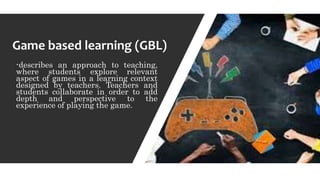
-describes an approach to teaching,
where students explore relevant
aspect of games in a learning context
designed by teachers. Teachers and
students collaborate in order to add
depth and perspective to the
experience of playing the game.
Game based learning (GBL)
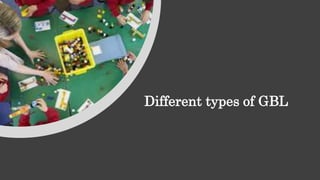
Different types of GBL
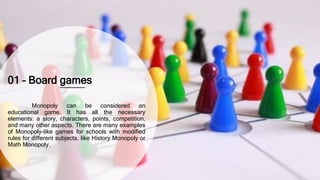
01 – Board games
Monopoly can be considered an
educational game. It has all the necessary
elements: a story, characters, points, competition,
and many other aspects. There are many examples
of Monopoly-like games for schools with modified
rules for different subjects, like History Monopoly or
Math Monopoly.
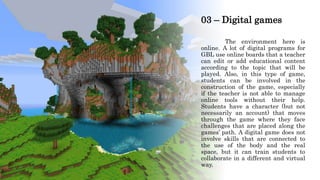
03 – Digital games
The environment here is
online. A lot of digital programs for
GBL use online boards that a teacher
can edit or add educational content
according to the topic that will be
played. Also, in this type of game,
students can be involved in the
construction of the game, especially
if the teacher is not able to manage
online tools without their help.
Students have a character (but not
necessarily an account) that moves
through the game where they face
challenges that are placed along the
games’ path. A digital game does not
involve skills that are connected to
the use of the body and the real
space, but it can train students to
collaborate in a different and virtual
way.
What
are the
benefits?
01 – Motivation
-GBL is very effective, as games are naturally motivating and engaging.
Moreover, games provide something that can be described as “far from a traditional
lesson” and they are often include competition among students; which can raise the
level of motivation in a classroom.
02 – Inclusion
Playing can challenge students and force them to step out of their
comfort zone. Roles and tasks can be differentiated to include all students.
03 – Student centered
Games are naturally student-centered and students
should be involved in the preparation of the game. If they
are engaged and interested, they will accomplish tasks more
willingly than with traditional activities.
04–Critical thinking and decision
taking
These are two skills that can be
practiced and learned especially when
engaging in role play. When students
are assigned to play specific
characters in certain environments,
they have to decide, on the spot, what
to do in order to reach the goal.
05 – Group work
Unity is strength and
everyone loses or wins when they
play a game together.
06 – Creativity
Imagination has no limits.
Teachers can leave opportunities
inside of a game where students
can fill in the blanks with their own
solutions and ideas.
• The excessive use of game-based
learning can lead to needless competition
among employees to win badges and
medals that are an integral part of games.
This can bring with it some of the
following risks:
• Learner focus shifts to winning rather
than learning, especially if the rewards
assume more significance
• Shifts employees’ focus away from
collaboration
• Diminishes the importance of
cooperation and sharing of ideas
Excessive use of
game-based
learning
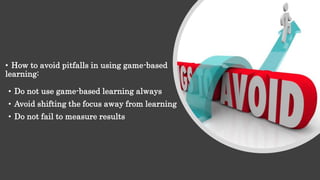
• How to avoid pitfalls in using game-based
learning:
• Do not use game-based learning always
• Avoid shifting the focus away from learning
• Do not fail to measure results
EDUC 266-Game-based learning.pptx

EDUC 266-Game-based learning.pptx

  • 1.
    By: Mr. EdelP. Diaz and Mrs. Mary Dove A. Paglinawan
  • 3.
    -describes an approachto teaching, where students explore relevant aspect of games in a learning context designed by teachers. Teachers and students collaborate in order to add depth and perspective to the experience of playing the game. Game based learning (GBL)
  • 4.
  • 5.
    01 – Boardgames Monopoly can be considered an educational game. It has all the necessary elements: a story, characters, points, competition, and many other aspects. There are many examples of Monopoly-like games for schools with modified rules for different subjects, like History Monopoly or Math Monopoly.
  • 7.
    03 – Digitalgames The environment here is online. A lot of digital programs for GBL use online boards that a teacher can edit or add educational content according to the topic that will be played. Also, in this type of game, students can be involved in the construction of the game, especially if the teacher is not able to manage online tools without their help. Students have a character (but not necessarily an account) that moves through the game where they face challenges that are placed along the games’ path. A digital game does not involve skills that are connected to the use of the body and the real space, but it can train students to collaborate in a different and virtual way.
  • 8.
  • 9.
    01 – Motivation -GBLis very effective, as games are naturally motivating and engaging. Moreover, games provide something that can be described as “far from a traditional lesson” and they are often include competition among students; which can raise the level of motivation in a classroom. 02 – Inclusion Playing can challenge students and force them to step out of their comfort zone. Roles and tasks can be differentiated to include all students.
  • 10.
    03 – Studentcentered Games are naturally student-centered and students should be involved in the preparation of the game. If they are engaged and interested, they will accomplish tasks more willingly than with traditional activities. 04–Critical thinking and decision taking These are two skills that can be practiced and learned especially when engaging in role play. When students are assigned to play specific characters in certain environments, they have to decide, on the spot, what to do in order to reach the goal.
  • 11.
    05 – Groupwork Unity is strength and everyone loses or wins when they play a game together. 06 – Creativity Imagination has no limits. Teachers can leave opportunities inside of a game where students can fill in the blanks with their own solutions and ideas.
  • 12.
    • The excessiveuse of game-based learning can lead to needless competition among employees to win badges and medals that are an integral part of games. This can bring with it some of the following risks: • Learner focus shifts to winning rather than learning, especially if the rewards assume more significance • Shifts employees’ focus away from collaboration • Diminishes the importance of cooperation and sharing of ideas Excessive use of game-based learning
  • 13.
    • How toavoid pitfalls in using game-based learning: • Do not use game-based learning always • Avoid shifting the focus away from learning • Do not fail to measure results