• Anatomy
• Parts of midbrain
• Tracts and Nuclei
• Imaging

• Vascular anatomy
• Lesions
• The midbrain is the most rostral part of the
brainstem and sits above the pons and is
adjoined rostrally to the thalamus.
• Midbrain/Mesencephalon
• From the Greek mesos - middle, and
enkephalos – brain
• “bridge portion”
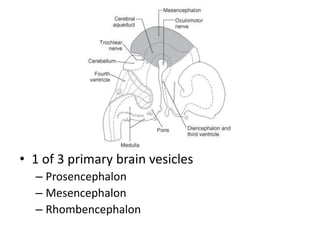
• 1 of 3 primary brain vesicles
– Prosencephalon
– Mesencephalon
– Rhombencephalon
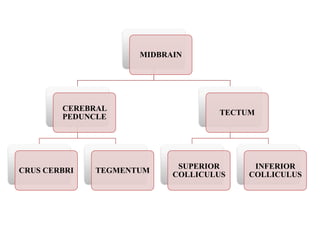
MIDBRAIN

CEREBRAL
PEDUNCLE

CRUS CERBRI

TEGMENTUM

TECTUM

SUPERIOR
COLLICULUS

INFERIOR
COLLICULUS
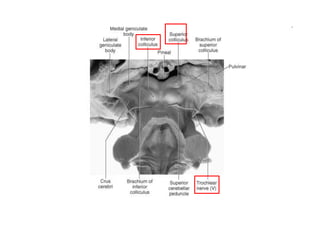
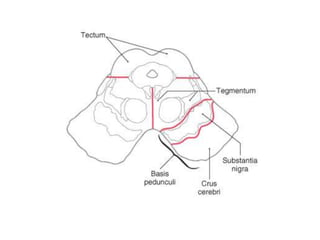
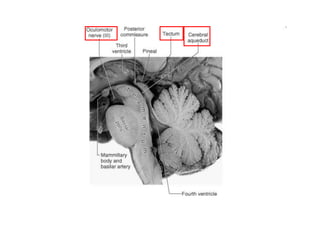
• The tectum (“roof”) is the dorsal part of the

mesencephalon (midbrain).
• Consists of the inferior and the superior colliculi.
– The superior colliculus is involved in preliminary visual
processing and control of eye movements.
– The inferior colliculus is involved in auditory
processing. It receives input from various brain stem
nuclei and projects to the medial geniculate nucleus
of the thalamus, which relays auditory information to
the primary auditory cortex.
– Both colliculi also have descending projections to the
paramedian pontine reticular formation and spinal
cord.
– Collectively the colliculi are referred to as the corpora
quadrigemina.
• The tegmentum (from Latin for "covering”) is
a general area within the brainstem. It is
located between the ventricular system and
distinctive basal or ventral structures at each
level.
• The midbrain tegmentum is the part of the
midbrain extending from the substantia nigra
to the cerebral aqueduct in a horizontal
section
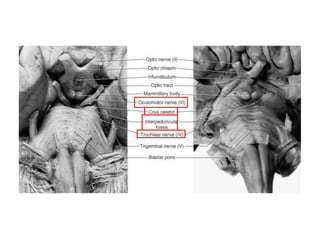
• The nuclei of CN III and IV are located in the
tegmentum portion of the midbrain.
Cerebral Peduncle
• The cerebral peduncle, by most classifications,
is everything in the mesencephalon except the
tectum.
• The region includes the midbrain tegmentum,
crus cerebri and pretectum.
• The large ventral bundle of efferent fibers is
referred to as the crus cerebri or the pes
pedunculi.
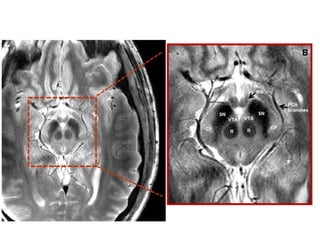
Red nucleus
• The red nucleus and substantia nigra are
subcortical centers of the extrapyramidal motor
system.
• With a developed corticospinal tract, in humans
red nucleus does not have a crucial role
• The majority of red nucleus axons do not project
to the spinal cord, but instead (via its
parvocellular part) relay from the motor cortex to
the cerebellum through the inferior olivary
complex.
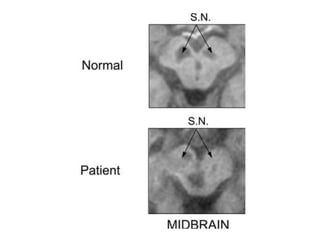
Substantia nigra
• Pigmented layer- melanin granules
• Dorsal to peduncles and ventral to the red
nucleus .
• Composed zona compacta and zona reticulata
• The GABAergic neurons in the pars reticulata
convey the final processed signals of the basal
ganglia to the thalamus and superior
colliculus.
• The dopaminergic neurons of pars compacta
mainly deals with motor control
Tracts
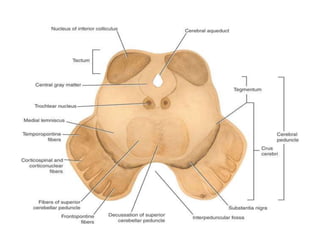
• Main tracts
– Crus cerebri
– Dentatorubrothalamic (red nucleus)
– Medial longitudinal fasciculus
– Spinothalamic tract
– Medial leminiscus
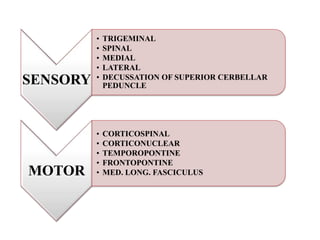
TRACTS

SENSORY

MOTOR

•
•
•
•
•

TRIGEMINAL
SPINAL
MEDIAL
LATERAL
DECUSSATION OF SUPERIOR CERBELLAR
PEDUNCLE

•
•
•
•
•

CORTICOSPINAL
CORTICONUCLEAR
TEMPOROPONTINE
FRONTOPONTINE
MED. LONG. FASCICULUS
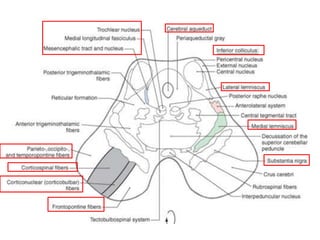
• Cruscerebri (“crus”-structure resembling leg)
– 1. corticopontine fibers (frontopontineprojection)
medial 5th
• fibers from the precentral gyrus (motor strip) to the nuclei of
cranial nerves V (trigeminal), VII (facial) and XII (hypoglossal).

– 2. corticospinal fibers (middle three 5ths)
– 3. temporopontine fibers (lateral 5ths)
• they originate in the temporal lobe and end in the nuclei
pontis.
MLF
• Medial longitudinal fasciculus: Connects the
cranial nerve nuclei III ,IV and VI together, and
integrates movements directed by the gaze
centers (frontal eye field) and information about

head movement (from vestibulocochlear nerve).
• It is an integral component of saccadic eye
movements as well as vestibulo-ocular and
optokinetic reflexes
• Spinothalamic tract
– pain, temperature,touch,pressure

• Medial lemniscus
– sensory input from the gracile and cuneate nuclei
to the thalamus
Nuclei
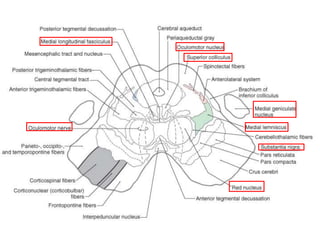
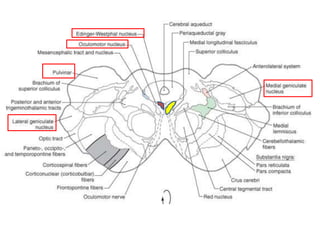
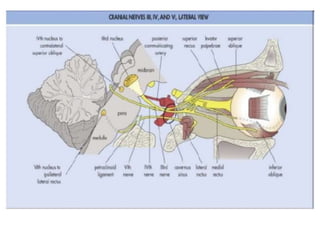
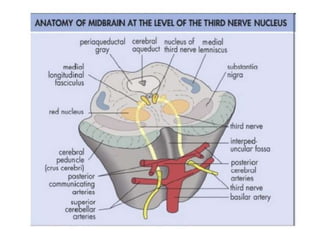
1. Nucleus of Oculomotor nerve.
2. Nucleus of Edinger- Westphal: supplies
preganglionic parasympathetic fibers to the
eye, constricting the pupil, accommodating
the lens , and convergence of the eyes

3. Nucleus CN IV(trochlear)
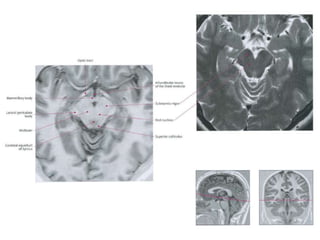
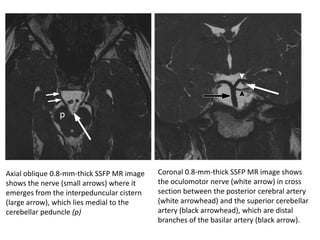
Axial oblique 0.8-mm-thick SSFP MR image
shows the nerve (small arrows) where it
emerges from the interpeduncular cistern
(large arrow), which lies medial to the
cerebellar peduncle (p)

Coronal 0.8-mm-thick SSFP MR image shows
the oculomotor nerve (white arrow) in cross
section between the posterior cerebral artery
(white arrowhead) and the superior cerebellar
artery (black arrowhead), which are distal
branches of the basilar artery (black arrow).
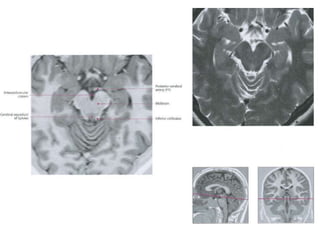
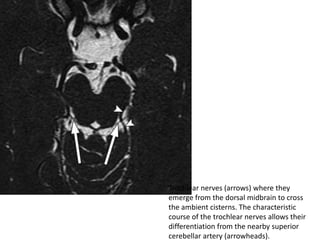
Trochlear nerves (arrows) where they
emerge from the dorsal midbrain to cross
the ambient cisterns. The characteristic
course of the trochlear nerves allows their
differentiation from the nearby superior
cerebellar artery (arrowheads).
Blood Supply
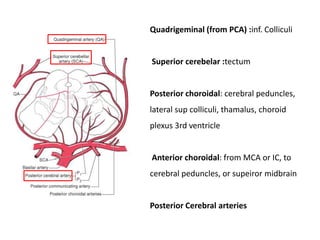
Quadrigeminal (from PCA) :inf. Colliculi

Superior cerebelar :tectum

Posterior choroidal: cerebral peduncles,
lateral sup colliculi, thamalus, choroid
plexus 3rd ventricle

Anterior choroidal: from MCA or IC, to
cerebral peduncles, or supeiror midbrain

Posterior Cerebral arteries
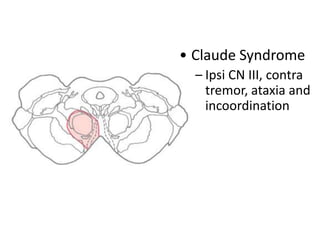
• Claude Syndrome
– Ipsi CN III, contra
tremor, ataxia and
incoordination
• Rubral tremor (Holme’s tremor)
– A coarse, slow (4Hz) tremor, especially present in
the upper extremities, that is found at rest,
postural and intention.
Midbrain-Neuroradiology

Midbrain-Neuroradiology

  • 2.
    • Anatomy • Partsof midbrain • Tracts and Nuclei • Imaging • Vascular anatomy • Lesions
  • 3.
    • The midbrainis the most rostral part of the brainstem and sits above the pons and is adjoined rostrally to the thalamus. • Midbrain/Mesencephalon • From the Greek mesos - middle, and enkephalos – brain • “bridge portion”
  • 4.
    • 1 of3 primary brain vesicles – Prosencephalon – Mesencephalon – Rhombencephalon
  • 7.
  • 10.
    • The tectum(“roof”) is the dorsal part of the mesencephalon (midbrain). • Consists of the inferior and the superior colliculi. – The superior colliculus is involved in preliminary visual processing and control of eye movements. – The inferior colliculus is involved in auditory processing. It receives input from various brain stem nuclei and projects to the medial geniculate nucleus of the thalamus, which relays auditory information to the primary auditory cortex. – Both colliculi also have descending projections to the paramedian pontine reticular formation and spinal cord. – Collectively the colliculi are referred to as the corpora quadrigemina.
  • 12.
    • The tegmentum(from Latin for "covering”) is a general area within the brainstem. It is located between the ventricular system and distinctive basal or ventral structures at each level. • The midbrain tegmentum is the part of the midbrain extending from the substantia nigra to the cerebral aqueduct in a horizontal section • The nuclei of CN III and IV are located in the tegmentum portion of the midbrain.
  • 13.
    Cerebral Peduncle • Thecerebral peduncle, by most classifications, is everything in the mesencephalon except the tectum. • The region includes the midbrain tegmentum, crus cerebri and pretectum. • The large ventral bundle of efferent fibers is referred to as the crus cerebri or the pes pedunculi.
  • 17.
    Red nucleus • Thered nucleus and substantia nigra are subcortical centers of the extrapyramidal motor system. • With a developed corticospinal tract, in humans red nucleus does not have a crucial role • The majority of red nucleus axons do not project to the spinal cord, but instead (via its parvocellular part) relay from the motor cortex to the cerebellum through the inferior olivary complex.
  • 18.
    Substantia nigra • Pigmentedlayer- melanin granules • Dorsal to peduncles and ventral to the red nucleus . • Composed zona compacta and zona reticulata • The GABAergic neurons in the pars reticulata convey the final processed signals of the basal ganglia to the thalamus and superior colliculus. • The dopaminergic neurons of pars compacta mainly deals with motor control
  • 19.
    Tracts • Main tracts –Crus cerebri – Dentatorubrothalamic (red nucleus) – Medial longitudinal fasciculus – Spinothalamic tract – Medial leminiscus
  • 20.
    TRACTS SENSORY MOTOR • • • • • TRIGEMINAL SPINAL MEDIAL LATERAL DECUSSATION OF SUPERIORCERBELLAR PEDUNCLE • • • • • CORTICOSPINAL CORTICONUCLEAR TEMPOROPONTINE FRONTOPONTINE MED. LONG. FASCICULUS
  • 21.
    • Cruscerebri (“crus”-structureresembling leg) – 1. corticopontine fibers (frontopontineprojection) medial 5th • fibers from the precentral gyrus (motor strip) to the nuclei of cranial nerves V (trigeminal), VII (facial) and XII (hypoglossal). – 2. corticospinal fibers (middle three 5ths) – 3. temporopontine fibers (lateral 5ths) • they originate in the temporal lobe and end in the nuclei pontis.
  • 22.
    MLF • Medial longitudinalfasciculus: Connects the cranial nerve nuclei III ,IV and VI together, and integrates movements directed by the gaze centers (frontal eye field) and information about head movement (from vestibulocochlear nerve). • It is an integral component of saccadic eye movements as well as vestibulo-ocular and optokinetic reflexes
  • 23.
    • Spinothalamic tract –pain, temperature,touch,pressure • Medial lemniscus – sensory input from the gracile and cuneate nuclei to the thalamus
  • 24.
    Nuclei 1. Nucleus ofOculomotor nerve. 2. Nucleus of Edinger- Westphal: supplies preganglionic parasympathetic fibers to the eye, constricting the pupil, accommodating the lens , and convergence of the eyes 3. Nucleus CN IV(trochlear)
  • 34.
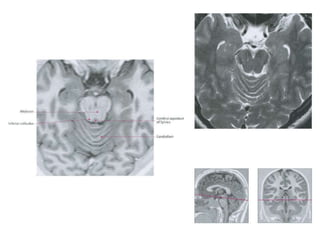
    Axial oblique 0.8-mm-thickSSFP MR image shows the nerve (small arrows) where it emerges from the interpeduncular cistern (large arrow), which lies medial to the cerebellar peduncle (p) Coronal 0.8-mm-thick SSFP MR image shows the oculomotor nerve (white arrow) in cross section between the posterior cerebral artery (white arrowhead) and the superior cerebellar artery (black arrowhead), which are distal branches of the basilar artery (black arrow).
  • 35.
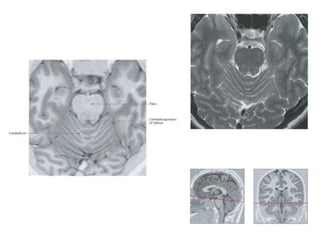
    Trochlear nerves (arrows)where they emerge from the dorsal midbrain to cross the ambient cisterns. The characteristic course of the trochlear nerves allows their differentiation from the nearby superior cerebellar artery (arrowheads).
  • 38.
  • 39.
    Quadrigeminal (from PCA):inf. Colliculi Superior cerebelar :tectum Posterior choroidal: cerebral peduncles, lateral sup colliculi, thamalus, choroid plexus 3rd ventricle Anterior choroidal: from MCA or IC, to cerebral peduncles, or supeiror midbrain Posterior Cerebral arteries
  • 42.
    • Claude Syndrome –Ipsi CN III, contra tremor, ataxia and incoordination
  • 43.
    • Rubral tremor(Holme’s tremor) – A coarse, slow (4Hz) tremor, especially present in the upper extremities, that is found at rest, postural and intention.

Editor's Notes

  • #27 The third nerve exits the midbrain anteriorly,crosses near the junction of the internal carotid and posterior communicating artery in the subarachnoid space, and enters the cavernous sinus,where it runs in the lateral wall. The fourth nerve exits the midbrain posteriorly and crosses to the opposite side, to move forward in thesubarachnoid space and into the cavernous sinus.
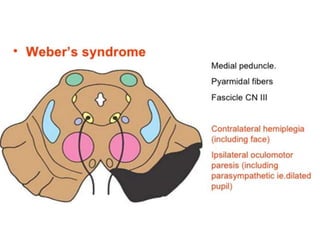
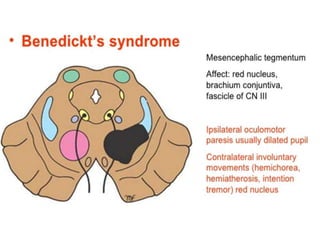
  • #28 The fascicles of thethird nerve pass through the red nucleus, substantia nigra, and crus cerebri before they exit into theinterpeduncularfossa.