Development
of the
Stomach
• Stomach develops from distal part of foregut.
• It is initially a simple tubular midline structure.
• Around the middle of the fourth week, a slight
dilation indicates the site of the future stomach.
It first appears as a fusiform enlargement of the
caudal part of the foregut.
• This primordium soon enlarges and broadens
dorsally. This is due to differential growth on
dorsal side. During the next 2 weeks the dorsal
border of the primitive stomach grows faster
than its ventral border; this demarcates the
greater curvature of the stomach.
Lateral view of developing stomach in successive stages
showing differential growth dorsally.
Rotation of the
developing stomach
• During development the developing
stomach rotates along two axes.
• These rotations determine the final
position of stomach in left hypochondrium.
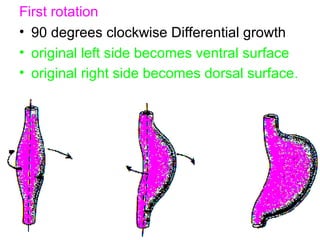
First rotation
• 90 degrees clockwise Differential growth
• original left side becomes ventral surface
• original right side becomes dorsal surface.
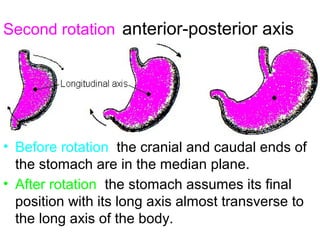
Second rotation anterior-posterior axis
• Before rotation, the cranial and caudal ends of
the stomach are in the median plane.
• After rotation, the stomach assumes its final
position with its long axis almost transverse to
the long axis of the body.
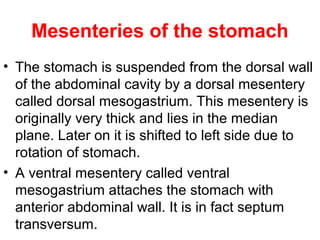
Mesenteries of the stomach
• The stomach is suspended from the dorsal wall
of the abdominal cavity by a dorsal mesentery
called dorsal mesogastrium. This mesentery is
originally very thick and lies in the median
plane. Later on it is shifted to left side due to
rotation of stomach.
• A ventral mesentery called ventral
mesogastrium attaches the stomach with
anterior abdominal wall. It is in fact septum
transversum.
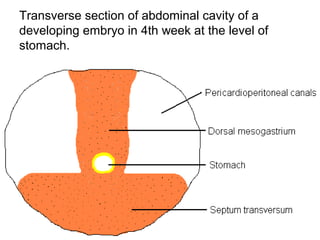
Transverse section of abdominal cavity of a
developing embryo in 4th week at the level of
stomach.
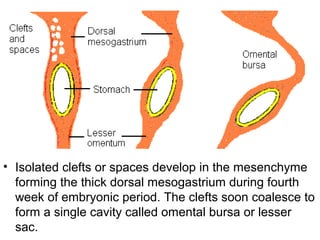
• Isolated clefts or spaces develop in the mesenchyme
forming the thick dorsal mesogastrium during fourth
week of embryonic period. The clefts soon coalesce to
form a single cavity called omental bursa or lesser
sac.
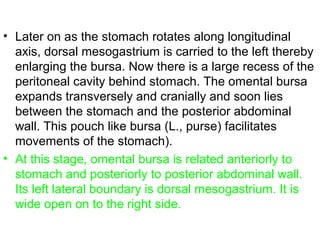
• Later on as the stomach rotates along longitudinal
axis, dorsal mesogastrium is carried to the left thereby
enlarging the bursa. Now there is a large recess of the
peritoneal cavity behind stomach. The omental bursa
expands transversely and cranially and soon lies
between the stomach and the posterior abdominal
wall. This pouch like bursa (L., purse) facilitates
movements of the stomach).
• At this stage, omental bursa is related anteriorly to
stomach and posteriorly to posterior abdominal wall.
Its left lateral boundary is dorsal mesogastrium. It is
wide open on to the right side.
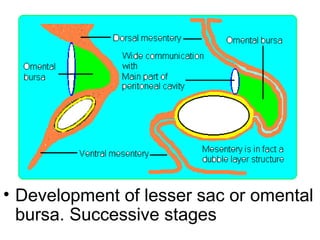
• Development of lesser sac or omental
bursa. Successive stages
• The primordium of spleen appears in 5th week
of development as a mesodermal proliferation
between the two leaves of dorsal
mesogastrium.
• As the omental bursa expands and swings to
the left side, a portion of dorsal mesogastrium
behind spleen fuses with the peritoneum of
posterior abdominal wall.
• The fused layers are absorbed and disappear.
• Thus the tail of pancreas becomes
retroperitoneal.
• Remember that pancreas develops in
dorsal mesoduodenum, but later on its tail
expands into dorsal mesogastrium.
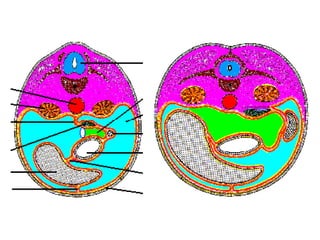
• Spleen maintains its intraperitoneal
position.
• It is connected with dorsal body wall in the
region of left kidney by lienorenal ligament
(Lien L., spleen) and to stomach by
gastrosplenic ligament.
• These two ligaments are nothing but parts
of dorsal mesogastrium.
• Later on as stomach enlarges and rotates
around anterio-posterior axis the dorsal
mesogastrium forming the left wall of omental
bursa is thrown downward.
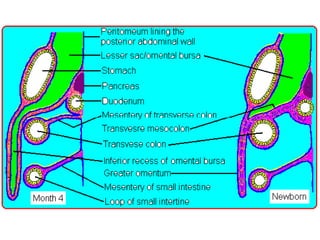
• It grows enormously downward forming anterior
and posterior layers of dorsal mesogastrium in
front of transverse colon and small intestinal
loops like an apron. Anterior layer is hanging
down from greater curvature of stomach and
posterior layer from posterior abdominal wall.
• The space between the two layers is called
inferior recess of omental bursa.
• Later on these anterior and posterior layers
fuse to form a single sheet hanging downward
from greater curvature of stomach.
• The posterior layer also fuses with the
mesentery of transverse colon.
• The fused apron of dorsal mesogastrium
hanging downward from greater curvature of
stomach is now called greater omentum (L., fat
skin).
• This is a four-layered membrane. It
overhangs the developing intestines.
• The inferior recess of omental bursa
disappears as the anterior and posterior
layers of greater omentum fuse.
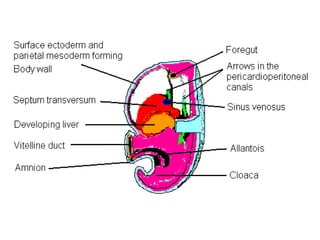
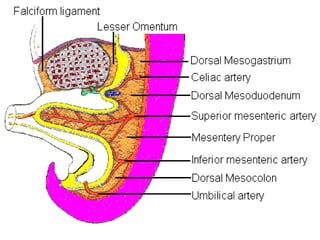
• Ventral mesogastrium is actually septum
transversum. It is between foregut and anterior
abdominal wall. Later on the liver bud enters in
septum transversum and the liver grows within
septum transversum. As a result of the
enormous growth of liver, the mesenchyme of
septum transversum becomes stretched and
membranous thus forming
1. falciform ligament, between anterior
abdominal wall and liver
2. the peritoneal coving forming the false capsule of
liver
3. and lesser omentum between liver and
stomach/upper part of duodenum.
• The free margin of falciform ligament contains
umbilical vein, which after birth is obliterated to
form ligamentum teres hepatic.
• Lesser omentum between liver and stomach is
called hepato-gastric ligament, while the part of
lesser omentum between liver and duodenum
is hepato-duodenal ligament.
• The free margin of lesser omentum
between liver and duodenum contains bile
duct, portal vein and hepatic artery. In
adults the right border of lesser omentum
forms the anterior boundary of epiploic
foramen. Epiploic foramen is the
connection between lesser sac and
greater sac.
• Liver is completely covered by peritoneum
forming the false capsule of liver. It is derived
from the mesenchyme of septum transversum.
• Superiorly a triangular portion of liver is not
covered by peritoneum. This triangular area is
called the bare area of liver. It is covered by
diaphragm. Here liver is attached to diaphragm
by areolar tissue.
• Remember that diaphragm also develops from
septum transversum.
• Stomach is supplied by
1. left gastric artery – a branch of celiac artery
2. right gastric artery – a branch of common
hepatic artery – a branch of celiac artery
3. right gastro-epiploic – a branch of gastro-
duodenal artery – a branch of common
hepatic artery – a branch of celiac artery
4. left gastro-epiploic – a branch of splenic
artery – a branch of celiac artery
Development
of the
Duodenum
• Duodenum begins to develop in the early part
of fourth week.
• It (epithelium) develops from caudal part of
foregut and cranial part of midgut.
• All the other layers of duodenum are derived
from surrounding splanchnic mesenchyme.
• The junction of the two parts of the duodenum
is just distal to the origin of the liver
diverticulum and in adult it is common bile duct.
• At this junction the ventral and dorsal
pancreatic buds are also developing.
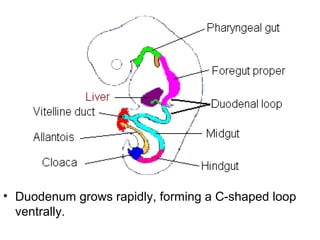
• Duodenum grows rapidly, forming a C-shaped loop
ventrally.
• As stomach rotates 90 degrees in clockwise
direction around its longitudinal axis to the left,
duodenal loop rotates to the right.
• This rotation together with rapid growth of
pancreas swings duodenum from its initial
midline position to the right.
• Duodenum and pancreas are pressed against
posterior abdominal wall. The right leaf of
dorsal meso-duodenum fuses with parietal
layer of peritoneum. The two layers
subsequently disappear. Duodenum and
pancreas become retroperitoneal structures.
• Mesoduodenum disappears entirely except in
the region of pylorus of stomach, where a small
portion of duodenum (duodenal cap) retains its
mesentery and remains intraperitoneal.
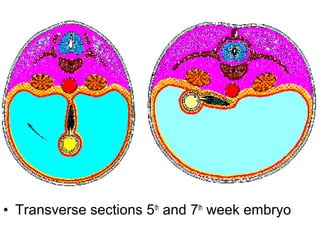
• Transverse sections 5th
and 7th
week embryo
• During the fifth and sixth weeks, the lumen of
duodenum becomes progressively smaller and
is temporarily obliterated because of the
proliferation of its epithelial cells. Normally
vacuolization occurs because of degeneration
of the epithelial cells. As a result, the
duodenum normally becomes re-canalized by
the end of the embryonic period. But
sometimes the occlusion persists leading to
duodenal stenosis.
• Because duodenum is developing from
foregut and midgut, it is supplied by
branches of celiac and superior
mesenteric arteries.
1.right gastric - a branch of hepatic artery - a
branch of celiac trunk.
2.supra-duodenal – arises from either gastro-
duodenal, hepatic artery, or right gastric
artery. Gastro-duodenal and right gastric are
branches of hepatic artery. Hepatic artery is
branch of celiac trunk.
1. right gastro-epiploic - a branch of
hepatic artery - a branch of celiac
trunk.
2. superior pancreatico-duodenal - a
branch of hepatic artery - a branch of
celiac trunk.
3. inferior pancreatico-duodenal – a
branch of superior mesenteric artery.

Development of stomach

  • 1.
  • 2.
    • Stomach developsfrom distal part of foregut. • It is initially a simple tubular midline structure. • Around the middle of the fourth week, a slight dilation indicates the site of the future stomach. It first appears as a fusiform enlargement of the caudal part of the foregut. • This primordium soon enlarges and broadens dorsally. This is due to differential growth on dorsal side. During the next 2 weeks the dorsal border of the primitive stomach grows faster than its ventral border; this demarcates the greater curvature of the stomach.
  • 3.
    Lateral view ofdeveloping stomach in successive stages showing differential growth dorsally.
  • 4.
    Rotation of the developingstomach • During development the developing stomach rotates along two axes. • These rotations determine the final position of stomach in left hypochondrium.
  • 5.
    First rotation • 90degrees clockwise Differential growth • original left side becomes ventral surface • original right side becomes dorsal surface.
  • 6.
    Second rotation anterior-posterioraxis • Before rotation, the cranial and caudal ends of the stomach are in the median plane. • After rotation, the stomach assumes its final position with its long axis almost transverse to the long axis of the body.
  • 7.
    Mesenteries of thestomach • The stomach is suspended from the dorsal wall of the abdominal cavity by a dorsal mesentery called dorsal mesogastrium. This mesentery is originally very thick and lies in the median plane. Later on it is shifted to left side due to rotation of stomach. • A ventral mesentery called ventral mesogastrium attaches the stomach with anterior abdominal wall. It is in fact septum transversum.
  • 8.
    Transverse section ofabdominal cavity of a developing embryo in 4th week at the level of stomach.
  • 9.
    • Isolated cleftsor spaces develop in the mesenchyme forming the thick dorsal mesogastrium during fourth week of embryonic period. The clefts soon coalesce to form a single cavity called omental bursa or lesser sac.
  • 10.
    • Later onas the stomach rotates along longitudinal axis, dorsal mesogastrium is carried to the left thereby enlarging the bursa. Now there is a large recess of the peritoneal cavity behind stomach. The omental bursa expands transversely and cranially and soon lies between the stomach and the posterior abdominal wall. This pouch like bursa (L., purse) facilitates movements of the stomach). • At this stage, omental bursa is related anteriorly to stomach and posteriorly to posterior abdominal wall. Its left lateral boundary is dorsal mesogastrium. It is wide open on to the right side.
  • 11.
    • Development oflesser sac or omental bursa. Successive stages
  • 12.
    • The primordiumof spleen appears in 5th week of development as a mesodermal proliferation between the two leaves of dorsal mesogastrium. • As the omental bursa expands and swings to the left side, a portion of dorsal mesogastrium behind spleen fuses with the peritoneum of posterior abdominal wall. • The fused layers are absorbed and disappear.
  • 13.
    • Thus thetail of pancreas becomes retroperitoneal. • Remember that pancreas develops in dorsal mesoduodenum, but later on its tail expands into dorsal mesogastrium.
  • 15.
    • Spleen maintainsits intraperitoneal position. • It is connected with dorsal body wall in the region of left kidney by lienorenal ligament (Lien L., spleen) and to stomach by gastrosplenic ligament. • These two ligaments are nothing but parts of dorsal mesogastrium.
  • 16.
    • Later onas stomach enlarges and rotates around anterio-posterior axis the dorsal mesogastrium forming the left wall of omental bursa is thrown downward. • It grows enormously downward forming anterior and posterior layers of dorsal mesogastrium in front of transverse colon and small intestinal loops like an apron. Anterior layer is hanging down from greater curvature of stomach and posterior layer from posterior abdominal wall. • The space between the two layers is called inferior recess of omental bursa.
  • 18.
    • Later onthese anterior and posterior layers fuse to form a single sheet hanging downward from greater curvature of stomach. • The posterior layer also fuses with the mesentery of transverse colon. • The fused apron of dorsal mesogastrium hanging downward from greater curvature of stomach is now called greater omentum (L., fat skin).
  • 19.
    • This isa four-layered membrane. It overhangs the developing intestines. • The inferior recess of omental bursa disappears as the anterior and posterior layers of greater omentum fuse.
  • 20.
    • Ventral mesogastriumis actually septum transversum. It is between foregut and anterior abdominal wall. Later on the liver bud enters in septum transversum and the liver grows within septum transversum. As a result of the enormous growth of liver, the mesenchyme of septum transversum becomes stretched and membranous thus forming 1. falciform ligament, between anterior abdominal wall and liver 2. the peritoneal coving forming the false capsule of liver 3. and lesser omentum between liver and stomach/upper part of duodenum.
  • 22.
    • The freemargin of falciform ligament contains umbilical vein, which after birth is obliterated to form ligamentum teres hepatic. • Lesser omentum between liver and stomach is called hepato-gastric ligament, while the part of lesser omentum between liver and duodenum is hepato-duodenal ligament.
  • 23.
    • The freemargin of lesser omentum between liver and duodenum contains bile duct, portal vein and hepatic artery. In adults the right border of lesser omentum forms the anterior boundary of epiploic foramen. Epiploic foramen is the connection between lesser sac and greater sac.
  • 24.
    • Liver iscompletely covered by peritoneum forming the false capsule of liver. It is derived from the mesenchyme of septum transversum. • Superiorly a triangular portion of liver is not covered by peritoneum. This triangular area is called the bare area of liver. It is covered by diaphragm. Here liver is attached to diaphragm by areolar tissue. • Remember that diaphragm also develops from septum transversum.
  • 26.
    • Stomach issupplied by 1. left gastric artery – a branch of celiac artery 2. right gastric artery – a branch of common hepatic artery – a branch of celiac artery 3. right gastro-epiploic – a branch of gastro- duodenal artery – a branch of common hepatic artery – a branch of celiac artery 4. left gastro-epiploic – a branch of splenic artery – a branch of celiac artery
  • 27.
  • 28.
    • Duodenum beginsto develop in the early part of fourth week. • It (epithelium) develops from caudal part of foregut and cranial part of midgut. • All the other layers of duodenum are derived from surrounding splanchnic mesenchyme. • The junction of the two parts of the duodenum is just distal to the origin of the liver diverticulum and in adult it is common bile duct. • At this junction the ventral and dorsal pancreatic buds are also developing.
  • 29.
    • Duodenum growsrapidly, forming a C-shaped loop ventrally.
  • 30.
    • As stomachrotates 90 degrees in clockwise direction around its longitudinal axis to the left, duodenal loop rotates to the right. • This rotation together with rapid growth of pancreas swings duodenum from its initial midline position to the right.
  • 31.
    • Duodenum andpancreas are pressed against posterior abdominal wall. The right leaf of dorsal meso-duodenum fuses with parietal layer of peritoneum. The two layers subsequently disappear. Duodenum and pancreas become retroperitoneal structures. • Mesoduodenum disappears entirely except in the region of pylorus of stomach, where a small portion of duodenum (duodenal cap) retains its mesentery and remains intraperitoneal.
  • 32.
    • Transverse sections5th and 7th week embryo
  • 33.
    • During thefifth and sixth weeks, the lumen of duodenum becomes progressively smaller and is temporarily obliterated because of the proliferation of its epithelial cells. Normally vacuolization occurs because of degeneration of the epithelial cells. As a result, the duodenum normally becomes re-canalized by the end of the embryonic period. But sometimes the occlusion persists leading to duodenal stenosis.
  • 34.
    • Because duodenumis developing from foregut and midgut, it is supplied by branches of celiac and superior mesenteric arteries. 1.right gastric - a branch of hepatic artery - a branch of celiac trunk. 2.supra-duodenal – arises from either gastro- duodenal, hepatic artery, or right gastric artery. Gastro-duodenal and right gastric are branches of hepatic artery. Hepatic artery is branch of celiac trunk.
  • 35.
    1. right gastro-epiploic- a branch of hepatic artery - a branch of celiac trunk. 2. superior pancreatico-duodenal - a branch of hepatic artery - a branch of celiac trunk. 3. inferior pancreatico-duodenal – a branch of superior mesenteric artery.