EMBRYOLOGY, BLOOD SUPPLY AND
RELATED SURGICAL ANATOMY
OF STOMACH
The stomach is a muscular, hollow, dilated part of
the digestion system,
which functions as an important organ of the
digestive tract.
It is involved in the second phase of digestion,
following mastication (chewing).
The stomach is located between the esophagus
and the small intestine.
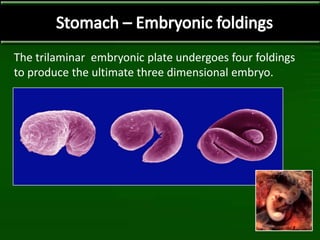
The trilaminar embryonic plate undergoes four foldings
to produce the ultimate three dimensional embryo.
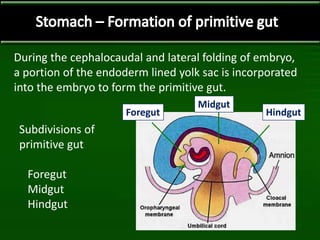
During the cephalocaudal and lateral folding of embryo,
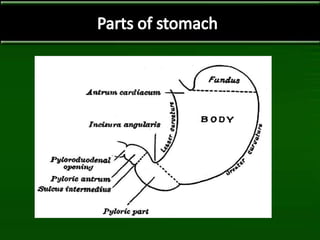
a portion of the endoderm lined yolk sac is incorporated
into the embryo to form the primitive gut.
Foregut
Midgut
Hindgut
Subdivisions of
primitive gut
Foregut
Midgut
Hindgut
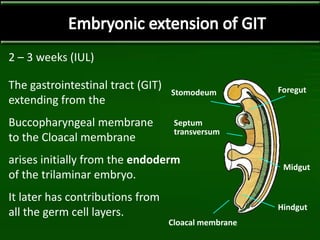
2 – 3 weeks (IUL)
The gastrointestinal tract (GIT)
extending from the
Buccopharyngeal membrane
to the Cloacal membrane
arises initially from the endoderm
of the trilaminar embryo.
It later has contributions from
all the germ cell layers.
Stomodeum
Cloacal membrane
Septum
transversum
Foregut
Midgut
Hindgut
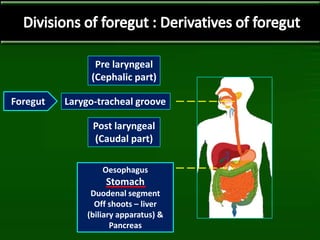
Larygo-tracheal groove
Pre laryngeal
(Cephalic part)
Post laryngeal
(Caudal part)
Foregut
Oesophagus
Stomach
Duodenal segment
Off shoots – liver
(biliary apparatus) &
Pancreas
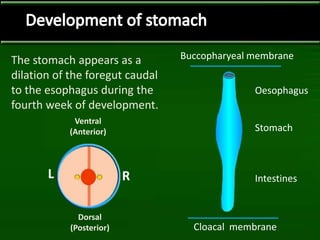
The stomach appears as a
dilation of the foregut caudal
to the esophagus during the
fourth week of development.
Stomach
Oesophagus
Intestines
Buccopharyeal membrane
Cloacal membrane
Ventral
(Anterior)
Dorsal
(Posterior)
RL
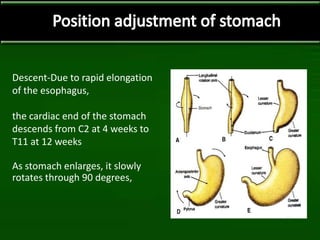
Descent-Due to rapid elongation
of the esophagus,
the cardiac end of the stomach
descends from C2 at 4 weeks to
T11 at 12 weeks
As stomach enlarges, it slowly
rotates through 90 degrees,
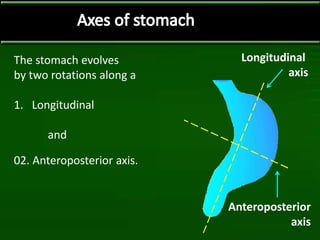
The stomach evolves
by two rotations along a
1. Longitudinal
and
02. Anteroposterior axis.
Longitudinal
axis
Anteroposterior
axis
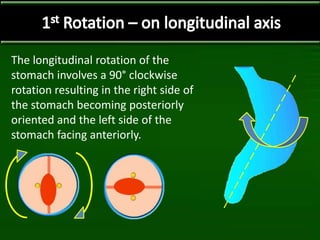
The longitudinal rotation of the
stomach involves a 90° clockwise
rotation resulting in the right side of
the stomach becoming posteriorly
oriented and the left side of the
stomach facing anteriorly.
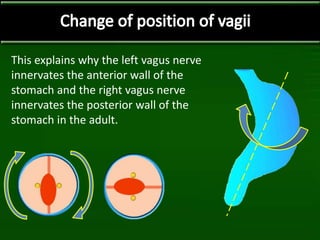
This explains why the left vagus nerve
innervates the anterior wall of the
stomach and the right vagus nerve
innervates the posterior wall of the
stomach in the adult.
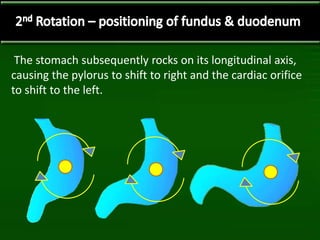
The stomach subsequently rocks on its longitudinal axis,
causing the pylorus to shift to right and the cardiac orifice
to shift to the left.
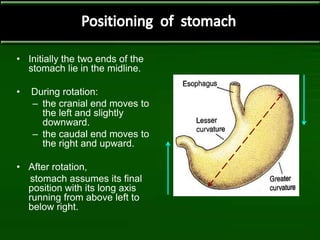
• Initially the two ends of the
stomach lie in the midline.
• During rotation:
– the cranial end moves to
the left and slightly
downward.
– the caudal end moves to
the right and upward.
• After rotation,
stomach assumes its final
position with its long axis
running from above left to
below right.
During this rotation one side
of the stomach grows faster
than the other forming the
greater and
lesser curvatures
of the stomach
Oesophagus
Intestines
Stomach
Lessercurvature
Greatercurvature
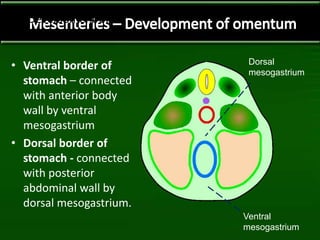
Development of
omentum
• Ventral border of
stomach – connected
with anterior body
wall by ventral
mesogastrium
• Dorsal border of
stomach - connected
with posterior
abdominal wall by
dorsal mesogastrium.
Dorsal
mesogastrium
Ventral
mesogastrium
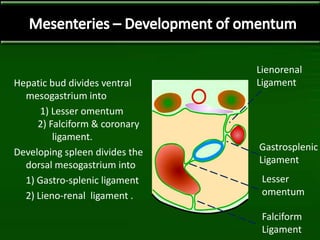
Hepatic bud divides ventral
mesogastrium into
1) Lesser omentum
2) Falciform & coronary
ligament.
Developing spleen divides the
dorsal mesogastrium into
1) Gastro-splenic ligament
2) Lieno-renal ligament .
Lienorenal
Ligament
Gastrosplenic
Ligament
Lesser
omentum
Falciform
Ligament
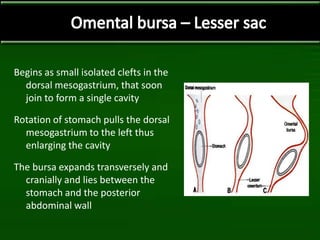
Begins as small isolated clefts in the
dorsal mesogastrium, that soon
join to form a single cavity
Rotation of stomach pulls the dorsal
mesogastrium to the left thus
enlarging the cavity
The bursa expands transversely and
cranially and lies between the
stomach and the posterior
abdominal wall
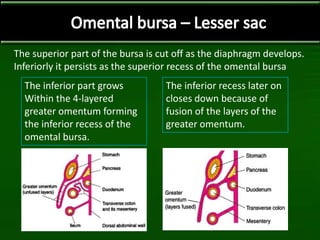
The superior part of the bursa is cut off as the diaphragm develops.
Inferiorly it persists as the superior recess of the omental bursa
The inferior part grows
Within the 4-layered
greater omentum forming
the inferior recess of the
omental bursa.
The inferior recess later on
closes down because of
fusion of the layers of the
greater omentum.
Factors demanding rich vascularity:
1. Highly distensible & mobile area in GI Tract
(Frequent changes in volume)
2. Five types of cells – High metabolic activity
3. 2nd phase of digestion – Brisk peristalsis
4. Three layers of sheets of muscles.
5. Propulsive pressures against pyloric sphincter
and physiological oesophageal sphincter.
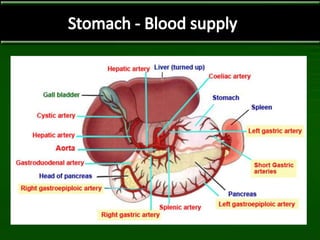
Coeliac trunk : Direct anterior branch from aorta is
main source of arterial supply.
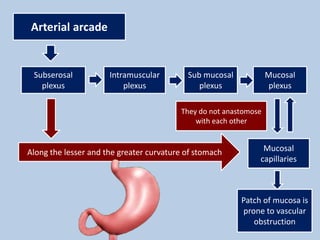
Arterial arcade
Subserosal
plexus
Intramuscular
plexus
Sub mucosal
plexus
Mucosal
plexus
Mucosal
capillaries
Along the lesser and the greater curvature of stomach
Patch of mucosa is
prone to vascular
obstruction
They do not anastomose
with each other
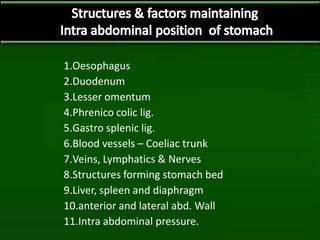
1.Oesophagus
2.Duodenum
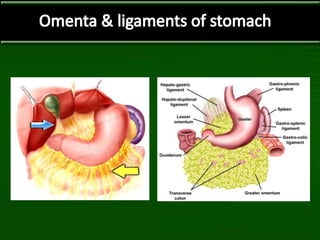
3.Lesser omentum
4.Phrenico colic lig.
5.Gastro splenic lig.
6.Blood vessels – Coeliac trunk
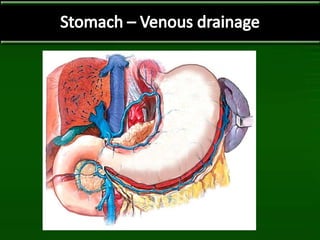
7.Veins, Lymphatics & Nerves
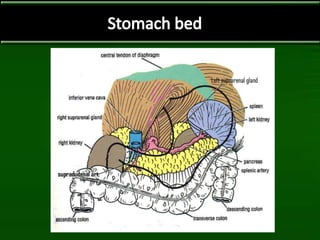
8.Structures forming stomach bed
9.Liver, spleen and diaphragm
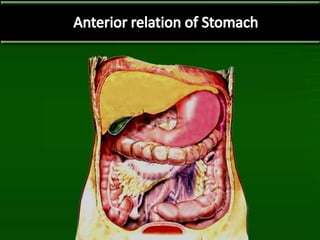
10.anterior and lateral abd. Wall
11.Intra abdominal pressure.
01. Malrotation of stomach
02. Changes in shapes of stomach
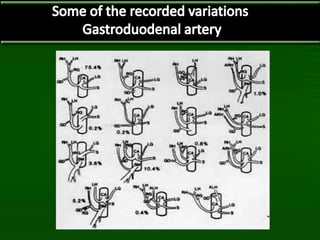
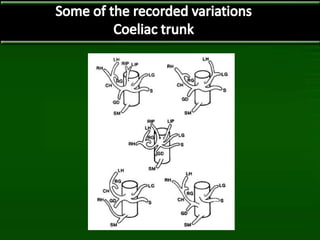
03. Variation of origin of blood vessels
04. Congenital hypertrophic pyloric stenosis
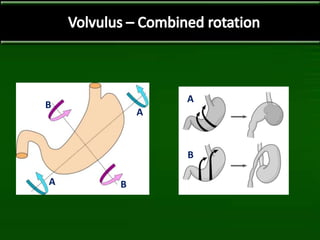
Gastric volvulus or volvulus of stomach a twisting of all or part
of the stomach by more than 180 degrees with obstruction of
the flow of material through the stomach, variable loss of
blood supply and possible tissue death.
The twisting can occur
around the long axis of the stomach
- organoaxial or
around the axis perpendicular to this
- mesentericoaxial.
About one third of volvulus cases are associated with
hiatus hernia.
Gastric volvulus is a rare but potentially
life-threatening clinical entity
due to possible gastric necrosis.
A wandering spleen may also be
associated with gastric volvulus.
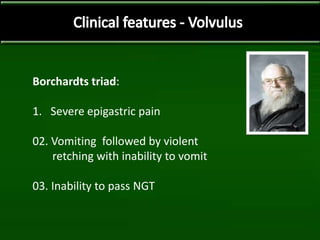
Borchardts triad:
1. Severe epigastric pain
02. Vomiting followed by violent
retching with inability to vomit
03. Inability to pass NGT
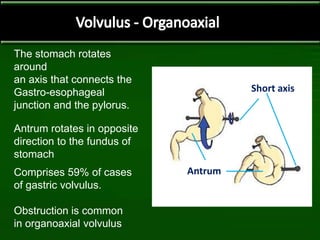
The stomach rotates
around
an axis that connects the
Gastro-esophageal
junction and the pylorus.
Antrum rotates in opposite
direction to the fundus of
stomach
Comprises 59% of cases
of gastric volvulus.
Obstruction is common
in organoaxial volvulus
Short axis
Antrum
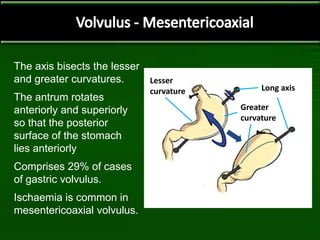
The axis bisects the lesser
and greater curvatures.
The antrum rotates
anteriorly and superiorly
so that the posterior
surface of the stomach
lies anteriorly
Comprises 29% of cases
of gastric volvulus.
Ischaemia is common in
mesentericoaxial volvulus.
Greater
curvature
Long axis
Lesser
curvature
A
A
A
B
B
B
Development of stomach

Development of stomach

  • 1.
    EMBRYOLOGY, BLOOD SUPPLYAND RELATED SURGICAL ANATOMY OF STOMACH
  • 2.
    The stomach isa muscular, hollow, dilated part of the digestion system, which functions as an important organ of the digestive tract. It is involved in the second phase of digestion, following mastication (chewing). The stomach is located between the esophagus and the small intestine.
  • 3.
    The trilaminar embryonicplate undergoes four foldings to produce the ultimate three dimensional embryo.
  • 4.
    During the cephalocaudaland lateral folding of embryo, a portion of the endoderm lined yolk sac is incorporated into the embryo to form the primitive gut. Foregut Midgut Hindgut Subdivisions of primitive gut Foregut Midgut Hindgut
  • 5.
    2 – 3weeks (IUL) The gastrointestinal tract (GIT) extending from the Buccopharyngeal membrane to the Cloacal membrane arises initially from the endoderm of the trilaminar embryo. It later has contributions from all the germ cell layers. Stomodeum Cloacal membrane Septum transversum Foregut Midgut Hindgut
  • 6.
    Larygo-tracheal groove Pre laryngeal (Cephalicpart) Post laryngeal (Caudal part) Foregut Oesophagus Stomach Duodenal segment Off shoots – liver (biliary apparatus) & Pancreas
  • 7.
    The stomach appearsas a dilation of the foregut caudal to the esophagus during the fourth week of development. Stomach Oesophagus Intestines Buccopharyeal membrane Cloacal membrane Ventral (Anterior) Dorsal (Posterior) RL
  • 8.
    Descent-Due to rapidelongation of the esophagus, the cardiac end of the stomach descends from C2 at 4 weeks to T11 at 12 weeks As stomach enlarges, it slowly rotates through 90 degrees,
  • 9.
    The stomach evolves bytwo rotations along a 1. Longitudinal and 02. Anteroposterior axis. Longitudinal axis Anteroposterior axis
  • 10.
    The longitudinal rotationof the stomach involves a 90° clockwise rotation resulting in the right side of the stomach becoming posteriorly oriented and the left side of the stomach facing anteriorly.
  • 11.
    This explains whythe left vagus nerve innervates the anterior wall of the stomach and the right vagus nerve innervates the posterior wall of the stomach in the adult.
  • 12.
    The stomach subsequentlyrocks on its longitudinal axis, causing the pylorus to shift to right and the cardiac orifice to shift to the left.
  • 13.
    • Initially thetwo ends of the stomach lie in the midline. • During rotation: – the cranial end moves to the left and slightly downward. – the caudal end moves to the right and upward. • After rotation, stomach assumes its final position with its long axis running from above left to below right.
  • 14.
    During this rotationone side of the stomach grows faster than the other forming the greater and lesser curvatures of the stomach Oesophagus Intestines Stomach Lessercurvature Greatercurvature
  • 15.
    Development of omentum • Ventralborder of stomach – connected with anterior body wall by ventral mesogastrium • Dorsal border of stomach - connected with posterior abdominal wall by dorsal mesogastrium. Dorsal mesogastrium Ventral mesogastrium
  • 16.
    Hepatic bud dividesventral mesogastrium into 1) Lesser omentum 2) Falciform & coronary ligament. Developing spleen divides the dorsal mesogastrium into 1) Gastro-splenic ligament 2) Lieno-renal ligament . Lienorenal Ligament Gastrosplenic Ligament Lesser omentum Falciform Ligament
  • 17.
    Begins as smallisolated clefts in the dorsal mesogastrium, that soon join to form a single cavity Rotation of stomach pulls the dorsal mesogastrium to the left thus enlarging the cavity The bursa expands transversely and cranially and lies between the stomach and the posterior abdominal wall
  • 18.
    The superior partof the bursa is cut off as the diaphragm develops. Inferiorly it persists as the superior recess of the omental bursa The inferior part grows Within the 4-layered greater omentum forming the inferior recess of the omental bursa. The inferior recess later on closes down because of fusion of the layers of the greater omentum.
  • 19.
    Factors demanding richvascularity: 1. Highly distensible & mobile area in GI Tract (Frequent changes in volume) 2. Five types of cells – High metabolic activity 3. 2nd phase of digestion – Brisk peristalsis 4. Three layers of sheets of muscles. 5. Propulsive pressures against pyloric sphincter and physiological oesophageal sphincter. Coeliac trunk : Direct anterior branch from aorta is main source of arterial supply.
  • 21.
    Arterial arcade Subserosal plexus Intramuscular plexus Sub mucosal plexus Mucosal plexus Mucosal capillaries Alongthe lesser and the greater curvature of stomach Patch of mucosa is prone to vascular obstruction They do not anastomose with each other
  • 26.
    1.Oesophagus 2.Duodenum 3.Lesser omentum 4.Phrenico coliclig. 5.Gastro splenic lig. 6.Blood vessels – Coeliac trunk 7.Veins, Lymphatics & Nerves 8.Structures forming stomach bed 9.Liver, spleen and diaphragm 10.anterior and lateral abd. Wall 11.Intra abdominal pressure.
  • 28.
    01. Malrotation ofstomach 02. Changes in shapes of stomach 03. Variation of origin of blood vessels 04. Congenital hypertrophic pyloric stenosis
  • 31.
    Gastric volvulus orvolvulus of stomach a twisting of all or part of the stomach by more than 180 degrees with obstruction of the flow of material through the stomach, variable loss of blood supply and possible tissue death. The twisting can occur around the long axis of the stomach - organoaxial or around the axis perpendicular to this - mesentericoaxial. About one third of volvulus cases are associated with hiatus hernia.
  • 32.
    Gastric volvulus isa rare but potentially life-threatening clinical entity due to possible gastric necrosis. A wandering spleen may also be associated with gastric volvulus.
  • 33.
    Borchardts triad: 1. Severeepigastric pain 02. Vomiting followed by violent retching with inability to vomit 03. Inability to pass NGT
  • 34.
    The stomach rotates around anaxis that connects the Gastro-esophageal junction and the pylorus. Antrum rotates in opposite direction to the fundus of stomach Comprises 59% of cases of gastric volvulus. Obstruction is common in organoaxial volvulus Short axis Antrum
  • 35.
    The axis bisectsthe lesser and greater curvatures. The antrum rotates anteriorly and superiorly so that the posterior surface of the stomach lies anteriorly Comprises 29% of cases of gastric volvulus. Ischaemia is common in mesentericoaxial volvulus. Greater curvature Long axis Lesser curvature
  • 36.

Editor's Notes

  • #37 It is reported that most cases of chronic gastric volvulus are related to mesenteroaxial rotation. Additionally is described in the literature that a normal stomach cannot rotate more than 180° unless the gastrosplenic or gastrocolic ligaments are divided. The aetiology of gastric volvulus is thought to be secondary to laxity or lack of the gastric (gastrohepatic, gastrosplenic, gastroduodenal, and gastrophrenic) ligaments, allowing approximation of cardiac and pyloric ends when the stomach is full, leading to volvulus,The mortality rate of gastric volvulus is reported to be up to 42–56%, secondary to gastric ischaemia, perforation, and necrosisRef: http://dx.doi.org/10.1155/2013/561752Gastric Volvulus and Wandering Spleen: A Rare Surgical Emergency